Background and PurposezzNew-onset headache in elderly patients is generally suggestive of a high probability of secondary headache, and the subtypes of primary headache diagnoses are still unclear in the elderly. This study investigated the characteristics of headache with an older age at onset (≥65 years) and compared the characteristics between younger and older age groups.
MethodszzWe prospectively collected demographic and clinical data of 1,627 patients who first visited 11 tertiary hospitals in Korea due to headache between August 2014 and Febru- ary 2015. Headache subtype was categorized according to the International Classification of Headache Disorders, Third Edition Beta Version.
ResultszzIn total, 152 patients (9.3%, 106 women and 46 men) experienced headache that began from 65 years of age [elderly-onset group (EOG)], while the remaining 1,475 patients who first experienced headache before the age of 65 years were classified as the younger-age- at-onset group (YOG). Among the primary headache types, tension-type headache (55.6%
vs. 28.8%) and other primary headache disorders (OPH, 31.0% vs. 17.3%) were more com- mon in the EOG than in the YOG, while migraine was less frequent (13.5% vs. 52.2%) (p=0.001) in the EOG. Among OPH, primary stabbing headache (87.2%) was more frequent in the EOG than in the YOG (p=0.032). The pain was significantly less severe (p=0.026) and the frequency of medication overuse headache was higher in EOG than in YOG (23.5% vs.
7.6%, p=0.040).
ConclusionszzTension-type headache and OPH headaches, primarily stabbing headache, were more common in EOG patients than in YOG patients. The pain intensity, distribution of head- ache diagnoses, and frequency of medication overuse differed according to the age at headache onset.
Key Wordszz old age, International Classification of Headache Disorders, Third Edition Beta Version, tension-type headache,
medication-overuse headache, other primary headache disorders.
Characteristics of Elderly-Onset (≥65 years) Headache Diagnosed Using the International Classification
of Headache Disorders, Third Edition Beta Version
INTRODUCTION
Headache is one of the most common neurological complaints of elderly patients,1 and about 52% of patients with headache are elderly (≥65 years).2 Accordingly, careful and pru- dent consideration of the diagnosis is important in elderly patients with headache, and in- vestigating the general features of headache in the elderly is mandatory for providing the correct treatment.3 However, there is a lack of detailed information about headache in el- derly patients, particularly new-onset headache in the elderly. Studies of the prevalence of headache have usually included only younger patients (<65 years)4 or only a few elderly pa- Tae-Jin Songa,b, Yong-Jae Kima,
Byung-Kun Kimc, Byung-Su Kimd, Jae-Moon Kime, Soo-Kyoung Kimf, Heui-Soo Moong, Myoung-Jin Chah, Kwang-Yeol Parki, Jong-Hee Sohnj, Min Kyung Chuk, Soo-Jin Chol
a Department of Neurology, Ewha Womans University School of Medicine, Seoul, Korea
b Department of Neurology,
Yonsei University School of Medicine, Seoul, Korea
c Department of Neurology, Eulji University School of Medicine, Seoul, Korea
dDepartment of Neurology, Bundang Jesaeng General Hospital, Daejin Medical Center, Seongnam, Korea
eDepartment of Neurology, Chungnam National University College of Medicine, Daejeon, Korea
f Department of Neurology, Gyeongsang National University Hospital, Jinju, Korea
gDepartment of Neurology, Kangbuk Samsung Medical Center, Sungkyunkwan University School of Medicine, Seoul, Korea
hDepartment of Neurology, National Police Hospital, Seoul, Korea
i Department of Neurology,
Chung-Ang University Hospital, Chung-Ang University
College of Medicine, Seoul, Korea
j Department of Neurology, Chuncheon Sacred Heart Hospital, Hallym University College of Medicine, Chuncheon, Korea
k Department of Neurology, Sacred Heart Hospital, Hallym University College of Medicine, Anyang, Korea
l Department of Neurology, Dongtan Sacred Heart Hospital, Hallym University College of Medicine, Hwaseong, Korea
pISSN 1738-6586 / eISSN 2005-5013 / J Clin Neurol 2016;12(4):419-425 / http://dx.doi.org/10.3988/jcn.2016.12.4.419
Received December 22, 2015 Revised February 5, 2016 Accepted February 4, 2016 Correspondence Soo-Jin Cho, MD, PhD Department of Neurology, Dongtan Sacred Heart Hospital, Hallym University College of Medicine, 7 Keunjaebong-gil, Hwaseong 18450, Korea
Tel +82-31-8086-2310 Fax +82-31-8086-2317 E-mail [email protected]
cc This is an Open Access article distributed under the terms of the Creative Commons Attribution Non-Com- mercial License (http://creativecommons.org/licenses/by-nc/3.0) which permits unrestricted non-commercial use, distribution, and reproduction in any medium, provided the original work is properly cited.
JCN
Open Access ORIGINAL ARTICLEHeadache in Elderly Koreans
JCN
tients.5 Moreover, studies that did include relatively large populations of elderly patients with headache did not use the updated the International Classification of Headache Disor- ders, Third Edition Beta Version (ICHD-3β).2,6,7
The characteristics of headache differ between elderly and younger patients.8 Headache in elderly patients more frequent- ly have typical aura without headache, hypnic headache, facial pain syndrome, and secondary headache, which may be caused by hormonal or metabolic changes, concomitant diseases, and various medications.8 Therefore, investigations of headache should consider the age of the patients. In addition, ICHD- 3β expanded the subtypes of primary headache disorders and the probable diagnostic entities, and changed the criteria for chronic migraine compared to previous versions, and so applying ICHD-3β may be helpful when investigating head- ache in elderly patients.9
We conducted a prospective cross-sectional multicenter headache registry study to evaluate characteristics of first- visit patients with elderly-onset (≥65 years) headache based on the ICHD-3β criteria in a Korean population.
METHODS
Standard protocol approval, registration, and patient consent
This study was a substudy of a prospective, cross-sectional, multicenter study based on the Headache Registry Using CHD-3β for First-Visit Patients (HEREIN) study.10 Data were obtained from consecutive first-visit patients with headache treated at the neurology outpatient departments of 11 hospi- tals (9 university hospitals, comprising 6 tertiary and 3 sec- ondary referral hospitals, plus 2 general secondary referral hospitals) in Korea between August 2014 and February 2015.10 The information, history, and diagnosis of patients with head- ache were performed by board-certified neurologists with headache expertise. The participants were Koreans aged 19–
100 years who had complained of headache as the main rea- son for their outpatient visit, and they had no communica- tion disability that would interfere with history-taking.
Patients with impaired cognitive function or language prob- lems or any other serious medical or psychiatric condition based on a physician’s evaluation were excluded, as well as those who visited the hospital for major symptoms other than headache. This study protocol was reviewed and ap- proved by the ethics committee of each participating hospital.
All patients gave informed consent to participate in this study or waived informed consent in accordance with the decision of the ethics committee of each hospital.10
Headache assessment and diagnosis
All enrolled patients completed a self-administered question- naire and were examined by a headache specialist at each cen- ter. If secondary headache was suspected, the blood and/or ce- rebrospinal fluid (obtained via lumbar puncture) were/was sampled. Brain imaging including the vasculature was also conducted if necessary based on the recommendation of the headache specialist. The questionnaire was designed to obtain information about the medical history and characteristics of headache including routes of access to the hospital, aura, fre- quency and severity using a visual analog scale (VAS), pain characteristics, attack location and duration, presence or ab- sence of aggravation after routine physical activity, accompa- nying symptoms, and autonomic features including vertigo.
The detailed method for reaching the final diagnosis was described in a previous study and was supplemented (Supple- mentaty Material in the online-only Data Supplement).6 In brief, the confirmative diagnosis was made based on the ICHD-3β criteria after considering the questionnaire results, medical records, neurological examination, appropriate test- ing, and treatment response. Controversial cases were re- viewed by researchers in case-analysis meetings. The patients were classified according to the age at the onset of the pre- senting headache. Those who first experienced the headache from the age of 65 years were classified as the elderly onset group (EOG), while those with a first headache before the age of 65 years were classified as the younger-age-at-onset group (YOG).
Thirty-one patients were assigned randomly using the R- program (https://www.r-project.org), which was also used to evaluate the interrater agreement. Each investigator indepen- dently reviewed the structured clinical data and subsequently reported the diagnosis by e-mail, and levels of agreement for the headache classification were calculated.
Statistical analysis
Statistical analyses were performed using the Windows SPSS software package (version 20.0, SPSS Inc., Chicago, IL, USA).
Continuous variables are presented as mean±standard devi- ation values, and categorical variables are presented as fre- quencies and percentages. Continuous or interval-scaled vari- ables were compared using Student’s t-test or the Mann- Whitney test, and categorical variables were compared using the chi-square test or Fisher’s exact test. The interrater agree- ment was assessed by calculating the Fleiss’ kappa coefficient among the researchers, which was 0.61. A two-tailed proba- bility value of p<0.05 was considered to be indicative of sta- tistical significance.
Song TJ et al.
JCN
RESULTS
Demographic data of the study population
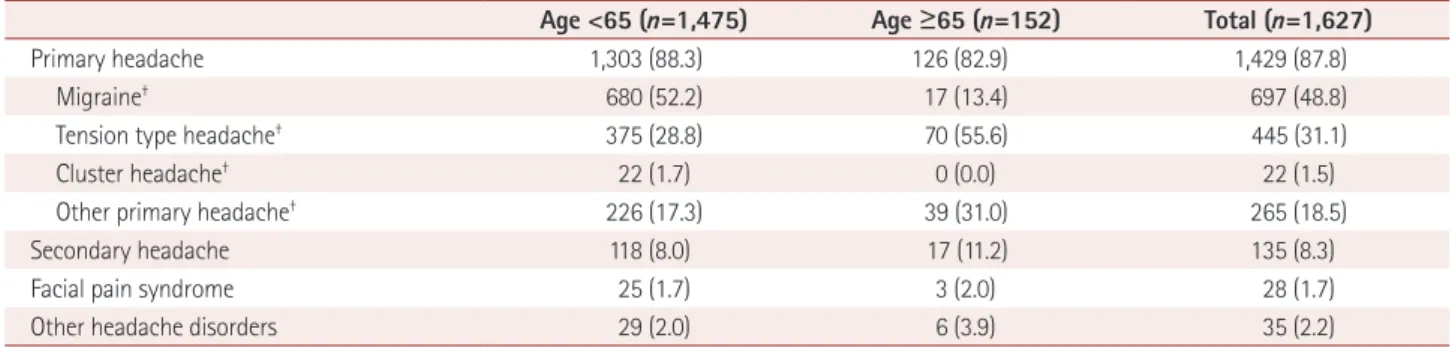
The 1,627 patients in the HEREIN study were aged 47.3±14.6 years, with a higher proportion of female patients [605 males (37.2%) vs. 1,022 females (62.8%)]. The EOG included 152 (9.3%) patients aged 72.6±5.8 years. Brain imaging was per- formed in 1,080 patients [total 66.4%: 30.1% received brain computed tomography (CT) and 36.3% received magnetic resonance imaging (MRI)], and the rate of brain imaging did not differ between the EOG (27.6% received brain CT and 39.5% received brain MRI) and the YOG (30.3% vs. 36.0%) (p=0.666). The most common abnormalities associated with headache were as follows: sinusitis (n=6), non-traumatic in- tracranial hemorrhage (n=4), spontaneous intracranial hy- potension (n=4), cerebral arterial dissection (n=3), reversible cerebral vasoconstriction syndrome (n=3), and intracranial malignancy (n=2).11 Brain imaging in cases of primary stab- bing headache were conducted with CT (n=44, 24.6%) or MRI (n=42, 23.4%). No neurovascular compression was found in patients with primary stabbing headache in our study.
Of the 1,627 patients, 1,429 (87.8%) were diagnosed with primary headache, 135 (8.3%) with secondary headache, 28 (1.7%) with facial pain syndrome, and 35 (2.2%) as other headache disorder. The frequencies of secondary headache (11.2% vs. 8.0%), facial pain syndrome (2.0% vs. 1.7%), and other headache disorders (3.9% vs. 2.0%) tended to be higher in the EOG than in the YOG, while primary headache (82.9%
vs. 88.3%) tended to be less frequently diagnosed in the EOG, but there were no statistically significant differences (p=0.193) (Table 1).
Comparisons of primary headache, secondary headache, and facial pain syndrome
The 1,429 patients with primary headache were aged 47.1±14.4 years, with a higher proportion of female patients (n=922,
64.5%). Tension-type headache (55.6% vs. 28.8%) and other primary headache disorders (31.0% vs. 17.3%) were more fre- quent in the EOG than in the YOG, and migraine (13.5% vs.
52.2%) was less frequent in the EOG (p<0.001). No case of clus- ter headache was detected in the EOG.
Migraine was more frequent in female patients (63.8%) than in male patients (31.6%, p=0.001) in the YOG, but its fre- quency did not differ with sex in the EOG (13.3% of females vs. 13.9% of males, p=0.996).
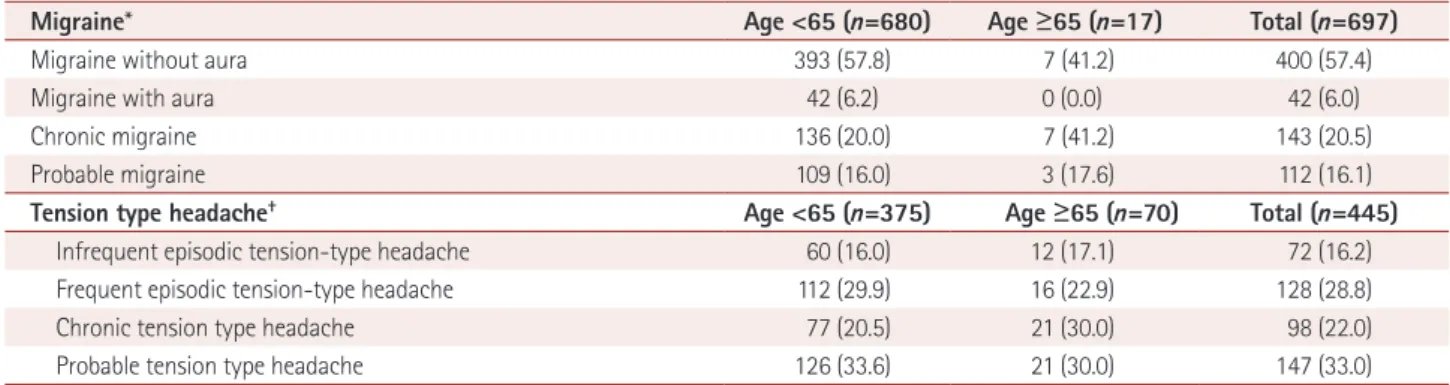
Marginal significance (p=0.062) was noted between the EOG and YOG for the migraine subgroup, particularly chronic migraine (41.2% EOG vs. 20.0% YOG) after exclud- ing the probable migraine subtype. This result was not signif- icant when probable migraine was included (p=0.139) (Table 2). The VAS score was lower in the EOG than that in the YOG (6.2±1.3 vs. 7.3±1.4, p=0.026). Episodic tension-type headache tended to be less frequent in the EOG than in the YOG (p=0.297) regardless of whether or not probable ten- sion-type headache was excluded (p=0.199) (Table 2). The VAS score for patients with tension-type headache did not dif- fer between the EOG and the YOG (5.2±1.1 vs. 5.1±1.2, p=0.121).
Regarding other primary headache disorders, primary stabbing headache (87.2%) was the most common diagnosis in the EOG, whereas primary exercise headache, primary headache associated with sexual-activity, and primary thun- derclap headache were more frequently noted in the YOG (p=0.032) (Table 3). The frequency of medication overuse headache (MOH) was higher in EOG than in YOG (23.5%
vs. 7.6%, p=0.040) but did not differ significantly in those with tension-type headache (5.7% vs. 2.9%, p=0.271) (Table 4). Moreover, the following main causes of MOH did not dif- fer between the EOG and YOG (p=0.551): combination an- algesics (36.4% vs. 42.9%), nonsteroidal anti-inflammatory drugs (27.3% vs. 28.6%), and triptan (0.0% vs. 7.1%) use.
The distribution of secondary headache subtypes (p=0.239)
Table 1. Comparison* between aged (≥65) onset group and younger age onset (<65) group
Age <65 (n=1,475) Age ≥65 (n=152) Total (n=1,627)
Primary headache 1,303 (88.3) 126 (82.9) 1,429 (87.8)
Migraine† 680 (52.2) 17 (13.4) 697 (48.8)
Tension type headache† 375 (28.8) 70 (55.6) 445 (31.1)
Cluster headache† 22 (1.7) 0 (0.0) 22 (1.5)
Other primary headache† 226 (17.3) 39 (31.0) 265 (18.5)
Secondary headache 118 (8.0) 17 (11.2) 135 (8.3)
Facial pain syndrome 25 (1.7) 3 (2.0) 28 (1.7)
Other headache disorders 29 (2.0) 6 (3.9) 35 (2.2)
Values are number (%).
*p=0.193 by chi-square test with frequency of primary headache, secondary headache, facial pain syndrome, and other headache disorders, †Including di- agnosed as probable type, †The percent (%) represents ratio of each headaches in primary headache.
Headache in Elderly Koreans
JCN
did not differ between the EOG and YOG. The most com- mon secondary headache diagnosis was headache attributed to infection in both of the study groups (Table 5).
Comparison aged (≥65 years) onset with the younger age (<65 years) onset group in elderly (≥65 years) patients
Among the 210 elderly (≥65 years) patients with headache, 152 (72.4%) were defined as EOG and 58 (27.6%) had head- ache before the age of 65-years. Older age (72.6±5.8 vs.
70.1±5.2, p=0.001) and proportion of different types of head- ache, particularly migraine (11.2% vs. 36.2%) and other pri- mary headache disorders (25.7% vs. 8.6%), differ between EOG and YOG among elderly (≥65 years) patients (p=0.003) (Supplementary Table 1 in the online-only Data Supplement).
DISCUSSION
This prospective, first-visit, outpatient-based, multicenter study using ICHD-3β has demonstrated the following fea- tures of elderly-onset headache compared with younger-age- at-onset headache. First, tension-type headache and other primary headache disorders were more common, whereas
migraine was less common in patients with headache that began from the age of 65 years in a Korean population. Sec- ond, ICHD-3β was useful for diagnosing elderly patients with first-onset headache.
Tension-type headache was the most frequent diagnosis in previous studies, with prevalence rates ranging from 11% in Singapore to 20–40% in the USA and >80% in Denmark in a general population-based study.12 Moreover, Spanish tertiary hospital data show that the frequency of tension headache in older patients (age ≥65 years) is about 30%.2 Other studies have found annual prevalence rates of tension-type headache of 16–44% in elderly patients.13-16 In the present study we as- sessed the frequency of tension headache among elderly-on- set patients with primary headache, and the increased fre- quency of tension-type headache we detected in older patients was in line with these previous studies.
In this study, the second most common primary headache diagnosis in the EOG was other primary headache disorders, particularly primary stabbing headache. In contrast, new daily persistent headache, primary exercise headache, prima- ry headache associated with sexual-activity, and primary thunderclap headache were relatively common diagnoses in the YOG. This intergroup difference may be associated with Table 2. Comparison of migraine and tension type headache between aged (≥65) onset group and younger age onset (<65) group
Migraine* Age <65 (n=680) Age ≥65 (n=17) Total (n=697)
Migraine without aura 393 (57.8) 7 (41.2) 400 (57.4)
Migraine with aura 42 (6.2) 0 (0.0) 42 (6.0)
Chronic migraine 136 (20.0) 7 (41.2) 143 (20.5)
Probable migraine 109 (16.0) 3 (17.6) 112 (16.1)
Tension type headache† Age <65 (n=375) Age ≥65 (n=70) Total (n=445)
Infrequent episodic tension-type headache 60 (16.0) 12 (17.1) 72 (16.2)
Frequent episodic tension-type headache 112 (29.9) 16 (22.9) 128 (28.8)
Chronic tension type headache 77 (20.5) 21 (30.0) 98 (22.0)
Probable tension type headache 126 (33.6) 21 (30.0) 147 (33.0)
Values are number (%).
*p=0.062 after excluding probable migraine and p=0.139 after including probable migraine, †p=0.199 after excluding probable tension type headache and p=0.297 after including probable tension type headache.
Table 3. Comparison* of other primary headache disorder between aged (≥65) onset group and younger age onset (<65) group
Type of other primary headache disorders Age <65 (n=226) Age ≥65 (n=39) Total (n=265)
Primary cough headache 8 (3.5) 0 (0.0) 8 (3.0)
Primary exercise headache 19 (8.4) 1 (2.6) 20 (7.5)
Primary headache associated with sexual activity 10 (4.4) 0 (0.0) 10 (3.8)
Primary thunderclap headache 19 (8.4) 0 (0.0) 19 (7.2)
Cold-stimulus headache 1 (0.4) 0 (0.0) 1 (0.4)
Primary stabbing headache 145 (64.2) 34 (87.2) 179 (67.5)
Nummular headache 1 (0.4) 0 (0.0) 1 (0.4)
Hypnic headache 0 (0.0) 1 (2.6) 1 (0.4)
New daily persistent headache 23 (10.3) 3 (7.6) 26 (9.8)
Values are number (%).
*p=0.032 by chi-square test.
Song TJ et al.
JCN
the characteristics of the headache (attack frequency, dura- tion, and/or potency), physical activity, combined vascular risk factors, hormonal changes, and concomitant drug usage.6 It is uncertain why the frequency of primary stabbing head- ache was higher in the EOG than in the YOG in our study.
However, there are several possible causes that could explain our results. First, increased cervicogenic headache, nerve in- flammation, or vascular tortuosity are often noted in elderly populations, and these problems could result in an associa- tion between primary stabbing headache and the findings in our EOG.17,18 Second, even though the rate of braining imag- ing was higher (48.0%) in our study than in a previous study19 (5%) investigating primary stabbing headache, there is a pos- sibility of existing secondary causes for primary stabbing headache in patients in whom brain imaging was not con- ducted. Third, the mean age at onset has varied from 28 to 47 years in studies based on the Second Edition of the Interna- tional Classification of Headache Disorders (ICHD-2), but the mean age for patients with primary stabbing headache was 53–74 years in a recent study from Asia, and so primary stabbing headache may be common among the elderly.2,19 Fourth, our study applied ICHD-3β rather than ICHD-2 for classifying headache. The diagnostic yield of chronic mi- graine and other primary headaches is more favorable for ICHD-3β than for ICHD-2. In particular, the primary stab- bing headache diagnostic criteria that limited the pain distri- bution to the first division of the trigeminal nerve were de- leted from ICHD-3β.9 Therefore, our results may be more explainable than those obtained in previous studies.
Migraine was the third most frequent diagnosis in the EOG.
The annual incidence of migraine in the elderly population has been reported to range from 10% to 25%.6,20 Previous studies found that the migraine prevalence decreases progres- sively during ageing.21,22 Moreover, in our study migraine with aura was rare in the EOG, which is consistent with the findings of a previous epidemiological study.2 Late-life mi- graine accompaniment is not rare in the elderly, but we en- rolled elderly patients with their first presentation of head- ache, and so aura without headache was not detected.23 Furthermore, we found that chronic migraine tended to be more common in the EOG. Migraine transforms into chron- ic headache and changes over time, particularly in elderly patients.24-26 Chronic daily headache is a neurological condi- tion that reportedly affects 1–4% of the general population.27,28 Patients with chronic daily headache have initially suffered from episodic headache that subsequently develops into chronic daily headache.27 Therefore, physicians should con- sider the characteristics of these primary headaches, includ- ing their chronicity, when diagnosing and/or treating mi- graine and tension-type headache in the elderly.
The patients in the EOG with migraine had less-severe pain, which is compatible with the results in a previous cross- sectional study involving outpatients aged ≥60 years.29 Al- though the exact mechanism underlying the decreased in- tensity of headache with ageing is still unclear, increased somatosensory pain thresholds and decreased estrogen-with- drawal-related migraine in elderly headache patients might account for our results.30,31
Female dominancy was noted in the YOG but not in the EOG among our migraineurs. Migraine generally begins af- Table 4. Comparison of frequency of medication overuse headache between aged (≥65) onset group and younger age onset (<65) group
Age <65 Ncase/Ntotal (%) Age ≥65 Ncase/Ntotal (%) p value*
Migraine 52/680 (7.6) 4/17 (23.5) 0.040
Tension-type headache 11/375 (2.9) 4/70 (5.7) 0.271
Other primary headache disorders 1/226 (0.4) 0/39 (0.0) Not available
Values are number of case/total number of each headache (%).
*p value were acquired by Fisher’s exact test according to each headaches.
Table 5. Comparison* of secondary headache between aged (≥65) onset group and younger age onset (<65) group
Type of secondary headache Age <65 (n=118) Age ≥65 (n=17) Total (n=135)
Trauma or injury to the head and/or neck 12 (10.2) 1 (5.8) 13 (9.6)
Cranial or cervical vascular disorder 16 (13.6) 2 (11.8) 18 (13.3)
Non-vascular intracranial disorder 23 (19.5) 0 (0.0) 23 (17.0)
Substance or its withdrawal 10 (8.5) 2 (11.8) 12 (8.9)
Infection 31 (26.2) 5 (29.4) 36 (26.8)
Homeostasis 3 (2.5) 2 (11.8) 5 (3.7)
Cranium, neck, eyes, ears, nose, sinuses, teeth,
mouth or other facial or cervical structure 23 (19.5) 5 (29.4) 28 (20.7)
Values are number (%).
*p=0.239 by chi-square test.
Headache in Elderly Koreans
JCN
ter menarche, is more common during menstruation, and of- ten improves during pregnancy and after menopause.32 The estrogen-withdrawal hypothesis is the most commonly used to explain the female preponderance in migraine.33 If the op- posing roles of estrogen (increases neural activity) and pro- gesterone (decreases neural activity) within the brain become unbalanced, these conditions may alter the susceptibility to migraine.34 Furthermore, because increased estrogen is relat- ed to the up-regulation of serotonin in the brain, consequent menstruation-related cyclical changes in serotonin levels in the trigeminal nerve ganglia could contribute to the selective response to estrogen withdrawal and may increase the likeli- hood of migraine developing.35
The frequency of MOH was higher in EOG migraineurs than in YOG migraineurs, which is consistent with a previ- ous study finding that patients with MOH more frequently transformed from migraine than those with chronic tension- type headache (69.2% vs. 23.8%).6 Our results suggest that the characteristics or underlying headache for MOH may have differed between the EOG and YOG. Further large population studies of whether the features of MOH are in- fluenced by the age at headache onset are needed.
Our study had some limitations that should be considered.
First, it was a cross-sectional study with no long-term longi- tudinal follow-up. Moreover, this prospective multicenter study did not determine headaches diagnosed as “probable,”
which could cause bias. Therefore, a long-term longitudinal study should be performed in the future. Second, our data involved subjective descriptions of current symptoms and recall of previous events, and so recall or selection bias could have affected the obtained results. Third, the smallness of the EOG sample may have resulted in type II errors, while the relatively large YOG sample may have caused type I errors, such as no or only marginal differences in migraine frequen- cy. Caution is therefore needed when interpreting our find- ings. Lastly, our study did not investigate important factors that could be associated with or contribute to headache, such as sociodemographic, family, psychological, or life-event fac- tors. Further studies of whether these factors are related to headache are still needed.
In conclusion, tension-type headache and other primary headache disorders were more common in patients with head- ache that began from an age of 65 years in a Korean popula- tion. The frequency of headache differed according to the age of the patients at the headache onset.
Supplementary Materials
The online-only Data Supplement is available with this arti- cle at http://dx.doi.org/10.3988/jcn.2016.12.4.419.
Conflicts of Interest
The authors have no financial conflicts of interest.
Acknowledgements
This study was supported by a grant from the Korean Headache Society, the Korean Geriatrics Society and by the Basic Science Research Pro- gram through the National Research Foundation of Korea (NRF) funded by the Ministry of Education (grant no. 2015R1D1A1A01057934).
REFERENCES
1. Hale WE, Perkins LL, May FE, Marks RG, Stewart RB. Symptom prevalence in the elderly. An evaluation of age, sex, disease, and medi- cation use. J Am Geriatr Soc 1986;34:333-340.
2. Ruiz M, Pedraza MI, de la Cruz C, Barón J, Muñoz I, Rodríguez C, et al. Headache in the elderly: characteristics in a series of 262 patients.
Neurologia 2014;29:321-326.
3. Fuh JL, Wang SJ, Lu SR, Tsai PH, Lai TH, Lai KL. A 13-year long- term outcome study of elderly with chronic daily headache. Cepha- lalgia 2008;28:1017-1022.
4. Rasmussen BK, Jensen R, Schroll M, Olesen J. Epidemiology of head- ache in a general population--a prevalence study. J Clin Epidemiol 1991;44:1147-1157.
5. Pryse-Phillips W, Findlay H, Tugwell P, Edmeads J, Murray TJ, Nel- son RF. A Canadian population survey on the clinical, epidemiologic and societal impact of migraine and tension-type headache. Can J Neurol Sci 1992;19:333-339.
6. Prencipe M, Casini AR, Ferretti C, Santini M, Pezzella F, Scaldaferri N, et al. Prevalence of headache in an elderly population: attack fre- quency, disability, and use of medication. J Neurol Neurosurg Psychia- try 2001;70:377-381.
7. Tai ML, Jivanadham JS, Tan CT, Sharma VK. Primary headache in the elderly in South-East Asia. J Headache Pain 2012;13:291-297.
8. Bamford CC, Mays M, Tepper SJ. Unusual headaches in the elderly.
Curr Pain Headache Rep 2011;15:295-301.
9. Headache Classification Committee of the International Headache Society (IHS). The International Classification of Headache Disor- ders, 3rd edition (beta version). Cephalalgia 2013;33:629-808.
10. Cho SJ, Kim BK, Kim BS, Kim JM, Kim SK, Moon HS, et al. Vestibu- lar migraine in multicenter neurology clinics according to the ap- pendix criteria in the third beta edition of the International Classifi- cation of Headache Disorders. Cephalalgia 2016;36:454-462.
11. Kim BK, Cho SJ, Kim BS, Sohn JH, Kim SK, Cha MJ, et al. Compre- hensive application of the International Classification of Headache Disorders third edition, beta version. J Korean Med Sci 2016;31:106- 12. Manzoni GC, Stovner LJ. Epidemiology of headache. Handb Clin 113.
Neurol 2010;97:3-22.
13. Kaniecki RG. Tension-type headache in the elderly. Curr Treat Op- tions Neurol 2007;9:31-37.
14. Schwaiger J, Kiechl S, Seppi K, Sawires M, Stockner H, Erlacher T, et al. Prevalence of primary headaches and cranial neuralgias in men and women aged 55-94 years (Bruneck Study). Cephalalgia 2009;29:
179-187.
15. Crystal SC, Grosberg BM. Tension-type headache in the elderly.
Curr Pain Headache Rep 2009;13:474-478.
16. Pérez-Martínez D, Puente-Muñoz A, Anciones B. [Headache among oldest old (+75 years): findings from 736 consecutive subjects in out- patient neurological clinic]. Neurologia 2008;23:436-440.
17. Edmeads J. The cervical spine and headache. Neurology 1988;38:
1874-1878.
18. Love S, Coakham HB. Trigeminal neuralgia: pathology and patho- genesis. Brain 2001;124(Pt 12):2347-2360.
19. Fuh JL, Kuo KH, Wang SJ. Primary stabbing headache in a headache
Song TJ et al.
JCN
clinic. Cephalalgia 2007;27:1005-1009.
20. Camarda R, Monastero R. Prevalence of primary headaches in Ital- ian elderly: preliminary data from the Zabút Aging Project. Neurol Sci 2003;24 Suppl 2:S122-S124.
21. Bigal ME, Liberman JN, Lipton RB. Age-dependent prevalence and clinical features of migraine. Neurology 2006;67:246-251.
22. Yoon MS, Katsarava Z, Obermann M, Fritsche G, Oezyurt M, Kae- sewinkel K, et al. Prevalence of primary headaches in Germany: re- sults of the German Headache Consortium Study. J Headache Pain 2012;13:215-223.
23. Vongvaivanich K, Lertakyamanee P, Silberstein SD, Dodick DW.
Late-life migraine accompaniments: a narrative review. Cephalalgia 2015;35:894-911.
24. Buse DC, Manack AN, Fanning KM, Serrano D, Reed ML, Turkel CC, et al. Chronic migraine prevalence, disability, and sociodemo- graphic factors: results from the American Migraine Prevalence and Prevention Study. Headache 2012;52:1456-1470.
25. Kim BK, Chu MK, Lee TG, Kim JM, Chung CS, Lee KS. Prevalence and impact of migraine and tension-type headache in Korea. J Clin Neurol 2012;8:204-211.
26. Martins KM, Bordini CA, Bigal ME, Speciali JG. Migraine in the el- derly: a comparison with migraine in young adults. Headache 2006;
46:312-316.
27. Cho SJ, Chu MK. Risk factors of chronic daily headache or chronic migraine. Curr Pain Headache Rep 2015;19:465.
28. Park JW, Moon HS, Kim JM, Lee KS, Chu MK. Chronic daily head- ache in Korea: prevalence, clinical characteristics, medical consulta- tion and management. J Clin Neurol 2014;10:236-243.
29. Mazzotta G, Gallai V, Alberti A, Billeci AM, Coppola F, Sarchielli P.
Characteristics of migraine in an out-patient population over 60 years of age. Cephalalgia 2003;23:953-960.
30. Lautenbacher S, Kunz M, Strate P, Nielsen J, Arendt-Nielsen L. Age effects on pain thresholds, temporal summation and spatial summa- tion of heat and pressure pain. Pain 2005;115:410-418.
31. Ripa P, Ornello R, Degan D, Tiseo C, Stewart J, Pistoia F, et al. Mi- graine in menopausal women: a systematic review. Int J Womens Health 2015;7:773-782.
32. Sacco S, Ricci S, Degan D, Carolei A. Migraine in women: the role of hormones and their impact on vascular diseases. J Headache Pain 2012;13:177-189.
33. Somerville BW. The role of estradiol withdrawal in the etiology of menstrual migraine. Neurology 1972;22:355-365.
34. te Velde ER, Pearson PL. The variability of female reproductive age- ing. Hum Reprod Update 2002;8:141-154.
35. MacGregor EA. Migraine headache in perimenopausal and meno- pausal women. Curr Pain Headache Rep 2009;13:399-403.