Original Article
pISSN 2233-9019 · eISSN 2233-9116
Korean J Fam Pract. 2015;5(3, suppl. 2):890-894
KJFP
Korean Journal of Family Practice서 론
흡연은 암, 심장질환, 만성 폐질환, 뇌졸중 등의 위험인자로 자유 라디칼과 산화스트레스를 일으켜 만성 염증을 일으킨다.
1
)담배에는 기체, 증기, 일산화탄소, 페놀, 암모니아, 포름알데하이드, 벤젠, 피 린, 니코틴, 타르 등의 입자 등4000
개가 넘는 화학물질들이 포함되 어 있다.2)혈색소는 글로빈(
globin
)과 헴(heme
)으로 이루어진 색소단백으로 산소의 운반에 관여한다. 혈색소치에 영향을 미치는 인자로는 인종, 나이, 성별, 체중, 체질량 지수, 페리틴, 흡연 등을 들 수 있다.3)흡연자에서는 흡연으로 인해 발생한 일산화탄소로 인해 비흡연자 에 비해 혈색소량이 증가하는 것으로 알려져 있다. 흡연 시 나오는 일산화 탄소가 혈색소에 부착되어
carboxyhemoglobin
이 형성됨에따라 산소 운반능이 없어지면서 전체적인 혈색소의 산소 운반 능력 이 감소하게 된다.4) 따라서 흡연자에서 감소된 산소 운반능을 보상 하기 위해서 혈색소를 높게 유지하게 된다.4)
이처럼 흡연자에서 산소 운반능력의 증가 없이 보상적으로 증가 한 혈색소 때문에 비흡연자와 같은 혈색소 수치일 경우에도 실제로 는 비흡연자에 비해 산소 운반 가능한 혈색소가 더 적고 이로 인해 빈혈 진단이 가려질 수 있다.
이전의 연구에서 혈색소치에 성별, 체중, 비만도, 흡연 유무와 흡 연량이 영향을 줄 수 있다4, 5) 하였으나, 이에 대한 국내 연구는 매우 적은 실정이다.
이에 빈혈이 없는
30
~50
대 한국 성인 남성을 대상으로 흡연과 혈 색소 간의 관계를 살펴 보고자 본 연구를 시행하였다.건강한 30~50대 남성에서 혈색소와 흡연의 관련성
장미, 최봉석, 김선희, 김영진, 신경숙, 유병욱, 조용진, 오정은
*, 조주연, 홍성호
순천향대학교 의과대학 가정의학교실
The Relationship between Cigarette Smoking and Hemoglobin in Age 30~50s Healthy Men
Mi Jang, Bong-Suk Choi, Sun-Hee Kim, Yung-Jin Kim, Kyung-Suk Shin, Byung-Wook Yoo, Yong Jin-Cho, Jung-Eun Oh
*, Choo-Yon Cho, Sung-Ho Hong
Department of Family Medicine, Soonchunhyang University College of Medicine
Background: Although serum hemoglobin levels may be normal in some cigarette smokers, practically their hemoglobin has less oxygen binding capacity compared to non-smokers, which results in the presence of anemia being masked. In this study, we investigated the effects of smoking on hemoglobin by comparing current smokers and nonsmokers, three groups , each grouped by hemoglobin levels consisting of 30- to 50-year-old males.
Methods: Participants included 30- to 50-year-old males who visited a university hospital’s health clinic located in Chungnam province for a routine health check between January and December of 2013, To analyze the relationship between smoking and hemoglobin, multinomial logistic regression was used on the following variables: age, serum ferritin levels, BMI, total serum cholesterol, TG, and HDL.
Results: After analysis with multinomial logistic regression of age, serum ferritin levels, BMI, total serum cholesterol, TG, and HDL, the risk of current smoking was shown to increase in the category 3 hemoglobin group and low HDL group when compared to the category 1 hemoglobin group,.
Conclusion: Hemoglobin and smoking are connected in age 30~50s men Keywords: smoking, hemoglobin, ferritin, HDL-cholesterol
Received February 28, 2015 Revised September 22, 2015 Accepted September 22, 2015 Corresponding Author Jung-Eun Oh
Tel: +82-31-655-2596 E-mail: [email protected]
Copyright © 2015 The Korean Academy of Family Medicine
This is an open-access article distributed under the terms of the Creative Commons Attribution Non-Commercial License (http://creativecommons.org/licenses/by-nc/3.0) which permits unrestricted noncommercial use, distribution, and reproduction in any medium, provided the original work is properly cited.
장미 외. 건강한 30~50대 남성에서 혈색소와 흡연의 관련성 Korean Journal of Family Practice
KJFP
Original Article
Korean Journal of Family Practice
방 법
1. 연구대상과 기간
2013
년1
월부터12
월까지1
년간 충남소재 한 대학병원건강증진 센터를 건강검진 목적으로 방문한30
~50
대의 수검자5555
명 중 여 성, 혈색소<13g
/dL
인 경우, 혈청 페리틴이500μg
/L
이상인 경우 와 검사하지 않은 경우를 제외하고 혈색소 대사가 간에서 되는 것 을 감안하여 만성B
형,C
형간염,alanine aminotrasferase
(ALT
)와aspartate aminotransferase
(AST
)가 참고치 기준 (ALT
>40 IU
/L
,AST
>40 IU
/L
)보다2
배 초과한 경우를 제외하여 총1301
명을 대 상으로 분석하였다.2. 연구방법
1) 신체 계측 및 혈액검사
신체계측은 가벼운 옷을 입고 신발을 벗은 상태에서 훈련된 검 사자가 키(
kg
)와 체중(m
)을 측정하였고, 체중을 키의 제곱으로 나 누어 체질량 지수(kg
/m
2)를 계산하였다. 혈액검사는8
시간 금식을 한 참여자의 혈색소,AST
,ALT
, 페리틴, 중성지방, 총 콜레스테롤, 고밀도 콜레스테롤을Roche COBAS C
-702
(Roche
,co
.,Seoul
,Korea
)로 측정하였다.2) 흡연 습관 조사
환자의 나이, 흡연여부 등의 일반적인 특성은 검진 문진표를 이 용하여 조사하였다.
담배를 한번도 피우지 않은 사람과 담배를 피우다 금연을 한 사 람들을 비흡연군으로, 현재 흡연을 하는 사람을 흡연군으로 분류하 였다.
3) 변수에 대한 정의
체질량 지수
25kg
/m
2 이상을 비만으로 정의하고,National Cholesterol Education Program
(NCEP
)에 따라서 총 콜레스테롤이240mg
/dl
이상을 고콜레스테롤혈증으로 정의하였다.6) 중성지방은200mg
/dl
이상을 고중성지방혈증으로 정의하고HDL
콜레스테롤 이40
미만인 경우를 저고밀도콜레스테롤혈증으로 정의하였다.6)혈색소는 농도를 백분위에 따라
3
등분 하여 세구간(1
분위군 혈 색소<15
.3g
/dL
,2
분위군15
.3g
/dL
≤ 혈색소<16g
/dL
,3
분위군16g
/dL
≤ 혈색소)으로 분류하였다.3. 분석방법
검진 대상자의 혈색소 세 그룹을
ANOVA test
로 각각 나이, 흡연 상태, 체질량 지수, 페리틴, 총 콜레스테롤, 중성지방, 고밀도 콜레 스테롤을 비교하였다.흡연과 혈색소의 관계를 알아보기 위해 나이, 페리틴, 체질량 지 수, 총 콜레스테롤, 중성지방, 고밀도 콜레스테롤을 보정하여 다중 로지스틱 회귀분석을 시행하였다.
p
-value
가0
.05
이하인 것을 통계적으로 유의하다 해석하 였고Statistical Package for the Social Science
(SPSS
)version 17
.0
(SPSS
,Chicago
,IL
) 이용하여 통계분석을 시행하였다.결 과
1. 흡연군과 비흡연군의 일반적 특성 비교
연구대상자는 총
1301
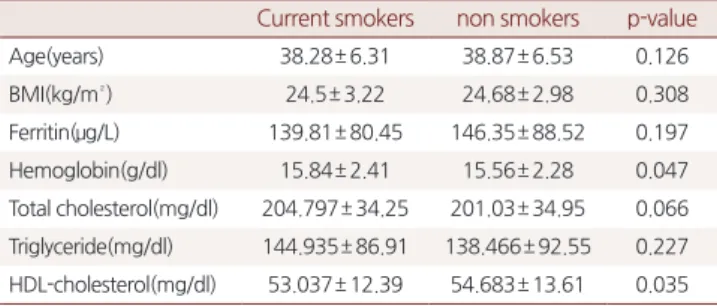
명으로 흡연군과 비흡연군으로 구분하여 각각 일반적 특성을 비교하였다.(Table 1
) 흡연군에서 혈색소의 평 균은15
.84g
/dL
로 비흡연군(15
.56g
/dL
)에 비해 혈색소가 높게 나 타났다.(P
=0
.047
)또 고밀도콜레스테롤의 경우 흡연 에서의 평균은53
.037mg
/dl
로 비흡연군(54
.683mg
/dl
)보다 낮았다.(P
=0
.035
)2. 혈색소 그룹에 따른 일반적인 특성 비교
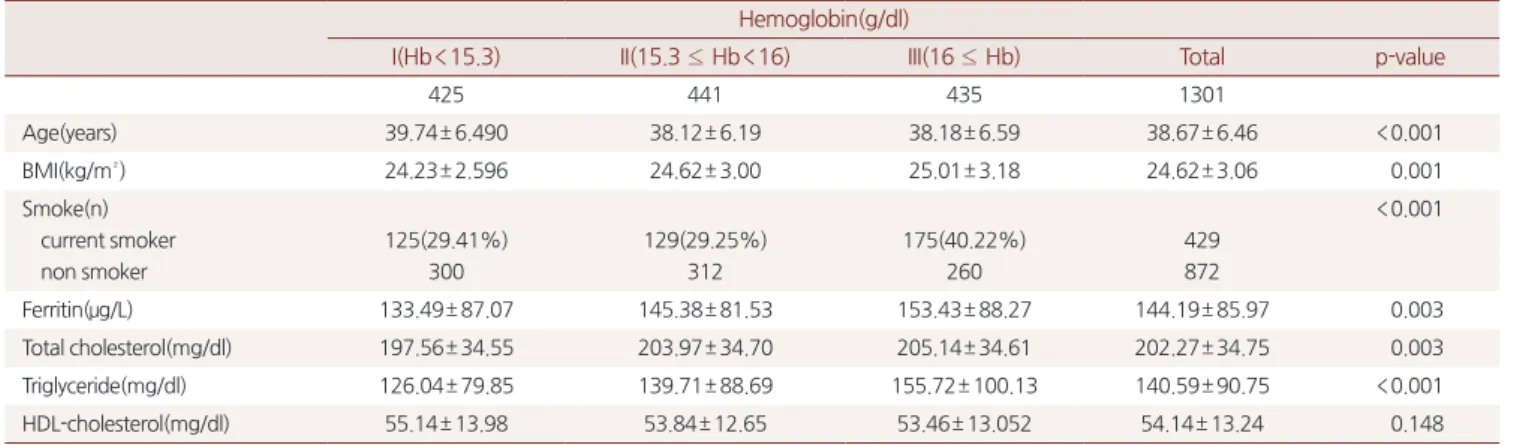
혈색소 집단
I
,II
,III
각각에서 현재 흡연을 하는 사람은125
(29
.41
%),129
(29
.25
%),175
(40
.22
%)명 이였고, 페리틴의 평균 은 각각197
.56μg
/L
,203
.97μg
/L
,205
.14μg
/L
로 유의한 차이가 있 었다.(p
=0
.003
) 총콜레스테롤은 각각197
.56mg
/dl
,203
.97mg
/dl
,205
.14mg
/dl
(p
=0
.003
)이고, 중성지방은126
.04mg
/dl
,139
.71mg
/dl
,155
.72mg
/dl
(p
<0
.001
)로 혈색소가 높은 군에서 높게 나타났 고, 고밀도콜레스테롤은 각각55
.14mg
/dl
,53
.84mg
/dl
,53
.46mg
/dl
로 유의한 차이는 없었다.(p
=0
.148
)(Table 2
)3. 혈색소에 영향을 미칠 수 있는 변수에 대한 로지스틱 회귀분석 결과
나이, 비만, 페리틴, 고콜레스테롤혈증, 고중성지방혈증, 저고밀 도콜레스테롤혈증을 보정하여 다중 로지스틱 회귀분석을 시행한 결과 혈색소 농도1
분위 군을 기준으로 하였을 때3
분위 군의 교차 비가1
.58
(95
%CI
,1
.183
~2
.118
)로 현재 흡연의 위험성이 증가하Table 1. General characteristics of current smoking group and non smoking group
Current smokers non smokers p-value
Age(years) 38.28± 6.31 38.87± 6.53 0.126
BMI(kg/m²) 24.5± 3.22 24.68± 2.98 0.308
Ferritin(μg/L) 139.81± 80.45 146.35± 88.52 0.197
Hemoglobin(g/dl) 15.84± 2.41 15.56± 2.28 0.047
Total cholesterol(mg/dl) 204.797± 34.25 201.03± 34.95 0.066 Triglyceride(mg/dl) 144.935± 86.91 138.466± 92.55 0.227 HDL-cholesterol(mg/dl) 53.037± 12.39 54.683± 13.61 0.035 BMI; body mass index, Hb; hemoglobin, HDL-cholesterol; high density lipid cholesteol
* P value is calculated from chi-squre test
Mi Jang, et al. The Relationship between Cigarette Smoking and Hemoglobin in Age 30~50s Healthy Men
Korean Journal of Family Practice
KJFP
였고, 이는 통계적으로 유의하였다.(
P
<0
.05
) (Table 3
) 고 찰본 연구 결과
30
대에서50
대까지의 성인 남성에서 페리틴,BMI
, 중성지방, 총콜레스테롤, 고밀도콜레스테롤에 독립적으로 흡연과 높은 혈색소 농도는 관련성이 있었다.연구 결과 혈색소
3
분위군은1
분위 군에 비해 현재 흡연의 위험 이 증가하였는데, 이는1990
년의Nordenberg D
등의 연구 결과와 유사하였다.7)2010
년에Muhammad A M
등이 발표한 연구에서도 흡연이 전혈에서의 혈색소를 증가 시키는 것과 관련이 있다8)고 하 였고,Milman N
등의 연구에서도 흡연이 여성과 남성 모두에게서 혈색소 증가 효과가 있다고 하였다9).Tirlapur VG
등의 연구에서 는 남녀 모두heavy smoker
에서 혈색소가 올라간다10)하였고,1992
년 남시규 등은 한국인을 대상으로 헌혈자의 혈액비중, 혈색소 및hematocrit
치에 영향을 미치는 인자에 관한 연구에서 혈색소치에 영향을 줄 수 있는 변수로 성별, 체중, 비만도, 흡연 유무, 흡연량을 보고하였다.11)흡연은 니코틴, 산화질소, 일산화탄소, 자유 라디칼 등 많은 독소 와 발암물질을 포함한다. 일산화 탄소는 혈색소와의 친화력이 산소 의
245
배이다. 일반적으로 흡연을 하지 않는 사람의COHb
는1
.5
% 미만인데 비해 흡연을 하는 사람의COHb
는3
~15
%이다.12) 흡연으 로 인한 일산화 탄소 때문에 산소 운반능이 없는COHb
가 증가하 고 산소와 결합된 혈색소가 감소함에 따라 조직에 산소공급이 줄어 들게 된다.13) 이것을 보정하기 위해 혈색소 증가가 발생하게 된다.Nordenberg D
등의 연구에서는 흡연자에서 빈혈이 가려질 수 있기 때문에 혈색소의 하한치를 보정해야 한다고 하였다.7)흡연과 페리틴의 경우
Ghio
등의 미국 국민건강영양조사 자료를 이용하여 분석한 연구에서 흡연자에서 비흡연자에 비해 혈청 및 폐포 세척액에서 페리틴이 높았다고 하였다.14) 반면 호주인을 대상으 로 조사한 연구에서는 남녀 모두에서 혈청 페리틴이 흡연력과는 관 련성이 없다는 연구가 있었으며,15) 김서윤 등이 한국의 국민건강영 양조사 자료를 이용하여 분석한 연구에서도
20
세 이상의 한국 성인 Table 2. General characteristics of 3 hemoglobin groupsHemoglobin(g/dl)
I(Hb<15.3) II(15.3 ≤ Hb<16) III(16 ≤ Hb) Total p-value
425 441 435 1301
Age(years) 39.74± 6.490 38.12± 6.19 38.18± 6.59 38.67± 6.46 <0.001
BMI(kg/m²) 24.23± 2.596 24.62± 3.00 25.01± 3.18 24.62± 3.06 0.001
Smoke(n) current smoker non smoker
125(29.41%) 300
129(29.25%) 312
175(40.22%) 260
429 872
<0.001
Ferritin(μg/L) 133.49± 87.07 145.38± 81.53 153.43± 88.27 144.19± 85.97 0.003
Total cholesterol(mg/dl) 197.56± 34.55 203.97± 34.70 205.14± 34.61 202.27± 34.75 0.003
Triglyceride(mg/dl) 126.04± 79.85 139.71± 88.69 155.72± 100.13 140.59± 90.75 <0.001
HDL-cholesterol(mg/dl) 55.14± 13.98 53.84± 12.65 53.46± 13.052 54.14± 13.24 0.148
BMI; body mass index, HDL-cholesterol; high density lipid cholesteol
* P-value is calculated from chi-squre test, ANOVA test.
Table 3. Odds ratio for Smoking status using binary logistic regression analysis
Odd ratio P-value
Hemoglobin(g/dl) 1. Hb<15.3(n= 425) 2. 15.3 ≤ Hb<16(n= 441) 3. 16 ≤ Hb(n= 435)
1 0.960(0.713~1.293) 1.583(1.183~2.118)
0.788 0.002 Ferritin(μg/L)
1. ferritin<102.2(n= 434) 2. 102.2 ≤ ferritin<169.30 (n= 441)
3. 169.30 ≤ ferritin (n= 430)
1 0.880(0.661~1.172)
0.853(0.638~1.140)
0.383
0.282
Age(years)
1. 30 ≤ age<40(n= 760) 2. 40 ≤ age<50(n= 431) 3. 50 ≤ age(n= 110)
1 0.781(0.601~1.013) 0.925(0.602~1.421)
0.063 0.722 Obesity(BMI≥ 25kg/m²)
no(n= 758) yes(n= 543)
1
0.791(0.616~1.017) 0.067 Hypertriglycemia
(TG≥ 200mg/dl) no(n= 1073) yes(n= 228)
1
1.158(0.836~1.605) 0.377 Hypercholesterolemia
(cholesterol≥ 240mg/dl) no(n= 1123) yes(n= 178)
1
1.277(0.910~1.791) 0.157 Low HDL cholesterol
(HDL ≤ 40mg/dl) no(n= 769) yes(n= 531)
1
1.301(1.011~1.673) 0.040 BMI; body mass index, Hb; hemoglobin, TG; triglyceride, HDL-cholesterol; high density lipid cholesteol
P-value is calculated from binary logistic regression
장미 외. 건강한 30~50대 남성에서 혈색소와 흡연의 관련성 Korean Journal of Family Practice
KJFP
에서 흡연자와 비흡연자에서 혈청 페리틴 농도는 차이가 없었고 혈 청 페리틴 농도는 흡연량과 페기능과 연관성이 없다고 하였다.16) 본 연구에서는 흡연과 페리틴이 연관성이 없다는 결과가 나왔다.
Klesges RC
등에 의하면 흡연 군에서 체질량 지수가 비 흡연 군과 비교하여 유의하게 낮다는 것을 보고하였다.17) 본 연구에서는 흡연 과 비만과의 연관이 없다는 결과가 나왔고 이는Mizuno O
등의 연 구결과와 일치하였다.18) 이처럼 상반된 연구결과는 향후 추가적인 연구가 필요할 것으로 생각된다.낮은 고밀도 콜레스테롤은 관상동맥질환의 위험인자로 흡연과 연관이 있다고 알려져 있다.
Batić
-Mujanović O
등의 연구에서 흡 연자에서 고밀도 콜레스테롤이 비흡연자와 비교하여 통계적으로 유의하게 낮다고 보고19)하였고,Craig WY
등의 연구에서도 흡연이 고밀도콜레스테롤치를 낮춘다고 하였으며20), 이는 본 논문의 결과 와 일치하나, 보다 명확한 연관성 파악을 위해서는 추가 연구가 필 요할 것으로 생각된다.이 논문의 제한점은
1
개 대학병원의 건강검진센터 내원자를 대 상으로 하여 전체 인구집단을 대표할수 없다는 점이다. 집단의 특 징상60
대 이상 연구 대상의 수가 매우 적어 대상군에서 제외하였 다는 점도 연령과 흡연과의 관련성을 알아보는데 제한점으로 작용 했을 것으로 생각된다. 또한 단면연구이므로 흡연과 혈색소간의 관 련성을 원인-결과의 관계로 설명할수 없고, 혈색소와 지질대사에 영향을 줄 수 있는 흡연량, 흡연기간, 음주습관, 식사습관, 운동습 관을 고려하지 않았다는 데서 이 논문의 제한점을 찾을 수 있다.그러나, 한국인을 대상으로 하여 혈색소에 큰 영향을 미칠 수 있 는 페리틴과 함께 비만, 고콜레스테롤혈증, 고중성지방혈증, 낮은 고밀도콜레스테롤혈증에 독립적으로 흡연과 혈색소 사이의 관련성 을 연구한 것에서 큰 의미가 있을 것으로 생각된다.
결론적으로
30
~50
대의 성인 남성에서 혈색소와 흡연이 연관이 있으므로 빈혈의 진단에 흡연 유무를 고려해야 할 것으로 생각된다.요 약
연구배경: 흡연자에서 산소 운반능력의 증가 없이 보상적으로 증가 한 혈색소 때문에 정상인과 같은 혈색소 수치일 경우에도 실제로는 비흡연자에 비해 산소 운반 가능한 혈색소가 더 적고 이로 인해 빈 혈 진단이 가려질 수 있다. 본 연구에서는 빈혈이 없는
30
~50
대 남 성에서 흡연이 혈색소에 미치는 영향을 현재 흡연자와 비 흡연자 간 에 혈색소 삼분위 그룹을 비교하여 알아보고자 한다.방법:
2013
년1
월부터12
월까지1
년간 충남소재 한 대학병원건강 증진 센터를 건강검진 목적으로 방문한30
~50
대의 성인 남성을 대 상으로 하였다.흡연과 혈색소의 관계를 알기 위해 나이, 페리틴, 체질량지수, 총콜레스테롤, 중성지방, 고밀도 콜레스테롤을 보정하여 다중 로지스틱 회귀분석을 시행하였다.
결과: 나이, 비만, 페리틴, 고콜레스테롤혈증, 고중성지방혈증, 저 고밀도콜레스테롤혈증을 보정하여 다중 로지스틱 회귀분석을 시행 한 결과 혈색소 농도
1
분위 군을 기준으로 하였을 때3
분위 군과 고 밀도 콜레스테롤이 낮은 군에서 현재 흡연의 위험성이 증가하였다.결론:
30
~50
대의 성인 남성에서 혈색소와 흡연이 관련되어 있었다.중심단어: 흡연, 혈색소, 페리틴, 고밀도 콜레스테롤
REFERENCES
1. You SA, Wang Q. Ferritin in atherosclerosis. Clin Chim Acta 2005;357:1-16.
2. Tirlapur VG, Gicheru K, Charalambous BM, Evans PJ, Mir MA.
Packed cell volume, haemoglobin, and oxygen saturation changes in healthy smokers and non-smokers. Thorax 1983;38:785-7.
3. Yun SH, Choi YH, Moon YS, Ahn SH, Kim TG. Difference in hemoglobin between smokers and non-smokers. Korean J Fam Med 2002;23: 80-6.
4. Shah BK, Nepal AK, Agrawal M, Sinha AK. The effect of cigarette smoking on hemoglobin levels compared between smokers and non smokers. Sunsari Technical College Journal 2012;1:42-44.
5. Ashish G, Desh D, Naveen G. Study of relationship of tobacco smoking with haemoglobin concentration in healthy adult. Journal of pharmaceutical and biomedical sciences 2010;1:1-3.
6. 1.National Cholesterol Education Program (NCEP) Expert Panel on Detection, Evaluation, and Treatment of High Blood Cholesterol in Adults (Adult Treatment Panel III). Third Report of the National Cholesterol Education Program (NCEP) Expert Panel on Detection, Evaluation, and Treatment of High Blood Cholesterol in Adults (Adult Treatment Panel III) final report. Circulation 2002; 106:3143.
7. Nordenberg D. Yip R, Binkin NJ. The effect of cigarette smoking on hemoglobin levels and anemia screenig. JAMA 1990;264:1556-9.
8. Mahsud MAJ, Khan A, Hussain J. Hematological changes in tobacco using type II diabetic patients. Gomal Journal of Medical Sciences 2010;8:8-11.
9. Milman N, Pedersen A. Blood haemoglobin concentrations are higher in smokers and heavy alcohol consumers than in non- smokers and abstainers.should we adjust the reference range?
Annals of Hematology 2009;88:687-94.
10. Tirlapur VG, Gicheru K, Charalambous BM, Evans PJ, Mir MA.
Packed cell volume, haemoglobin, and oxygen saturation changes in healthy smokers and non-smokers. Thorax 1983 Oct;38:785-7.
11. Nam SG, Kim BS. A Study on Factors Affecting the Specific Gravity, Hemoglobin and Hematocrit in Voluntary Blood Donors . Inje medical J 1992;13:337-46.
12. Light A, Grass C, Pursley D, Kruse J. Carboxyhemoglobin levels in smokers vs. Non smokers in a Smoking Environment. Respir Care
Mi Jang, et al. The Relationship between Cigarette Smoking and Hemoglobin in Age 30~50s Healthy Men
Korean Journal of Family Practice
KJFP
2007;52:1576.
13. Sagone Jr AL, Lawrence T, Balcerzak SP. Effect of Smoking on Tissue Oxygen Supply.Blood 1973; 41:845-51.
14. Ghio AJ, Hilborn ED, Stonehuerner JG, Dailey LA, Carter JD, Richards JH, et al. Particulate matter in cigarette smoke alters iron homeostasis to produce a biological effect. Am J Respir Crit Care Med 2008;178 1130-8.
15. Leggett BA, Brown NN, Bryant SJ, Duplock L, Powell LW, Halliday JW. Factors affecting the concentrations of ferritin in serum in a healthy Australian population. Clin Chem 1990;36:1350-5.
16. Kim SY, Lee SH, Lee IS, Kim SB, Moon CS, Jung SM, et al. The relationship between serum ferritin concentrations, smoking and lung function in Korean. Tuberc Respir Dis 2012;72: 163-8.
17. Klesges RC, Klesges LM. The relationship between body mass and cigarette smoking using a biochoemical index of smoking exposure.
Int J Obes Relat metab Disord 1993;17:585-91.
18. Mizuno O, Okamoto K, Sawada M, Mimura M, Watanabe T, morishita T: Obesity and smoking: relationship with waist circumference and obesity-related disorders in men undergoing a health screening. J Atheroscler Thromb 2005;12:199-204.
19. Batić-Mujanović O, Zildzić M, Beganlić A, Kusljugić Z. The effect of cigarette smoking on HDL-cholesterol level. Med Arh 2006;60(6 Suppl 2):90-2
20. Craig WY, Palomaki GE, Haddow JE. Cigarette smoking and serum lipid and lipoprotein concentrations: an analysis of published data BMJ 1989;298:784-8.