INTRODUCTION
Of the various smoking cessation strategies, Quitline ser- vices have been reported to be effective in many previous studies (1-4). In general, the term ‘‘Quitline’’ service refers to a telephone-based service providing treatment for depen- dence on or withdrawal symptoms from mostly nicotine and alcohol. Quitline provides easily accessible and conve- nient counseling services for smoking cessation to those who require help and may supplement face-to-face support or be an adjunct for self-help interventions or pharmacotherapy.
This service uses 2 approaches (5). One is a ‘‘reactive’’ approach where users obtain information or assistance by telephoning Quitline, and the other is a ‘‘proactive’’ approach where a trained counselor telephones the smokers to provide support in initiating a quit attempt and maintaining prolonged absti- nence (5, 6).
The effectiveness of proactive telephone counseling, in par-
ticular, has been reported in many studies. According to a recent meta-analysis of the effectiveness of proactive tele- phone counseling for smoking cessation, the unweighted mean quit rate of the proactive counseling group was 19%
(range, 7-33%), and the unweighted mean odds ratio (OR) was 1.64 compared with the control group (6).
Countries where these national or state Quitlines are known to be operated include the United States, Australia, New Zealand, Sweden, the United Kingdom (5). However, to the best of our knowledge, no report from the East regard- ing those Quitline services has been published except the one from Hong Kong (9).
Moreover, information on the predictors of successful smok- ing cessation among the Quitline users is lacking. Only a few studies have reported the predictors of successful smok- ing cessation among users of the Quitline service; these pre- dictors are as follows: older age, low cigarette consumption per day, higher education level, and smoking initiation at
888
Seung-Kwon Myung, Jae-Gahb Park*, Woo Kyung Bae�, Yeon Ji Lee�, Yeol Kim, and Hong Gwan Seo
Smoking Cessation Clinic and Center for Cancer Prevention and Detection, National Cancer Center &
Cancer Prevention Branch, National Cancer Control Research Institute, National Cancer Center, Goyang;
Department of Surgery*, Seoul National University College of Medicine & Cancer Research Institute and Cancer Research Center, Seoul; Department of Family Medicine�, Seoul National University, Seoul, Korea
Address for correspondence Hong Gwan Seo, M.D.
Smoking Cessation Clinic and Center for Cancer Prevention and Detection, National Cancer Center, 809 Madu 1-dong, Ilsandong-gu, Goyang 410-769, Korea
Tel : +82.31-920-1707, Fax : +82.31-920-0451 E-mail : [email protected]
*This study was supported by the Funds for Health Promotion provided by the Ministry of Health and Wel- fare of Korea for the implementation of the smoking cessation policy of the Korean Government.
DOI: 10.3346/jkms.2008.23.5.888
Effectiveness of Proactive Quitline Service and Predictors of
Successful Smoking Cessation: Findings from a Preliminary Study of Quitline Service for Smoking Cessation in Korea
Received : 18 October 2007 Accepted : 23 January 2008 This study was to evaluate the effectiveness of the first proactive Quitline service
for smoking cessation in Korea and determine the predictors of successful smok- ing cessation. Smoking participants were voluntarily recruited from 18 community health centers. The participants were proactively counseled for smoking cessation via 7 sessions conducted for 30 days from November 1, 2005 to January 31, 2006.
Of the 649 smoking participants, 522 completed 30 days at the end of the study and were included in the final analysis. The continuous abstinence rate at 30 days of follow-up was found to be 38.3% (200/522), in the intention-to-treat analysis.
Compared with non-quitters, quitters were mostly male, smoked <20 cigarettes/
day, had started smoking at the age of ≥20 yr, and were less dependent on nico- tine. Based on the stepwise multiple logistic regression analysis, the significant predictors of successful smoking cessation were determined to be male sex, low cigarette consumption, and older age at smoking initiation. We investigated the short-term effectiveness of the Quitline service and determined the predictors of successful smoking cessation.
Key Words : Tobacco; Counseling; Telephone; Abstinence; Predictor
later age (7-9).
We conducted this study to investigate the effectiveness of the Quitline service and the predictors of successful smok- ing cessation in Korea.
MATERLALS AND METHODS Recruitment of smoking participants
From November 1, 2005 to January 31, 2006, smoking participants were voluntarily enrolled in the Quitline ser- vice center via 18 community health centers located at 4 megalopolises nationwide. At the time of enrollment, the sociodemographic characteristics and other smoking-related behaviors were recorded. All procedures were conducted after obtaining the participants’ verbal consent. An approval procedure of this study from the institutional review board of the National Cancer Center was not done because this preliminary project was initially implemented as a smoking cessation policy of the government. Fig. 1 shows a flowchart for selection of the population subjects included in the final analysis. In order to estimate the continuous abstinence rate at 30 days of follow-up, we included 522 of the 649 partici- pants in the final analysis, and 127 were excluded because they were designated as ‘‘in progress’’ in the program, that is, they did not complete 30 days of follow-up at the end of the study.
A 30-day smoking cessation program for the proactive Quitline service
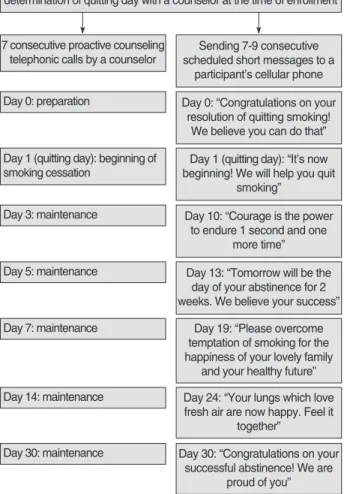
Fig. 2 shows a 30-day smoking cessation program for the proactive Quitline service newly developed for this project;
this consists of 7 consecutive scheduled counseling sessions conducted on day 0 (the day before the appointed quitting day), day 1 (the quitting day), day 3, day 5, day 7, day 14, and day 30. When the scheduled day for this counseling service was a holiday, a participant received a counseling service on the available day, before or after the scheduled day.
This project used the short message service via cellular phones after the participants’ enrollment. The participants themselves decided the counseling days at their conve- nience. All the counseling sessions were conducted in a one- on-one manner over the telephone by 10 trained smoking cessation counselors who had completed a special training program for smoking cessation counseling at Quitline after studying psychology, clinical psychology, the science of public health, or the science of nursing at the university.
Enrollment in the Quitline service center via 18 community health centers
(n=843)
Smoking participants in the Quitline service (n=649)
Population subjects included in the final analysis (n=522): smoking participants who completed 30 days of follow-up at
the end of the study
Not participating (n=194): by reason of a change of mind, being unable to
contact, etc.
Smoking participants who did not complete 30 days of follow-up at the end of the study (n=127): by reason of no response to 3 consecutive telephonic calls at the time of interview, rejection to further counseling, and death or certain
diseases.
Fig. 1. Flowchart for the selection of population subjects included in the final analysis.
Fig. 2. The 30-day smoking cessation program of the proactive Quitline service used in this study.
Enrollment of smoking participants in the Quitline service center and determination of quitting day with a counselor at the time of enrollment
7 consecutive proactive counseling telephonic calls by a counselor
Sending 7-9 consecutive scheduled short messages to a
participant’s cellular phone Day 0: preparation Day 0: “Congratulations on your
resolution of quitting smoking!
We believe you can do that”
Day 1 (quitting day): beginning of smoking cessation
Day 1 (quitting day): “It’s now beginning! We will help you quit
smoking”
Day 3: maintenance Day 10: “Courage is the power to endure 1 second and one
more time”
Day 5: maintenance Day 13: “Tomorrow will be the day of your abstinence for 2 weeks. We believe your success”
Day 7: maintenance Day 19: “Please overcome temptation of smoking for the happiness of your lovely family
and your healthy future”
Day 14: maintenance Day 24: “Your lungs which love fresh air are now happy. Feel it
together”
Day 30: maintenance Day 30: “Congratulations on your successful abstinence! We are
proud of you”
The Quitline services operated from 9 a.m. to 6 p.m. dur- ing weekdays and were closed on Saturdays, Sundays, and holidays.
Short message services were sent via cellular phones to encourage and support the participants’ abstinence as part of the program; this involved sending 7-9 consecutive sched- uled short messages in the following order. ‘‘Congratulations on your resolution of quitting smoking! We believe you can do that’’, on day 0; ‘‘It’s now beginning! We will help you quit smoking’’, on day 1; ‘‘Courage is the power to endure 1 sec and one more time’’, on day 10; ‘‘Tomorrow will be the day of your abstinence for 2 weeks. We believe your success’’, on day 13; ‘‘Please overcome temptation of smoking for the happiness of your lovely family and your healthy future’’, on day 19; ‘‘Your lungs which love fresh air are now happy.
Feel it together’’, on day 24; and ‘‘Congratulations on your successful abstinence! We are proud of you’’, on day 30.
Baseline data collection
Baseline data were collected, including sociodemographic characteristics (sex, age, occupational status, education level, and type of medical security) and smoking-related charac- teristics (cigarette consumption per day, age at smoking ini- tiation, previous quitting attempts, and Fagerstrom Test for Nicotine Dependence [FTND]score) at the time of the first interview by a smoking cessation counselor.
Outcome measures
The main outcome measure was the self-reported contin- uous abstinence rate at 30 days of follow-up. In our study, abstinence at a follow-up interview on day 30 refers to con- tinuous abstinence because the participants were considered to be abstinent only if they reported not having smoked since the preceding counseling session, and only those who were abstinent received the next counseling session. We cal- culated the continuous abstinence rate based on self-reports because biochemical validation is considered uninformative in low-intensity intervention studies such as those on this Quiline service (10, 11). In the intention-to-treat analysis,
‘‘abstinence failure’’ included both ‘‘failure to maintain absti- nence’’ (smoking between days 1 and 30 or refusal to partic- ipate in the program further) and ‘‘loss to follow-up’’ (no response to 3 telephonic calls, refusal to participate in the program on day 0, and inability to participate in the pro- gram due to certain diseases or death). Participants who did not complete 30 days of follow-up at the end of the study were considered to be ‘‘in progress’’ and were excluded while calculating the abstinence rate.
Statistical analyses
We estimated the self-reported continuous abstinence rate
Sex
Male 599 (92.3)
Female 50 (7.7)
Age (yr)
≤19 3 (0.5)
20-29 120 (18.5)
30-39 190 (29.3)
40-49 159 (24.5)
50-59 107 (16.5)
≥60 70 (10.8)
Occupational status
Employed or self-employed 335 (51.6)
Students 37 (5.7)
Housewives 15 (2.3)
Unemployed 106 (16.3)
Others 156 (24.0)
Education level
Middle school or below 89 (13.7)
High school 257 (39.6)
College or above 288 (44.4)
Type of medical security�
Occupational medical insurance 383 (59.0)
Regional medical insurance 227 (35.0)
Medical care 25 (3.9)
Cigarette consumption per day
≤10 122 (18.8)
11-20 323 (49.8)
21-30 126 (19.4)
≥31 71 (10.9)
Age at smoking initiation (yr)
≤13 11 (1.7)
14-16 96 (14.8)
17-19 224 (34.5)
20-24 255 (39.3)
25-29 38 (5.9)
≥30 16 (2.5)
Previous quitting attempt
No 75 (11.9)
Yes 557 (88.1)
Fagerstrom Test for Nicotine Dependence (FTND) score
0-3 (mild) 259 (40.3)
4-6 (moderate) 267 (41.6)
7-10 (severe) 116 (18.1)
Baseline characteristics Number (%)
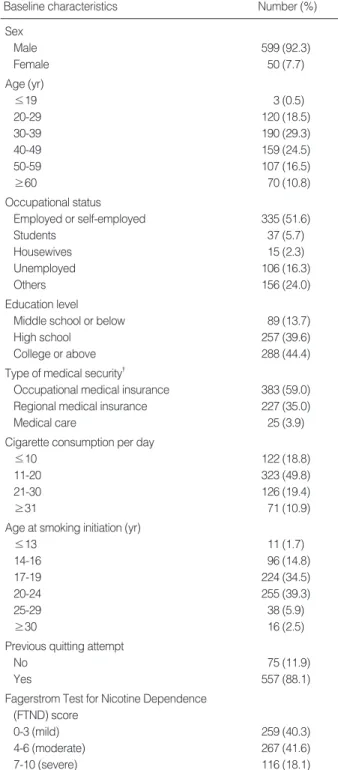
Table 1. Baseline sociodemographic and smoking-related char- acteristics of the smoking participants who utilized the Quitline service for smoking cessation (n=649)*
*Because of rounding off, not all percentages add up to 100. The sum of the participants may be less than 649 due to missing values; �Medi- cal security in Korea is divided into medical insurance and medical care; 97% of the total population has registered occupational (58%) or regional (42%) medical insurance. The remaining 3% who cannot afford insurance are protected and supported by medical care.
after 30 days of follow-up based on both a per-protocol anal- ysis and an intention-to-treat analysis. In the per-protocol analysis, those lost to follow-up who could not be contactable, could not continue the protocol due to a certain disease or death, or rejected their participation on day 0, were exclud- ed from the denominator in calculating an abstinence rate.
In the intention-to-treat analysis, those lost to follow-up were considered to be in ‘‘abstinence failure’’ and included in the denominator in calculating an abstinence rate.
We used Pearson’s chi-square test to identify the predic- tors of successful abstinence in a univariate analysis. Step- wise multiple logistic regression analysis was performed to assess the predictors of abstinence with adjustments for con- founding variables and to estimate ORs and 95% confidence intervals (CIs). All the statistical tests were 2-sided, and p<
0.05 was considered to be statistically significant. We used the Statistical Package for the Social Sciences (SPSS) 12.0 K software for Windows for data analyses.
RESULTS
Baseline characteristics of the smoking participants
Table 1 shows the baseline characteristics of the smoking participants who utilized the Quitline service for smoking cessation. Of the 649 participants, 92.3% were male, 29.3%
were aged 30-39 yr, and 51.6% were employed or self-em- ployed. Eleven participants were aged 13 or below at smok- ing initiation.
Continuous abstinence rate at 30 days of follow-up
Of the 522 smoking participants who completed 30 days of follow-up, 200 (38.5%) were continuously abstinent, 201 (38.3%) failed to maintain abstinence, and 121 (23.2%)
were lost to follow-up. The continuous abstinence rates at 30 days of follow-up were found to be 49.9% (200/401) in the per-protocol analysis and 38.3% (200/522) in the inten- tion-to-treat analysis (Table 2).
Differences in baseline characteristics of quitters and non- quitters as determined by univariate analysis
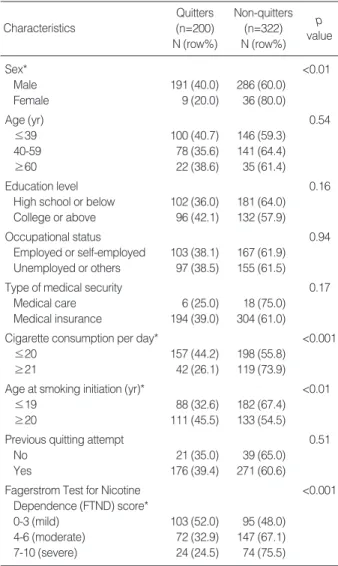
As shown in Table 3, the predictors of successful smoking cessation at 30 days of follow-up as determined by the uni- variate analysis were as follows: male sex; smoking 20 or less cigarettes per day; age, 20 yr or more at smoking initiation;
and low FTND scores. No significant differences in age, education level, occupational status, type of medical securi- ty, and previous quitting attempts were noted between the quitters and non-quitters.
Self-reported smoking status
Smoking (failure to maintain abstinence) 201 (38.5) Not smoking (successful maintenance of 200 (38.3)
abstinence)
Lost to follow-up 121 (23.2)
Continuous abstinence rate at 30 days of follow-up interview
By per-protocol analysis 200/401 (49.9) By intention-to-treat analysis 200/522 (38.3) Number (%) Table 2. Self-reported smoking status and continuous absti- nence rate at 30 days of follow-up interview as determined by per-protocol analysis and intention-to-treat analysis (n=522)*
*Of the 649 participants, we included only 522 in the final analysis, and 127 were excluded because they were considered to be ‘‘in progress’’
in the program, that is, they did not complete 30 days of follow-up at the end of the study.
Sex* <0.01
Male 191 (40.0) 286 (60.0)
Female 9 (20.0) 36 (80.0)
Age (yr) 0.54
≤39 100 (40.7) 146 (59.3)
40-59 78 (35.6) 141 (64.4)
≥60 22 (38.6) 35 (61.4)
Education level 0.16
High school or below 102 (36.0) 181 (64.0) College or above 96 (42.1) 132 (57.9)
Occupational status 0.94
Employed or self-employed 103 (38.1) 167 (61.9) Unemployed or others 97 (38.5) 155 (61.5)
Type of medical security 0.17
Medical care 6 (25.0) 18 (75.0)
Medical insurance 194 (39.0) 304 (61.0)
Cigarette consumption per day* <0.001
≤20 157 (44.2) 198 (55.8)
≥21 42 (26.1) 119 (73.9)
Age at smoking initiation (yr)* <0.01
≤19 88 (32.6) 182 (67.4)
≥20 111 (45.5) 133 (54.5)
Previous quitting attempt 0.51
No 21 (35.0) 39 (65.0)
Yes 176 (39.4) 271 (60.6)
Fagerstrom Test for Nicotine <0.001
Dependence (FTND) score*
0-3 (mild) 103 (52.0) 95 (48.0)
4-6 (moderate) 72 (32.9) 147 (67.1)
7-10 (severe) 24 (24.5) 74 (75.5)
Characteristics
Non-quitters (n=322) N (row%) Quitters
(n=200) N (row%)
p value Table 3. Differences in baseline characteristics of non-quitters and quitters at 30 days of follow-up interview based on inten- tion-to-treat analysis in univariable analysis (n=522)
*Statistically significant: p<0.05.
Predictors of smoking cessation based on stepwise multiple logistic regression analysis
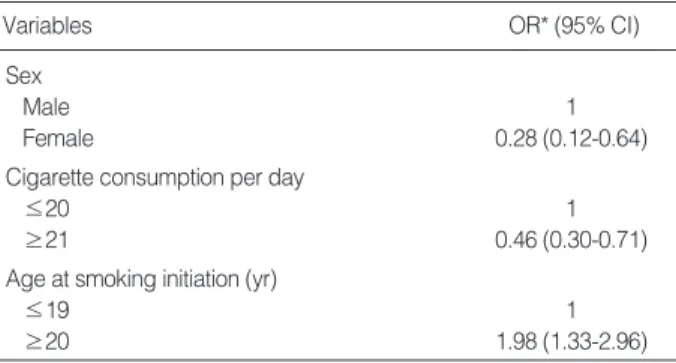
In the stepwise multiple logistic regression analysis, the predictors of smoking cessation at 30 days of follow-up were male sex; smoking 20 or less cigarettes per day; and age, 20 yr or more at smoking initiation, after adjusting for confound- ing factors such as sex, age, education level, occupational status, type of medical security, cigarette consumption per day, age at smoking initiation, and previous quitting attempts (Table 4). The FTND score was excluded in the stepwise multiple logistic regression analysis in order to avoid multi- collinearity between the cigarette consumption per day and the FTND scores. Education level and type of medical secu- rity had no significant association with successful smoking cessation after adjusting for sex and age, an OR of 1.12 (col- lege or above compared with high school or below), 1.42 (medical insurance compared with medical care), respective- ly (not represented in Table).
DISCUSSION
We conducted the preliminary project of Quitline for smoking cessation in Korea, which, to our knowledge, is the second Quitline service operating in the East following the first one in Hong Kong.
The intention-to-treat analysis performed in our study showed that 38.3% of the participants of the Quitline ser- vice were successfully abstinent at 30 days of follow-up. There have been few studies on the Quitline service that have report- ed abstinence rates at 30 days of follow-up. Zhu et al. (3) reported that among participants receiving an average of 3.0 telephone counseling sessions, 23.7% were abstinent at 1 month. Lipkus et al. (12) found that 19.2% participants receiving 2 tailored telephone sessions from health care pro-
viders prompting intervention and tailored print communi- cations were abstinent at 1 month. Miller et al. (13) suggest- ed that point prevalence abstinence at 3 weeks of follow-up was 19% in the Quitline service; however, this period did not equal 30 days of follow-up.
The abstinence rate in our study was slightly higher than those in the previous 2 studies. This finding is mainly asso- ciated with the fact that our telephone counseling protocol consisted of more proactive counseling sessions (7 consecu- tive sessions) than in the previous studies. According to a recent meta-analysis (5) of the effectiveness of telephone counseling for smoking cessation published in The Cochrane Library, 7 trials providing 1 or 2 calls showed no significant effect. In contrast, 19 trials offering between 3 and 6 sessions showed a significant effect (OR, 1.23; 95% CI, 1.23-1.55).
Moreover, proactive counseling has been considered to be more effective in encouraging participants to quit smoking than reactive counseling, as shown previously (5, 6). There- fore, we suggest that the more proactive counseling calls the Quiline service provides, the more effective the service can be because these frequent proactive counseling might not only encourage smoking participants to quit smoking but also motivate them to maintain abstinence. Nevertheless, further analyses regarding this topic will be required in the future.
In addition, the short message service using cellular phones might have contributed to the participants’ successful smok- ing cessation; 7-9 consecutive scheduled short messages were sent in order to encourage and support their abstinence. This short message service using cellular phones as a part of the Quitline service protocol is very unique and can be effective in countries in which Quitline services operate, including Korea, where cellular phones are commonly used. In Korea, there are 83.8 cellular mobile subscribers per 100 inhabitants according to the Information and Communication Technol- ogy Statistics 2006 of the International Telecommunication Union (14).
Another possible explanation for the higher smoking ces- sation rate is thought to be associated with the smokers’ New Year’s resolutions to quit smoking; a New Year was includ- ed in our study periods.
Furthermore, even though our criteria for abstinence were more rigorous than those in previous studies, the abstinence rate in our study was higher than those in previous studies.
In our protocol, participants could progress to the next coun- seling session of a total of 7 sessions only if they were absti- nent during the previous session. This implies that the absti- nence rate at 30 days of follow-up in our study was the con- tinuous abstinence rate over 7 consecutive sessions.
Our study measured the current smoking status without using biochemical validation techniques such as urinary coti- nine concentration or expired carbon monoxide commonly used in smoking cessation-related researches because bio- chemical validation is considered to be uninformative in
Sex
Male 1
Female 0.28 (0.12-0.64)
Cigarette consumption per day
≤20 1
≥21 0.46 (0.30-0.71)
Age at smoking initiation (yr)
≤19 1
≥20 1.98 (1.33-2.96)
OR* (95% CI) Variables
Table 4. Predictors of successful smoking cessation at 30 days of follow-up as determined by the stepwise multiple logistic regression analysis (n=522)
*Adjusted for sex, age, education level, occupational status, type of medical security, cigarette consumption per day, age at smoking initia- tion, and previous quitting attempts.
OR, odds ratio; CI, confidence interval.
low-intensity interventions such as those in the Quitline service (3, 10, 11). Moreover, several previous studies have suggested that self-reported smoking status is considerably accurate (15, 16).
The univariate analysis helped in determining 4 predictors of successful smoking cessation, namely, sex, age at smok- ing initiation, cigarette consumption per day, and the sever- ity of nicotine dependence, which were consistent with those determined in previous studies. Further, previous studies have indicated that the predictors of smoking cessation were as follows: age, sex, cigarette consumption per day, readiness to quit smoking, follow-up time, education level, perceived ease or difficulty in quitting, presence of smokers at home, helpful support during quitting, previous history of absti- nence, use of clinical help and/or nicotine replacement ther- apy (6-9). No differences were noted in the predictors of smoking cessation between the results of the univariate and the multiple logistic regression analyses because we exclud- ed the variable FTND score in the final analysis in order to avoid multicollinearity with the cigarette consumption per day. The final predictors of successful smoking cessation were male sex; smoking 20 or less cigarettes per day; age, 20 yr or more at smoking initiation, in the stepwise multiple logis- tic regression analysis adjusted for possible independent vari- ables.
Nonetheless, there are several limitations of this study.
First, the effectiveness of this preliminary Quitline service is limited to the short term. A long-term study will be required because the effectiveness of the interventions for smoking cessation tends to decrease as the follow-up time increases.
Second, of a total of 522 participants, 23.2% were lost to follow-up. Most of them were those who did not respond to 3 consecutive telephonic calls at the time of a counseling session. Non-responders were considered to have resumed smoking; however, further evaluation of the reason for not responding is required. Third, the proportion of female par- ticipants was extremely low. However, this can be explained by sex differences in the smoking prevalence in Korea. Accord- ing to the reports of the Korean Association of Smoking and Health conducted in December 2006, the smoking preva- lence was 44.1% among Korean men, but only 2.3% among Korean women. Fourth, we did not explore other possible motivations and various social supports as factors for suc- cessful smoking cessation. Fifth, our study had no control group. Finally, our study had a potential selection bias due to the enrollment from community health centers, not from the general population. Furthermore, 194 of 843 enrollees did not participate in this Quitline service by reasons of mind change, being unable to contact, etc. It might be another explanation associated with a possible selection bias that attitudes toward the study protocol and Quitline service were different for those 194 persons. Further studies with a control group would be needed in order to investigate the evident effectiveness of the Quitline service.
In conclusion, we investigated the short-term effective- ness of the Quitline service and determined the predictors of successful smoking cessation. Further studies with longer follow-up periods should be conducted to determine the effec- tiveness and usefulness of the Quitline service.
ACKNOWLEDGMENTS
We thank many people who supported and helped this study; the Ministry of Health and Welfare, the Government of Korea; Tae Min Song, Doctor of Engineering, Korean Institute for Health and Social Affairs; Cheol Whan Kim, M.D., Ph.D., Inje University College of Medicine; Hyung Joon Jhun, M.D., Ph.D., Department of Occupational and Environmental Medicine, Korea University Ansan Hospi- tal; Eun Ha Lee, Chief, Counseling Team of the Quitline Center; and the 10 smoking cessation counselors.
REFERENCES
1. Owen L. Impact of a telephone helpline for smokers who called dur- ing a mass media campaign. Tob Control 2000; 9: 148-54.
2. Platt S, Tannahill A, Watson J, Fraser E. Effectiveness of antismok- ing telephone helpline: follow up survey. BMJ 1997; 314: 1371-5.
3. Zhu SH, Anderson CM, Tedeschi GJ, Rosbrook B, Johnson CE, Byrd M, Gutierrez-Terrell E. Evidence of real-world effectiveness of a telephone quitline for smokers. N Engl J Med 2002; 347: 1087-93.
4. An LC, Zhu SH, Nelson DB, Arikian NJ, Nugent S, Partin MR, Joseph AM. Benefits of telephone care over primary care for smoking ces- sation: a randomized trial. Arch Intern Med 2006; 166: 536-42.
5. Stead LF, Perera R, Lancaster T. Telephone counseling for smoking cessation. Cochrane Database Syst Rev 2006; 3: CD002850.
6. Pan W. Proactive telephone counseling as an adjunct to minimal intervention to for smoking cessation: a meta-analysis. Health Educ Res 2006; 21: 416-27.
7. Jaen CR, Cummings KM, Zielezny M, O’Shea R. Patterns and pre- dictors of smoking cessation among users of a telephone hotline.
Public Health Rep 1993; 108: 772-8.
8. Balanda KP, Lowe JB, O’Connor-Fleming ML. Comparison of two self-help smoking cessation booklets. Tob Control 1999; 8: 57-61.
9. Abdullah AS, Lam TH, Chan SS, Hedley AJ. Which smokers use the smoking cessation Quitline in Hong Kong, and how effective is the Quitline? Tob Control 2004; 13: 415-21.
10. Velicer WF, Prochaska JO, Rossi JS, Snow MG. Assessing outcome in smoking cessation studies. Psychol Bull 1992; 111: 23-41.
11. SRNT Subcommittee on Biochemical Verification. Biochemical ver- ification of tobacco use and cessation. Nicotine Tob Res 2002; 4:
149-59.
12. Lipkus IM, Lyna PR, Rimer BK. Using tailored interventions to enhance smoking cessation among African-Americans at a commu- nity health center. Nicotine Tob Res 1999; 1: 77-85.
13. Miller CL, Wakefield M, Roberts L. Uptake and effectiveness of the
Australian telephone Quitline service in the context of a mass media campaign. Tob Control 2003; 12 (Suppl 2): ii53-8.
14. International Telecommunication Union. ITU ICT Eye: ICT Statis- tics 2006. Available at: www.itu.int/ITU-D/icteye/DisplayCountry.
aspx?code=KOR.
15. Glasgow RE, Mullooly JP, Vogt TM, Stevens VJ, Lichtenstein E,
Hollis JF, Lando HA, Severson HH, Pearson KA, Vogt MR. Bio- chemical validation of smoking status: pros, cons, and data from four low-intensity intervention trials. Addict Behav 1993; 18: 511-27.
16. Patrick DL, Cheadle A, Thompson DC, Diehr P, Koepsell T, Kinne S. The validity of self-reported smoking; a review and meta-analy- sis. Am J Public Health 1994; 84: 1086-93.