서 론
심혈관 질환(
cardiovascular disease
,CVD
)은 많은 나라에서 주요 질환 및 사망 원인으로 분류된다.2009
년도 미국 사망자료를 분석 한 결과, 매일2
,150
여명의 미국인이CVD
로 사망하며, 이는2009
년 미국 성인 사망률 중 약34
%를 차지했다.1) 우리나라도2013
년도 총사망자
23
,260
명 중CVD
사망자 수가5
,209
명, 약22
.4
%로2
위를 차 지했다. 아울러 인구 고령화 및 서구화된 생활 방식으로CVD
의 발 생률과 유병률은 계속 증가될 것으로 예상된다.2) 이에 따라 이를 치 료하기 위한 경피적 관상동맥 확장술과 스텐트 삽입술, 관상동맥 우 회술 등의 시술과 수술도 매년 급증하고 있다. 특히CVD
사망률의68
% 이상을 차지하고 있는 허혈성 심질환의 경우, 치료 후6
개월에Received July 20, 2020 Revised November 10, 2020 Accepted November 22, 2020
Corresponding author Jung-Min Ahn Tel: +82-2-3010-3995, Fax: +82-2-475-6898 E-mail: [email protected]
ORCID: https://orcid.org/0000-0003-4031-391X
*본 논문은 1저자 정민영의 석사 학위 논문을 수정, 보완한 것입니다.
Copyright © 2020 The Korean Academy of Family Medicine
This is an open-access article distributed under the terms of the Creative Commons At- tribution Non-Commercial License (http://creativecommons.org/licenses/by-nc/4.0) which permits unrestricted noncommercial use, distribution, and reproduction in any medium, provided the original work is properly cited.
Original Article
https://doi.org/10.21215/kjfp.2020.10.6.448 eISSN 2233-9116
Korean J Fam Pract. 2020;10(6):448-455
Korean Journal of Family Practice
KJFP
심장 재활 프로그램 참여 횟수와 재활 효과의 상관 관계 분석
정민영
1, 최혜란
2, 안정민
3,*
1울산대학교 의과대학 서울아산병원 알레르기내과학교실, 2울산대학교 의과대학 임상전문간호학교실, 3울산대학교 의과대학 서울아산병원 심장내과학교실
The Correlations between the Number of Cardiac Rehabilitation Program Participation and Its Effects
Min-Young Jung1, Hye-Ran Choi2, Jung-Min Ahn3,*
1Department of Allergy and Clinical Immunology, Asan Medical Center, University of Ulsan College of Medicine; 2Department of Clinical Nursing, University of Ulsan College of Medicine; 3Department of Cardiology, Asan Medical Center, University of Ulsan College of Medicine, Seoul, Korea
Background: There is no previous study analyzing the direct relationship between the number of cardiac rehabilitation programs (CRP) attended and their effect.
Methods: We reviewed the data of 144 patients with cardiovascular disease who participated in CRPs and completed the pre- and post-program evaluation. We collected data on the blood pressure (BP), body composition, maximum consumption of oxygen (VO2 max) by exercise test, and serum lipid levels. We compared the results of the pre- and post-program variables and analyzed correlations between the program participation number and the differences in the pre- and post-program data. Then, we performed subgroup analysis based on the program participation number (1–3, 4–10, 11–15, 16 and more).
Results: All data significantly differed after the program, except for the VO2 max and triglyceride level. On correlation analysis, pre-post changes in body weight (BW), body mass index (BMI), body fat mass (BFM), and body fat percentage (BFP) showed a significant negative correlation with the program participation number. In the subgroup analysis, systolic blood pressure (SBP) and pulse rate (PR) significantly decreased in the first group.
Body muscle mass increased while BFM, BFP, total cholesterol, and low-density lipoprotein cholesterol levels decreased in the second group. PR, BW BMI, BFM, and BFP decreased in the third group. SBP, PR, BFM, and BFP decreased and high-density lipoprotein cholesterol levels increased in the fourth group.
Conclusion: There are significant differences in cardiovascular risk factors after CRP. In addition, the participation number of CRPs shows significant correlation with its effects.
Keywords: Cardiac Rehabilitation; Cardiovascular Diseases; Correlation of Data; Body Composition; Cholesterol; Exercise Test
정민영 외. 심장 재활 프로그램 참여 횟수와 효과의 관계 Korean Journal of Family Practice
KJFP
서
3
년 이내에 재발 및 사망률이15
%–22
%이며,3) 심근경색이 재발한 경우 사망률이60
%–85
%로 더욱 증가한다. 따라서CVD
재발을 감 소시키는 것이 전체 사망률 감소와 비용-
효과 측면에 있어 매우 중 요하다.CVD
위험요소는 연령, 고혈압, 당뇨병, 비만, 흡연, 이상지질혈증, 운동부족 및 비활동적 생활 습관, 가족력 등이 있으며,4) 이 중CVD
재발을 줄일 수 있는 가장 중요한 요소는 생활 습관 교정(life style modification
,LSM
)으로 알려져 있다. 하지만, 시술과 약물 처방을 중 시하는 병원 시스템상LSM
은 등한시 되어온 경우가 많았다. 다행히 최근 의료인들도LSM
의 중요성을 깨닫고 많은 관련 연구들을 진행 하였으며, 이러한 연구들을 통해 심장 재활 프로그램(cardiac rehabilitation program
,CRP
)이 탄생하였다.CRP
는 의학적으로 관리되는 운동 프로그램을 중심으로 하며, 고 혈압, 당뇨병, 이상지질혈증의 조절, 금연 교육, 영양학적 상담 및 식 이요법 교육, 심리사회적 상담 등으로 이루어진 다학제간 접근 프로 그램5-7)으로, 관상동맥 우회 수술을 받은 환자의10
년 사망률을46
% 감소시켰고,8) 심혈관 조영술을 받은 심근경색 환자의 사망률 또한 유의미하게 감소시켰다.9) 또한 운동능력, 이상지질혈증, 비만, 우울 감 및 불안감을 호전시켰다는 연구결과도 있다.10) 더불어CRP
를 완 료한 환자들이 완료하지 않거나 참여하지 않은 환자들에 비해 사망 률이나 재입원율이 낮았다는 전향적 연구 결과들도 있다.11,12)하지만
CRP
참여 유무나 완료 여부에 따른 효과를 연구한 결과 들은 있으나, 아직까지 참여 횟수와 효과의 상관 관계를 조사한 확 인한 연구는 없었다. 이에 본 연구는CVD
환자에서CRP
참여 및 참여 횟수와 심장 재활 효과 간의 연관성에 대하여 조사하였다.방 법
1. 연구 대상 및 방법
본 연구는 후향적 관찰 연구로,
2009
년1
월부터2015
년4
월까지 일개 대학병원의CRP
에 참여한 만20
세 이상의 환자 중, 프로그램 전후로 운동 부하 검사(cardiopulmonary exercise test
,CET
), 체성분 분석(body composition analysis
,BCA
), 혈액검사, 혈압 및 맥박 측정 을 완료한144
명을 연구 대상으로 선정하였다.CET
는treadmill
을 이용하여 마스크를 착용한 상태로breath by breath
방법을 적용하여 최대 산소 섭취량(VO
2max
)을 측정하였고, 자동 혈압 및 맥박 측정기로 운동 중 혈압과 맥박을 측정하였다.CET
는 운동 장애의 조기 진단 및 환자의 심폐 예비 능력을 측정할 수 있는 유용한 방법이다.13)CET
로 측정된VO
2max
는 운동 능력 (metabolic equivalent of task
,MET
)으로 나타낸다. 즉, 안정 시VO
₂는3
.5 mL
/kg
/min
이며, 이를1 MET
의 운동 강도로 표기한다.CET
상1 MET
증가는 약11
%–18
%의CVD
사망률 감소 효과를 보여 강력한 예후인자 중 하나로 보고되었다.14,15)BCA
는8
시간 이상의 공복 상태에서Inbody 7
.20 Body Composi- tion Analyzer
(Biospace
,Seoul
,Korea
) 기계를 통해 생체 전기 저항 측 정법(bioimpedance analysis
)으로 분석하였다. 연구 대상자는 퇴원 후2
주에서4
주 이내 이 기계를 통해 체중, 체질량지수(body mass index
,BMI
), 근육량, 체지방량, 체지방률을CRP
시행 전 측정하였 고,12
주 후 같은 방법으로 분석하였다. 혈액 검사는8
시간 이상의 공복 상태에서 아침 정맥혈을 채혈하여 분석하였으며, 연구 병원의 진단검사의학과에서 시행하였다. 채혈은 퇴원 후2
주에서4
주 이내 에 심장 재활 프로그램을 시작하기 전, 그리고12
주 후에 시행되었 으며, 총 콜레스테롤(total cholesterol
,TC
), 중성 지방(triglyceride
,TG
), 저밀도 지단백 콜레스테롤(low density lipoprotein cholesterol
,LDL-C
), 고밀도 지단백 콜레스테롤(high density lipoprotein cholesterol
,HDL-C
)을 측정하였다. 혈압은 대상자가 혈압측정 전 적 어도5
분 간 등받이가 있는 의자에 앉아 다리는 꼬지 않고 발은 바 닥에 닿으며 팔은 심장 높이에 위치하도록 편한 자세로 하고 카페인 이나, 운동, 흡연 등 혈압에 변화를 줄 수 있는 요인들을 적어도 혈 압측정30
분 전에 중지하도록 하고 소변이 마렵지 않은 상태에서 전 자식 자동 혈압계를 이용하여 측정하였다.2. CRP
연구 대상 병원은
CVD
로 입원하여 심혈관 조영술을 시행 받은 모든 입원 환자에게 퇴원 전 교육을 시행하고 있으며, 교육을 받은 후CRP
참여 여부를 환자가 결정하도록 하고 있다. 프로그램의 종 류는12
주를 기준으로36
회(A type
),12
회(B type
),3
회(C type
),1
회(D type
)로 분류되어 있다. 퇴원 후 프로그램 시작하기 전에CET
,BCA
, 혈액 검사, 안정 시 혈압과 맥박을 측정하게 되고12
주 후 이를 다시 측정한다. 그러나 실제 환자들은 퇴원 시 처방한 횟수를 모두 완료 하지 못하거나, 추가로 프로그램을 처방 받아 처음 계획보다 더 많 이 수행한 경우도 있었다. 따라서 심장 재활의 효과를 타입별로 나 누어 비교하지 않고, 실제 참여 횟수를 기준으로 비교하였다.대상자들은 퇴원 후
2
주 간의 안정기가 지나고,2
주에서4
주 사이 에CRP
를 시작하도록 하였다.CRP
는1
회 참여 시 환자의 기저질환 확인 및 식습관 교정을 위한 영양상담20
분을 시행하고, 미리CET
를 통해 안정 시 맥박, 운동 시 최대 맥박, 운동 지속시간과 최대 운 동량을 측정한 후 운동 처방을 받아 그에 따른 준비운동, 본 운동 (걷기, 자전거 등의 유산소 운동, 스트레칭, 근력운동 포함), 마무리 운동을 포함하며 총60
분 간의 운동 치료가 진행된다. 그 후 환자에Original Article
Korean Journal of Family Practice
Min-Young Jung, et al. Cardiac Rehabilitation Program Participation Number and Its Effects
Korean Journal of Family Practice
KJFP
맞게 금연 교육과
LSM
및 심리사회적 상담, 심장 재활에 대한 상담 을40
분 시행하여, 회당120
분씩 진행하였다.추가 분석 시 대상자들을 참여 횟수별로
4
개의 군으로 나누어 분 석하였는데, 기본적으로 한 군당36
명씩을 기준으로 같은 참여 횟 수의 참여자들은 하나의 군으로 묶었다. 첫번째 그룹은46
명,1
회에 서3
회까지 참여자들이며 평균 참여 횟수는2
.7
회였다. 두번째 그룹 은30
명,4
회에서10
회까지 참여한 군이며 평균 참여 횟수는7
.1
회였 다. 세번째 그룹은11
회에서15
회까지의 참여자들로33
명이며 평균 참여 횟수는12
.2
회였다. 네번째 그룹은16
회에서46
회까지의 참여 자35
명이며 평균 참여 횟수는25
.8
회였다.3. 통계 및 연구 윤리
연구 대상자들의 일반적 특성 및 의학적 특성은 기술 통계 및 빈 도 분석을 통하여 분석하였다.
CRP
가CVD
환자의CET
결과,BCA
및 혈액학적 지표에 미치는 효과는paired t-test
로 참여 전과 후를 분 석하였다.CRP
참여 횟수에 따른 환자의CET
결과,BCA
및 혈액학 적 지표에 미치는 개선 정도를 검증하기 위하여 프로그램 참여 횟 수와 전후 결과 변화(프로그램 후 결과에서 전 결과를 뺀 값)의 상 관관계를 산점도와Spearman
’s correlation coefficient
를 통해서 분석 하였다. 이후 대상자들을 참여 횟수에 따라4
개의 군으로 나누어, 기술 통계 분석 및paired t-test
로 전후 비교 분석을 시행하였다. 자 료 분석은IBM SPSS Statistics 22
(IBM Co
.,Armonk
,NY
,USA
)을 이 용하였다. 모든 통계 분석은P<0
.05
일 때 통계적으로 유의한 것으로 간주하였다. 본 연구는 연구 대학 병원의 임상연구심의위원회(IRB
) 의 승인을 받아 이루어졌다(IRB
과제번호:2015-0379
).결 과
1. 연구 대상자의 일반적 특성
연구 대상자
144
명의 평균 나이는63
.4
세였고, 남성의 비율이79
.9
%였다. 평균 프로그램 참여 횟수는 약11
.4
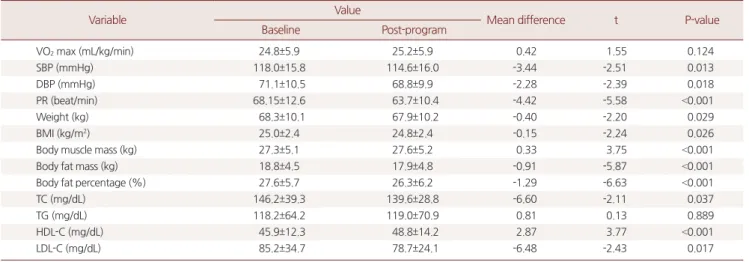
회였다(Table 1
).2. CRP 전후 결과 비교
전후 비교 결과,
VO
2max
및TG
는 둘 다 참여 후 약간 증가하였 으나 통계적으로 유의미한 차이를 보이지 않았다(P=0
.124
,P=0
.889
).반면 수축기 혈압(
P=0
.013
), 이완기 혈압(P=0
.018
), 맥박(P<0
.001
), 체 중(P=0
.029
),BMI
(P=0
.026
), 체지방량(P<0
.001
), 체지방률(P<0
.001
),TC
(P=0
.037
),LDL-C
(P=0
.017
)은 유의미하게 감소하였으며, 근육량 (P<0
.001
) 및HDL-C
(P<0
.001
)는 유의미한 증가를 보였다(Table 2
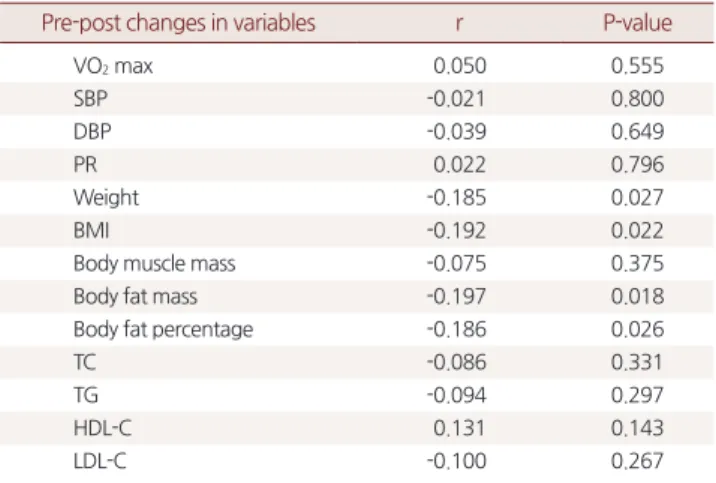
).3. CRP 참여 횟수와 전후 결과 변화의 상관관계 분석
분석 결과 체중(
r=-0
.185
,P=0
.027
),BMI
(r=-0
.192
,P=0
.022
), 체지Table 1. Baseline characteristics of study subjects (n=144)
Variable Value
Age (y) 63.4±10.0
Sex (male) 115 (79.9)
Number of program participation 11.4±9.6
Hypertension 57 (39.6)
Diabetes mellitus 31 (21.5)
Smoking history 59 (41.0)
Alcohol history 57 (39.6)
Values are presented as mean±standard deviation or number (%).
Table 2. Comparison of variables between baseline and post-program (n=144)
Variable Value
Mean difference t P-value
Baseline Post-program
VO2 max (mL/kg/min) 24.8±5.9 25.2±5.9 0.42 1.55 0.124
SBP (mmHg) 118.0±15.8 114.6±16.0 -3.44 -2.51 0.013
DBP (mmHg) 71.1±10.5 68.8±9.9 -2.28 -2.39 0.018
PR (beat/min) 68.15±12.6 63.7±10.4 -4.42 -5.58 <0.001
Weight (kg) 68.3±10.1 67.9±10.2 -0.40 -2.20 0.029
BMI (kg/m2) 25.0±2.4 24.8±2.4 -0.15 -2.24 0.026
Body muscle mass (kg) 27.3±5.1 27.6±5.2 0.33 3.75 <0.001
Body fat mass (kg) 18.8±4.5 17.9±4.8 -0.91 -5.87 <0.001
Body fat percentage (%) 27.6±5.7 26.3±6.2 -1.29 -6.63 <0.001
TC (mg/dL) 146.2±39.3 139.6±28.8 -6.60 -2.11 0.037
TG (mg/dL) 118.2±64.2 119.0±70.9 0.81 0.13 0.889
HDL-C (mg/dL) 45.9±12.3 48.8±14.2 2.87 3.77 <0.001
LDL-C (mg/dL) 85.2±34.7 78.7±24.1 -6.48 -2.43 0.017
Values are presented as mean±standard deviation.
VO2 max, maximal oxygen consumption; SBP, systolic blood pressure; DBP, diastolic blood pressure; PR, pulse rate; BMI, body mass index; TC, total cholesterol; TG, tri- glyceride; HDL-C, high-density lipoprotein cholesterol; LDL-C, low-density lipoprotein cholesterol.
P-values are from paired t-test.
정민영 외. 심장 재활 프로그램 참여 횟수와 효과의 관계 Korean Journal of Family Practice
KJFP
방량(
r=-0
.197
,P=0
.018
), 체지방률(r=-0
.186
,P=0
.026
)의 변화가 참여 횟수와 유의미한 음의 상관관계를 보였다(Table 3
). 즉, 참여 횟수가 증가할수록 체중,BMI
, 체지방량, 체지방률이 더 많이 감소하였다 (Figure 1
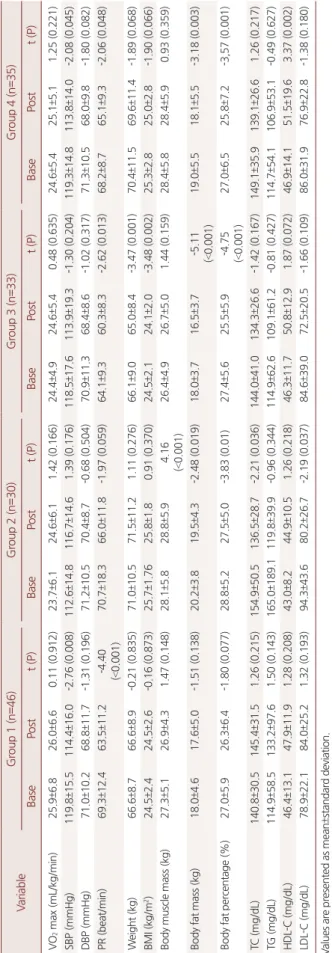
).4. 참여 횟수별로 4개의 군으로 나눠서 시행한 분석 결과
3
회 이하의 참여자들은 수축기 혈압(P=0
.008
) 및 맥박(P<0
.001
)이 감소한 것 외에 유의미한 전후 차이가 없었으나,4
회에서10
회까지의 두 번째 그룹에서는 근육량이 증가(P<0
.001
)하고 체지방량과 체지방 률이 감소(P=0
.019
,P=0
.001
)하며TC
와LDL-C
이 감소(P=0
.036
,P=0
.037
)하였다. 세번째 그룹에서는 맥박, 체중, 체질량지수, 체지방 량, 체지방률이 감소(P=0
.013
,P=0
.001
,P=0
.002
,P<0
.001
,P<0
.001
)하 였고, 네번째 그룹에서는 수축기 혈압, 맥박, 체지방량, 체지방률이 감소(P=0
.045
,P=0
.048
,P=0
.003
,P=0
.001
)하고HDL-C
이 증가(P=0
.002
) 하였다(Table 4
).Table 3. Correlations between the number of program participation and pre-post changes in variables (n=144)
Pre-post changes in variables r P-value
VO2 max 0.050 0.555
SBP -0.021 0.800
DBP -0.039 0.649
PR 0.022 0.796
Weight -0.185 0.027
BMI -0.192 0.022
Body muscle mass -0.075 0.375
Body fat mass -0.197 0.018
Body fat percentage -0.186 0.026
TC -0.086 0.331
TG -0.094 0.297
HDL-C 0.131 0.143
LDL-C -0.100 0.267
VO2 max, maximal oxygen consumption; SBP, systolic blood pressure; DBP, dia- stolic blood pressure; PR, pulse rate; BMI, body mass index; TC, total cholesterol;
TG, triglyceride; HDL-C, high-density lipoprotein cholesterol; LDL-C, low-density lipoprotein cholesterol.
Pre-post changes are calculated from postprogram results - preprogram results.
r and P-values are from Spearman’s correlation coefficient.
Figure 1. Scatter plots between the number of program participation and pre-post changes in variables. *Pre-post changes are calculated from postprogram results - preprogram results.
y=-0.66-0.02*x
0 10 20 30 40
5.00
2.50
.00 -2.50
-5.00
50
Weightchange(kg)
Program participation (number) Weight
y=-6.94E-3-0.03*x
0 10 20 30 40
2.50
.00
-2.50
-5.00
-7.50
50
Bodyfatmasschange(kg)
Program participation (number) Body fat mass
y=-1.06-0.02*x
0 10 20 30 40
4.00
2.00
.00
-2.00
-4.00
50
BMIchanges(kg/m)2
Program participation (number) Body mass index (BMI)
y=-4.8E-3-0.01*x
0 10 20 30 40
2.50 .00 -2.50 -5.00 -7.50
-10.00
50
Bodyfatpercentagechange(%)
Program participation (number) Body fat percentage
A B
C D
Min-Young Jung, et al. Cardiac Rehabilitation Program Participation Number and Its Effects
Korean Journal of Family Practice
KJFP
Table 4. Comparison of baseline and post-program variables in four subgroups (n=144) VariableGroup 1 (n=46)Group 2 (n=30)Group 3 (n=33)Group 4 (n=35) BasePostt (P)BasePostt (P)BasePostt (P)BasePostt (P) VO2 max (mL/kg/min)25.9±6.826.0±6.60.11 (0.912)23.7±6.124.6±6.11.42 (0.166)24.4±4.924.6±5.40.48 (0.635)24.6±5.425.1±5.11.25 (0.221) SBP (mmHg)119.8±15.5114.4±16.0-2.76 (0.008)112.6±14.8116.7±14.61.39 (0.176)118.5±17.6113.9±19.3-1.30 (0.204)119.3±14.8113.8±14.0-2.08 (0.045) DBP (mmHg)71.0±10.268.8±11.7-1.31 (0.196)71.2±10.570.4±8.7-0.68 (0.504)70.9±11.368.4±8.6-1.02 (0.317)71.3±10.568.0±9.8-1.80 (0.082) PR (beat/min)69.3±12.463.5±11.2-4.40 (<0.001)70.7±18.366.0±11.8-1.97 (0.059)64.1±9.360.3±8.3-2.62 (0.013)68.2±8.765.1±9.3-2.06 (0.048) Weight (kg)66.6±8.766.6±8.9-0.21 (0.835)71.0±10.571.5±11.21.11 (0.276)66.1±9.065.0±8.4-3.47 (0.001)70.4±11.569.6±11.4-1.89 (0.068) BMI (kg/m2)24.5±2.424.5±2.6-0.16 (0.873)25.7±1.7625.8±1.80.91 (0.370)24.5±2.124.1±2.0-3.48 (0.002)25.3±2.825.0±2.8-1.90 (0.066) Body muscle mass (kg)27.3±5.126.9±4.31.47 (0.148)28.1±5.828.8±5.94.16 (<0.001)26.4±4.926.7±5.01.44 (0.159)28.4±5.828.4±5.90.93 (0.359) Body fat mass (kg)18.0±4.617.6±5.0-1.51 (0.138)20.2±3.819.5±4.3-2.48 (0.019)18.0±3.716.5±3.7-5.11 (<0.001)19.0±5.518.1±5.5-3.18 (0.003) Body fat percentage (%)27.0±5.926.3±6.4-1.80 (0.077)28.8±5.227.5±5.0-3.83 (0.01)27.4±5.625.5±5.9-4.75 (<0.001)27.0±6.525.8±7.2-3,57 (0.001) TC (mg/dL)140.8±30.5145.4±31.51.26 (0.215)154.9±50.5136.5±28.7-2.21 (0.036)144.0±41.0134.3±26.6-1.42 (0.167)149.1±35.9139.1±26.61.26 (0.217) TG (mg/dL)114.9±58.5133.2±97.61.50 (0.143)165.0±189.1119.8±39.9-0.96 (0.344)114.9±62.6109.1±61.2-0.81 (0.427)114.7±54.1106.9±53.1-0.49 (0.627) HDL-C (mg/dL)46.4±13.147.9±11.91.28 (0.208)43.0±8.244.9±10.51.26 (0.218)46.3±11.750.8±12.91.87 (0.072)46.9±14.151.5±19.63.37 (0.002) LDL-C (mg/dL)78.9±22.184.0±25.21.32 (0.193)94.3±43.680.2±26.7-2.19 (0.037)84.6±39.072.5±20.5-1.66 (0.109)86.0±31.976.9±22.8-1.38 (0.180) Values are presented as mean±standard deviation. VO2 max, maximal oxygen consumption; SBP, systolic blood pressure; DBP, diastolic blood pressure; PR, pulse rate; BMI, body mass index; TC, total cholesterol; TG, triglyceride; HDL-C, high-density lipoprotein choles- terol; LDL-C, low-density lipoprotein cholesterol. The range and mean of participation number of subgroups: 1–3 (2.7) in group 1, 4–10 (7.1) in group 2, 11–15 (12.2) in group 3, 16–46 (25.8) in group 4. P-values are from paired t-test.
정민영 외. 심장 재활 프로그램 참여 횟수와 효과의 관계 Korean Journal of Family Practice
KJFP
고 찰
본 연구는
CVD
로 입원 치료 후 퇴원하여CRP
에 참여한 환자들 을 대상으로, 참여 전후의 운동 능력, 체성분 및 혈액학적 지표, 안 정 시 혈압과 맥박의 변화를 보고자 시행되었다. 또한, 프로그램 참 여 횟수와 이러한 재활 효과들이 유의미한 상관관계가 있는지 확인 해 보고자 하였다. 연구 결과,CRP
참여자들의 수축기 및 이완기 혈 압, 맥박, 체중 및BMI
, 체지방량과 체지방률,TC
와LDL-C
은 유의 미하게 감소하고, 근육량과HDL-C
은 유의미하게 상승하였다. 또한, 프로그램 참여 횟수가 증가할수록 체중과BMI
, 체지방량과 체지방 률이 유의미하게 감소하였다. 그리고subgroup analysis
에서도 참여 횟수가 증가할수록 더 많은 위험요소들이 교정되는 것이 확인되었 다.이는 기존에 알려진
CRP
의 효과를 재확인한 결과라고 할 수 있 다. 혈압, 맥박, 체중 및BMI
, 체지방량과 체지방률,TC
와LDL-C
의 감소 및 근육량과HDL-C
의 상승은 대상자들의 삶의 질을 높이고CVD
재발을 막는데 중요한 요소들이며, 이전 연구 결과와도 일치 한다.10,16-18)이미
CRP
의 효과가 잘 증명되어 있지만,CRP
에 의뢰되거나 실제 참여하는CVD
환자의 비율은 높지 않을 것으로 생각된다. 캐나다Ontario
주에서2011
년 및2012
년에 실시한 연구결과CRP
의 적응증 이 되는3
,739
명 중51
.8
%가 의뢰되었으며,19) 미국의 경우30
% 이내 의 환자만이CRP
에 참여한다는 보고가 있다.20) 또한 일본은CRP
참여율이 전국적으로4
%–8
% 밖에 되지 않는다는 결과가 있다.21) 아 직CRP
의뢰율에 대한 체계적인 국내 연구 결과는 없으나, 일본과 비슷한 정도일 것으로 생각된다. 본 연구 결과를 통해CRP
의 효과 를 재확인함과 더불어, 국내CVD
환자들에게 적극적인CRP
참여 를 독려하는 근거가 될 수 있을 것이다.또 본 연구는
12
주 간의CRP
참여 기간 동안 참여 횟수가 증가할 수록 체중과BMI
, 체지방량과 체지방률이 감소한다는 것을 확인한 첫 연구로서, 기존의 연구들은 주로CRP
참여 여부에 중점을 두었 으나,8) 본 연구를 통해 참여 여부뿐만 아니라 참여 횟수에도 신경을 써야 함을 확인하였다. 그 동안CRP
의 효과, 특히 사망률 변화나 혈 액 검사의 변화를 본 연구 역시 대부분 참여자와 비참여자를 비교 하여 얻어진 결과들이거나 참여 전후를 비교하여 확인된 것들이었 다.8,9) 그나마 최근 연구 중 프로그램 완료자와 비완료자를 비교하거 나, 횟수별로 그룹을 나눠 그 효과를 비교한 연구는 있었으나, 상관 관계까지 분석하지는 않았다.11,12) 하지만 본 연구의 경우12
주 이내 에 프로그램 참여 횟수와 체중, 체지방량이 유의미한 음의 상관관 계가 있음을 밝혀, 참여자들에게 더 적극적인 참여를 권장할 수 있는 이론적 근거가 될 수 있을 것이다. 그러나 환자 상태에 따른 적절 한 참여 강도를 정하기 위해서는 추가적인 연구가 필요할 것으로 보 인다.
본 연구에서 이전 연구 결과10,18)와는 다르게
CRP
참여 전후의VO
2max
는 약간 증가하긴 하였으나 유의미한 차이를 보이지 않았 는데,VO
2max
의 유의미한 변화를 보기 위해서는12
주 이상의 기간 이 필요하기 때문인 것으로 생각된다. 또한TG
도 참여 전후로 유의 미한 차이를 보이지 않았는데,TG
는 운동보다는 식이, 특히 검사 전1–2
일간의 식이의 영향을 많이 받아 유의미한 차이를 보이지 않았 을 것으로 생각된다.본 연구는 후향적 관찰연구이므로 명확한 인과관계를 규명할 수 없는 것이 약점이다. 또한 나이, 성별, 기저질환, 운동 종류 및 강도, 처방 약물의 변화 등 다양한 변수들을 교정하지 못한 한계점이 있 어 결과 해석에 주의를 요한다. 그러나
CRP
참여 횟수와 재활 효과 간의 상관관계를 분석하여 유의미한 결과를 확인한 첫 연구라는 점, 그리고VO
2max
라는 객관적이면서 측정하기 어려운 변수를 활 용했다는 것은 강점이다.결론적으로, 본 연구는
CRP
가 참여자의 수축기 및 이완기 혈압, 맥박, 체중 및BMI
, 체지방량과 체지방률,TC
와LDL-C
을 유의미하 게 감소시키고, 근육량과HDL-C
은 유의미하게 증가시키는 것을 확 인하였고,12
주의 기간 안에서 참여 횟수가 증가할수록 체중과BMI
, 체지방량과 체지방률이 더 많이 감소하는 것을 확인하였다.추후
CRP
참여 강도와 재활 효과에 대한 대규모의 전향적 연구가 필요할 것으로 보이며, 특히 환자 상태에 따라 적절한 참여 강도를 정하는데 참고가 될 만한 연구가 필요할 것으로 보인다. 아울러 심 질환 환자들에게 더 적극적으로CRP
참여를 독려해야 할 것이며, 현재CRP
에 참여하고 있는 환자들도 적절한 참여 횟수를 유지하도 록 교육해야 할 것으로 사료된다.요 약
연구배경: 심장 재활 프로그램(
cardiac rehabilitation program
,CRP
) 의 필요성 및 효과에 대한 근거 자료는 많으나, 아직까지 프로그램 의 참여 횟수와 재활 효과의 상관 관계를 직접적으로 증명한 연구 는 없었다.방법: 본 연구는
2009
년1
월부터2015
년4
월까지 한 대학 병원의CRP
에 참여한 심혈관 질환 환자 중 프로그램 전후의 운동 부하 검 사(최대 산소 섭취량 측정), 체성분 분석, 혈액 검사, 혈압 및 맥박 측정을 완료한144
명을 대상으로 하였다. 프로그램 참여 전후 검사 결과를 비교 분석하였고, 프로그램 참여 횟수와 검사 결과 개선 정Min-Young Jung, et al. Cardiac Rehabilitation Program Participation Number and Its Effects
Korean Journal of Family Practice
KJFP
도의 상관 관계를 분석하였다. 또한 대상자들을 참여 횟수에 따라
4
개의 군(1–3
회,4–10
회,11–15
회,16
회 이상)으로 나누어 검사 결과 들을 전후 비교하였다.결과: 프로그램 전후 비교 결과, 최대 산소 섭취량 및 중성 지방은 유의미한 변화를 보이지 않았으나, 수축기 혈압(
SBP
), 이완기 혈압, 맥박, 체중, 체질량지수(BMI
), 근육량, 체지방량(BFM
), 체지방률 (BFP
), 총 콜레스테롤(TC
), 고밀도 지단백 콜레스테롤(HDL-C
), 저밀 도 지단백 콜레스테롤(LDL-C
)은 모두 통계적으로 유의미한 호전을 보였다. 프로그램 참여 횟수와 참여 전후 결과 변화의 상관관계를 분석한 결과, 체중,BMI
,BFM
,BFP
가 참여 횟수가 증가할수록 유의 미하게 감소하는 음의 상관관계를 보였다. 이후4
개의 군으로 나누 어 분석한 결과, 첫번째 그룹에서는SBP
및 맥박이 유의미하게 감소 하였고, 두번째 그룹은 근육량이 증가하고BFM
,BFP
,TC
,LDL-C
가 유의미하게 감소하였다. 세번째 그룹에서는 맥박, 체중,BFM
,BFP
이 감소하였고 네 번째 그룹에서는SBP
, 맥박, 체지방량, 체지방률이 감 소하고HDL-C
가 증가하였다.결론:
CRP
가 참여자의 심혈관 위험요소를 호전시키고, 참여 횟수 가 증가할수록 일부 효과가 유의미하게 증가하는 것을 상관 관계 및 전후 비교 분석으로 확인하였다.중심단어: 심장 재활; 심혈관 질환; 상관관계; 체성분; 콜레스테롤;
운동 검사
감사의 글
원고 투고 과정을 도와준 강남위담한방병원 가정의학과 이상훈 에게 감사드린다.
CONFLICT OF INTEREST
No potential conflict of interest relevant to this article was reported
. ORCIDMin-Young Jung
,https
://orcid
.org
/0000-0002-8237-8650 Hye-Ran Choi
,https
://orcid
.org
/0000-0001-5683-7916 Jung-Min Ahn
,https
://orcid
.org
/0000-0003-4031-391X
REFERENCES
1. Go AS, Mozaffarian D, Roger VL, Benjamin EJ, Berry JD, Borden WB, et al.
Heart disease and stroke statistics--2013 update: a report from the Ameri- can Heart Association. Circulation 2013; 127: e6-245.
2. Mathers CD, Loncar D. Projections of global mortality and burden of dis- ease from 2002 to 2030. PLoS Med 2006; 3: e442.
3. Roger VL, Go AS, Lloyd-Jones DM, Adams RJ, Berry JD, Brown TM, et al.
Heart disease and stroke statistics--2011 update: a report from the Ameri- can Heart Association. Circulation 2011; 123: e18-209.
4. Kones R, Rumana U. Prevention of cardiovascular disease: updating the im- mensity of the challenge and the role of risk factors. Hosp Pract (1995) 2014;
42: 92-100.
5. Leon AS, Franklin BA, Costa F, Balady GJ, Berra KA, Stewart KJ, et al. Cardi- ac rehabilitation and secondary prevention of coronary heart disease: an American Heart Association scientific statement from the Council on Clin- ical Cardiology (Subcommittee on Exercise, Cardiac Rehabilitation, and Prevention) and the Council on Nutrition, Physical Activity, and Metabo- lism (Subcommittee on Physical Activity), in collaboration with the Ameri- can association of Cardiovascular and Pulmonary Rehabilitation. Circula- tion 2005; 111: 369-76.
6. Wenger NK. Current status of cardiac rehabilitation. J Am Coll Cardiol 2008; 51: 1619-31.
7. Shephard RJ, Franklin B. Changes in the quality of life: a major goal of cardi- ac rehabilitation. J Cardiopulm Rehabil 2001; 21: 189-200.
8. Pack QR, Goel K, Lahr BD, Greason KL, Squires RW, Lopez-Jimenez F, et al.
Participation in cardiac rehabilitation and survival after coronary artery by- pass graft surgery: a community-based study. Circulation 2013; 128: 590-7.
9. Martin BJ, Arena R, Haykowsky M, Hauer T, Austford LD, Knudtson M, et al. Cardiovascular fitness and mortality after contemporary cardiac rehabili- tation. Mayo Clin Proc 2013; 88: 455-63.
10. Menezes AR, Lavie CJ, Milani RV, Forman DE, King M, Williams MA. Car- diac rehabilitation in the United States. Prog Cardiovasc Dis 2014; 56: 522-9.
11. Martin BJ, Hauer T, Arena R, Austford LD, Galbraith PD, Lewin AM, et al.
Cardiac rehabilitation attendance and outcomes in coronary artery disease patients. Circulation 2012; 126: 677-87.
12. Hammill BG, Curtis LH, Schulman KA, Whellan DJ. Relationship between cardiac rehabilitation and long-term risks of death and myocardial infarc- tion among elderly Medicare beneficiaries. Circulation 2010; 121: 63-70.
13. Weber KT, Janicki JS, McElroy PA, Reddy HK. Concepts and applications of cardiopulmonary exercise testing. Chest 1988; 93: 843-7.
14. Goraya TY, Jacobsen SJ, Pellikka PA, Miller TD, Khan A, Weston SA, et al.
Prognostic value of treadmill exercise testing in elderly persons. Ann Intern Med 2000; 132: 862-70.
15. Spin JM, Prakash M, Froelicher VF, Partington S, Marcus R, Do D, et al. The prognostic value of exercise testing in elderly men. Am J Med 2002; 112:
453-9.
16. Ades PA. Cardiac rehabilitation and secondary prevention of coronary heart disease. N Engl J Med 2001; 345: 892-902.
17. Banz WJ, Maher MA, Thompson WG, Bassett DR, Moore W, Ashraf M, et al. Effects of resistance versus aerobic training on coronary artery disease risk factors. Exp Biol Med (Maywood) 2003; 228: 434-40.
정민영 외. 심장 재활 프로그램 참여 횟수와 효과의 관계 Korean Journal of Family Practice
KJFP
18. Maines TY, Lavie CJ, Milani RV, Cassidy MM, Gilliland YE, Murgo JP. Ef- fects of cardiac rehabilitation and exercise programs on exercise capacity, coronary risk factors, behavior, and quality of life in patients with coronary artery disease. South Med J 1997; 90: 43-9.
19. Brady S, Purdham D, Oh P, Grace S. Clinical and sociodemographic corre- lates of referral for cardiac rehabilitation following cardiac revascularization in Ontario. Heart Lung 2013; 42: 320-5.
20. Thomas RJ, King M, Lui K, Oldridge N, Piña IL, Spertus J, et al. AACVPR/
ACC/AHA 2007 performance measures on cardiac rehabilitation for refer- ral to and delivery of cardiac rehabilitation/secondary prevention services endorsed by the American College of Chest Physicians, American College
of Sports Medicine, American Physical Therapy Association, Canadian As- sociation of Cardiac Rehabilitation, European Association for Cardiovascu- lar Prevention and Rehabilitation, Inter-American Heart Foundation, Na- tional Association of Clinical Nurse Specialists, Preventive Cardiovascular Nurses Association, and the Society of Thoracic Surgeons. J Am Coll Cardi- ol 2007; 50: 1400-33.
21. Goto Y, Saito M, Iwasaka T, Daida H, Kohzuki M, Ueshima K, et al. Poor im- plementation of cardiac rehabilitation despite broad dissemination of coro- nary interventions for acute myocardial infarction in Japan: a nationwide survey. Circ J 2007; 71: 173-9.