Printed in the Republic of Korea
http://dx.doi.org/10.5012/jkcs.2013.57.3.382
Heterostructured Nanophotocatalysts for Degradation of Organophosphate Pesticides from Aqueous Streams
Paramjeet Kaur, Priti Bansal, and Dhiraj Sud*
Department of Chemistry, Sant Longowal Institute of Engineering and Technology, (Deemed to be University), Longowal 148106, India. *E-mail: [email protected]
(Received February 28, 2013; Accepted May 10, 2013)
ABSTRACT. The present paper focuses on the synthesis, characterization and application of nanophotocatalyst for degrada- tion of quinalphos and monocrotophos. Novel heterostructured ZnO/TiO2 photocatalyst (Z9T) was prepared and characterized with X-ray diffraction (XRD), SEM and UV–vis diffuses reflectance spectroscopy. The average crystalline size of synthe- sized Z9T was found to be 21.48 nm. The pesticides were degraded in the presence of nanophotocatalysts i.e., TiO2, ZnO, TiO2/ZnO mixed in various proportions and heterostructured nanophotocatalyst synthesized by Sol-Gel method. The batch experiments were performed by adding photocatalyst to 100 ml of pesticide solution and suspension was subjected to irradia- tion under UV light. In case of mixed catalyst, the maximum degradation of monocrotophos and quinalphos has been observed when ZnO and TiO2 were in the ratio of 7:3 and 8:2 respectively. The degradation efficiency with synthesized heterostruc- tured nanophotocatalyst (Z9T) was found to be comparable with TiO2.
Key words: Nanophotocatalyst, Degradation, Quinalphos, Monocrotophos, Z9T
INTRODUCTION
Organophosphate pesticides (OP’s) are relatively solu- ble in water and have significant potential for entering aquatic environments through surface runoff, sprays, and soil leachates. These have been detected frequently in environmental waters, and the issue of their removal from aqueous streams has gained momentum. Pesticides con- tamination of aqueous streams is matter of great concern to the regulation bodies as well as environmental societies.
The current technologies available for water treatment are found to be insufficient for removal of the pesticides from aqueous streams. Alternately, the Advanced Oxidation Pro- cesses (AOP’s) have emerged as best available technology (BAT) as per US EPA for removal of organic pollutants.
Environment friendly semiconductor nanomaterials have found diverse applications in numerous fields such as photo- voltaics,1 photocatalysis,2−4 self-cleaning coatings,5 advanced oxidation,6 and photoelectrocatalytic degradation of organic compounds.7 Several semiconductors can act as photocat- alyst for light-induced chemical transformations because of their unique electronic structure, e.g. TiO2, ZnO, Fe2O3, WO3 and CdS. Among all of these, TiO2 and ZnO have been studied extensively for the removal of organic pollut- ants such as synthetic dyes, pesticides, phenols, chlorophe- nols etc. from the aqueous streams. Both, TiO2 and ZnO absorb 5% of solar radiation.
Quinalphos (O,O-diethyl O-quinoxalin-2-yl phospho- rothioate) and Monocrotophos (dimethyl [(E)-4-(methy- lamino)-4-oxobut-2-en-2-yl] phosphate) are widely used OP’s in Indian agriculture. Quinalphos (QP) is used for controlling caterpillar and scale insect on fruit trees, cotton, vegetables, peanuts and pest complex on rice.8,9 Mono- crotophos (MCP) is most popular and widely used OP owing to its low cost and high efficiency in controlling pests mainly on cotton crop, rice and sugarcane, and active against large variety of insects in India. World Health Organization (WHO) and Environmental Protection Agency (EPA) classified Quinalphos in class II as moderate toxic and MCP in class I – highly toxic compound. However, Monocrotophos is continually used for the control of major pests in agriculture in developing countries like India primarily due to lack of alternative replacements.10
Many studies have been reported on degradation of OP’s (containing P=S and P–S groups), such as Methamidophos,11,12 Malathion,13,14 Parathion15 etc. by heterogeneous photoca- talysis. These findings have showed that OP’s degrade rap- idly and non-selectively in an illuminated suspension of TiO2. The feasibility of photocatalytic degradation of monocro- tophos using floating TiO2·SiO2 photocatalyst beads,16 synthesized La doped ZnO nanoparticles and IO3− doped TiO2 nanoparticles was reported.17,18 No study has been reported for photocatalytic degradation of Quinalphos using photocatalyst.
In continuation with the work done earlier by our research group,19−22 the present paper reports (i) the degradation of Quinalphos and Monocrotophos in the presence of TiO2 and the effects of various process parameters (catalyst loading, type of catalyst and pH) on the efficiency of pho- tocatalytic degradation, (ii) synthesis and characterization of nanophotocatalyst named Z9T and (iii) photocatalytic activ- ity of nanophotocatalyst Z9T and comparison with TiO2, ZnO, TiO2/ZnO in mixed ratio in the presence of UV light.
EXPERIMENT Material
Commercial samples of technical grade: Quinalphos (>95%) and Monocrotophos (>95%) were obtained from Crops Chemical Limited, Kotkapura, Punjab (India) and used as received for present study. Titania P-25 having 85% anatase and 15% rutile phase (surface area 50 m2/g) was obtained from Degussa and ZnO (surface area 5 m2/g) from Merck. Potassium dichromate, sulfuric acid, silver sulphate, and mercuric sulphate were purchased from S.D.
Fine Chemical, India. HCl and NaOH were obtained from Merck, India. All other chemicals used were of analytical grade. Millipore water was used for preparation of vari- ous solutions. The pH of the solutions was adjusted with 1 M HCl or 1 M NaOH.
Instruments
The degradation process was carried out in specially designed reaction vessels (diameter 0.08 m and volume 500 ml) in the photoreactor equipped with 4 UV tubes each of 30W (Philips). The intensity of UV light was 2.4×10⁶ einstein/minute measured by chemical method i.e., potas- sium ferrioxalate actinometry.23 Constant stirring of solu- tion was insured by using magnetic stirrers, and aeration was done with the help of aquarium aerator. The experimental set-up used for photodegradation experiment was reported earlier.19 The spectra were taken with UV–vis spectro- photometer (DR 4000); pH meter (Thermo Orion 920A) was used to adjust the pH of the solution.
PROCEDURE
Preparation and Characterization of Nanosized Pho- tocatalysts
The nanosized heterostructured ZnO/TiO2 (Z9T) pho- tocatalyst was prepared using TiO2 and Zn(NO3)2·6H2O as starting materials, and NaOH was used as the precipitant without further purification. Zn(NO3)2·6H2O was dissolved
in a minimum amount of deionized water with constant stirring until clear solution was obtained. 1M NaOH solution was added till white amorphous precipitates of Zn(OH)2 were formed. Then the required amount of TiO2 was added with constant stirring for the preparation of the hetero- structured ZnO/TiO2 photocatalyst with the Zn/Ti molar ratios of 9:1, by maintaining pH to about 7. The precip- itates were stirred for 20 hrs for homogeneous mixing.
The precipitates were filtered and washed with deionized water to remove the soluble ions. The wet powder obtained was dried at 100oC in air to form the precursors of the het- erostructured ZnO/TiO2 photocatalyst which were further calcined at 250oC in air for 3 hours. The nanosized pho- tocatalyst was obtained in powder form labeled as Z9T.22
Characterization was done by XRD, SEM and UV-DR.
X-ray powder diffraction (XRD) analysis of the hetero- structured ZnO/TiO2 photocatalyst powder was carried out at room temperature by using a Rigaku D/max-III C diffracto- meter with Cu-Kα radiation (λ = 0.15418 nm) over the 2θ collection range of 20–100oC. The accelerating voltage of 40 kV, emission current of 30 mA and the scanning speed of 4.4 counts per second were used. UV-vis trans- mittance spectra (UV-vis) were recorded in air at room tem- perature in the wavelength range of 200–700 nm using Perkin Elmer Lambda 750 UV/vis/NIR spectrophotometer. Micro- scopic feature of catalyst was studied with scanning electron microscopy (SEM, Hitachi-S-3400N) using fine catalyst powder supported on carbon tape and coated with gold.
Photocatalytic Degradation Experiments
For the degradation experiments, 0.1 gm of photocat- alyst was added to 100 ml of pesticide solution, and sus- pension was subjected to irradiation under UV light. The aqueous suspension was magnetically stirred and aerated throughout the experiment. At different time intervals, ali- quot was taken out with the help of syringe and then fil- tered through Millipore syringe filter of 0.45 µm. The absorption spectra were recorded at λmax 320 nm for Quinalphos and 216 nm for Monocrotophos. The rate of degradation was studied in terms of changes in absorption spectra. The degradation efficiency (%) has been calcu- lated as follows:
Efficiency (%) = [(C0– C) / C0] × 100
where C0 is the initial concentration of pesticide and C is the concentration of pesticide after photoirradiation. The nanophotocatalysts used in the present study are TiO2, ZnO, TiO2/ZnO in mixed ratio and synthesized heterostructured nanophotocatalyst.
RESULTS AND DISCUSSION
The molecular structures and properties of Quinalphos and Monocrotophos are illustrated in Table 1. Monocro- tophos is highly soluble in water while Quinalphos has less solubility in water but high in ethanol. Quinalphos shows characteristic absorption peaks at 240 nm and 320 nm and Monocrotophos shows at 216 nm in UV region (Table 1). The rate of degradation was recorded with respect to the change in intensity of absorption peaks at 216 nm for Monocrotophos and 320 nm for Quinalphos.
The absorption peaks corresponding with pesticides diminished during reaction, which showed that the pes- ticides had been degraded.
Characterization of Catalyst
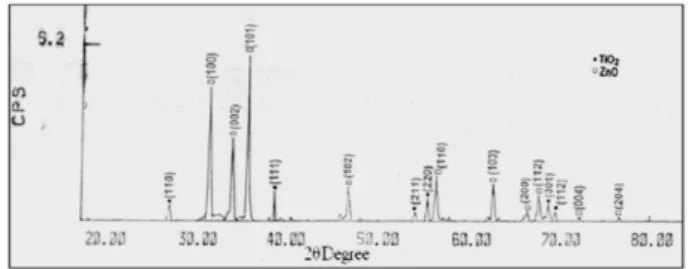
The prepared heterostructured TiO2/ZnO photocatalyst (Z9T) was characterized by XRD, SEM and UV-vis trans- mittance spectroscopy. The X-ray diffraction pattern of pre- pared sample (Z9T) is shown in Fig. 1. From the XRD pattern and corresponding characteristics 2θ values of the diffraction peaks, it can be confirmed that TiO2 is in rutile form having tetragonal structure as the peaks matched with
Joint Committee Powder Diffraction Standards (JCPDS) card number 21-1276 while ZnO is in zincite phase (JCPDS card number 36-1451). The h, k, l values are shown in fig- ure at respective peaks. The average crystallite size of Z9T was calculated to be about 21.48 nm using the Scherrer Equation,14,22 t = Kλ / B cos θ, where the number K is a coefficient having value 0.9, λ = 0.1541 nm is the X-ray wavelength, B is the full width half maximum (FWHM) of the catalyst, θ is the diffraction angle.
The energy band gap of sample has been calculated accord- ing to the equation widely adapted for crystalline semi- conductors.24,25
αhν = A (hν − Eg)n/2 Table 1. Properties of pesticides used in present study
Common name Monocrotophos Quinalphos
Pesticide group Organophosphate Organophosphate
IUPAC name dimethyl [(E)-4-(methylamino)-4-oxobut-2-en-2-yl] phosphate O,O-diethyl O-quinoxalin-2-yl phosphorothioate
Molecular formula C7H14NO5P C12H15N2O3PS
Molecular weight 223.2 298.3
Activity Aliphatic organophosphate insecticide and Acaricide Aromatic organophosphate insecticide and Acaricide
Solubility in water 100% at 20oC 20 mg/L
Toxicity Class I II
Acute oral LD50 for rats 14 mg/kg 14−37 mg/kg
Structure
Spectra λmax = 240 nm and 320 nm
Figure 1. XRD pattern of Z9T.
where α, ν, A, Eg, and n are the absorption coefficient, incident light frequency, constant, band gap, and an integer (normally equal to 1, 2, 4, or 6), respectively. The α and ν values at the steep edges of the transmission spectra were used to construct the plots of (αhν)1/2 against photon energy.
As seen in Fig. 2, the band gap of sample was determined by the intersection of the extrapolated linear portion of the plot with the energy axis. The calculated band gap value of synthesized photocatalyst was 3.60 eV.
The structure and morphology of the Z9T photo catalyst was studied using Scanning Electron Microscope (SEM).
The SEM unit was operated at 15 kV of accelerating volt- age. Fig. 3 shows the SEM photograph of the Z9T under 15000X magnification. The coupled photocatalyst Z9T consist of nanosized particles and their size seems to be less than 100 nm. TiO2 nanoparticles and ZnO nanorods aggregate to form irregular shaped clusters.
Control Experiments
The degradation of quinalphos and monocrotophos was carried out under different experimental conditions viz UV
light and TiO2/UV light. The degradation rate was recorded in terms of change in intensity of characteristic peak at 320 nm for quinalphos and 240 nm for monocrotophos.
Initially blank experiments were performed under UV irradiation without addition of catalyst (UV alone) and only 4% and 13.29% degradation of quinalphos and monocro- tophos was observed respectively. The photocatalytic deg- radation experiment was performed by taking 0.1 gm photocatalyst in 100 ml solution of the pesticide solution.
About 89% degradation of quinalphos and 60% degra- dation of monocrotophos were achieved in the presence of the semiconductor (TiO2) and UV light in 4 h. The results from the degradation of both the pesticides reveal that TiO2 shows good photocatalytic activity for the degrada- tion of pesticides.
Effect of Parameters
To determine the effect of catalyst dose (TiO2), the experi- ments were performed by varying the catalyst dose from 0.5 to 2.0 g/L for pesticide solutions. The results reveal that efficiency of degradation increases up to concentration 1.5 g/L for quinalphos after that the rate of degradation decreases but for monocrotophos degradation efficiency increases up to 2.0 g/L catalyst dose.26 This is in accor- dance with the previous studies24 and can be explained on the basis of optimum catalyst loading which depends on initial solute concentration. The total active surface area increases with the increase of catalyst dose.25 At the same time, higher dose of photocatalyst increases turbidity of the suspension which leads to decrease the penetration of UV light. Hence photo activated volume of suspension decreases.27
The experiments to check the effect of pH were carried out in the pH range 2−10 for both of the pesticides. The maximum degradation was obtained at pH 8 for the quinal- phos and pH 4 for the monocrotophos while sharp decrease occurred at both high and low pH.26 The results are explained28 and in accordance with the earlier findings for degrada- tion of trichlorfon in suspension of titanium dioxide.29 The dependence of degradation on pH depends not only on the pKa of TiO2 but that of the substrate as well. Otherwise, the trend (degradation vs pH) would have been uniform for both the substrates.
HPLC Studies
The aqueous solutions of photo degraded pesticides are further analyzed by high performance liquid chromatography (HPLC). The HPLC chromatograms after 2 h of irradia- tion are shown in Fig. 4. HPLC chromatogram confirms Figure 2. Plot of (αhν)1/2 vs hν for Z9T.
Figure 3. SEM Surface morphology of heterostructured Z9T nano- photocatalyst (1 bar length = 300 nm).
the formation and disappearance of intermediates during photodegradation of quinalphos and monocrotophos. Sev- eral small organic intermediates were formed, out of which the major products of quinalphos are with retention time 11.988 and 3.788 min. For the monocrotophos the major products with retention time 6.058 and 8.819 min are formed.
Kinetics
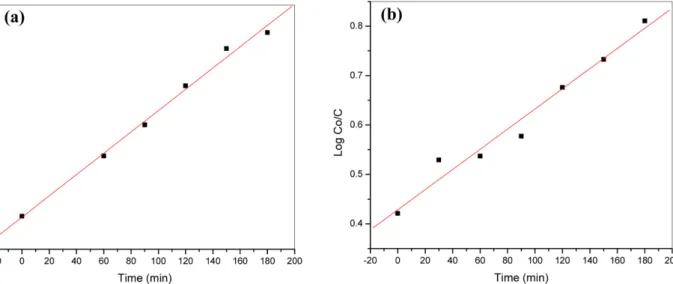
Fig. 5 shows the kinetic of disappearance of quinalphos and monocrotophos for an initial concentration 20 ppm respectively. The results show that the photocatalytic deg- radation of pesticide in aqueous TiO2 can be described by the pseudo first order kinetic model ln(Co/C) = kt, where Co is an initial concentration and C is concentration at time t. The correlation constant for the fitted line is R2= 0.99664 for quinalphos26 and R2= 0.9758 for monocro- tophos. The rate constant has been calculated to be 0.00567 min−1 for quinalphos and 0.00199 min−1 for monocrotophos.
Degradation of pesticides with mixed and synthesized catalyst
Photodegradation experiments were also performed by using fixed amount of pesticide (20 ppm) with catalyst dose, i.e., 1 g/l of ZnO/TiO2 mixed in different ratio (9:1, 8:2, 7:3 and 6:4), synthesized heterostructured nanopho- tocatalyst (Z9T). The results are compared with photo- catalytic efficiency of TiO2 and ZnO at natural pH in UV light for 4 hours. The percentage degradation of pesticide by using various catalysts is reported in Fig. 6.
Experimental studies show that the degradation occurs at higher rate with TiO2 as compared with ZnO. The present result is in confirmation with earlier findings of using TiO2 for the photocatalytic degradation of pesticides and the proposed mechanism of degradation for TiO2 and ZnO.30 However, when the photocatalysts were mixed, the degradation was comparatively high as compared to use TiO2 and ZnO alone. The maximum degradation (81%) of Monocrotophos has been observed with ZnO and TiO2 Figure 4. HPLC chromatograms of (a) Quinalphos and (b) Monocrotophos after 2 h of irradiation.
Figure 5. Kinetic study of degradation of (a) Quinalphos and (b) Monocrotophos.
mixed in 7:3. However, 93.50% degradation of Quinal- phos has been observed with ZnO and TiO2 in 8:2. In ear- lier findings higher rate of photocatalytic degradation of Malachite Green20 and Methyl Blue31 were reported with TiO2 and ZnO mixed in the ratio 1:9 and 9:1 respectively.
Quinalphos and Monocrotophos were also subjected to photo degradation in presence of synthesized heterostruc- tured nanophotocatalyst (Z9T). Z9Tshowed the best pho- tocatalytic degradation efficiency (96% of Quinalphos and 84.2% of Monocrotophos) in comparison to all other pho- tocatalysts (Fig. 6). The better degradation efficiency of Z9T may be explained on the basis of smaller crystallite size (21.48 nm). As the catalyst grain size is reduced to a few nanometers, an elevated density of active sites for sub- strate adsorption and catalysis can be guaranteed. Thus, higher surface-to-volume ratio as compared to the bulk material results in improved efficiency.
CONCLUSION
The photocatalytic degradation of Quinalphos and Monocro- tophos in aqueous solution was carried out using TiO2, ZnO, both the catalysts mixed in different proportions and synthesized heterostructured nanophotocatalyst. The rate constant for degradation of Quinalphos and Monocroto- phos with TiO2 has been calculated to be 0.00567 min−1 and 0.00199 min−1 respectively. XRD studies of synthesized photocatalyst Z9T reveal the existence of TiO2 in rutile form and ZnO in zincite phase. The smaller crystalline size of Z9T was found to be responsible for the better pho- tocatalytic efficiency in comparison to others. The studies
related to synthesis of new photocatalyst with improved efficiency will helpful in designing photocatalytic degra- dation based water treatment plants.
Acknowledgments. Support from Panjab University, Chan- digarh and JP University, Solan are gratefully acknowl- edged. And the publication cost of this paper was supported by the Korean Chemical Society.
REFERENCES
1. Yu, H.; Zhang, S.; Zhao, H.; Zhang, H. Phys. Chem. 2010, 12, 6625.
2. Hoffmann, M. R.; Martin, S. T.; Choi, W.; Bahnemann, D. W. Chem. Rev. (Washington, D.C.) 1995, 95, 69.
3. Fujishima, A.; Hashimoto, K.; Iyoda, T.; Fukayama, S.;
Yoshimoto, T.; Saitoh, T. U.S. Patent US6939611, 2005.
4. Sud, D.; Kaur, P.; Crit. Rev. Env. Sci. Tech. 2012, 42, 2365.
5. Mor, G. K.; Varghese, O. K.; Paulose, M.; Grimes, C. A.
Sensor Lett. 2003, 1, 42.
6. Bessa, E.; Sant’Anna, G. L. Jr.; Dezotti, M. J. Adv. Oxid.
Technol. 1999, 4, 196.
7. Cardoso, J. C.; Lizier, T. M.; Zanoni, M. V. B. Appl. Catal., B 2010, 99, 96.
8. Reddy, P. S.; Ghewande, M. P. Pesticides 1986, 20, 52.
9. Jena, M., Dani, R. C., Rajamani, S. Oryza. 1990, 27, 96.
10. Banerjee, S. K.; Turkar, K. S.; Wanjari, R. R. Pestology 2000, 24, 14.
11. Xu, Y.; Wang, L.; Gu, G. Environ. Sci. 2002, 21, 574.
12. Zhang, L.; Yan, F.; Wang, Y. J. Inorg. Mater. 2006, 42, 1379.
13. Doong, R.; Chang, W. J. Photochem. Photobiol., A 1997, 107, 239.
14. Kralj, M. B.; Cernigoj, U.; Franko, M. Water Res. 2007, 41, 4504.
15. Moctezuma, E.; Leyva, E.; Palestino, G. J. Photochem. Pho- tobiol., A 2006, 186, 71.
16. Anandan, S.; Vinu, A.; Sheeja Lovely, K. L. P.; Gokulakrish- nan, N.; Srinivasu, P.; Mori, T.; Murugesan, V.; Sivamurugan, V.; Ariga, K. J. Mol. Catal. A: Chem. 2007, 266, 149.
17. Anandan, S.; Kathiravan, K.; Murugesan, V.; Ikuma, Y.
Catal. Commun. 2009, 10, 1014.
18. Shifu, C.; Gengyu, C. Solar Energy 2005, 79, 1.
19. Kansal, S. K.; Singh, M.; Sud, D. J. Hazard. Mater. 2007, 141, 581.
20. Bansal, P.; Bhullar, N.; Sud, D. Desalin. Water Treat. 2009, 12, 108.
21. Bansal, P.; Singh, D.; Sud, D. Sep. Purif. Technol. 2010, 72, 357.
22. Bansal, P.; Dhir, A.; Parkash, N. T.; Sud, D. Indian J. Chem., Sect. A. 2011, 50, 991.
23. Kansal, S. K.; Singh, M.; Sud, D. Chem. Eng. Commun.
2007, 194, 787.
24. Rahman, A.; Muneer, M. Desalination 2005, 181, 161.
25. Gonclaves, M. S. T.; Oliveira-Campose, A. M. F.; Pinto, E. M.
Figure 6. Degradation of pesticides by using various photocatalyst.
M. S.; Plasencia, P. M. S.; Queiroz, M. J. R. P. Chemo- sphere 1999, 39, 781.
26. Kaur, P.; Sud, D. J. Mol. Catal. A: Chem. 2012, 365, 32.
27. Daneshvar, N.; Salari, D.; Khataee, A. R. J. Photochem.
Photobiol., A 2003, 162, 317.
28. Zhu, X. L.; Yuan, C. W.; Bao, Y. C.; Yang, J. H.; Wu, Y.
Z. J. Mol. Catal. A: Chem. 2005, 229, 95.
29. Liu, W.; Chen, S.; Zhao, W.; Zhang, S. Desalination 2009, 249, 1288.
30. Pirkannicmi, K.; Sillanpaa, M. Chemosphere 2002, 48, 1047.
31. Kansal, S. K.; Singh, M.; Kaur, M. P.; Sud, D. Indian Chem. Eng., B. 2006, 47, 111.