Received March 12, 208 Revised March 26, 2018 Accepted March 26, 2018 Corresponding author Si-Woo Lee
Mibyeong Research Center, Korea Institute of Oriental Medicine, 1672 Yuseongdaero, Yuseong-gu, Daejeon, South Korea
Tel: +82-42-868-9286, Fax: +82-42-869-2733, E-mail: [email protected]
Ⓒ The Society of Sasang Constitutional Medicine.
All rights reserved. This is an open acess article distributed under the terms of the Creative Commons attribution Non-commercial License (http:// creativecommons.org/licenses/by-nc/3.0/)
사상체질에 따른 수부, 족부, 복부의 냉증
배광호․박기현․이시우*
한국한의학연구원 미래의학부
Abstract
Cold hypersensitivity in the Hands, Feet and Abdomen according to Sasang Constitution
Kwang-Ho Bae․Ki-Hyun Park․Si-Woo Lee*
Division of Future Medical Research, Korea Institute of Oriental Medicine.
Objectives
This study was aimed to examine cold hypersensitivity tendency in the hands, feet and abdomen according to Sasang constitution among Koreans.
Methods
Multi stage stratified sampling was conducted for random selection of 1,100 participants aged ≥ 19 years, based on sex, age, region in Oct.2010. Cold hypersensitivity was measured using a questionnaire to score the extent of cold hypersensitivity in the hands, feet, abdomen. Subjects’ constitution was diagnosed by Korea Sasang Constitutional Diagnostic Questionnaire (KS-15). The cold hypersensitivity scores according to Sasang constitution were analyzed using logistic regression and one way ANOVA.
Results
On the one way ANOVA, Soeumin group’s cold hypersensitivity in the hands and feet scores were significantly higher than those of Taeeumin and Soyangin groups. However, there was no significant difference in the abdominal cold hypersensitivity scores by constitution. The regression analysis, adjusted for age, sex, and sociodemographic variables, showed that Soeumin group had significantly higher cold hypersensitivity effects of the hands (β = 0.105, p = 0.002) and feet (β = 0.099, p = 0.003) than Taeeumin group.
Conclusions
Soeumin group significantly had higher cold hypersensitivity scores in the hands and feet than Taeumin and Soyangin group.
Key Words: Sasang Constitution, Sasang typology, cold hypersensitivity, cold extremities
Ⅰ. 緖論
냉증은 일종의 주관적 증상으로, 냉감을 느끼지 않 을 만한 환경에서도 신체의 특정 부위에 과도한 냉감 을 갖는 것을 말한다1. 이 증상은 한국을 비롯한 동아 시아에 특히 많은 것으로 알려져 있으며 여성에서 흔 히 관찰된다2,3. 냉감을 느끼는 신체 부위는 다양한 편 이나 손, 발, 하복부에서 빈발하며 가벼운 불쾌감에서 부터 일상생활을 유지하기 힘든 상태에 이르기까지 그 정도 또한 다양한 편이다4,5.
또한 냉증은 여러 만성질환과 연관성을 갖고 있는 것으로 알려져 있다. 한의학에서는 ‘脾主四末’이론 을 바탕으로 손발의 냉증이 脾의 온후작용에 문제가 있어 발생될 수 있음을 말하였고, 실제로 최근의 임상 연구에서도 기능성 소화불량을 비롯한 소화기 질환과 수족냉증이 연관성이 있음을 보고하였다6,7.
다른 한편으로 냉증은 일종의 未病상태로도 인식 되어왔는데, 즉 냉증이 여러 만성질환들을 동반하거 나 만성질환의 원인이 될 수 있다는 것이다. 최근 몇 몇 연구들에서 냉증이 만성 비염, 퇴행성 관절염, 피 로, 목결림, 월경통, 우울경향 등과 연관이 있다고 보 고하였다8,9. 때문에 냉증을 치료하고 예방하는 것은 일상생활의 불편감 해소뿐 아니라 다른 질환의 발생 을 예방할 수 있다는 입장에서 매우 중요하다고 생각 된다.
기존의 사상체질과 냉증관련 연구를 살펴보면, 부 인과 냉증 환자 43명을 대상으로 사상체질과의 관계 를 살펴본 연구가 있었는데10, 이 연구에서는 소양인 에게서 냉증이 적게 분포했음을 보고하였다. 백11의 연구에서는 한방병원과 한의원에 내원한 대상자 1241 명을 대상으로 연구한 결과 소음인에서 태음, 소양인 보다 냉증 경향이 높았음을 보고하였다. 이러한 연구 들을 통해 체질 별로 냉증 경향이 달리 나타난다는 것을 알 수 있었으나 대상자 선정에 있어 특정 환자집 단이나 의료기관 내원자들을 대상으로하여 선택 편향 발생 가능성을 배제할 수 없었다.
이에 본 연구에서는 다단계 층화추출 방법을 이용하
여 표본을 선정하고 이 대상자들로부터 설문데이터를 수집하여 체질과 냉증과의 관계를 밝히고자 하였다.
Ⅱ. 硏究對象 및 方法
1. 연구대상
본 연구는 2015년 10월 설문조사 전문 기관인 갤럽 (Gallup Korea institute)에 의뢰하여 실시되었다. 주민 등록 인구통계를 바탕으로 성별, 연령, 지역별 배분을 통한 다단계층화추출(multi stage stratified sampling) 방 법을 이용하여 1100명의 표본을 선정하고(95% 신뢰 수준, ±3.0% 표본오차) 설문 조사를 실시하였다. 설문 조사는 면접원 (interviewer)에 의한 1:1 방문면접조사 (face to face interview)로 진행되었다. 대상자들은 면접 원의 도움을 받으면서 구조화된 설문지(structured questionnaire)에 답하였다.
2. 냉증 평가
냉증의 평가는 한의학연구원에서 개발한 간소화된 7문항의 한열 설문 중 신체부위의 냉감을 묻는 3가지 문항을 가지고 평가하였다12. 손, 발, 배 부위의 냉온 감각에 대해 해당 부위가 차가울수록 1점에 가까운 점수를, 따뜻할수록 7점에 가까운 점수를 답하도록 7점척도로 구성되어 있다. 분석에서는 해석의 편의를 위해 이를 역산하여 차가울수록 7점으로, 따뜻할수록 1점으로 하였다.
3. 사상체질 판정
사상체질의 판정은 체형, 성격, 소증 기반의 단축형 사상체질 진단 설문지(KS-15)13를 사용하였다. KS-15 는 소증 8문항, 성격 6문항, 체형(BMI) 1문항으로 구성 되어있다. KS-15는 태양인 판정이 불가하므로 본 연구 에서는 대상자들을 태음인, 소양인, 소음인만으로 분 류하였다.
4. 통계분석
대상자들의 일반적 특성(성별, 연령, body mass in- dex, 음주, 흡연, 배우자 유무, 수입, 직업, 교육) 중 범주형 데이터는 빈도 분석(frequency analysis)을 수행 하였고, 연속형 자료와 체질별 수족냉증은 일원배치 분산분석(one way ANOVA)을 통해 평균(mean)과 표준 편차(standard deviation, SD)로 나타내었다. 사후분석 은 Scheffe검증을 사용하였으며, 유의수준은 P < 0.05 로 설정하였다. 체질이 수족냉증 점수(수부, 족부 점수 의 합)에 독립적으로 영향을 주는 지 확인하기 위해서 로지스틱 회귀분석을 수행하였으며, 냉증에 영향을 줄 수 있는 특성(성별, 연령, 흡연, 음주, 배우자 여부, 소득, 직업, 교육)들을 보정 변수로 사용하였다. 단, KS-15체질 판정의 변수로 사용되는 BMI는 제외하였
다. 통계 프로그램은 SPSS 22.0(IBM, Chicago, IL, USA) 을 이용하였다.
Ⅲ. 硏究結果
1. 일반적 특성
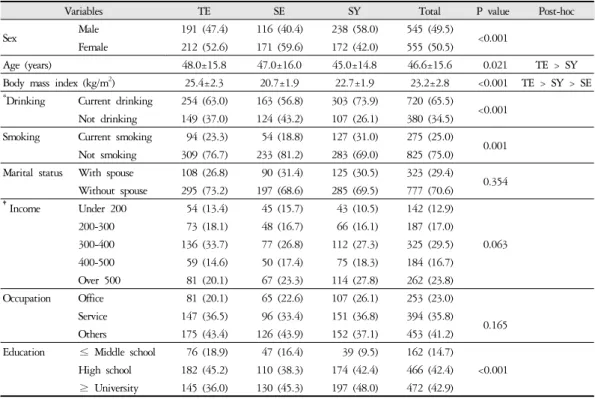
전체 1100명 대상자 중 남성 545명(49.5%), 여성 555명(50.5%) 이었다. 평균 연령은 46.6세 였으며 평균 BMI (kg/m2)는 23.2였다. 체질별 성별 분포는 소음인 (남: 40.4, 여: 59.6), 태음인(남: 47.4, 여: 52.6)에서는 여성이 많았으나, 소양인 그룹(남: 58.0, 여: 42.0)에서 는 남성이 더 많은 분포를 보였다. 또한 Table 1에서 제시한 바와 같이 연령, 음주, 흡연, 교육수준에서도 체질 간 차이가 관찰되었다.
Table 1. Participants’ general characteristics
Variables TE SE SY Total P value Post-hoc
Sex Male 191 (47.4) 116 (40.4) 238 (58.0) 545 (49.5)
<0.001
Female 212 (52.6) 171 (59.6) 172 (42.0) 555 (50.5)
Age (years) 48.0±15.8 47.0±16.0 45.0±14.8 46.6±15.6 0.021 TE > SY
Body mass index (kg/m2) 25.4±2.3 20.7±1.9 22.7±1.9 23.2±2.8 <0.001 TE > SY > SE
*Drinking Current drinking 254 (63.0) 163 (56.8) 303 (73.9) 720 (65.5)
<0.001 Not drinking 149 (37.0) 124 (43.2) 107 (26.1) 380 (34.5)
Smoking Current smoking 94 (23.3) 54 (18.8) 127 (31.0) 275 (25.0)
0.001 Not smoking 309 (76.7) 233 (81.2) 283 (69.0) 825 (75.0)
Marital status With spouse 108 (26.8) 90 (31.4) 125 (30.5) 323 (29.4)
0.354 Without spouse 295 (73.2) 197 (68.6) 285 (69.5) 777 (70.6)
†Income Under 200 54 (13.4) 45 (15.7) 43 (10.5) 142 (12.9)
0.063
200-300 73 (18.1) 48 (16.7) 66 (16.1) 187 (17.0)
300-400 136 (33.7) 77 (26.8) 112 (27.3) 325 (29.5)
400-500 59 (14.6) 50 (17.4) 75 (18.3) 184 (16.7)
Over 500 81 (20.1) 67 (23.3) 114 (27.8) 262 (23.8)
Occupation Office 81 (20.1) 65 (22.6) 107 (26.1) 253 (23.0)
Service 147 (36.5) 96 (33.4) 151 (36.8) 394 (35.8)
0.165
Others 175 (43.4) 126 (43.9) 152 (37.1) 453 (41.2)
Education ≤ Middle school 76 (18.9) 47 (16.4) 39 (9.5) 162 (14.7)
<0.001 High school 182 (45.2) 110 (38.3) 174 (42.4) 466 (42.4)
≥ University 145 (36.0) 130 (45.3) 197 (48.0) 472 (42.9)
Data are shown as n (%) or the mean ± standard deviation. P values were calculated by chi-square test or one-way ANOVA. Post-hoc was carried out using the Scheffe.
* “Current drinker” was defined as alcohol consumption at least once a month, “Not drinking” was defined as alcohol consumption less than once a month., †Average monthly household income (unit: 10,000 KRW), TE = Taeeumin, SE = Soeumin, SY = Soyang
2. 체질별 냉증 점수
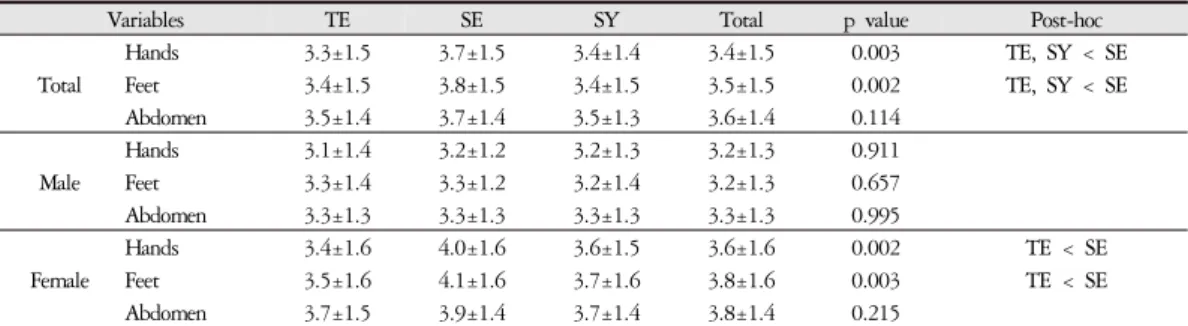
체질에 따른 부위별 냉증 점수는 Table 2에 제시한 바와 같다. 소음인에서 수부, 족부의 점수가 태음인, 소양인 그룹에 비해 유의하게 더 높은 경향을 보였다.
복부에서는 소음인 그룹이 다른 그룹보다 점수가 낮 았으나 유의한 차이가 관찰되지 않았다.
남성만을 대상으로 체질에 따른 냉증 점수를 평가 한 결과 수부, 족부, 복부 모두 유의한 차이가 관찰되 지 않았다. 여성 집단에서는 수부, 족부에서 소음인이 태음인보다 유의하게 점수가 낮게 관찰되었으며, 복
부에서는 유의한 차이가 관찰되지 않았다 (Table 2).
3. 수족냉증에 대한 체질의 영향
체질이 수부, 족부냉증 점수에 미치는 영향을 알아 보기 위해 회귀분석을 실시하였다. 그 결과 태음인 기 준으로 소음인은 냉증 점수에(p < 0.005)에 유의한 차이 를 보였으며, 소양인은 유의한 차이를 보이지 않았다.
태음인보다 소음인이 연령, 성별(Model 2), 그리고 사회 적 변수들을 보정했음에도(Model 3) 수부, 족부의 냉증 점수가 유의하게 높은 경향을 보였다 (Table 3, 4).
Table 2. Comparison of the cold hypersensitivity scores according to Sasang constitution
Variables TE SE SY Total p value Post-hoc
Total
Hands 3.3±1.5 3.7±1.5 3.4±1.4 3.4±1.5 0.003 TE, SY < SE
Feet 3.4±1.5 3.8±1.5 3.4±1.5 3.5±1.5 0.002 TE, SY < SE
Abdomen 3.5±1.4 3.7±1.4 3.5±1.3 3.6±1.4 0.114
Male
Hands 3.1±1.4 3.2±1.2 3.2±1.3 3.2±1.3 0.911
Feet 3.3±1.4 3.3±1.2 3.2±1.4 3.2±1.3 0.657
Abdomen 3.3±1.3 3.3±1.3 3.3±1.3 3.3±1.3 0.995
Female
Hands 3.4±1.6 4.0±1.6 3.6±1.5 3.6±1.6 0.002 TE < SE
Feet 3.5±1.6 4.1±1.6 3.7±1.6 3.8±1.6 0.003 TE < SE
Abdomen 3.7±1.5 3.9±1.4 3.7±1.4 3.8±1.4 0.215
P values were calculated by one-way ANOVA. Post-hoc was carried out using the Scheffe.
TE = Taeeumin, SE = Soeumin, SY = Soyangin
Table 3. Logistic regression analysis for cold hypersensitivity score in the hands according to Sasang constitution Cold hypersensitivity score in the hands
Models SE SY
B SE β P value B SE β P value
Model 1 0.376 0.113 0.112 0.001 0.103 0.103 0.034 0.319
Model 2 0.347 0.112 0.104 0.002 0.156 0.102 0.051 0.129
Model 3 0.353 0.113 0.105 0.002 0.162 0.103 0.053 0.002
Taeeum was employed as the reference in every analysis.
Model 1: unadjusted, Model 2: adjusted for sex and age, Model 3: adjusted for sex, age, drinking, smoking, marital status, income, occupation, and education, B = unstandardized regression coefficients, SE = standard error, β = standardized regression coefficients, SE = Soeumin, SY = Soyangin
Table 4. Logistic regression analysis for cold hypersensitivity score in the feet according to Sasang constitution Cold hypersensitivity score in the feet
Models SE SY
B SE β P value B SE β P value
Model 1 0.368 0.116 0.107 0.002 -0.002 0.105 -0.001 0.985
Model 2 0.335 0.115 0.097 0.004 0.054 0.105 0.017 0.604
Model 3 0.340 0.115 0.099 0.003 0.049 0.105 0.016 0.644
Taeeum was employed as the reference in every analysis.
Model 1: unadjusted, Model 2: adjusted for sex and age, Model 3: adjusted for sex, age, drinking, smoking, marital status, income, occupation, and education, B = unstandardized regression coefficients, SE = standard error, β = standardized regression coefficients, SE = Soeumin, SY = Soyangin
Ⅳ. 考察
냉증은 그 자체로 일상생활에 많은 불편감을 주는 것과 동시에 한의사에게는 변증을 진단함에 있어 고 려해야하는 변수 중 하나이다. 또한 최근에는 냉증이 질환으로 발전할 수 있는 미병 상태로 인식되거나 여 러 질환 및 증상들과 연관이 있다는 연구결과들이 발 표되고 있다. 한국에서는 수족냉증을 갖고 있는 그룹 에서 기립성 저혈압, 기능성 소화불량, 퇴행성 관절염, 만성 비염, 소화기 염증 등의 빈도가 높다는 연구보고 가 있었다6,9,14. 일본에서는 한국의 냉증과 개념이 유 사한 “hiesho”를 갖고 있는 환자들이 높은 빈도로 조산, 지연분만, 어깨 결림, 등결림, 피로, 눈의 피로 등의 증상을 갖고 있다고 보고하였다8,15. 서양에서는 냉증 을 수면 장애, 갈증을 느끼지 못함, 약물의 과민성, 정상내압 녹내장, 이명 등과 연관이 있다는 보고를 하였다16-18.
뿐만 아니라, 한국인의 상당수가 냉증을 호소하며 한의원, 한방병원에 냉증을 주소로 내원하는 환자 또 한 많기 때문에 한의학에서 냉증에 대한 연구는 임상 적인 측면에서도 매우 중요하다고 할 수 있다4.
그동안 냉증에 대한 여러 연구가 있어왔지만 한국 의 인구분포를 고려하여 냉증과 사상체질의 관계를 분석한 것은 드물었기에 이를 본 연구를 통해 알아보 고자 하였다. 본 연구는 훈련된 조사원이 대상자를 방문하여 대상자로 하여금 구조화된 설문지에 응답하 는 방식으로 이루어졌다. 체질에 대한 평가는 백13 등 이 개발한 단축형 사상체질 진단설문지(KS-15)를 이 용하였고, 냉증의 평가는 윤12 등이 개발한 한열 설문 중 신체 부위의 냉감을 묻는 부분을 이용하였다.
결과는 Table 2에서 알 수 있듯이 소음인, 특히 여성 에게서 냉증 점수가 다른 체질에 비해 유의하게 높게 관찰되는 것을 확인하였는데, 이는 이19의 연구에서 부인과에 내원한 107명의 냉증 환자들을 대상으로 분 석한 결과 소음인이 48.6%로 높게 나타났음을 보고한 것, 백11이 한방병원과 한의원에 내원한 대상자 1241 명을 분석하여 소음인이 다른 체질보다 냉증 경향이
높았다고 보고한 것, 신20이 한방병원에 내원한 9213 명을 대상으로 손발의 한열을 묻는 질문에 소음인이 다른 체질에 비해 유의하게 ‘찬 편이다’라는 대답의 빈도가 가장 높았던 것, 장21이 한방병원, 한의원에 내원한 남성 168명, 여성 250명을 대상으로 한 연구에 서 수족의 냉증이 소음인에서 50%로 가장 높았던 것, 이22가 500명의 대상자들을 분석하여 태음인에서 손 발이 따뜻한 경우가 많고, 소음인에서 손발이 찬 경우 가 많다고 보고한 것과 유사한 결과이다.
Table 3,4는 Table 1에서 제시한 다양한 인구, 사회 학적 변수들을 보정하였을 때에도 냉증 점수가 체질 별로 다른 지를 살펴보기 위해 실시한 회귀분석 결과 를 제시한 것이다. 냉감은 남성보다는 여성에서, 노년 층보다는 청년층에서, 비만한 체형보다는 마른 체형 에서 잘 나타난다는 이전 연구들을 참고하여 연령, 성별을 비롯한 사회적 변수들을 보정하였다16,23. 이 분석을 통해 소음인은 태음인에 비해 다른 변수들을 보정하였음에도 손, 발의 냉증 경향이 있다는 것을 확인할 수 있었다.
본 연구는 몇가지 제한점을 갖고 있다. 첫째, 냉증 상태의 평가를 설문에만 의존하였고, 냉증을 객관적 으로 평가할 수 있는 적외선 체열진단기(D.I.T.I), 체표 온도계, 냉부하 검사기 등을 사용하지 못하였다. 둘째, 설문 도구를 통해 냉증 정도만을 평가했을 뿐, 증상의 기간, 발생 시점, 악화요인 등에 대한 자세한 조사가 이뤄지지 못했다. 그럼에도 불구하고 본 연구는 기존 연구들과는 달리 한국의 일반적 인구 분포와 유사한 표본을 추출하여 대상자들을 선정하였다는 점에서 그 가치가 있다고 생각된다.
최근 한의학에서 체질 및 변증과 냉증과의 관계를 주제로 하는 연구들과 한약, 침, 뜸 등의 한의 치료에 대한 연구들은 비교적 활발히 진행되고 있으나 아직 까지 변증 및 체질에 기반한 냉증 치료의 대규모 연구 는 매우 부족한 실정이다. 또한 냉증에 대한 양생법 연구는 더더욱 부족하다고 할 수 있다. 현재까지 알려 진 냉증의 양생법은 주로 냉증 부위의 보온과, 운동, 항산화 작용을 갖는 음식 등에 초점이 맞춰져 있는데
이는 대부분 말초 혈류순환의 유지 또는 증가, 혈관 건강, 기초대사량 증가, 자율신경 조절 등에 그 목적이
있다24-26(Table 5). 향후 체질 및 변증 별 냉증에 대한
한의 치료 연구, 냉증의 양생법에 대한 체계적 정리 및 근거를 마련할 수 있는 연구들이 활발히 진행되기 를 희망한다.
Ⅴ. 結論
본 연구는 한국인에서 사상체질 별 냉증 경향을 살펴보기 위해 다단계층화추출(multi stage stratified sampling) 방법을 이용하여 1100명의 표본을 선정하고 설문조사를 수행하여 다음과 같은 결론을 얻었다.
1. 체질별 성별 분포는 소음인(남: 40.4, 여: 59.6), 태음인(남: 47.4, 여: 52.6)에서는 여성이 많았으 나, 소양인 그룹(남: 58.0, 여: 42.0)에서는 남성이 더 많은 분포를 보였다.
2. 소음인 그룹에서 수부, 족부의 냉증 점수가 태음 인, 소양인 그룹에 비해 유의하게 더 높은 경향을 보였다. 복부의 냉증 점수는 체질 간 유의한 차이 가 관찰되지 않았다.
3. 태음인 그룹보다 소음인 그룹에서 연령, 성별, 그리고 사회적 변수들을 보정했음에도 수부, 족 부의 냉증 점수가 유의하게 높은 경향을 보였다.
본 연구가 체질 별 냉증의 양생, 치료 연구에 일조 할 수 있기를 희망한다.
Ⅵ. 감사의 글
본 연구는 2018년도 한국한의학연구원 기관주요 사업인 “빅데이터 기반 한의 건강예측 기술개발”(Grant No. K18092)과 “미병자료 통합분석 및 예방관리 시스 템 개발사업”(Grant No. NRF-2014M3A9D7034335)의 지원을 받아 수행된 연구임.
Ⅶ. References
1. Jang JB, Lee GS, Song BG. Study on the definition of the Female`s Part-Coldness Syndrome. J Korean Med. 1994;15(2):397-411. (Korean)
2. Hur YM, Chae JH, Chung KW, Kim JJ, Jeong HU, Kim JW, Seo SY et al. Feeling of Cold Hands and Feet is a Highly Heritable Phenotype. Twin Res Hum Genet. 2012;15(02):166-169.
3. Terasawa K. On the Recognition and Treatment of
"Hie-Sho" (Chilphobia) in the Traditional Kampoh Medicine. The Japanese journal of pharmacognosy.
1987;41(2):85-96. (Jpanese)
4. Jang JB, Lee KS, Song BK. Epidemiologic Study of Female`s Part-Cold Hypersensitivity Syndrome. J Korean Med. 1995;16(1):21-35. (Korean)
5. Sakaguchi S, Kuge H, Mori H, Miyazaki J, Tanaka TH, Hanyu K et al. Extraction of items identifying hiesho (cold disorder) and their utility in young males and females. J Integr Med. 2016;14(1):36-43.
6. Bae KH, Lee JA, Park KH, Yoo JH, Lee YS, Lee
Variables Examples
Lifestyle Bath (water: 38~40℃), avoiding stress, regular sleep habit, keeping warm (wearing lots of thin layers and loose clothing, gloves and thick socks), avoiding fatigue, smoking cessation, avoiding low BMI
Regimen Avoiding ingestion of cold foods, avoiding fasting, appropriate salt intake, anti-oxidant food
Exercise Regular physical activity (but not excessive), gentle exercise, autogenic training, yoga, abdominal respiration, controlled breathing
Table 5. Lifestyle guidance for cold hypersensitivity
SW. Cold Hypersensitivity in the Hands and Feet May Be Associated with Functional Dyspepsia: Results of a Multicenter Survey Study. Evid Based Complement Alternat Med. 2016;2016:8948690.
7. Unschuld PU. Huang Di Nei Jing Su Wen. Nature, Knowledge and Imagery in an Ancient Chinese Medical Text. London: Univ of California Press. 2003.
8. Yoshino T, Katayama K, Munakata K, Horiba Y, Yamaguchi R, Imoto S et al. Statistical analysis of hie (cold sensation) and hiesho (cold disorder) in kam- po clinic. Evid Based Complement Alternat Med.
2013;2013:398458.
9. Bae KH, Go HY, Park KH, Ahn I, Yoon Y, Lee S. The association between cold hypersensitivity in the hands and feet and chronic disease: results of a multicentre study. BMC Complement Altern Med.
2018;18(1):40.
10. Lee IS, Kim JW, Lee SH. Study for Relationship be- tween the Type of Differentiation of Symptoms and Signs of Oriental Gynecology and Sasang Constitution.
J Sasang Constitut Med. 1997;19(2):263-281. (Korean) 11. Baek YH, Kim HS, Lee SW, Ryu JH, Kim YY, Jang
ES. Study On the Ordinary Symptoms Characteristics of Gender Difference According to Sasang Constitution.
J Physiol & Pathol Korean Med. 2009;23(1):251-258.
(Korean)
12. Yoon YH, Kim HS, Lee YS, Yoo JH, Lee SW.
Developing an optimized cold/heat questionnaire.
Integr Med Res. 2015;4(4):225-230.
13. Baek YH, Jang ES, Park KH, Yoo JH, Jin HJ, Lee SW. Development and Validation of Brief KS-15 (Korea Sasang Constitutional Diagnostic Questionnaire) Based on Body Shape, Temperament and Symptoms.
J Sasang Constitut Med. 2015;27(2):211-221. (Korean) 14. Jang K-H, Song H-S, Lee D-K, Kim S-H, Kim S-W.
A study of association between Cold Hypersensitivity and Orthostatic Hypotension(OH). J of Orlental
Medlcal Thermology. 2003;2(1):29-34. (Korean) 15. Nakamura S, Horiuchi S. Relationship between ad-
vanced maternal age, hiesho (sensitivity to cold) and abnormal delivery in Japan. Open Nurs J. 2013;7:
142-148.
16. Mozaffarieh M, Fontana Gasio P, Schotzau A, Orgul S, Flammer J, Krauchi K. Thermal discomfort with cold extremities in relation to age, gender, and body mass index in a random sample of a Swiss urban population. Popul Health Metr. 2010;8:17.
17. Konieczka K, Ritch R, Traverso CE, Kim DM, Kook MS, Gallino A et al. Flammer syndrome. EPMA J.
2014;5(1):11.
18. Krauchi K, Gasio PF, Vollenweider S, Von Arb M, Dubler B, Orgül S et al. Cold extremities and diffi- culties initiating sleep: evidence of co-morbidity from a random sample of a Swiss urban population. J Sleep Res. 2008;17(4):420-426.
19. Lee JY, Choi YJ, Lee IS, Cho HS, Kim JW, Jeon SH.
Research of Relationship Between Cold Hypersensitivity and Sasang Constitution J Korean Obstet Gynecol.
2014;27(4):57. (Korean)
20. Shin S, Lee J. Study on the Characteristics of Ordinary Symptoms in Overweight and Obesity Patients accord- ing to Sasang Constitution. J Korean Med Obes Res.
2013;13(1):33-45. (Korean)
21. Jang E, Kim H, Lee H, Baek Y, Lee S. The Clinical Study on the Ordinary and Pathological Symptoms according to Sasang Constitution. J Sasang Constitut Med. 2007;19(3):144-155. (Korean)
22. Lee SH,Han SS, Jang ES, Kim JY. Clinical Study on the Characteristics of Heat and Cold according to Sasang Constitutions. J Physiol & Pathol Korean Med.
2005;19(03):811-814. (Korean)
23. Pham DD, Lee J, Kim G, Song J, Kim J, Leem CH.
Relationship of the Cold-Heat Sensation of the Limbs and Abdomen with Physiological Biomarkers. Evid
Based Complement Alternat Med. 2016;2016:2718051.
24. Vahedian Z, Fakhraie G, Bovet J, Mozaffarieh M.
Nutritional recommendations for individuals with Flammer syndrome. EPMA J. 2017;8(2):187-195.
25. Scleroderma & Raynaud’s UK. Managing Raynaud's.
Available from:URL: https://www.sruk.co.uk/raynauds/
managing-raynauds/.
26. Katsuki T, Mori IK, Housing M, Yanagimoto IY.
Effects of Taking a Hot Spring Bath on Relaxation.
Studies Fukui University. 2005;61(4):1-7.