• 검색 결과가 없습니다.

Berberine Induces p53-Dependent Apoptosis through Inhibition of DNA Methyltransferase3b in Hep3B Cells

N/A
N/A
Protected

Academic year: 2021

Share "Berberine Induces p53-Dependent Apoptosis through Inhibition of DNA Methyltransferase3b in Hep3B Cells"

Copied!
9
0
0

로드 중.... (전체 텍스트 보기)

전체 글

(1)

* Corresponding author:

Bae Dong Jung

College of Veterinary Medicine, Kangwon National University, 1 Gangwondaehak-gil, Chuncheon 24341, Korea

E-mail:

[email protected]

* ORCID:

https://orcid.org/0000-0002-6653-9928

ORIGINAL ARTICLE

Berberine Induces p53-Dependent Apoptosis through Inhibition of DNA Methyltransferase3b in Hep3B Cells

Dae-Yeon Kim 1 , Seon-Hyoung Kim 1 , Hee-Tae Cheong 1 , Chang-Six Ra 2 , Ki-Jong Rhee 3 , Bae Dong Jung 1

1

College of Veterinary Medicine & Institute of Veterinary Science, Kangwon National University, Chuncheon, Korea

2

College of Animal Life Sciences, Kangwon National University, Chuncheon, Korea

3

Department of Biomedical Laboratory Science, College of Health Sciences, Yonsei University at Wonju, Wonju, Korea

Hep3B 세포에서 베르베린은 DNA methyltransferase3b 억제를 통해 p53을 발현시켜 세포사멸을 유도

김대연 1 , 김선형 1 , 정희태 1 , 라창식 2 , 이기종 3 , 정배동 1

1

강원대학교 춘천캠퍼스 수의과대학 동물의학종합연구,

2

강원대학교 춘천캠퍼스 동물생명과학대학,

3

연세대학교 원주캠퍼스 보건과학대학 생명의학연구소

ARTICLE INFO ABSTRACT

Received

January 9, 2020

Revised

January 30, 2020

Accepted

January 31, 2020

The tumor suppressor gene, p53, is inactivated in the human hepatocellular carcinoma cells line, Hep3B. Berberine has been reported to inhibit the proliferation of cancer cells. This study examined whether apoptosis was induced in berberine-treated Hep3B cells and observed the association between apoptosis and the expression of p53 and DNA methyltransferase (DNMT). The cell viability was measured using an MTT assay. Apoptosis of Hep3B was measured using annexin V flow cytometry. Berberine-treated cells were examined for their DNMT enzymatic activity, mRNA expression, and protein synthesis. The p53 levels were examined by Western blot analysis. The berberine treatment resulted in increased Hep3B cell death and apoptosis in a time- and dose-dependent manner. The DNMT3b activity, mRNA expression, and protein levels all decreased after the berberine treatment. In contrast, the p53 protein levels increased with a concomitant decrease in DNMT3b. No change in the expression of ERK was observed, but the P-ERK levels decreased in a dose dependent manner. These results indicate that a treatment of Hep3B cells with berberine can reduce the expression of DNMT3b, leading to an increase in the tumor suppressant gene p53 and an increase in cell apoptosis. This shows that berberine can effectively suppress the proliferation of liver cancer cells.

Copyright © 2020 The Korean Society for Clinical Laboratory Science. All rights reserved.

Key words Apoptosis Berberine

DNA methyltransferase Hepatocellular carcinoma p53

INTRODUCTION

Liver cancer is one of the most common cancers worldwide [1]. Genetic alteration is one of the key contributing factors for liver carcinogenesis and

genetic alterations is heavily influenced by DNA methylation [2]. Specific DNA methylations are regulated by expression of DNA methyltransferase (DNMT) and as such, DNMT expression are associated with liver carcinogenesis [3, 4]. Three forms of DNMT exist. DNMT1 acts on nascent DNA during cellular differentiation resulting in formation of hemimethylated CpG dinucleotides (maintenance DNMT) [5, 6]. DNMT3a and DNMT3b methylate CpG dinucleotides during early

Korean Society for Clinical Laboratory Science

(2)

replication (de novo DNMT). The loss of either DNMT3a or DNMT3b exhibits a profound effect on cells [7, 8].

The functions of the three DNMTs are overlapping. For example, DNMT1 can acts as a de novo DNMT whereas DNMT3a and DNMT3b can act as maintenance DNMT [9, 10]. It has been reported that DNMT can influence tumor suppressor gene expression such as p53 [11, 12].

Several therapies are available for treatment of liver cancer [13]. Of these methods, anti-cancer drugs inhibit cell activity. However, all existing anti-cancer therapies have a myriad of inherent side-effects [14].

Therefore, development of new therapeutic regimens with minimal side-effects are necessary. Recently, natural products and/or extracts from natural products, which have limited adverse effects, have been examined as adjunct therapy for cancer [15].

One such natural product, berberine, has anti-cancer effects on stomach cancer, lung cancer and cervical cancer. In addition, berberine exert anti-oxidative effects as well as other pharmacologic properties [16].

Berberine has been reported to inhibit cancer cell proliferation [17, 18], decrease TNF-alpha expression [19], and regulate urokinase-plasminogen activator inhibitor (PAI) [20]. In addition, berberine can modulate the caspases-mitochondria-dependent pathway [21] to enhance apoptosis. In 2014, Yao et al reported that berberine can induce hypomethylation of p53 in multiple myeloma cells resulting in apoptosis [22].

Another report suggested that administration of berberine caused demethylation of DNA in rat liver [23]. Collectively, these reports suggest that berberine may affect p53 methylation status in the liver.

In the current study, we evaluated the effects of berberine on the Hep3B liver cancer cell line [24].

Hep3B cells were treated with berberine in vitro and the induction of apoptosis, p53 expression and DNMT activity was assessed.

MATERIALS AND METHODS

1. Cell culture

The human hepatocellular carcinoma cell line Hep3B (ATTC, Manassas, VA, USA) were cultured on 100 mm culture plates (Falcon, Corning, NY, USA) in Dulbecco’s modified Eagle’s medium (DMEM, Sigma, Irvine, United Kingdom) containing 10% fetal calf serum (GE Healthcare Bio-Sciences AB, Bjorkgatan, Uppsala, Sweden), penicillin (100 g/mL; GE Healthcare Life Sciences, Pasching, Austria) at 37°C in humidified chamber at 5% CO

2

. Berberine hydrochloride (Sigma- Aldrich, Louis, MO, USA) was dissolved in deionized water (1 mM) and diluted prior to addition to culture media for 24 or 48 hours.

2. MTT assay

Cells in the exponential growth phase were harvested, adjusted to 4×10

4

cells/mL and seeded in a 96-well plate. After incubating for 24 hours, the cell culture medium was removed and fresh media containing berberine was added. Cells were incubated for both 24 and 48 hours, followed by the addition of 100 L EZ-Cytox (MTT reagent; DoGenBio, Guro, Seoul, Korea). After incubation at 37°C for 4 hours, the absorbance was measured at 450 nm using a microplate reader (Molecular Devices, San Jose, CA, USA). The survival rate was determined using growth rate %=

(optical density of treated cells/optical density of untreated cells)×100.

3. Flow cytometric analysis for detection of apoptosis Hep3B cells were cultured for 24 hours with varying concentrations of berberine (50, 200, and 400 M), detached with trypsin and then stained with annexin V-FITC/PI detection kit (BD Pharmingen, San Diego, CA, USA). The cells were analyzed immediately on a flow cytometer (BD Pharmingen).

4. Measurement of DNMT activity

Nuclear proteins were isolated using EpiQuik

TM

(3)

Nuclear Extraction Kit I (Epigentek, Brooklyn, NY, USA) from berberine treated cells. After measuring the protein concentration with the BCA Protein Assay Kit (Thermo scientific, Rockford, IL, USA), total DNMT activity was analyzed using EpiQuik

TM

DNA Methyl- transferase Activity/Inhibition Assay (Epigentek).

5. RNA extraction and cDNA synthesis

Cells were homogenized with 1 mL of Trizol Reagent (Ambion, Carlsbad, NM, USA), mixed with 0.3 mL of chloroform and centrifuged at 12,000 rpm for 15 min at 4°C. The aqueous layer was transferred to a new tube and 0.6 mL isopropanol added. The tubes were inverted several times and centrifuged at 12,000 rpm for 10 min at 4°C. The supernatant was removed and the RNA pellet washed with 70% alcohol. The RNA pellet was briefly air-dried and dissolved in DEPC-treated water.

Total RNA concentration was measured using Nano Drop (Molecular Devices). The cDNA was synthesized using the primescript 1st strand cDNA synthesis kit (TaKaRa, Kusatsu, Tokyo, Japan).

6. PCR

PCR was performed using the premix Taq

TM

(TaKaRa) and specific primers. Primer sequences and PCR conditions are as follows. Amplification for DNMT1 was conducted for 30 cycles, denaturation at 94°C for 30 s, annealing at 60°C for 30 s, and extension at 72°C for 30 s.

DNMT1 sense primer sequence is 5’-AGCCTTCGG CTGACTGGCTGG-3’ and antisense primer sequence is 5’-CTGCCCATCATCATGACCTGG-3’. Amplification for DNMT3a was conducted for 35 cycles, denaturation at 94°C for 30 s, annealing at 60°C for 30 s, and extension at 72°C for 30 s. DNMT3a sense primer sequence is 5’-GACTGTATGGATGTTCTGTCAG-3’ and antisense primer sequence is 5’-ATTTGTCCTGGCAGACGAAGCA-3’.

Amplification for DNMT3b was conducted for 35 cycles, denaturation at 94°C for 30 s, annealing at 60°C for 30 s, and extension at 72°C for 30s. The DNMT3b sense primer sequence is 5’-GCTGCAGACCAVCTC TGTGGCACG-3’ and antisense primer sequence is

5’-GCCGCCTCTTCACCATCCCG-3’. The PCR products were analyzed by 3% agarose gel electrophoresis.

DNMT1 PCR product size is 150 bp, DNMT3a PCR product size is 146 bp, and DNMT3b PCR product size is 81 bp. Amplification of GAPDH was conducted for 30 cycles, denaturation at 94°C for 30 s, annealing at 50°C for 30 s, and extension at 72°C for 30 s. GAPDH sense primer sequence is 5’-ACCACAGTCCATGCCATCAC-3’

and antisense primer sequence is 5’-TCCACCACC CTGCTGTA-3’. The PCR products were analyzed by 2%

agarose gel electrophoresis. GAPDH PCR product size is 450 bp.

7. Protein extraction and Western blot analysis

Berberine treated cells were homogenized with a sonicator using lysis buffer containing protease inhibitors. Lysates were centrifuged at 12,000 rpm, 4°C, 20 min, and then protein lysates transferred to a new tube. Total protein concentration was assessed using the BCA Protein Assay Kit. Protein samples were boiled at 95°C for 5 min after addition of 5X SDS-PAGE loading buffer (25 mM Tris-HCL pH 6.8, 10% SDS, 50% glycerol, 0.5 M DTT, 0.5% bromophenol blue). After electro- phoresis, the proteins were transferred to a nitrocel- lulose membrane and blocked with 5% skim milk (Sigma-Aldrich) at room temperature for 2 hours.

Membranes were washed with 1X TBS-T and incubated

overnight at 4°C with specific antibodies against p53

(1:5000; Integrated DNA Technologies, Science Park II,

Singapore), ERK (1:5000; Integrated DNA Technologies),

P-ERK (1:5000; Integrated DNA Technologies), DNMT1

(1:1000; Integrated DNA Technologies), DNMT3a

(1:1000; Integrated DNA Technologies), and DNMT3b

(1:1000; Integrated DNA Technologies). The membrane

was washed with 1X TBS-T and incubated for 2 hours

with HRP-conjugated goat anti-rabbit lgG polyclonal

antibody (Bethyl, Montgomery, AL, USA) or HRP-

conjugated anti-mouse lgG polyclonal antibody

(Bethyl) at room temperature. Bands were detected

using West Pico PLUS Chemiluminescent Substrate

(Thermo scientific).

(4)

Figure 1. Berberine inhibits cell proliferation of Hep3B cells. Hep3B cells (4×10

4

cells/mL) were seeded in a 96-well plate. After incubating for 24 h, the cell culture medium was removed and fresh media containing berberine (50, 100, 200, 400 M) was added for both 24 and 48 h. MTT reagent (100 L) was added and incubated at 37°C for 4 h. Absorbance was measured at 450 nm. The survival rate was determined using growth rate%=(optical density of treated cells/optical density of untreated cells)×100. Vertical bars indicate mean±SEM. * P <0.05, ** P <0.01, *** P <0.001.

Figure 2. Berberine induces apoptosis of Hep3B cells. Hep3B cells were cultured for 24 h with berberine (50, 200, and 400 M), detached with trypsin and then stained with annexin V-FITC/PI detection kit.

The cells were analyzed by flow cytometry. A representative data is shown.

8. Statistical analysis

All the experiments were conducted five times. The data were expressed as mean±SEM. All statistical analyses were performed by ANOVA using the Statistical Analysis System (SAS) software. When significance was detected by ANOVA, each treatment was compared using the least-squares or DUNCAN method. Significant differences among treatments were determined with a P-value less than 0.05.

RESULTS

1. Berberine decreases Hep3B cell growth

We assessed whether berberine could decrease growth of Hep3B cells. Hep3B cells were cultured with different concentrations of berberine (50, 100, 200, 400

M) for both 24 and 48 hours and cell viability assessed using the MTT assay. We found a statistically significant proportionate decrease in viable cells with increased concentrations of berberine at both 24 and 48 hours (Figure 1). This result suggests that berberine inhibited cell growth in Hep3B hepatocellular carcinoma cells.

2. Berberine induces apoptosis of Hep3B cells

To determine if the decrease in cell viability after berberine treatment was in part due to increased

apoptosis, berberine treated cells were stained with FITC-conjugated annexin V and analyzed by flow cytometry. Berberine treatment at 50, 200, and 400 M resulted in an increase in apoptotic cells (Figure 2). At higher concentrations of berberine treatment, the percentage of both apoptotic cells (annexin-V positive) and dead cells (PI positive) increased (Figure 2). This result indicates that the decreased cell viability shown in berberine treated cells are in part due to increased apoptosis and subsequent cell death.

3. p53 production is induced by berberine in Hep3B cells

p53 is known to induce apoptosis [25]. In addition, it

has been reported that Hep3B cells do not express p53

[23]. We found that Hep3B cells treated with berberine

produced the p53 protein as determined by Western

blot analysis (Figure 3). The statistically significant

increase in p53 protein was proportionate to the

increased concentration of berberine treatment. In

contrast, the protein levels of total ERK remained

(5)

Figure 3. Western blot analysis of ERK, P-ERK and p53 in berberine treated Hep3B cells. (A) Hep3B cells were cultured for 24 h with berberine (50, 100, 200, and 400 M) and cell lysates analyzed for p53, ERK and phosphorylated ERF (P-ERK) by Western blot analysis.

-actin was used as a control. (B) Densitometry analysis of p53, ERK and P-ERK was performed by normalizing against -actin. Vertical bars indicate mean±SEM. * P <0.05, ** P <0.01.

Figure 4. Berberine decreases DNMT enzymatic activity in Hep3B cells. Hep3B cells were cultured for 24 h with berberine (50, 100, 200, and 400 M) and nuclear proteins isolated. The total nuclear protein concentration was normalized and DNMT activity assessed.

The horizontal dotted line indicate baseline DNMT enzymatic activity of untreated control Hep3B cells. Vertical bars indicate mean±SEM.

* P <0.05. Results are expressed relative to DNMT activity levels of untreated controls at each point using the set value 1.0 (horizontal dotted line).

constant at all concentration of berberine used but the levels of P-ERK decreased at higher concentrations of berberine. The changes occurring in total ERK and P-ERK by berberine treatment was consistent with a previous report [26].

4. Berberine inhibits DNMT activity in Hep3B cells The data thus far implicate that berberine induces expression of p53 which in turn may induce apoptosis of Hep3B cells. To elucidate the mechanism of p53 upregulation, we examined DNMT activity in Hep3B cells treated with berberine for 24 hours. DNMT activity of untreated control cells were set as 1 and the activity of DNMT of cells after berberine treatment was compared. We found that DNMT activity showed a decrease in berberine treated cells although only the 100 M berberine treated group showing a statistical

significance (Figure 4).

5. Berberine inhibits DNMT mRNA expression and protein production in Hep3B cells

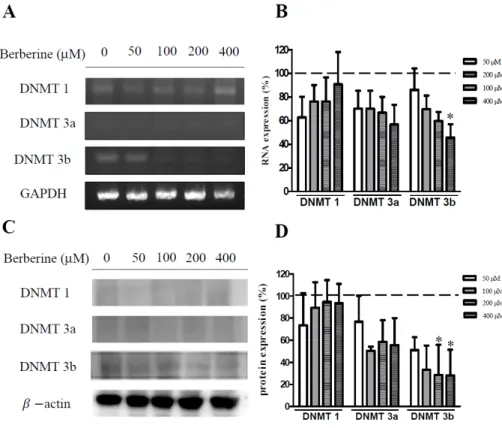
Since berberine treatment decreased DNMT enzymatic activity, we determined if the decrease in DNMT activity was due to decreased expression and/or synthesis of DNMT. DNTM1, DNMT3a and DNMT3b mRNA expression levels and protein levels were examined by RT-PCR and Western blot analysis, respectively. Hep3B cells were treated with berberine (50, 100, 200, 400 M) for 24 hours. RT-PCR results show that the expression levels of DNMT1 and DNMT3a remain constant irrespective of berberine treatment (Figure 5A, B). In contrast, DNMT 3b levels significantly decreased at higher concentrations (>100 M) of berberine treatment. Western blot analysis showed similar results corresponding to the mRNA expression data with DNMT3b protein levels decreasing at higher concentrations of berberine (Figure 5C, D).

DISCUSSION

Berberine is an anti-oxidative compound present in

natural products such as phellodendron bark and

Coptis [27, 28], although berberine has been reported

(6)

Figure 5. RT-PCR and Western blot analysis of DNMT1, DNMT3a and DNMT3b. (A, B) Hep3B cells were cultured for 24 h with berberine (50, 100, 200, and 400 M) and RT-PCR analysis was performed for DNMT1, DNMT3a and DNMT3b. Densitometry analysis was performed by normalizing against GAPDH expression. Vertical bars indicate mean±SEM. * P <0.05.

(C, D) Hep3B cells were cultured for 24 h with berberine (50, 100, 200, and 400 M) and cell lysates analyzed for DNMT1, DNMT3a and DNMT3b by Western blot analysis. -actin was used as a control. Vertical bars indicate mean±SEM. * P <0.05. Results are expressed relative to mRNA and protein levels of untreated controls at each point using the set value 100 (horizontal dotted line).

to exert anti-proliferative effects on human colon cancer cells [29] and human esophageal cancer cells [30] as well as induction of apoptosis of human liver cancer cells via the mitochondrial pathway [31], there has been no reported cytotoxic side-effects of berberine. In the current study, we showed that berberine can induce cell death in the human hepatocellular cell line Hep3B. Based on the MTT assay, the growth inhibitory effect of berberine appears to be time- and dose-dependent (Figure 1). Furthermore, the anti-growth effect is in part due to induction of apoptosis as determined by annexin V staining (Figure 2). These results are consistent with the data previously reported where the human hepatic carcinoma cell line HepG2 cells are also susceptible to cell death and apoptosis after berberine treatment [31].

Epigenetic mechanisms such as DNA methylation exert a myriad of effects on hepatocellular carcinoma (HCC) disease. Examples include, the tumor suppressor gene RASSF1A [32], the critical risk factors for developing HCC are infection by hepatitis B virus (HBV), hepatitis C virus (HCV), aflatoxins, and chronic

alcoholism is an example of methylation [33]. These epigenetic mechanisms contribute to increased fre- quency of hyper-methylation of the tumor suppressor genes consequently increased HCC development [3].

Methylation of the RASSF1A promoter result in decreased RASSF1A expression and protein levels which ultimately promote growth of hepatocellular carcinoma [34, 35].

The ERK signaling pathway promotes cellular proliferation and berberine has been reported to decrease ERK pathway by inducing activation of AMPK [36, 37]. Downregulation of ERK pathway has been also shown for berberine-treated human glioblastoma cells [36]. Our results provide additional evidence that berberine down-regulates the ERK pathway in Hep3B cells (Figure 3).

Additionally, the results from the current study show that the inactivated tumor suppressor protein p53 [38]

is reactivated in the presence of berberine (Figure 3). In

Hep3B cells, p53 is methylated by DNMT and thus

inactive [3]. In a murine model of non-alcoholic fatty

liver disease (NAFLD), alteration of the DNA methy-

(7)

lation pattern normalized the abnormal increase in L-type Pyruvate Kinase (L-PK) gene [23]. Based on this report, we tentatively suggest that the induction of p53 in Hep3B cells by berberine was caused by decrease in DNMT3b expression. Many types of DNMT exist but DNA methylation is regulated predominantly by DNMT1, DNMT3a and DNMT3b. These three DNMT exert a direct effect on cell apoptosis. Our results indicate that of these three DNMTs examined, only DNMT3b expression and protein levels decreased in response to berberine treatment (Figure 5). It is possible that the decrease of DNMT3b was sufficient to induce apoptosis in Hep3B cells [7, 8]. We have yet to find a direct mechanistic link between DNAMT3b and p53.

However, it has been shown that 5-aza-deoxycytidine can induce demethylation of DNA resulting in activity of the p53 pathway and apoptosis [12]. Furthermore, berberine downregulated expression of DNMT1 and DNMT3b in the human multiple myeloma cell line U266 resulting in induction of apoptosis [22]. Another report further supports the connection between DNMT and p53 [39].

In a great number of the previous studies, berberine is direct or indirect effects and potential mechanisms on variety of human malignancies, including hepato- cellular carcinoma, have been investigated and elucidated. In this study, we revealed that the anticancer effect of berberine was related to p53 using Hep3B cell, a p53 inactivated cell, and the expression of p53 was related to DNMT expression for the first time.

These results may help to clarify the mechanism of anti-cancer effects of berberine.

요 약

종양 억제 유전자 p53은 인간 간암세포 Hep3B에서는 불활 성화되어 있다. 베르베린(berberine)은 암세포의 증식을 억제 하는 것으로 보고되어 있다. 우리는 베르베린을 처리한 Hep3B 세포에서 세포사멸이 유도되는지를 조사하였고 이 세포사멸이 p53과 DNA methyltransferase의 발현과 연관되어 있는지를 관찰하였다. MTT 분석을 통하여 세포 생존력을 측정하였다. 세

포사멸은 각각 Annexin V flow 세포 분석을 사용하여 측정하 였다. 베르베린이 처리된 세포에서 DNMT 효소 활성, mRNA 발현, 단백질 발현 정도가 검사되었으며, p53 단백질 발현은 웨 스턴 블롯 분석에 의해 검사되었다. 베르베린 처리는 시간 및 용 량 의존적으로 Hep3B세포의 세포사멸을 증가시켰다. 베르베 린 처리 시 DNMT3b의 활성 정도, mRNA 발현 그리고 단백질 발현 정도가 모두 감소되었다. 이와는 대조적으로, Hep3B에서 는 비활성인 p53 단백질의 발현은 DNMT3b의 감소와 동시에 증가했다. ERK의 발현은 변화가 없었으나, P-ERK의 발현은 농도 의존적으로 감소하는 것으로 나타났다. 이러한 결과는 Hep3B 세포에 베르베린의 처리는 DNMT3b의 발현을 감소시 켜서 종양 억제 유전자인 p53의 증가를 유도할 수 있고, 이를 통 해서 세포사멸을 증가 시킬 수 있다는 것을 나타낸다. 이는 베르 베린이 간암 세포의 증식 억제에 효과적으로 작용할 수 있음을 보여준다.

Acknowledgements: This study was supported by 2017 Research Grant from Kangwon National University (No.520170383) and Basic Science Research Program through the National Research Foundation of Korea (NRF) funded by the Ministry of Education (2018 R1D1A1B07043224).

Conflict of interest: None

Author’s information (Position): Kim DY

1

, Graduate student; Kim SH

1

, Graduate student; Cheong HT

1

, Professor; Ra CS

2

, Professor; Rhee KJ

3

, Professor; Jung BD

1

, Professor.

REFERENCES

1. Simonetti RG, Camma C, Fiorello F, Politi F, D’amico G, Pagliaro L. Hepatocellular carcinoma a worldwide problem and the major risk factors. Dig Dis Sci. 1991;36:962-972.

2. Baylin SB, Herman JG. DNA hypermethylation in tumorigenesis:

epigenetics joins genetics. Trends Genet. 2000;16:168-174.

https://doi.org/10.1016/S0168-9525(99)01971-X

3. Park HJ, Yu E, Shim YH. DNA methyltransferase expression and DNA hypermethylation in human hepatocellular carcinoma.

Cancer Lett. 2006;233:271-278. https://doi.org/10.1016/j.canlet.

2005.03.017

4. Oh B-K, Kim H, Park HJ, Shim YE, Choi J, Park C, et al. DNA methyltransferase expression and DNA methylation in human hepatocellular carcinoma and their clinicopathological cor- relation. Int J Mol Med. 2007;20:65-73. https://doi.org/10.3892/

ijmm.20.1.65

(8)

5. Rovertson KD. DNA methylation, methyltransferases, and cancer.

Oncogene. 2001;20:3139-3155.

6. Bestor TH. Activation of mammalian DNA methyltransferase by cleavage of a Zn binding regulatory domain. EMBO J. 1992;11:

2611-2617. https://doi.org/10.1002/j.1460-2075.1992.tb05326.x 7. Schneider-Stock R, Ocker M. Epigenetic therapy in cancer: mo-

lecular background and clinical development of histone deacety- lase and DNA methyltransferase inhibitors. IDrugs. 2007;10:

557-561.

8. Okano M, Bell DW, Haber DA, Li E. DNA methyltransferases Dnmt3a and Dnmt3b are essential for de novo methylation and mammalian development. Cell. 1999;99:247-257. https://doi.

org/10.1016/S0092-8674(00)81656-6

9. Vertino PM, Yen R-W C, Gao J, Baylin SB. De novo methylation of CpG island sequences in human fibroblasts overexpressing DNA (Cytosine-5-)-Methyltransferase. Mol Cell Biol. 1996;16:4555-4565.

https://doi.org/10.1128/mcb.16.8.4555

10. Rhee I, Jair KW, Yen R-W C, Lengauer C, Herman JG, Kinzler KW, et al. CpG methylation is maintained in human cancer cells lacking DNMT1. Nature. 2000;404:1003-1007. https://doi.

org/10.1038/35010000

11. Tate PH, Bird AP. Effects of DNA methylation on DNA-binding proteins and gene expression. Curr Opin Genet Dev. 1993;3:

226-231. https://doi.org/10.1016/0959-437x(93)90027-m 12. Alan Wang Y, Kamarova Y, Shen KC, Jiang Z, Hahn MJ, Wang Y,

et al. DNA methyltransferase-3a interacts with p53 and represses p53-mediated gene expression. Cancer Biol Ther. 2005;4:1138- 1143. https://doi.org/10.4161/cbt.4.10.2073

13. Varela M, Real MI, Burrel M, Fomer A, Sala M, Brunet M, et al.

Chemoembolization of hepatocellular carcinoma with drug elut- ing beads: Efficacy and doxorubicin pharmacokinetics. J Hepatol.

2007;46:474-481. https://doi.org/10.1016/j.jhep.2006.10.020 14. Duffy A, Greten T. Developing better treatments in hepatocellular

carcinoma. Expert Rev Gastroenterol Hepatol. 2014;4:551–560.

https://doi.org/10.1586/egh.10.58

15. Engel N, Oppermann C, Falodun A, Kragl U. Proliferative effects of five traditional Nigerian medicinal plant extracts on human breast and bone cancer cell lines. J Ethnopharmacol. 2011;

137:1003-1010. https://doi.org/10.1016/j.jep.2011.07.023 16. Wu HL, Chuang TY, Diamond MP, Azziz R, Chen Y-H.

Berberine inhibits the proliferation of human uterine leio- myoma cells. Fertil Steril. 2015;103:1098-1106. https://doi.

org/10.1016/j.fertnstert.2015.01.010

17. Xu J, Long Y, Ni L, Yuan X, Yu N, Wu R, Tao J, Zhang Y. Anticancer effect of berberine based on experimental animal models of vari- ous cancers: a systematic review and meta-analysis. BMC Cancer.

2019;19:589. https://doi.org/10.1186/s12885-019-5791-1 18. Guo P, Cai C, Wu X, Fan X, Huang W, Zhou J, Wu Q, Huang Y,

Zhao W, Zhang F, Wang Q, Zhang Y, Fang J. An insight into the molecular mechanism of berberine towards multiple cancer types through systems pharmacology. Front Pharmacol.

2019;10:857. https://doi.org/10.3389/fphar.2019.00857 19. Kim S, Choi JH, Kim JB, Nam SJ, Yang J-H, Kim J-H, et al.

Berberine Suppresses TNF--induced MMP-9 and Cell Invasion through Inhibition of AP-1 Activity in MDA-MB-231 Human Breast Cancer Cells. Molecules. 2008;13:2975-2985. https://doi.

org/10.3390/molecules13122975

20. Peng P-L, Hsieh Y-S, Wang C-J, Hsu J-L, Chou F-P. Inhibitory ef- fect of berberine on the invasion of human lung cancer cells via decreased productions of urokinase-plasminogen activator and matrix metalloproteinase-2. Toxicol Appl Pharmacol. 2006;214:

8-15. https://doi.org/10.1016/j.taap.2005.11.010

21. Gupta SC, Kim JH, Prasad S, Aggarwal BB. Regulation of survival, proliferation, invasion, angiogenesis, and metastasis of tumor cells through modulation of inflammatory pathways by nutraceuticals. Cancer Metastasis Rev. 2010;29:405-434.

https://doi.org/10.1007/s10555-010-9235-2

22. Qing Y, Hu H, Liu Y, Feng T, Meng W, Jiang L, et al. Berberine in- duces apoptosis in human multiple myeloma cell line U266 through hypomethylation of p53 promoter. Cell Biol Int.

2013;38:563-570. https://doi.org/10.1002/cbin.10206

23. Zhang Y, C,hang X, Song X, Chen C, Chen H, Lu Z, et al.

Berberine reverses abnormal expression of L-type pyruvate kin- ase by DNA demethylation and histone acetylation in the livers of the non-alcoholic fatty disease rat. Int J Clin Exp Med. 2015;

8:7535-7543.

24. Puisieux A, Galvin K, Troalen F, Bressac B, Marcais C, Galun E, et al. Retinoblastoma and p53 tumor suppressor genes in human hepatoma cell lines. FASEB. 1993;7:1407-1413. https://doi.

org/10.1096/fasebj.7.14.8224613

25. Levine AJ. p53, the cellular gatekeeper review for growth and division. Cell. 1997;88:323-331. https://doi.org/10.1016/s0092- 8674(00)81871-1

26. Wang H, Li K, Ma L, Wu S, Hu J, Yan H, et al. Berberine inhibits enterovirus 71 replication by downregulating the MEK/ERK sig- naling pathway and autophagy. Virol. 2017;14:2. https://doi.

org/10.1186/s12985-016-0674-4

27. Hwang JM, Wang CJ, Chou FP, Tseng TH, Hsieh YS, Lin WL, et al.

Inhibitory effect of berberine on tert-butyl hydroperoxide-in- duced oxidative damage in rat liver. Arch Toxicol. 2002;76:

664-670. https://doi.org/10.1007/s00204-002-0351-9

28. Yokozawa T, Ishida A, Kashiwada Y, Cho EJ, Kim HY, Ikeshiro Y.

Coptidis Rhizoma: protective effects against peroxynitrite-in- duced oxidative damage and elucidation of its active components. J Pharm Pharmacol. 2004;56:547-556. https://doi.

org/10.1211/0022357023024

29. Fukuda K, Hibiya Y, Mutoh M, Koshiji M, Akao S, Fujiwara H.

Inhibition by berberine of cyclooxygenase-2 transcriptional ac- tivity in human colon cancer cells. Ethnopharmacol. 1999;66:

227-233. https://doi.org/10.1016/s0378-8741(98)00162-7 30. Iizuka N, Miyamoto K, Okita K, Tangoku A, Hayashi H, Yosino S,

et al. Inhibitory effect of Coptidis Rhizoma and berberine on the proliferation of human esophageal cancer cell lines. Cancer Lett.

2000;148:19-25. https://doi.org/10.1016/s0304-3835(99)00264-5 31. Wang N, Feng Y, Zhu M, Tsang C-H, Man K, Tong Y, et al.

Berberine induces autophagic cell death and mitochondrial apoptosis in liver cancer cells: the cellular mechanism. . J Cell Biochem. 2010;111:1426-1436. https://doi.org/10.1002/jcb.22869 32. Zhang YJ, Ahsan H, Chen Y, Lunn RM, Wang LY, Chen SY, et al.

High frequency of promoter hypermethylation of RASSF1A and p16 and its relationship to aflatoxin B1–DNA adduct levels in hu- man hepatocellular carcinoma. Mol Carcinog. 2002;35:85-92.

https://doi.org/10.1002/mc.10076

33. Lambert MP, Paliwal A, Vaissiere T, Chemin I, Zoulim F,

(9)

Tommasino M, et al. Aberrant DNA methylation distinguishes hepatocellular carcinoma associated with HBV and HCV in- fection and alcohol intake. J Hepatol. 2011;54:705-715.

https://doi.org/10.1016/j.jhep.2010.07.027

34. Yeo W, Wong N, Wong WL, Lai PB.S, Zhong S, Johnson PJ. High frequency of promoter hypermethylation of RASSF1A in tumor and plasma of patients with hepatocellular carcinoma. Liver Int.

2005;25:266-272. https://doi.org/10.1111/j.1478-3231.2005.01084.x 35. Hu L, Chen G, Yu H, Qiu X. Clinicopathological significance of

RASSF1A reduced expression and hypermethylation in hep- atocellular carcinoma. Hepatol Int. 2010;4:423-432. https://doi.

org/10.1007/s12072-010-9164-8

36. Liu Q, Xu X, Zhao M, Wei Z, Li X, Zhang X, et al. Berberine in- duces senescence of human glioblastoma cells by downregulating the EGFR–MEK–ERK signaling pathway. Mol Cancer Ther.

2014;14:355-363. https://doi.org/10.1158/1535-7163.mct-14-0634 37. Kim HS, Kim M, Kim EJ, Yang Y, Lee MS, Lim JS. Berberine-in-

duced AMPK activation inhibits the metastatic potential of mela- noma cells via reduction of ERK activity and COX-2 protein expression. Biochem Pharmacol. 2012;83:385-394. https://doi.

org/10.1016/j.bcp.2011.11.008

38. Friedman SL, Shaulian E, Littlewood T, Resnitzky D, Oren M.

Resistance to p53-mediated growth arrest and apoptosis in Hep 3B hepatoma cells. Oncogene. 1997;15:63-70. https://doi.

org/10.1038/sj.onc.1201149

39. Estève P-O, Chin HG, Pradhan S. Human maintenance DNA (cytosine-5)-methyltransferase and p53 modulate expression of p53-repressed promoters. Proc Natl Acad Sci USA. 2005;102:

1000-1005. https://doi.org/10.1073/pnas.0407729102

수치

Figure 1. Berberine inhibits cell proliferation of Hep3B cells. Hep3B  cells  (4×10 4   cells/mL)  were  seeded  in  a  96-well  plate
Figure  4.  Berberine  decreases  DNMT  enzymatic  activity  in  Hep3B  cells.  Hep3B  cells  were  cultured  for  24  h  with  berberine  (50,  100,  200,  and  400  M)  and  nuclear  proteins  isolated
Figure  5.  RT-PCR  and  Western  blot  analysis  of  DNMT1,  DNMT3a  and  DNMT3b.  (A,  B)  Hep3B  cells  were  cultured  for  24  h  with  berberine  (50,  100,  200,  and  400  M)  and  RT-PCR  analysis  was  performed  for  DNMT1,  DNMT3a  and  DNMT3b

참조

관련 문서

A study on the mechanisms by which the aqueous extract of Inonotus obliquus induces apoptosis and inhibits proliferation in HT-29 human colon cancer

Salinomycin Induces Apoptosis in PC-3 Human Prostate Cancer Cells via G1 Cell Cycle Arrest and Ca 2+ -Dependent Mitochondrial Pathway.. Kwang youn Kim, Sun nyoung

Sanguinarine, a benzophenanthridine alkaloid, induces apoptosis in MDA-MB-231 human breast carcinoma cells through a reactive oxygen species-mediated mitochondrial

PAX2 binds to the promoter of BAX and inhibits its expression; therefore, PAX2 inhibition is associated with increased levels of BAX, which induces apoptosis of HeLa cells via

In this study, we investigated the effect of resveratrol on A549 lung cancer cells (expressing wild-type p53) and compared it with that observed for SKOV3 ovarian

18beta- glycyrrhetinic acid induces apoptosis through modulation of Akt/FOXO3a/Bim pathway in human breast cancer MCF-7 cells.. 18Beta-glycyrrhetinic acid

Red pepper seed water extract inhibits preadipocyte differentiation and induces mature adipocyte apoptosis in 3T3-L1 cells.. Hwa-Jin Kim 2 , Mi-Kyoung You 3 , Young-Hyun Lee 1

Deoxypodophyllotoxin Induces G2/M cell cycle arrest and apoptosis in SGC-7901 cells and inhibits tumor growth in vivo. Anthricin Isolated from Anthriscus sylvestris