• 검색 결과가 없습니다.

Endovascular Rescue of a Narrowed Aorto-Aortic Bypass Graft in a Patient with Takayasu’s Arteritis

N/A
N/A
Protected

Academic year: 2021

Share "Endovascular Rescue of a Narrowed Aorto-Aortic Bypass Graft in a Patient with Takayasu’s Arteritis"

Copied!
4
0
0

로드 중.... (전체 텍스트 보기)

전체 글

(1)

ISSN: 2233-601X (Print) ISSN: 2093-6516 (Online)

− 556 −

Departments of

1

Thoracic and Cardiovascular Surgery,

2

Radiology, and

3

Division of Cardiology, Heart Center, Gachon University Gil Medical Center, Gachon University

Received: January 21, 2014, Revised: March 17, 2014, Accepted: March 18, 2014, Published online: December 5, 2014

Corresponding author: Chul Hyun Park, Department of Thoracic and Cardiovascular Surgery, Gachon University Gil Medical Center, 21 Namdong-daero 774beon-gil, Namdong-gu, Incheon 405-760, Korea

(Tel) 82-32-460-8426 (Fax) 82-32-460-3668 (E-mail) [email protected]

C

The Korean Society for Thoracic and Cardiovascular Surgery. 2014. All right reserved.

CC
This is an open access article distributed under the terms of the Creative Commons Attribution Non-Commercial License (http://creative- commons.org/licenses/by-nc/3.0) which permits unrestricted non-commercial use, distribution, and reproduction in any medium, provided the original work is properly cited.

Endovascular Rescue of a Narrowed Aorto-Aortic Bypass Graft in a Patient with Takayasu’s Arteritis

Kuk Hui Son, M.D., Ph.D.

1

, Ji Sung Kim, M.D.

1

, Jeong Ho Kim, M.D.

2

, Wook-Jin Chung, M.D., Ph.D.

3

, Sujoa Ahn, M.D.

2

, Chul Hyun Park, M.D., Ph.D.

1

We report a case of successful endovascular treatment of a pseudoaneurysm and the obstruction of an aorto-aortic bypass graft, which had been performed to treat Takayasu’s arteritis fifteen years prior, at the thoracic aorta. Along with the immediate relief of proximal hypertension that had caused severe heart failure, the successful exclusion of the pseudoaneurysm and the patency of the stem graft were maintained three years after the procedure.

Key words: 1. Aortic Aneurysm 2. Stents

3. Vascular disease

CASE REPORT

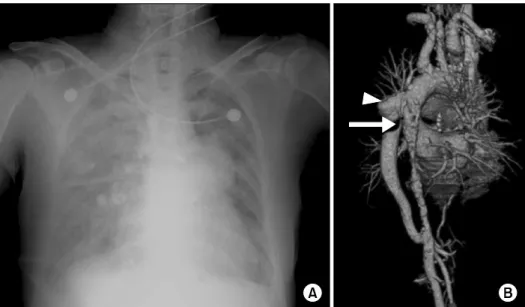
A 59-year-old female visited an emergency room of Gachon University Gil Medical Center due to dyspnea that had lasted for five days. The initial blood pressure in her right arm was 220/100 mmHg, and her respiration rate was 40 breaths per minute. Chest radiography revealed car- diomegaly, a prominent aortic notch, and pulmonary edema, which explained her tachypnea and arterial hypoxemia (Fig.

1A). The laboratory data was as follows: creatine kinase-MB, 1.20 ng/mL; troponin I, 0.08 ng/mL; brain natriuretic peptide, 5,850 pg/mL; creatinine, 1.3 mg/dL; C-reactive protein, 12.30 mg/L; and an erythrocyte sedimentation rate of 1.1 mm/hr.

An electrocardiogram showed sinus tachycardia with a Q wave on V1, ST segment elevation from V1 to V3, and T wave inversion on anterior precordial and inferior limb leads.

Echocardiography showed akinesia of the anterior wall ante-

roseptum, and inferoseptum from the low middle left ven- tricle to the apex with thinning and a preserved ejection frac- tion of 50% with left ventricular hypertrophy. The medical history taken from the patient’s family revealed that she had been diagnosed with hypertension, Takayasu’s arteritis, and cerebral infarction at another hospital fifteen years ago. In ad- dition, an aortic bypass graft procedure carried out to treat thoracic aortic stenosis 15 years ago. When the patient pre- sented to an emergency room of Gachon University Gil Medical Center she had left hemiparesis as the sequel of her previous stroke.

Computed tomography revealed severe stenosis in the de- scending thoracic aorta and diffuse circumferential wall calci- fications (Fig. 1B). Wall thickening was also observed in the distal portion of the aortic arch and in the left common car- otid artery. Between the proximal descending thoracic aorta and supraceliac abdominal aorta, there was a bypass graft,

Korean J Thorac Cardiovasc Surg 2014;47:556-559 □ Case Report □

http://dx.doi.org/10.5090/kjtcs.2014.47.6.556

(2)

Occluded Aorto-Aortic Bypass Graft

− 557 −

Fig. 1. Chest radiograph and computed tomography scan before the stent graft procedure. (A) Chest radiograph taken in the emergency room showing cardiomegaly and pulmonary edema. The aortic notch was prominent. (B) Computed tomography image showing severe stenosis in the descending thoracic aorta and diffuse circumferential wall calcification. Vascular wall thickening was observed in the distal portion of the aortic arch and in the left common carotid artery. The bypass graft was from the distal aortic arch to the abdominal aorta above the celiac trunk. There was a 3-cm pseudoaneurysm (arrowhead) and severe luminal stenosis in the proximal segment of the by- pass graft (arrow).

which had a 3-cm pseudoaneurysm at the proximal anasto- mosis and severe luminal stenosis at its proximal segment.

Endovascular repair was performed to treat the pseudoa- neurysm and graft stenosis simultaneously. Under general an- esthesia, the descending aorta was accessed via a right com- mon femoral artery puncture. After the narrowed proximal portion of the graft was dilated with a 12×4 cm balloon cath- eter (Ultrathin; Boston Scientific, Natick, MA, USA), a ta- pered stent graft (proximal diameter 32 mm, distal diameter 24 mm, length 10 cm; Seal, S&G Biotech Co., Seongnam, Korea) was implanted from the proximal descending aorta in- to the bypass graft. The bare stent portion of the stent graft was deployed proximally to the left subclavian artery. To re- lieve the stenosis at the middle portion of the graft, a bare metal stent 28 mm in diameter and 8 cm in length (Hercules;

S&G Biotech Co.) was implanted. The absence of a pressure gradient between the stent graft and the distal native aorta was confirmed before the catheter and sheath were removed.

The patient was extubated three days after the endovascular stent graft procedure. Postoperative computed tomography showed good stent graft patency in the descending thoracic

aorta and that the pseudoaneurysm was thrombosed (Fig. 2B).

The patient was discharged uneventfully with no pressure difference between the right arm and the legs. She showed no complications for three years after the stent graft procedure, and a follow-up computed tomography scan showed that the graft was patent and that the size of the pseudoaneurysm re- mained unchanged.

DISCUSSION

Atypical aortic coarctation has been reported to occur any-

where along the length of the aorta, except in the ascending

aorta [1]. Atypical aortic coarctation is a rare condition that

is associated with Takayasu’s arteritis, fibromuscular dyspla-

sia, congenital hypoplasia, and atherosclerosis [1-3]. Extra-

anatomical bypass, aortic patch plasty, anatomic graft inter-

position, and stent-graft insertion have been reported as surgi-

cal treatments for atypical aortic coarctation [4]. Although the

medical records of our patient’s first operation had been lost,

we speculate that she underwent extra-anatomical aortic by-

pass grafting because of the coarctation-like features of her

(3)

Kuk Hui Son, et al

− 558 −

Fig. 2. Angiography and computed tomography after stent grafting. (A) The narrowed portion of the proximal graft was dilated with a 12 mm×4 cm balloon catheter (Ultrathin, Boston Scientific) and a 32 mm (proximal diameter)×24 mm (distal diameter)×10 cm (length) aortic stent graft (Seal, S&G) and a 28 mm×8 cm vascular stent (Hercules, S&G) were implanted. (B) Computed tomography image taken ten days after stent placement showing a patent aortic stent graft in the descending thoracic aorta and the thrombosed aortic pseudoaneurysm.

descending aorta.

Taketani et al. [3] reviewed outcomes of the surgical treat- ment of atypical aortic coarctation complicating Takayasu’s arteritis in 33 consecutive patients over 44 years, and re- ported 10 anastomotic aneurysms, one case of anastomotic stenosis, and two cases of graft deterioration. In another re- view of 106 Takayasu’s arteritis patients who underwent vari- ous arterial reconstruction procedures, 31 anastomotic aneur- ysms occurred in 19 patients [5]. The overall primary 10-year cumulative patency rates of carotid, subclavian, aorto-aortic, renal, and mesenteric arterial reconstructions were 88%, 64%, 100%, 68%, and 67%, respectively [5]. Although this review demonstrated excellent patency rates for aorto-aortic bypasses [5], our patient displayed symptoms of heart failure because of the stenosis of her graft. After a computed tomography ex- am, we determined that the bypass graft obstruction caused increased afterload and impeded myocardial function. Uwabe et al. [6] reported on a patient with an occluded hypoplastic descending thoracic aorta that required re-operation because of graft failure between the descending thoracic aorta and the infrarenal abdominal aorta. This patient also had a history of Takayasu’s arteritis. Although performing an axillobifemoral

bypass was a surgical option, they chose to perform an as- cending-descending aortic bypass because doing so was ex- pected to result in improved long-term patency and to more effectively reduce left ventricle afterload [6].

In conclusion, we believe that endovascular repair, if fea- sible, is safer than other options for treating complications of aorto-aortic bypasses, which occur frequently when they are performed to treat Takayasu’s arteritis. Based on our literature search on PubMed, this report is the first of its kind.

CONFLICT OF INTEREST

No potential conflict of interest relevant to this article was reported.

REFERENCES

1. Lande A. Takayasu’s arteritis and congenital coarctation of the descending thoracic and abdominal aorta: a critical review. AJR Am J Roentgenol 1976;127:227-33.

2. Janzen J, Vuong PN, Rothenberger-Janzen K. Takayasu’s ar-

teritis and fibromuscular dysplasia as causes of acquired

atypical coarctation of the aorta: retrospective analysis of

(4)

Occluded Aorto-Aortic Bypass Graft

− 559 − seven cases. Heart Vessels 1999;14:277-82.

3. Taketani T, Miyata T, Morota T, Takamoto S. Surgical treat- ment of atypical aortic coarctation complicating Takayasu’s arteritis: experience with 33 cases over 44 years. J Vasc Surg 2005;41:597-601.

4. Keith DS, Markey B, Schiedler M. Successful long-term stenting of an atypical descending aortic coarctation. J Vasc

Surg 2002;35:166-7.

5. Miyata T, Sato O, Koyama H, Shigematsu H, Tada Y.

Long-term survival after surgical treatment of patients with Takayasu’s arteritis. Circulation 2003;108:1474-80.

6. Uwabe K, Okada O, Harada M. Ascending to descending aor-

ta bypass for middle aortic syndrome. Circ J 2007;71:1162-3.

수치

Fig. 1. Chest radiograph and computed tomography scan before the stent graft procedure
Fig. 2. Angiography and computed tomography after stent grafting. (A) The narrowed portion of the proximal graft was dilated with a 12  mm×4 cm balloon catheter (Ultrathin, Boston Scientific) and a 32 mm (proximal diameter)×24 mm (distal diameter)×10 cm (l

참조

관련 문서

success rates of dental implants placed at the time of or after alveolar ridge augmentation with an autogenous mandibular bone graft and titanium mesh: a 3-to

At the end of the study, a reevaluation of each study case was performed with the same questionnaire. The result shows there has been a meaningful result in the group

[r]

8.50… thin-walled, closed x-s of arbitrary shape subjected to an applied torque, assumed to be in a state of uniform torsion, axial strain and stress components vanish  n(s)

It considers the energy use of the different components that are involved in the distribution and viewing of video content: data centres and content delivery networks

After first field tests, we expect electric passenger drones or eVTOL aircraft (short for electric vertical take-off and landing) to start providing commercial mobility

1 John Owen, Justification by Faith Alone, in The Works of John Owen, ed. John Bolt, trans. Scott Clark, "Do This and Live: Christ's Active Obedience as the

- distributes indexes across multiple computers and/or multiple sites - essential for fast query processing with large numbers of documents - many variations: