• 검색 결과가 없습니다.

A Treatment Case of Endoscopic Removal of Left Ventricular Thrombus, During Coronary Artery Bypass Graft

N/A
N/A
Protected

Academic year: 2021

Share "A Treatment Case of Endoscopic Removal of Left Ventricular Thrombus, During Coronary Artery Bypass Graft"

Copied!
3
0
0

로드 중.... (전체 텍스트 보기)

전체 글

(1)

Korean J Thorac Cardiovasc Surg 2014;47:434-436 □ How to do it □ http://dx.doi.org/10.5090/kjtcs.2014.47.4.434 ISSN: 2233-601X (Print) ISSN: 2093-6516 (Online)

− 434 −

Departments of

1

Thoracic and Cardiovascular Surgery and

2

Family Medicine, Kangwon National University School of Medicine Received: November 1, 2013, Revised: November 30, 2013, Accepted: December 1, 2013, Published online: August 5, 2014

Corresponding author: Hyun-Seok Park, Department of Thoracic and Cardiovascular Surgery, Kangwon National University Hospital, Kangwon National University School of Medicine, 156 Baengnyeong-ro, Chuncheon 200-722, Korea

(Tel) 82-33-241-5740 (Fax) 82-33-241-5740 (E-mail) [email protected]

C

The Korean Society for Thoracic and Cardiovascular Surgery. 2014. All right reserved.

CC
This is an open access article distributed under the terms of the Creative Commons Attribution Non-Commercial License (http://creative- commons.org/licenses/by-nc/3.0) which permits unrestricted non-commercial use, distribution, and reproduction in any medium, provided the original work is properly cited.

A Treatment Case of Endoscopic Removal of Left Ventricular Thrombus, During Coronary Artery Bypass Graft

Hyun-Seok Park, M.D.

1

, Se-Min Ryu, M.D.

1

, Seong-Joon Cho, M.D.

1

, Sung-Min Park, M.D.

1

, Sun-Hye Lim, M.D.

2

Left ventricular thrombus is a common complication related to acute myocardial infarction. Removing this with an incision of the free wall of the left ventricle may cause fatal cardiac dysfunction or arrhythmias. Furthermore, per- forming incision and suture on the fragile myocardium of an acute myocardial infarction patient may cause serious bleeding complications. If there is a patient with left ventricular thrombus who needs thoracotomy for another rea- son, the case is attempted with the thought that if effective intraventricular visualization and manipulation can be done, fatalities caused by incision and suture may be reduced. For patients undergoing cardiopulmonary bypass, if intracardiac manipulation is required, an endoscope can be used, and given the potential complications after the in- cision and suturing of the infarcted tissue, the benefits are deemed sufficient.

Key words: 1. Thrombus

2. Coronary artery bypass grafting 3. Endoscopy

CASE REPORT

A 63-year-old male patient with underlying diseases of cer- ebral infarction, diabetes, hypertension, and hyperlipidemia, which occurred about 15 years previously, was admitted to the emergency room at the hospital due to chest pain and dyspnea, which had been worsening steadily starting about 6 days before presentation. The patient had been suffering from intermittent dyspnea and chest pain, which had started to in- crease in frequency and symptoms about a month ago, ac- companied by sensations of body swelling. Although the pa- tient was diagnosed with hypertension several years back, he had not been taking any medication and was not aware of any diabetes or hyperlipidemia. His vital signs were checked

on the day of his visit and were as follows: blood pressure at 120/80 mmHg, heart rate at 79 breaths per minute (bpm), respiratory rate at 20 bpm, and body temperature at 36.9

o

C.

Electrocardiography was done, which indicated ST-segment

depression in the precordial lead V5, V6, as well as T-wave

inversion, and the results of a laboratory test showed that car-

diac enzymes had increased (creatine kinase-myocardial band

at 3.6 ng/mL, myoglobin at 119 ng/mL, troponin-I at 5.52

ng/mL, and brain natriuretic peptide at 643 pg/mL). Accor-

dingly, a diagnosis of non-ST segment elevation myocardial

infarction was made, and the patient was admitted to the car-

diology department at the hospital and had coronary arteriog-

raphy (CAG) done. The CAG showed critical stenosis in the

proximal right coronary artery (RCA) and chronic occlusive

(2)

A Treatment Case of Endoscopic Removal of Left Ventricular Thrombus, During Coronary Artery Bypass Graft

− 435 −

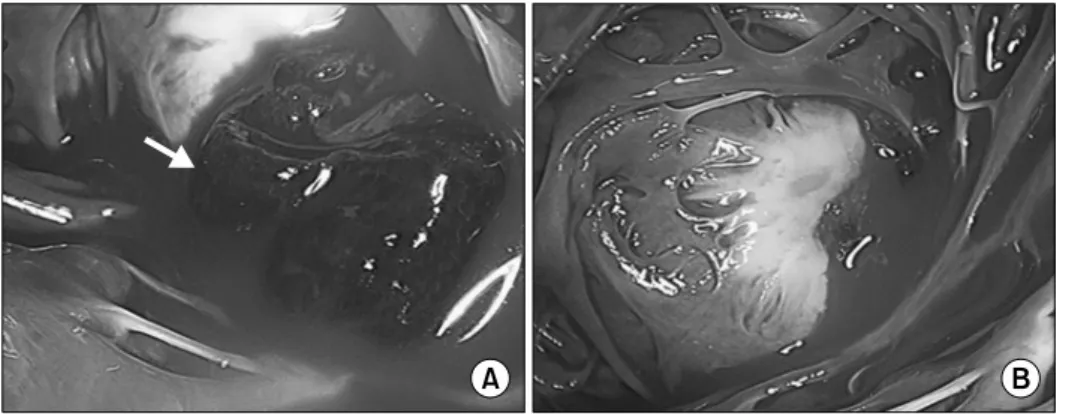
Fig. 2. Intraoperative findings. (A) Left ventricular thrombus (arrow). (B) Same region after removal.

Fig. 1. Preoperative echocardiography finding: hypoechogenic, mo- bile thrombus was observed (arrows).

lesion in the proximal left anterior descending coronary artery (LAD). The patient was transferred over to the department of thoracic and cardiovascular surgery in order to undergo emer- gent coronary artery bypass grafting. In the transthoracic echocardiography (TTE) done during the preoperative evalua- tion, left ventricular (LV) ejection fraction of 40% was ob- served, as well as LV dilatation, and there was regional wall motion abnormality (RWMA) in the LV apex. RWMA was observed in the mid-to-apical region. Hypokinesia was shown on the mid portion. Akinesia was shown in the apical region and at the apex. A 1.75×1.48 cm mobile thrombus was also observed (Fig. 1).

Median sternotomy was done under general anesthesia. The left internal thoracic artery (LITA) was harvested, and at the same time, the left great saphenous vein was harvested in the lower knee. While performing heparin infusion, cardiopulmo-

nary bypass (CPB) was done under the left atrial vent. After aorta cross-clamping (ACC), cardioplegia was perfused via the antegrade route to induce cardiac arrest. There was ische- mic change in the LV apex area, so it was deemed that per- forming thrombus evacuation after the left ventriculotomy carried too much risk. Transverse aortotomy was done prox- imal to ACC to advance the endoscope up to the LV via the aortic valve to obtain the desired view, and evacuation was done using a pair of endoscopic forceps (Fig. 2). Although preoperative TTE indicated that the LV wall thickness was normal and infarction was already in progress, and under the judgment that the trabeculation may have been damaged within the LV, highly adhesive areas were not removed.

After the aortotomy was repaired, and after LITA to proximal LAD and aorto-proximal RCA anastomosis with a harvested saphenous vein graft, CPB weaning was done without any special events. The time taken for CPB was 355 minutes, while ACC took 218 minutes. The surgery ended with a total of four chest tubes left in both pleurae, the mediastinum, and the LV apex area. The patient was transferred to the car- diovascular care unit, and extubation was done the next day.

Anticoagulation was done using warfarin after the surgery, and thrombus was not found in the TTE done a month after the surgery (Fig. 3).

DISCUSSION

The left ventricular thrombus is a common complication

related to acute myocardial infarction [1]. For its evacuation,

an incision has to be made in the free wall of the left ven-

tricle, and the surgeon must check the structure within the

(3)

Hyun-Seok Park, et al

− 436 − Fig. 3. Follow-up echocardiography finding: 1 month after surgery, thrombus was not observed on apex of left ventricle.

other ventricles before removal. However, this process may cause fatal cardiac dysfunction or arrhythmias [2]. Further, for patients with acute myocardial infarction, the incision and suture of the fragile myocardium may cause serious bleeding complications [2]. If intra-ventricular visualization can be done effectively, the possibility of severe heart failure, ar- rhythmias, and bleeding complications, which may be caused by the incision and suture, may be reduced.

A report on the use of endoscopy in heart surgery has al- ready been published by Burke et al. [3], and an approach with an aortic root was attempted by Watanabe et al. [4].

Endoscopy has also been used for LV thrombectomy in adults by Kikuchi et al. [2] and Duarte et al. [5]. Notably, Duarte et al. [5] performed LV apical thrombectomy by using a 10-mm scope to access the LV in transverse aortotomy, which is a similar method to that used in the present case.

When using an endoscope in heart surgery, obtaining the appropriate view may prove to be an obstacle. However, for patients undergoing CBP, intracardiac visualization can be done easily. For simple procedures as in this case, desired re- sults can be obtained by using not a specific device but a standard endoscope. Considering potential complications after

the incision and suturing of the infarcted tissue, it is deemed that the present case has sufficient benefits.

With advancements in robotic surgery, minimally invasive surgery is becoming more established when it comes to car- diac surgery as well. According to Wiedemann et al. [6], ro- botic surgery, which includes the use of the endoscope owing to the advancements in medical imaging, will reduce un- necessary incisions. Minimally invasive surgery is being at- tempted using the endoscope in nearly all areas of adult car- diac surgery. Furthermore, when it comes to pediatric cardiac surgery as well, it is being done on an ever-increasing basis not only for extra-cardiac anomalies, such as patent ductus arteriosus closure but also in other congenial deformation areas.

CONFLICT OF INTEREST

No potential conflict of interest relevant to this article was reported.

REFERENCES

1. Osherov AB, Borovik-Raz M, Aronson D, et al. Incidence of early left ventricular thrombus after acute anterior wall my- ocardial infarction in the primary coronary intervention era.

Am Heart J 2009;157:1074-80.

2. Kikuchi C, Shimada K, Nakayama K, Ohzeki H. Video-as- sisted transaortic left ventricular thrombectomy and coronary artery bypass grafting. Gen Thorac Cardiovasc Surg 2009;

57:208-10.

3. Burke RP, Michielon G, Wernovsky G. Video-assisted car- dioscopy in congenital heart operations. Ann Thorac Surg 1994;58:864-8.

4. Watanabe H, Hayashi J, Takahashi M, Takekubo M, Tosaka Y. Aortic root endoscopy in pediatric cardiac operations for aortic valvuloplasty. J Card Surg 2002;17:398-9.

5. Duarte IG, Fenton KN, Brown WM 3rd. Video-assisted re- moval of left ventricular mass. Ann Thorac Surg 1997;

63:833-5.

6. Wiedemann D, Schachner T, Kocher A, Weidinger F,

Bonatti J, Bonaros N. Robotic totally endoscopic surgery for

congenital cardiac anomalies. Eur Surg 2011;43:212-7.

수치

Fig. 1. Preoperative echocardiography finding: hypoechogenic, mo- mo-bile thrombus was observed (arrows).

참조

관련 문서

The aims of this study are to evaluate the endoscopic modality for assessment of severity of ulcerative colitis during follow up and to know whether there

Patient had laparoscopic surgery on the adnexal tumor and excised tissue was removed through Douglas pouch incision by single surgeon.. Results: The mean age

Therefore, cTnT is a recommended biomarker for use in the detection of myocardial infarction (MI) and in acute coronary syndromes.[8] Indeed, several authors

The positive change pattern of CK-MB according to time on acute myocardiac infarction patient.. The positive change pattern of troponin-T according to time on

Approved clinical use of bone marrow stem cells for myocardial infarction treatment... Cardiac

It considers the energy use of the different components that are involved in the distribution and viewing of video content: data centres and content delivery networks

After first field tests, we expect electric passenger drones or eVTOL aircraft (short for electric vertical take-off and landing) to start providing commercial mobility

1 John Owen, Justification by Faith Alone, in The Works of John Owen, ed. John Bolt, trans. Scott Clark, "Do This and Live: Christ's Active Obedience as the