
온라인 청소년 비만예방 프로그램에 관한 체계적 문헌고찰
1박부경
1
경북대학교 간호대학 조교수
1
Systematic review on the online adolescent obesity prevention program
Bu Kyung Park
11College of Nursing, Kyungpook National University
Purpose: The purpose of this study was to identify the trend of online adolescent obesity prevention program abroad and its effectiveness on BMI, body fat, diet and physical activity, and other variables.
Methods: This study was conducted based on PRISMA guidelines for systematic review. A search of electronic biblographic database of Medline, CINAHL, HealthSTAR, ERIC from 2000 to 2017 was carried out to identify studies of RCT that included online adolescent obesity program. Results: Of 416 publications identified, 9 studies met inclusion and exclusion criteria. Five studies reported that BMI was significantly decreased after use of online program. Conclusion: More research on online adolescent obesity prevention program is required because adolescent obesity is sharply increasing but only few RCT or long-term studies were conducted on adolescent obesity in Korea,
Key words: Adolescents, BMI, education, obesity, online, prevention 주요어 : 청소년, BMI, 비만, 온라인, 교육
서 론
1 . 연구의 필요성
비만은 전 세계적으로 중요한 건강 이슈로 대두되고 있다. 미국의 National Health and Nutrition
Examination Survey (NHANES)의 보고에 의하면 미국 내 아동 및 청소년 비만은 최근 30년간 5%에서 21%로 증가하였고[1], 이러한 추세가 계속된다면 이는 가정과 국가에 큰 경제적 부담이 되어 2030년까지 8600억 달러 의 건강관리 비용을 차지할 것으로 예상되고 있다[2].
이와 같은 상황은 국내에서도 비슷한데, 최근 한국인의
Corresponding author :Bu Kyung Park
소속 : RN, PhD, College of Nursing, Kyungpook NationalUniversity, 680 Gukchabosangro, Jung-gu, Daegu 41944, South Korea Tel: +82-53-420-4929 Fax: +82-53-421-2758 E-mail:[email protected]
Received : Feb 15, 2018 Revised : Feb 27, 2018 Accepted : Mar 2, 2018
식생활 서구화와 신체활동 감소 및 영양 과잉 섭취 등 으로 인해 비만 인구가 급속히 증가하고 있으며, 그 중 청소년의 비만이 크게 증가하고 있다[3]. 2012년 아동 및 청소년의 비만율(만2세 - 18세)은 전체 9.6%, 남자 10.7%, 여자 8.3%이고, 연령별로는 12-18세에서 전체 14.1%, 남자 17.4%, 여자 10.0%로 가장 높았다[4].
청소년기는 신체 성장 및 정서발달이 급격히 일어나 는 시기이다. 이 시기는 건강 증진의 측면에서 중요한 시기인데, 그 이유는 이 시기에 형성된 건강 행동 양상 이 이후 성인기의 건강문제에 영향을 줄 수 있기 때문 이다[5]. 또한 청소년의 비만은 성인 비만으로의 이환율 이 높고, 고혈압, 고지혈증, 당뇨등과 같은 다양한 합병 증을 동반하며, 우울, 자존감 저하, 또래관계 문제 등 청 소년의 사회 심리적 문제와도 관련이 되기 때문에 청소 년 비만 예방을 위한 효과적인 중재가 필요하다[6].
청소년 비만은 식습관, 생활 습관, 가족과 학교를 포 함한 사회적 환경, 유전 등 복잡하고 다양한 원인에 의 해 야기된다고 알려져 있다[7]. 따라서 건강 증진을 위 한 중재가 광범위한 사회 물리적, 경제적, 정책적 중재 내용을 포함하지 않는다면, 근본적인 비만 유발행위를 수정하는 것은 불가능하다[7]. 실제로, 비만한 개개인의 식습관과 운동 습관을 바꾸는 데에만 초점을 두었던 전 통적인 비만 예방 중재는 가족이나 심리 사회적 요인까 지 중재에 포함한 연구에 비해 덜 효과적임이 밝혀졌다 [8].
2. 연구 목적
최근 인터넷과 무선 통신망과 같은 information technology(IT)의 발달은 건강 소비자들에게 좀 더 손쉬 운 건강 정보에의 접근 통로를 제공하였다[9]. 연령별로 인터넷 사용량을 봤을 때, 특히 청소년의 인터넷 사용량 이 높았다. Pew Research Center[10]에 따르면 95%의 미국 청소년이 인터넷을 사용하고 있으며, 그 중 31%는 온라인으로 건강, 다이어트, 운동 관련 정보를 검색하고 습득한다고 하였다. 또한 현재 다양한 비만 예방 프로그 램이 연구되고 있지만, 실제 간호 현장에서 비용-효과적 인 비만 예방 프로그램의 개발이 여전히 요구되고 있다 [11]. 따라서 온라인에 기반한 청소년 비만 예방 교육 프로그램이 많은 수의 청소년을 대상으로 한 효과적인 중재를 제공할 수 있을 것이다.
이에 본 연구에서는 국외에서 최근 시행된 온라인 청 소년 비만 예방 프로그램의 BMI(Body mass index)와 체지방 감량에 관한 효과를 분석함으로써 온라인 청소 년 비만 예방 프로그램의 실제적인 효과를 평가하고자 한다. 국내에서 많은 연구자들에 의해 온라인 청소년 건 강중재 연구가 활발히 진행되었고 현재까지도 증가하고 있다. 이러한 시점에 온라인 기반 청소년 건강교육이 활 발히 이루어진 외국의 사례를 검토해봄으로써 온라인 청소년 비만 예방 교육 프로그램 개발에 중요한 근거를 제공할 뿐 아니라 예상되는 장단점을 알고 국내 연구자 들이 좀 더 효과적인 프로그램 개발에 도움을 줄 수 있 을 것이다. 따라서 본 연구의 목적은 체계적인 문헌고찰 방법(systematic review)을 이용하여 (1) 2000년부터 2017년까지 시행된 온라인 청소년 비만 예방 프로그램 의 동향을 파악하고, (2) PRISMA의 체계적 문헌고찰 지 침에 따라 구체적인 문헌 선택 및 배제 기준을 바탕으 로 선정된 연구들의 BMI와 체지방 감소 효과 여부를 파 악함으로써 실제적인 비만 예방 효과를 평가하기 위함 이다.
연구 방법
1. 연구설계
본 연구는 Preferred Reporting Items for Systematic Reviews and Meta Analysis (PRISMA) 지 침에 따라 시행되었다[12]. PRISMA는 세계 각국의 중재 및 방법론에 관한 전문가들이 모여 능률적이고 합리적 인 systematic review와 meta analysis의 시행 및 보고 를 위해 고안한 체계적인 문헌고찰 지침이다. 본 연구에 서 PRISMA 지침이 선택된 이유는 이 지침이 27개의 체 크리스트와 4단계의 흐름도를 통해 문헌고찰 결과를 명 확히 보고할 수 있도록 도와주기 때문이다.
2. 문헌 선택 및 배제 기준
문헌 선택을 위한 기준은 다음과 같다: (1) 동료평가
저널(peer-reviewed journals)에 게재된 영문 논문일
것, (2) Randomized controlled trials(RCT) 연구일 것,
(3) 온라인 기반 중재연구일 것, (4) 청소년 또는 초, 중,
고등학생을 대상으로 한 연구일 것, (5) 측정가능한 객
관적 변화를 확인하기 위하여 체중 또는 BMI의 변화 또
는 식생활과 신체활동 양상의 변화가 종속변수에 포함 되어 측정된 연구일 것.
본 연구는 중재연구를 대상으로 하였기 때문에 문헌 배제 기준은 다음과 같다: (1) 비만예방을 위한 온라인 기반 중재가 없는 서술적 연구는 배제함, (2) 스마트폰 이나 타블렛을 사용한 연구는 스크린 크기나 무선 인터 넷 사용으로 인한 속도 저하 등의 이유로 컴퓨터를 이 용한 온라인 기반 중재연구와의 차이가 있을 수 있으므 로 제외함, (3) 그러나 연구배경(예를 들면, 학교, 지역 사회, 병원 등)에 따른 제한을 두지는 않음.
3. 문헌검색 전략( 데이터베이스와 검색어)
최근 시행된 온라인 청소년 비만 예방 프로그램의 동 향을 파악하기 위해 문헌검색 년도는 2000년 이후부터 2017년까지 제한하였다. 문헌검색은 전자 데이터베이스 (Electronic Database, DB)를 활용하여 (1) Medline, (2) Cumulative Index to Nursing and Allied Health Literature(CINAHL), (3) HealthSTAR, (4) Education Resources Information Center(ERIC)를 이용하였다.
사용된 검색어는 “adolescents”, “teen(or teenager)”, “Internet”, “online”, “Web-based”,
“obesity”, “diet”, “physical activity”, “BMI”,
“height”, “weight”를 조합하여 각각의 데이터베이스에 서 검색하였다.
4. 문헌의 질 평가
문헌 선택 및 배제 기준을 포함하는 근거표(evidence table)을 먼저 작성 한 다음, 그 표를 이용하여 검색된 문헌의 질을 두 명의 연구자가 독립적으로 평가하였다.
먼저 문헌검색전략을 이용하여 검색된 모든 논문의 제 목과 초록을 검토한 뒤, 근거표에 기준하여 모든 조건이 맞는 문헌들을 선택하여 다시 각 문헌 전체를 검토하였 다. 이 과정에서 두 연구자(간호학 박사학위 소지자와 박사과정생)는 독립적으로 수행된 결과를 서로 교차 확 인하였고, 이러한 확인 과정은 최종 문헌이 선택되기까 지 4차례 반복되었다.
5. 자료추출
문헌 선택 및 배제 기준에 의해 작성된 근거표와 본 연구의 목적에 따라 아래와 같은 정보가 최종 선택된
문헌들로부터 추출되었다: “저자, 연도, 표본수, 대조군, 부모의 참여여부, 이론적 기틀(theoretical framework), 측정변수 및 중재 이행여부(adherence), 연구결과, 연구 의 장, 단점”.
연구 결과
1. 체계적 문헌고찰 대상 문헌의 일반적 특성 및 연구 동향
총 416개의 검색된 문헌 중, 9개의 문헌이 선택 및 배제 기준에 부합하여 청소년을 대상으로 한 온라인 비 만 예방 프로그램에 대한 근거 평가를 위해 선택되었다 (Figure 1). 본 연구에서는 온라인 청소년 비만 예방 프 로그램의 효과를 증명한 무작위 대조군 실험연구 수 및 BMI 감소 등의 비만 예방 효과를 통계적으로 검증한 논 문 편수가 적어 메타분석을 통한 동질성 검정력과 효과 크기에 대한 확증적 분석결과를 얻기에는 제한이 있기 때문에 메타분석은 시행되지 않았다.
다수의 제외된 중재 연구들은 RCT 연구설계가 아니 거나, 종속변수에 체중 또는 BMI가 포함되지 않은 연구 들이었다. 5개의 연구가 부모와 같은 가족 구성원을 중 재에 포함하였다[13-17]. 일부 연구는 특정 인종(중국계 미국인, 아프리카계 미국인 등)을 대상으로 한 맞춤 프 로그램을 개발하여 제공하였다[13-15,17].
대부분의 연구에서 2그룹 중재를 실시하였으나 3그룹 (부모를 포함한 실험군, 부모를 제외한 실험군, 대조군) 설계[16] 또는 4그룹 (온라인프로그램 실험군, 프로그램 과 추가 중재 실험군, 프로그램과 문자 중재 실험군, 대 조군) 중재를 실시한 연구[18]도 있었다.
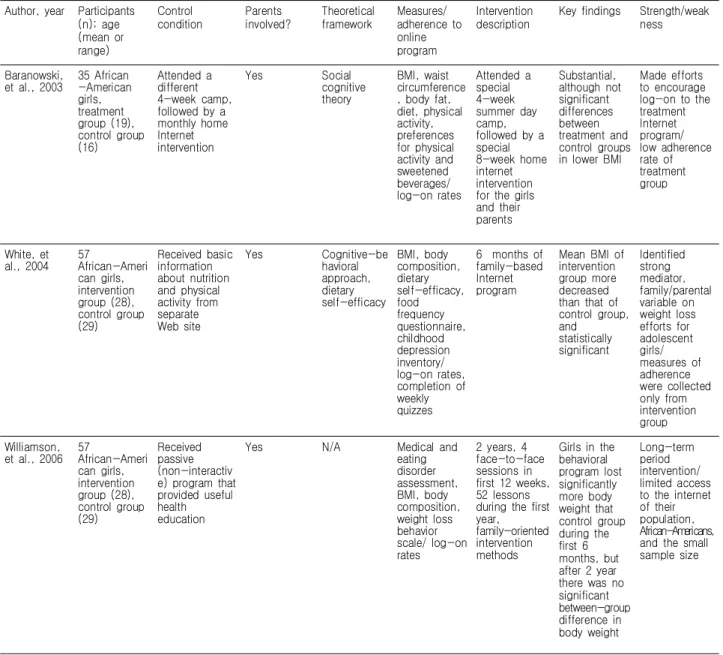
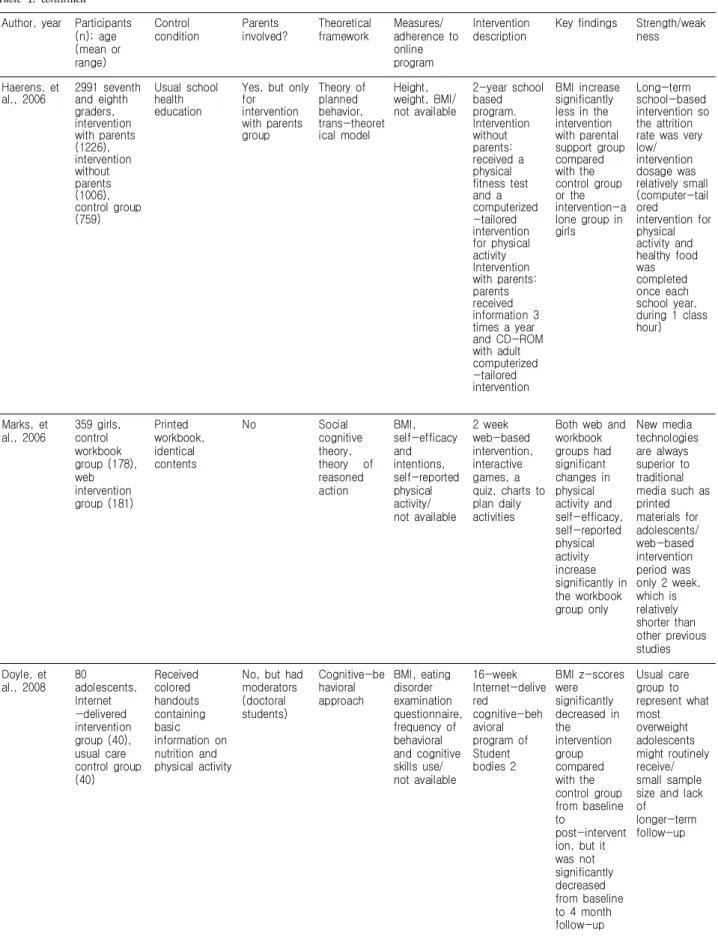
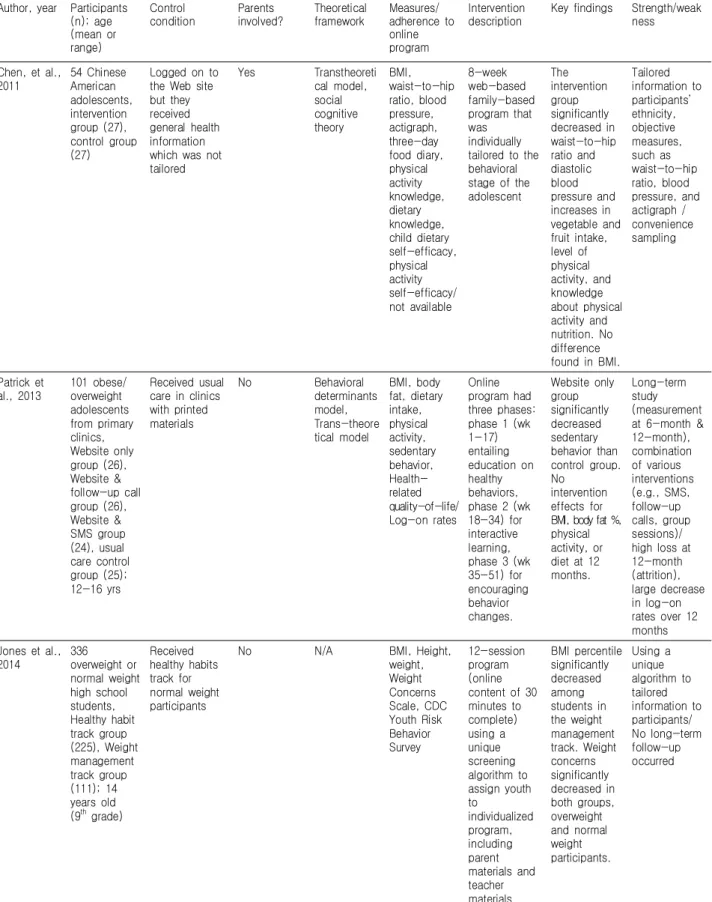
이론적 기틀을 이용하여 온라인 프로그램을 개발하거 나 중재 설계에 적용한 연구가 대부분이고, 사회인지이 론(social cognitive theory)이 가장 많이 적용되었다 [13,17,19]. 종속변수로는 문헌 선택 기준인 BMI나 체중 이외에도 허리와 엉덩이 둘레, 체지방량, 식생활과 신체 활동 정도, 자기 효능감, 섭식장애 증상 등을 측정하였 다(Table 1).
2. 온라인 청소년 비만 예방 프로그램의 BMI 와 체지방 감소 효과
모든 대상 문헌에서 공통적으로 측정되었던 BMI는 5
개 연구에서 통계적으로 유의한 차이가 측정되었다 [14-16,20,28]. 3개의 연구에서는 BMI가 중재 후 감소하 였지만 통계적으로 유의한 차이는 없었고[13,17,18], 1개 의 연구에서는 BMI를 사전조사에서만 측정하여 비교할 수 없었다[19].
BMI 다음으로 자주 측정되었던 종속변수로는 DEXA (또는 DXA: Dual energy X-ray absorptiometry)에 의 해 측정된 체지방량[13-15,18]과 자가 보고된 식생활 및 신체활동[13,14,17-19]이 있었다. 그 중 4개의 연구에서 실험군의 유의한 체지방 감소[14,15] 또는 식생활 및 신
체활동 개선 양상[17,18]을 보였다.
중재 기간과 이후 추적 기간에 따라 온라인 프로그램 의 효과가 달라지는 양상을 보였다. 8개 연구 중 4개 연 구는 1-4개월 정도의 단기 연구였고[13,19,20], 나머지 연구들은 최소 6개월에서 최대 2년까지 온라인 프로그 램 중재와 추적 관찰을 하였다[14-16,18]. 장기 추적 연 구 중 첫 6개월 동안은 실험군에서 유의한 체중감소가 관찰되었지만, 2년 뒤 추적 관찰에서는 유의한 그룹간 차이가 관찰되지 않은 경우도 있었다[15].
Table 1. Summary of Online Adolescent Obesity Prevention Program
Author, year Participants (n); age (mean or range)
Control condition
Parents involved?
Theoretical framework
Measures/
adherence to online program
Intervention description
Key findings Strength/weak ness
Baranowski,
et al., 2003 35 African -American girls, treatment group (19), control group (16)
Attended a different 4-week camp, followed by a monthly home Internet intervention
Yes Social
cognitive theory
BMI, waist circumference , body fat, diet, physical activity, preferences for physical activity and sweetened beverages/
log-on rates
Attended a special 4-week summer day camp, followed by a special 8-week home internet intervention for the girls and their parents
Substantial, although not significant differences between treatment and control groups in lower BMI
Made efforts to encourage log-on to the treatment Internet program/
low adherence rate of treatment group
White, et al., 2004 57
African-Ameri can girls, intervention group (28), control group (29)
Received basic information about nutrition and physical activity from separate Web site
Yes Cognitive-be
havioral approach, dietary self-efficacy
BMI, body composition, dietary self-efficacy, food frequency questionnaire, childhood depression inventory/
log-on rates, completion of weekly quizzes
6 months of family-based Internet program
Mean BMI of intervention group more decreased than that of control group, and
statistically significant
Identified strong mediator, family/parental variable on weight loss efforts for adolescent girls/
measures of adherence were collected only from intervention group Williamson,
et al., 2006 57
African-Ameri can girls, intervention group (28), control group (29)
Received passive (non-interactiv e) program that provided useful health education
Yes N/A Medical and
eating disorder assessment, BMI, body composition, weight loss behavior scale/ log-on rates
2 years, 4 face-to-face sessions in first 12 weeks, 52 lessons during the first year, family-oriented intervention methods
Girls in the behavioral program lost significantly more body weight that control group during the first 6 months, but after 2 year there was no significant between-group difference in body weight
Long-term period intervention/
limited access to the internet of their population, African-Americans, and the small sample size
Table 1. continued
Author, year Participants(n); age (mean or range)
Control condition
Parents involved?
Theoretical framework
Measures/
adherence to online program
Intervention description
Key findings Strength/weak ness
Haerens, et
al., 2006 2991 seventh and eighth graders, intervention with parents (1226), intervention without parents (1006), control group (759)
Usual school health education
Yes, but only for
intervention with parents group
Theory of planned behavior, trans-theoret ical model
Height, weight, BMI/
not available
2-year school based program.
Intervention without parents:
received a physical fitness test and a computerized -tailored intervention for physical activity Intervention with parents:
parents received information 3 times a year and CD-ROM with adult computerized -tailored intervention
BMI increase significantly less in the intervention with parental support group compared with the control group or the intervention-a lone group in girls
Long-term school-based intervention so the attrition rate was very low/
intervention dosage was relatively small (computer-tail ored
intervention for physical activity and healthy food was completed once each school year, during 1 class hour)
Marks, et al., 2006
359 girls, control workbook group (178), web intervention group (181)
Printed workbook, identical contents
No Social
cognitive theory, theory of reasoned action
BMI, self-efficacy and intentions, self-reported physical activity/
not available
2 week web-based intervention, interactive games, a quiz, charts to plan daily activities
Both web and workbook groups had significant changes in physical activity and self-efficacy, self-reported physical activity increase significantly in the workbook group only
New media technologies are always superior to traditional media such as printed materials for adolescents/
web-based intervention period was only 2 week, which is relatively shorter than other previous studies Doyle, et
al., 2008 80
adolescents, Internet -delivered intervention group (40), usual care control group (40)
Received colored handouts containing basic information on nutrition and physical activity
No, but had moderators (doctoral students)
Cognitive-be havioral approach
BMI, eating disorder examination questionnaire, frequency of behavioral and cognitive skills use/
not available
16-week Internet-delive red
cognitive-beh avioral program of Student bodies 2
BMI z-scores were significantly decreased in the intervention group compared with the control group from baseline to
post-intervent ion, but it was not significantly decreased from baseline to 4 month follow-up
Usual care group to represent what most overweight adolescents might routinely receive/
small sample size and lack of
longer-term follow-up
Table 1. continued
Author, year Participants(n); age (mean or range)
Control condition
Parents involved?
Theoretical framework
Measures/
adherence to online program
Intervention description
Key findings Strength/weak ness
Chen, et al., 2011
54 Chinese American adolescents, intervention group (27), control group (27)
Logged on to the Web site but they received general health information which was not tailored
Yes Transtheoreti
cal model, social cognitive theory
BMI, waist-to-hip ratio, blood pressure, actigraph, three-day food diary, physical activity knowledge, dietary knowledge, child dietary self-efficacy, physical activity self-efficacy/
not available
8-week web-based family-based program that was individually tailored to the behavioral stage of the adolescent
The intervention group significantly decreased in waist-to-hip ratio and diastolic blood pressure and increases in vegetable and fruit intake, level of physical activity, and knowledge about physical activity and nutrition. No difference found in BMI.
Tailored information to participants’
ethnicity, objective measures, such as waist-to-hip ratio, blood pressure, and actigraph / convenience sampling
Patrick et al., 2013
101 obese/
overweight adolescents from primary clinics, Website only group (26), Website &
follow-up call group (26), Website &
SMS group (24), usual care control group (25);
12-16 yrs
Received usual care in clinics with printed materials
No Behavioral
determinants model, Trans-theore tical model
BMI, body fat, dietary intake, physical activity, sedentary behavior, Health- related quality-of-life/
Log-on rates Online program had three phases:
phase 1 (wk 1-17) entailing education on healthy behaviors, phase 2 (wk 18-34) for interactive learning, phase 3 (wk 35-51) for encouraging behavior changes.
Website only group significantly decreased sedentary behavior than control group.
No intervention effects for BMI, body fat %, physical activity, or diet at 12 months.
Long-term study (measurement at 6-month &
12-month), combination of various interventions (e.g., SMS, follow-up calls, group sessions)/
high loss at 12-month (attrition), large decrease in log-on rates over 12 months Jones et al.,
2014
336 overweight or normal weight high school students, Healthy habit track group (225), Weight management track group (111); 14 years old (9thgrade)
Received healthy habits track for normal weight participants
No N/A BMI, Height,
weight, Weight Concerns Scale, CDC Youth Risk Behavior Survey
12-session program (online content of 30 minutes to complete) using a unique screening algorithm to assign youth to
individualized program, including parent materials and teacher materials
BMI percentile significantly decreased among students in the weight management track. Weight concerns significantly decreased in both groups, overweight and normal weight participants.
Using a unique algorithm to tailored information to participants/
No long-term follow-up occurred
Figure 1. PRISMA Flow Diagram
논 의
비만의 예방 및 치료를 위해 생활 습관을 바꾸는 중 재는 식습관, 운동, 그리고 생활 습관을 수정하는 3가지 중재를 말하며, 이러한 중재를 통해 비만 환자의 초기 체중을 7-10% 감량함으로 써 심혈관계 합병증이나 당 뇨를 개선할 수 있다[21]. 최근 많이 이용되고 있는 새 로운 커뮤니케이션 방식(예를 들어, 온라인 이메일, 소셜 미디어 등)을 생활 습관 개선 및 비만 예방 중재 연구에 적용하는 사례도 늘어나고 있으며 효과적인 중재 방법 이라고 보고되었다[22]. 이에 본 연구에서는 국외에서 청소년을 대상으로 시행한 온라인 비만 예방 프로그램 의 동향을 파악하고 그 효과를 파악하기 위해 RCT를
중심으로 체계적인 문헌고찰 및 분석을 하였다. 본 연구 는 체계적인 PRISMA 권고지침에 따라 RCT연구만을 선 별하여 시행된 연구이므로 본 연구의 결과는 높은 근거 수준을 가진다고 볼 수 있다.
국내에서도 온라인 비만 관리 프로그램을 개발 및 적 용한 연구들[3,23]이 시행되었지만 청소년 대상의 RCT 나 장기 추적 연구는 찾아보기 힘든 현황을 고려할 때, 국내에서도 청소년 비만 예방을 위한 온라인 기반 프로 그램 및 RCT 연구가 시급히 필요함을 시사하고 있다.
미국에서 비만의 예방 및 치료를 위해 생활 습관 중
재를 가장 먼저 제안한 것과 마찬가지로[21], Korean
Society for the Study of Obesity (KSSO, 2009)에서도
청소년의 비만관리를 위해 식이, 운동, 행동수정요법의
병행을 추천하고 있다[24]. 그러나 단순히 건강한 식생 활과 신체 활동 증진을 강조하는 일방향의 온라인 교육 은 성공적이지 않을 수 도 있다. 본 연구에서 선정된 문 헌 중 통계적으로 유의한 결과를 보고한 온라인 프로그 램들은 대부분 상호작용 요소(weekly quizzes와 게임 등)을 포함하거나 대상자의 수준에 맞춰진 중재 프로그 램(computerized- tailored intervention)을 제공하였다 [14,16,19]. 이는 기존의 연구 결과, 상호작용 또는 맞춤 온라인 환자교육 프로그램이 일반적인 온라인 프로그램 보다 더 효과적이라는 연구들[25]과도 맥을 같이 하고 있다. 따라서 효과적인 청소년 비만 예방 프로그램 개발 을 위해서는 대상자 개개인의 수준에 맞춘 프로그램 내 용을 추가하거나 대상자가 적극적으로 참여하여 프로그 램과 상호작용을 할 수 있는 요소들을 고려해야 할 것 으로 보인다.
객관적인 비만 예방 효과를 측정하기 위해 모든 연구 에서 체중과 키를 이용한 BMI를 종속변수로 포함하였 다. 그 외에도 체지방량이나 허리와 엉덩이 둘레 비율 (waist-to-hip ratio)을 측정한 연구들도 있었다 [13-15,17]. BMI는 그 편리성과 비용효과적인 이유로 가 장 자주 사용되는 비만 측정 도구이지만, 이것은 지방과 지방이 없는 조직의 비율, 즉 근육이나 뼈를 구별하지 못한다[26]. 다시 말해, 신체 활동을 통해 근육의 양을 증가시키고 지방의 양을 줄일 수 있지만, BMI 수치를 이용하여 근육과 지방의 비율 변화를 측정할 수 없다.
따라서 BMI 숫자는 체지방량의 긍정적인 감량을 반영하 지 못할 수도 있다. 식생활과 신체 활동 정도를 측정할 경우에도 개관적인 도구의 선택이 중요한데, 대부분의 연구에서는 자가보고 형식의 식습관 및 신체 활동 사정 도구를 사용하였다[13,14,18-20]. 반면 신체 활동의 객 관적인 측정을 위해 ActiGraph를 사용한 연구도 있었다 [17]. ActiGraph을 착용한 대상자가 설문지를 통해 자가 보고한 신체 활동 정도를 Actigraph수치와 비교한 연구 에서 측정 도구(Activraph vs. self-report)에 따른 결 과가 유의하게 다름을 알 수 있었다[27]. 따라서 정확한 중재 효과를 측정하기 위해서는 도구의 실행가능성과 비용-효과 측면 분만 아니라 정확도와 타당성도 검토 후 적절한 도구를 선정해야 할 것이다.
결론 및 임상적 의의
본 연구는 온라인 청소년 비만 예방 프로그램의 국외 동향을 파악하고 그 효과를 분석하였다. 연구결과, 온라 인 비만 예방 프로그램이 BMI를 감소시키고, 건강한 식 생활과 생활 습관을 개선하는데 효과가 있는 것으로 나 타났다. 그러나 중재의 내용이나 측정 도구의 차이로 인 해 모든 연구에서 통계적으로 유의한 효과를 보이지는 않았다.
청소년 비만은 당장 눈에 보이는 합병증이 없을 수도 있지만 이후 성인기의 여러 만성 질환의 원인이 될 수 있다. 청소년의 증가하는 온라인 사용량을 고려해봤을 때, 온라인을 이용한 온라인 비만 예방 프로그램은 효과 적인 청소년 비만 예방을 위한 중요한 중재 수단이 될 수 있다. 이에 본 연구는 온라인 비만 예방 프로그램의 국외 연구 동향과 그 효과에 대한 근거를 제공함으로써 향후 국내 온라인 비만 예방 프로그램 개발 및 중재 연 구 활성화를 위한 지침이 될 것이다.
참고문헌
![Figure 1. PRISMA Flow Diagram 논 의 비만의 예방 및 치료를 위해 생활 습관을 바꾸는 중 재는 식습관, 운동, 그리고 생활 습관을 수정하는 3가지 중재를 말하며, 이러한 중재를 통해 비만 환자의 초기 체중을 7-10% 감량함으로 써 심혈관계 합병증이나 당 뇨를 개선할 수 있다[21]](https://thumb-ap.123doks.com/thumbv2/123dokinfo/4682606.253706/7.892.196.696.133.675/비만의-치료를-습관을-바꾸는-수정하는-감량함으로-심혈관계-합병증이나.webp)
