진단검사의학과 검사실에 질량분석기가 도입된 이래, 전 세계적 으로 임상진료용 검사를 위한 질량분석법의 활용도가 높아졌다.
이는 질량분석법이 농도가 매우 낮은 미량 물질들을 측정하는 데 유용하고, 기존의 면역검사법에 비하여 자가항체나 이종항체 등 에 의한 간섭이 없어 민감도와 특이도가 높고, 여러 대상물질들을 동시에 측정하는 다중검사(multiplexing)가 가능하다는 등 장점 들이 많기 때문이었다[1-4]. 현재 남용약물다중선별검사, 혈중약물 농도측정, 비타민 D, 호르몬, 신생아선별검사를 포함한 대사산물 측정 등 다양한 임상검사들이 질량분석기로 수행되고 있다[1, 2, 5].
하지만, 진단검사의학과 임상검사실에서 질량분석기를 도입, 운 영할 경우, 장비가 고가이고 적합한 시설환경이 필요하며 검사법
국내 임상질량분석검사 일반현황 및 의견에 대한 설문조사(2018)
A Questionnaire Survey on General Status and Opinions about Clinical Mass Spectrometric Analysis in Korea (2018)
조성은1·채효진2·박형두3·전사일4·이용화5·윤여민6·송상훈7·이상국8·이경훈9·송정한9·이수연3; 대한임상화학회 산하 임상질량분석연구위원회
Sung-Eun Cho, M.D.1, Hyojin Chae, M.D.2, Hyung-Doo Park, M.D.3, Sail Chun, M.D.4, Yong-Wha Lee, M.D.5, Yeo-Min Yun, M.D.6, Sang Hoon Song, M.D.7, Sang-Guk Lee, M.D.8, Kyunghoon Lee, M.D.9, Junghan Song, M.D.9, Soo-Youn Lee, M.D.3; On behalf of the Clinical Mass Spectrometry Research Committee of Korean Society of Clinical Chemistry
랩지노믹스 검사센터1, 가톨릭대학교 의과대학 서울성모병원 진단검사의학과2, 성균관대학교 의과대학 삼성서울병원 진단검사의학과3,
울산대학교 의과대학 서울아산병원 진단검사의학과4, 순천향대학교 의과대학 순천향대학교부천병원 진단검사의학과5, 건국대학교
의학전문대학원 건국대학교병원 진단검사의학과6, 서울대학교 의과대학 서울대학교병원 진단검사의학과7, 연세대학교 의과대학 세브란스병원
진단검사의학과8, 서울대학교 의과대학 분당서울대학교병원 진단검사의학과9
LabGenomics Clinical Laboratories1, Seongnam; Department of Laboratory Medicine2, Seoul St. Mary’s Hospital, College of Medicine, The Catholic University of Korea, Seoul; Department of Laboratory Medicine and Genetics3, Samsung Medical Center, Sungkyunkwan University School of Medicine, Seoul; Department of Laboratory Medicine4, University of Ulsan College of Medicine and Asan Medical Center, Seoul;
Department of Laboratory Medicine and Genetics5, Soonchunhyang University Bucheon Hospital, Soonchunhyang University College of Medicine, Bucheon; Department of Laboratory Medicine6, Konkuk University Medical Center, Konkuk University School of Medicine, Seoul;
Department of Laboratory Medicine7, Seoul National University Hospital, Seoul National University College of Medicine, Seoul; Department of Laboratory Medicine8, Severance Hospital, Yonsei University College of Medicine, Seoul; Department of Laboratory Medicine9, Seoul National University Bundang Hospital, Seoul National University College of Medicine, Seongnam, Korea
Vol. 9, No. 3: 161-165, July 2019
https://doi.org/10.3343/lmo.2019.9.3.161 임상화학
Corresponding author: Soo-Youn Lee, M.D.
https://orcid.org/0000-0001-7595-4042
Department of Laboratory Medicine and Genetics, Samsung Medical Center, Sungkyunkwan University School of Medicine, 81 Irwon-ro, Gangnam-gu, Seoul 06351, Korea
Tel: +82-2-3410-1834, Fax: +82-2-3410-2719, E-mail: [email protected] Received: December 19, 2018
Revision received: January 28, 2019 Accepted: March 11, 2019
This article is available from http://www.labmedonline.org 2019, Laboratory Medicine Online
This is an Open Access article distributed under the terms of the Creative Commons Attribution Non-Commercial License (http://creativecommons.org/licenses/by-nc/4.0/) which permits unrestricted non-commercial use, distribution, and reproduction in any medium, provided the original work is properly cited.
The Clinical Mass Spectrometry Research Committee (CMSRC), in affiliation with the Korean Society of Clinical Chemistry (KSCC), conducted a questionnaire survey on opinions about the general status of clinical mass spectrometric analysis in Korea. As a result, we understand that this field has passed through the introductory stage and is settled as a field of clinical laboratory testing in Korea, with the number of new laboratories performing mass spectrometric analysis being low. In spite of the many difficulties in introducing and operating clinical mass spectrometric analy- sis, there is a strong interest in this field, and even though further expansion is expected, there are still many issues to be resolved. In the future, it will be necessary to make concrete and thorough efforts to further develop the laboratory tests using clinical mass spectrometric analysis in Ko- rea, centering on the CMSRC affiliated with the KSCC.
Key Words: Questionnaire survey, Clinical mass spectrometric analysis, General status, Future developments
2017-03-16 https://crossmark-cdn.crossref.org/widget/v2.0/logos/CROSSMARK_Color_square.svg
자체개발과 검증과정이 어렵고 전처리방법을 포함한 검사방법이 복잡하고 수작업 의존도가 높아서 숙련된 인력이 확보되어야 하는 등 고려사항이나 어려움이 많다[1, 2]. 실제로도 국내에서 2015년 이 후 최근 3년간 3기관만이 임상질량분석검사를 새로이 도입하였다.
이에 2018년에 발족한 대한임상화학회 산하 임상질량분석연구 위원회(Clinical Mass Spectrometry Research Committee, CMSRC) 에서는, 먼저 국내 임상질량분석검사 운영현황을 파악하고 진단검 사의학과 전문의들을 포함한 관련 의료인들의 의견을 수렴하여, 국내 기반자료 구축 및 추후 위원회 활동의 기초를 마련하고자, 임 상질량분석검사 일반현황 및 의견에 대한 설문조사를 실시하였다.
설문문항은 국내외 설문수행 관련문헌[6-11]을 참고하여 위원회 에서 자체 개발하였고, 온라인 및 오프라인 설문조사를 실시하였 다. 온라인 설문조사에서는 주로 임상질량분석검사 현황을 파악 하기 위한 목적으로, 임상질량분석검사를 실제로 수행하고 있는 총 19개의 의료기관에서 임상질량분석 검사실 책임자인 진단검사 의학과 전문의를 대상으로 실시하여, 국내 대학병원 11기관과 전
문수탁기관 6기관에 종사하는 17명으로부터 회신을 받았다. 오프 라인 설문조사는 2018년 대한임상화학회 춘계학술대회 참가자를 대상으로 임상질량분석검사 현재 및 미래 전망에 대한 일반적인 의견과 요구를 수렴하기 위한 내용이었다. 온라인과 오프라인 전 체답변자 수는 90명이었다.
본 설문 결과, 임상질량분석검사를 직접 수행하고 있는 기관들 에서의 운영현황은, 질량분석기 장비 수(1–10대, 중앙값 3대), 진단 검사의학과 전문의 수(1–3명, 중앙값 1명), 임상병리사 수(1–5명, 중앙값 2명) 등에서 다양하였고, 검사항목도 신생아선별검사(11기 관, 64.7%), 카르니틴(3기관, 17.6%), 리소좀축적질환(3기관, 17.6%), 비타민D (10기관, 58.8%), 호모시스테인(4기관, 23.5%), 남용약물다 중선별검사(3기관, 17.6%), 항경련제(6기관, 35.3%), 항결핵제(1기 관, 5.9%), 타크롤리무스(8기관, 47.1%), 시롤리무스(8기관, 47.1%), 싸이클로스포린(7기관, 41.2%), 에베롤리무스(8기관, 47.1%), 보리 코나졸(6기관, 35.3%), 메타네프린(7기관, 41.2%), 스테로이드(1기 관, 5.9%) 등 다양하였다. 검사실 책임자 17명의 임상질량분석 검
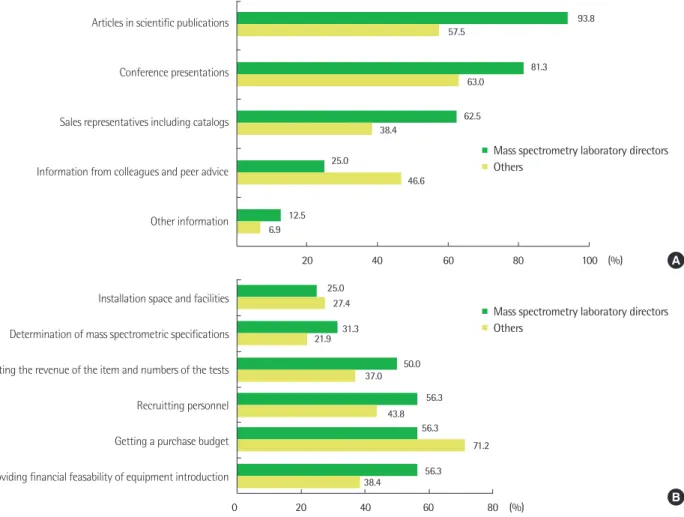
Fig. 1. General status and opinions about clinical mass spectrometric analysis in Korea. For each question, responders were asked to check up to three items according to priority. (A) What information sources are referenced in relation to mass spectrometric information? (B) What are the dif- ficulties in introducing and purchasing mass spectrometry equipment? (Continued to the next page)
93.8 57.5
81.3 63.0
62.5 Articles in scientific publications
Conference presentations
Sales representatives including catalogs
Information from colleagues and peer advice
Other information
20 40 60 80 100 (%) 38.4
25.0
46.6
12.5 6.9
Mass spectrometry laboratory directors Others
Installation space and facilities Determination of mass spectrometric specifications Forecasting the revenue of the item and numbers of the tests Recruitting personnel Getting a purchase budget
Providing financial feasability of equipment introduction
0 20 40 60 80 (%) 27.4
25.0
21.9 31.3
50.0 37.0
56.3
56.3 71.2 43.8
56.3 38.4
Mass spectrometry laboratory directors Others
A
B
사실 근무연수는 1–17년(중앙값 8년)이고, 임상질량분석검사 개 설 경험(14명)과 논문작성 경험(12명)이 있었다. 이 기관들에서 임 상질량분석검사 최초 도입 후 경과 기간은 대부분 5년 이상이었 고, 그 중 10년 이상인 기관도 9기관이나 되었다. 이는 국내 임상질 량분석검사 분야가 이미 제품수명주기(product life cycle)에서의 초기 도입기(introduction stage)를 지나, 진단검사의 한 분야로서 정착되고, 활발한 검사서비스를 제공하는 단계임을 의미하는 한 편, 최근 3년 내 시작한 신규검사실 수는 많지 않음을 의미하기도 한다.
의견조사 결과, 임상질량분석 검사정보와 관련하여 참고하는 정보제공원(information source)에 대한 복수답변 결과는 Fig. 1A 와 같았다. 질량분석기 장비 도입 및 구매에 관한 사항 중 어려운 점으로는 질량분석기 구매예산확보, 검사인력확보, 장비도입의 타
당성 제시 등이 있었다(Fig. 1B). 임상질량분석 관련 교육 요구도를 살펴본 결과, 임상질량분석 검사실 책임자들은 검사실자체개발검 사 개설 방법에 대한 교육을, 이외 답변자들에서는 질량분석기 기 본원리를 포함한 다양한 항목에 대하여 교육을 원하는 것으로 나 타났다(Fig. 1C). 설문참여자 모두 임상질량분석검사 개설의 총괄 책임자는 진단검사의학과 전문의라고 답변하였다. 임상질량분석 관련자로서 질량분석검사 운영전반에 대하여 얼마나 익숙하다고 스스로 평가하는지에 대한 답변으로 임상질량분석 검사실 책임자 중 75%는 기본 개념은 이해하지만 운영은 어렵다고 하였고, 25%만 이 충분히 이해하고 기기를 운영한다고 평가하였다. 질량분석기 장비운영 시 어려운 점에 대한 복수답변 결과, 검사항목 개설 과정 이 가장 어려움을 확인하였다(Fig. 1D). 질량분석 관련학회 참여 경험은 Mass Spectrometry: Applications to the Clinical Lab (MSACL) Basic principles about mass spectrometry
Basic principles about LC Writing manuscript about mass spectrometry Trouble shooting method Quality control and equipment management Sapmple preparation techniques
LDT setting method
20 40 60 80 100 (%)
18.8
32.9 25.0
50.7 6.3
12.3
31.3 42.5
25.0 62.5
58.9 21.9 62.5
37.0 93.8
Mass spectrometry laboratory directors Others
C New health technology assessment
Maintenance of equipment Personnel training Turn around time Revenue of the item
Test item setting process
20 40 60 80 100 (%)
6.3
37.5 43.8
56.3
75.0
81.3
D Fig. 1. Continued. (C) Which items would you receive if the Clinical Mass Spectrometry Research Committee conducts a training program about clinical mass spectrometric analysis? (D) What are the difficulties in performing and managing the clinical mass spectrometric analysis? (only ap- plied to the mass spectrometry laboratory directors)
Abbreviations: LC, liquid chromatography; LDT, laboratory developed test.
Fig. 2. Opinions about the prediction of future trends in clinical mass spectrometric analysis in Korea. For each question, responders were asked to check up to three items according to priority. (A) What are the challenges that must be addressed in order to further expand the field of clinical mass spectrometric analysis in the future? (B) Which test items are expected to expand further in the clinical mass spectrometric analysis field in your laboratory in the future?
Lowering the purchase price of the mass spectrometry Introduction of the automation system in mass spectrometry Diversification of test items New health technology assessment related problem Development and dissemination of test automation reagents Simplification of sample preparation technique and instrument operation
20 40 60 80 100 (%) 18.8
52.1 25.0
38.4 37.5 37.0
24.7 43.8
62.5 41.1
87.5 39.7
Mass spectrometry laboratory directors Others
A Proteins
Vitamin Metabolites Neonatal screening test Drug of abuse Hormones Therapeutic drug monitoring
0 10 20 30 40 50 60 70 80 (%) 12.515.1
18.8
31.5 25.0
32.9 34.337.5
50.0 30.1
56.3
68.8 56.2
63.0
Mass spectrometry laboratory directors Others
B (68.8%), KSMS (25.0%), ASMS (18.8%), HUPO (12.5%), KHUPO
(12.5%) 등의 순으로 나타났다.
임상질량분석검사 미래 전망에 대한 의견조사 결과, 추후 임상 질량분석검사에서 가장 자동화가 필요한 과정은 전처리과정이라 는 답변이었고, 임상질량분석검사가 더욱 확장되기 위하여 선결되 어야 할 부분으로는, 도입, 구매, 운영 시의 어려움 외에도 자동화 과정을 포함한 여러 항목들이 선결되어야 한다고 답하여, 본 분야 의 확장을 위해 선결해야 할 사항들이 많음을 확인할 수 있었다 (Fig. 2A). 그럼에도 불구하고, 앞으로 임상질량분석검사의 확장 여 부에 대한 질문에는 임상질량분석 검사실 책임자의 100%, 전체 설 문답변자의 74.4%가 확장될 것으로 답변하여, 임상질량분석검사 의 확장에 대한 관심과 기대가 컸고, 현재 수행하는 검사 중에 추 후 더욱 확장될 것으로 예상하는 검사항목으로는 약물 및 호르몬 검사 등이 있었다(Fig. 2B).
본 연구는 국내 임상질량분석검사 운영현황 및 임상검사실 검
사인력들의 의견을 처음으로 파악한 데 의의가 있다. 국내 임상질 량분석검사 분야는 이미 초기 도입기를 지나, 진단검사의 한 분야 로서 정착되고, 활발한 검사서비스를 제공하는 단계에 들어섰다.
그러나, 임상질량분석검사를 시행하는 대다수의 기관들에서 공통 으로 시행하는 대표적인 검사항목들은 아직도 많지 않으며, 대다 수 상급종합병원에서는 임상질량분석검사가 수행될 수 있도록 저 변 확대도 지속적으로 필요하다고 생각된다. 또한, 전반적으로 임 상질량분석검사에 대한 관심은 높은 상태이며 본 분야가 더욱 확 장될 것으로 예상되지만, 검사 도입 및 운영에 어려움이 있고, 임상 질량분석검사의 확대를 위해서는 선결해야 할 사항들도 많음을 본 설문을 통해 확인하였다. 앞으로 본 위원회에서는 국내 임상검 사실에서의 질량분석기반 임상검사 확대와 발전을 위한 여러 가지 활동들을 진행해 나갈 것이다. 우선 상기 일반현황 및 의견 파악 과, 실제 수행기관 대상 2차 설문을 통한 구체적 현황 파악을 토대 로 국내 기반자료 구축이 첫 번째 활동이며, 질량분석기반 임상검
사의 표준화와 질 향상을 목적으로 구체적인 표준지침을 개발, 발 표할 예정이고, 정기학술세미나 또는 워크숍 개최, 국내외 관련학 회 참여 및 관련연구자 간 교류, 공동연구기획 등의 다양한 학술활 동도 진행할 예정이다. 임상질량분석연구위원회는 임상질량분석 검사를 보다 활성화하기 위한 구체적이고 적극적인 노력을 기울일 것이다.
요 약
대한임상화학회 산하 임상질량분석연구위원회에서 국내 임상 질량분석검사 일반 현황 및 의견에 대한 설문조사를 실시한 본 연 구는 국내 임상질량분석검사 운영현황 및 임상검사실 검사인력들 의 의견을 처음으로 파악한 데 의의가 있다. 국내 임상질량분석검 사 분야는 이미 초기 도입기를 지나, 진단검사의 한 분야로서 정착 되고, 활발한 검사서비스를 제공하는 단계에 들어섰다. 임상질량 분석검사에 대한 관심은 전반적으로 높은 상태이며, 본 분야가 더 욱 확장될 것으로 예상된다. 하지만, 검사 도입 및 운영에 어려움이 있고, 임상질량분석검사의 확대를 위해서는 선결해야 할 사항들 도 많음을 본 설문을 통해 확인하였다. 임상질량분석연구위원회 는 임상질량분석검사를 보다 활성화하기 위한 구체적이고 적극적 인 노력을 기울일 것이다.
이해관계
저자들은 본 연구와 관련하여 어떠한 이해관계도 없음을 밝힙니다.
감사의 글
본 연구는 대한임상화학회의 연구비 지원을 받아 수행되었습니다.
REFERENCES
1. Adaway JE, Keevil BG, Owen LJ. Liquid chromatography tandem mass spectrometry in the clinical laboratory. Ann Clin Biochem 2015;52:18- 38.
2. Antonelli G, Marinova M, Artusi C, Plebani M. Mass spectrometry or immunoassay: est modus in rebus. Clin Chem Lab Med 2017:55:1243-5.
3. Hoofnagle AN and Wener MH. The fundamental flaws of immunoas- says and potential solutions using tandem mass spectrometry. J Immu- nol Methods 2009;347:3-11.
4. Kim B, Lee MN, Park HD, Kim JW, Chang YS, Park WS, et al. Dried blood spot testing for seven steroids using liquid chromatography-tan- dem mass spectrometry with reference interval determination in the Korean population. Ann Lab Med 2015;35:578-85.
5. Han M, Jun SH, Song SH, Park KU, Kim JQ, Song J. Use of tandem mass spectrometry for newborn screening of 6 lysosomal storage dis- orders in a Korean population. Korean J Lab Med 2011;31:250-6.
6. Yu S, Kang ES, Park MH. A questionnaire survey of HLA crossmatch tests in Korea (2015). Lab Med Online 2017;7:147-56.
7. Kim CK, Lee H, Yong D, Kim YA. National survey on biosafety in clini- cal tuberculosis laboratories in Korea. Lab Med Online 2017;7:189-95.
8. Lee S, Yu GG, Park KH, Lee SY, Jekarl DW, Yoon NS, et al. Survey of fungal cultures and the identification tests used by diagnostic labora- tories in Korea. J Lab Med Qual Assur 2016;38:143-50.
9. Koh YR, Kim SY, Kim IS, Chang CL, Lee EY, Son HC, et al. Customer satisfaction survey with clinical laboratory and phlebotomy services at a tertiary care unit level. Ann Lab Med 2014;34:380-5.
10. de Denus S, Letarte N, Hurlimann T, Lambert JP, Lavoie A, Robb L, et al. An evaluation of pharmacists’ expectations towards pharmacoge- nomics. Pharmacogenomics 2013;14:165-75.
11. Elewa H, Alkhiyami D, Alsahan D, Abdel-Aziz A. A survey on the aware- ness and attitude of pharmacists and doctors towards the application of pharmacogenomics and its challenges in Qatar. J Eval Clin Pract 2015;21:703-9.