Effects of Trust Determinants on Firm Performance in the Buyer-Supplier Relationships: Empirical Evidence from the
Warehousing firms in Busan, South Korea
Sinje Sung* · Sangmok Kang**
구매자와 공급자 관계에서 기업의 성과에 대한 신뢰 결정요인의 영향:
부산시 창고업을 대상으로
성신제*·강상목**
Abstract : This paper provides an empirical analysis of the effects of trust determinants on firm
performance in the buyer-supplier relationships by considering warehousing firms in Busan, South Korea. We employed AVAS transformation regressions to address the limitations of linear regressions and found nonlinear relationships between firm performance and trust determinants. Specifically, “long- term and repeated interactions,” “geographical proximity,” and “cultures and norms of firms and formal institutions” had positive linear relationships with firm performance, and “information sharing and reciprocity” induced an increasing pattern in firm performance. Finally, “interdependence and asset specificity” and “uncertainty removal” led to a decreasing pattern in firm performance. These results suggest that the relationship between trust and firm performance is contingent on the trust determinants that are important source of trust in buyer-supplier relationships and the influence of trust determinants on firm performance varied according to their levels.Key Words : trust determinants, firm performance, buyer-supplier relationships, warehousing firms,
Busan, AVAS요약 :본 연구는 부산시 물류창고업을 대상으로 구매자-공급자간 관계에서 신뢰의 결정요인이 기업의 성
과에 미치는 영향을 밝히는데 목적이 있다. 이를 위해 설문자료를 이용하여 선형 회귀의 제한 점을 처리하는 AVAS 변환 분석을 하였으며 그 결과는 다음과 같다. 첫째, 기업의 성과는 “장기적·반복적 상호작용”, “지리적 근접성”, “기업의 문화 및 규범과 공식적 제도” 등의 요인과 대체적으로 정(+)의 비례관계를 형성한다. 둘째, 기업의 성과는 “정보공유와 호혜성”과 체증적 정(+)의 관계를 보인다. 마지막으로, 기업의 성과는 “상호의존과 자산전용성” 및 “불확실성 제거”와는 체감적 정(+)의 관계를 형성한다. 이러한 결과는 신뢰와 기업의 성과 간 관계는 구매자-공급자 관계에서 신뢰의 중요한 요인인 신뢰 결정요인에 의해 결정되며, 기업의 성과에 대한 신뢰 결정요인의 영향은 신뢰 결정요인의 수준에 따라 다르게 나타남을 보여준다.
주요어 :신뢰 결정요인, 기업성과, 구매자-공급자 관계, 창고업, 부산, AVAS
* Teacher, Bugok Girls’ Middle School, [email protected]
** Professor, Department of Economics, College of Economics and International Trade, Pusan National University, [email protected]
1. Introduction
With the increasing importance of supply chain management, the buyer-supplier relationship in supply chain management has received considerable attention from management scholars, logistics scholars, business scholars, economists, and economic geographers. In general, buyers and suppliers place great emphasis on cooperative relationships to survive in competitive en- vironments characterized by rapid product commod- itization and evolving customer needs. Firms that form strong relationships with their suppliers can better align their interests and goals with those of their sup- pliers (Yang, 2009). Such firms tend to pursue growth and competitiveness by working with their partners based on effective cooperation, which can lead to the development of new products and skills and a decrease in competition (Londe and Maltz, 1992; Varadarajan and Cunningham, 1995; Weitz and Jap, 1995; Doel, 1999; Mentzer et al., 2000; Gertler, 2003; Bathelt and Glückler, 2003; Glückler, 2005; Panayides and Lun, 2009). In most cases, cooperative buyer-supplier rela- tionships are a prerequisite for long-term benefit, that is, firm performance (Landeros and Monczka, 1989).
However, firms with cooperative buyer-supplier rela- tionships still face some problems in achieving growth.
First, because evolving markets require a short and quick product life cycle, firms face more competition than ever before. Second, an information imbalance and a lack of resources can lead to inefficient buyer- supplier relationships. Previous studies have used the concept of “looseness” to describe inefficiencies in buyer-supplier relationships (Luo, 2005). Weitz and Jap (1995), Moore (1998), Mentzer et al. (2000), and Murphy (2003) suggested that a cooperative network is a potential strategy for offsetting this looseness for improved buyer-supplier relationships. A cooperative network requires the exchange of information and re-
sources to maintain relationships and facilitate success for both sides. Thus, firms, by this, can share financial risk, improve service quality, increase productivity, and reduce costs.
The formation of a buyer-supplier relationships can be explained through the following three theories:
First, social exchange theory suggests that firms form relationships as a strategy for acquiring necessary resources, learning new technical skills, and sharing information (Varadarajan and Cunningham, 1995;
Eisenhardt and Schoonhoven, 1996). According to this theory, when partners provide each other with reciprocal benefits over time, social relationships are formed and maintained based on strong enterprise cultures and norms (Gouldner, 1960; Storper and Ven- ables, 2004). However, if partners provide no recipro- cal benefits, then such social relationships are not like- ly to exist (Lawler et al., 2000). Recently, Yang (2009) suggested that social capital derived from social net- works and organizational linkages plays an important role in the formation of buyer-supplier relationships.
In particular, buyers and suppliers in a cooperative social capital network are closely integrated through voluntary, informal, and reciprocal relationships and the exchange of resources (Das and Teng, 2000). Also, trust enhances flexibility and adaptability so that firms can quickly react in a rapidly changing economic en- vironment. This is because trust fosters successful col- laborations between buyers and suppliers (성신제·이 희열 , 2009; Uzzi, 1997; Park, 1999; Darr and Talmud, 2003; Nam, 2003; Uzzi and Lancaster, 2003).
Second, the formation of buyer-supplier relation- ships can be explained by interdependence theory.
The basic premise of this theory is that how goal interdependence is structured determines how indi- viduals interact, which in turn determines outcomes.
There are three types of interdependence: cooperative,
competitive, and individual (Deutsch, 1949; Johnson
and Johnson, 2005). In particular, when cooperative
interdependence is structured, one’s actions facilitate others’ goal achievement. That is, cooperative interde- pendence exists when individuals perceive that they can achieve their goals if and only if other individuals with whom they are cooperatively linked also reach their goals. Thus, these individuals help one another to achieve goals. By inducing firms to take an interest in the profitability of their partners, buyer-supplier relationships based on cooperative interdependence al- low partners to perceive shared fate and engage in sup- portive behaviors. Ultimately, such relationships have a long-term orientation, emphasizing loyalty, informa- tion sharing, and uncertainty removal (Ellram and Cooper, 1990). When partners share their experiences and insights, they can facilitate each other’s growth (Burt, 1992; Kogut and Zander, 1996; Hennart and Larimo, 1998; Gulati et al., 2000; Wang and Zajac, 2007). Specially, trust lets firms learn and innovate through “know-how” sharing between buyers and sup- pliers (Bigley and Pearce, 1998; DiMaggio and Louch, 1998; Mizruchi and Stearns, 2001; McEvily et al., 2003). One of the important purposes in building re- lationships between buyers and suppliers is to develop know-how regarding management and technologies through trading firms. The firms that learn create in- novation by combining their own know-how with the know-how from other trading firms.
Third, knowledge-based theory emphasizes the importance of knowledge integration based on the for- mation of buyer-supplier relationships. In other words, firms form relationships to realize synergistic effects through combined knowledge (Grant, 1996). Knowl- edge-based theory recognizes firms as a conceptual framework or an agency for integrating knowledge (Roper and Crone, 2003; Nielsen, 2005). Venkatra- man and Tanriverdi (2004) found that the synergistic effect of integrated knowledge derived from relation- ships between firms is stronger than that of the sum of individual firms’ knowledge. At this time, trust can
achieve a higher synergy between buyers and suppliers (Carney, 1998; Sako, 1991; Sako and Helper, 1998).
Firms try to focus on the specialization of their core competencies, and to complement all other aspects through relationships between buyers and suppliers.
The firms that make up the complementary relation- ships can foster synergy by integrating their mutual core competencies through trust relationships.
According to social exchange theory, interdepen- dence theory, and knowledge-based theory, the essence of strong relationship between buyers and suppliers is trust, which in turn affects the firm performance.
Economic geographers also consider ‘trust’ as an im- portant contributing factor to firm development with regard to the creation of clusters, learning regions, and institutionally ‘thick’ places, and the creativity and innovation of firms (Dicken and Malmberg, 2001;
Winder, 2001; Bathelt and Taylor, 2002; Mollering, G., 2002; Murphy, 2002; Boggs and Rantisi, 2003;
Ettlinger, 2003; Aoyama et al., 2006; Aoyama and Ratick, 2007).
On the whole, trust between firms was determined by the determinants of the trust (성신제·이희열, 2007).
1)The following determinants are likely to influ- ence the characteristics of trust between firms: 1) long- term and repeated interactions, 2) information sharing and reciprocity, 3) interdependence and asset specific- ity, 4) uncertainty removal, 5) geographical proximity, and 6) cultures and norms of firms & formal institu- tions (Dasgupta, 1988; North, 1990; Ensminger, 1997, 2001; Rowthorn, 1999; Peng, 2004). Thus, these are major factors not only sources of trust between buyers and suppliers but also influencing buyer-supplier rela- tionships (성신제·이희열, 2009; Moore, 1998; Sako and Helper, 1998; Spekman and Carraway, 2005; Plo- etner and Ehret, 2006).
“Long-term and repeated interactions” reflect con-
sistency, continuity, and effectiveness and play a criti-
cal role in the development of trust-based relationships
from opportunistic relationships. Therefore, buyer- supplier relationships formed based on trust are closely related to short-term improvements in productivity and a long-term competitive advantage in the market (Stuart, 1997). The competitiveness of a buyer-supplier relationship can be influenced by the quality of the re- lationship, which is highly dependent on the presence of trust (Hsu, 2005). A stable and collaborative buyer- supplier relationship based on long-term and repeated interactions represents a source of competitive advan- tage for firms, particularly in this era of information and globalization, in which firms can focus on their core business activities as well as obtain opportuni- ties for market development (Dyer and Singh, 1998;
Anslinger, 2004). However, the main reason why buy- er-supplier relationships can fail over time is because of changes in relationship-building strategies.
“Information sharing and reciprocity” reflect the ef- fectiveness of information sharing between buyers and suppliers for the coordination of various business ac- tivities (Sanders and Premus, 2005; Hung et al., 2011).
Information sharing can remove the distrust caused by an information imbalance between partners. Reci- procity can be easily formed through trust between buyers and suppliers (Nelson and Cooprider, 1996).
Ultimately, information sharing and reciprocity can help enrich a firm’s knowledge resources by extending its access to its partner’s information and knowledge.
“Interdependence and asset specificity” reflect the value of a firm’s network of relationships with custom- ers, suppliers, and alliance partners (Gulati and Klet- ter, 2005). That is, if a firm believes that its partner has valuable resources, then the firm has strong motives to build trust with the partner through control of op- portunistic behaviors and the proliferation of assets.
By doing so, the firm can form and maintain an inter- dependent relationship with its partner (Helper, 1990;
Smitka, 1991; Gerlach, 1992; Uzzi, 1997). Kale et al.
(2000) suggested that interdependence and asset speci-
ficity can form the basis for learning and knowledge transfer between buyers and suppliers. Firms tend to treat their relationships as valuable assets. In dynamic markets, firms that form trust-based relationships with their key partners place great emphasis on maintaining interdependent relationships by expanding their assets for their mutual benefit (Dyer and Singh, 1998).
“Uncertainty removal” suggests that a firm implicit- ly and explicitly pledges ongoing relationships with its partner (Dwyer et al., 1987). In addition, uncertainty removal can be explained as a firm’s strong willingness to ensure the continuity of relationships (Anderson and Weitz, 1989; Morgan and Hunt 1994). Removing the uncertainty between buyers and suppliers brings mutual respect and drives out the need for competi- tion. Therefore, a decrease in the level of uncertainty in the buyer-supplier relationship increases the level of trust, resulting in increased profits (Lee et al., 2004;
Wang et al., 2011).
“Geographical proximity” pointed out to the physical distance between firms in a relationship.
Geographical proximity plays a critical role in the for- mation of relationships between firms. In this regard, Daniel et al. (1995) verified that if buyers and suppli- ers are located nearby, then they can more easily form their relationships based on trust and reduce logistics and inventory costs. MacKinnon et al. (2004) paid close attention to geographical proximity in buyer- supplier relationships to examine ‘industry district and learning region and found that geographical proxim- ity can facilitate individual contracts and thus buyer- supplier relationships.
“Cultures and norms of firms and formal institu-
tions” can help embed buyer-supplier relationships in
the social space (Granovetter, 1985). A firm is more
efficient when its culture and norms are based on
trust instead of competition (Smitka, 1991; Sako and
Helper, 1998; Kidd et al., 2010). In addition, formal
institutions can help establish a macro-foundation for
the formation of buyer-supplier relationships (Sako, 1992; Knack et al., 1997; Hodgson, 1998; Temple and Johnson, 1998; Ensminger, 2001; Helmsing, 2001;
Arnulf et al., 2005).
Meanwhile, several studies on the relationship between trust and firm performance have attracted a fair amount of attention. However, there is no overall agreement as to the evidences of trust’s effect on firm performance in buyer-supplier relationships. That is, these are roughly categorized as 1) no relationship be- tween trust and firm performance (Aulakh et al., 1996;
Fryxell et al., 2002, Nielsen and Nielsen, 2009), 2) negative relationship (McEvily et al., 2003; Krishnan et al., 2006; Patzelt and Shepherd, 2008), and 3) posi- tive or inverted U shaped relationships (Dyer and Chu, 2003; Tzafrir, 2005; Fink and Kessler, 2010; Gaur et al., 2011; Wang et al., 2011). So far, the inconclusive and partial findings in the existing studies suggest that there is need to explore the contingency factors which may decrease or increase the effect of trust on firm per- formance (Gaur et al., 2011). In this perspective, Dyer and Chu (2011) state that the relationship between trust and firm performance is contingent on the trust determinants that are important source of trust in buyer-supplier relationships.
Therefore, we are going to explore about how firm performance is influenced by the levels on trust deter- minants. This study extends previous research by ex- amining the various nonlinear relationships between trust determinants and firm performance. Although trust determinants in buyer-supplier relationships can provide partners with opportunities for learning, ac- quiring, sharing, and innovation, they may also have discriminative effects on firm performance. Thus, this study differs from previous studies in that this study accounts for nonlinear relationships between trust determinants and firm performance in buyer-supplier relationships.
In addition, previous studies have focused on gen-
eral business relationships between firms, but this study contributes to the literature by focusing on the relationships between trust determinants and firm per- formance in the warehousing industry. To the authors’
knowledge, no study has provided an empirical analy- sis on the different types in firm performance based on the levels of trust determinants in the context of the warehousing industry.
Ultimately, the vital purpose forming buyer-supplier relationships is to maximize profits by accelerating the movement of goods; ensuring that right goods get to the right place in right amounts at the right time;
and simultaneously minimizing shipping costs (성신 제·강상목 , 2011; Aoyama et al., 2006; Bowen, 2008).
The role of logistics firms under supply chain manage- ment offers solutions for reconciling another firm’s wrong goals (Bowen, 2008). Such solutions typically depend on warehousing firms because these firms play an adjusting role to ensure that required goods get to the required place in required amounts at the required time through buyer-supplier relationships (Klein, 2004; Lasserre, 2004; Quinn, 2005; Bowen, 2008).
Busan is logistic hub city in South Korea. Especially,
the Busan Port is a representative transshipment hub
ports to connect the East and the West in Northeast
Asia. It is also the fifth busiest container port in the
world. For these reasons, most of domestic and in-
ternational warehousing firms have their head and
branches in Busan. So, we focused on the warehousing
firms in Busan. Accordingly, the purpose of this paper
is to provide an empirical analysis of the effects of trust
determinants on firm performance in buyer-supplier
relationships in the context of warehousing firms in
Busan, South Korea.
2. Methodology
We consider a nonlinear regression model as an ad- ditive model and conduct a survey for trust determi- nants in buyer-supplier relationships. To check the re- liability and collinearity of all variables, we conducted a generalized linear regression analysis by using the ordinary least squares (OLS) method in the first step.
In addition, to address the limitations of using a linear regression model in the case of a nonlinear relation- ship between the dependent variable and independent variables, we employed an AVAS (additivity and vari- ance stabilizing) transformation model as one of the additive models in the second step. Because the AVAS transformation model is a type of nonparametric re- gression analysis, it assumes no functional form for relationships between variables. Thus, the AVAS trans- formation model allows the use of a flexible functional form for relationships between variables.
In terms of the survey for trust determinants in buyer-supplier relationships, the questionnaire for trust determinants was composed of items that were measured using a five-point Likert-type scale ranging from “strongly disagree” (1) to “strongly agree” (5). As
discussed earlier, the six variables for trust determi- nants were 1) “long-term and repeated interactions,” 2)
“information sharing and reciprocity,” 3) “interdepen- dence and asset specificity,” 4) “uncertainty removal,”
5) “geographical proximity,” and 6) “cultures and norms of firms & formal institutions.” In addition to these six explanatory variables for trust determinants, we employed the firm’s total sales to measure firm performance as the dependent variable and considered the number of employees, fixed assets, and operating expenses as three control variables.
We collected the survey data through door-to-door interviews targeting 310 warehousing firms in Busan, South Korea, from July 25 to November 25, 2008. For the survey, we took “the key-informant approach”, which has been widely used in empirical studies. In general, key informants were general or senior manag- ers with wide access to the firm’s strategic information.
Among the 310 firms, 162 (53.6%) responded to the questionnaire through key informants. However, we excluded 10 responses because of errors or missing data, and thus, we considered a total of 152 respon- dents. Table 1 provides a profile of the respondents.
The survey results indicate that all trust determinants scored above 3, with standard deviations ranging
Table 1. Profile of the respondent firms
Average Standard deviation N
Long-term and repeated interactions 3.1053 0.943 152
Information sharing and reciprocity 3.0329 0.767 152
Interdependence and asset specificity 3.1118 0.802 152
Uncertainty removal 3.1842 0.938 152
Geographical proximity 3.1447 0.952 152
Cultures and norms of firms & formal institutions 3.1842 0.887 152
Employees(number) 40 95 152
Average fixed assets($1,000) 3.354 8.469 152
Annual operating expenses($1,000) 17.650 105.700 152
Annual total’s sales($1,000) 23.224 138.000 152
Note: The values of trust determinants are the average scores expressed by five-point scale.
from 0.767 to 0.952. On average, the 152 firms had 40 employees, USD 3.354 million in fixed assets, USD 17.650 million in operating expenses, and USD 23.224 million in sales.
3. The Linear Model
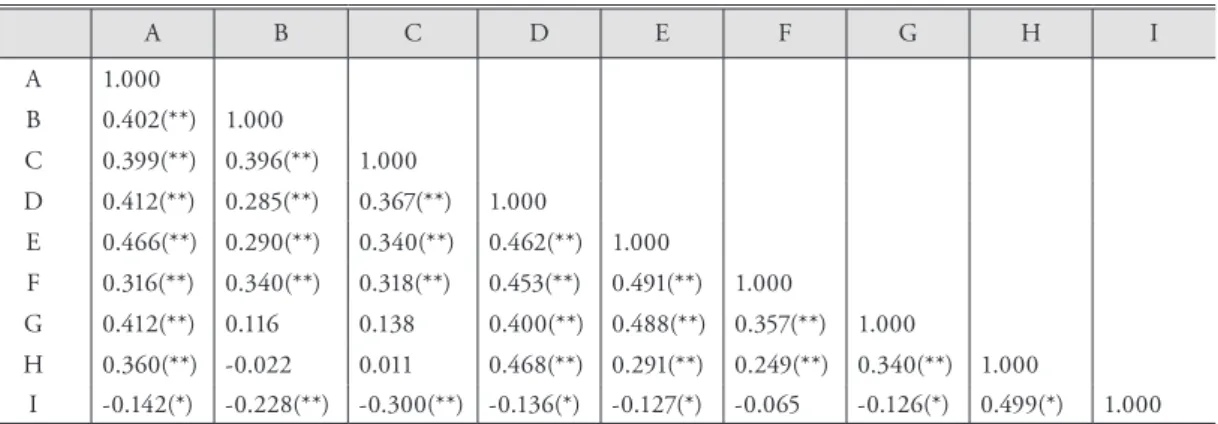
Before modeling the relationship between trust determinants and firm performance in buyer-supplier relationships, we evaluated the reliability and collin- earity of all variables. First, we conducted a reliability analysis for all variables to confirm the consistency of the respondents. Cronbach’s alpha (α) was 0.872, im- plying acceptable reliability for all the scales. Second, we conducted a Pearson correlation analysis for each variable to determine the multicollinearity between the variables. As shown in Table 2, no correlation coef- ficient exceeded 0.5, indicating no multicollinearity between the variables.
In the first step, we conducted a linear regres-
sion analysis using the ordinary least squares (OLS) method to model the relationship between trust deter- minants and firm performance. That is, we regressed firm performance (Y) as the dependent variable on
“long-term and repeated interactions” (LOREIN),
“information sharing and reciprocity” (NSHRE), “in- terdependence and asset specificity” (INAS), “uncer- tainty removal” (UNRE), “geographical proximity”
(GEPR), and “cultures and norms of firms and formal institutions” (CUNOFO). In addition, we included three control variables—the number of employees (NUEM), fixed assets (FIAS), and operating expenses (OPEX)—in the regression to reflect the effects of buy- er-supplier relationships on firm performance. Table 3 shows the regression.
With the parameters in Table 3, we constructed the following regression function:
Table 2. Correlation matrix of measurements
A B C D E F G H I
A 1.000
B 0.402(**) 1.000
C 0.399(**) 0.396(**) 1.000
D 0.412(**) 0.285(**) 0.367(**) 1.000
E 0.466(**) 0.290(**) 0.340(**) 0.462(**) 1.000
F 0.316(**) 0.340(**) 0.318(**) 0.453(**) 0.491(**) 1.000
G 0.412(**) 0.116 0.138 0.400(**) 0.488(**) 0.357(**) 1.000
H 0.360(**) -0.022 0.011 0.468(**) 0.291(**) 0.249(**) 0.340(**) 1.000
I -0.142(*) -0.228(**) -0.300(**) -0.136(*) -0.127(*) -0.065 -0.126(*) 0.499(*) 1.000 Notes: a. A: long-term and repeated interactions, B: information sharing and reciprocity,
C: interdependence and asset specificity, D: uncertainty removal, E: geographical proximity, F: cultures and norms of firms & formal institutions, G: number of employees,
H: fixed assets, I: operating expenses
b. ** Correlation is significant at the 0.01 level (2-tailed) c. * Correlation is significant at the 0.05 level (2-tailed).
Y=0.325LOREIN + 0.249NSHRE + 0.253INAS + (p=0.010) (p=0.039) (p=0.035) 0.318UNRE + 0.433GEPR + 0.360CUNOFO - (p=0.008) (p=0.000) (p=0.001) 0.030NUEM + 0.270FIAS - 0.028OPEX + (p=0.654) (p=0.000) (p=0.546)
10.872 (1)
The results indicate that R
2was 0.724, that is, 72.4% of the total variation in Y (firm performance) was explained by the nine independent variables, including the three control variables. F-statistics (=41.412) confirmed that the linear regression model was generally significant. All the independent variables except for NUEM and OPEX were significant at the 5% level.
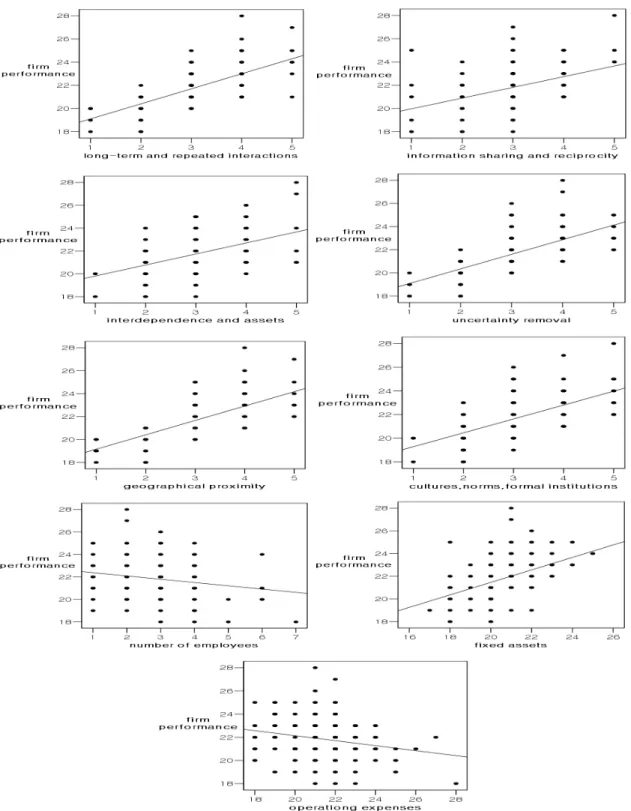
The relationships between the dependent and inde- pendent variables were generally explained by the lin- ear regression model. As shown in Figure 1, however, these relationships were nonlinear. This clearly con- firms that the linear equation based on the OLS meth- od failed to fully explain the relationships between the independent and dependent variables. Thus, we con-
sidered an alternative way to address the limitations of the linear regression model, that is, we employed an additive model based on a nonlinear model as follows:
Y=α+ ∑
ni=1
f
i(X
i)+ε (2)
where the error ε is independent of Xj, E(ε)=0, and var(ε)=σ
2. In addition, f
iis a univariate arbitrary func- tion (e.g., smoothing function). Commonly used methods for finding the nonlinear function f
iinclude the alternating conditional expectation (ACE) (Brei- man and Friedman, 1986) and the additivity and vari- ance stabilizing (AVAS) transformation (Tibshirani, 1988). The general form for estimating a nonparamet- ric function is
θ (Y)=α+ ∑
nj=1
f
j(X
j)+ε (3)
where ε has a mean of zero and is independent of Xj.
The transformation θ(Y) and the function f
j(Xj) are arbitrary smoothers. The ACE is a nonparametric gen- eralization of additive models that can find the best-fit solution by maximizing the correlated transformation
Table 3. The result by OLS regressionDependent variable: Y(firm’s performance) Unstandardized Coefficients Standardized Coefficients
t value Sig.
B Std. Error Beta
(Constant) 10.872 1.780 6.109 0.000
LOREIN 0.325 0.124 0.176 2.621 0.010
INSHRE 0.249 0.119 0.109 2.086 0.039
INAS 0.253 0.115 0.116 2.125 0.035
UNRE 0.318 0.117 0.171 2.707 0.008
GEPR 0.433 0.113 0.236 3.832 0.000
CUNOFO 0.360 0.108 0.183 3.323 0.001
NUEM -0.030 0.066 -0.021 -0.450 0.654
FIAS 0.270 0.060 0.231 4.464 0.000
OPEX -0.028 0.047 -0.029 -0.605 0.546
Adjusted R2 : 0.724 F-statistic : 41.412 Sig. : 0.000
Figure 1. The regression lines of dependent variable against independent variables
of variables. De Veaux and Steele (1989), De Veaux (1990), and Sum et al. (1995) demonstrated that the ACE can be used to identify appropriate transforma- tions for response and predictor variables.
However, Tibshirani (1988) suggested that although the ACE is a useful exploratory tool when a special nonlinear transformation for response and explanatory variables is necessary, it is more appropriate for cor- relation analyses than for regressions. Accordingly, we employed the AVAS additive model (Tibshirani, 1988) because there is no guarantee that the error term in the ACE transformed model is normally distributed with constant variance. The AVAS model is a modified ver- sion of the ACE designed specifically for regressions, and its purpose is to achieve the constant variance of residuals for θ(Y). This is, its objective is to obtain the transformations f1(X1), ···, fn(Xn) and θ(Y) for the random variables Y and X1,…Xn. Thus, the AVAS model is much more reliable than the ACE for finding transformations for regressions than for correlations.
4. The AVAS Model
We conducted an AVAS transformation analysis to model the relationship between firm performance and trust determinants in buyer-supplier relationships. For this, we employed the AVAS program in S-PlusTM, which automatically transforms and plots original val- ues into new ones according to its AVAS algorithm.
By applying transformed values to the AVAS model, we conducted a regression analysis to examine the rela- tionship between firm performance and trust determi- nants in buyer-supplier relationships. Here the trans- formed values are denoted as tY (firm performance), tLOREIN (long-term and repeated interactions), tINSHRE (information sharing and reciprocity), tI- NAS (interdependence and asset specificity), tUNRE (uncertainty removal), tGEPR (geographical proxim- ity), tCUNOFO (cultures and norms of firms and for- mal institutions), tNUEM (the number of employees), tFIAS (fixed assets), and tOPEX (operating expenses).
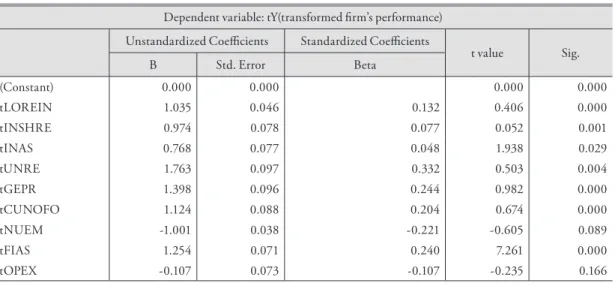
Table 4 shows the regression results.
The results indicate that R
2was 0.743. That is,
Table 4. The result of AVAS transformation regression analysis (1) Dependent variable: tY(transformed firm’s performance) Unstandardized Coefficients Standardized Coefficients
t value Sig.
B Std. Error Beta
(Constant) 0.000 0.000 0.000 0.000
tLOREIN 1.035 0.046 0.132 0.406 0.000
tINSHRE 0.974 0.078 0.077 0.052 0.001
tINAS 0.768 0.077 0.048 1.938 0.029
tUNRE 1.763 0.097 0.332 0.503 0.004
tGEPR 1.398 0.096 0.244 0.982 0.000
tCUNOFO 1.124 0.088 0.204 0.674 0.000
tNUEM -1.001 0.038 -0.221 -0.605 0.089
tFIAS 1.254 0.071 0.240 7.261 0.000
tOPEX -0.107 0.073 -0.107 -0.235 0.166
Adjusted R2 : 0.743 F-statistic : 31.864 Sig. : 0.007
74.3% of tY was explained by the nine transformed variables. F-statistics (31.864, p<0.01) confirmed that the regression results for the AVAS transformation model were significant. In addition, all the trans- formed explanatory variables except for tNUEM and tOPEX were significant at the 5% level. Based on the estimated coefficients, we derived the following AVAS transformation regression model:
tY = 1.035tLOREIN + 0.974tNSHRE + 0.768tINAS + (p=0.000) (p=0.001) (p=0.029) 1.763tUNRE + 1.398tGEPR + 1.124tCUNOFO -
(p=0.004) (p=0.000) (p=0.000) 1.001tNUEM + 1.254tFIAS - 0.107tOPEX (4) (p=0.089) (p=0.000) (p=0.166)
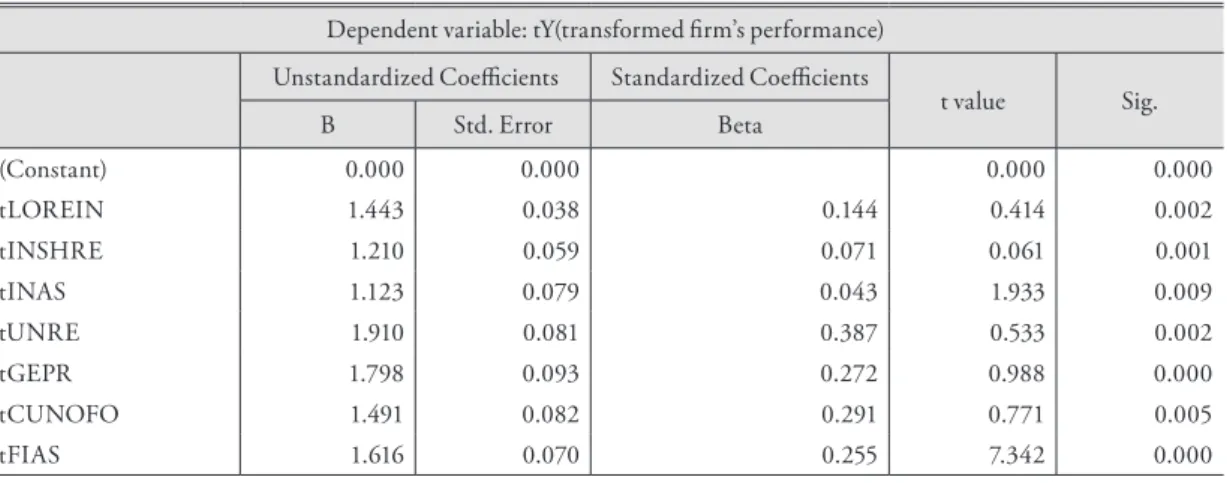
To derive an AVAS transformation model including only significant variables, we removed those variables that were nonsignificant at the 5% level by using back- ward stepwise. Table 5 shows the results.
The results indicate that R
2was 0.724, and the coef- ficients of all explanatory variables were significant at the 5% level. F-statistics (30.434) confirmed that the AVAS transformation model was significant. Thus, the estimation equation with only significant variables can
be expressed as
tY = 1.443tLOREIN + 1.210tNSHRE + 1.123tINAS + (p=0.002) (p=0.001) (p=0.009) 1.910tUNRE + 1.798tGEPR + 1.491tCUNOFO + (p=0.002) (p=0.000) (p=0.005)
1.616tFIAS (5)
(p=0.000)
Because the AVAS transformation regression model derived from transformed values was meaningful, we plotted smooth curves to investigate the causal rela- tionships between original and transformed values.
Figure 2 shows the individual smooth curves for the original (x-axis) and transformed (y-axis) values of both the dependent variable (firm performance) and the independent variables (long-term and repeated in- teractions, information sharing and reciprocity, inter- dependence and asset specificity, uncertainty removal, geographical proximity, cultures and norms of firms and formal institutions, the number of employees, fixed assets, and operating expenses). In Figure 2, the y-axis and the x-axis of plot A indicate transformed and original values, respectively, for firm performance.
In the seven remaining plots, the y-axis and the x-axis
Table 5. The result of AVAS transformation regression analysis (2) Dependent variable: tY(transformed firm’s performance) Unstandardized Coefficients Standardized Coefficients
t value Sig.
B Std. Error Beta
(Constant) 0.000 0.000 0.000 0.000
tLOREIN 1.443 0.038 0.144 0.414 0.002
tINSHRE 1.210 0.059 0.071 0.061 0.001
tINAS 1.123 0.079 0.043 1.933 0.009
tUNRE 1.910 0.081 0.387 0.533 0.002
tGEPR 1.798 0.093 0.272 0.988 0.000
tCUNOFO 1.491 0.082 0.291 0.771 0.005
tFIAS 1.616 0.070 0.255 7.342 0.000
Adjusted R2 : 0.724 F-statistic : 30.434 Sig. : 0.000
show transformed and original values for the level of importance of each trust determinant.
As shown in Figure. 2, firm performance (Y) had a positive linear relationship with transformed firm performance (tY). The results for the AVAS transfor- mation regression equation (5) indicate that the trans- formed independent variables (tLOREIN, tNSHRE, tINAS, tUNRE, tGEPR, tCUNOFO, and tFIAS)
had positive linear relationships with tY. In addition,
these transformed independent variables had positive
linear relationships with Y, as indicated by the positive
linear relationship between Y and tY (plot A in Figure
1). Thus, we regarded the y-axis as Y and substituted
tY for Y in Figure. 2. As a result, Figure 2 shows more
detailed relationships between firm performance and
trust determinants. That is, the results of the original
Figure 2. The relationship of the original value against AVAS transformed valueOLS regression show only positive (+) or negative (-) relationships between the dependant and indepen- dent variables, but those of the AVAS transformation regression concretely indicate various nonlinear rela- tionships between the dependent variable and some independent variables.
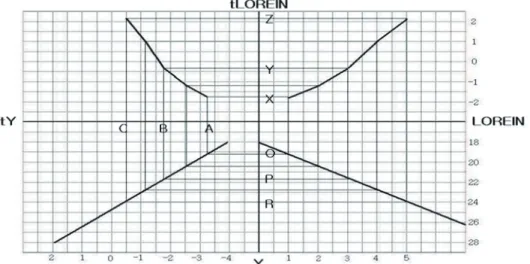
For example, the causal relationships between origi- nal values and AVAS-transformed values are illustrated by the quadrants in Figure. 3, which plots the transfor- mation process for firm performance and LOREIN.
The X, Y, and Z points for tLOREIN (transformed long-term and repeated interactions) corresponded to the A, B, C points for tY (transformed firm perfor- mance), respectively, and the A, B, and C points for tY had positive linear relationships with the O, P, and R points for Y (fi rm performance). In this regard, the X, Y, and Z points for tLOREIN can be matched with the O, P, and R points for Y. Th e relationships between fi rm performance and the other trust determinants can be also explained in a similar manner.
Finally, we transformed linear relationships between firm performance and trust determinants into non- linear relationships, which reported the increasing or diminishing pattern of fi rm performance according to
the levels of importance of trust determinants.
First, as shown in Figure 2, plots B, F, and G show a positive linear relationship, implying that as “long- term and repeated interactions” (LOREIN), “geo- graphical proximity” (GEPR), and “cultures and norms of firms and formal institutions” (CUNOFO) increased, fi rm performance also increased constantly.
Second, plot C shows an increasing pattern between
“information sharing and reciprocity” and fi rm perfor- mance. Th at is, as “information sharing and reciproc- ity” increased, firm performance improved slowly at first but faster over time, suggesting that “the gradual intensifi cation of information sharing and reciprocity”
can accelerate improvements in fi rm performance.
Third, plots D and E report a decreasing pattern, indicating that “interdependence and asset specifi city”
and “uncertainty removal” played critical roles in the initial stages of partner relationships, but that they did not have sustained effects on firm performance. This suggests that it is critical to consider these factors in the initial stages of partner relationships. Thus, “in- terdependence and asset specificity” and “uncertainty removal” led to decelerating improvements in firm performance.
Figure 3. The relationship between the original value and AVAS transformed value
Fourth, plot I show that the fixed assets induced a decreasing pattern at the first part and a constant pat- tern at the second part in firm performance.
5. Conclusion
In this paper, we empirically examined the effects of trust determinants on firm performance in buyer-seller relationships by considering a sample of warehous- ing firms in Busan, South Korea. We investigated the relationships between firm performance and various trust determinants, including “long-term and repeated interaction,” “information sharing and reciprocity,”
“interdependence and asset specificity,” “uncertainty removal,” “geographical proximity,” and “cultures and norms of firms and formal institutions.” We first esti- mated these relationships by conducting OLS regres- sions and then examined their nonlinear relationships through AVAS transformation regressions to address the limitations of linear regressions. The results can be summarized as follows: First, “long-term and repeated interactions,” “geographical proximity,” and “cultures and norms of firms and formal institutions” had posi- tive linear relationships with firm performance, that is, increases in their factors led to proportional im- provements in firm performance. Second, increases in
“information sharing and reciprocity” induced an in- creasing pattern in firm performance. As “information sharing and reciprocity” between partners increased, firm performance improved accelerately. Third, in- creases in “interdependence and asset specificity” and
“uncertainty removal” induced a decreasing pattern in firm performance. That is, these factors made substan- tial contributions to firm performance in the initial, not mature stages of firm partnerships.
These results suggest that various determinants of trust in buyer-supplier relationships can make substan-
tial contributions to firm performance. This suggests the importance of ensuring trust in buyer-supplier relationships for improving firm performance. In ad- dition, the AVAS analysis indicates that the effects of the trust determinants on firm performance varied ac- cording to their levels. This suggests that it is critical to control trust determinants in a step-by-step manner to maximize firm performance.
Social exchange theorists, interdependence theo- rists, and knowledge-based theorists describe trust as the most important one of the key variables in the relationship between firms. The findings in this article confirm the postulates of social exchange theory, in- terdependence theory, and knowledge-based theory which considers trust as identifying outcomes of relationship between buyers and suppliers. While the majority of the existing studies suggest that firm performance is influenced by the trust between firms, further findings of this study help us to understand better the trust affecting the firm performance. That is, our study suggests that the relationship between trust and firm performance is contingent on the trust determinants that are important source of trust in buyer-supplier relationships and the influence of trust determinants on firm performance varied according to their levels. Therefore, we can contribute the study contributes to explore the contingency factors which may decrease or increase the effect of trust on firm per- formance.
Despite these contributions, the limitation of the research is also evident. We considered only suppliers for the survey. Thus, future research should examine dyadic relationships by considering both buyers and suppliers using the qualitative research method. Also, future researchers should expand the research regions.
This may enable a better understanding the effect of
trust on firm performance.
Notes
1) The studies on determinants of the trust are as in the following. Information sharing and reciprocity (Ekeh(1974), Aoki(1990), Nelson and Cooprider(1996), Doz and Hamel(1998), Sako and Helper(1998), Shin and Lee(1999)), formal institutions (DiMaggio and Pow- ell(1983), Luhmann(1988), Giddens(1990), Gerlach(1992)), cultures and norms of firms(Dore(1983), Sako(1992)), long-term and repeated interactions(Axelrod(1984), Granovetter(1985), Kreps(1990), Aulakh et al.(1996), Sako and Helper(1998)), uncertainty removal(Walker and We- ber(1984), Zucker(1986)), geographical proximity(Daniel
et al.(1995), Cooke and Morgan(1998), MacKinnon et al.(2002)), asset specificity(Williamson(1985), Mor-
gan and Hunter(1994)), interdependence(Bradach and Eccles(1989), Lusch and Brown(1996), Dyer and Singh(1998)).References
성신제·강상목, 2011, 물류산업의 공간연구를 위한 개념
체계에 관한 연구, 대한지리학회지, 46(1), 81-99.
성신제·이희열, 2009, 부산시 물류창고업의 신뢰형성 수
준과 연계의 공간적 특성, 한국경제지리학회지, 12(4), 454-476.
성신제·이희열, 2007, 경제공간에서 신뢰형성에 관한 이
론적 고찰, 대한지리학회지, 42(4), 560-581.
Anderson, E. and Weitz, B., 1989, Determinants of con- tinuity in conventional industrial channel dyads,
Marketing Science, 8(4), 310-323.
Anslinger, P., 2004, Creating successful alliances, Journal
of Business Strategy, 25(2), 1-8.
Aoyama, Y. and Ratick, S. J., 2007, Trust, transactions, and information technologies in the U.S.logistics industry, Economic Geography, 83(2), 159-180.
Aoyama, Y., Ratick, S. J. and Schwarz, G., 2006, Orga- nization dynamics of the U.S. logistics industry:
an economic geography perspective, Professional
Geographer, 58(3), 327-340.
Arnulf, J. K., Dreyer, H. C. and Grenness, C. E., 2005,
Trust and knowledge creation: how the dynamics of trust and absorptive capacity may affect supply chain management development projects, Interna-
tional Journal of Logistics Research and Applications,
8(3), 225-236.Aulakh, P., Kotabe, M. and Sahay, A., 1996, Trust and per- formance in cross-border marketing partnerships:
a behavioral approach, Journal of International
Business Studies, 27(5), 1005-1032.
Bathelt, H. and Glückler, J., 2003, Toward a relational eco- nomic geography, Journal of Economic Geography, 3(2), 117-144.
Bathelt, H. and Taylor, M., 2002, Clusters, power and place: Inequality and local growth in time-space,
Geografiska Annaler, 84(B), 93-109.
Boggs, J. S. and Rantisi, N. M., 2003, The ‘relational turn’
in economic geography, Journal of Economic Geog-
raphy, 3(2), 109-116.
Bowen, J. T., 2008, Moving Place: The geography of ware- housing in the US, Journal of Transport Geography, 16(6), 379-387.
Breiman, L. and Friedman, J. H., 1985, Estimating opti- mal transformations for multiple regression and correlation, Journal of American Statistical Associa-
tion, 80(391), 580-619.
Burt, R. S., 1992, Structural Holes: The social structure of
competition, Harvard University, Cambridge,
MA.Calantone, R. J,, Cavusgil, S. T. and Zhao, Y., 2002, Learning orientation, firm innovation capability, and firm performance, Industrial Marketing Man-
agement, 31(6), 515-524.
Choi, Y. H., Souiden, N. and Skandrani, H., 2012, The differential impact of trust types on inter-firm relationships: Some empirical evidences from the Japanese eyeglass industry, Asian Business and
Management, 11(5), 541-562.
Daniel, W., Martin, A. and Cadet, C., 1995, Agile Path-
finders in the Aircraft and Automobile Industries: A Progress Report, The MIT Press, Boston.
Das, T. K. and Teng, B. S.. 2000, A resource-based theory of strategic alliances, Journal of Management,
26(1), 31-61.
Dasgupta, P., 1988, Trust as a commodity, in Gambetta, D. (ed.), Trust-making and Breaking Cooperative
Relations, Basil Blackwell, New York, NY, 49-72.
De Veaux, R. D., 1989, Finding transformations for regres- sion using the ACE algorithm, Sociological methods and research, 18(2/3), 327-359.
De Veaux, R. D. and Steele, J. M., 1989, ACE guided-trans- formation methods for estimation of the coefficient of soil-water diffusivity, Technometrics, 31(1), 91-98.
Dicken, P. and Malmberg, A., 2001, Firms in territories:
A relational perspective, Economic Geography, 77(4), 345-363.
Doel, C.,1999, Towards a supply-chain community? In- sights from governance processes in the food in- dustry, Environment and Planning A, 31(1), 69-85.
Dwyer, F. R., Schurr, P. H. and Sejo, O., 1987, Develop- ing buyer-seller relationship, Journal of Marketing, 51(2), 11-27.
Dyer, J. H. and Chu, W. J., 2003, The role of trustworthi- ness in reducing transaction costs and improving performance: empirical evidence from the United States, Japan, and Korea, Organization Science, 14(1), 57-68.
Dyer, J. H. and Chu, W. J., 2011, The determinants of trust in supplier-automaker relations in the US, Japan, and Korea: a retrospective, Journal of International
Business Studies, 42(1), 28-34.
Dyer, J. H and Singh, H., 1998, The relational view: coop- erative strategy and sources of interorganizational competitive advantage, Academy of Management
Review, 23(4), 660-679.
Eisenhardt, K. M. and Schoonhoven, C. B., 1996, Resource-based view of strategic alliance forma- tion: strategic and social effects in entrepreneurial firms, Organization Science, 7(2), 136-150.
Ellram, L. M. and Cooper, M. C., 1990, Supply chain management, partnerships, and the shipper third party relationship, International Journal of Logis-
tics Management, 1(2), 1-10.
Emden, Z., Yaprak, A. and Cavusgil, S. T., 2005, Learn- ing from experience in international alliances:
antecedents and form performance implications,
Journal of Business Research, 58(7), 883-892.
Ensminger, J., 1997, Changing Property Right: Recon- ciling Formal and Informal Rights to Land in Africa, in Drobak, J. N. and Nye, J. V. C. (ed.),
The Frintiers of the New Institutional Economics,
Academic Press, San Diego, 165-196.Ensminger, J., 2001, Reputation, Trust and the Principal Agent Problem, in Cook, K. (ed.), Trust in Society, Russell Sage Foundation, New York, NY, 185-201.
Ettlinger, N., 2003, Cultural economic geography and a relational and microspace approach to trusts, ra- tionalities, networks, and change in collaborative workplace, Journal of Economic Geography, 3(2), 145-171.
Fink, M. and Kessler, A., 2010, Cooperation, trust and performance-empirical results from three coun- tries, British Journal of Management, 21(2), 469- 483.
Fryxell, G. E., Dooley, R. S. and Vryza, M., 2002, After the ink dries: the interaction of trust and control in U.S.-based international joint ventures, Journal
of Management Studies, 39(6), 865-886.
Gaur, A. S., Mukherjee, D., Gaur, S. S. and Schmid, F., 2011, Environmental and firm level influences on inter-organizational trust and SME performance,
Journal of Management Studies, 48(8), 1752-1781.
Gerlach, M. L., 1992, Allianc Capitalism: The Social Orga-
nization of Japanese Business, Berkeley University
of California Press, Berkeley.Gertler, M.S., 2003, Tacit knowledge and the economic geography of context or the indefinable tacitness of being(there), Journal of Economic Geography, 3(1), 75-99.
Glückler, J., 2005, Making embeddedness work: social practice, institutions, in foreign consulting mar- kets, Environment and Planning A, 37(10), 1727- 1750.
Gouldner, A. W., 1960, The norm of reciprocity: a prelimi- nary statement, American Sociological Review, 25, 161-178.
Granovetter, M., 1985, Economic action and social struc-
ture: the problem of embeddedness, American
Journal of Sociology, 91(3), 481-510.
Grant, R. M., 1996, Toward a knowledge-based theory of the firm, Strategic Management Journal, 17(4), 109-122.
Gulati, R. and Kletter, D., 2005, Shrinking core, expand- ing periphery: the relational architecture of high- performing organizations, California Management
Review, 47(3), 77-104.
Gulati, R., Nohria, N and Zaheer, A., 2000, Strategic net- works, Strategic Management Journal, 21(3), 203- 215.
Hastie, T. and Tibshirani, R., 1986, Generalized additive models (with discussion), Statistical Science, 1(3), 297-318.
Helmsing, A. H. J., 2001, Externalities, learning and gov- ernance: new perspectives on local economic de- velopment, Development and Change, 32(2), 277- 308.
Helper, S., 1990, Comparative supplier relations in the US and Japanese auto industries: an exit-voice ap- proach, Business Economic History, 19(2),153-162.
Hennart, J. F. and Larimo, J., 1998, The impact of culture on the strategy of multinational enterprises: does national origin affect ownership decisions?, Jour-
nal of International Business Studies, 29(3), 515-
538.Hodgson, G., 1998, Competence and contract in the theo- ry of the firm, Journal of Economic Behavior, 35(2), 179-201.
Hsu, L. L., 2005, SCM system effects on performance for interaction between suppliers and buyers, Indus-
trial Management and Data Systems, 105(7), 857-
875.Hung, W. H., Ho, C. F., Jou J. J., and Tai, Y. M., 2011, Sharing information strategically in a supply chain: antecedents, content and impact, Interna-
tional Journal of Logistics research and Applications,
14(2),111-133.Johnson, D. W. and Johnson, R., 2005, New develop- ments in social interdependence theory, Psychology
Monographs, 131(4), 285-358.
Kale, P., Singh, H. and Perlmutter, H., 2000, Learning and protection of proprietary assets in strategic al- liances: building relational capital, Strategic Man-
agement Journal, 21(3), 217-237.
Kidd, J., Richter, F. J. and Stumm, M., 2010, Learning and trust in supply chain management: disinterme- diation, ethics and cultural pressures in brief dy- namic alliances, International Journal of Logistics
Research and Applications, 6(4), 259-275.
Klein, O., 2004, Social perception of time, distance, and high-speed transportation, Time and Society, 13(2/3), 245-263.
Knack, S., Keefer, I. and Keefer, P., 1997, Does social capital have an economic payoff? a cross-country investigation, Quarterly Journal of Economics, 112(4), 1251-1288.
Kogut, B. and Zander, U., 1996, What firms do? coordina- tion, identity, and learning, Organization Science, 7(5), 502-518.
Krishnan, R., Martin, X. and Noorderhaven, N. G., 2006, When does trust matter to alliance performance?,
Academy of Management Journal, 49(5), 894-917.
Krogh, G. V., Nonaka, I. and Aben, M., 2001, Making the most of your company’s knowledge: a strategic framework, Long Range Planning, 34(4), 421-439.
Lamming, R. and Hampson, J., 1996, The environment as a supply chain management issue, British Journal
of Management, 7(1), 45-52.
Landeros, R. and Monczka, R. M., 1989, Cooperative buyer/seller relationships and a firm’s competitive posture, Journal of Purchasing and Materials Man-
agement, 25(3), 9-8.
La Londe, B. J. and Maltz, A. B., 1992, Some propositions about outsourcing the logistics function, Interna-
tional Journal of Logistics Management, 3(1), 1-10.
Lasserre, F., 2004, Logistics and the internet: transporta- tion and location issues are crucial in the logistics Chain, Journal of Transport Geography, 12(1), 73- 84.
Lawler, E., Thye, S. and Yoon, J., 2000, Emotion and group cohesion in productive exchange, American
Journal of Sociology, 106(3), 616-657.
Lee, J. N., Miranda, S. M. and Kim, Y. M., 2004, IT out- sourcing strategics: universalistic, contingency, and configurational explanations of success, Infor-
mation Systems Research, 15(2), 110-131.
Luo, Y., 2005, How important are shared perceptions of procedural justice in cooperative alliances?, Acad-
emy of Management Journal, 48(4), 695-709.
MacKinnon, D. P., Lockwood, C. M. and Williams, J., 2004, Confidence limits for the indirect effect:
distribution of the product and resampling meth- ods, Multivariate Behavioral Research, 39(1), 99- 128.
Madhavan, R. and Grover, R.,1998, From embedded knowledge to embodied knowledge: new product development as knowledge management, Journal
of Marketing, 62(4), 1-12.
McEvily, B., Perrone, V. and Zaheer, A., 2003, Trust as an organizing principle”, Organization Science, 14(1), 91-103.
Mentzer, J. T., Min, S. and Zacharia, Z. G., 2000, The nature of interfirm partnering in supply chain management, Journal of Retailing, 76(4), 549-568.
Mollering, G., 2002, Perceived trustworthiness and inter- firm governance: Empirical evidence from the UK printing industry, Cambridge Journal of Economics, 26(2), 136-160.
Moore, K. R., 1998, Trust and relationship commitment in logistics alliances: a buyer perspective, Interna-
tional Journal of Purchasing and Materials Manage- ment, 34(4), 24-37.
Morgan, R. M. and Hunt, S. D., 1994, The commitment- trust theory of relationship marketing, Journal of
Marketing, 58(3), 20-38.
Murphy, J. T., 2002, Network, trust, and innovation in Tanzania’s manufacturing sector, World develop- ment, 30(4), 591-619.
Murphy, J. T., 2003, Social space and industrial develop- ment in east Africa: deconstructing the logic of industry network in Mwanza, Tanzania, Journal of
Economic Geography, 3(2), 173-198.
Nelson, K. M. and Cooprider, J. G., 1996, The contribu- tion of shared knowledge to IS group perfor-
mance, MIS Quarterly, 20(4), 409-429.
Nielsen, B. B., 2005, The role of knowledge embeddedness in the creation of synergies in strategic alliance,
Journal of Business Research, 58(9), 1194-1204.
Nielsen, B. B. and Nielsen, S., 2009, Learning and innova- tion in international strategic alliances: an empiri- cal test of the role of trust and tacitness, Journal of
Management Studies, 46(6), 1031-1056.
North, D., 1990, Institutional Change and Economic Perfor-
mance, Cambridge University Press, Cambridge.
Panayides, P. M. and Lun, Y. H. V., 2009, The impact of trust on innovativeness and supply chain perfor- mance, International Journal of Production Eco-
nomics, 122(1), 35-46.
Patzelt, H. and Shepherd, D. A., 2008, The decision to persist with underperforming alliances: the role of trust and control, Journal of Management Studies, 45(7), 1217-1243.
Peng, Y. S., 2004, Kinship networks and entrepreneurs in China’s transitional economic, American Journal
of Sociology, 109(5), 1045-1074.
Ploetner, O. and Ehret, M., 2006, From relationships to partnerships: new form of cooperation between buyer and seller, Industrial Marketing Manage-
ment, 35(1), 4-9.
Quinn, C., 2005, Warehouses big growth trend in exurbs,
Atlanta Journal Constitution, December, 3E.
Roper, S. and Crone, M., 2003, Knowledge complemen- tarity and coordination in the local supply chain:
some empirical evidence, British Journal of Man-
agement, 14(4), 339-355.
Rowthorn, R., 1999, Marriage and Trust: some Lessons from Economics, Cambridge Journal of Economics, 23(5), 661-691.
Sako, M., 1992, Prices, Quality and Trust: Inter-Firm Rela-
tion in Britain and Japan, Cambridge University
Press, Cambridge.Sako, M. and Helper, S., 1998, Determinants of trust in sup- plier relations: evidence from the automotive indus- try in Japan and United States, Journal of Economic
Behavior and Organization, 34(3), 387-417.
Sanders, N. R. and Premus, R., 2005, Modeling the rela-
tionship between firm IT capability, collabora- tion, and performance, Journal of Business Logis-
tics, 26(1), 1-23.
Smitka, M., 1991, Competitive Ties: Subcontracting in the
Japanese Automotive Industry, Columbia Univer-
sity Press, New York.Spekman, R. E. and Carraway, R., 2005, Making the tran- sition to collaborative buyer-seller relationships:
An emerging framework, Industrial Marketing
Management, 35(1), 10-19.
Storper, M. and Venables, A. J., 2004, Buzz: face-to-face contact and the urban economy, Journal of Eco-
nomic Geography, 4(4), 351-370.
Stuart, F., 1997, Supply chain strategy organizational in- fluence through supplier alliances, British Journal
of Management, 8(3), 223-236.
Sum, C. C., Yang, K. K., James, S. K. and Quek, S.
A.,1995, An analysis of material requirements planning (MRP) benefits using Alternating Con- ditional Expectation (ACE), Journal of operations
management, 13, 35-58.
Swink, M., Narasimhan, R. and Kim, S. W., 2005, Manu- facturing practices and strategy integration: ef- fects on cost efficiency, flexibility, and market- based performance, Decision Sciences Journal, 36(3), 427-457.
Temple, J. and Johnson, P. A., 1998, Social capability and economic growth, Quarterly Journal of Economics, 113(3), 965-1021.
Tibshirani, R., 1988, Estimating transformations for re- gression via additivity and variance stabilization, Journal of the American Statistical Association, 83(402), 394-405.
Tzafrir, S. S., 2005, The relationship between trust, HRM practices and firm performance, The International
Journal of Human Resource Management, 16(9),
600-1622.Uzzi, B., 1997, Toward a network perspective on organi- zational decline, International Journal of Sociology
and Social Policy, 17(7/8), 111-155.
Varadarajan, P. R. and Cunningham, M., 1995, Strategic
alliances: a synthesis of conceptual foundations,
Journal of the Academy of Marketing Science, 23(4),
282-296.Venkatraman, N. and Tanriverdi, H., 2004, Reflecting
‘knowledge’ in strategy research: Conceptual Is- sues and Methodological Challenges, in Ketchen, D. J. and Bergh, D. D. (ed.) Research Methodology
in Strategy and Management, Elsevier Ltd, Boston,
33-66.Wang, L., Yeung, J. H. Y. and Zhang, M., 2011, The impact of trust and contract on innovation per- formance: the moderating role of environmental uncertainty, International Journal of Production
Economics, 134(1), 114-122.
Wang, L. and Zajac, E. J., 2007, Alliance or acquisition? a dyadic perspective on interfirm resource combina- tions, Strategic Management Journal, 28(13), 1291- 1317.
Weitz, B. A. and Jap, S. D., 1995, Relationship marketing and distribution channels, Journal of the Academy
of Marketing Science, 23(4), 305-320.
Winder, G., 2001, Building trust and managing business over distance: A geography of reaper manufacturer D.S.Morgan’s correspondence, 1867, Economic Geography, 77(2), 95-121.
Yang, J., 2009, The determinants of supply chain alliance performance: an empirical study, International
Journal of Production Research, 47(4), 1055-1069.
교신: 강상목, 609-735, 부산광역시 금정구 장전동, 부산
대학교 경제통상대학 경제학부 (이메일: smkang
@pusan.ac.kr, 전화: 051-510-2586)
Correspondence: Sangmok Kang, Department of Eco- nomics, College of Economics and International Trade, Pusan National University, Jangjeon-dong, Geumjeong-gu, Busan 609-735, Korea (e-mail:
[email protected], phone: +82-51-510-2586)