ꠏꠏꠏꠏꠏꠏꠏꠏꠏꠏꠏꠏꠏꠏꠏꠏꠏꠏꠏꠏꠏꠏꠏꠏꠏꠏꠏꠏꠏꠏꠏꠏꠏꠏꠏꠏ
교신저자: 박혜순, 서울시 송파구 풍납동 388-1, 울산의대 서울아산병원 가정의학교실
Tel: 02)3010-3813, Fax: 02)3010-3815, E-mail: [email protected], Mobile: 011-742-6607
건강검진 수진자에서 말초혈액 내 백혈구수와 대사증후군과의 연관성
울산대학교 의과대학 서울아산병원 가정의학교실
이 고 은․박 혜 순
Relationship Between White Blood Cell Counts and the Metabolic Syndrome
Go Eun Lee, Hye Soon Park
Department of Family Medicine, Asan Medical Center, University of Ulsan College of Medicine
요 약
연구배경: 백혈구(White Blood Cell: 이하 WBC)는 염증 질환을 알아내는데 중요한 임상적 지표로 쓰이고 있으며, 많은 연구에서 비만 및 심혈관 질환은 low grade inflammation과 연관이 있다고 알려져 왔다. 이에 본 연구에서는 염증 지표인 백혈구수와 대사증후군과의 연관성을 알아보고자 하였다.
방법: 일개 종합병원의 건강검진센터에서 검진을 시행받은 6,542명 중 급성 염증성 질환 및 암 질환 을 나타낸 28명을 제외한 6,514명(남 3,838명, 여 2,676명)을 대상으로 하였다. 대사증후군의 정의는 체질량 지수≧25 kg/m2, 혈압≧130/85 mmHg, 공복 혈당≧110 mg/dL, 중성지방≧150 mmHg, HDL-콜 레스테롤 남자<40 mg/dL, 여자<50 mg/dL 중 3가지 이상이 있을 때로 하였다. 증가된 백혈구와 대사 증후군과의 연관성을 보기 위해 백혈구를 사분위수로 나누어 다중로짓 회귀분석을 실시하였다.
결과: 1) 백혈구의 사분위수가 증가할수록 체질량 지수 및 심혈관 위험인자가 증가하였다. 2) 대사증 후군에 대한 각각의 항목이 있는 경우 없는 경우보다 백혈구 증가에 대한 교차비가 유의하게 증가하였 다(P<0.05). 3) 백혈구의 가장 낮은 사분위수를 기준으로 했을 때 2분위, 3분위, 4분위에서의 대사증후 군에 대한 교차비는 각각 1.57 (1.27∼1.94), 2.29 (1.85∼2.83), 3.03 (2.51∼3.74)로 유의하게 증가하는 양상을 보였다(P<0.0001). 4) 비만한 정도가 심할수록, 대사증후군 항목의 군집 현상이 심할수록 백혈 구수가 유의하게 증가하는 경향을 보였다(P<0.001).
결론: 한국인에서 대사증후군은 백혈구 증가와 관련이 있었으며, 비만의 정도가 심할수록, 대사증후군 항목의 군집 현상이 심할수록 백혈구 증가 현상이 현저해짐을 알 수 있었다. 염증 소견을 감소시키기 위해 비만 및 대사증후군에 대한 관리와 치료가 중요하다고 하겠다.
ꠏꠏꠏꠏꠏꠏꠏꠏꠏꠏꠏꠏꠏꠏꠏꠏꠏꠏꠏꠏꠏꠏꠏꠏꠏꠏꠏꠏꠏꠏꠏꠏꠏꠏꠏꠏꠏꠏꠏꠏꠏꠏꠏꠏꠏꠏꠏꠏ 중심단어: 백혈구수, 비만, 대사증후군
서 론
Proinflammatory cytokine인 Interleukin-6 (IL-6), Tumor necrosis factor-α (TNF-α), C-reactive protein (CRP)의 증가 및 백혈구수의 증가 등은 혈관 내피세 포의 기능 이상을 나타내는 low grade inflammation의 만성적 상태를 반영하며 이러한 지표가 높을수록 심혈 관 질환과 관련이 높다고 알려져 있다1,2). 또한, 염증 지표가 높을 때 질병의 이환 혹은 사망률이 증가한다 는 것은 이미 알려져 있으며3,4), 염증 지표를 낮춰 질 병의 위험을 낮추기 위한 여러 시도들이 행해지고 있 다5,6).
대사증후군은 인슐린저항성에 의해 나타나는 표현 형으로 National Cholesterol Education Program Adult Treatment Panel III에서 임상적으로 사용하기 편리하 게 그 정의를 제시하였다7). 국내에도 비만 인구가 늘 어나면서 대사증후군의 유병률은 남성 14.2%, 여성 17.7%로 나타난 바 있으며8), 이 수치는 점차 증가할 것으로 생각된다. 또한, 대사증후군이 존재하는 경우 그렇지 않은 경우에 비해 이환율 및 사망률이 현저히 높아지므로 그 중요성이 더욱 크다고 하겠다4). 일부 서양인에서 조사된 연구에 의하면 백혈구수의 증가가 대사증후군과 관련성이 높다고 보고하였다1). 이에 본 연구는 한국인에서 대사증후군과 염증 상태를 나타내는 지표 중 하나인 백혈구수와의 관계를 알아보 고자 하였다.
방 법 1. 연구 대상
일개 종합병원의 건강검진센터에서 검진을 시행 받 은 무증상의 20세 이상 성인 남녀 6,542명 중 급성 염 증성 질환 및 암 질환을 나타낸 28명을 제외한 6,514 명 (남 3,838명, 여 2,676명)을 대상으로 하였다.
2. 연구 방법 1) 신체 계측
모든 수진자들에게 최소 8시간 금식을 하도록 한 후, 얇은 가운만을 걸친 상태에서 신장과 체중을 측정
하였고 체질량 지수는 체중 (kg)을 키의 제곱 (m2)으로 나누어 구하였다. 비만의 정의는 아시아-태평양 비만 치료지침을 이용하여9) 체질량 지수≧25 kg/m2으로 하 였다.
2) 백혈구
혈액검사 중 백혈구수는 electronic impedence &
flow cytometry (sysmax XE-2100)법을 이용하여 측 정하였다. 백혈구수는 4.8×10³/mm3미만, 4.8∼5.5×
103/mm3, 5.6∼6.6×10³/mm3, 6.7×10³/mm3이상의 사분위로 나누었다. 백혈구수가 가장 높은 사분위에 해당하는 6.7×10³/mm3이상의 경우를 증가된 백혈구 수로 정의하였다.
3) 대사증후군
대사증후군의 정의는 혈압, 공복 혈당, 중성지방, HDL-콜레스테롤의 경우는 NCEP ATP III의 기준을 적용하였고7) 허리둘레 대신 체질량지수를 이용하여, 다음의 5가지 항목; 체질량 지수≧25 kg/m2, 혈압≧130/
85 mmHg, 공복 혈당≧110 mg/dL, 중성지방≧150 mm Hg, HDL-콜레스테롤 남자≦40 mg/dL, 여자≦50 mg/
dL 중 3가지 이상을 가지고 있을 때로 정의하였다. 혈 압은 10분 이상 안정 상태를 유지한 후 자동혈압측정 계로 우측 상완에서 측정하였고, 공복 혈당, 총콜레스 테롤, 중성지방, HDL-콜레스테롤은 enzymatic method (Toshiba 2000 ER)를 사용하여 측정하였다.
3. 통계 분석
백혈구 사분위수에 따른 체질량 지수 및 심혈관 위 험인자의 비교와 체질량 지수 및 대사증후군 항목의 군집에 따른 백혈구수의 비교는 ANOVA test를 이용 하였다. 증가된 백혈구수에 대하여 대사증후군 각 항 목의 유무에 따른 교차비와 대사증후군의 군집에 따른 교차비는 연령 및 성별을 보정한 후 다중로짓 회귀분 석을 시행하여 95% 신뢰구간과 함께 제시하였다. 경 향 분석은 평균치의 경우 회귀분석으로, 교차비의 경 우 x2-test for trend를 이용하였다. SAS 8.02를 이용하 여 분석하였으며 P값이 0.05미만일 때 유의한 것으로 판정하였다.
결 과 1. 연구대상자들의 기본적 특성
연구 대상자의 평균 연령은 46.3±10.7세였고, 체질 량 지수는 24.0±3.0 kg/m2이었으며 백혈구수는 5.84
±1.5×10³/mm3였다. 다른 심혈관 위험인자에 대한 수 치를 Table 1에 제시하였다 (Table 1).
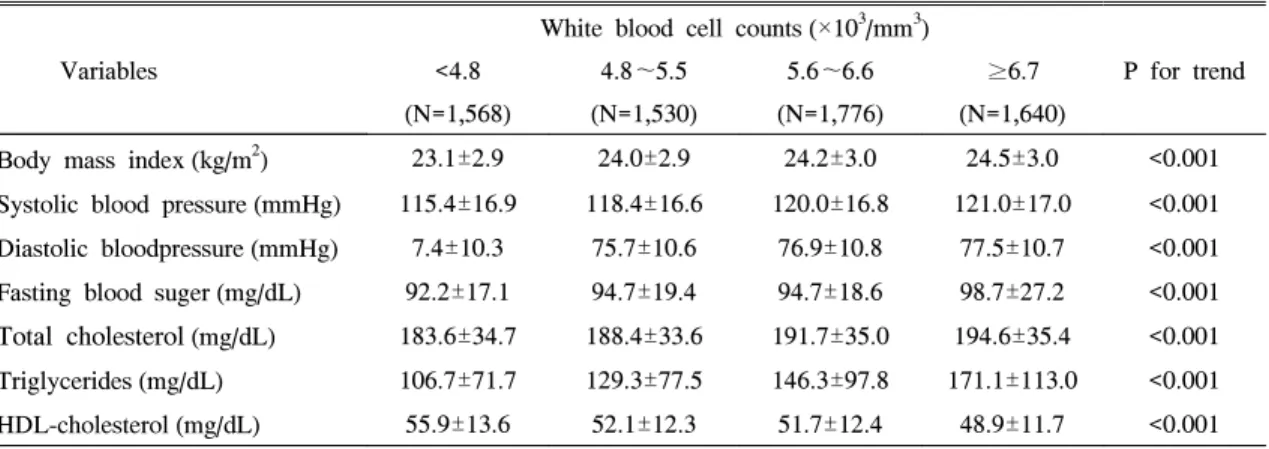
2. 백혈구 사분위수에 따른 체질량 지수 및 심 혈관계 위험인자
백혈구 사분위수가 증가할수록 체질량 지수, 수축기
혈압, 이완기 혈압, 공복 혈당, 총콜레스테롤, 중성지방 은 유의하게 증가하였으며 (P<0.001), HDL-콜레스테 롤은 유의하게 감소하였다 (P<0.001) (Table 2).
3. 대사증후군 각 항목의 유무에 따른 백혈구 증가에 대한 교차비
증가된 백혈구수를 사분위수에 해당하는 6.7×
103/mm3이상을 기준으로 했을 때, 대사증후군 각 항 목의 유무에 따라 증가된 백혈구수에 대한 교차비를 연령과 성별을 보정한 후 95% 신뢰구간과 함께 표 3 에 제시하였다. 대사증후군 각각의 항목이 없을 때에
Table 1. Basal Characteristics of Study Subjects
Variables Mean±SD
Total (N=6,514) Men (N=3,838) Women (N=2,676)
Age (years) 46.3±10.7 46.1±10.5 46.6±11.1
Body mass index (kg/m2)
24.0±3.0 24.6±2.8 23.1±3.1
Systolic blood pressure (mmHg)
118.8±17.0 121.3±15.6 115.1±18.2
Diastolic blood pressure (mmHg)76.1±10.7 77.9±10.5 73.5±10.5
Fasting blood glucose (mg/dL)95.1±21.1 98.0±23.3 90.8±16.6
Total cholesterol (mg/dL)189.7±35.0 191.1±34.5 187.6±35.4
Triglycerides (mg/dL)
139.0±94.9 158.8±104.9 110.6±69.2
HDL-cholesterol (mg/dL)
52.1±52.1 48.8±11.4 56.9±13.1
White blood cell count (×10
3/mm
3) 5.8±1.5 6.1±1.6 5.5±1.5
Table 2. Body Mass Index and Cardiovascular Risk Factors According to the Quartiles of White Blood cell Counts
White blood cell counts (×10
3/mm
3)
Variables <4.8 4.8∼5.5 5.6∼6.6 ≥6.7 P for trend
(N=1,568) (N=1,530) (N=1,776) (N=1,640)
Body mass index (kg/m
2) 23.1±2.9 24.0±2.9 24.2±3.0 24.5±3.0 <0.001
Systolic blood pressure (mmHg) 115.4±16.9 118.4±16.6 120.0±16.8 121.0±17.0 <0.001
Diastolic bloodpressure (mmHg) 7.4±10.3 75.7±10.6 76.9±10.8 77.5±10.7 <0.001
Fasting blood suger (mg/dL) 92.2±17.1 94.7±19.4 94.7±18.6 98.7±27.2 <0.001
Total cholesterol(mg/dL) 183.6±34.7 188.4±33.6 191.7±35.0 194.6±35.4 <0.001
Triglycerides (mg/dL) 106.7±71.7 129.3±77.5 146.3±97.8 171.1±113.0 <0.001
HDL-cholesterol (mg/dL) 55.9±13.6 52.1±12.3 51.7±12.4 48.9±11.7 <0.001
Table 3. Odds Ratio and 95% Confidence Intervals for Elevated WBC Level (≥6.7×10
3/mm
3) in each Component of Metabolic Syndrome after Adjustment for Age and Sex
Variables Category Odds ratio 95% Confidence
Interval
Body mass index (kg/m
2) <25 1.00
≥25 1.02 1.02∼1.31
Blood pressure (mmHg) <130/85 1.00
≥130/85 1.16 1.05∼1.28
Fasting blood glucose (mg/dL) <110 1.00
≥110 1.38 1.19∼1.59
Triglycerides (mg/dL) <150 1.00
≥150 2.11 1.91∼2.33
HDL-cholesterol (mg/dL) Men≥ 40, Women≥ 50 1.00
Men< 40, Women< 50 1.22 1.11∼1.34
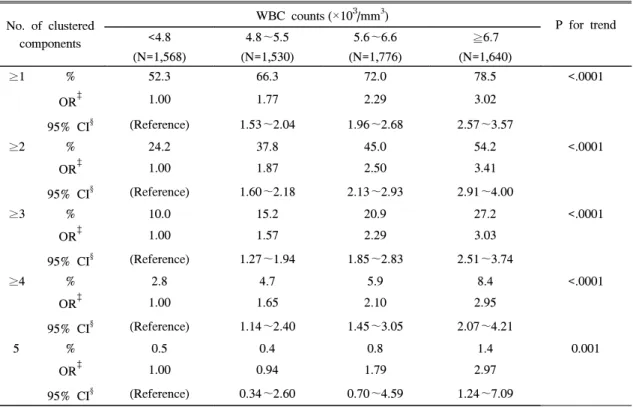
Table 4. Risk for Clustered Components of Metabolic Syndrome, According to White Blood Cell Counts (after adjustment for age and sex)
No. of clustered components
WBC counts (×10
3/mm
3)
P for trend
<4.8 4.8∼5.5 5.6∼6.6 ≧6.7
(N=1,568) (N=1,530) (N=1,776) (N=1,640)
≥1 % 52.3 66.3 72.0 78.5 <.0001
OR
‡1.00 1.77 2.29 3.02
95% CI
§(Reference) 1.53∼2.04 1.96∼2.68 2.57∼3.57
≥2 % 24.2 37.8 45.0 54.2 <.0001
OR
‡1.00 1.87 2.50 3.41
95% CI
§(Reference) 1.60∼2.18 2.13∼2.93 2.91∼4.00
≥3 % 10.0 15.2 20.9 27.2 <.0001
OR
‡1.00 1.57 2.29 3.03
95% CI
§(Reference) 1.27∼1.94 1.85∼2.83 2.51∼3.74
≥4 % 2.8 4.7 5.9 8.4 <.0001
OR
‡1.00 1.65 2.10 2.95
95% CI
§(Reference) 1.14∼2.40 1.45∼3.05 2.07∼4.21
5 % 0.5 0.4 0.8 1.4 0.001
OR
‡1.00 0.94 1.79 2.97
95% CI
§(Reference) 0.34∼2.60 0.70∼4.59 1.24∼7.09
* Components of metabolic syndrome: Body mass index ≥ 25 kg/m
2, Blood pressure ≥ 130/85 mmHg, Fasting blood glucose ≥ 110 mg/dL, Triglycerides ≥ 150 mg/dL, HDL-cholesterol; Men < 40 mg/dL, Women < 50 mg/dL
‡
Odds Ratio
§
Confidence Interval
비해 있을 때 증가된 백혈구수에 대해 한 교차비는 다 음과 같다. 체질량 지수 25 kg/m2이상일 때 1.02 (1.02
∼1.31), 혈압 130/85 mmHg 이상일 때 1.16 (1.05∼
1.35), 공복 혈당 110 mg/dl 이상일 때 1.38 (1.19∼
1.59), 중성지방이 150 mg/dl 이상일 때 2.11 (1.91∼
2.33), HDL-콜레스테롤이 남성 40 mg/dL, 여성 50 mg/dL 미만일 때 1.22 (1.11∼1.34)으로 유의하게 나 타났다 (P<0.05) (Table 3).
4. 백혈구수에 따른 대사증후군 군집성의 위 험도
백혈구의 가장 낮은 사분위수를 기준으로 했을 때 2 분위, 3분위, 4분위에서의 대사증후군에 대한 교차비 는 각각 1.57 (1.27∼1.94), 2.29 (1.85∼2.83), 3.03 (2.51∼
3.74)로 유의하게 증가하는 양상을 보였다 (P<0.0001).
다른 대사증후군의 군집 현상에 대해서도 백혈구수가
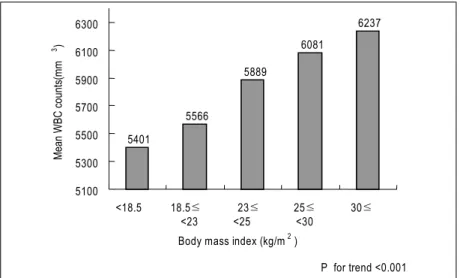
Fig. 1. Mean white blood cell counts according to body mass index category
5401
5566
5889
6081
6237
5100 5300 5500 5700 5900 6100 6300
<18.5 18.5≤
<23
23≤
<25
25≤
<30
30≤
Body mass index (kg/m )
2Mean WBC co unts (mm )
3P for trend <0.001
Fig. 2. Mean white blood cell counts according to numbers of components of metabolic syndrome
6041
6235
6362 6391
6588
5900 6000 6100 6200 6300 6400 6500 6600 6700
1 2 3 4 5
Numbers of components of metabolic Syndrome
M ean W BC c oun ts (m m )
3P for trend <0.001 6041
6235
6362 6391
6588
5900 6000 6100 6200 6300 6400 6500 6600 6700
1 2 3 4 5
Numbers of components of metabolic Syndrome
M ean W BC c oun ts (m m )
3P for trend <0.001
2분위, 3분위, 4분위로 증가할수록 교차비가 유의하게 증가하는 경향을 나타내었다 (P<0.001) (Table 4).
5. 체질량 지수 및 대사증후군 항목의 군집에 따른 백혈구수
체질량 지수 및 대사증후군 항목의 군집 현상에 따 른 백혈구수를 살펴보았을 때 체질량 지수가 증가할수 록, 대사증후군 항목의 군집 현상이 심할수록 백혈구 수가 유의하게 증가하는 경향을 보였다 (P<0.001) (Fig 1, Fig 2).
고 찰
본 연구 결과로 대사증후군과 백혈구 증가와는 유의 한 관련성이 있는 것으로 나타났다. 대사증후군 각각 의 항목이 백혈구 증가와 유의한 관련이 있으며 이러 한 항목들의 군집 현상 또한 백혈구 증가와 유의한 관 련성이 있는 것으로 나타났다.
백혈구는 전통적으로 감염, 혈액 질환 여부를 알아 내는 중요한 임상적 지표로 쓰여왔고, 그 외에도 나이, 성, 인종, 임신, 흡연 여부, 알코올 섭취량에 따라 영향 을 받는다는 것이 알려져 왔다. 그러나 최근 십여 년간 의 연구 결과를 보면, 지방 세포에서 분비된 proinfl- ammatory cytokine에 의해 발생한 인슐린저항성과 이 러한 인슐린저항성으로 인한 당뇨, 고혈압, LDL-콜레 스테롤 증가, HDL-콜레스테롤 증가와 같은 대사증후 군의 각 구성요소와 백혈구가 강력한 양의 상관관계가 있다는 것이 밝혀지고 있다10∼12). 또한, 백혈구수가 정 상 범위에 있다 하더라도 그 수의 증가는 이러한 염증 상태로 인한 심혈관계 질환 발생을 예측할 수 있는 인 자여서 그 중요성이 더해지고 있다13∼17). 본 연구 결과 에서 나타난 대사증후군과 백혈구 증가와의 유의한 관 련성은 기존의 다른 연구 결과와 일치한다18∼25). 비만에 의해 백혈구수가 증가하는 기전은 아직 명확 하게 밝혀지지 않았다. 다만, 지방세포에서 전염증물 질인 tumor necrosis factor (TNF)-α, interleukin (IL)-6 을 많이 생산하고, 이들 cytokine은 간에서 염증반응의 지표인 acute phase reactant의 합성을 자극하여 전신 의 염증반응을 나타내는 지표인 백혈구, 섬유소원,
C-reactive protein (CRP)을 증가시키는 것으로 알려져
있다26,27). 국내 일부 연구에서 비만은 독립적으로 CRP
증가와 관련이 있는 것으로 나타나 서양인에 비해 비 만의 정도가 심하지 않더라도 한국인에서 과다한 체중 은 만성 염증상태와 관련이 있음이 증명된 바 있다. 특 히, 복부의 비만은 지방분해 증가, 조직 내 중성지방 증가, acyl CoA증가, 유리지방산의 농도 증가로 인슐 린저항성과 고인슐린혈증을 나타나며18,20), 복부 비만 과 백혈구 증가와 유의한 관련성이 있다고 보고된 바 있다20). 본 연구에서는 기존의 자료를 이용하여 분석 하였기 때문에 복부 비만에 대한 평가를 할 수 없었는 데 추후 복부 비만과 염증 지표와의 관련성에 대한 연 구가 뒤따라야 할 것이다.
본 연구의 제한점으로는 일부 종합병원 검진센터를 방문한 수검자를 대상으로 조사한 연구이기 때문에 지 역사회 전체를 대표할 수 없다는 점, 후향적 조사로 시 행되었기 때문에 백혈구수에 영향을 줄 수 있는 다른 요인들인 흡연, 음주 등을 고려하지 못한 점을 들 수 있다. 또한 대사증후군을 정의함에 있어 허리둘레를 지표로 사용하지 못하고 체질량지수로 대치하여 판정 한 한계점이 있다. 그러나 대사증후군의 정의가 각 단 체 및 연구자에 따라 다르게 제시하고 있으며7,28,29), 우 리 나라 또한 아직 뚜렷한 정의가 없는 상태이므로 이 에 대해서는 한국인에게 사용하기 적절한 대사증후군 에 대한 판정 기준을 정할 필요가 있다.
결론적으로 한국인에서 비만 및 대사증후군이 독립 적으로 백혈구수 증가와 관련이 있었으며, 이러한 만 성 염증 상태를 개선시키기 위해서는 체중 조절과 대 사증후군의 관리가 중요하다고 하겠다.
ABSTRACT
Background: Increased WBC counts have been associated with inflammatory condition. Recently, ma- ny studies have shown that obesity and the metabolic syndrome is associated with low-grade systemic inflammation. This study was attempted to illustrate the relationship between WBC counts and the meta- bolic syndrome among Korean.
Methods: The subjects included 6,542 adults (males 3,833, females 2,676). We excluded acute ill patients and cancer patients among them, finally 6,514 adults were examined. Logistic regression analysis was used to evaluate the association between WBC counts and the metabolic syndrome with an adju- stment for age and sex.
Results: 1) As WBC counts increased, the values of body mass index and cardiovascular risk factors were increased significantly. 2) The odds ratio for elevated WBC counts (≥6.7×10³/mm3) increased significantly in the subjects with each components of the metabolic syndrome compared to the subjects without them. 3) The odds ratio for the metabolic syndrome increased linearly as 1.57 (1.27∼1.94), 2.29 (1.85∼2.83), and 3.03 (2.51∼3.74) according to the quartile of WBC count level. 4) As body mass index and clustering of components of metabolic synd- rome increased, WBC counts increased significantly.
Conclusion: Increased WBC counts were signific- antly associated with body mass index and the metabolic syndrome among Korean. Management of obesity and the metabolic syndrome might be important to reduce inflammation.
ꠏꠏꠏꠏꠏꠏꠏꠏꠏꠏꠏꠏꠏꠏꠏꠏꠏꠏꠏꠏꠏꠏꠏꠏꠏꠏꠏꠏꠏꠏꠏꠏꠏꠏꠏꠏꠏꠏꠏꠏꠏꠏꠏꠏꠏꠏꠏꠏ
Key Words: White blood cell counts, Obesity,
Metabolic syndrome
참 고 문 헌
1. Ford ES. The metabolic syndrome and C-reactive protein, fibrinogen, and leukocyte count: findings from the Third national Health and Nutrition Ex- amination Survey. Atherosclerosis 2003;168:351-8.
2. Hak AE, Pols HA, Stehouwer CD, Meijer J, Kil- iaan AJ, Hoffman A, et al. Markers of inflamm- ation and cellular adhesion molecules in relation to insulin resistance in non diabetic elderly: the Rotterdam study. J Clin Endocrinol Metab 2001;
86:4398-405.
3. Insomaa B, Almgren P, Tuomi T, Forsen B, Lahti K, Nissen M, et al. Cardiovascular morbidity and mortality associated with the metabolic syndro- me. Diabetes care 2001;24:683-9.
4. Malik S, Wong ND, Franklin SS, Kamath TV, LItalien GJ, Pio JR, et al. Impact of the metabo- lic syndrome on mortality from coronary heart dis- ease, cardiovascular disease, and all cause in Uni- ted States adults. Circulation 2004;110:1245-50.
5. Colhoun HM, Betteridge DJ, Durrington PN, Hi- tman GA, Neil HA, Livingstone SJ, et al. Prim- ary prevention of cardiovascular disease with atorvastatin in type 2 diabetes in the Collaborative Atorvastatin Diabestes Study(CARDS): multicentre randomized placebo-controlled trial. Lancet; 2004;
364:685-96.
6. Cannon CP, Brauwald E, McCabe CH, Raider DJ, Rouleau JL, Belder R, et al. Intensive vs moder- ate lipid lowering with statins in acute coronary syndromes. N Engl J Med 2004;350:1495-504.
7. National Heart Lung and Blood Institute. Execu- tive Summary of the third report of the National Cholesterol Education Program (NCEP) Export Panel on Detection, Evaluation, and Treatment of High Blood Cholesterol in Adults (Adult Treat- ment Panel Ⅲ). JAMA 2001;285:2486-97.
8. Park HS, Oh SW, Cho SI, Choi WH, Kim YS.
The metabolic syndrome and associated lifestyle factors among South Korean adults. Int J Epide- miol 2004;33:328-36.
9. 대한비만학회. 비만의 진단과 치료: 아시아 태평양 지침. 서울: 도서출판 의학: 2000.
10. R.Stuart G, Richard RF, Linda DC, Elisa TL, Barbara VH, Peter JS. Risk factor clustering in the insulin resistance syndrome. Am J Epidemiol 1998;48:869-78.
11. Pedro M, Jean BR, Elizabeth M, Ludovic D, Vanina B, Jean F, et al. Prevalence of insulin
resistance syndrome in Southwestern France and its relationship with inflammatory and hemostatic markers. Diabetes care 2002;25:1371-7.
12. KM Choi, J Lee, YH Kim, KB Kim, DL Kim, SG Kim, et al. Relation between insulin resis- tance and hematological parameters in elderly Koreans-Southwest Seoul(SWS) study. Diabetes Res Clin Prac 2003;60:205-12.
13. Gary DF, Irene T, Richard HG, Teri M, Samuel GS, Stephen S. The leukocyte count: correlates and relationship to coronary risk factors: the CARDIA study. Int J Epidemiol 1990;19:889-93.
14. John WG, Ian AB, Peter MS, David B, John RO, Philip J, et al. Fibrinogen, viscosity, and white blood cell count are major risk factors for isch- emic heart disease. Circulation 1991;83:836-44.
15. Weijenberg MP, Feskens EJM, Kromhout D. Wh- ite blood cell count and the risk of coronary he- art disease and all cause mortality in elderly men.
Arterioscler Thromb Vas Biol. 1996;16:499-501.
16. Adrienne C, David RG, Nathan DW, Adrian MO, William BK. Pre-existent cardiovascular conditi- ons and long term prognosis after initial myocar- dial infarction: the Framingham study. Am Heart J 1993;125:863-72.
17. Matti M, Vesa M, Pekka K, Jussi KH, Erkki OM, Leena T, et al. Leukocyte as a coronary risk factor in a dyslipidemic male population.
Am Heart J 1992;123:873-7.
18. Giovanni T, Jaap CS, Marco T, Michele M, Giorgio DS, Massimo C. The white blood cell count: its relationship to plasma insulin and other cardiovascular risk factors in healthy male individuals. J Intern Med 1996;239:435-41.
19. Noriyuki N, Mitsuru S, Kokoro S, Kazue N, Shi- geki M, Toshio T, et al. Associations between white blood cell and features of the metabolic syndrome in Japanese male office workers. Ind Health 2002;40:273-7.
20. Carantoni M, Zuliani G, Volpato S, Palmieri E, Mezzetti A, Vergnani L, et al. Relationships between fasting plasma insulin, anthropometries, and metabolic parameters in a very old healthy population. Metabolism 1998;47:535-40.
21. John D, Rory C, Paul A, Richard P. Association of fibrinogen, C-reactive protein, albumin, or leukocyte count with coronary heart disease metaanalysis of prospective studies. JAMA 1998;279: 1477-82.
22. Isao S, Kunio Y, Fujiko I. Association of body mass index, body fat, and weight gain with inflammation markers among rural residents in Japan. Circ J 2003;67:323-9.
23. 황상태, 김범수, 황상준, 서정열, 김병진, 이원영 등.
말초혈액 내 백혈구수와 대사증후군과의 연관성.
대한순환기학회지 2004;34:280-7.
24. Nkanishi N, SUzuki K, Tatara K. White blood cell count and clustered features of metabolic syndrome in Japanese male office workers. Occup Med 2002;52:213-8.
25. 최태순, 문유선, 최영호, 고석연, 관경섭, 김윤기.
백혈구수와 대사증후군의 군집성의 연관성-일개 대학병원 건강증진센터 수진자를 대상으로-. 가정 의학회지 2004;25:34-9.
26. 황정숙, 이승훈, 박혜순. 한국 성인 남성에서 CRP 와 비만과의 연관성. 가정의학회지 2003;24:58-63.
27. Chris JH, Jan HN, Karin HT, Wim HM, Paul HC, Margriet S, et al. Leptin and the proinflam- matory state associated with human obesity. J Clin Endocrinol Metab 2004;89:1773-8.
28. Alberti KG, Zimmet PZ. Definintion, diagnosis and classification of diabetes mellitus and its complications. Part 1: diagnosis and classification of diabetes mellitus provisional report of a WHO consultation. Diabet Med 1998;15:539-53.
29. Reaven GM. Banting lecture 1988. Role of insu- lin resistance in human disease. Diabetes 1988;
37:1595-607.