Impact of Enzyme Replacement Therapy on Linear Growth in Korean Patients with Mucopolysaccharidosis Type II (Hunter Syndrome)
Hunter syndrome (or mucopolysaccharidosis type II [MPS II]) arises because of a deficiency in the lysosomal enzyme iduronate-2-sulfatase. Short stature is a prominent and consistent feature in MPS II. Enzyme replacement therapy (ERT) with idursulfase (Elaprase®) or idursulfase beta (Hunterase®) have been developed for these patients. The effect of ERT on the growth of Korean patients with Hunter syndrome was evaluated at a single center. This study comprised 32 patients, who had received ERT for at least 2 yr; they were divided into three groups according to their ages at the start of ERT: group 1 (< 6 yr, n = 14), group 2 (6-10 yr, n = 11), and group 3 (10-20 yr, n = 7). The patients showed marked growth retardation as they got older. ERT may have less effect on the growth of patients with the severe form of Hunter syndrome. The height z-scores in groups 2 and 3 revealed a significant change (the estimated slopes before and after the treatment were -0.047 and -0.007, respectively: difference in the slope, 0.04; P < 0.001). Growth in response to ERT could be an important treatment outcome or an endpoint for future studies.
Keywords: Mucopolysaccharidosis II; Hunter Syndrome; Enzyme Replacement Therapy;
Growth; Elaprase; Hunterase Sung Yoon Cho,1* Rimm Huh,2*
Mi Sun Chang,2 Jieun Lee,2 Younghee Kwun,2 Se Hyun Maeng,2 Su Jin Kim,3 Young Bae Sohn,4 Sung Won Park,5 Eun-Kyung Kwon,2 Sun Ju Han,2 Jooyoun Jung,2 and Dong-Kyu Jin2
1Department of Pediatrics, Hanyang University Guri Hopistal, Hanyang University College of Medicine, Guri; 2Department of Pediatrics, Samsung Medical Center, Sungkyunkwan University School of Medicine, Seoul; 3Department of Pediatrics, Kwandong University College of Medicine, Myongji Hospital, Goyang; 4Department of Medical Genetics, Ajou University Hospital, Ajou University School of Medicine, Suwon; 5Department of Pediatrics, Kwandong University College of Medicine, Cheil General Hospital & Woman’s Health care Center, Seoul, Korea
*Sung Yoon Cho and Rimm Huh contributed equally to this work.
Received: 2 September 2013 Accepted: 13 November 2013 Address for Correspondence:
Dong-Kyu Jin, MD
Department of Pediatrics, Samsung Medical Center, Sungkyunkwan University School of Medicine, 81 Irwon-ro, Gangnam-gu, Seoul 135-710, Korea
Tel: +82.2-3410-3525, Fax: +82.2-3410-0043 E-mail: [email protected]
This study was supported by a grant from Samsung Medical Center (#GFO1130061).
http://dx.doi.org/10.3346/jkms.2014.29.2.254 • J Korean Med Sci 2014; 29: 254-260
INTRODUCTION
Hunter syndrome (or mucopolysaccharidosis type II [MPS II], OMIM# 309900) is a rare and life-limiting X-linked recessive disorder that affects approximately 1 in 77,000- 94,000 newborn boys (1-3). The cause of the disease is a deficiency in the lysosomal enzyme iduronate-2-sulfatase (IDS, EC 3.1.6.13), which is responsible for breaking down glycosaminoglycans (GAGs) within cells (4). Impaired GAG degradation results in progressive damage of various tissues and organs (4). Affected individuals present with coarse facial features, short stature, skeletal deformities, and joint stiffness, and frequently show mental retardation (4, 5).
Short stature is a prominent and consistent feature of Hunter syndrome (5-7); this generally becomes evident when the individual is approximately 8-10 yr of age (5, 7, 8).
During childhood, short stature may have a negative impact on their quality of life and social functioning (9-11). In addition, the physical growth of patients is of paramount importance in pediatric practice and is a highly emotive issue for parents. Thus, ame- liorating short stature may be beneficial to patients and their parents.
Enzyme replacement therapy (ERT) with idursulfase (Elap rase®; Shire HGT Phar- maceuticals, Cambridge, MA, USA) has been available for patients with MPS II since August 2006 in the US, since March 2007 in Europe, and since February 2009 in Korea.
More recently, ERT with idursulfase beta (Hunterase®; Green Cross Corp., Yongin, Ko- rea) has been commercially available in Korea. A phase I/II clinical trial showed that idursulfase beta treatment was well tolerated in Korean patients with MPS II and re- sulted in a significant reduction in urinary excretion of GAGs and an improvement in the 6-min walking test distance (12). The effectiveness of ERT in pulmonary function and joint mobility was evaluated in several studies (13, 14).
Pediatrics
To date, few studies have investigated the effect of ERT on the growth of individuals with MPS II (6, 15). No data are available for Asian MPS II patients, or for patients younger than 6 yr of age. The present retrospective analysis assessed the effect of ERT on the linear growth of Korean Hunter syndrome patients of different ages and phenotypes.
MATERIALS AND METHODS Patient population and data collection
All the participants were recruited from the Department of Pe- diatrics in Samsung Medical Center. The diagnosis of MPS II was based on the clinical findings, as well as abnormal excre- tion of urinary GAGs and deficiency of IDS enzyme activity in skin fibroblasts or peripheral blood leukocytes. The disease was confirmed in all the patients by molecular analysis. Mutations of patient 4-32 were described previously (16). Those with car- diac failure, a history of hematopoietic stem cell transplanta- tion or orthopedic surgery, and those on nocturnal respiratory support were excluded from this study. Patients on long-term oral steroid treatment and those who had previously received growth hormone therapy were excluded. Those who experi- enced episodes of anaphylaxis during ERT (17) and female pa- tients with Hunter syndrome were also excluded. Patients who had commenced ERT (Elaprase® or Hunterase®) before they were 20 yr and had received ERT for at least 2 yr were included.
All patients had received ERT (0.5 mg/kg) on a weekly basis, shortly after they were diagnosed or since 2009, when ERT be- came available in Korea.
The impact of ERT on growth was analyzed in patients for whom height data had been obtained on at least one occasion within 24 months before or after the start of the treatment. The height data were analyzed within 3 age-stratified groups. Two age cut-off points at the start of the ERT—6 yr and 10 yr—were selected because patients with Hunter syndrome tend to grow faster in their early years, followed by markedly reduced growth after around 8 yr of age onward. The patient’s height was mea- sured using a stadiometer (accuracy to 1 mm) according to stan- dard protocols.
The clinical phenotypes of the patients were classified as se- vere if the patients had cognitive impairment, and as attenuat- ed if they had no cognitive impairment even with pronounced bone and visceral involvement. Our previous study suggested that mild phenotype may be related to residual lysosomal en- zyme activity (18). Type of mutation was determined based on the experience of the authors: mutations predicted to be asso- ciated with a severe phenotype (large deletion, recombination, deletion or nonsense mutation) and those predicted to be as- sociated with a less-severe phenotype (splicing, insertion, in- sertion/deletion or missense mutation).
Data analysis
Three groups of patients were analyzed according to their ages at the start of the ERT (baseline): group 1 included patients un- der 6 yr of age (n = 14), group 2 included patients aged 6-10 yr (n = 11), and group 3 included patients aged 10-20 yr (n = 7).
The raw height data of the three groups were plotted against normal height data for boys from Korea. Height was expressed as the standard deviation score (SDS) based on normative data from Korean references. A z-score < -2 is generally considered to be indicative of short stature, and this score was used to plot the heights in the current study. For group 2 and group 3 with attenuated MPS II, the mean changes in the patients’ heights and z-scores (± SD) from baseline were calculated.
A piecewise regression using a mixed model was used to an- alyze the age-corrected standardized height scores (z-scores) before and after the start of the ERT (± 24 months of the start of the treatment) for the patients in groups 2 and 3. Individual anal- yses of the patients in groups 2 and 3 were conducted to assess covariates that were likely to impact on growth: age at start of ERT (6-10 vs 10-20 yr), type of mutation, and phenotype.
Ethics statement
This study was approved by the institute review board at the Samsung Medical Center (IRB number: 2013-05-035). Informed consent was obtained from all patients or their parents.
RESULTS Patients
The demographic and molecular data of the 32 MPS II patients are listed in Table 1. The 32 boys started to receive ERT between the ages of 4 months until they were 19 yr 4 months (median age of starting ERT, 7 yr). All the patients were born at term and presented with typical clinical features of MPS II (median age of diagnosis, 3 yr 4 months). Cognitive involvement was evident in 13 of the 32 patients.
Effect of ERT on growth
In group 1 (n = 14; age range at starting ERT, 4 months-5 yr 10 months), the heights of the patients at the initiation of ERT rang- ed from 78 to 119.4 cm (median, 106.3 cm). None of the boys were of short stature (< -2 SDS) at the start of the ERT, and the mean height SDS of the patients in group 1 was 0.48 ± 1.71. The mean increase in height over the 2-yr period of ERT was 11.5 ± 5.8 cm. The growth charts and the z-scores are shown in Fig. 1A and D. The growth curves during the ERT show that the height of 12 of these patients was still within the normal range based on normative data from Korean references. Two patients (pa- tient 8, patient 13) whose height decreased to less than -2 SDS exhibited severe cognitive impairment when they were diag- nosed with the disease. Changes in the z-scores and the growth
velocities of these patients are not presented as figures because of a lack of data on the heights of the subjects prior to undergo- ing ERT.
In group 2 (n = 11; age range at starting ERT, 6 yr 1 month-10 yr), the patients’ heights at the initiation of ERT ranged from 98 to 122.5 cm (median, 116.2 cm). Six patients were considered to be of short stature at the start of ERT, and the mean height SDS of the patients in group 2 was -2.6 ± 1.79. During 3 yr of ERT, the mean increase in height was 9.4 ± 6.1 cm. The growth charts and the z-scores are shown in Fig. 1B and E. The yearly growth ve- locity was calculated for the seven patients in group 2 with at- tenuated MPS II. The increase in height was 3.1 cm (z-score = -0.22; one patient was excluded from this analysis due to lack of data of height before ERT) in the year before the ERT, compared with 4.9 cm (z-score = 0.24), 3.8 cm (z-score = -0.02), and 4.2 cm (z-score = -0.04) in the first, second, and third years of the ERT, respectively (Fig. 2A, C).
In group 3 (n = 7; age range at starting ERT, 10 yr 3 months-19 yr 4 months), the heights of the patients at the initiation of ERT
ranged from 116.7 to 142.4 cm (median, 127.7 cm). Five patients were considered to be of short stature at the start of ERT, and the mean height SDS of the patients in group 3 was -5.12 ± 3.79.
During 3 yr of ERT, the mean increase in the height of the pa- tients was 9.5 ± 7.6 cm. The growth charts and the z-scores are shown in Fig. 1C and F. The increase in the heights of six pa- tients in group 3 with attenuated MPS II was 0.7 cm (z-score = -0.47) in the year before the ERT compared with 3.9 cm (z-score
= 0.02), 2.5 cm (z-score = -0.01), and 3.6 cm (z-score = 0.1) in the first, second, and third years of the ERT, respectively (Fig.
2B, D).
Analysis of the height z-scores of the 17 patients in groups 2 and 3
The overall analysis of the raw data using the height z-scores of the 17 patients who were aged 6-20 yr at the start of the ERT showed that the slope of the regression over time after the treat- ment (in months) was significantly changed compared with before the treatment (the estimated slopes before and after the Table 1. Demographic and molecular data of the patients with MPS II
Patient Age (yr)
at diagnosis Age (yr)
at starting ERT Current age
(yr) Phenotype Type of mutation
in IDS Nucleotide
change Amino acid
change Group 1
1 2 3 4 5 6 7 8 9 10 11 12 13 14
1.2 3.3 2.11 4.2 2.7 3.4 2.8 3.11 0.4 5.1 1.6 1.4 3 1.7
1.3 3.5 2.11 5 5.6 5.1 4.8 5.2 0.4 5.3 2.4 4.1 4 4.4
3.11 5.1 4.11 8.1 9.4 9.8 8.6 9 3.8 9.1 6.2 8 7.11 8.2
S A A S A S S S A A S A S S
Deletion Deletion Nonsense Recombination Missense Nonsense Recombination Deletion Deletion Deep intron Deletion Deletion Deletion Splicing
c.768delT
large deletion (exon4_7) c.1327C > T c.682C > G c.223C > T large deletion (exon1_6) c.1402delC c.596_599delAACA c.359_360insATCC c.596_599delAACA c.1007-1G > A
p.P256fsX24 p.R443X p.P228A p.Q75X
p.R468GfsX17 p.K199RfsX13 p.P120HfsX11 p.K199RfsX13 Group 2
15 16 17 18 19 20 21 22 23 24 25
3.5 7.2 2.3 3.8 4.9 3.1 2.9 3.8 6.5 2.7 4.11
8.9 7.11 6.1 8.7 9.8 9.2 7.1 9.6 8 10 6.9
12.8 11.1 10 12.6 13.7 13.1 11 13.5 11.11 13.11 10.7
A A S S S A A S A A A
Splicing Deletion/insertion Recombination Deletion Deletion Missense Missense Recombination Missense Splicing Missense
c.1181-1G > C c.1222delinsTA c.420delG c.344delA c.590C > G c.1565T > C c.253G > A c.1122C > T c.1004A > G
p.P408YfsX23 p.G140fsX p.N115fsX p.P197R p.L522P p.A85T p.H335R Group 3
26 27 28 29 30 31 32
5.5 12.2 4.9 6.9 10.1 7.2 18.7
10.3 14.11 12.11 10.3 18.8 16.2 19.4
14.3 18.9 16.9 14.1 22.1 20.1 23.2
A A S A A A A
Missense Splicing Missense Missense Insertion Nonsense Splicing
c.781C > G c.1122C > T c.1454T > A c.181T > C c.673_674insC c.1327C > T c.1122C > T
p.P261A p.I485K p.S61P p.P228fsX p.R443X
Group 1, aged under 6 yr at the time of starting enzyme replacement therapy (ERT); Group 2, aged 6-10 yr at the time of starting ERT; Group 3, aged 10-20 yr at the time of starting ERT; S, severe form of MPS II; A, attenuated form of MPS II; recombination, recombination of IDS-IDS2.
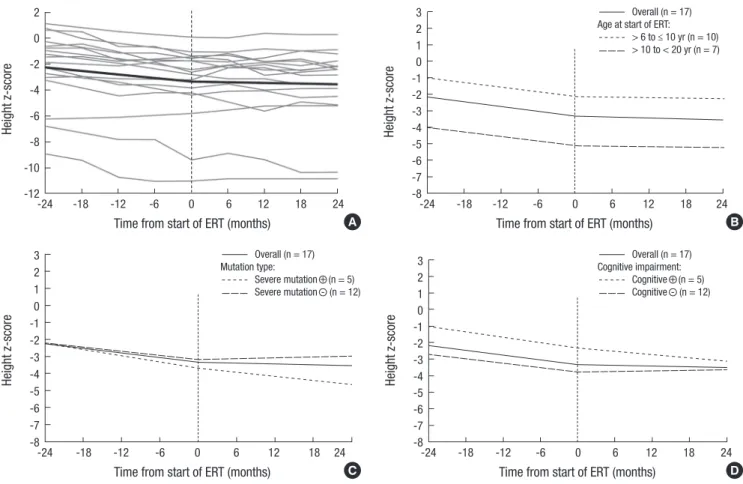
treatment were -0.047 and -0.007, respectively: difference in the slope, 0.04; P < 0.001) (Fig. 3A). The slope of the regression was particularly more changed in the 12 patients in groups 2 and 3 with the attenuated form of the disease (from -0.045 to 0.004:
difference in the slope, 0.049; P < 0.001). In contrast, the slope of the regression was not significantly changed in the 6 patients in groups 2 and 3 with the severe form of the disease (from -0.053 to -0.035: difference in the slope, 0.018; P = 0.129).
Impact of age at start of ERT
Patients with Hunter syndrome aged 6-20 yr were shorter on
average when compared to their peers. The height deficit was more pronounced in patients aged 10-20 yr of age at the start of treatment (difference in z-score at the start of ERT, 2.89; P = 0.095) (Fig. 3B). Before treatment, the estimated slope difference be- tween the older and the younger age groups was 0.003 (P = 0.725), and it was -0.001 (P = 0.876) after treatment. The angle of the slope was modified by ERT to a similar degree in both groups (Fig. 3B).
Impact of type of mutation
No significant difference was observed for the height deficit in Fig. 1. Growth charts and z-scores for height for Hunter syndrome patients. (A) Growth charts for group 1 (aged less than 6 yr at initiation of ERT). (B) Growth charts for group 2 (aged 6-10 yr at initiation of ERT). (C) Growth charts for group 3 (aged 10-20 yr at initiation of ERT). (D) Z scores for group 1 (aged less than 6 yr at initiation of ERT). (E) Z scores for group 2 (aged 6-10 yr at initiation of ERT). (F) Z scores for group 3 (aged 10-20 yr at initiation of ERT). The dotted lines indicate patient growth before enzyme re- placement therapy (ERT), and the continuous lines denote the growth while receiving ERT. The shaded area represents the 3rd to the 97th percentiles of height in boys based on normative data from Korean references. The red lines represent the patients with the attenuated form, and the blue lines denote those with the severe form.
Height (cm)
Age at visit (yr)
0 1 2 3 4 5 6 7 8 9 10 11 12 13 14 15 16 200
180 160 140 120 100 80 60 40
Normal population No ERT On ERT
Height (cm)
Age at visit (yr)
0 1 2 3 4 5 6 7 8 9 10 11 12 13 14 15 16 200
180 160 140 120 100 80 60 40
Normal population No ERT On ERT
Height (cm)
Age at visit (yr)
0 1 2 3 4 5 6 7 8 9 10 11 12 13 14 15 16 17 18 19 20 21 22 23 24 200
180 160 140 120 100 80 60 40
Normal population No ERT On ERT
Height z-score
Age at visit (yr)
0 1 2 3 4 5 6 7 8 9 10 11 12 13 14 15 16 54
32 10 -1-2 -3-4 -5-6 -7-8
No ERT On ERT
Height z-score
Age at visit (yr)
0 1 2 3 4 5 6 7 8 9 10 11 12 13 14 15 16 54
32 10 -1-2 -3-4 -5-6 -7-8
No ERT On ERT
Height z-score
Age at visit (yr)
0 1 2 3 4 5 6 7 8 9 10 11 12 13 14 15 16 17 18 19 20 21 22 23 24 5
3 1 -1 -3 -5 -7 -9 -11
No ERT On ERT A
C
E
B
D
F
terms of z-scores between the two groups according the type of mutation (difference in z-score at the start of ERT, -0.705; P = 0.666) (Fig. 3C). The angle of the slope was modified by ERT in the patients without severe type of mutation. Before treatment, the estimated slope difference was 0.017 (P = 0.158), and it was 0.04 (P < 0.001) after treatment (Fig. 3C).
Impact of cognitive involvement
Contrary to expectations, the height deficit was more pronounc- ed in patients without cognitive impairment (difference in z- score at the start of ERT, 1.549; P = 0.337) (Fig. 3D). The z-score declined progressively in patients with cognitive involvement;
however, a small change was evident in the trajectory of the slope following the initiation of ERT in the patients without cognitive impairment. Before treatment, the estimated slope difference was 0.006 (P = 0.623), and it was 0.037 (P < 0.001) after treat- ment (Fig. 3D).
DISCUSSION
This study is the first to report on the effects of ERT on the growth of Asian patients with Hunter syndrome. We evaluated the ef- fects of ERT on the growth of patients from one country who at- tended a single center. The same method was used to measure the heights of the patients at the center. Therefore, the data are unlikely to be confounded by ethnic differences, and the chang- es in the heights of the patients were measured relatively accu- rately. In addition, this study included an analysis of the growth trajectories of Hunter syndrome patients who started to receive ERT before they were 6 yr old.
Patients with MPS II show a significantly different growth pat- tern to that seen in healthy children. During the first 3 yr of life, MPS II children grow faster than healthy children. However, af- ter this period, they show a clearly negative trend of pathologi- cal deviations in comparison with their healthy peers (7). Our patients reflected these two distinct growth patterns found in Hunter syndrome. The patients showed marked growth retar- Fig. 2. Yearly growth velocity and z-score of the patients with the attenuated form of groups 2 and 3. (A) Yearly growth velocity for group 2 (aged 6-10 yr at initiation of ERT). (B) Yearly growth velocity for group 3 (aged 10-20 yr at initiation of ERT). (C). Z scores for group 2 (aged 6-10 yr at initiation of ERT). (D) Z scores for group 3 (aged 10-20 yr at ini- tiation of ERT).
Growth velocity (cm/yr)
Year prior to ERT start
(n = 6)
1st year on ERT (n = 7)
2nd year on ERT (n = 7)
3rd year on ERT (n = 7) 8
7 6 5 4 3 2 1
Growth velocity (cm/yr)
Year prior to ERT start
(n = 6)
1st year on ERT (n = 6)
2nd year on ERT (n = 6)
3rd year on ERT (n = 6) 10
8 6
4
2 0
-2
Annual change in height (z-score)
Year prior to ERT start
(n = 6)
1st year on ERT (n = 7)
2nd year on ERT (n = 7)
3rd year on ERT (n = 7) 1.5
1.0
0.5
0.0
-0.5
-1.0
-1.5
Annual change in height (z-score)
Year prior to ERT start
(n = 6)
1st year on ERT (n = 6)
2nd year on ERT (n = 6)
3rd year on ERT (n = 6) 1.5
1.0
0.5 0.0
-0.5
-1.0
-1.5 A
C
B
D
Fig. 3. Regression plot showing the height z-scores before and after initiation of enzyme replacement therapy (ERT) in 17 patients aged 6-20 yr at treatment start. (A) The gray lines show the regression plot for each patient. The slope of the regression was significantly changed after the ERT compared with before the treatment (difference in z-score, 0.04; P < 0.001). (B) Impact of age at start of ERT. (C) Impact of type of mutation. (D) Impact of cognitive impairment.
Height z-score
Time from start of ERT (months)
-24 -18 -12 -6 0 6 12 18 24 2
0 -2 -4 -6 -8 -10 -12
Height z-score
Time from start of ERT (months)
-24 -18 -12 -6 0 6 12 18 24 3
2 1 0 -1 -2 -3 -4 -5 -6 -7 -8
Overall (n = 17) Age at start of ERT:
> 6 to ≤ 10 yr (n = 10)
> 10 to < 20 yr (n = 7)
Height z-score
Time from start of ERT (months)
-24 -18 -12 -6 0 6 12 18 24
3 2 1 0 -1 -2 -3 -4 -5 -6 -7 -8
Overall (n = 17) Mutation type:
Severe mutation + (n = 5) Severe mutation - (n = 12)
Height z-score
Time from start of ERT (months)
-24 -18 -12 -6 0 6 12 18 24 3
2 1 0 -1 -2 -3 -4 -5 -6 -7 -8
Overall (n = 17) Cognitive impairment:
Cognitive + (n = 5) Cognitive - (n = 12) A
C
B
D
dation as they got older, as seen by the height SDS of groups 1, 2, and 3 at the initiation of ERT (0.48 ± 1.71, -2.6 ± 1.79, and -5.12
± 3.79, respectively).
Today, more patients are diagnosed at a younger age because of the heightened awareness of Hunter syndrome after the ap- proval of ERT for the disease. Six patients were diagnosed at Samsung Medical Center in the last 3 yr. Their median age at diagnosis was 3.1 yr (range 1 yr 2 months-3 yr 8 months), and their height SDS at diagnosis was 0.74 ± 0.99, which reflects the characteristic faster growth of MPS II children during their first 3 yr of life. Among these patients, 3 patients were excluded from this study because their treatment period was less than 2 yr. Eval- uating the effect of ERT on the growth of younger aged children with Hunter syndrome is difficult due to their faster growth dur- ing their first 3 yr of life compared to the healthy children and their marked growth retardation after this period.
Patients in group 2 showed a tendency toward growth resto- ration after initiation of ERT, as well as marked growth retarda- tion before treatment initiation. Growth restoration was also seen in the patients in group 3 who started the ERT at over the age of 10 yr. One previous study suggested that ERT may have a positive impact on height, particularly if it was started before 10 yr of age in patients with the attenuated form of the disease (6).
In our study, improvements in growth velocity and change of z- score slowed down at 2nd and 3rd year compared to those of at 1st year of ERT in group 2 with attenuated form as shown in Fig.
2A and C. However, their annual growth velocities were improv- ed compared with those before ERT. Interestingly, even the pa- tients who started ERT in their late teens showed an impro ve- ment in their growth patterns. This result may be explained by the characteristic delayed puberty of patients with MPS II (al- though we did not check the pubertal status of the patients in this study), in addition to the large number of individuals (6 of 7 patients) with the attenuated form of the disease.
ERT may have less of an effect on the growth of patients with the severe form because of more severe dysostosis multiplex, malnutrition caused by poor oral intake due to dysphagia, ab- dominal distension (hepatosplenomegaly), and poor general condition due to multiorgan dysfunction. As shown in Fig. 3D, growth restoration after ERT in the patients with the severe phe- notype of the disease was not favorable.
Data from Hunter Outcome Survey (HOS) showed signifi- cant improvements in growth after ERT in the study population of 133 patients with both phenotypes of Hunter syndrome aged 8-15 yr at treatment start (15). Similarly, ERT improved the over- all growth pattern of the patients in groups 2 and 3 according to
their growth curves in this study. In the study from HOS, covari- ates that significantly impacted on growth were age at start of ERT (8-11 vs 12-15 yr) and type of mutation. In our study, only age at start of ERT (6-10 vs 10-20 yr) had a significant impact on growth.
The improvement in growth observed in this study is likely to have resulted from a reduction in joint contracture rather than new bone growth because ERT is assumed to have little or no effect on bones. Physiotherapy may be beneficial in reducing joint contracture because it can cause the muscles and tendons to adapt to the new bone growth. Most of our patients (26 of the 32) underwent physiotherapy. Other general improvements, such as better pulmonary function, may also have a beneficial impact on the patient’s growth.
The z-score, which was used for analysis in this study, is based on the general population, and small numbers of patients with Hunter syndrome could be included in the current study due to rarity of this disease. Information on the natural growth pat- terns of patients with Hunter syndrome is needed for accurate assessment of the effect of ERT. However, obtaining this type of information is not easy because the disease is very rare, and ethical reasons should dictate that treatment should be offered to all patients diagnosed with Hunter syndrome.
In conclusion, growth in response to ERT could be an impor- tant treatment outcome or an endpoint for future studies. Fur- ther long-term studies of the effect of ERT on the growth of Asian patients with Hunter syndrome should include larger groups for a more precise evaluation of the effect. In addition, further evaluation is needed of the psychosocial impact of short stature and its amelioration in patients with Hunter syndrome.
DISCLOSURE
The authors have no conflicts of interest to disclose.
REFERENCES
1. Poorthuis BJ, Wevers RA, Kleijer WJ, Groener JE, de Jong JG, van Weely S, Niezen-Koning KE, van Diggelen OP. The frequency of lysosomal storage diseases in The Netherlands. Hum Genet 1999; 105: 151-6.
2. Baehner F, Schmiedeskamp C, Krummenauer F, Miebach E, Bajbouj M, Whybra C, Kohlschütter A, Kampmann C, Beck M. Cumulative inci- dence rates of the mucopolysaccharidoses in Germany. J Inherit Metab Dis 2005; 28: 1011-7.
3. Lin HY, Lin SP, Chuang CK, Niu DM, Chen MR, Tsai FJ, Chao MC, Chiu PC, Lin SJ, Tsai LP, et al. Incidence of the mucopolysaccharidoses in Tai- wan, 1984-2004. Am J Med Genet A 2009; 149A: 960-4.
4. Neufeld E, Muenzer J. The metabolic and molecular bases of inherited disease. In: Scriver CR, Beaudet AL, Sly WS, Valle D, editors. The muco- polysaccharidoses. New York: McGraw-Hill, 2001, p3421-52.
5. Schwartz IV, Ribeiro MG, Mota JG, Toralles MB, Correia P, Horovitz D, Santos ES, Monlleo IL, Fett-Conte AC, Sobrinho RP, et al. A clinical study of 77 patients with mucopolysaccharidosis type II. Acta Paediatr Suppl 2007; 96: 63-70.
6. Schulze-Frenking G, Jones SA, Roberts J, Beck M, Wraith JE. Effects of enzyme replacement therapy on growth in patients with mucopolysac- charidosis type II. J Inherit Metab Dis 2011; 34: 203-8.
7. Rozdzynska A, Tylki-Szymanska A, Jurecka A, Cieslik J. Growth pattern and growth prediction of body height in children with mucopolysacchari- dosis type II. Acta Paediatr 2011; 100: 456-60.
8. Wraith JE, Beck M, Giugliani R, Clarke J, Martin R, Muenzer J; HOS In- vestigators. Initial report from the Hunter Outcome Survey. Genet Med 2008; 10: 508-16.
9. Gordon M, Crouthamel C, Post EM, Richman RA. Psychosocial aspects of constitutional short stature: social competence, behavior problems, self-esteem, and family functioning. J Pediatr 1982; 101: 477-80.
10. Stabler B, Clopper RR, Siegel PT, Stoppani C, Compton PG, Underwood LE. Academic achievement and psychological adjustment in short chil- dren: the National Cooperative Growth Study. J Dev Behav Pediatr 1994;
15: 1-6.
11. Stephen MD, Varni JW, Limbers CA, Yafi M, Heptulla RA, Renukuntla VS, Bell CS, Brosnan PG. Health-related quality of life and cognitive func- tioning in pediatric short stature: comparison of growth-hormone-naïve, growth-hormone-treated, and healthy samples. Eur J Pediatr 2011; 170:
351-8.
12. Sohn YB, Cho SY, Park SW, Kim SJ, Ko AR, Kwon EK, Han SJ, Jin DK.
Phase I/II clinical trial of enzyme replacement therapy with idursulfase beta in patients with mucopolysaccharidosis II (Hunter syndrome). Or- phanet J Rare Dis 2013; 8: 42.
13. Muenzer J, Wraith JE, Beck M, Giugliani R, Harmatz P, Eng CM, Vellodi A, Martin R, Ramaswami U, Gucsavas-Calikoglu M, et al. A phase II/III clinical study of enzyme replacement therapy with idursulfase in muco- polysaccharidosis II (Hunter syndrome). Genet Med 2006; 8: 465-73.
14. Muenzer J, Beck M, Eng CM, Giugliani R, Harmatz P, Martin R, Ramas- wami U, Vellodi A, Wraith JE, Cleary M, et al. Long-term, open-labeled extension study of idursulfase in the treatment of Hunter syndrome. Gen- et Med 2011; 13: 95-101.
15. Jones SA, Parini R, Harmatz P, Giugliani R, Fang J, Mendelsohn NJ; HOS Natural History Working Group on behalf of HOS Investigators. The ef- fect of idursulfase on growth in patients with Hunter syndrome: data from the Hunter Outcome Survey (HOS). Mol Genet Metab 2013; 109:
41-8.
16. Sohn YB, Ki CS, Kim CH, Ko AR, Yook YJ, Lee SJ, Kim SJ, Park SW, Yeau S, Kwon EK, et al. Identification of 11 novel mutations in 49 Korean pa- tients with mucopolysaccharidosis type II. Clin Genet 2012; 81: 185-90.
17. Kim J, Park MR, Kim DS, Lee JO, Maeng SH, Cho SY, Han Y, Ahn K, Jin DK. IgE-mediated anaphylaxis and allergic reactions to idursulfase in patients with Hunter syndrome. Allergy 2013; 68: 796-802.
18. Lee OJ, Kim SJ, Sohn YB, Park HD, Lee SY, Kim CH, Ko AR, Yook YJ, Lee SJ, Park SW, et al. A study of the relationship between clinical phenotypes and plasma iduronate-2-sulfatase enzyme activities in Hunter syndrome patients. Korean J Pediatr 2012; 55: 88-92.