Received: May 3, 2015 ∙ Revised: May 13, 2015 ∙ Accepted: May 15, 2015 Corresponding Author: Sung Hyun Kyung
Hospital of Semyung University, St. Sangbang 4-63, Chungju City, Chungcheongdo 380-080, Republic of Korea.
Tel: +82-43-841-1739 / Fax: +82-43-856-1731 E-mail: [email protected]
ⓒ The Association of Pediatrics of Korean Medicine. All rights reserved. This is an open-access article distributed under the tenus of the Creative Commons Attribution Non-Commercial License (http://creativecommons.org/licenses/by-nc/3.0/), which permits unrestricted non-commercial use, distribution, and reproduction in any medium, provided the original work is properly cited.
Pubmed로 검색한 소아 천식의 침술 및 혈위약물요법 치료에 관한 문헌고찰
송창은․지현우․이학경․성현경
세명대학교 한의학과
Abstract
A Literature Study of Oriental Medicine Therapy for Pediatric Asthma Mainly about Acupuncture and Acupoint Application in Pubmed
Song Chang Eun․Jee Hyun Woo․Lee Hak Kyeong․Sung Hyun Kyung University of Korean medicine, Semyung university
Objectives
Asthma is an allergic disease that frequently occurs in children. This study aims to research acupuncture and acupoint-application treatment of pediatric asthma.
Methods
We got 53,653 search results with searching word ‘child’ ‘children’ ‘pediatric’ ‘juvenile’ ‘adolescence’ ‘baby’
‘infant’ ‘asthma’ in Pubmed and got 147 results among them with searching word ‘acupuncture’ ‘acupoint application’. We selected 13 articles among them which were seem to be related to this study. We classified these studies according to the type of study, the treatment methods and treatment outcomes.
Results
There were few studies about acupuncture and acupoint application on pediatric asthma. According to current research, conducting acupuncture and acupoint application treatment on pediatric asthma patient is recommended. Especially, acupoint application and laser acupuncture treatment were important to consider as treatment options on pediatric asthma patients for non-invasive way and less painful to children.
Conclusions
For the study on acupuncture and acupoint application treatment in pediatric asthma, it is necessary that we conduct research on various merit of acupuncture. More clinical data would be needed to prove the effects of acupuncture and acupoint application treatment in pediatric asthma.
Key words : Pediatric asthma, Acupuncture, Acupoint-application treatment, Literature review
폐쇄를 특징으로 한다1). 특히 아동기의 천식은 정확한 치료 및 지속적인 관리가 이루어지지 않을 경우 불가 역적인 기도 변형이 초래되어 성인기로 이행될 수 있 는 위험성이 있다2).
특히 천식 증상이 심할수록 활동 제한과 병원 입원, 학교 결석이 잦아지며 아동의 신체적, 정서적, 사회적 기능에 제한을 줄 뿐만 아니라 보호자에게는 신체 활 동, 정신적, 경제적인 영향을 미쳐 결국 이들의 삶의 질을 저하시키게 된다3). 최근 초등학생을 대상으로 한 역학조사에 따르면 천식진단은 1995년 7.7%, 2000년 9.1%, 2006년 7.8%로 나타나 천식의 유병률은 지속적 으로 증가하는 추세임을 알 수 있다. 학령기의 천식은 잦은 결석으로 학교 수업에 지장을 주며, 천식이나 투 약 중인 약물이 학습에 영향을 미칠 수 있다4).
천식에 대한 서양 의학적 치료는 속효성이 뛰어나 급한 증상을 치료하는 데 있어서는 유효하나 완치나 예방에는 한계가 있고, 심각한 부작용을 나타내기도 한다. 또한 만성적 경과를 밟는 질병의 특성으로 치료 가 장기적으로 이루어지며, 약물복용으로 인한 합병증 혹은 부작용을 겪게 된다. 따라서 환자들은 치료법을 선택 시 안전하고, 부작용이 적으며 합병증도 치료하 며 궁극적으로 삶의 질을 개선 시켜주는 치료법을 원 하고 있다5). 이러한 시점에서 기존치료법보다 부작용 이 적고, 안정적이며 장기적 치료법으로써 한의학 치 료의 필요성이 대두되고 있다.
한의학에서 천식은 哮喘, 風寒喘, 痰喘의 범위에 속 하며 일반적으로 熄風化痰, 宣肺止咳의 방법으로 치료 하게 된다6). 그러나 현재 대부분의 연구는 한약치료 위 주인 경우가 많으며 침술치료 등에 대한 연구는 적은 실정이다.
이에 저자는 천식의 한의학적 치료법 중 안정성이 뛰어나고, 부작용이 적은 침술치료와 혈위약물요법에 대한 치료적 근거를 제시하기 위하여, 현재 소아천식 에 사용되는 침술치료와 혈위약물요법의 최근 연구에 대하여 조사하였다.
항목에서 child, newborn, infant, preschool child, child, Adolescent로 선택하였으며 article type, text option, language, sex, subjects 등 다른 조건에는 제한 을 주지 않았다. 검색어는 ‘child’ ‘children’ ‘pediatric’
‘juvenile’ ‘adolescence’ ‘baby’ ‘infant’ 과 ‘asthma’를 검 색하여 나온 53653편의 논문 중 검색어 ‘acupuncture’
‘acupoint application’을 포함하는 논문 147편을 검색 하였고 검색기간을 2005년 1월 1일부터 2015년 4월 현 재까지 10년의 기간으로 설정하여 55편의 논문이 검색 되었다.
이 가운데 중복되거나 소아천식과 연관성이 없는 21편, 연구대상이 소아뿐만 아니라 성인까지 포함하는 논문 12편, 단순 보완대체의학으로서의 침술치료 소개 연구 9편, 실험논문 1편 등은 제외하여 총 13편의 논문 이 선정되었다.
가능한 모든 논문은 full text를 이용하여 평가하였으 나, abstract만 존재하는 경우 abstract를 이용하여 평가하 였다. 연구는 연구목적, 연구디자인, intervention, peri- od, sample size, evaluation, result로 나누어 분석하였다.
Ⅲ. Results
1. 출판경향분석
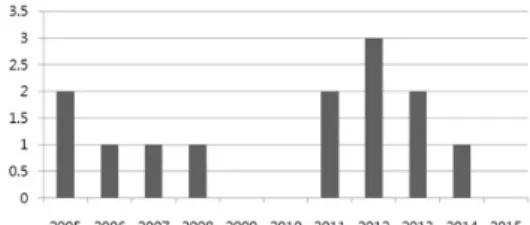
선정된 13편의 논문 중, 출판 국가는 중국이 8편으로 제일 많은 숫자를 차지하였으며, 나머지 국가는 모두 1편씩이 선정되었다 (Fig. 1). 연도별로 분류했을 때는 2005~2010년 사이에 출판된 논문이 5편, 2011~2015년 사이 출판된 논문이 8편으로 나타났다 (Fig. 2).
2. 연구방법분석
총 13편의 논문 중, Systemic review 논문 1편 Case study 논문은 4편, Control trial 논문은 2편, Randomaized control trial 논문은 6편으로 Randomized control trial 논문이 많은 수를 차지하였다 (Fig. 3, Table 1).
Fig. 1. Sorted by country Fig. 2. Sorted by year
Fig. 3. Type of study Table 1. Design of Study
Year First
Author Type of Study Sample
size Age Group Periods of
Treatment
2005 Gao XA7) controlled clinical
trial 150 4-14 years
Treatment (n=75): Herb + acupoint-application Control (n=75): Amoxicillin and clavulanate Potassium tab (0.125-0.25 g): Tid
Ketotifen (0.5-1.0 mg): Bid
Procaterol hydrochlorid (8-25 μg): Bid Promethazine Hydrochloride syp (5-10 ml): Tid Etc: Budesonide, Becotide
2 weeks
2005 Chen J8) controlled clinical
trial 34 4-13
years
Treatment (n=16): Electronic stimulation + acupoint-application
Control (n=18): Placebo stimulation
7 days (once in a day) 2006 Lisheng L9) clinical case study 60 - Treatment (n=30): Acupoint-application
Control (n=30): Ketotifen -
2007 Stockert K10)
randomized, placebo-controlled
pilot study
17 6-12
years
Treatment (n=8): Laser acupuncture (10 weeks) + Probiotics (7 weeks)
Control (n=9): Placebo light pen
10 weeks (Laser) + 7 weeks (Oral)
2008 Nedeljković M11)
prospective, randomized, controlled clinical
trial
100 7-17
years
Treatment (n=50): 6-Ki SuJok treatment + conservative drug therapy
Control (n=50): Conservative drug therapy
12 days
2011 Liao12)
randomized controlled clinical
trial
200 3-37
months
Treatment (n=100): Basement drugs + acupoint-application
Control (n=100): Basement drugs
[Anti+Aminophylline 3 mg/kg (IV) once/day Albuterol sulfate 0.5 ml + 0.9% Nacl 2 ml (inhal) 10min. twice/day]
5 days (8 hours/ once in
a day)
2011 Scheewe S13)
randomized, controlled clinical
trial
93 12-15
years
Acupuncture (n=46): Basement drugs + acupuncture Control (n=47): Basement drugs
12 times (1 month)
2012 Wen BL14) clinical case study 609 - Acupoint-application 3 times
(30 days)
2012 Wu F15)
randomized, controlled clinical
trial
90 5-14
years
Group Ⅰ(n=30): Xiaochuangao acupoint paste (XAP) treatment
Group Ⅱ(n=30): Hormone treatment Group Ⅲ(n=30): XAP + hormone treatment
3 times (30 days)
trial
2014 Li N19) Clinical case study 164 -
Acupoint-application treatment no reaction (n=43)
mild reaction (n=42) moderate reaction (n=39) severe reaction (n=40)
30 days once every ten
days in dog-days
Fig. 4. Orted by intervention
Table 2. Acupoints of Treatment Publish
year
First Author
Type of
Treatment Acupoint Number of
Treatments Time of Treatment
2005 Gao XA7) acupoint-application KI1 2 weeks
(once in a day) -
2005 Chen J8) acupoint-application BL13 - -
Table 3. Acupoint of Acupuncture Treatment (Laser Acupuncture + Acupuncture)
Frequency Acupoint
3 times LU7, BL13, CV17
2 times LU5, LU9, LI4, BL23, ST36, ST41,SP6, KI6
1 times
LU1, LU11, LUI2, LI2, LI6, LI11, LI 19, LI20, BL17, BL18, BL20, BL21, BL42, ST13, ST25, ST40, ST44, SP3, SP9, SP10, HE3, HE5, HE7, SI3, Ki3, KI8, KI27, PE6, TE5, TE15, GA3, GA34, GA40, GA41, LR2, LR3, LR8,
LR13, CV4, CV6, CV9, CV21, GV4, GV13, GV14
Fig. 5. Acupoint of acupoint-application treatment
Table 5. The Effects of Clinical Treatment Publish
year
First
Author Group Results
2005 Gao XA7) Treatment (n=75) Control (n=75)
EOS
Treatment: 0.50 ± 0.34 to 0.21 ± 0.18 (P<0.05) Control: 0.48 ± 0.29 to 0.20 ± 0.17 (P<0.05) IgE
Treatment: 899.82 ± 763.46 to 237.73 ± 188.34 (P<0.01) Control: 891.12 ± 768.15 to 220.77 ± 187.59 (P<0.01)
2005 Chen J8) Treatment (n=16) Control (n=18)
1. IL-10
Treatment: 6.62 ± 2.94 to 30.42 ± 10.93 (P<0.01) Control: 6.38 ± 2.82 to 16.97 ± 7.24 (P<0.05) 2. IFN-γ
Treatment: 15.97 ± 6.84 to 16.75 ± 6.28 Control: 16.20 ± 6.70 to 16.98 ± 6.06 2006 Lisheng L9) Treatment (n=30)
Control (n=30) Effective rate : Treatment group 85% (P<0.05)
2007 Stockert K10) Treatment (n=8) Control (n=9)
1. PFV: between two group (P=0.034) Treatment: 25.2 ± 16.2 to 7.9 ± 2.9 (P=0.015) Control: 15.5 ± 1.8 to 17.8 ± 23.9 (P=0.25) 2. FEV1
Treatment: 81.8 ± 8.1 to 86.3 ± 5.7 Control: 81.5 ± 8.0 to 88.6 ± 8.5 3. Quality of life
Treatment: 62.1 ± 20 to 54.9 ± 25.4 Control: 47.8 ± 9.5 to 34.6 ± 16.6 4. Beta minetics
Treatment: 8.7 ± 15.4 to 9.1 ± 15.4 Control: 3.1 ± 6.2 to 3.7 ± 6.7
2008 Nedeljković M11) Treatment (n=50) Control (n=50)
FVC: Treatment group shows more bigger increase range than control group FEV1: Treatment group shows more bigger increase range than control group FEF 25-75%: Treatment group shows more bigger increase range than control group
PEFR: Treatment group shows more bigger increase range than control group Table 4. Prescription of Acupoint-Application
Publish year
First
Author Herb
2005 Gao XA7) Asiasarum heterotropoides F. Maekawa var. mandshuricum F. Maekawa, Asiasarum sieboldi F. Maekawa.
2005 Chen J8)
Bowsellia carteri, Isatis tinctoria Linne, Fritillaria cirrhosa D. Don, Ligularia sibirica (L.) Cass, Tussilago farfara L., Prunus persica (L.) Batsch, Carthamus tinctorius, Bupleurum falcatum L., Sinapis alba L., Dryobalanops aromatica Gaertn. f.
2006 Lisheng L9) -
2011 Liao12) -
2012 Wen BL14) Sinapis alba L, Corydalis ternata Nakai,
2012 Wu F15) Sinapis alba L., Asarum sieboldii var. seoulense Nakai, Corydalis ternata Nakai, Euphorbia kansui Liou ex Wang
2014 Li N19) -
3. 치료방법분석
치료법은 acupoint-application이 7회로 가장 많았 으며 laser acupuncture가 4회, acupuncture 2회 순으 로 사용되었다 (Fig. 4). 침술의 혈위는 Table 2과 같이 다양한 경혈들이 사용되었고, 혈위약물요법에서 빈용
된 혈위는 肺俞 (BL13) 定喘 (EXB1), 膻中 (CV17), 天 突 (CV22), 膈俞 (BL17), 大椎 (GV14) 순이며 (Table 3), 다용된 본초는 백개자, 세신, 현호색 등이다 (Fig. 5).
4. 치료효과 분석
2011 Scheewe S13) Acupuncture (n=46) Control (n=47)
Acupuncture : 84.6 ± 9.6 to 85.4 ± 8.6 Control : 84.6 ± 10.01 to 84.9 ± 8.3 2. MEF
Acupuncture : 88.5 ± 26.8 to 89.2 ± 26.1 Control : 86.8 ± 27.9 to 86.2 ± 23.1 3. DeltaFEV1
Acupuncture : -2.9 ± 7.6 to 1.0 ± 16.4 Control : –4.0 ± 9.8 to –0.2 ± 15.2 4. PEF
Acupuncture : 16.1 ± 8.3 to 12.5 ± 5.5 Control : 20.4 ± 9.4 to 16.9 ± 8.8 (P<0.05) 5. STAIC(State trait anxiety inventory for children) Trait Acupuncture : 32.4 ± 5.8 to 32.5 ± 8.2 Control : 36.4 ± 8.9 to 33.6 ± 10.0 State Acupuncture : 41.5 ± 8.1 to 38.4 ± 8.7 Control : 45.2 ± 8.8 to 44.4 ± 9.2 (P<0.05) 6. Number of using medications : decreased
7. Symtoms (cough, breatheless, whistle, squeeze) : decreased 8. Inspiratory difficulties : decreased
2012 Wen BL14) Treatment influenced by recipes of Chinese drugs, preparations, prescriptions of acupoints, chance, time and skin reactions
2012 Wu F16)
Group Ⅰ: XAP Group Ⅱ: Hormone Group Ⅲ: XAP + Hormone
1. Effective rate
Group Ⅰ: 63.3% Group Ⅱ: 69.2% Group Ⅲ: 93.1%
2. FEV
Group Ⅰ: 53.21 ± 15.02 to 78.82 ± 18.94 Group Ⅱ: 52.20 ± 15.02 to 76.77 ± 18.94 Group Ⅲ: 53.38 ± 15.02 to 89.65 ± 18.94 3. PEF
Group Ⅰ: 55.80 ± 13.27 to 79.03 ± 17.09 Group Ⅱ: 54.62 ± 13.27 to 82.20 ± 17.09 Group Ⅲ: 55.30 ± 13.27 to 93.52 ± 17.09 4. FEV1/FVC
Group Ⅰ: 54.31 ± 18.06 to 76.98 ± 19.40 Group Ⅱ: 56.01 ± 18.06 to 79.86 ± 19.40 Group Ⅲ: 55.54 ± 18.06 to 91.54 ± 19.40
2012 Juanhua15) Systemic review
2013 Elseify MY17) Treatment
1. 48 patients reported better exercise tolerance (P<0.001) 2. FEV : 81.8 ± 25.2 to 98.5 ± 28.1
FVC : 85.4 ± 21.5 to 104.3 ± 26.2 FEV1/FVC : 79.6 ± 14.5 to 82.9 ± 13.5 PEF : 71.8 ± 22.9 to 84.3 ± 24.1 3. ACQ : improved
13.9 ± 3.8 to 23.3 ± 3.6 (P<0.001) 4. 92% of patients became well controlled
5. Inhaled steroids dose decreased from 200-450 to 0-200 μg/day
6. all patients stopped short acting B2 agonist (SABA) rescue (P<0.01, 0.001)
2013 Karlson G18) Acupuncture/
Control
Symtom score (Questionnaire) : Compared with the control group, the reduction in asthma symptoms (P=0.0376) and reduction use of inhaled steroids (P=0.0005) was significantly larger in the intervention group
Use of inhaled steroids & use of β2 agonist were decreased at 3 month treatment
2014 Li N19)
no reaction (n=43)/
mild reaction (n=42)/
moderate reaction (n=39)/
severe reaction (n=40)
1. Effective rate (%) no reaction (n=43) : 58.14%
mild reaction (n=42) : 88.10%
moderate reaction (n=39) : 94.87%
severe reaction (n=40) : 97.50%
2. Cough-asthma score, wheezing rale score, reattack times were decreased (P<0.05, P<0.01)
Ⅳ. Discussion
천식은 표적기관이 기관지인 알레르기 질환으로, 임 상적으로 기도 염증에 의해 발생하는 기관지 폐쇄를 특징으로 하며 기침, 가래와 기도폐쇄에 의한 호흡곤 란의 증상 등을 나타내며 이러한 증상들은 만성 염증 에 의해 반복되면서 장기간에 걸쳐 나타나고 기도 폐 쇄의 증상이 더욱 심하게 나타나며 때로는 비가역적 폐기능의 저하까지 진행된다1).
천식은 지난 수십년 간 전 세계적으로 50%씩 증가 하여 중요한 보건문제가 되고 있으며 우리나라에서는 천식을 경험한 어린이 수가 1980년대에는 5%정도에 서 2000년대에는 13%로 증가하였고, 이는 서구화된 주거 환경의 변화, 모유수유 감소 등의 식습관의 변화, 대기오염 및 환경위생의 변화 등과 밀접한 관계가 있 다1). 2013년의 조사에 따르면 18세 이하 소아청소년의 천식 유병률은 4.3%에 달하고 있다20).
천식의 급성악화는 질병의 이환율과 사망률 등에 중요한 인자이며 이로 인해 환자 개인 및 사회적으로 상당한 의료비용을 소요하게 한다. 따라서 악화초기나 전조기에 적극적인 치료가 환자의 예후와 사회경제적 비용의 절감에 있어 중요하다고 할 수 있다21-2).
천식은 哮喘, 風寒喘, 痰喘의 범위에 속하며6)원인 으로는 痰, 外感, 食傷, 勞倦 등을 들었으며 특히 소아 는 肺臟橋嫩하고 肺, 脾, 腎 三臟이 不足하여 痰濕內 盛한 것이 內因이 되며 氣候變化, 寒溫失調, 六淫之邪 등의 外因으로 원인을 세분화하였다23). 한의학적 치료 에 대한 연구는 in vitro 수준의 연구가 대부분이며, 임 상적인 연구에서는 황 등24-5), 방 등26)의 연구에서 천식 환자에게 한약치료를 한 후의 치료효과를 보는 연구들 이 있었으며 침치료에 대한 연구는 Suzuki27)의 연구 외에는 아직 많은 연구가 이뤄지지는 않은 실정이다.
이에 천식의 한의학적 치료법 침술치료와 혈위약물요 법에 대한 치료적 근거를 제시하기 위하여, 현재 소아 천식에 사용되는 침술치료와 혈위약물요법의 최근 연 구에 대하여 조사하였다.
검색방법은 pubmed에서 검색어를 ‘child’ ‘children’
‘pediatric’ ‘juvenile’ ‘adolescence’ ‘baby’ ‘infant’ 과
‘asthma’를 검색하여 나온 53,653편의 논문 중 검색어
‘acupuncture’ ‘acupoint application’을 포함하는 논문 147편을 검색하였고 검색기간을 2005년 1월 1일부터 2015년 4월 현재까지 10년의 기간으로 설정하여 55편 의 논문이 검색되었다. 이 가운데 중복되거나 소아천
식과 연관성이 없는 21편, 연구대상이 소아뿐만 아니 라 성인까지 포함하는 논문 13편, 단순 보완대체의학 으로서의 침술치료 소개 연구 9편 등은 제외하여 총 13편의 논문을 선정하였으며 이를 출판경향, 연구방법, 치료방법, 치료효과 등으로 기준을 나누어 분석하였다.
먼저 출판경향을 살펴보면, 13편의 논문 중, 국가별 분류는 중국이 8편으로 제일 많은 숫자를 차지하였고 나머지 국가는 모두 1편씩이 선정되었다 (Fig. 1). 연도별 로 분류했을 때는 2005~2010년 사이에 출판된 논문이 5편, 2011~2015년 사이 출판된 논문이 8편으로 나타났 다 (Fig. 2). 연구방법에 있어서는 Randomaized control trial 논문이 6편으로 가장 많았다 (Fig. 3). 치료방법에 있어서는 acupuncture와 acupoint-application으로 나 누었을 때 각각 6편, 7편이었고 acupuncture를 다시 Laser acupuncture와 일반 acupuncture로 세분화했을 때 각각 4편, 2편으로 침술치료 중에서도 Laser acu- puncture를 다룬 연구가 더 많았던 것을 알 수 있다 (Fig. 4). 치료방법에 있어 Laser acupuncture는 20~60초 정도의 시간동안 acupuncture 30분 정도, 그리고 acu- point-application은 2시간에서 8시간까지 장시간 치료 시간을 가지는 것을 알 수 있었으며 (Table 2), 치료 혈위 에 대해서 분석한 결과 acupoint-application은 肺俞 (BL13) 7회, 定喘 (EXB1), 膻中 (CV17) 5회, 膈俞 (BL7), 大椎 (GV14), 天突 (CV22) 3회, 心俞 (BL15)혈이 2회 나머지 혈자리는 1회 순으로 나타났으며 가장 빈용된 혈은 肺俞 (BL13), 定喘(EXB1), 膻中 (CV17) 등이라 할 수 있으며 (Fig. 5). 또한 acupoint-application의 처방 을 분석한 결과 본초는 백개자 3회, 세신, 현호색 2회, 유황금, 판람근, 천패모, 자완, 관동, 도인, 홍화, 시호, 빙편, 감수는 1회 순으로 사용된 것을 알 수 있었다 (Table 4).
침술에 있어서는 BL13, CV17, LU7, KI6, LI11, ST 41, BL42 등의 혈위를 사용하였고, Laser acupuncture 에서는 LU5, LU7, LU9, LI4, ST36, SP6, CV17, BL13, BL23, GV14 등의 혈자리를 다용하였다 (Table 3). 이 처럼 소아천식의 치료에 있어 경혈을 응용한 치료법을 모색할 때 비침습적이고 통증이 적어 소아에 적용하기 용이한 혈위약물요법이나 레이저침 요법을 다용하는 것을 볼 수 있었다. 혈위약물요법은 약물과 경락의 작 용을 결합한 종합치료법으로써 소량의 각종 약물로 혈 위를 자극하여 인체 면역기능을 강화함으로써 질병을 예방하는 것으로, 최근 중국과 대만을 중심으로 冬病 夏治의 원리에 따른 삼복첩, 삼구첩 등이 광범위하게
는 치료 후 알레르기와 연관 있는 물질인 EOS와 IgE 등의 수치가 유의하게 감소한 것을 볼 수 있었으며 Lisheng L 등9)의 연구에서는 치료군의 유효율이 유의 하게 85%가 나왔으며 Liao12)등의 연구에서는 치료군 에서만 wheezing sound가 유의한 정도로 감소하였다.
Chen 등8)의 연구에서는 치료 후 면역관련물질인 IL-10 과 IFN-γ 수치가 감소하였으나 IL-10 수치만 유의한 수준으로 감소하였다. 폐기능을 객관적으로 측정한 Stockert K10), Nedeljković M11), Scheewe S13), Magda Y17)등의 연구에서는 대체적으로 FEV, FVC, PEF 등 의 수치로 표현되는 폐기능이 대부분 향상되었으며, 유의한 수준이 아니더라도 대체적으로는 대조군 보다 치료효과가 좋은 것으로 나타났다. Stockert K10), Scheewe S13) Magda Y17), Karlson G18)등의 연구에서 는 주관적 증상과 설문평가, 삶의 질 평가에 있어서 치 료군에서 더 좋은 결과를 나타냄을 알 수 있었다. Li N19)등의 연구에서는 먼저 혈위약물요법을 시행하고 반응에 따라 군을 4개로 나누었는데, 그동안 혈위첩부 요법에서는 약물을 혈위에 부착한 후 증상의 개선정도 를 보는 형식이었지만 이 연구에서는 첩부요법으로 생 긴 홍조, 가려움, 수포 등의 피부반응에 따라서 무반응 (n=43), 약한반응 (n=42), 보통반응 (n=39), 심한반응 (n=40) 4그룹으로 나누고 나타나는 치료 및 예방효과 를 1년동안 관찰한 결과 기침-천식점수, 천명-수포음점 수, 천식발작횟수는 치료 전 점수보다 4개 그룹 모두 명백히 감소되었으며 (P<0.05, P<0.01), 그룹 간의 비 교는 무반응군과 약한 반응그룹이 보통반응과 심한반 응 그룹보다 높았고 (P>0.05), 총 치료율은 무반응, 약 한반응, 보통반응, 심한반응 그룹이 각기 58.14%, 88.10%, 94.87%, 97.50% 를 기록하였으며 약한반응, 보통반응, 심한반응 그룹이 무반응 그룹보다 치료효과 가 높았고 (P<0.01), 약한반응 그룹이 보통반응, 심한 반응 그룹보다 치료효과율이 낮았으나 (P<0.05), 보통 반응과 심한반응 그룹 사이에서의 치료효과율 차이는 별로 없었다 (P>0.05). 이를 통해 같은 혈위약물요법을 사용하더라도 피부반응이 뚜렷함에 따라서 대체적으 로 치료효과가 더 좋게 나타나는 것을 볼 수 있었다.
그러므로 치료시간을 설정할 때 환자마다 피부의 상태
이 있었으나 환자의 종류가 다양하고, 치료법, 그리고 결과의 측정값도 다양하여 객관적으로 비교하기에 쉽 지 않았다. 침술요법은 연구가 부족하여 사용 혈위 외 에는 분석하기에 어려운 점이 많았다.
이처럼 소아 천식에 대한 치료 중 침술요법, 혈위약 물요법 등의 논문을 분석해본 결과 소아에 적용할 수 있는 레이져 침술요법과 혈위약물요법 등에서 천식에 유효한 치료효과가 있는 것을 알 수 있었으며, 앞으로 국내에서도 이를 응용한 후속연구가 필요할 것으로 사 료된다.
Ⅴ Conclusion
1. PubMed에서 최근 10년간 소아천식의 치료에 있어 침술치료 및 혈위약물요법 등에 대한 논문을 검색하 여 13건의 유의미한 연구를 얻어 이를 연구방법, 치 료방법, 치료효과 등으로 나누어 분석하였다 2. 소아천식은 만성질환으로 장기적 양약복용으로 부
작용을 겪는 경우가 많기에, 부작용이 없는 침술 및 혈위약물요법이 효과적일 수 있으며 소아천식의 치 료에 있어 침술치료와 혈위첩부요법은 FEV, FVC, PEF 등의 수치로 표현되는 폐기능을 향상시켰으며 알레르기 반응 및 염증반응에 관여하는 EOS, IgE, IL-10, IFN-γ 수치를 감소시켰으며 wheezing sound, cough 등의 천식의 증상을 개선시키고, 삶의 질도 향상됨을 나타내었다.
3. 침술요법의 다용 혈위는 列缺 (LU7), 肺俞 (BL13), 膻 中 (CV17)등이며, 혈위첩부요법의 다용혈위는 肺俞 (BL13), 膻中 (CV17), 定喘 (EXB1)이고 혈위첩부요 법의 다용 본초는 백개자, 현호색, 세신이다.
4. 소아천식의 치료에 있어 침술요법, 특히 레이저침술 요법과 혈위첩부요법은 비침습적이고, 통증이 적어 서 소아천식환자에게 응용해 보기 좋을 것으로 사료 된다.
Ⅵ. Acknowledgement
이 논문은 2015학년도 세명대학교 교내학술연구비 지원에 의해 수행된 연구임 (This paper was sup- ported by the Semyung University Research Grant of 2015)
References
1. Hong CE. Pediatrics. Seoul: Daehan. 2007:1127-36.
2. Yoon HS, Lee HR, Kim WK. An assessment of asthmatic knowledge of school teachers. J Pediatr Allergy Respir Dis. 1998;8(2):179-89.
3. Clark NM, Feldman CH, Evans D, Levinson MJ, Mellins RB, Wasilewski Y. The impact of health education on frequency and cost of health care use by low income children with asthma. J Allergy Clin Immunol. 1986;
78(1):108-15.
4. Jee HM, Kim KW, Kim CS, Sohn MH, Shin DC, Kim KE. Prevalence of asthma, rhinitis and eczema in korean children using the international study of asthma and allergies in childhood (ISAAC) questionnaires. J Allergy Clin Immunol. 2009;19(2):165-75.
5. Park YC, Baek YH, Park DS. The study on recent acupuncture treatment in asthma. J Korean Acupunct Moxibusition Soc. 2007;24(1):217-25.
6. Choi WJ, Kim JH. A literature study on pediatric bronchial asthma. J Pediatr Korean Med. 2007;21(1):1-9.
7. Gao XA, Zhu JS. Clinical observation on hailong juanxiao recipe combined with kechuanping mounting on yong- quan acupoint in treating children' bronchial asthma in the stage of attack. Zhongguo Zhong Xi Yi Jie He Za Zhi. 2005;25(8):738-40.
8. Chen J, Zhang CM, Chen H. Clinical observation on acupoint electro-superconducting therapy with Chinese herbal drugs contained pad in treating children asthma.
Zhongguo Zhong Xi Yi Jie He Za Zhi. 2005;25(12):
1120-2.
9. Lisheng L, Mingming W, Huili C. Point application of medicated cakes for treatment of asthma in children-a report of 60 cases. J Tradit Chin Med. 2006;26(3):165-6.
10. Stockert K, Schneider B, Porenta G, Rath R, Nissel
H, Eichler I. Laser acupuncture and probiotics in school age children with asthma: a randomized, placebo-con- trolled pilot study of therapy guided by principles of Traditional Chinese Medicine. Pediatr Allergy Immunol. 2007;18(2):160-6
11. Nedeljković M, Ljustina-Pribić R, Savić K. Innovative approach to laser acupuncture therapy of acute ob- struction in asthmatic children. Med Pregl. 2008;61 (3-4):123-30.
12. Liao HW. Acupoint sticking therapy for 100 cases of infants asthmatic bronchitis. Zhongguo Zhen Jiu.
2011;31(7):585-6.
13. Scheewe S, Vogt L, Minakawa S, Eichmann D, Welle S, Stachow R, Banzer W. Acupuncture in children and adolescents with bronchial asthma: a randomised con- trolled study. Complement Ther Med. 2011;19(5):239-46.
14. Wen BL, Liu BY, Jin P, Wang XF, Xiang XX, Liu XF, Hu JQ, Lu F, He LY, Zhu WZ, Fang YG, Wang Y. Clinical research of acupoint application for
“treatment of winter disease in summer” used to prevent and treat bronchial asthma in children. J Tradit Chin Med. 2012;32(1):31-9.
15. Zhang J, Li X, Xu J, Ernst E. Laser acupuncture for the treatment of asthma in children: a systematic review of randomized controlled trials. J Asthma. 2012;49(7):
773-7.
16. Wu f, Yao MH, Zhu Y. Clinical study on prevention of recurrence of asthma in children by Xiaochuangao acupoint paste: treating winter diseases in summer.
Zhongguo Zhong Yao Za Zhi. 2012;37(17):2646-8.
17. Elseify MY, Mohammed NH, Alsharkawy AA, Elseoudy ME. Laser acupuncture in treatment of childhood bron- chial asthma. J Complement Integr Med. 2013;9(10):
199-203.
18. Karlson G, Bennicke P. Acupuncture in asthmatic children: a prospective, randomized, controlled clinical trial of efficacy. Altern Ther Health Med. 2013;19(4):13-9.
19. Li N, Xing YJ, Zhao M, Geng WJ, Zhao M. Influence of different skin reactions of acupoint-application on clinical outcomes in the prevention and treatment of bronchial asthma. Zhen Ci Yan Jiu. 2014; 39(3):222-7.
20. Leem DW, Park KH, Moon IJ, Kim SR, Koh BS, Park HJ, Lee JH, Park JW. Critical pathway of acute
J Allergy Clin Immunol. 2000;106:493-9.
22. Hokins G, Mccowan C, Nervile RG, Thomas GE, Smith B, Silverman S. Risk factors and costs associated with an asthma attack. Thorax. 2000;55:19-24.
23. Kim YH. A clinical study on pediatric bronchial asthma.
J Pediatr Korean Med. 2002;16(1):133-48.
24. Hwang WS, Choi JY, Lee JS, Jung HJ, Rhee HK, Jung SK. The effects of Gamipaimo-tang on blood eosino- phil, serum IgE and cytokines in asthmatic patients.
J Korean Orient Int Med. 2003;24(4):747-58.
25. Hwang WS, Jung HJ, Ju CY, Lee JS, Lee KK, Rhee HK, Jung SK. A study on changes in blood eosinophil,
J Korean Orient Int Med. 2011;32(1):10-25.
27. Suzuki M, Namura K, Egawa M, Yano T. Effect of acupuncture treatment in patients with bronchial asthma. J Korean Acupunct Moxibustion Soc. 2007;
24(5):185-95.
28. Sung HK, Min SY, Kim JH. Clinical trial study about preventing winter diseases through summer prophylactic treatment using acupoint sticking. J Pediatr Korean Med. 2010;24(2):59-74.
29. Lee SH, Kim CY, Chang GT. A literature study of Samguchup - based on the traditional chinese medical journal. J Pediatr Korean Med. 2012;26(4):1-9.