• 검색 결과가 없습니다.

개선된 광촉매 효과를 위한 수열법에 의한 삼원계 Bi2WO6-GO-TiO2 나노복합체의 쉬운 합성 방법

N/A
N/A
Protected

Academic year: 2021

Share "개선된 광촉매 효과를 위한 수열법에 의한 삼원계 Bi2WO6-GO-TiO2 나노복합체의 쉬운 합성 방법"

Copied!
9
0
0

로드 중.... (전체 텍스트 보기)

전체 글

(1)

Article https://doi.org/10.14478/ace.2017.1046

1)

1. Introduction

Graphene has been reported as a substrate source for synthetic nano- materials that have many different targets, using a variety of synthetic

† Corresponding Author: Hanseo University,

Department of Advanced Materials Science & Engineering, 46, Hanseo 1-ro, Haemi-myeon, Seosan-si, Chungcheongnam-do, Korea

Tel: +82-41-660-1337 e-mail: [email protected]

pISSN: 1225-0112 eISSN: 2288-4505 @ 2017 The Korean Society of Industrial and Engineering Chemistry. All rights reserved.

approaches and combined with many types of nanomaterials[1]. With considerable potential in the fields of electronics, photocatalysis, and photovoltaic devices, the development of graphene-based composite materials has been a research focus for many years and many positive results have been achieved, facilitating the potential for advanced ap- plications in science fields[2-4]. Meanwhile, titanium dioxide (TiO

2

), an inexpensive, non-toxic material with high chemical durability, espe- cially showing unsurpassed optical decomposition, promises to be a motivation for scientists in preparing high applicability of nano-

개선된 광촉매 효과를 위한 수열법에 의한

삼원계 Bi 2 WO 6 -GO-TiO 2 나노복합체의 쉬운 합성 방법

응웬 딩 궁 디엔⋅조광연*⋅오원춘

*한서대학교 신소재공학과, *한국세라믹기술원

(2017년 5월 15일 접수, 2017년 7월 17일 심사, 2017년 10월 23일 채택)

New Synthesis of the Ternary Type Bi 2 WO 6 -GO-TiO 2 Nanocomposites by the Hydrothermal Method for the Improvement of the Photo-catalytic Effect

Dinh Cung Tien Nguyen, Kwang Youn Cho

*

, and Won-Chun Oh

Department of Advanced Materials Science & Engineering, Hanseo University, 46, Hanseo 1-ro, Haemi-myeon, Seosan-si, Chungcheongnam-do, Korea

*Korea Institutes of Ceramic Engineering and Technology, Soho-ro, Jinju-si, Gyeongsangnam-do, Republic of Korea (Received May 15, 2017; Revised July 17, 2017; Accepted October 23, 2017)

초 록

독창적 물질인 Bi

2

WO

6

-GO-TiO

2

나노복합체를 쉬운 수열법에 의해 성공적으로 합성하였다. 수열반응을 하는 동안, 그 래핀 시트 위에 Bi

2

WO

6

와 TiO

2

를 도포하였다. 합성한 Bi

2

WO

6

-GO-TiO

2

복합체형 광촉매는 X-선 회절법(XRD), 주사전 자현미경(SEM), 에너지 분산 X-선(EDX) 분석, 투과전자현미경(TEM), 라만분광법, UV-Vis 확산반사 분광법(UV-vis-DRS), 및 X-선 광전자분광기(XPS)에 의하여 특성화하였다. Bi

2

WO

6

나노입자는 불규칙한 dark-square block 나노 플페이트 형상을 보였으며, 이산화티탄 나노입자는 퀜텀 도트 사이즈로 그래핀 시트 위 표면을 덮고 있었다. 로다민 비의 분해 는 농도감소의 측정과 함께 UV 분광법에 의하여 관찰하였다. 합성된 물질의 광촉매 반응은 Langmuir-Hinshelwood 모 델과 띠 이론으로 설명하였다.

Abstract

A novel material, Bi

2

WO

6

-GO-TiO

2

composite, was successfully synthesized using a facile hydrothermal method. During the hydrothermal reaction, the loading of Bi

2

WO

6

and TiO

2

nanoparticles onto graphene sheets was achieved. The obtained Bi

2

WO

6-GO-TiO2

composite photo-catalysts were characterized by X-ray diffraction (XRD), scanning electron microscopy (SEM), energy dispersive X-ray (EDX) analysis, transmission electron microscopy (TEM), Raman spectroscopy, ultraviolet-visible diffuse reflectance spectroscopy (UV-vis-DRS), and X-ray photoelectron spectroscopy (XPS). The Bi

2

WO

6

nanoparticle showed an irreg- ular dark-square block nanoplate shape, while TiO

2

nanoparticles covered the surface of the graphene sheets with a quantum dot size. The degradation of rhodamine B (RhB), methylene blue trihydrate (MB), and reactive black B (RBB) dyes in an aque- ous solution with different initial amount of catalysts was observed by UV spectrophotometry after measuring the decrease in the concentration. As a result, the Bi

2

WO

6

-GO-TiO

2

composite showed good decolorization activity with MB solution under visible light. The Bi

2

WO

6

-GO-TiO

2

composite is expected to become a new potential material for decolorization activity.

Photocatalytic reactions with different photocatalysts were explained by the Langmuir-Hinshelwood model and a band theory.

Keywords: graphene nanocomposites, hydrothermal, decolorization, quantum dots, Bi

2

WO

6

, porous TiO

2

(2)

tion of electroconductive, self-cleaning, antibacterial, and antifungal cotton fabric without toxicity[8]. It was found that the combination of graphene and TiO

2

is very effective, not only in the area of nano- composite preparation, but also in many different areas of application, notably in the biomedical field[9,10].

With the band gap energy Eg = 2.65 eV, Bi

2

WO

6

is expected to be a promising inorganic material source for photodegradation with visible light irradiation, as well as for many other applications of composite materials[11-14]. On the other hand, with the high band gap energy of TiO

2

, the combination of two sources was judged to be feasible, novel, environmental friendly, and a contribution to the creation of a new semiconductor material[15]. The advantages of the TiO

2

and Bi

2

WO

6

combination is that both materials are excited when irradiated under UV light, resulting in the occurrence of photogenerated electrons ex- change, thereby participating in photodegradation reaction[15]. Xu et al. synthesized porous and visible-light absorbing Bi

2

WO

6

/TiO

2

hetero- junction films with improved photoelectrochemical and photocatalytic performances[16]. Zhang et al. reported the engineering nanostructured Bi

2

WO

6

-TiO

2

toward the effective utilization of natural light in photo- catalysis[15]. However, until now, no report has been presented on the synthesis of the Bi

2

WO

6

-GO-TiO

2

composite by the hydrothermal method used in the present study. However, it has been reported that the photogenerated electrons and holes of Bi

2

WO

6

easily separate and transfer by using the hydrothermal method[17,18].

The objective of the study is to elucidate the easy preparation of a Bi

2

WO

6

-GO-TiO

2

composite using a one-step hydrothermal method. In this process, Bi salt and Na

2

WO

4

were dissolved in distilled water, and the obtained solution was stirred at a medium temperature after mixing with graphene oxide and a TiO

2

precursor. Subsequently, the obtained solution was transferred to an autoclave for hydrothermal reaction. The structure and morphology of the Bi

2

WO

6

-GO-TiO

2

composite were al- so characterized.

2. Experimental

2.1. Materials

Graphene oxide was prepared in the laboratory from natural graphite using the Hummer-Offeman’s method and used in the formation of composites. Titanium (IV) oxide (TiO

2

, nano power, 99.7%) used as a titanium source was purchased from Sigma-Aldrich Co. (USA).

Ethanol (95%), and sodium hydroxide (NaOH, 93.0-100%) were pur- chased from Duskan Pure Chemicals Co. Ltd., Korea. Sodium tungstate (Na

2

WO

4

. 2H

2

O) and sodium lauryl sulfate (C

12

H

25

NaO

4

S) were pur- chased from Daejung Chemicals Co. Ltd., Korea. Reactive Black B (RBB) was purchased from JAY Chemical Industries Ltd., India.

Bismuth(III) nitrate pentahydrate (Bi(NO

3

)

3

. 5H

2

O), rhodamine B

composites

Bi(NO

3

)

3

. 5H

2

O (0.6 g) and Na

2

WO

4

. 2H

2

O (0.4 g) were dissolved at the same time in 30 mL distilled water, then heated to 80 ℃ with magnetic stirring for 30 min to form white dispersion which was des- ignated as part A. Part A ultrasonicated for 30 min in order to disperse the compounds in the solvent sufficiently. For Bi

2

WO

6

-GO synthesis, part A was obtained after separate heating and stirring processes, and the sonication of the graphene oxide (0.01 g) in 25 mL distilled water for 30 min was conducted to form part B (Ultrasonic Processor, VCX 750, 500 Watt, Korea, Power 500 Watt, frequency 20 KHz, Amplitude 50%, low intensity). Part A was mixed with part B and 0.1 g C

12

H

25

NaO

4

S, with continuous vigorous stirring for 1 hour. Meanwhile, after stirring for 30 min, the TiO

2

nanopowder (0.1 g) and C

12

H

25

NaO

4

S (0.1 g) were added to form the Bi

2

WO

6

-TiO

2

dispersion. Similarly, the graphene oxide (0.01 g) was sonicated in 25 mL distilled water for 30 min, followed the addition of TiO

2

nanopowder (0.1 g) and C

12

H

25

NaO

4

S (0.1 g) to obtain the Bi

2

WO

6

-GO-TiO

2

composite. After a hydrothermal reaction occurred at 140 ℃ after 24 hours, the temperature of the mix- ture was reduced to ambient temperature, and the mixture was filtered through What-man filter paper (Φ = 110 mm). The product was wash- ed with distilled water 3 times and 95% ethanol twice. After drying under vacuum at 105 ℃ for 24 h, the Bi

2

WO

6

-GO, Bi

2

WO

6

-TiO

2

, and Bi

2

WO

6

-GO-TiO

2

nanocomposites were synthesized.

2.3. Characterization

The X-ray diffraction (XRD, Shimadz XD-D1) technique was used to identify the crystallinity with monochromatic high-intensity CuKα radiation (λ= 1.5406 Å). Scanning electron microscopy (SEM) was conducted using a UV-vis spectrophotometer (Neosys-2000) with BaSO

4

as a reference at room temperature which was converted from reflection to absorbance using the Kubelka-Munk method. Transmission electron microscopy (TEM) was also used to examine the size and dis- tribution of the titanium and iron particles deposited on the fullerene surface of various samples. The TEM specimens were prepared by placing a few drops of the sample solution on a carbon grid. The Raman spectra of the prepared samples were observed using a spec- trometer (Jasco Model Name NRS-3100) with an excitation laser wave- length of 532.06 nm. The XPS analysis was performed using a VG Scientific ESCALAB250 XPS system equipped with a monochromated Al Kα X-ray source (hv = 1486.6 eV) with charge compensation. A UV/Vis spectrophotometer (Optizen POP, Mecasys, Korea) was used for the photodegradation experiments.

2.4. Analysis of the photocatalytic activity

Typical photocatalytic test were carried out at room temperature.

0.05 g of Bi

2

WO

6

-GO-TiO

2

composite was dissolved in 75 mL RhB

(3)

solution (5.0 × 10

-5

mol/L). Prior to the irradiation, the mixture sol- ution was maintained in a dark box for 2 hours to establish the adsorp- tion/desorption equilibrium of organic dyes. Next, the solution was ir- radiated under visible light irradiation (λ ≥ 420 nm). The visible light was made from a 8-watt lamp (Fawoo, Lumidas-H, Korea, λ ≥ 420 nm) with a filter (Kenko Zeta, transmittance > 90%) to prevent any radiation below 410 nm to make sure that the photocatalytic activ- ity was carried out under visible light. The first sample was withdrawn at the end of the dark adsorption period before the light was turned on in order to determine the RhB concentration in the solution after dark adsorption. The starting point (t = 0) of the reaction was defined as that where the concentration of RhB solution was recorded as C

0

. Afterwards, these samples were extracted from the solution mixtures at regular intervals from the reactor in an order of 30, 60, 90, 120, and 180 min. The powders were dispersed using a centrifuge (10,000 ppm/15 min) before the analysis. The dye concentration in the solution was measured as a function of the irradiation time.

A UV-spectrophotometer (Opizen POP, Korea) was used for analyz- ing the photodegradation of the concentration of the RhB solution (C).

Spectrophotometric analysis was performed on each sample of RhB at regular time intervals at which the absorbance spectrum was obtained.

The spectral range was investigated at λ

max

= 554, 665, 591 nm, re- spectively, for RhB, MB, and RBB by using a calibration curve since no reaction occurred with the absorption of products at these wavelengths. The degradation capacity (η%) was calculated as

η(%) = (1-C/C

o

) × 100

The photodegradation of dye organic was also observed on the RhB with (a) Bi

2

WO

6

-GO, (b) Bi

2

WO

6

-TiO

2

, and (c) Bi

2

WO

6

-GO-TiO

2

par- ticles and blank (without photocatalyst) following the same procedure as that mentioned above. The photodegradation of MB and RBB sol- ution proceeded through a similar process. All experiments were car- ried out at room temperature. The samples were labeled as BGT-1, BGT-3, and BGT-5 corresponding to the different amount of Bi

2

WO

6

-GO-TiO

2

nanocomposite of 0.01, 0.03, and 0.05 g, respectively.

3. Results and Discussion

3.1. Characterization

X-ray diffraction (XRD) analysis is used to determine the compo- nent crystalline phase information, and to assess the purity and crystal- line size of the nanocomposite. The results of XRD patterns of the Bi

2

WO

6

-GO-TiO

2

composite are shown in Figure 1. The purity of the Bi

2

WO

6

-GO-TiO

2

composite was expressed through the presence of two main diffraction peaks with Bi

2

WO

6

and TiO

2

, without the un- expected peaks. Following the XRD results, the characteristic signals at approximately 2 θ = 28.38, 32.86, 47.21, 55.91, 58.70, 76.11, 78.44°, and 87.66° corresponded to the (131), (200), (202), (133), (262), (109), (307), and (318) planes of Bi

2

WO

6

nanoparticles, respectively. On the other hand, the signals of rutile and anatase TiO

2

were shown at 2 θ = 35.98° and 68.77°, corresponding to characteristic peaks at (101) and (116), respectively. With the simultaneous existence of anatase and rutile phases, TiO

2

patterns are expected to expand the ability of the photocatalytic activity of the Bi

2

WO

6

-GO-TiO

2

composite[19].

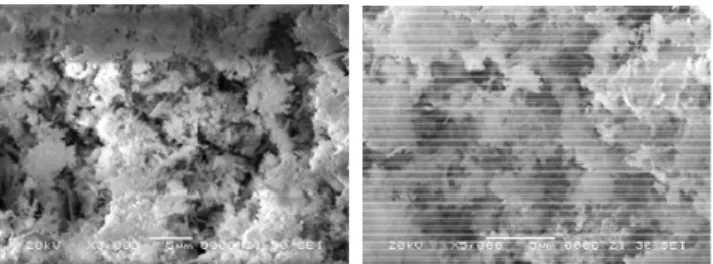
The shape and structure of the nanomaterial surface with high reso- lution are analyzed using the SEM method. The results of SEM analy- sis of the Bi

2

WO

6

-GO-TiO

2

composite in Figure 2 indicated that the graphene surface was covered with a mixture of Bi

2

WO

6

and TiO

2

nanoparticles. This mixture was uniformly distributed throughout the rough graphene surface. The morphological features of both the Bi

2

WO

6

and TiO

2

particles were a small size and porous shape. With this morphogenesis and sustainable link, the ability to switch the charge between Bi

2

WO

6

and TiO

2

as well as switch the charge among Bi

2

WO

6

, TiO

2

, and graphene increased.

To further enhance the structural investigation and provide clear im- ages of the dispersion and morphology, TEM images were taken of the Bi

2

WO

6

-GO-TiO

2

nanocomposite. As shown in Figures 3(a-d), Bi

2

WO

6

presents a nanoplates shown as irregular dark-square blocks. The square Bi

2

WO

6

nanoplates can be attributed to anisotropic growth in the crystalline-ripened process[20]. The results in Figures 3(e-f) show that the TiO

2

nanoparticles had similar small sizes and were uniformly distributed throughout the surface of the graphene, as well as on the surface of Bi

2

WO

6

. Especially, the TiO

2

nanoparticles were covered on the surface of the graphene sheets and Bi

2

WO

6

with the quantum dot size of about 4 nm. All of the above information showed that both nanoparticles were successfully loaded on the 2-dimensional graphene oxide with a strong binding. The quantum dot size of TiO

2

and the square Bi

2

WO

6

nanoplate provide new insight into the binding capacity Figure 1. XRD patterns of the Bi

2

WO

6

-GO-TiO

2

composites.

Figure 2. SEM morphology of the Bi

2

WO

6

-GO-TiO

2

composite.

(4)

of the nanocomponents. As a result, the moving charge from TiO

2

to Bi

2

WO

6

will occur easily and help to limit the recombination of the photogenerated electron-holes, releasing the necessary energy for pho- todegradation reaction.

To consolidate the structural information of the Bi

2

WO

6

-GO-TiO

2

nanocomposite, Raman spectra were measured and the results are shown in Figure 4. The information from the Raman spectrum results showed that both Bi

2

WO

6

and TiO

2

were successfully mounted on the graphene surface. Besides, the lack of any unexpected signals demon- strated that the nanomaterial was almost pure. The TiO

2

nanoparticles had a three signals fluctuation in the range shift of 500-750 cm

-1

, whereas the signal of the Bi

2

WO

6

nanoparticles was presented at the range shift of 790-850 cm

-1

. All of the signals were strong and showed high intensity. From the Raman spectrum line, we can see that there was a blue-shift of the Bi

2

WO

6

signal compared to the peak of Bi

2

WO

6

in the Bi

2

WO

6

-GO (905 cm

-1

) and Bi

2

WO

6

-GO-TiO

2

(820 cm

-1

) composites. This can be considered as demonstrating the formation of new links in the Bi

2

WO

6

-GO-TiO

2

nanocomposite. On the other hand, the existence of the D and G bands in the Raman results is evidence of the presence of carbon in the survey nanomaterials. Notably, the D and G bands of the Bi

2

WO

6

-GO and Bi

2

WO

6

-GO-TiO

2

composites ap- peared at 1350 cm

-1

and 1595 cm

-1

, respectively. However, a slight dif- ference is shown in the ratio of I

D

/I

G

, specifically as follows. The cal- culated I

D

/I

G

ratio of the Bi

2

WO

6

-GO composite was found to be approx- imately 0.984, while the calculated I

D

/I

G

ratio of the Bi

2

WO

6

-GO-TiO

2

composite was reduced to 0.972, demonstrating the higher structural in- tegrity of graphene from the fabrication[21].

The ability to absorb ultraviolet and visible light was studied using the UV-vis diffuse reflectance spectra. All of the samples had a max- imum absorption wavelength in the visible region with the range of 400-500 nm, corresponding to the shift of electrons from the con- duction band to the valence band. Compared to the absorption edge of the Bi

2

WO

6

-GO-TiO

2

with the Bi

2

WO

6

-GO and Bi

2

WO

6

-TiO

2

compo- sites, this indicated the redshift absorption. Clearly, this phenomenon promises to enhance the catalytic activity of the Bi

2

WO

6

-GO-TiO

2

composite. The results of the Kubelka-Munk transformation from UV-vis diffuse reflection data are shown in Figure 5. The straight line approaching the curve intersects with the horizontal axis, which is known as indicating the band gap energy value. The band gap energy of the material group is in the range of 2.8-3.1 eV, of which the sam- ples of Bi

2

WO

6

-GO-TiO

2

, Bi

2

WO

6

-TiO

2

, and Bi

2

WO

6

-GO were 2.8, 2.9, and 3.1 eV, respectively. The decreasing E

g

of the Bi

2

WO

6

-GO-TiO

2

nanocomposite can be attributed to both the inherent light absorption capacity of carbon materials and the electron transitions between car- bon of graphene and metal oxide (Bi

2

WO

6

and TiO

2

) phase[22,23].

(a) (b)

(c) (d)

(e) (f)

Figure 3. TEM images of the Bi

2

WO

6

-GO (a and b), Bi

2

WO

6

-TiO

2

(c and d) and Bi

2

WO

6

-GO-TiO

2

(e and f) composites.

Figure 4. Raman spectra of (a) Bi

2

WO

6

-TiO

2

and (b) Bi

2

WO

6

-GO composites.

Figure 5. Kubelka-Munk transformations of the UV-vis diffuse

reflection of the Bi

2

WO

6

-GO-TiO

2

, Bi

2

WO

6

-TiO

2

and Bi

2

WO

6

-GO

composites.

(5)

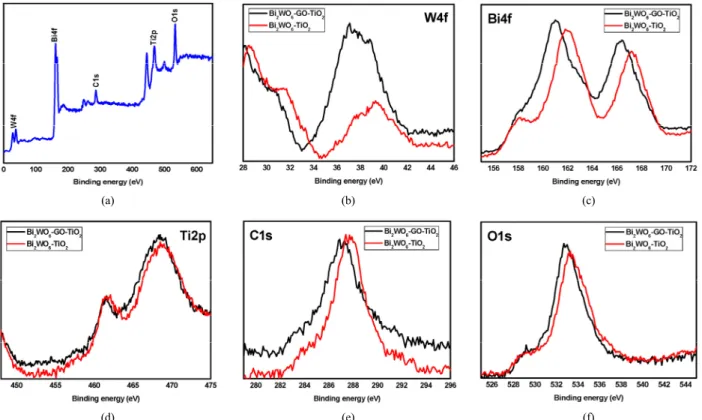
The XPS spectrum was measured to provide exact information on the composition and the chemical state of the elements on the surface, as well as the chemical bonds that are formed in the survey materials.

According to the results shown in Figure 6, the surface of the survey nanomaterial was identified as containing the elements of Bi, W, Ti, O, and C, without the presence of other elements, reflecting the ele- mental composition of the nanomaterial. In addition, examining the binding energy when compared to the similarity of the signal peaks placement, the results presented the appearance of the new chemical bonds in the Bi

2

WO

6

-GO-TiO

2

nanocomposite. Considering the status of the carbon element, Figure 6(d) shows the appearance of two main signals at 286.7 and 287.7 eV, proving the presence of epoxy or the hydroxyl group (C-O) and C = O or carboxyl, respectively. The above results indicate that graphene oxide was transformed into GO after the synthesis process of the Bi

2

WO

6

-GO-TiO

2

nanocomposite[24]. The presence of the O1s signal of the Bi

2

WO

6

-GO-TiO

2

nanocomposite at 532.9 eV is due to the absorbed oxygen. The existence of this signal proves the expansion of the Bi

2

WO

6

-GO-TiO

2

surface area compared to the Bi

2

WO

6

-TiO

2

nanocomposite[21].

3.2. Photodegradation

The photocatalytic activity of organic dyes with the survey nano- composites was processed with two steps: keep stirring 2 hours in the dark box for establishing the adsorption/desorption equilibrium of or- ganic dyes. Then done the photodegradation experiments with different dye solutions, nanocomposites amount under visible light irradiation

with 180 min irradiation. The results of photodegradation test were showed below.

3.2.1. Survey the effect of different nanocomposites with RhB organic dye

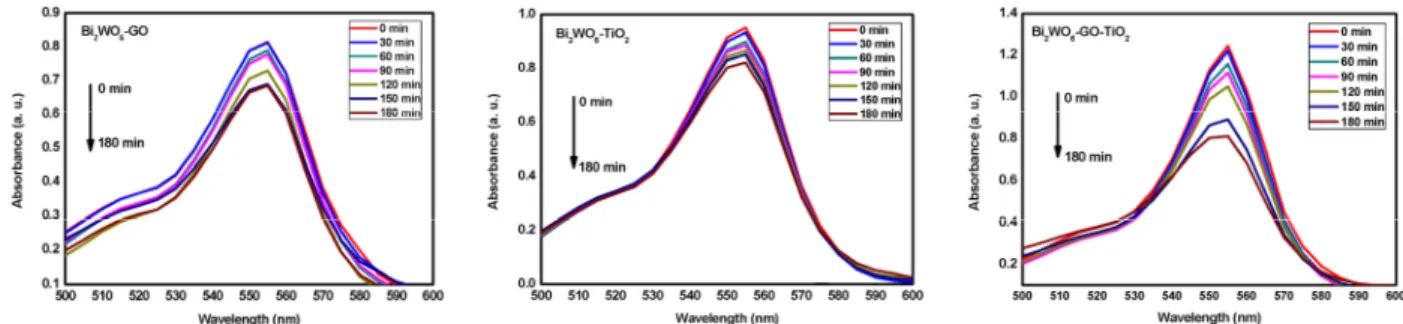
With different irradiation times ranging from 0 to 180 min, the pho- tocatalytic degradation of the RhB aqueous solution in the presence of the prepared Bi

2

WO

6

-GO-TiO

2

, Bi

2

WO

6

-GO, and Bi

2

WO

6

-TiO

2

nano- composites is shown in Figure 7. The experiments were carried out at 100 mL of 5.0 × 10

-5

mol/L RhB concentration, 0.05 g catalyst, and neutral pH. The results from Figure 8 show the Bi

2

WO

6

-GO-TiO

2

nanocomposite expressed the best photodegradation. The absorption ca- pacity continued to increase with the increase of irradiation time; how- ever, the Bi

2

WO

6

-GO-TiO

2

nanocomposite retained the highest absorp- tion capacity. Typically, the Bi

2

WO

6

-GO-TiO

2

nanocomposite showed outstanding photodegradation results around 34.6%, under the same ex- perimental conditions. Meanwhile, after 180 minutes of irradiation, the Bi

2

WO

6

-GO and Bi

2

WO

6

-TiO

2

nanocomposites showed photodegradation results around of 13%-15%.

Photocatalytic reactions with different photocatalysts were presented by the Langmuir-Hinshelwood model[25]. The photocatalytic degrada- tion of RhB containing different photocatalysts obeys the pseu- do-first-order kinetics with respect to the concentration of RhB.

-dc/dt = k

app

c (I) (a)

(b)

(c)

(d)

(e)

(f)

Figure 6. The survey XPS spectra of the Bi

2

WO

6

-GO-TiO

2

composite (a) and the high-resolution XPS spectra of (b) W4f, (c) Bi4f, (d) Ti2p,

(e) C1s and (f) O1s spectra of the Bi

2

WO

6

-GO-TiO

2

, and Bi

2

WO

6

-TiO

2

composites.

(6)

Integration of (I) (with the restriction of c = c

0

at t = 0, where c

0

is the initial concentration in the bulk solution after dark adsorption and t is the reaction time) will lead to the following expected relation:

-ln(c/c

0

) = k

app

t (II)

where c and c

0

are the reactant concentration at times t = t and t = 0, respectively, and k

app

and t are the apparent reaction rate constant and time, respectively. According to (II), a plot of -ln(c/c

0

) versus t will yield a slope of k

app.

The results are shown in Figure 9. The RhB degradation rate constant for Bi

2

WO

6

-GO-TiO

2

reached 1.4 × 10

-3

min

-1

, and the result was greater than both Bi

2

WO

6

-GO and Bi

2

WO

6

-TiO

2

nanocomposites. The Bi

2

WO

6

-GO-TiO

2

nanocomposite is therefore expected to become a new potential material for photocatalyst degradation activity.

The photocatalytic activity of the Bi

2

WO

6

-GO composite can be ex- plained based on the electronic interaction and charge equilibration be- tween graphene and Bi

2

WO

6

lead to the negative shift in the Fermi level of Bi

2

WO

6

-GO which plays an important role in the photo- catalytic process[26]. In the Bi

2

WO

6

-TiO

2

case, the main reason for the increase in optimal photodegradation rate can be due to the relatively well-matched energy band between TiO

2

and Bi

2

WO

6

, from that, an excellent separation efficiency of photogenerated electron-hole pairs in

visible light regions, suggesting that the improved photocatalytic activ- ity under visible light can be achieved[19].

There are two noteworthy points in the photocatalytic activity en- hancement of the Bi

2

WO

6

-GO-TiO

2

composites. First, the presence of graphene oxide with the high density of oxygen-containing functional groups plays the role of an electron acceptor, photosensitizer, and the adsorbent to efficiently enhance the photodegradation of organic dyes [27,28]. Besides, graphene oxide exhibited the role as an electron ac- ceptor which participates in facilitating electron transfer process from Bi

2

WO

6

to join the reduction reaction as well as enhancing charge sep- aration and therefore, enhancing the photodegradation[29,30]. Second, the decrease of the band gap energy value of the Bi

2

WO

6

-GO-TiO

2

composites also creates favorable conditions for the transfer and sepa- ration of photogenerated electrons and hole between Bi

2

WO

6

and TiO

2

. Thus, it has been found that the Bi

2

WO

6

-GO-TiO

2

composite exhibited higher photocatalytic activities than both the Bi

2

WO

6

-GO and Bi

2

WO

6

-TiO

2

composites.

3.2.2. Survey the effect of different organic dyes

The photocatalytic degradation of the RhB, MB and RBB aqueous solutions with different irradiation times from 0 to 180 min in the presence of the prepared Bi

2

WO

6

-GO-TiO

2

nanocomposites is shown in Figure 10. The experiments were carried out at 100 mL of 5.0 × 10

-5

mol/L dye concentration, 0.05 g nanocomposite, and neutral pH.

From the Figure 10, the Bi

2

WO

6

-GO-TiO

2

nanocomposite with the

Figure 7. Degradation of RhB as a function of the Bi

2

WO

6

-GO, Bi

2

WO

6

-TiO

2

and Bi

2

WO

6

-GO-TiO

2

composites.

Figure 8. Degradation efficiency of RhB organic dye by the the Bi

2

WO

6

-GO, Bi

2

WO

6

-TiO

2

and Bi

2

WO

6

-GO-TiO

2

nanocomposites under visible light irradiation. The amount of nanocomposites was 0.05 g. The dye concentrtion was 5.0 × 10

-5

mol/L with neutral pH.

Figure 9. Variations in -ln(C/C

ads

) as a function of irradiation time and

linear of different photocatalyst on the degradation of RhB.

(7)

MB dye solution expressed the best photodegradation. After 120 mi- nutes for establishing the adsorption/desorption equilibrium, the Bi

2

WO

6

-GO-TiO

2

nanocomposite shows the adsorption capacity with the low value around 1.39%, and 6.97% of the RBB and RhB sol- utions, respectively. However, the Bi

2

WO

6

-GO-TiO

2

nanocomposite achieved around 38.46% MB removal. The absorption capacity con- tinued to increase with the increase of irradiation time; and the Bi

2

WO

6

-GO-TiO

2

nanocomposite retained the highest absorption ca- pacity for the MB solution. Typically, after 180 min for irradiation with visible light, the MB solution was decreased 43.65% better than the RhB and RBB solution with 24.49%, and 6.48%, respectively. The above results implied the Bi

2

WO

6

-GO-TiO

2

nanocomposite showed the best photocatalyst activity for the MB solution.

3.2.3. Survey the effect of nanocomposites amount

For surveying the effect of the nanocomposite amount, the photo- catalytic degradation of the aqueous solution of MB was processed

with the different amount from 0.03 to 0.05 g of the prepared Bi

2

WO

6

-GO-TiO

2

nanocomposites. The reaction conditions were car- ried out at 100 mL of 5.0 × 10

-5

mol/L MB concentration, and neutral pH. The results showed in Figure 11.

In the first 120 minutes for establishing the adsorption/desorption equilibrium, the results in Figure 11 showed that the adsorption ca- pacity of the Bi

2

WO

6

-GO-TiO

2

with values were 8.97, 29.63%, and 36.46%; respectively with 0.03, 0.04 g, and 0.05 g of the Bi

2

WO

6

-GO-TiO

2

nanocomposite. The longer the time is, the decreasing of the maxima absorption intensity can be observed. Besides, after 180 min under visible light radiation, the absorption capacity of the 0.05 g Bi

2

WO

6

-GO-TiO

2

nanocomposite was 43.65%. Overall, we can be no- ticed that the Bi

2

WO

6

-GO-TiO

2

nanocomposite had the photocatalytic activity stability and efficiency.

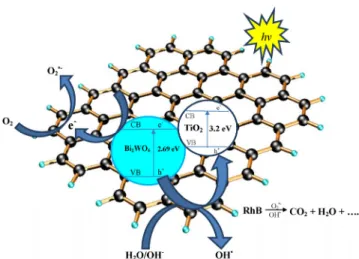
Bi

2

WO

6

and TiO

2

under visible light irradiation is shown in Figure 12. Under the visible light irradiation, the Bi

2

WO

6

can be excited and then shift to the graphene surface to join the reduction reaction (e

-CB

) as well as generate electron-hole pairs. Meanwhile, the photogenerated holes of Bi

2

WO

6

can also travel to the VB of TiO

2

and them switch the graphene surface to participate in oxidation reactions (h

+VB

), re- straining the recombination of electrons and holes[19]. The photo- generated electron-hole shifts to the surface and interacts with sub- stances such as hydroxyl group and oxygen, where the adsorption cre- ates free radicals on the surface of the semiconductor. The photo-oxi- dation of the RhB dye by Bi

2

WO

6

decorated with TiO

2

is demonstrated in the following equation[31-33].

Bi

2

WO

6

-TiO

2

+ hv→ (Bi

2

WO

6

-TiO

2

) (h

+

, e

-

) (Bi

2

WO

6

-TiO

2

) (h

+

, e

-

)→ Bi

2

WO

6

(e

-

) + TiO

2

(h

+

) Graphene + e

-

→ Graphene (e

-

)

O

2

+ e

-

→ O

2⋅-

Figure 10. Degradation efficiency of different organic dyes by the Bi

2

WO

6

-GO-TiO

2

nanocomposite under visible light irradiation. The amount of Bi

2

WO

6

-GO-TiO

2

nanocomposite was 0.05 g. The concentrtion of dyes was 5.0 × 10

-5

mol/L with neutral pH.

Figure 11. Degradation efficiency of nanocomposites amount (0.03, 0.04, and 0.05 g) by the Bi

2

WO

6

-GO-TiO

2

nanocomposite under visible light irradiation with MB solution. The dye concentrtion was 5.0 × 10

-5

mol/L with neutral pH.

Figure 12. The scheme of excitation and charge transfer process

between TiO

2

nanoparticles, Bi

2

WO

6

nanoparticles and graphene

sheets.

(8)

4. Conclusion

Considering the different aspects of the above results, we success- fully synthesized Bi

2

WO

6

-GO-TiO

2

nanocomposite by hydrothermal method. With the simultaneous existence of anatase and rutile phases, the TiO

2

nanoparticles indicate the possible enhancement of the ability of the photocatalytic activity of the Bi

2

WO

6

-GO-TiO

2

composite From SEM and TEM images, we suggested that both the Bi

2

WO

6

and TiO

2

nanostructures were successfully loaded onto the transparent graphene sheets. Furthermore, the irregular dark-square block nanoplate shape of the Bi

2

WO

6

nanoparticle and the quantum dots size of TiO

2

promise the enhanced photocatalytic activity of the Bi

2

WO

6

-GO-TiO

2

composite. The Raman, XPS, and DRS spectrum also play a key role to confirming the structures of the Bi

2

WO

6

-GO-TiO

2

composite. The RhB degradation results showed that the Bi

2

WO

6

-GO-TiO

2

composite is a considerably more effective photocatalyst than either the Bi

2

WO

6

-GO or the Bi

2

WO

6

-TiO

2

composite. The study results also showed that the material is capable of photocatalytic degradation of RhB, MB, amd RBB in the visible light region. The MB degradation results showed that the Bi

2

WO

6

-GO-TiO

2

composite is expected to be- come a new potential material for photodegradation activity with ex- cellent photodegradation.

References

1. C. Hu, T. Lu, and F. Chen, A brief review of graphene-metal ox- ide composites synthesis and applications in photocatalysis, J.

Chin. Adv. Mater. Soc., 1, 21-39 (2013).

2. L. Zhu, Z. D. Meng, M. L. Chen, F. J. Zhang, J. G. Choi, J. Y.

Park, and W. C. Oh, Photodegradation of MB solution by the met- al (Fe, Ni and Co) containing AC/TiO

2

photocatalyst under the UV irradiation, J. Photo. Sci., 1, 69 (2010).

3. H. Zhang, X. Lv, Y. Li, Y. Wang, and J. Li, P25-graphene compo- site as a high performance photocatalyst, ACS Nano, 4, 380-386 (2010).

4. S. R. Kim, M. K. Parvez, and M. Chhowalla, UV-reduction of gra- phene oxide and its application as an interfacial layer to reduce the back-transport reactions in dye-sensitized solar cells, Chem. Phys.

Lett., 483, 124-127 (2009).

5. W. Low and V. Boonamnuayvitaya, Enhancing the photocatalytic activity of TiO

2

co-doping of graphene-Fe

3+

ions for formaldehyde removal, J. Environ. Manage., 127, 142-149 (2013).

6. H.-I. Kim, G.-H. Moon, D. Monllor-Satoca, Y. Park, and W. Choi, Solar photoconversion using graphene/TiO

2

composites: Nanographene shell on TiO

2

core versus TiO

2

nanoparticles on graphene sheet, J.

Phys. Chem. C, 116(1), 1535-1543 (2012).

7. D. Zhao, G. Sheng, C. Chen, and X. Wang, Enhanced photo- catalytic degradation of methylene blue under visible irradiation on

9. C. Chung, Y.-K. Kim, D. Shin, S.-R. Ryoo, B.-H. Hong, and D.-H. Min, Biomedical applications of graphene and graphene ox- ide, Acc. Chem. Res., 46(10), 2211-2224 (2013).

10. Y. Kikuchia, K. Sunadaa, T. Iyodaa, K. Hashimoto, and A.

Fujishimaa, Photocatalytic bactericidal effect of TiO

2

thin films:

dynamic view of the active oxygen species responsible for the ef- fect, J. Photochem. Photobiol. A, 106, 51-56 (1997).

11. Z. Zhang, W. Wang, M. Shang, and W. Yin, Low-temperature combustion synthesis of Bi

2

WO

6

nanoparticles as a visible-light- driven photocatalyst, J. Hazard. Mater., 177, 1013-1018 (2010).

12. J. Ren, W. Wang, L. Zhang, J. Chang, and S. P. Hu, Photocatalytic inactivation of bacteria by photocatalyst Bi

2

WO

6

un- der visible light, Catal. Commun., 10, 1940-1943 (2009).

13. Z. Cui, D. Zeng, T. Tang, J. Liu, and C. Xie, Enhanced visible light photocatalytic activity of QDS modified Bi

2

WO

6

nano- structures, Catal. Commun., 11, 1054-1057 (2010).

14. J. Ren, W. Wang, S. Sun, L. Zhang, and J. Chang, Enhanced pho- tocatalytic activity of Bi

2

WO

6

loaded with Ag nanoparticles under visible light irradiation, Appl. Catal. B, 92, 50-55 (2009).

15. Y. Zhang, Y. Zhang, L. Fei, X. Jiang, C. Pan, and Y. Wang, Engineering nanostructured Bi

2

WO

6

-TiO

2

toward effective uti- lization of natural light in photocatalysis, J. Am. Chem. Soc., 94, 4157-4161 (2011).

16. Q. C. Xu, D. V. Wellia, Y. H. Ng, R. Amal, and T. T. Y. Tan, Synthesis of porous and visible-light absorbing Bi

2

WO

6

/TiO

2

heter- ojunction films with improved photoelectrochemical and photo- catalytic performances, J. Phys. Chem. C, 115(15), 7419-7428 (2011).

17. F. Zhou and Y. Zhu, Significant photocatalytic enhancement in methylene blue degradation of Bi

2

WO

6

photocatalysts via graphene hybridization, J. Adv. Ceram., 1(1), 72-78 (2012).

18. H. Fu, L. Zhang, W. Yao, and Y. Zhu, Photocatalytic properties of nanosized Bi

2

WO

6

catalysts synthesized via a hydrothermal process, Appl. Catal. B, 66, 100-110 (2006).

19. Y. Zhang, L. Fei, X. Jiang, C. Pan, and Y. Wang, Engineering nanostructured Bi

2

WO

6

-TiO

2

toward effective utilization of natural light in photocatalysis, J. Am. Ceram. Soc., 94, 4157-4161 (2011).

20. Y.-L. Min, K. Zhang, Y.-C. Chen, and Y.-G. Zhang, Enhanced photocatalytic performance of Bi

2

WO

6

by graphene supporter as charge transfer channel, Sep. Purif. Technol., 86, 98-105 (2012).

21. Z. Sun, J. Guo, S. Zhu, L. Mao, J. Ma, and D. Zhang, A high-per- formance Bi

2

WO

6

-graphene photocatalyst for the visible light-in- duced H

2

and O

2

generation, Nanoscale, 6, 2186-2193 (2014).

22. C. G. Silva and J. L. Faria, Photocatalytic oxidation of benzen de- rivatives in aqueous suspensions: synergic effect induced by the introduction of carbon nanotubes in a TiO

2

matrix, Appl. Catal. B, 101, 81-89 (2010).

23. D. C. T. Nguyen, K. Y. Cho, and W. C. Oh, Synthesis of

frost-like CuO combined graphene-TiO

2

by self-assembly method

and its high photocatalytic performance, Appl. Surf. Sci., 412,

252-261 (2017).

(9)

24. J. Yang, X. Wang, X. Zhao, J. Dai, and S. Mo, Synthesis of uni- form Bi

2

WO

6

-reduced graphene oxide nanocomposites with sig- nificantly enhanced photocatalytic reduction activity, J. Phys.

Chem., 119(6), 3068-3078 (2015).

25. Y. Li, X. Li, and J. Li, Photocatalytic degradation of methyl or- ange by TiO

2

-coated activated carbon and kinetic study, Water Res., 40, 1119-1126 (2006).

26. E. Gao, W. Wang, M. Shang, and J. Xu, Synthesis and enhanced photocatalytic performance of graphene-Bi

2

WO

6

composite, Phys.

Chem. Chem. Phys., 13, 2887-2893 (2011).

27. F. Dong, Z. Y. Wang, Y. J. Sun, W. K. Ho, and H. D. Zhang, Engineering the nanoarchitecture and texture of polymeric carbon nitride semiconductor for enhanced visible light photocatalytic ac- tivity, J. Colloid Interface Sci., 401, 70-79 (2013).

28. T. D. Nguyen-Phan, V. H. Pham, E. W. Shin, H. D. Pham, S.

Kim, J. S. Chung, and S. H. Hur, The role of graphene oxide con- tent on the adsorption-enhanced photocatalysis of titanium diox- ide/graphene oxide composites, Chem. Eng. J., 170, 226-232 (2011).

29. D. C. T. Nguyen, K. Y. Cho, and W. C. Oh, Synthesis of meso- porous SiO

2

/Cu

2

O-graphene nanocomposites and their highly effi- cien photocatalytic performance for dye pollutants. RSC Adv., 7, 29284-29294 (2017).

30. S. Min and G. Lu, Sites for High efficient photocatalytic hydrogen evolution on a limited-layered MoS

2

cocatalyst confined on gra- phene sheets-The role of graphene, J. Phys. Chem. C, 116(48), 25415-25424 (2012).

31. J. P. Zou, J. Ma, J. M. Luo, J. Yu, J. He, Y. Meng, and X. B.

Luo, Fabrication of novel heterostructured few layered WS2- Bi

2

WO

6

/Bi

3.84

W

0.16

O

6.24

composites with enhanced photocatalytic performance, Appl. Catal. B, 179, 220-228 (2015).

32. G. Colón, S. Murcia López, M. C. Hidalgoa, and J. A. Nvíoa, Sunlight highly photoactive Bi

2

WO

6

-TiO

2

heterostructures for rhodamine B degradation, Chem. Commun., 46, 4809-4811 (2016).

33. D. C. T. Nguyen, K. Y. Cho, and W. C. Oh, A facile route to syn-

thesize ternary Cu

2

O quantum dot/graphene-TiO

2

nanocomposites

with an improved photocatalytic effect, Fullerenes, Nanotubes and

Carbon Nanostructures DOI: 10.1080/1536383X.2017.1344648 (2017).

수치

Figure 2. SEM morphology of the Bi 2 WO 6 -GO-TiO 2  composite.
Figure 4. Raman spectra of (a) Bi 2 WO 6 -TiO 2  and (b) Bi 2 WO 6 -GO  composites.
Figure 6. The survey XPS spectra of the Bi 2 WO 6 -GO-TiO 2  composite (a) and the high-resolution XPS spectra of (b) W4f, (c) Bi4f, (d) Ti2p,  (e) C1s and (f) O1s spectra of the Bi 2 WO 6 -GO-TiO 2 , and Bi 2 WO 6 -TiO 2  composites.
Figure 7. Degradation of RhB as a function of the Bi 2 WO 6 -GO, Bi 2 WO 6 -TiO 2  and Bi 2 WO 6 -GO-TiO 2  composites.
+2

참조

관련 문서

두 쌍의 대각의 크기가 각각 같은

이에 전남지역 중학생들 대상의 설문조사를 통해서 체벌의 실태와 중학교 교사와 학생들의 체벌에 관한 인식 및 체벌의 교육적 효과 등을 파악하여 체벌이 진정

웹 표준을 지원하는 플랫폼에서 큰 수정없이 실행 가능함 패키징을 통해 다양한 기기를 위한 앱을 작성할 수 있음 네이티브 앱과

[r]

상기 신입생 장학금 외에도 본교는 신입생장학금-재학생장학금-해외연수장학금-대학원진학장학금에 이르는 전주기 장학제도를 운영하고 있으며, 다양한 교외장학금

The index is calculated with the latest 5-year auction data of 400 selected Classic, Modern, and Contemporary Chinese painting artists from major auction houses..

지구의의 위치에 따라 태양의 남중 고도가 달라지는 경우를 골라 기호를 썼지만 이를 통해 알 수 있는 계 절이 변하는 까닭을 쓰지 못했다.. 하 알맞은 그래프의 형태를

The “Asset Allocation” portfolio assumes the following weights: 25% in the S&P 500, 10% in the Russell 2000, 15% in the MSCI EAFE, 5% in the MSCI EME, 25% in the