doi:10.1053/seiz.2001.0605, available online at http://www.idealibrary.com on
Low dose and slow titration of topiramate as adjunctive therapy in refractory partial epilepsies: a multicentre open clinical trial
KOREAN TOPIRAMATE STUDY GROUP
Correspondence to: Byung-In Lee. MD, Professor of Neurology, Yonsei University College of Medicine, Severance Hospital CPO Box 8044, Seoul, Korea. E-mail : [email protected]
Purpose: A multicentre open clinical trial was conducted to evaluate the clinical usefulness of a slower titration of topiramate (TPM) to 300 mg/day as adjunctive therapy for medically intractable partial epilepsies.
Methods: Ninteen centres participated in the trial. Study patients had to have had two or more seizures per 4 weeks whilst taking maximum tolerated doses of one but not more than two anti-epileptic drugs. The starting dose of TPM was 25 mg /day and the dose was increased weekly by 25 mg/day until 100 mg/day was reached. Thereafter TPM was increased by 50 mg/day weekly up to the target dose of 300 mg /day, which was followed by an 8 week maintence phase. Seizure outcomes were measured by intention-to-treat analysis (ITTA)
Results: Two hundred and thirteen patients entered the study. Median seizure frequency reduction rate was 44.8%, responder rate was 47.6%, and seizure free rate was 9.0%. These results were comparable to that of TPM 600 mg/day in our previous controlled trial. In subgroup analysis, seizure free rate was higher in those patients with a lower baseline seizure frequency rate.
Seventeen patients (8.0%) were prematurely withdrawn from the study due to adverse events (AE) or lack of effect. One or more AEs were reported in 22% of patients, with dizziness being the most frequent AE. Other AEs occurred in less than 5%
of patients.
Conclusion: TPM 300 mg/day was effective and in conjunction with a slower dose-titration, markedly reduced the incidence of AEs, compared with previous study.
c
2002 BEA Trading Ltd. Published by Elsevier Science Ltd. All rights reserved Key words: topiramate; slow titration; efficacy; safety.
INTRODUCTION
Topiramate (TPM) is a new antiepileptic drug (AED) having multiple mechanisms of action (Perucca, 1997). Randomized controlled trials of TPM at variable target doses (200–1000 mg /day) revealed that TPM 200 mg /day was not significantly more effective than placebo while TPM in doses of 400 mg /day or above produced statistically significant seizure reductions
1–6. However there was no evidence of a dose–response relationship with TPM in the dose ranges between 400–1000 mg /day, which suggested that the effective dose of TPM might be between 200 and 400 mg /day
7–9. In the pooled analysis of randomized controlled trials of TPM, most adverse events (AEs) emerged within the first 8 weeks of TPM therapy, coinciding with the period of rapid
dose-escalation
9, 10. Subsequent studies revealed that a weekly dose-escalation of TPM of 50 mg /day was associated with a lower incidence of premature drug withdrawal than a weekly dose-escalation of 100–200 mg /day without any delay in efficacy
11, 12. The importance of slow dose-titration of TPM was further stressed by clinical experience obtained after its marketing approval. Sander
13, for instance, recommended a starting dose of TPM 25 to 50 mg /day and a gradual dose-escalation by 25 to 50 mg /day biweekly. However, firm evidence in favour of a slower dose-escalation has not yet been provided.
We previously conducted a randomized controlled trial of TPM which adopted a titration schedule of a weekly increment of 50 mg /day until a target dose of TPM 600 mg /day
14. The efficacy and safety of TPM in this trial was quite favourable, however,
1059–1311/02/$22.00/0 c 2002 BEA Trading Ltd. Published by Elsevier Science Ltd. All rights reserved
no significant differences in efficacy measures were found between patients taking TPM ≤200 mg /day,
≤ 400 mg /day, and ≤600 mg/day. The incidence of AEs was high and the majority of AEs still occurred during the titration phase. A multicentre open clinical trial was conducted to evaluate the efficacy of a slower titration and a target dose of TPM 300 mg /day.
METHODS Patients
Eligible patients were between 16 and 65 year-old and a written consent form was signed. Patient inclusion and exclusion criteria were identical to the previous controlled trial
14(1999). Briefly, patients had to have well documented partial onset epilepsies and have two or more seizures every 4 weeks during the baseline phase whilst taking maximum tolerated doses of at least one but not more than two anti-epileptic drugs (AED). Only clinically identifiable seizures were counted, which were simple partial motor seizures (SPMS), complex partial seizures (CPS), and secon- darily generalized tonic–clonic seizures (SGTCs).
Study Protocols
Nineteen centres participated in the trial after IRB approval at each centre. The study protocol was basically similar to our previous controlled trial with a few exceptions. Patients visited the clinic every 4 week intervals during each 8 weeks of baseline, titration, and maintenance phases. The dose-titration consisted of a starting dose of TPM 25 mg /day and weekly escalation by 25 mg /day until 100 mg/day was reached. Thereafter TPM was increased weekly by 50 mg /day until the target dose of 300 mg/day was obtained. Throughout the study, the doses of concomitant AEDs were not altered. TPM was supplied in a pill box and compliance was assessed by counting tablets remaining in the pill box at every visit. The physicians assessed adverse events and seizure frequencies by using seizure diaries, detailed questions, and examinations at each visits.
Haematologic studies, blood chemistry, urinalysis, and an electrocardiogram were performed at specified times throughout the study.
Outcome Measures
Efficacy and safety of TPM were measured by intention-to-treat analysis (ITTA). The primary efficacy measure was the change from the baseline
to the experimental period in frequency of seizures every 4 weeks (median seizure frequency reduction rate: MSFRR). Secondary efficacy measures were the responder rate (percentage of patients achieving
>50% seizure frequency reduction: RR), seizure free rate (SFR), and a global evaluation by patients and physicians. Subgroup analysis was conducted for patients entering the maintenance phase. Efficacy measures (MSFRR, RR, SFR) were analyzed according to the number of concomitant AEDs, hepatic enzyme inducing or non-inducing AEDs, daily dose of TPM at the start of the maintenance phase, and baseline seizure frequencies.
Statistics
The primary data set for the efficacy analysis consisted of all study patients for whom at least one seizure evaluation was available during the double-blind period. The t-test was used to compare seizure frequency reduction rates. The responder rates between two groups were compared by using the χ
2test. The relationship between baseline seizure frequencies and SFR was expressed by an odds ratio (OR) using logistic regression.
RESULTS
Between May and December, 1999, a total of 239 patients were recruited and 213 of them satisfied the inclusion criteria to enter the titration phase.
One hundred and ninty eight patients entered the maintenance phase and 182 patients completed the trial as planned (Fig. 1). The mean dose of TPM at the end of the titration phase was 264 ± 70 mg /day and 149 of 199 patients finishing the titration phase were taking 300 mg /day. The baseline characteristics of study patients, which are summarized in Table 1, were comparable with that of the TPM group in our previous controlled trial except for having a lower median seizure frequency (3.7 episodes /4 weeks vs. 5.6 episodes /4 weeks, P = 0.03) and a higher proportion of patients with SPMS (23.9% vs.
12.1%, P = 0.02).
Efficacy
Efficacy data was available for 210 patients (three patients were withdrawn from the study shortly after the introduction of TPM). The data is summarized in Table 2. MSFRR was 44.8%, RR was 47.6% and SFR was 9.0%, respectively. Slightly more than 50%
of patients and physicians rated TPM as moderately
baseline phase
titration phase
mainetance phase
V1(0wk)
(n = 239) (n = 213) (n = 199) (n = 183)
V2(4wk) V3(8wk) V4(12wk) V5(16wk) V6(20wk) V7(24wk)
Fig. 1: Progression of the trial. Number of patients subjected for ITTA of efficacy n = 210. Number of patients subjected for ITTA of safety n = 213. Number of patients subjected for the subgroup analysis n = 188.
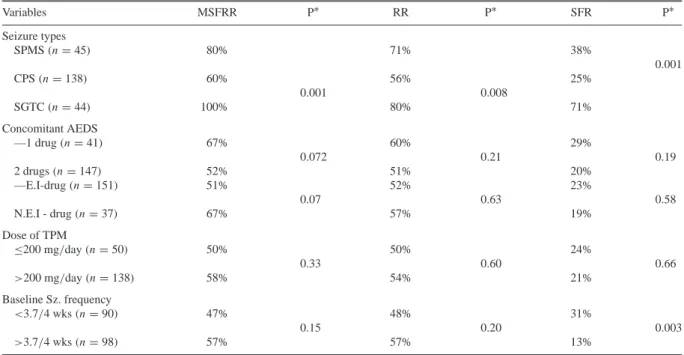
or markedly effective in this study. In the subgroup analysis (Table 3), TPM was more effective in SGTC than CPS in all efficacy measures. However, we did not find any differences in efficacy between patients taking one or two AEDs, patients taking enzyme inducing or non-inducing AEDs, and patients taking TPM ≤200 mg /day or TPM > 200 mg/day.
For different baseline seizure frequencies, MSFRR and RR were not significantly different, however, SFR was significantly higher in patients with lower baseline seizure frequencies, 31% in patients with less than 3.7 episodes /4 weeks and 13% in patients with 3.7 or more episodes /4 weeks (P = 0.003). The correlations between baseline seizure frequencies and SFR analyzed by logistic regression analysis revealed an OR of 0.83 (95% confidence interval: 0.72–0.97), which suggested that the OR of SFR decreased by 0.83 times in response to an increase in baseline seizure frequency by one episode /4 wks.
Table 1: Baseline characteristics of study patients.
Variables Current study
(n = 213)
Age (yr-old) 30.1 ± 10.2 y.o
Sex (M:F) 56.3:43.7
Body weight (kg) 63.6 ± 11.0
Duration of illness (yrs) 15.8 ± 9.0
Seizure frequency Median:3.7/4 wks
Mean:8.3 ± 17.6/4 wks Seizure types:
SPMS 23.9%
CPS 78.4%
SGTC 44.1%
No. AEDS:
1 drug 24.4%
2 drugs 75.4%
SPMS: simple partial motor seizure; CPS: complex partial seizure;
SGTC: secondarily generalized tonic–clonic seizure.
Safety
Among two hundred and thirteen patients entered the titration phase, 47 patients (22%) developed AEs.
Thirty eight patients (81%) reported AEs during the titration phase, 21 patients (45%) reported AEs during
Table 2: Efficacy by ITTA.
Variables Current study
(n = 210) Median seizure frequency
baseline phase 3.7/4 wks
experimental phase 2.1/4 wks
MSFRR 44.8%
Responder rate 47.6%
Seizure free rate 9.0%
Global evaluation by physician:
excellent 25.2%
good 27.7%
fair 15.8%
no effect 31.2%
by patients:
excellent 26.2%
good 26.2%
fair 25.2%
no effect 22.3%
MSFRR: median seizure frequency reduction rate.
the maintenance phase: 9 of them (19%) reported the emergence of AEs only during the maintenance phase.
The most common AE was dizziness (10.0%) which was followed by somnolence (3.3%), anorexia (2.3%), weight loss (2.3%), headache (1.9%), abdominal pain and discomfort (1.9%), nausea and vomiting (1.9%), visual disturbances (1.4%), and memory impairment (1.4%). Twenty-nine patients (14%) were prematurely withdrawn from the study due to AEs in 13 (6.1%), lack of efficacy in 4 (1.9%) and non-drug related causes in 12 patients (5.6%). Among those AEs precipitating premature drug withdrawal, dizziness was the most common (6 patients), ataxia occurred in 2 patients, and other various AEs in one patient each.
Weight loss
The incidence of weight loss ≥5% and ≥10% of baseline body weight was 40% and 11% respectively.
The mean weight loss was 1 .1 ± 1.3 kg. We measured
the body mass index [BMI: body weight (kg) ÷ height
(m
2)] of individual patients and grouped them into the
underweight (BMI < 20), normal (20 ≤ BMI < 25),
and overweight (BMI ≥ 25). The incidence of weight
Table 3: Subgroup analysis for the efficacy of topiramate(n = 188).
Variables MSFRR P∗ RR P∗ SFR P∗
Seizure types
SPMS(n = 45) 80% 71% 38%
0.001
CPS(n = 138) 60% 56% 25%
0.001 0.008
SGTC(n = 44) 100% 80% 71%
Concomitant AEDS
—1 drug(n = 41) 67% 60% 29%
0.072 0.21 0.19
2 drugs(n = 147) 52% 51% 20%
—E.I-drug(n = 151) 51% 52% 23%
0.07 0.63 0.58
N.E.I - drug(n = 37) 67% 57% 19%
Dose of TPM
≤200 mg/day (n = 50) 50% 50% 24%
0.33 0.60 0.66
>200 mg/day (n = 138) 58% 54% 21%
Baseline Sz. frequency
<3.7/4 wks (n = 90) 47% 48% 31%
0.15 0.20 0.003
>3.7/4 wks (n = 98) 57% 57% 13%
∗P value calculated by chi-square test; SPMS: simple partial motor seizure; CPS: complex partial seizure; SGTC: secondarily generalized tonic–clonic seizure; E.I: enzyme inducing; NEI: not enzyme inducing; MSFRR: median seizure frequency reduction rate; RR: responder rate;
SFR: seizure free rate.
loss ≥5% of their baseline body weight was 30% in the underweight, 37% in the normal body weight, and 50% in the overweight, which was not significantly different. However, the absolute mean body weight loss of each group was 0 .4 ± 0.8 kg, 0.9 ± 1.1 kg, and 1 .6 ± 1.6 kg respectively, which was significantly different (P = 0.0005).
DISCUSSION
Although this study was an open, non-randomized trial, we adopted a rigid study protocol identical to our previous controlled trial (except the lower target dose and slower titration schedule) and recruited a large number of patients for an indirect comparison of the outcomes with our previous clinical experiences.
In fact, the baseline characteristics of study patients and all efficacy measurements of TPM 300 mg /day in this trial were quite comparable with that of TPM 600 mg /day in our previous controlled trial (MSFRR; 44.8% vs. 51.3%, RR; 47.6% vs. 50.6%, SFR; 9.0% vs. 7.9%, in the current and the previous study respectively). Also, the RR(47.6%) in this trial was exactly the same as that of a recent small- scale placebo-controlled trial which had shown a significant efficacy of TPM 300 mg /day compared to placebo
15. Therefore, the result seemed to support the view that TPM 300 mg /day is as effective as higher doses of TPM, which is consistent with the assump-
tion derived from the meta-analysis of randomized
controlled trials, that the effective dose of TPM is
between 200 mg /day and 400 mg/day
7–9. However,
the subgroup analysis based on the concomitant
AEDs (enzyme inducers vs. non-inducers) and the
TPM doses (≤ 200 mg/day vs. >200 mg/day) did
not reveal any significant differences in all efficacy
measures and suggests that TPM 300 mg /day may not
be the minimal effective dose. In fact, the lack of a
dose–response relationship for TPM is consistent with
the results of our previous controlled trial, indicating
that a significant number of patients may respond
to TPM at lower doses than 300 mg /day. Recently,
Stephan et al.
16reported a very wide range of TPM
doses in their responders and one third of their
patients, seizure free for longer than 6 months, were
taking TPM 100 mg /day or less. The discrepancy
between the effective dose of TPM in controlled trials
and clinical experience or subgroup analysis of our
trials might be related to the methodological issues of
efficacy analysis. In previous controlled trials, many
patients did not reach the target dose due to the
fixed and rapid titration schedules of TPM, yet the
analysis was conducted according to the TPM dosage
that patients were assigned. Reife et al.
9recently
conducted an analysis of pooled data from controlled
trials of TPM according to the dosage at which patients
completed the study instead of the target doses. Their
results showed a much greater efficacy of TPM at
200 mg /day than placebo and there was evidence of
slightly better efficacies as TPM doses got higher.
Their work strongly suggests that the concept of a specific or minimal effective dose of TPM is a statistical issue rather than a clinical issue. Therefore, the demonstration of comparable efficacies between TPM 300 mg /day and TPM 600 mg/day should be interpreted as that most patients respond to TPM 300 mg /day or less. The slightly higher numbers of efficacy measures and better global evaluation by the patients and the physicians in our previous controlled trial suggested that some patients might respond better to higher doses of TPM than 300 mg /day.
In the subgroup analysis, SGTC was found to be better responsive to TPM than CPS, which was some- what different from the result of our previous study as well as the results of meta-analysis. The reason for the discrepancy is unclear and further investigation may be needed. However, TPM is a broad spectrum AED and has been found quite effective against refractory GTC
17. The other variable affecting the outcome measure was the baseline seizure frequency; MSFRR and RR were not different but SFR was significantly higher in patients whose baseline seizure frequencies were less than 3.7 episodes /4 week compared to the patients with higher baseline seizure frequencies.
Logistic regression analysis also revealed an inverse correlation between baseline seizure frequencies and SFR, which was consistent with the general concept that successful seizure control is largely dependent upon the severity of seizures
18. This may suggest that a significant proportion of patients with intractable partial epilepsies having less frequent seizures can be successfully controlled by add-on of TPM, this may significantly improve their quality of life.
The adoption of a slower dose-titration schedule in this trial markedly decreased the incidence of AEs which was only 22% compared to 81.3% in our previous placebo controlled trial. This number was even lower than the incidence of AEs in the placebo group of our previous trial, which might be related to the open nature of the study. The most common AE was dizziness, a non-specific CNS symptom, and the incidence of other AEs were less than 5%. The incidence of anorexia and abdominal pain/discomfort, the most common and troublesome AEs in our previous controlled study, were only 2.3% and 1.9%
respectively. These results suggest that anorexia and G–I symptoms as with other AEs are subjected to the process of physiological adaptation. On the other hand, the incidence of TPM-related premature withdrawel from the study was not different from our previous study, which might suggest the presence of a ceiling effect in the TPM-related premature withdrawel rate.
The incidence of weight loss (≥5% of baseline body weight) by TPM add-on therapy was 40% which
was comparable with our previous controlled trial, however, the mean weight loss was only 1 .1 ± 1.3 kg compared to 3 .4 ± 4.9 kg in our previous trial and only 2.3% of patients reported weight loss as an AE compared to 8.8% in our previous study. This might be related to both a slower dose-titration and a lower target dose of TPM.
In conclusion, this study demonstrated that TPM 300 mg /day was effective and, in conjunction with a slower dose-titration, greatly reduced the incidence of AEs. However the subgroup analysis did not support that TPM 300 mg /day was the minimal effective dose.
Baseline seizure frequencies were closely related with SFR but not MSFRR or RR, which need to be considered in future clinical trials.
ACKNOWLEDGEMENT
This study was supported by a research grant from Janssen Korea Ltd.
CONFLICT OF INTEREST None declared.
REFERENCES
1. Ben-Menachem, E., Henrikson, O, Dam, M.et al. Double- blind, placebo-controlled trial of topiramate as add-on therapy in patients with refractory partial seizures.Epilepsia 1996; 37:
539–543.
2. Faught, E., Wilder, B. J., Ramsay, R. E. et al. Topiramate placebo-controlled dose-ranging trial in refractory partial epilepsy using 200, 400, and 600 mg daily dosages.Neurology 1996; 46: 1684–1690.
3. Privitera, M., Fincham, R., Penry, J.et al. Topiramate placebo- controlled dose-ranging trial in refractory partial epilepsy using 600, 800 and 1000 mg daily dosage.Neurology 1996;
46: 1678–1683.
4. Rosenfeld, W., Abou-Khalil, B., Reife, R., Hegadus, R., Pledger, G. and Topiramate YF/YG Study Group. Placebo- controlled trial of topiramate as adjunctive therapy to carba- mazepine or phenytoin for partial-onset epilepsy.Epilepsia 1996; 37 (Suppl. 5): 153.
5. Sharief, M., Viteri, C., Ben-Menachem, E., Weber, M, Reife, R. and Pledger, G Double blind, placebo-controlled study in patients with refractory partial epilepsy.Epilepsy Research 1996; 25: 217–224.
6. Tassinari, C. A., Michelucci, R., Chauvel, P.et al. Double- blind placebo-controlled trial of topiramate (600 mg daily) for treatment of refractory partial epilepsy.Epilepsia 1996; 37:
763–768.
7. Perucca, E. A pharmacological and clinical review on topi- ramate, a new antiepileptic drug.Pharmacological Research 1997; 35: 241–256.
8. Marson, A. G., Kadir, Z. A., Hutton, J. L. and Chad- wick, D. W. The new antiepileptic drugs: a systematic review of their efficacy and tolerability.Epilepsia 1997; 38: 859–880.
9. Reife, R., Pledger, G. and Wu, S. C. Topiramate as add-on therapy: Pooled analysis of randomized controlled trials in adults.Epilepsia 2000; 41 (Suppl. 1): S66–S71.
10. Shorvon, S. D. Safety of topiramate: adverse events and relationships to dosing.Epilepsia 1996; 37 (Suppl. 2): 18–22.
11. Edwards, K. R., Kamin, M. and Topiramate TPS–TR Study Group. The beneficial effect of slowing the initial titration rate of topiramate.Neurology 1997; 48 (Suppl. 2): A39.
12. Sackellares, J. C., Kamin, M. and Topiramate TPS–TR Study Group. Onset of anticonvulsant effect of topiramate, a new antiepileptic drug (AED).Neurology 1997; 48 (Suppl. 2): A37.
13. Sander, J. W. A. S. Practical aspects of the use of topiramate in patients with epilepsy. Epilepsia 1997; 38 (Suppl. 1):
S56–S58.
14. Korean Topiramate Study Group. Topiramate in medi- cally intractable partial epilepsies: Double-blind placebo- controlled randomized parallel group trial.Epilepsia 1999; 40:
1767–1774.
15. Stephen, L. J., Sills, G. J. and Brodie, M. J. Topiramate in refractory epilepsy: a prospective observational study.
Epilepsia 2000; 41: 977–980.
16. Yen, D. J., Yu, H. Y., Guo, Y. C., Chen, C., Yiu, C. H. and SU, M. S. A double-blind, placebo-controlled study of topiramate in adult patients with refractory partial epilepsy.
Epilepsia 2000; 41: 1162–1166.
17. Biton, V., Montouris, G. D., Ritter, F.et al. A randomized, placebo-controlled study of topiramate in primary generalized tonic–clonic seizures.Neurology 1999; 52: 1330–1337.
18. Kwan, P. and Brodie, M. Early identification of refractory epilepsy. New England Journal of Medicine 2000; 342:
341–319.