Copyright ⓒ 2010, The Microbiological Society of Korea
국내에서 분리된 Acinetobacter baumannii의 Integron과 연관된 다제내성 분석
김성환·최지혜·박은진·서인원·손승렬*
단국대학교 첨단과학대학 미생물학과 및 기초과학연구소
Analysis of Integron-Associated Multi-Drug Resistance of Acinetobacter baumannii Isolated in Korea
Seong Hwan Kim, Ji Hye Choi, Eun Jin Park, In Won Suh, and Seung-Yeol Son*
Department of Microbiology and Institute of Basic Sciences, Dankook University, Cheonan 330-714, Republic of Korea (Received July 30, 2010/Accepted September 16, 2010)
Acinetobacter baumannii 1625, a clinical isolate identified by Vitek and 16S rDNA sequence, showed an extended resistance to most β-lactams including imipenem, kanamycin, gentamicin, tobramycin, and cephalosporins of the third and fourth generations, and produced metallo-β-lactamase (MBL) of IMP-1 type which is rare in Korea. The isolate contained a class 1 integron of about 2.5 kb in size and the integron included accA4 (aminoglycoside resistance gene), blaIMP-1 (carbapenem resistance gene), and blaOXA-2 (extended-spectrum β-lactam resistance gene) gene cassettes in order. The coexistence of IMP-1 type and OXA-2 type β-lactamase gene cassettes in an integron has not been reported in Korea. The transformed integron rendered the E. coli transformant resistant more than eight folds against imipenem, ampicilin, piperacillin, cefazolin, cefoperazone, and aztreonam comparing to the reference strain. This study clearly showed that the extended multi-drug resistance of A. baumannii 1625 was mainly due to the integron.
Keywords: A. baumannii, carbapenem-resistance, integron, MBL
Acinetobacter는 토양 및 물 등의 자연계에서 분리되는 호기 성 포도당 비 발효, 그람 음성 구간균으로 운동성은 없으며, 건 강한 사람의 피부에 정상 상재세균으로 존재한다. 대부분의 Acinetobacter 균종은 환경미생물이지만, 인체나 동물감염의 경우 A. baumannii (유전종 2), A. genospecies 3, 및 A. geno- species 13TU (Tjenberhg and Ursing) 균종이 대부분을 차지 하며, 특히 A. baumannii에 의한 감염이 대부분을 차지하고 유 전종 3, 및 유전종 13TU에 의한 감염도 점차 증가하고 있다 (1). Acinetobacter로 인하여 야기되는 감염의 중요한 문제점은 다양한 항생제에 대한 내성발생이다. Acinetobacter의 carbapenem 내성 기전에는 항균제의 막 투과성 감소나 유출, 그리고 다양 한 β-lactamase에 의한 내성 등이 있는데, 이들에 의한 carbapenem 내성은 대부분 유도에 의하거나 미약하며, 다른 균으로의 전파가능성이 적다. 이들의 내성기전보다 중요한 것 은 carbapenemase에 의한 carbapenem의 불활성화이다. 최근 carbapenem 항균제의 사용이 증가되면서 Pseudomonas
* For correspondence. E-mail: [email protected]; Tel: +82-41-550- 3455; Fax: +82-41-550-3409
aeruginosa, A. baumannii, Serratia marcescens 및 Entero- bacter cloacae 등의 carbapenemase 생성균들이 증가하고 있 어 이들에 대한 감염증의 치료와 내성연구의 중요성이 부각되 고 있다(13).
Carbapenem을 분해하는 carbapenemase에는 Class A, B, D 등이 있으나, 이중에서 carbapenem을 가장 잘 분해하는 것은 class B이며 효소의 활성을 위해 zinc와 같은 metal 이온이 필 요하기 때문에 metallo-β-lactamase (MBL)로 명명되었다(16).
MBL 유전자는 대부분 IMP형(blaIMP)과 VIM형(blaVIM) family 로 나뉘는데 아시아, 유럽, 북아메리카, 남아메리카를 포함하여 전 세계적으로 보고되고 있으며, 브라질의 Sao Paulo에서는 SPM-1형(17)이 보고되었다. 이 중 blaIMP-1 유전자는 1991년 일본에서 P. aeruginosa로부터 처음 분리되었으며, 주로 일본, 아시아 및 유럽에서 분리되고 있다(18). blaVIM-1 type은 이태리 Verona에서 처음 분리되었으며, 이어서 프랑스에서 VIM-2형 이 분리되었다(6, 15). VIM형의 MBL은 IMP형과 약 30% 정 도 아미노산 유사성을 보이며, IMP형과 같이 aztreonam을 제 외한 모든 β-lactam 항균제를 가수분해할 수 있다(14). 국내에
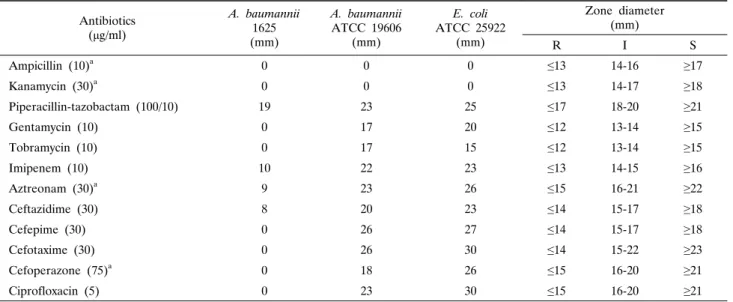
Table 1. Antibiotic resistance of A. baumannii 1625 by disk diffusion method Antibiotics
(μg/ml)
A. baumannii (mm)1625
A. baumannii ATCC 19606
(mm)
E. coli ATCC 25922
(mm)
Zone diameter (mm)
R I S
Ampicillin (10)a 0 0 0 ≤13 14-16 ≥17
Kanamycin (30)a 0 0 0 ≤13 14-17 ≥18
Piperacillin-tazobactam (100/10) 19 23 25 ≤17 18-20 ≥21
Gentamycin (10) 0 17 20 ≤12 13-14 ≥15
Tobramycin (10) 0 17 15 ≤12 13-14 ≥15
Imipenem (10) 10 22 23 ≤13 14-15 ≥16
Aztreonam (30)a 9 23 26 ≤15 16-21 ≥22
Ceftazidime (30) 8 20 23 ≤14 15-17 ≥18
Cefepime (30) 0 26 27 ≤14 15-17 ≥18
Cefotaxime (30) 0 26 30 ≤14 15-22 ≥23
Cefoperazone (75)a 0 18 26 ≤15 16-20 ≥21
Ciprofloxacin (5) 0 23 30 ≤15 16-20 ≥21
a Interpretive standards for Acinetobacter spp. were not available in CLSI guideline, and the interpretive standards for Enterobacteriaceae in NCCLS (2007) are used instead.
Abbreviations: R, resistant; I, intermediate; S, susceptible.
서는 1995년 MBL을 생성하는 P. aeruginosa와 P. putida 다 수를 분리하여 그것이 프랑스에서 보고된 VIM-2형과 염기서 열이 같음을 보고 하였으며(8), 이어 A. baumannii에서도 VIM-2 형이 검출되었다(19). MBL의 유전자는 일반적으로 integron내 에 cassette 형식으로 삽입되어 존재한다고 알려져 있고, 이는 carbapenem 항균제를 가장 잘 분해하기 때문에 내성기전에서 매우 중요하다(2).
Integron은 Tn21 family에 속하는 이동성 DNA element로 서 tyrosine recombinase에 속하는 intergrase (intI)를 발현시켜 gene cassette를 획득하며, 이들을 발현시키는 promoter를 5′CS (Conserved Sequence)에 가지고 있다. Integron은 intI의 염기 서열에 의해 분류되며 지금까지 10종류의 integron이 알려져 있다. 이중 5가지 integron만 내성 유전자와 연관되어 있으며 (4), 임상에서 분리되는 균주는 대부분 class 1 integron을 가지 고 있다. 대부분의 blaIMP 유전자와 blaVIM 유전자는 class 1 integron에 존재하며 드물게 class 3 integron에 존재하는 예가 보고 되기도 하였다(2). Martinez-Frejio 등(10)은 9개국에서 분리된 균주에서 integron을 검사하였는데, integron을 갖고 있 지 않은 균주 보다 integron을 갖고 있는 균주들이 서로 다른 항균제에 대한 내성이 많았다고 보고하였다. Integron은 스스 로 이동(transposition) 할 수 없으며, 대부분 transposon에 위 치한다. 만약 이 transpson이 전달성 plasmid에 존재한다면 내 성 유전자가 genome과 genome 사이에서 쉽게 이동 할 수 있 으며, MBL을 포함한 내성유전자 확산의 중요한 제공자 역할 을 할 것이다.
기회 감염성 세균인 A. baumannii에 의한 감염증 치료에는 대부분의 항생제 내성균들이 분비하는 β-lactamase에 안정한 carbapenem 계열(imipenem, meropenem 등)의 항생제들이 사 용되고 있는데, 최근 이 계열의 항생제에 내성을 지니는 A.
baumannii 균들이 증가하고 있어 치료가 어려워지고 있으며
이에 따른 내성연구의 중요성이 부각되고 있다(3). 국내외에서 항생제 내성과 관련된 integron들이 보고된 경우는 많이 있으 나, carbapenem 내성을 나타내는 A. baumannii 균의 integron 에 관한 보고는 소수에 불과하다. 그리하여 본 연구는 새로운 내성 증가에 관여되는 요소가 무엇인지 알아보고자 2005년 말 국내 임상 검체에서 새로이 분리되어 MBL을 생성하는 것으로 보이는 균주를 동정한 후, 항생제 내성 양상을 파악하고, 보유 내성 유전자 및 내성 유전자형을 조사 하고자 하였으며, 또한 내성에 관련된 integron의 유무와 구조를 파악하고 이해하고자 하였다.
2005년 말 국내 대학병원의 환자 검체(농)에서 분리된 균주 로서, Vitek system 및 디스크 확산법에서 imipenem에 내성인 균주가 선별 되었다. 실험대상 균주는 Vitek test 결과 A.
baumannii 임을 확인하였고, 또한 16S rDNA 염기서열 분석으 로 A. baumannii임을 다시 확인 할 수 있었다(자료 미제시).
이 실험 균주를 A. baumannii 1625로 명명하고 디스크 확산법 (11)으로 항균제 감수성검사를 시행한 결과 사용한 항생제에 대하여 모두 내성임을 확인하였고, 미량액체배지희석법 (microbroth dilution method)에 의한 최소억제농도(MIC) 측정 (12) 결과도 그 결과를 뒷받침 해 주었다. Imipenem과 meropenem에 대한 MIC도 각각 64 μg/ml와 64 μg/ml 이상을 나타내어 MBL 생성균주로 간주할 수 있었고, penicillin 계열 은 물론, 그 외 제 3세대 및 제 4세대 cephalosporin 계열 항균 제와 aminoglycoside 계열 항균제에도 모두 내성이며, mono- bactam 계열에도 내성임을 확인하였다(Tables 1 and 2).
Ethylenediamine tetraacetic acid (EDTA)에 의해 A. bau- mannii 1625가 생산하는 MBL의 활성억제 효과를 알아보고자 imipenem-EDTA double disk synergy test (7)를 시행하였다.
MBL은 효소의 활성을 위해 zinc 이온을 필요로 하며, EDTA 에 의해 zinc 이온이 제거되기 때문에 EDTA disk 주위의 A.
Table 2. Minimal inhibitory concentrations (MICs) of β-lacatams and aminoglycosides against A. baumannii 1625, E. coli DH5α transformant and E. coli DH5α reference strain
Antibiotics
MIC (μg/ml) A. baumannii
1625 E. coli
transfomant E. coli DH5α
Ampicillin >128 >128 2
Imipenem 64 1 0.06
meropenem >64 0.125 0.06
Piperacillin >256 >256 0.5
Cefazolin >128 128 -
Cefotaxime >64 0.125 0.06
Cefoperazone >64 >64 -
Aztreonam >64 2 0.125
1 2 3 4 M 6 7 8 9
Fig. 1. Amplification of blaIMP-1 and blaVIM-2 genes in A. baumannii 1625 and transformants.
Lanes 1 and 6 : Total DNA of A. baumannii 1625 was used as a template.
Lanes 2 and 7 : Plasmid DNA of A. baumannii 1625 was used as a template.
Lanes 3 and 8 : Amplified integron DNA of A. baumannii 1625 was used as a template.
Lanes 4 and 9 : Plasmid DNA of a transformant was used as a template.
Lane M : DNA size marker.
blaIMP-1 gene specific primers were used in lanes 1-4 and blaVIM-2
gene specific primers were used in lanes 6-9.
baumannii 1625는 imipenem에 대해 감수성을 나타내게 된다.
Imipenem disk가 단독으로 있을 때에는 억제대의 직경이 약 10 mm 정도였으나, 실험 결과 imipenem disk와 EDTA disk 사이에서 상승효과에 의한 억제대의 확장현상이 관찰되었으며, 이는 A. baumannii 1625의 β-lactamase는 활성에 금속이온이 필요한 MBL임을 확인할 수 있었다(자료 미제시).
국내에서 imipenem 내성을 일으키는 유전자로 밝혀진 IMP-1형과 VIM-2형 유전자를 알아보고자, 각각에 특이적인 primer들을 사용하여 PCR을 시행한 결과, A. baumannii 1625 는 VIM-2 특이적인 primer에 의해서는 증폭되지 않았으나, IMP-1 특이적인 primer에 의해서는 plasmid DNA를 주형으로 사용하였을 때, 약 500 bp의 크기의 증폭산물이 관찰 되었으며 (Fig. 1), 이 염기서열은 기존에 보고된 blaIMP-1의 염기서열과 일치하였다.
순수하게 분리 및 정제된 A. baumannii 1625의 plasmid DNA를 주형으로 하여 5′CS와 3′CS primer로 약 2.5 kb의 integron을 증폭하였으며, 이 integron을 주형으로 사용하였을 때에도 blaIMP-1 유전자가 증폭되었다(Fig. 1). 이 integron의 염 기서열을 분석한 결과, 길이가 총 2,552 bp인 integron으로서 3 개의 항생제 내성 유전자 cassette들이 존재하였고, 5′CS와 3′CS도 확인되었다. 5′CS에서 재결합 부위인 attI1 존재를 확 인하였고, NCBI [http://www.ncbi.nlm.nih.gov/]의 Database와 비교한 결과 class 1 integron 임을 알 수 있었다. 3개의 gene cassette는 각 유전자 사이마다 gene cassette 특유의 59-be (base element)가 존재하고 있었으며, core site와 inverse core site 역시 존재하는 것을 알 수 있었다. 이는 기존에 보고된 A.
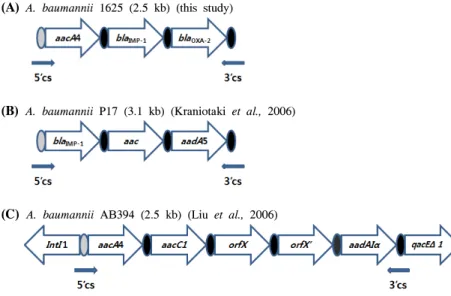
baumannii에서 발견된 integron들과 비교 했을 때 크기는 비슷 하지만 내성유전자의 분포와 구조에서 차이를 보였다(Fig. 2).
Integron의 첫 번째 유전자 cassette는 accA4 유전자로 amino- glycoside-6′-N-acetyltransferase를 생성하여 aminoglycoside의 6번째 아미노 그룹을 가수분해 하며, aminoglycoside 변형 효 소 중 가장 광범위한 내성을 보인다. 이 gene cassette는 5′CS 윗부분에 있는 intergrase 바로 다음에 위치하였으므로 pro- motor에 의해 강하게 발현 되었을 것으로 생각된다. 실제로 A.
baumannii 1625는 kanamycin은 물론 항균제 감수성 검사 시 사용되었던 gentamicin, tobramycin에 내성을 보였는데(Table 1), 이 유전자에 의해 감수성이 저하된 것으로 보인다. 두 번째 위치한 blaIMP-1 gene은 MBL을 생성하는 유전자로 한국에서 많이 분리되는 VIM-2형과는 달리 잘 발견되지 않았으나, 2002 년에 Yum 등(19)이 국내에서 IMP-1형을 가진 A. baumannii 를 보고하였다. 이 연구에서 밝혀진 blaIMP-1 유전자의 염기서 열은 Yum 등(19)이 보고한 유전자의 염기서열과 98% 일치하 였다. 이 유전자가 생산하는 MBL은 cabapenem계열인 imipenem 에 내성을 갖도록 하는 주요 요인이며, 실험결과에서도 내성을 나타내었다(Table 1). 마지막에 위치하는 blaOXA-2 유전자는 extended spectrum β-lactamase의 한 종류인 oxacillinase를 암 호화하고 있다. 이 효소가 과형성 되면 aztreonam, cefotaxime 등에 내성을 나타낼 수 있다. 항균제 감수성 검사 시 사용했던 cefazolin, cefotaxime, cefoperazone 등에 내성을 보여 준 것으 로 보아 이 유전자에 의해 감수성이 저하된 것으로 생각된다.
이 integron은 유전자 cassette가 3개 이므로 gene cassette들이 많이 삽입되어 있는 다른 integron보다는 유전자 모두가 잘 발 현될 것으로 사료되며, 앞서 시행한 항균제 감수성 시험 결과 처럼 다제내성을 나타내는 것이 integron의 분석과 일치함을
(A) A. baumannii 1625 (2.5 kb) (this study)
(B) A. baumannii P17 (3.1 kb) (Kraniotaki et al., 2006)
(C) A. baumannii AB394 (2.5 kb) (Liu et al., 2006)
Fig. 2. Comparison of structures of integrons found in A. baumannii 1625 and other A. baumannii.
Coding sequences are indicated by block arrows with corresponding names, and transcriptional orientations. Black filled arrows indicate the position and direction of primers 5'CS and 3'CS used for amplification.
알 수 있다.
또한 후에 시행한 transformants의 MIC 실험에서도 대조 균 주보다 대부분의 항생제에서 내성이 증가 한 것으로 보아 cloning된 integron내의 내성 유전자 casseette의 발현이 이루어 진 것으로 볼 수 있다. MIC실험에 사용한 항균제 중 내성이 없는 E. coli DH5α보다 8배 이상 증가한 항목이 imipenem, ampicilin, piperacillin, cefazolin, cefoperazone, aztreonam인 것은 이 integron내의 gene cassette들의 영향 인 것으로 사료 된다(Table 2). 특히 IMP-1형의 MBL은 aztreonam을 가수분 해하지 못하나, integron내에 함께 연결된 OXA-2형 β -lactamase에 의해 carbapenem계열의 항생제에 모두 내성을 보인 것으로 생각되며, 동시에 존재하는 경우 광범위한 다제내 성을 보여줌을 확인 할 수 있었다.
A. baumannii 1625는 integron이 가진 3종류의 내성 유전자 cassette에 의해 다양한 종류와 넒은 범위의 항생제에 내성을 보이는 것으로 본 연구에서 확인하였다. 이전에 보고된 연구들 과 비교 했을 때, IMP-1형과 OXA-2형 β-lactamase가 동시에 존재하는 A. baumannii는 국내에서 보고된 바 없었고, 이 균주 가 분리된 이후에도 carbapenemase를 생산하는 A. baumannii 가 더욱 확산되고 있으며, 내성 유전자의 종류도 다양해지고 있다. 만약 A. baumannii 1625의 integron이 전달성 plasmid에 위치하였다면 conjugation에 의해 항생제 내성 유전자들은 쉽 게 다른 병원균들로 전파될 수 있을 것이므로 이에 대한 많은 연구가 필요하다고 판단된다.
적요
임상분리 균주인 A. baumannii 1625는 imipenem (carbapenem 계열)을 포함한 대부분의 β-lactam계열의 항생제들과 kanamycin, gentamicin, tobramycin 및 제 3세대와 4세대 cephalosporin
계열의 항생제들에 광범위한 내성을 나타내었고, 한국에서는 드문 IMP-1형 metallo-β-lactamase (MBL) 를 생성하는 균주 임이 확인되었다. A. baumannii 1625는 약 2.5 kb 크기의 class 1 integron을 갖고 있었으며, 이 integron내에 amino- glycoside계열 내성 유전자인 accA4, carbapenem 계열 내성 유전자인 blaIMP-1, 광범위한 β-lactam 내성 유전자인 blaOXA-2
유전자 cassette들이 차례대로 위치해 있음을 확인하였는데, 이 것은 IMP-1형과 OXA-2형 β-lactamase의 유전자를 같은 integron내에 동시에 갖는 새로운 배열 및 구조로서 이전에 국 내에서 보고된 바 없는 것이다. 이 2.5 kb 크기의 integron을 항생제 내성이 없는 E. coli에 형질전환 시켰을 때, imipenem, ampicillin, piperacillin, cefazolin, cefoperazone, aztreonam 등 의 항생제들에 대하여 8배 이상 증가된 내성정도를 보였다. 이 는 A. baumannii 1625의 integron이 다제내성을 부여하는 기 능을 하고 있음을 보여준다.
참고문헌
1. Bergogne-Bé̍rézin, E. and K.J. Towner. 1996. Acinetobacter spp.
as nsocomial pathogens : microbiolgical, clinical, and epide- miological features. Clin. Microbiol. Rev. 9, 148-165.
2. Collis, C.M., M.J. Kim, S.R. Partridge, H.W. Stokes, and R.M.
Hall. 2002. Characterization of the class 3 integron and the site- specific recombination system it determines. J. Bacteriol. 184, 3017-3026.
3. Corbella, X., A. Montero, M. Pujol, M.A. Domiguez, J. Ayats, and M.J. Argerich. 2000. Emergence and rapid spread of carbapenem resistance during a large and sustained hospital outbreak of multiresistant Acinetobater baumannii. J. Clin.
Microbiol. 38, 4086-4095.
4. Correia, M., F. Boavida, F. Grosso, M.J. Salgad, L.M. Lito, J.M., Cristino, S. Mendo, and A. Duarte. 2003. Molecular characteri- zation of a new class 3 integron in Klebsiella pneumoniae.
Antimicrob. Agents Chemother. 47, 2838-2843.
5. Kraniotaki, E., R. Manganelli, E. Platsouka, A. Grossato, O.
Paniara, and G. Palù. 2006. Molecular investigation of an outbreak of multidrug-resistant Acinetobacter baumannii, with characterisation of class 1 integrons. J. Antimicrob. Agents. 28, 193-199.
6. Lauretti, L., M.I. Ricco, A. Mazzriol, G. Cornaglia, G.
Amicosante, R. Fontana, and M. Rossolini. 1999. Cloning and characterization of blaVIM, a new intergron-borne metallo-β -lactamase gene form a Pseudomonas aeruginosa clinical isolate.
Antibicrob. Agents Chemother. 43, 1584-1590.
7. Lee, K., Y. Chong, H.B. Shin, Y.A. Kim, D. Yong, and J.H.
Yum. 2001. Modified hodge and EDTA-disk synergy tests to screen metallo-β-lactamase-producing strains of Pseudomonas aeruginosa and Acinetobacter species. Clin. Microbiol. Infect. 7, 88-102.
8. Lee, K., J.B. Lim, J.H. Yum, D. Yong, Y. Chong, J.M. Kim, and D.M. Livermore. 2002. blaVIM-2 cassette containing novel integrons in metallo-β-lactamase-preoducing Pseudomonas aeruginosa and Pseudomonas putida isolates disseminated in a Korean hospital.
Antimicrob. Agents Chemother. 46, 1053-1058.
9. Liu, S.Y., J.Y. Lin, C. Chu, L.H. Su, T.Y. Lin, and C.H. Chiu.
2006. Integron-associated imipenem resistance in Acinetobacter baumannii isolated from a regional hospital in Taiwan. J.
Antimicrob. Agents Chemother. 27, 81-84.
10. Martinez-Freijo, P., A.C. Fluit, F.J. Schmitz, V.S.C. Grek, J.
Verhouf, and N.E. Jones. 1998. Class 1 integrons in Gram- negative isolates from different European hospitals and associ- ation with decreased susceptibility to multiple antibiotic compounds.
J. Antimicrob. Chemother. 42, 689-696.
11. National Committee for Clinical laboratory Standards. 1998.
Performance standards for antimicrobial susceptibility testing. 6th
informational supplement. Pennsylvania: NCCLS, 1998:M100-S6.
12. National Committee for Clinical laboratory Standards. 2000.
Method for dilution antimicrobial susceptibility tests for bacteria that grow aerobically-5th editions: approved standard. Wayne:
NCCLS, 2000;M7-A5.
13. Nemec, A., L. Janda, O. Melter, and L. Dijkshoorn. 1999.
Genotypic similarity of multiresistant Acinetobacter baumannii isolates in the Czech Republic. J. Med. Microbiol. 48, 287-296.
14. Nordamann, P. and L. Poirel. 2002. Emerging carbapenemases in Gram-negative aerobes. Clin. Microbiol. Infect. Dis. 8, 321-331.
15. Poirel, L., T. Nass, D. Nicolas, L. Collet, S. Bellais, J.D. Cavallo, and P. Nordmann. 2000. Characterization of VIM-2, a carbapenem-hydrolyzing metallo-β-lactamase and its plasmid and integron-bone gene from a Pseudomonas aeruginosa clinical isolate in France. Antimicrob. Agents Chemother. 44, 891-897.
16. Rasmussen, B.A., Y. Gluzman, and E.P. Tally. 1990. Cloning and sequencing of the class B β-lactamase gene(ccrA) from Bacteroides fragilis TAL3636. Antimicrob. Agents Chemother. 34, 1590-1592.
17. Toleman, M.A., A.M. Simm, T.A. Murphy, A.C. Gales, D.J.
Biedenbach, R.N. Jones, and T.R. Walsh. 2002. Molecular Characterization of SPM-1, a novel metallo-β-lactamase isolated in Latin America: report from the SENTRY antimicrobial program. J. Antimicrob. Chemother. 50, 673-679.
18. Watanabe, N., S. Iyobe, M. Inoue, and S. Nitsuhashi. 1991.
Transferable imipenem resistance in Pseudomonas aeruginosa.
Antimicrob. Agents Chemother. 35, 147-151.
19. Yum, J.H., K. Yi, H. Lee, D. Yong, K. Lee, J.M. Lim, G.M.
Rossolini, and Y. Chong. 2002. Molecular characterization of metallo-β-lactamase-producing Acinetobacter baumannii and Acinetobater genospecies 3 from Korea; identification of two new integrons carrying the blaVIM-2 gene cassettes. J. Antimicrob.
Chemother. 49, 837-840.