Kor. J. Pharmacogn.
42(4) : 336∼ 340 (2011)
336
산초(Zanthoxylum schinifolium) 추출물의 다제내성 Acinetobacter baumannii 억제 효과
이경호1·이기형2*
1코오롱 생명과학연구소, 2공주대학교 산업과학대학
Anitimicrobial Effects of Zanthoxylum schinifolium Extracts against Multi-drug Resistant Acinetobacter baumannii
Keyong-ho Lee 1 and Ki-hyeong Rhee2*
1Kolon Life Science Inc., Yongin-city, 449-797 Korea
2College of Industrial Sciences, Kongju National University, Yesan 340-702, Korea
Abstract − The aim of this study was to investigate the possible utilization of Zanthoxylum schinifolium as a source of anti- microbial agents. The antimicrobial effects of Zanthoxylum schinifolium extracts were investigated against Acinetobacter bau- mannii, which is a multi-drug resistant pathogen, and 5 other pathogenic microorganisms. The hexane extract of Zanthoxylum schinifolium was more effective than the ethyl acetate, n-butanol and methanol extracts which were active against Acinetobacter baumannii 25, with minimum inhibitory concentrations(MIC) ranging from 0.8 mg/ml to 1.6 mg/ml. Tetracycline had no effect on Acinetobacter baumanniii. The hexane extract was highly active against Candida albicans IFO 6258, with an MIC of 1.5 mg/ml. In contrast, the ethyl acetate, n-butanol and methanol extracts showed no activity against the 5 pathogenic micro- organisms. Furthermore, a combination of hexane extract and ethyl acetate extract was significantly more active against the 5 Acinetobacter baumannii strains than n-butanol and methanol. These results suggest that Zanthoxylum schinifolium extracts have great potential as antimicrobial compounds against multi-drug resistant pathogens, and further studies are warranted.
Key words − Zanthoxylum schinifolium, Acinetobacter baumannii, mult-drug resistant
1929년 영국의 Fleming에 의해 페니실린이 발견되어 미 생물 감염에 대한 치료에 많은 도움이 되었으나, 곧 내성이 생겨 새로운 항생물질인 메치실린을 개발하게 되었고, 병원 성 미생물 특히, Staphylococcus aureus 의 치료에 큰 역할 을 하였다. 그러나, 이 항생물질의 과다한 사용으로 또다시 대부분의 항생물질에 대해서도 내성을 보이는 MRSA (methicillin-resistant Staphylococcus aureus)등이 출현하여 인간에게 예상치 않는 문제점이 나타나게 되었다.1,2) 그 중 현재 병원 감염의 원인균으로 증가하고 있는 Acinetobacter baumannii는 그람음성 짧은막대균으로 운동성이 없으며 oxidase 음성, catalase 양성이고, 포도당을 발효하지 않고 nitrate를 환원하지 않는다. 흔히 토양이나 물 등의 자연환경 에 널리 존재하며 특히 건조한 침대시트, 베게 및 호흡기구, 혈관 내 삽관 튜브 등의 병원환경에 오랫동안 서식하다가
면역력이 약한 환자에게서 결막염, 피부염, 폐렴, 뇌수막염, 패혈증, 수술부위 감염, 요로감염 등의 합병증을 일으키는 것 으로 알려져 있다.4) 과거에 A. baumannii는 전쟁과 같은 상 황에서 상처를 입은 환자들에게서 가장 흔히 분리되었다.7,20) 그러나 최근에는 원내감염을 일으키는 균으로 알려져 있고 특히 중환자실에서 A. baumannii에 의한 폐렴감염이 많이 보고되고 있다.6)더욱이 일반적으로 사용하는 여러 항생제 에 내성을 나타내는 다약제내성을 띄며 습한 환경보다는 건 조한 환경에서도 오래 생존하여 병원감염의 역학에 중요한 역할을 한다. 또한 A. baumannii는 Beta-lactam 항균제를 비 롯한 대부분의 약제에 높은 내성을 보이고 있다.20) 현재까 지는 imipenem이 가장 효과적인 치료제로 사용되고 있었다.
그러나 imipenem에도 내성을 보이는 균주가 나타나고 있으 며, imipenem 내성 균주에 의한 감염은 사실상 기존에 쓰 이던 항균제로는 치료가 어려우며 최근 colistin 같은 기존 에 쓰이지 않던 치료제를 사용하거나 두 가지 이상의 항균
*교신저자(E-mail):[email protected] (Tel): +82-41-330-1626
제를 병합하는 것이 시도되고 있다.17)하지만 최근에는 이 들 항생제에도 내성을 보이는 균주가 보고되고 있다.3) 현재 A. baumannii에 감염되면 효과적으로 치료할 수 있는 적절 한 항생제가 아직까지는 없는 점에서 내성병원균주에 대한 강력한 살균효과를 나타내는 새로운 항생제의 개발이 시급 한 것으로 판단된다.
산초(Zanthoxylum schinifolium)는 동북 아시아권에서 옛 날부터 사용되어 온 전통 향신료이며 우리나라, 일본, 중국 등에서 널리 자생하고 있는 운향과(Rutaceae)의 낙엽관목으 로서 산초나무의 과피는 청초라 하여 중국에서 사용되고 있 으며, 분지나무 또는 상초나무로도 불린다.5,15-16)열매는 삭 과이고 둥글며 녹색을 띤 갈색이며 다 익으면 검은색의 종 자가 나온다. 또한 대한약전에는 초피나무(Zanthoxylum piperitum)의 과피를 산초라 사용하며, 산초(Zanthoxylum schinifolium)와 비슷하지만 잎자루 밑 부분에 가시가 1개 달 리고 열매가 녹색을 띤 갈색이며 꽃잎이 있는 것이 다르다.10) 산초는 과실, 껍질, 잎 등을 향신료, 약용 및 제유용으로 이 용하며, 우리 정서에 친숙한 향미와 향기를 가져 광범위하게 사용되고 있으며, 구충제, 해독살충약, 감기약 등에 이용되어
왔다.8,15,16,22) 산초의 보고된 성분으로는 limonene, citronellal
등의 향기 주요성분과, flavonoid계 성분, caproic acid 등의 지방산 화합물이 있으며,5,10)생리활성으로는 최근 항혈전 활 성, 항산화 활성 및 항염증 활성이 보고되어 있다.10)또한 Vibrio parahaemolyticus 등의 식중독 세균 및 구강세균에 대한 항세균 활성이 보고되어 있으며,9,12,13)항진균 활성으 로는 피부사상균(dermatophytes)에 대한 활성이 보고된 바
있다.11,18) 그러나 현재까지 산초 추출물의 A. baumannii 같
은 다제내성 세균 및 기타 병원성 세균에 대한 연구는 보고 된 바 없다. 이에 본 연구에서는 전통약재를 이용한 약리학 적 연구와 식품학적 연구를 바탕으로 한 항생물질 타겟 스
크리닝 시스템을 활용하여21)산초추출물의 다제내성균 및 기타 병원성세균에 대한 효과를 살펴보고자 하였다.
재료 및 방법
산초추출물 및 검정균 균주 − 본 실험에 사용할 산초는 청주한방병원(충북 청주시)이 서울경동재래시장(청주상회) 에서 구입, 보관중인 것(No. CHM 21)을 장병화 원장이 감 별하여 제공하였다. 검정균주는 2010-2011년 간 고려대학교 구로병원 감염내과에서 분양받은 45균주(A.baumannii 1-45) 의 A. baumannii를 사용하였다. 또한 다양한 병원성세균인 Bacillus subtilis IAM 1069, Micrococcus luteus JCM 1464, Streptomyces murinus JCM 4333, 진균인Candida albicans IFO 6258, Aspergillus niger ATCC 9642를 사용하 였다.
산초 추출물 및 분획물의 조제 − 산초 지상부의 음건물 을 파쇄한 후, 각각 10배 중량의 methanol, ethanol(95%, 주 정), ethylacetate 및 hexane을 가하여 상온에서 24시간 추출 하였다. 한편 열수 추출의 경우에는 100oC에서 4시간 동안 추출하였다. 각각의 추출액은 여과 후 60oC이하에서 감압 농축하여 분말화한 후, 활성 및 수율을 평가하였다. 한편 추 출물의 활성분획은 산초 methanol 추출물을 물에 현탁한 후, hexane, ethylacetate, 및 n-butanol을 사용하여 순차적으로 분 획하였으며, 최종적으로 물 분획을 회수하였다. 회수된 분 획 물은 동일한 방법으로 감압 농축하여 분말로 조제한 후, A. baumannii 와 병원성세균억제 활성을 측정에 사용하였다.
검정균 배지 및 항균 활성평가 − A. baumannii 및 병원 성미생물의 항균활성 효과를 알아보기 위한 배지로는 45종 의 A. baumannii를 위해 brain heart infusion agar(Difco, USA)를 사용하였고 Bouillon agar(3 g dextrose, 10 g
Fig. 1. Antimicrobial activity of hexane, ethylacetate, n-butanol and tetracycline ext. of Zanthoxylum schinifolium against A.
baumanni and other pathogen
(A) Extracts of Zanthoxylum Schinifoliume against A. baumanni [1: Hexane fr., 2: ethylacetate fr., 3: n-butanol fr., 4: tetracycline, 5:
control (only DMSO)], (B) Extracts of Zanthoxylum Schinifoliume against pathogen(Bacillus subtilis IAM 1064) [1: Hexane fr., plus ethylacetate fr., 2: hexane fr., 3: ethylacetate fr., 4: n-butanol fr., 5: tetracycline, 6: control (only DMSO)].
polypeptone, 5 g NaCl, 10 g meat extract, 10 g agar, 증류 수 1,000 ml, pH 7.0)배지는 Bacillus subtilis IAM 1069, Micrococcus luteus JCM 1464, Streptomyces murinus JCM 4333에 대해 사용하였으며, Sabouraud medium(Polypeptone 5.0 g, Glucose 30.0 g, Agar 11.0 g, 증류수 1,000 ml, pH 7.0)배지는 Candida albicans IFO 6258에, Yeast-starch medium(Yeast extract 2.0 g, Soluble starch 10.0g, Agar 10.0 g)배지는 Aspergillus niger ATCC 9642에 사용하였다.
산초 추출물 및 분획물의 검정균에 대한 최소저해농도 (MIC)측정은 NCCLS의 표준화된 한천희석법으로 실시하였 다.19)각각의 추출물들을 100 mg/ml에서 0.5 mg/ml까지 각 각 최종농도보다 10배 높은 농도로 만들어 멸균한 후 50oC 로 식힌 측정용 배지에 10개의 각 농도별로 만들어진 항생 물질을 9:1의 비율로 시험관에서 잘 섞은 후 표준 접시에 붓는다. 굳은 뒤에 35-37oC의 배양기에 넣어 30-45분간 말 린 후 3일 이내에 사용하였다. 접종한 최종균수를 5 × 10⁵ CFU/ml로 맞춘 뒤 낮은 농도의 항생물질이 든 배지부터 접 종한 후 35oC에서 48시간 배양하였다. 각 균주는 duplication
하여 분주하였다. 배양한 후 육안으로 균이 자라지 않는 항 생물질 최소농도를 MIC로 결정하였다. 또한 hexane fr.과 ethylacetate fr.의 병용요법은 50 : 50(wt/wt)의 비율로 혼합 하여 사용하였다.
통계분석 − 모든 측정값은 3회 이상 반복 실험한 결과의 평균값과 표준편차(mean±SD)로 표시하였고, 각 실험군의 통계학적 분석은 window용 SPSS 12.0(SPSS Inc., Chicago, IL, USA)을 사용하였다.
결과 및 고찰
A. baumannii 에 대한 산초 추출물의 최소저해농도의 측정 − 최소생육저해농도에 대한 실험결과 추출물에서 3종 의 A. baumannii 5, 15, 25에 대해 hexane fr.에서 1.6±0.5, 1.6±0.4, 0.8±0.2 mg/ml의 높은 항균활성을 보였으며 ethylacetate fr.에서 2종의 A. baumannii 30, 45에 대해 1.6±0.3 mg/ml의 비교적 강한 항균활성을 보였다. 이는 tetracycline의 최소생육억제농도 범위(25±0.1 mg/ml - >
Table I. Minimal inhibitory concentration(MIC) of organic solvents extract toward multi-drug resistant A. baumannii Test organisms Tetracycline
(mg/ml)
Minimal Inhibitory Concentration(mg/ml)
Hexane fr. EtOAc3) fr. n-Butanol fr. Methanol fr. DMSO A. baumannii 51) >100±1.22) 1.6±0.5 12.5±0.2 25±0.5 25±0.3 >100±1.3 A. baumannii 15 >100±1.4 1.6±0.4 12.5±0.6 25±0.5 50±1.5 >100±1.5 A. baumannii 25 25±0.1 0.8±0.2 25±0.1 12.5±0.2 50±0.4 >100±1.2 A. baumannii 30 25±0.1 5.0±0.1 1.6±0.3 12.5±0.3 12.5±1.1 >100±0.5 A. baumannii 45 50±0.2 5.0±0.3 1.6±0.2 50±0.4 12.5±0.5 >100±0.5
1)Random isolated at shown to among the similar clear zones(data not shown) of each parts.
2)Results are means of three determinations and are expressed as mg/ml. we adjust volume for each drug that used methanol, n-Butanol, hexane or EtOAc ext.
3)Ethylacetate.
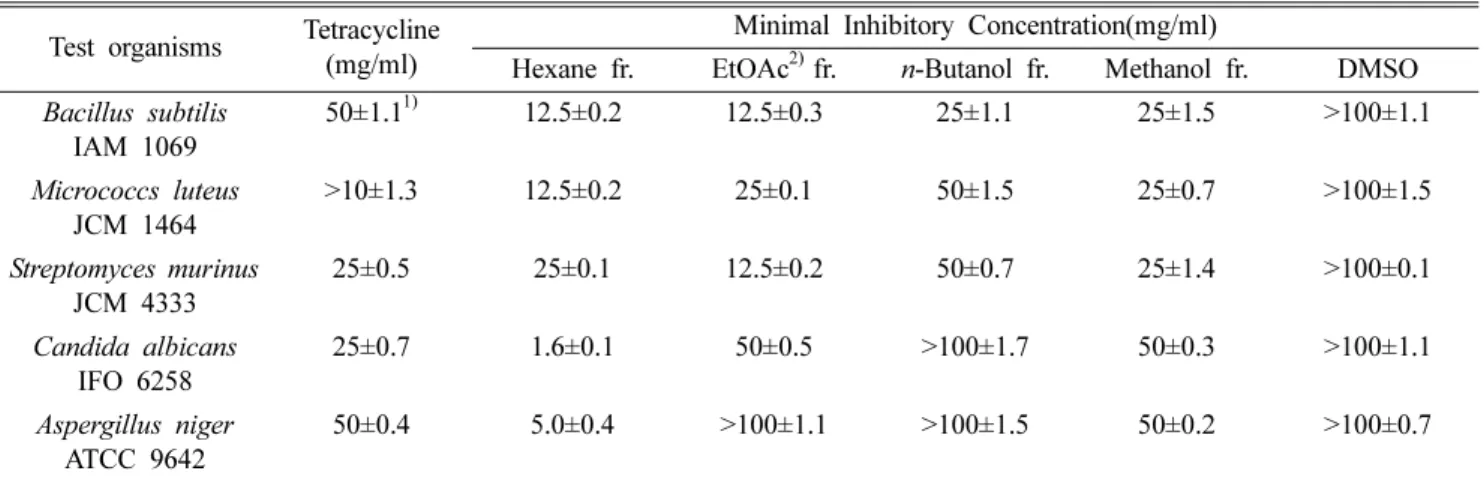
Table II. Minimal inhibitory concentration(MIC) of organic solvents extract toward various pathogenic microorganisms Test organisms Tetracycline
(mg/ml)
Minimal Inhibitory Concentration(mg/ml)
Hexane fr. EtOAc2) fr. n-Butanol fr. Methanol fr. DMSO Bacillus subtilis
IAM 1069
50±1.11) 12.5±0.2 12.5±0.3 25±1.1 25±1.5 >100±1.1 Micrococcs luteus
JCM 1464
>10±1.3 12.5±0.2 25±0.1 50±1.5 25±0.7 >100±1.5 Streptomyces murinus
JCM 4333
25±0.5 25±0.1 12.5±0.2 50±0.7 25±1.4 >100±0.1
Candida albicans IFO 6258
25±0.7 1.6±0.1 50±0.5 >100±1.7 50±0.3 >100±1.1 Aspergillus niger
ATCC 9642
50±0.4 5.0±0.4 >100±1.1 >100±1.5 50±0.2 >100±0.7
1)Results are means of three determinations and are expressed as mg/ml; we adjust volume for each drug that used methanol, n-Butanol, hexane or EtOAc ext.
2)Ethylacetate.
100±1.2 mg/ml)와 비교해 볼 때 A. baumannii 종에 넓은 범 위의 항균스펙트럼을 갖는 것으로 판단된다. 그러나 n-butanol fr.과 methanol fr.에서는 5종(5, 15, 25, 30, 45)의 A.
baumannii 에 대해 최소생육저해농도 범위(12.5±0.5 mg/ml - 50±0.2 mg/ml)으로 비교적 약한 항균활성이 측정되었다 (Table I).
병원성세균에 대한 산초 추출물의 항균효과 − 병원성 세 균과 진균에 대한 최소생육저해농도 측정결과 hexane fr.에 대한 Candida albicans IFO 6258와 Aspergillus niger ATCC 9642는 각각 1.6±0.1 mg/ml, 5.0±0.4 mg/ml로 낮은 농도에서 도 진균의 생육을 저해함이 관찰되었다. Bacillus subtilis IAM 1069, Micrococcus luteus JCM 1464, Streptomyces murinus JCM 4333에 대한 hexane fr.의 항균효과는 각각 12.5±0.2, 12.5±0.2, 25±0.1 mg/ml 로 나타내었다. Ethylacetate fr.에서 는 최소생육저해농도 범위 12.5±0.2 mg/ml 에서 >100±1.1 mg/ml로 다양한 항균활성을 나타내었다. n-butanol fr.과 methanol fr.에서는 대조항생물질인 tetracycline과 비교하여 볼 때 농도범위 25±1.1 mg/ml에서 >100±1.3 mg/ml로 비슷 한 항생효과를 관찰할 수 있었다(Table II).
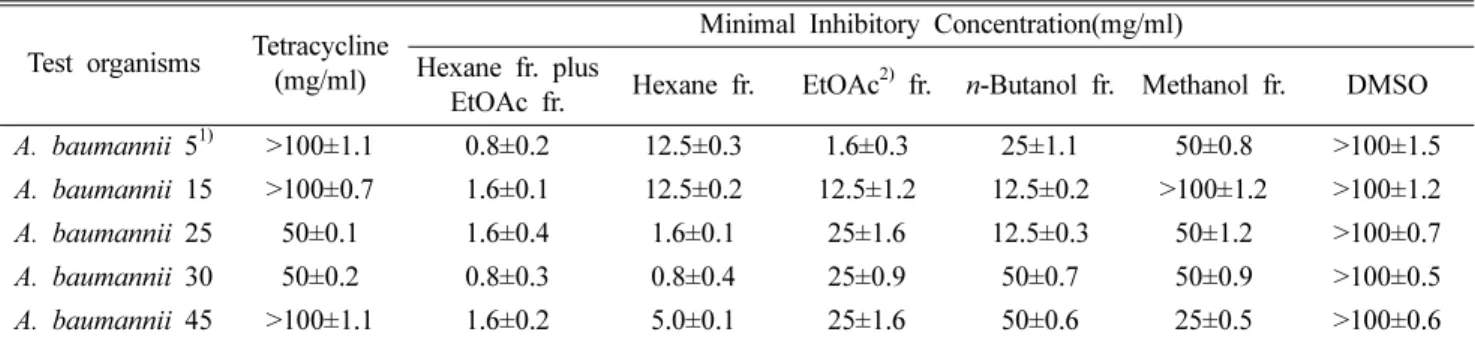
A. baumannii에 대한 산초 추출물의 병용요법에 의한 항균효과 − 5종의 A. baumannii에 대한 산초추출물의 병용 요법에 의한 효과를 알아보기 위해 비교적 활성이 높게 나 타난 hexane fr.과 ethylacetate fr.을 사용하였다. 두 종의 A.
baumannii 5, 30에 대한 최소생육저해농도 측정결과 각각 0.8±0.2 mg/ml로 강한 항균활성을 나타내었으며, 3종의 A.
baumannii 15, 25, 45 대한 최소생육저해농도 측정결과도 1.6±0.1 mg/ml로 높은 항균활성을 나타내었다. 이에 반해 n- butanol fr.과 methanol에서는 12.5±0.2 mg/ml에서 >100±1.2 mg/ml로 Table I과 유사한 결과를 나타내었다. 대조 항생물 질인 tetracycline은 50±0.1 mg/ml에서 >100±1.1 mg/ml로 낮은 항균활성을 나타내었다(Table III).
본 연구결과는 산초로부터 hexane, ethylacetate, n-butanol 추출물이 항생제 내성 균주들을 포함한 다양한 세균 및 진
균에 우수한 항균활성을 나타내며, 특히 hexane 추출물의 Candida albicans IFO 6258와 Aspergillus niger ATCC 9642 같은 진균에 대한 항생효과는, 보리 흰가루병 곰팡이 에 대한 산초 추출물의 항진균활성 연구와14) 유사한 결과를 나타내어 항진균제로서의 가능성도 검토해 볼 필요가 있다 고 사료된다.
결 론
본 연구에서는 전통약재로서 예로부터 향신료로 사용되 고 있는 산초추출물의 다제내성 A. baumannii 및 기타 병 원성세균에 대한 항균활성을 조사하였다. 산초추출물의 hexane fr.에서 5종의 A. baumannii 에 강한 항균활성이 있 음을 관찰하였다. 또한 ethylacetate fr., n-butanol fr.에서도 비교적 강한 항균활성을 보였다. 반면 1차 추출용매인 methanol과 대조군으로 사용한 tetracycline에서는 활성이 나 타나지 않았다. Bacillus subtilis IAM 1069를 비롯한 5종의 병원성 미생물에 대해서는 hexane fr.에서 강한 항균활성을 보였으며 ethylacetate fr.에서는 중등도의 항균활성을 나타 내었다. n-butanol fr., methanol fr. 및 tetracycline에서는 약 한 항균활성을 나타내었다. 강한 항균활성을 보이는 hexane fr.과 ethylacetate fr.의 병용요법은 단독으로 사용한 n-butanol fr. methanol fr.과 비교하여 볼 때 5종류의 A. baumannii에 모두 강한 항균활성을 나타내었다.
이러한 연구결과는 최근 큰 이슈가 되고 있는, 슈퍼박테 리아로 불리우는 CRE(carbapenem-resistant enterococci), MRSA(methicillin-resistant Staphylococcus aureus), VRSA (vancomycin-resistant Staphylococcus aureus)등에 대하여, 기존 항생제와 hexane 추출물의 병용요법에 의한 항생제 내 성균주제어 가능성도 검토하고 있다. 또한 앞으로 hexane 추출물과 ethylacetate 추출물의 정제 및 물질동정연구의 진 행을 계획하고 있다. 이는 신규항생제 개발에 중요한 토대 를 마련할 수 있을 것으로 사료된다.
Table III. Minimal inhibitory concentration(MIC) of hexane fr. plus EtOAc fr. toward multi-drug resistant A. baumannii
Test organisms Tetracycline (mg/ml)
Minimal Inhibitory Concentration(mg/ml) Hexane fr. plus
EtOAc fr. Hexane fr. EtOAc2) fr. n-Butanol fr. Methanol fr. DMSO A. baumannii 51) >100±1.1 0.8±0.2 12.5±0.3 1.6±0.3 25±1.1 50±0.8 >100±1.5 A. baumannii 15 >100±0.7 1.6±0.1 12.5±0.2 12.5±1.2 12.5±0.2 >100±1.2 >100±1.2 A. baumannii 25 50±0.1 1.6±0.4 1.6±0.1 25±1.6 12.5±0.3 50±1.2 >100±0.7 A. baumannii 30 50±0.2 0.8±0.3 0.8±0.4 25±0.9 50±0.7 50±0.9 >100±0.5 A. baumannii 45 >100±1.1 1.6±0.2 5.0±0.1 25±1.6 50±0.6 25±0.5 >100±0.6
1)Random isolated at shown to among the similar clear zones(data not shown) of each parts. Results are means of three determinations and are expressed as mg/ml; we adjust volume for each drug that used methanol, n-Butanol, hexane or EtOAc ext.
2)Ethylacetate.
인용문헌
1. Aswapokee, N. S., Tiengrim, B., Charoensook, K. and Sang- siriwut, K. (1998) Antimicrobial resistant pattern of Acine- tobacter sp. J. Infect. Dis. 15: 43-48.
2. Baraibar, J. H., Correa, D., Mariscal M., Gallego, J., Valles, J.
and Rello, M. (1997) Risk factors for infection by Acine- tobacter baumannii inintubated patients with nosocomial pneumonia. Chest. 112: 1050-1054.
3. Bergogne-Berezin, E. and Towner, K. J. (1996) Acinetobacter spp. as nosocomial pathogens: microbiological, clinical, and epidemiological features. Clin. Microbiol. Rev. 9: 148-165.
4. Bello, H., Gonzalez, G., Dominguez, M., Zemelman, R.. Gar- cia, A. and Mella, S. (1997) Activity of selected beta-lactams, ciprofloxacin, and amikacin against different Acinetobacter baumannii biotypes from Chilean hospitals. Diagn. Microbio.
Infect. Dis. 28: 183-186.
5. Cho, M. G. and Kim, H. (2003) Analysis of volatile com- pounds in leaves and fruits of Zanthoxylum schinifolium Sie- bold et Zucc.& Zanthoxylum piperiyum DC. by headspace SPME. Kor. J. Med. Crop. Sci. 11: 40-45.
6. Getchell-White, S. I., Donowitz, L. G. and Groschel, D. H.
(1989) The inanimate environment of an intensive care unit as a potential source of nosocomial bacteria: evidence for long survival of Acinetobacter calcoaceticus. Infect. Control.
Hosp. Epidemiol. 10: 402-407.
7. Hanberger, H., Garcia-Rodriguez, J. A., Gobernado, M., Goossens, H., Nilsson, L. E. and Struelens, M. J. (1999) Anti- biotic susceptibility among aerobic Gram-negative bacilli in intensive care units in 5 European countries. J. A. M. A. 281:
67-71.
8. Jang, M. J., Woo, M. H., Kim, Y. H., Yoon, D. Y. and Cho, S. H. (2007) Anti-throbogenic and anti-inflammatory effects of solvent fractions from leaves of Zanthoxylum schinifolium (sancho namu) in rats fed high fat diet. Kor. J. Nutrition. 40:
606-615.
9. Kim, B. S., Jang, H. S., Choi, C. S., Kim, J. S., Kon, G. S., Kwun, I. S., Son, K. H. and Sohn, H. Y. (2008) Antifungal of Zanthoxylum schinifolium against Fusarium graminearum, barey powedery mildew fungus. J. Life. Sci. 18: 974-979.
10. Kim, J., Lee, Y. A., Kim, Y. S., Jung, H. J., Kwak, D. J., Jie, W. D. and Yoon, S. H. (2000) Antimicrobial activities of san- cho(Zanthoxylum schinifolium S. et Z) on oral bacteria. J.
Kor. Soc. Hygiene. Sci. 6: 41-46.
11. Kim, J. H. (2003) Variation on the leaf monotrpenes con- centration of Zanthoxylum schinifolium at Mt. Muhak. J.
Basic Sci. 18: 137-149.
12. Kim, J. S., Gu, G. M., Jeong, Y. H., Yang, J. G. and Lee, G.
G. (2004) Antimicrobial activities of Zanthoxylum schini- folium extract against Vibrio parahaemolyticus. J. Kor. Soc.
Food Sci. Nutr. 33: 500-504.
13. Kim, K. W., Baek, J. K., Jang, Y. W., Kum, E. J., Kwon, Y.
S., Kim, H. J. and Shon, H. Y. (2005) Screening of anti- bacterial agent against Streptococcus mutans from natural and medicinal plants. J. Life Sci. 15: 715-725.
14. Kim, S. I. and Han, Y. S. (1997) Isolation and identification of antimicrobial compound from sancho(Zanthoxylum schin- ifolium). Korean J. Food Sci. Technol. 13: 56-63.
15. Lee, J. W. (1998) Volatile flavor components of korean san- cho fruit and tree(Zanthoxylum schinifolium). J. Kor. Soc.
Food Sci. Nutr. 11: 493-498.
16. Lee, M. S. and Chung, M. S. (2000) Analysis of volatile flo- vor components from Zanthoxylum schinifolium and sensory evaluation as natural spice. Kor. J. Food Cookery Sci. 16:
216-220.
17. Manikal, V. M., Landman, D., Saurina, G., Oydna, E., Lal, H.
and Nale, J. (2000) Endemic carbapenem-resistant Acine- tobacter species in Brooklyn, NewYork city, videprevalence, interinstitutional spread, and relation to antibioticus age. Clin.
Infect. Dis. 31: 101-106.
18. Min, K. H. (1998) Antifungal activity of the extracts of Zan- thoxylum schinifolium Sieb. et Zucc. against dermatophytes.
Mokche. Konhak. 26: 78-85.
19. National Committee for Clinical Laboratory Standards.
(1997) Methods for dilution antimicrobial susceptibility tests for bacteria that grow aerobically approved standard M7-A3.
NCCLS, Villanova, Pa.
20. Park, A. J. and Hong, H. R. (2003) Evaluation of methods for detection of antimicrobial resistance of Acinetobacter bau- mannii to imipenem. Korean J. Lab. Med. 23: 388-394.
21. Rhee, K. H. and Lee, K. H. (2011) Antimicrobial effects of Lonicera japonica against gram positive and gram negative anaerobic bacteria. Nat. Prod. Sci. 17: 23-25.
22. Ryu, K. H., Kwon, J. H., Lee, S. S., Ahn, Y. J. and Yoo, J. K.
(1998) Fungicidal activity of oriental medicinal plant extracts against plant pathogenic fungi. Agri. Chem. Biotechnol. 41:
600-604.
(2011. 9. 9 접수; 2011. 12. 20 심사; 2011. 12. 23 게재확정)