Antimicrobial Resistance Determinants in Imipenem-nonsusceptible Acinetobacter calcoaceticus-baumannii Complex Isolated in Daejeon,
Korea
Ji Youn Sung, Ph.D.1, Kye Chul Kwon, M.D.2, Hye Hyun Cho, M.S.2, and Sun Hoe Koo, M.D.2
Department of Biomedical Laboratory Science1, Far East University, Eumseong; Department of Laboratory Medicine2, College of Medicine, Chungnam National University, Daejeon, Korea
Background: Members of the Acinetobacter calcoaceticus-baumannii (Acb) complex are important opportunistic bacterial patho- gens and present significant therapeutic challenges in the treatment of nosocomial infections. In the present study, we investigat- ed the integrons and various genes involved in resistance to carbapenems, aminoglycosides, and fluoroquinolones in 56 imipen- em-nonsusceptible Acb complex isolates.
Methods: This study included 44 imipenem-nonsusceptible A. baumannii, 10 Acinetobacter genomic species 3, and 2 Acinetobacter genomic species 13TU strains isolated in Daejeon, Korea. The minimum inhibitory concentrations (MICs) were determined by Etest.
PCR and DNA sequencing were used to identify the genes that potentially contribute to each resistance phenotype.
Results: All A. baumannii isolates harbored the blaOXA-51-like gene, and 21 isolates (47.7%) co-produced OXA-23. However, isolates of Acinetobacter genomic species 3 and 13TU only contained blaIMP-1 or blaVIM-2. Most Acb complex isolates (94.6%) harbored class 1 in- tegrons, armA, and/or aminoglycoside-modifying enzymes (AMEs). Of particular note was the fact that armA and aph(3´)-Ia were only detected in A. baumannii isolates, which were highly resistant to amikacin (MIC50≥256) and gentamicin (MIC50≥1,024). In all 44 A. baumannii isolates, resistance to fluoroquinolones was conferred by sense mutations in the gyrA and parC. However, sense mutations in parC were not found in Acinetobacter genomic species 3 or 13TU isolates.
Conclusions: Several differences in carbapenem, aminoglycoside, and fluoroquinolone resistance gene content were detected among Acb complex isolates. However, most Acb complex isolates (87.5%) possessed integrons, carbapenemases, AMEs, and mu- tations in gyrA. The co-occurrence of several resistance determinants may present a significant threat.
Key Words: Acinetobacter baumannii, Acinetobacter genomic species, Carbapenemase, Integron
Received: June 3, 2011 Manuscript No: KJLM-11-058 Revision received: June 27, 2011
Accepted: July 19, 2011
Corresponding author: Sun Hoe Koo, M.D.
Department of Laboratory Medicine, College of Medicine, Chungnam National University, 640 Daesa-dong, Jung-gu, Daejeon 301-721, Korea
Tel: +82-42-280-7798, Fax: +82-42-257-5365, E-mail: [email protected] ISSN 1598-6535 © The Korean Society for Laboratory Medicine.
This is an Open Access article distributed under the terms of the Creative Commons Attribution Non-Commercial License (http://creativecommons.org/licenses/by-nc/3.0) which permits unrestricted non-commercial use, distribution, and reproduction in any medium, provided the original work is properly cited.
INTRODUCTION
Acinetobacter spp. are ubiquitous in the environment and have emerged as important opportunistic pathogens that cause nosocomial infections [1]. Currently, more than 30 named and unnamed species of Acinetobacter have been identified by DNA-DNA hybridization [2]. Acinetobacter
baumannii, which is the most frequently identified species from clinical infections and outbreaks, is genetically closely related and phenotypically similar to 2 other clinical spe- cies, namely, Acinetobacter genomic species (gen. sp.) 3 and 13TU and to Acinetobacter calcoaceticus, a soil bacterium.
This close similarity led to the proposal that these species should be grouped together in the so-called A. calcoaceti- cus-A. baumannii (Acb) complex [3]. With the exception of A. calcoaceticus, all members of this complex have been re- ported to be involved in nosocomial infections and are known to have the ability to spread within hospitals [4].
Acb complex has now become a major cause of hospital- acquired infections worldwide due to its remarkable propen- sity to rapidly acquire determinants of resistance to a wide range of antibacterial agents [5]. In particular, increasing resistance to carbapenems has been observed worldwide in the past decade. Carbapenemase production is the best-de- scribed mechanism of resistance to carbapenems, and vari-
ous metallo-β-lactamases (MBLs) and OXA-type carbapen- emases have been isolated from Acb complex strains world- wide [6-8]. In some instances, carbapenemase genes, such as blaIMP, blaVIM, blaGIM, or blaSIM, are located within class 1 integrons and lead to carbapenem resistance. Multidrug-re- sistant Acb complex strains have been known to acquire their antimicrobial resistance genes via class 1 integrons that carry single or multiple gene cassettes [9].
Aminoglycoside resistance genes, such as acetyltransfer- ase (aac), phosphotransferase (aph), and adenylyltransfer- ase (aad), are also typically found within integron gene cas- settes [10]. In addition, Acb complex strains carry various types of aminoglycoside-modifying enzymes (AMEs) and 16S rRNA methylases, which confer resistance to aminogly- cosides [11].
Increases in the number of fluoroquinolone-resistant Acb complex strains are mediated primarily by spontaneous mu- tations in the quinolone resistance-determining regions (QR- DRs) of either DNA gyrase (gyrA), topoisomerase IV (parC), or both [12].
Although the Acb complex has been recognized as an im- portant opportunistic pathogen associated with life-threat- ening nosocomial infections and hospital outbreaks, there is a relative paucity of data on the number and type of resis- tance genes in Acb complex strains isolated in Daejeon, Ko- rea. In the present study, we aimed to determine the genetic basis for multidrug resistance and the clonal relatedness of the Acb complex clinical isolates obtained from a university hospital in Daejeon. Molecular determinants enabling the multidrug resistant strains to exhibit co-resistance to car- bapenems, aminoglycosides, and fluoroquinolones were in- vestigated with a focus on integrons, carbapenemases, AMEs, 16S rRNA methylase, and mutations of the gyrA and parC genes.
MATERIALS AND METHODS
1. Bacterial isolates and rpoB gene analysis
A total of 56 consecutive and non-duplicate imipenem- nonsusceptible Acb complex isolates were collected from the university hospital laboratory in Daejeon, Korea, from January 2008 to December 2010. Acinetobacter spp. were identified by using the Vitek 2® automated ID system (Bio- Mérieux, Marcy l’Etoile, France) and partial sequencing of the rpoB housekeeping gene, as described previously [13].
2. Antimicrobial agents and minimum inhibitory concentration (MIC) determinations
The MICs of Acb complex isolates for imipenem, merope-
nem, gentamicin, amikacin, ceftazidime, cefepime, and cip- rofloxacin were determined using Etest (BioMérieux). In- terpretation was based on the criteria approved by the CLSI [14]. Escherichia coli ATCC 25922 was used as the reference strain.
3. Characterization of antimicrobial resistance determinants
All Acb complex isolates were subjected to PCR and se- quencing assays for the detection of antimicrobial resistance determinants and the identification of mutations associated with fluoroquinolone resistance. Specific primers for the de- tection of antimicrobial resistance determinants were used [15-18]. Chromosomal DNA was obtained from each target strain by using a genomic DNA purification kit (Promega, Madison, WI, USA) in accordance with standard protocols.
PCR was performed using 50 ng of genomic DNA, 2.5 µL of 10× Taq buffer, 0.5 µL of 10 mM dNTP mix, 20 pmol of each primer, and 0.7 U of Taq DNA polymerase (SolGent, Daejeon, Korea), in a total volume of 25 µL. Each antimi- crobial resistance determinant gene was amplified in a Ge- neAmp PCR System 9600 thermal cycler (Perkin-Elmer Cetus Corp., Norwalk, CT, USA) by pre-denaturation of the reaction mixture at 95˚C for 5 min, followed by 35 cycles of 95˚C for 30 sec, 52˚C for 40 sec, and 72˚C for 30 sec, with a final extension at 72˚C for 5 min. The amplicons were puri- fied with a PCR purification kit (SolGent) and were sequen- ced using a BigDye Terminator Cycle Sequencing Kit (PE Applied Biosystems, Foster City, CA, USA) and an ABI PR- ISM 3730XL DNA analyzer (PE Applied Biosystems). Inte- gron detection, characterization, and gene cassette amplifi- cation were carried out using previously described PCR me- thods [19].
4. Repetitive extragenic palindromic PCR (REP-PCR) for clonality assessment
In the REP-PCR method, the primer pair of REP1 (5´- IIIGCGCCGICATCAGGC-3´) and REP2 (5´-ACGTCT- TATCAGGCCTAC-3´) was used to amplify putative REP- like elements in the genomic DNA [20]. Amplification reac- tions were performed in a final volume of 50 µL, containing 100 ng of chromosomal DNA, 5 µL of 10× Taq buffer, 1.0 µL of 10 mM dNTP mix, 1.5 U of Taq DNA polymerase (SolGent), and 50 pmol of each primer. The cycling condi- tions were as follows: an initial denaturation step at 95˚C for 5 min; followed by 30 cycles of 92˚C for 50 sec, 48˚C for 55 sec, and 70˚C for 5 min; and a final extension step at 70˚C for 10 min. The amplified products were separated via elec- trophoresis on 1.5% agarose gels containing ethidium bro-
mide, and visualized using a BioDoc-14 Imaging system (UVP, Cambridge, UK).
RESULTS
1. Identification of Acinetobacter spp
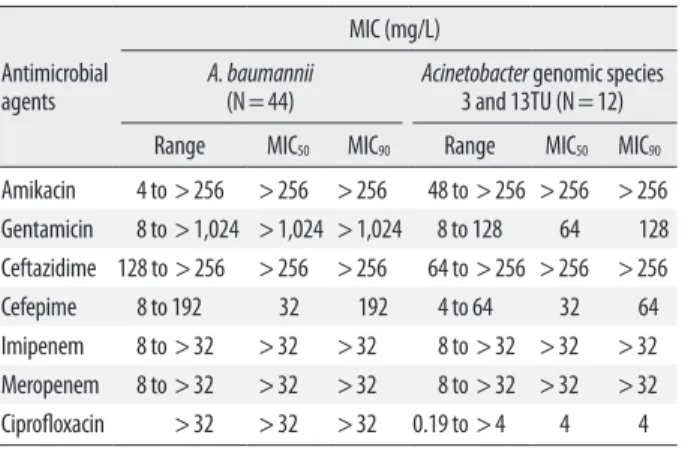
Isolates were assigned to 3 distinct Acinetobacter species on the basis of the results of rpoB gene analysis: A. bauman- nii (N=44), Acinetobacter gen. sp. 3 (N=10), and Acineto- bacter gen. sp. 13TU (N=2). The distribution of MICs for imipenem, meropenem, amikacin, ceftazidime, and cefepi me was similar among A. baumannii, Acinetobacter gen. sp. 3, and Acinetobacter gen. sp. 13TU. However, high-level resis- tance to gentamicin (MIC50≥1,024 mg/L) and ciprofloxacin (MIC50≥32 mg/L) was only seen in the A. baumannii iso- lates (Table 1).
2. Detection and characterization of integrons
Most of the Acb complex isolates (94.6%) contained class 1 integrons, which ranged between 1.8 and 3.0 kb in length.
However, no class 2 or class 3 integrons were found within the cohorts. The gene cassettes found in this study were di- vided into 4 types by nucleotide sequencing (Fig. 1). The type 1 amplicon (3.0 kb), obtained in 10 Acinetobacter gen.
sp. 3 isolates, carried aacA4-blaIMP-1-blaOXA-2 gene cassettes.
The type 2 amplicon (3.0 kb), found in 2 Acinetobacter gen.
sp. 13TU isolates, carried blaVIM-2-aacA7-aadA1 gene cas- settes. The type 3 amplicon (1.8 kb), detected in only 1 Aci- netobacter gen. sp. 13TU isolate, carried aac3-1-blaOXA-2-orfD gene cassettes. Forty-one A. baumannii isolates (93.2%) con- tained the type 4 amplicon (2.3 kb) carrying aacA4-catB8- aadA1 gene cassettes.
3. Carbapenem resistance genes in Acb complex isolates The distribution of carbapenem resistance genes among isolates of the 3 different Acinetobacter species is shown in Table 2. The blaOXA-23 gene was only amplified from 21 A.
baumannii isolates (47.7%), all of which harbored the up- stream insertion element ISAba1 and were highly resistant to imipenem (MICs≥32). The intrinsic β-lactamase gene, blaOXA-51-like, was amplified in all 44 A. baumannii isolates, and an upstream ISAba1 was identified in 39 strains (88.6%).
Other OXA-type carbapenemase genes, such as blaOXA-24 and blaOXA-58-like, were not found in this study.
Two MBL genes, blaIMP-1 and blaVIM-2, were detected in Acinetobacter gen. sp. 3 and 13TU. The blaSIM gene was not detected in any of our isolates. All imipenem-nonsuscepti- ble Acb complex isolates contained more than 1 carbapene- mase gene.
4. Aminoglycoside resistance genes in Acb complex isolates
Three different genes encoding AMEs were identified:
aac(6´)-Ib was the most prevalent, found in 52 isolates, fol- lowed by aph(3´)-Ia in 31 isolates, and aph(3´)-VI in 12 iso-
Table 1. The MIC distribution of 7 antimicrobial agents for the 56 A. calco- aceticus-baumannii complex isolates as determined by Etest
Antimicrobial agents
MIC (mg/L) A. baumannii
(N=44) Acinetobacter genomic species 3 and 13TU (N=12) Range MIC50 MIC90 Range MIC50 MIC90
Amikacin 4 to >256 >256 >256 48 to >256 >256 >256 Gentamicin 8 to >1,024 >1,024 >1,024 8 to 128 64 128 Ceftazidime 128 to >256 >256 >256 64 to >256 >256 >256 Cefepime 8 to 192 32 192 4 to 64 32 64 Imipenem 8 to >32 >32 >32 8 to >32 >32 >32 Meropenem 8 to >32 >32 >32 8 to >32 >32 >32 Ciprofloxacin >32 >32 >32 0.19 to >4 4 4 Abbreviation: MIC, minimum inhibitory concentration.
Type 1 Intl 1 aacA4 blaIMP-1 blaOXA-2 qacEΔ1 5´ CS
5´ CS
5´ CS
5´ CS
3´ CS
3´ CS
3´ CS
3´ CS
Intl 1 blaVIM-2 aacA7 aadA1 qacEΔ1
Intl 1 aac3-1 blaOXA-2 orfD qacEΔ1
Intl 1 aacA4 catB8 aadA1 qacEΔ1
Type 2 Type 3 Type 4
Fig. 1. Schematic representation of gene cassette structures located in the class 1 integron isolated from Acinetobacter calcoaceticus-baumannii complex isolates. The horizontal arrows indicate the translation orientation of the genes.
Table 2. Distribution of carbapenemase genes in imipenem-nonsusceptible Acinetobacter calcoaceticus-baumannii complex isolates
Genomic species
N of genes blaIMP-1 blaVIM-2 blaOXA-23blaOXA-51-
like
A. baumannii (N=44) 21 44
Acinetobacter genomic species 3 (N=10) 10 Acinetobacter genomic species 13TU (N=2) 2
Total (N=56) 10 2 21 44
lates (Table 3). All 10 Acinetobacter gen. sp. 3 isolates con- tained aac(6´)-Ib and aph(3´)-VI, whereas 31 A. baumannii isolates had the combination of aac(6´)-Ib/aph(3´)-Ia. The 16S rRNA methylase gene armA was detected in 41 A. bau- mannii isolates, but rmtA and rmtB were not detected in any Acb complex isolates tested. The 41 A. baumannii isolates containing armA were highly resistant to amikacin (MIC50≥ 256 mg/L) and gentamicin (MIC50≥1,024 mg/L).
The 3 A. baumannii isolates that did not contain integrons or 16S rRNA methylase and AMEs had low-level aminogly- coside resistance, with an amikacin MIC50 of 4 mg/L and a gentamicin MIC50 of 8 mg/L.
5. Characterization of quinolone resistance among Acb complex isolates
All A. baumannii isolates had sense mutations at the 83rd residue (serine to leucine) in gyrA and at the 80th residue (serine to leucine or tryptophan) in parC, and had high-level ciprofloxacin resistance (MIC50≥32 mg/L). However, sense mutations in parC were not detected in Acinetobacter gen.
sp. 3 and 13TU isolates. The sense mutations at the 83rd residue (serine to leucine) in gyrA were detected in only 8 Acinetobacter gen. sp. 3 isolates, which had low-level cipro- floxacin resistance (MIC50=4 mg/L). The 3 Acinetobacter gen. sp. isolates without sense mutations in either gyrA or
parC were susceptible to ciprofloxacin (MIC =0.19 mg/L).
6. REP-PCR patterns
To determine the clonality of all 56 Acb complex isolates, REP-PCR was performed on genomic DNA. The 44 A. bau- mannii isolates displayed only 2 REP-PCR types, designated type A and type B (Fig. 2). However, the Acinetobacter gen.
sp. 3 and 13TU isolates showed diverse band patterns.
DISCUSSION
This study analyzed various genes of Acb complex isolates that are responsible for resistance to carbapenems, amino- glycosides, and fluoroquinolones. Previous studies focused mainly on carbapenem or aminoglycoside resistance [11].
We found differences in the genetic characteristics of iso- lates from 3 different Acinetobacter species in terms of their carbapenem, aminoglycoside, and fluoroquinolone resis- tance.
Our study identified several differences in carbapenem resistance genes among Acinetobacter spp. isolates. OXA- type carbapenemase genes (blaOXA-23 and blaOXA-51-like) were only observed in A. baumannii isolates, while MBL genes (blaIMP-1 or blaVIM-2) were only present in Acinetobacter gen.
sp. 3 or 13TU isolates. This distribution is in accordance with previous reports of resistance genes among Acineto- bacter spp. [21, 22]. The presence of ISAba1 upstream of blaOXA genes provides a promoter sequence enhancing their expression [23]. In isolates possessing blaOXA-23, ISAba1 was consistently associated with blaOXA-23 and not with the bla-
OXA-51-like gene, suggesting that coexpression of these 2 genes does not occur. The dissemination of A. baumannii isolates harboring the blaOXA-23 gene has been previously reported in Korea [15, 24]. In addition, class 1 integrons harboring MBL genes were detected in Acinetobacter gen. sp. 3 and 13TU isolates. A 3.0-kb class 1 integron containing blaIMP-1 with Table 3. Distribution of aminoglycoside resistance genes in imipenem-non-
susceptible Acinetobacter calcoaceticus-baumannii complex isolates Genomic species
N of genes armA aac(6’)-Ib aph(3’)-
Ia aph(3’)- VI
A. baumannii (N=44) 41 41 31
Acinetobacter genomic species 3 (N=10) 10 10
Acinetobacter genomic species 13TU (N=2) 1 2
Total (N=56) 41 52 31 12
M Ab Ag Ab Ab Ab Ab Ab Ag M Ab Ab Ab Ab Ab Ab Ab Ab Ag Ab Ag 12,000
A A A B A A A A A A A A A A A
5,000 3,000 2,000 1,000 500 100
Fig. 2. Repetitive extragenic palindromic (REP)-PCR patterns of genomic DNA from imipenem-nonsusceptible Acinetobacter calcoaceticus-baumannii complex iso- lates. Lane M, 1-kb DNA size marker; Ab, Acinetobacter baumannii; Ag, Acinetobacter genomic species 3.
aacA4 and bla was described in A. baumannii (EF375699) and A. junii (EU014166) isolates recovered from Korea in 2007. In our previous study, we reported that multidrug re- sistant A. baumannii isolates contained class 1 integrons har- boring blaIMP-1 with aacA4 and blaOXA-2 [15]. However, an A.
baumannii isolate harboring blaIMP-1 was not detected in the present study. A 3.0-kb class 1 integron containing blaVIM-2
with aacA7 and aadA1 was described in A. baumannii (AF- 324464) recovered from Korea in 2002 [25].
In our study, significant variation was seen in the distri- bution of aminoglycoside resistance genes among Acineto- bacter gen. sp. isolates. The armA and aph (3´)-Ia genes were only detected in A. baumannii isolates, whereas aph(3´)-VI was only detected in Acinetobacter gen. sp. 3 and 13TU iso- lates. In particular, A. baumannii isolates containing armA showed high-level gentamicin resistance (MIC50 ≥1,024 mg/L). Unlike AMEs, which vary in their substrate ranges, 16S rRNA methylases confer high-level resistance to almost all clinically important aminoglycosides [11]. The armA gene was previously detected in A. baumannii, P. aeruginosa, E.
coli, K. pneumoniae, and S. marcescens [26], but has not been detected in other Acinetobacter gen. sp. so far.
A major mechanism of fluoroquinolone resistance in gram-negative bacteria involves changes in the structure of the drug targets, DNA gyrase and DNA topoisomerase IV [27]. In particular, amino acid substitutions in both the GyrA and ParC polypeptides are consistent with a high-level fluoroquinolone resistant phenotype [28]. In this study, all 44 A. baumannii isolates harboring sense mutations in both gyrA and parC showed high-level resistance to ciprofloxa- cin (MIC50 ≥32 mg/L). These results are similar to those re- ported in our study of multidrug resistant A. baumannii isolates [15].
In addition, identical banding patterns on REP-PCR pro- files were only seen among the A. baumannii isolates. Our results suggest that there is both clonal and horizontal spread of resistance genes between imipenem-nonsusceptible A.
baumannii isolates in the university hospital in Daejeon.
Despite the increasingly frequent discovery of multidrug resistant Acinetobacter spp. isolates in Korea, there is a rela- tive paucity of information regarding the antimicrobial re- sistance of this gram-negative bacillus in Daejeon. Although we found differences in genetic characteristics of isolates from 3 different Acinetobacter species, most (87.5%) of them possessed integrons, AMEs, carbapenemases, and mutations in gyrA. The co-occurrence of several resistance determi- nants may present a significant threat.
Authors’ Disclosures of Potential Conflicts of Interest No potential conflict of interest relevant to this article was reported.
REFERENCES
1. Bergogne-Bérézin E and Towner KJ. Acinetobacter spp. as nosoco- mial pathogens: microbiological, clinical, and epidemiological fea- tures. Clin Microbiol Rev 1996;9:148-65.
2. La Scola B, Gundi VA, Khamis A, Raoult D. Sequencing of the rpoB gene and flanking spacers for molecular identification of Aci- netobacter species. J Clin Microbiol 2006;44:827-32.
3. Gerner-Smidt P and Tjernberg I. Acinetobacter in Denmark: II.
Molecular studies of the Acinetobacter calcoaceticus-Acinetobacter baumannii complex. APMIS 1993;101:826-32.
4. van den Broek PJ, van der Reijden TJ, van Strijen E, Helmig-Sch- urter AV, Bernards AT, Dijkshoorn L. Endemic and epidemic Aci- netobacter species in a university hospital: an 8-year survey. J Clin Microbiol 2009;47:3593-9.
5. Gootz TD and Marra A. Acinetobacter baumannii: an emerging multidrug-resistant threat. Expert Rev Anti Infect Ther 2008;6:309- 6. Poirel L and Nordmann P. Carbapenem resistance in Acinetobacter 25.
baumannii mechanisms and epidemiology. Clin Microbiol Infect 2006;12:826-36.
7. Poirel L, Pitout JD, Nordmann P. Carbapenemases: molecular di- versity and clinical consequences. Future Microbiol 2007;2:501-12.
8. Mugnier PD, Poirel L, Nordmann P. Functional analysis of inser- tion sequence ISAba1, responsible for genomic plasticity of Aci- netobacter baumannii. J Bacteriol 2009;191:2414-8.
9. Petersen A, Guardabassi L, Dalsgaard A, Olsen JE. Class I integrons containing a dhfrI trimethoprim resistance gene cassette in aquatic Acinetobacter spp. FEMS Microbiol Lett 2000;182:73-6.
10. Nemec A, Dolzani L, Brisse S, van den Broek P, Dijkshoorn L. Di- versity of aminoglycoside-resistance genes and their association with class 1 integrons among strains of pan-European Acinetobacter baumannii clones. J Med Microbiol 2004;53:1233-40.
11. Cho YJ, Moon DC, Jin JS, Choi CH, Lee YC, Lee JC. Genetic basis of resistance to aminoglycosides in Acinetobacter spp. and spread of armA in Acinetobacter baumannii sequence group 1 in Korean hospitals. Diagn Microbiol Infect Dis 2009;64:185-90.
12. Vila J, Ruiz J, Goñi P, Marcos A, Jimenez de Anta T. Mutation in the gyrA gene of quinolone-resistant clinical isolates of Acineto- bacter baumannii. Antimicrob Agents Chemother 1995;39:1201-3.
13. Gundi VA, Dijkshoorn L, Burignat S, Raoult D, La Scola B. Valida- tion of partial rpoB gene sequence analysis for the identification of clinically important and emerging Acinetobacter species. Microbi- ology 2009;155:2333-41.
14. Clinical and Laboratory Standards Institute. Performance stan- dards for antimicrobial susceptibility testing: twentieth informa- tional supplement, M100-S20. Wayne, PA: Clinical and Labora- tory Standards Institute, 2010.
15. Koo SH, Kwon KC, Cho HH, Sung JY. Genetic basis of multidrug- resistant Acinetobacter baumannii clinical isolates from three uni- versity hospitals in Chungcheong province, Korea. Korean J Lab
16. Akers KS, Chaney C, Barsoumian A, Beckius M, Zera W, Yu X, et al. Aminoglycoside resistance and susceptibility testing errors in Acinetobacter baumannii-calcoaceticus complex. J Clin Microbiol 2010;48:1132-8.
17. Bogaerts P, Galimand M, Bauraing C, Deplano A, Vanhoof R, De Mendonca R, et al. Emergence of ArmA and RmtB aminoglycoside resistance 16S rRNA methylases in Belgium. J Antimicrob Che- mother 2007;59:459-64.
18. Mendes RE, Kiyota KA, Monteiro J, Castanheira M, Andrade SS, Gales AC, et al. Rapid detection and identification of metallo-β- lactamase-encoding genes by multiplex real-time PCR assay and melt curve analysis. J Clin Microbiol 2007;45:544-7.
19. Shin SY, Kwon KC, Park JW, Song JH, Ko YH, Sung JY, et al. Char- acteristics of aac(6´)-Ib-cr gene in extended-spectrum β-lactamase- producing Escherichia coli and Klebsiella pneumoniae isolated from Chungnam area. Korean J Lab Med 2009;29:541-50.
20. Bou G, Cerveró G, Domínguez MA, Quereda C, Martínez-Beltrán J. PCR-based DNA fingerprinting (REP-PCR, AP-PCR) and pulsed- field gel electrophoresis characterization of a nosocomial outbreak caused by imipenem- and meropenem-resistant Acinetobacter bau- mannii. Clin Microbiol Infect 2000;6:635-43.
21. Lee JH, Choi CH, Kang HY, Lee JY, Kim J, Lee YC, et al. Differen- ces in phenotypic and genotypic traits against antimicrobial agents between Acinetobacter baumannii and Acinetobacter genomic spe- cies 13TU. J Antimicrob Chemother 2007;59:633-9.
22. Lee K, Kim MN, Choi TY, Cho SE, Lee S, Whang DH, et al. Wide dissemination of OXA-type carbapenemases in clinical Acinetobac-
33:520-4.
23. Turton JF, Ward ME, Woodford N, Kaufmann ME, Pike R, Liver- more DM, et al. The role of ISAba1 in expression of OXA carbap- enemase genes in Acinetobacter baumannii. FEMS Microbiol Lett 2006;258:72-7.
24. Sung JY, Kwon KC, Park JW, Kim YS, Kim JM, Shin KS, et al. Dis- semination of IMP-1 and OXA type β-lactamase in carbapenem- resistant Acinetobacter baumannii. Korean J Lab Med 2008;28:16- 25. Yum JH, Yi K, Lee H, Yong D, Lee K, Kim JM, et al. Molecular char-23.
acterization of metallo-β-lactamase-producing Acinetobacter bau- mannii and Acinetobacter genomospecies 3 from Korea: identifica- tion of two new integrons carrying the bla(VIM-2) gene cassettes. J Antimicrob Chemother 2002;49:837-40.
26. Zhou Y, Yu H, Guo Q, Xu X, Ye X, Wu S, et al. Distribution of 16S rRNA methylases among different species of Gram-negative ba- cilli with high-level resistance to aminoglycosides. Eur J Clin Mi- crobiol Infect Dis 2010;29:1349-53.
27. Akasaka T, Tanaka M, Yamaguchi A, Sato K. Type II topoisomer- ase mutations in fluoroquinolone-resistant clinical strains of Pseu- domonas aeruginosa isolated in 1998 and 1999: role of target en- zyme in mechanism of fluoroquinolone resistance. Antimicrob Agents Chemother 2001;45:2263-8.
28. Valentine SC, Contreras D, Tan S, Real LJ, Chu S, Xu HH. Pheno- typic and molecular characterization of Acinetobacter baumannii clinical isolates from nosocomial outbreaks in Los Angeles County, California. J Clin Microbiol 2008;46:2499-507.