Characteristics of Acquired β-lactamase Gene in Clinical Isolates of Multidrug-resistant Pseudomonas aeruginosa
Sun Yang Chung1, Ji Youn Sung2, Kye Chul Kwon,2 Jong Woo Park,2 Chi Seon Ko,2 So Youn Shin,2 Jeong Hoon Song,2 Sun Hoe Koo2
1Health Promotion Center, Samsung Medical Center, Seoul,
2Department of Laboratory Medicine, Chungnam National University College of Medicine, Daejeon, Korea
Background: Recently, there have been reports of in- fections with multidrug-resistant Pseudomonas aeru- ginosa. To determine the mechanism of the resist- ance, we investigated the prevalence of Ambler class A and D β-lactamases, their extended-spectrum de- rivatives, and class B and D carbapenemase in mul- tidrug-resistant P. aeruginosa isolates.
Methods: During the period of March 2006 to May 2007, clinical isolates of multidrug-resistant P. aerugi- nosa were collected from patients in Chungnam National University Hospital, Daejeon, Korea. Inhibi- tor-potentiated disk diffusion tests were used for the screening of metallo-β-lactamase (MBL) production.
PCR and DNA sequencing were conducted for the de- tection of β-lactamase genes. We also employed the enterobacterial repetitive intergenic consensus (ERIC)- PCR method for an epidemiologic study.
Results: A total of 37 consecutive, non-duplicate, multidrug-resistant P. aeruginosa were isolated. Twenty- nine of 37 isolates harbored blaOXA-10 (56.8%), blaOXA-2 (18.9%), and blaOXA-1 (5.4%). Only one iso-
late produced IMP-1, and it also harbored blaOXA-1. None harbored Ambler class A β-lactamase or class D carbapenemase. The strains producing OXA type β-lactamases showed a significantly higher resist- ance to aminoglycoside compared to non-producers.
The ERIC-PCR pattern of the 19 OXA-10 producing strains indicated that the isolates were closely related in terms of clonality.
Conclusion: OXA type β-lactamases are the most prevalent among the acquired β-lactamases pro- duced by multidrug-resistant P. aeruginosa isolated at a university hospital in Chungcheong Province.
Besides β-lactam antibiotics, the strains harboring OXA type β-lactamase showed a significantly higher resistance to aminoglycoside and qunolone. (Korean J Clin Microbiol 2008;11:98-106)
Key Words: Multidrug resistance, Pseudomonas aerugi- nosa, OXA type β-lactamase, Metallo-β- lactamase (MBL)
Received 31 January, 2008, Accepted 20 August, 2008
Correspondence: Sun Hoe Koo, Department of Laboratory Medicine, Chungnam National University Hospital, 640, Daesa-dong, Jung-gu, Daejeon, Korea. (Tel) 82-42-280-7798, (Fax) 82-42-257-5365, (E- mail) [email protected]
98
서 론녹농균(Pseudomonas aeruginosa)은 호기성 포도당 비발효 그 람음성 간균으로 병원감염의 주요 원인균이다. 녹농균에 의한 감염은 대부분 기회감염이며, 외이도염, 골수염, 뇌수막염, 심내막염, 폐렴, 요로감염, 균혈증 등 다양한 감염증을 유발 한다[1].
녹농균에 의한 감염증의 치료에는 이 세균에 비교적 강한 항 균력을 지닌 β-lactam계열의 항균제인 ceftazidime, cefepime 및 carbapenem 등의 약제가 사용되고 있다. 그러나, 최근 cefe- pime이나 carbapenem에도 내성을 보이는 다제내성 녹농균의 감염이 증가하고 있어 많은 문제가 되고 있다[2]. 2003년
KONSAR surveillance 조사에 의하면 imipenem 내성인 녹농균 의 비율이 20%로 높았고, 이중 대부분은 다제내성 균이었다 [3]. 녹농균이 cefepime이나 carbapenem에 대한 내성을 획득하 는 기전 중 하나가 Ambler class A와 D에 속하는 extended spectrum β-lactamase (ESBL)의 생성 혹은 class B와 D에 속하 는 carbapenemase의 생성이다[4].
Class A에 속하며 장내세균에 의해 흔히 생성되는 TEM형 및 SHV형 ESBL은 드물지만 녹농균에서도 생성되는 것으로 알려져 있다[5]. VEB형[6] 및 cephalosporin계 항균제에 강한 분해활성을 갖는 PER-1형[7] 또한 녹농균에서 검출 된 바 있 다. 그러나 녹농균에서 주로 보고되는 ESBL은 class D에 속하 는 OXA형 β-lactamase로 우리나라에도 널리 퍼져 있으며 ESBL인 OXA-17 생성 녹농균도 보고된 바 있다[8,9].
녹농균이 생성하는 carbapenemase에는 2000년 남아프리카 공화국에서 분리된 녹농균에서 처음 보고된 class A의 GES형 ESBL[10], class B metallo-β-lactamase (MBL), 그리고 class D
의 OXA형 carbapenemase등이 있다.
이중 가장 강력한 carbapenemase인 MBL은 1988년 일본에서 처음 발견되었으며[11], imipenem을 가수분해하는 효소라는 의 미에서 IMP-1으로 명명되었다[12]. 그 후 일본을 비롯한 여러 나라에서 VIM형[13,14], SPM-1형[15], GIM-1형[16], 그리고 SIM-1형[17]등의 MBL이 보고되었다.
Class D의 OXA형 carbapenemase는 1985년에 스코틀랜드에 서 분리된 imipenem 내성 Acinetobacter baumannii에서 처음 확인되었으며[18] 지금은 유럽, 아시아, 브라질등 전세계적으 로 확산되었고[19], 국내에서도 2005년도에 분리된 녹농균에서 검출된 바 있다[20].
다제내성 녹농균의 출현 및 확산은 이 세균에 의한 감염증 치료에 많은 어려움을 가중시킬 수 있으므로 임상적으로 중요 한 문제이다. 녹농균이 다제내성을 보이는 중요한 원인중의 하 나가 β-lactamase생성에 의한 획득 내성이므로 다제내성 녹농 균을 대상으로 β-lactamase의 성상을 규명하는 것은 내성기전 을 연구하는데 중요하다. 본 연구에서는 충청지역에서 분리된 다제내성 녹농균을 대상으로 Ambler class A와 D에 속하는 ESBL과 class B와 D에 속하는 carbapenemase의 대표적인 유전 형들을 규명하여 내성세균의 확산을 방지하기 위한 기초자료 를 제공하고자 하였다.
재료 및 방법 1. 균주의 수집
2006년 3월부터 2007년 5월까지 충남대학교 의과대학병원 진단검사의학과에 의뢰된 임상검체 분리 녹농균 중 다제내성 을 보인 37주를 대상으로 하였다. 분리된 녹농균이 광범위 항 균제인 cefepime, amikacin, ciprofloxacin, piperacillin / tazo- bactam과 meropenem 중 3가지 이상의 항균제에 내성을 보일 경우 다제내성균으로 정하였다[21]. 항균제 내성에 상관없이 분리된 순서대로 균주를 수집하였으며, 동일 환자에서 반복 분 리된 균주는 수집대상에서 제외하였다. 분리된 균주의 균종은 전통적인 생화학적 방법 및 Vitek GNI card (bioMerieux Vitek Inc., Hazelwood, MO, USA)로 확인하였다.
2. 항균제 감수성 시험
미국의 Clinical and Laboratory Standards Institute (CLSI) 지 침에 따라[22] amikacin, gentamicin, netilmicin, tobramycin, ceftazidime, imipenem, piperacillin, ticarcillin, 및 ciprofloxacin (BBL, Cockeysville, MD, USA)과 aztreonam, cefepime, mer- openem, piperacillin–tazobactam, 및 ticarcillin-clavulanic acid (Oxoid, Cambridge, UK)에 대한 감수성을 Mueller-Hinton 한천 배지(Difco, Cockeysville, MD, USA)를 사용하여 디스크 확산 법으로 확인하였다. 항균제에 대한 최소억제농도(minimum in-
hibitory concentration, MIC)는 Mueller-Hinton 액체배지 (BBL) 를 사용하여 액체미량희석법으로 구하였다. Amikacin, genta- micin, netilmicin, tobramycin, aztreonam 및 piperacillin은 Sigma-Aldrich (St. Louis, MO, USA)에서 구입하여 사용하였으 며, 그 외 사용한 항균제는 ceftazidime (한미약품, 서울, 한국), cefepime (보령제약, 서울, 한국), imipenem (MSD, Elkton, VA, USA), meropenem (AstraZeneca, Cheshire, UK), ticarcillin 및 ciprofloxacin (ICN Biomedicals Inc, Costa, Mesa, CA, USA)이 었다. 정도관리를 위해서 Escherichia coli ATCC 25922와 P.
aeruginosa ATCC 27853을 동시에 시험하여 허용범위에 드는 지 확인하였다.
3. Inhibitor-potentiated disk diffusion (IPD) 방법을 이용한 Metallo-β-lactamase 생성 선별 검사
다제내성 녹농균을 대상으로 IPD 검사를[23] 실시하여 MBL 생성 균주를 선별하였다. MacConkey 한천 배지(Difco)에서 35oC, 24시간 동안 배양한 균 집락을 풀어 McFarland 표준액 0.5에 맞춘 후 균액을 Mueller-Hinton 한천배지에 접종하였다.
접종한 균액이 마른 후 두 개의 10μg imipenem disk를 두 디 스크 중심간의 거리가 4∼5 cm간격이 되게 하여 배지 위에 올 려놓고 두 개 중 한 개의 디스크에만 0.5 M EDTA용액 10μl를 분주하였다. 35oC, 18시간 배양한 다음 억제대를 판독하여 imi- penem과 imipenem-EDTA 디스크의 억제대 차가 7 mm 이상인 균주를 MBL 생성 선별검사의 양성으로 판단하였다[23].
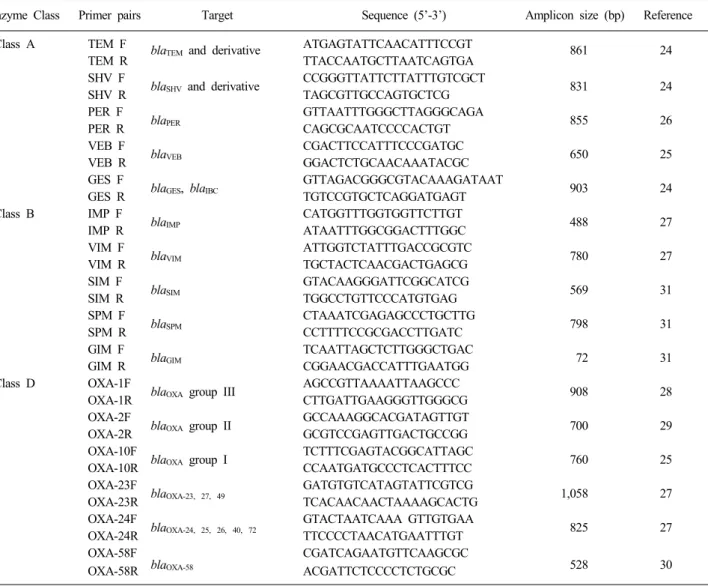
4. 분자생물학적 방법에 의한 β-lactamase 유전형 확인 β-lactamase의 유전형을 분석하기 위해 이미 보고된 바 있는 기존의 시발체를 사용하여 중합효소연쇄반응(polymerase chain reaction, PCR)을 수행하였다(Table 1). 대상 균주를 brain heart infusion 액체배지(Difco, Cockeysville, MI, USA)에 접종하여 37oC로 하룻밤 진탕 배양한 후 DNA purification kit (Promega, Madison, WI, USA)을 사용하여 배양액으로부터 DNA를 추출 하였다. DNA 추출액(5μL), 10× Taq buffer (2.5μL), 10 mM dNTP mix (0.5μL), primer 각 10 pmol, 0.7U Taq DNA poly- merase (솔젠트, 대전, 한국) 및 증류수를 혼합하여 25μL의 반 응용액을 만들었다. Gene Amp PCR System 9600 (Perkin- Elmer Centus Corp., Norwalk, CT, USA)으로 95oC에서 5분간 반응시킨 후, 95oC에서 20초, 59oC에서 40초, 72oC에서 30초씩 30회 증폭 반응시키고, 70oC에서 5분간 연장 반응시켰다. 각각 의 PCR 생산물을 ethidium bromide가 포함된 1% agarose gel에 서 40분간 전기영동하여 밴드를 확인하였다. 증폭산물을 DNA extraction kit (Qiagen, Hilden, Germany)로 분리 후, BigDye Terminator Cycle Sequencing Kit (PE Applied Biosystems, Foster City, CA, USA)와 ABI PRISM 3730xl DNA analyzer (PE Applied Biosystems)를 이용하여 염기 서열을 분석하였다.
Table 1. Oligonucleotides used as primers for amplification and sequencing
Enzyme Class Primer pairs Target Sequence (5’-3’) Amplicon size (bp) Reference
Class A TEM F blaTEM and derivative ATGAGTATTCAACATTTCCGT 861 24
TEM R TTACCAATGCTTAATCAGTGA
SHV F
blaSHV and derivative CCGGGTTATTCTTATTTGTCGCT
831 24
SHV R TAGCGTTGCCAGTGCTCG
PER F
blaPER GTTAATTTGGGCTTAGGGCAGA
855 26
PER R CAGCGCAATCCCCACTGT
VEB F
blaVEB CGACTTCCATTTCCCGATGC
650 25
VEB R GGACTCTGCAACAAATACGC
GES F
blaGES, blaIBC GTTAGACGGGCGTACAAAGATAAT
903 24
GES R TGTCCGTGCTCAGGATGAGT
Class B IMP F
blaIMP CATGGTTTGGTGGTTCTTGT
488 27
IMP R ATAATTTGGCGGACTTTGGC
VIM F
blaVIM ATTGGTCTATTTGACCGCGTC
780 27
VIM R TGCTACTCAACGACTGAGCG
SIM F
blaSIM GTACAAGGGATTCGGCATCG
569 31
SIM R TGGCCTGTTCCCATGTGAG
SPM F
blaSPM CTAAATCGAGAGCCCTGCTTG
798 31
SPM R CCTTTTCCGCGACCTTGATC
GIM F
blaGIM TCAATTAGCTCTTGGGCTGAC
72 31
GIM R CGGAACGACCATTTGAATGG
Class D OXA-1F
blaOXA group III AGCCGTTAAAATTAAGCCC
908 28
OXA-1R CTTGATTGAAGGGTTGGGCG
OXA-2F
blaOXA group II GCCAAAGGCACGATAGTTGT
700 29
OXA-2R GCGTCCGAGTTGACTGCCGG
OXA-10F
blaOXA group I TCTTTCGAGTACGGCATTAGC
760 25
OXA-10R CCAATGATGCCCTCACTTTCC
OXA-23F
blaOXA-23, 27, 49 GATGTGTCATAGTATTCGTCG
1,058 27
OXA-23R TCACAACAACTAAAAGCACTG
OXA-24F
blaOXA-24, 25, 26, 40, 72 GTACTAATCAAA GTTGTGAA
825 27
OXA-24R TTCCCCTAACATGAATTTGT
OXA-58F
blaOXA-58
CGATCAGAATGTTCAAGCGC
528 30
OXA-58R ACGATTCTCCCCTCTGCGC
Abbreviations: F, forward; R, reverse.
5. Enterobacterial repetitive intergenic consensus polymerase chain reaction (ERIC PCR)에 의한 역학적 연관성 조사 DNA purification kit (Promega)로 대상 균주의 DNA를 추출 하여 주형 DNA로 사용하였다. Primer로는 ERIC1R (5'-ATGT AAGCTCCTGGGGA-TTCAC-3')과 ERIC2 (5'-AAGTAAGTG ACTGGGGTGAGCG-3')로 명명된 장내세균의 반복 서열을 사 용하였다[32]. 증폭반응은 DNA 추출액 (5.0μL), 10× Taq buf- fer (5.0μL), 10 mM dNTP mix (1.0μL), primer 각 20 pmol, 1.4U Taq DNA polymerase (솔젠트)및 증류수를 혼합하여 50 μL의 혼합액으로 시행하였다. 95oC에서 5분간 반응시킨 후, 92oC에서 50초, 52oC에서 55초, 70oC에서 7분씩 35회 증폭 반 응시키고, 70oC에서 10분간 연장 반응시켰다. 증폭산물 (10μL) 은 ethidium bromide가 포함된 2% agarose gels에 전기영동 한 후 BioDoc-14TM Imaging system (UVP, Cambridge, UK)을 이
용하여 분석하였다. Band의 강도와 상관없이 band의 분자량과 개수로 각 균주를 비교하며, 두 개 이상의 밴드 차이가 있으면 역학적 상관관계가 없는 것으로 판단하였다[33].
결 과
1. 항균제 감수성 양상
시험기간 중 총 37주의 다제내성 녹농균이 환자의 임상검체 에서 분리되었으며, amikacin 91.9%, gentamicin 97.3%, ne- tilmicin 91.9%, tobramycin 86.5%, aztreonam 56.8%, ceftazi- dime 75.7%, cefepime 78.4%, imipenem 67.6%, meropenem 67.6%, piperacillin 54.1%, piperacillin-tazobactam 48.6%, ti- carcillin 97.3%, ticarcillin-clavulanic acid 83.8%, 그리고 cipro- floxacin 94.6%의 내성율을 보였다(Table 2).
Table 2. Antibiotic susceptability profiles and β-lactamases of multi-drug resistant Pseudomonas aeruginosa
Isolates Antibiotic susceptibilities
β-lactamase
AMK GEN NET TOB ATM CAZ FEP IPM MEM PIP TZP TIC TIM CIP
P2 P3 P4 P5 P7 P15 P17 P18 P21 P23 P25 P26 P29 P31 P34 P35 P40 P41 A2 A3 A8 A9 A10 A11 A13 A14 A15 A16 A18 A19 A26 A32 A36 A41 A42 A43 A50
R R R R I R R S R R R R R R S R R R R R R R R R R R R R R R R R R R R R R
R R R R R R R R R R R R R R S R R R R R R R R R R R R R R R R R R R R R R
R R R R R R R R R R R R R R S R R R R R R S R R R R R R R R R R R R R R S
R S R R S R R R R R R R R R S R R R R R R R R R S R R R R R S R R R R R R
R R S R R R R R R I R R R R R R R R I I R
I R
I I I I R
I R R I I I I I S
I R S I R R R S R R R R R R R I R
I R R R R I R
I R R R R R R R R R R R S
I R R R R R I S S R R R R R R I R R R R R R I R
I R R R R R R R I R R R R
R R R R R R R R R R R R R R R R R R S I I I R
I R
I R
I I R R I R
I I S R
R R R R R R R R R R R R R R R R R R S I R
I R
I R
I I R
I R R I R
I I S I
S S S R R R R R S R S R R R R R R R R S R S R S S S S R S R S S R S S R S
S R S R R R R R S R S R R S R S R S R S R S S S S S S R S R R S R S S R S
R R R R R R R R R R R R R R R R R R R R R R R R S R R R R R R R R R R R R
R R S R R R S R R R S R R R R R R S R R R S R R R R R R R R R R R R R R S
R R R R R R R R R R R R R R S R R S R R R R R R R R R R R R R R R R R R R
OXA-10 OXA-10 OXA-2 OXA-2, OXA-10
OXA-1, IMP OXA-10
OXA-2 OXA-2 OXA-2 OXA-10
OXA-2 OXA-10 OXA-10 OXA-10 OXA-10 OXA-10 OXA-10 OXA-10 OXA-10 OXA-10 OXA-10 OXA-2 OXA-10 OXA-10 OXA-10 OXA-10 OXA-1 Abbreviations: AMK, amikacin; GEN, gentamicin; NET, netilmicin; TOB, tobramycin; ATM, aztreonam; CAZ, ceftazidime; FEP, cefepime; IPM, imipenem; MEM meropenem; PIP, piperacillin; TZP, piperacillin-tazobactam; TIC, ticarcillin; TIM, ticarcillin-clavulanic acid; CIP, ciprofloxacin.
Table 3. Prevalence of Ambler class A, B, and D β-lactamases in multi-drug resistant Pseudomonas aeruginosa
Class Type of β-lactamases No.(%) of isolates Class B
Class D
Combined Not detected
IMP-1 OXA-1 OXA-2 OXA-10 IMP and OXA-1 OXA-2 and OXA10
1 (2.7)*7 2 (5.4)*7 7 (18.9)† 20 (54.1)† 1 (2.7)*7 1 (2.7)†7
9 (24.3)
*P23 strain: IMP-1 was combined with OXA-1; †P17 strain: OXA-2 was combined with OXA-10.
2. IPD방법을 이용한 MBL 생성 녹농균 선별
대상균주 37주 중 한 주인 P23만이 MBL 생성 선별검사에서 양성을 보였으며 imipenem 디스크에서 생긴 억제대 보다 imi- penem에 EDTA를 넣어준 디스크에서 생긴 억제대 크기가 10 mm 더 컸다.
3. β-lactamase 유전형
IPD 검사에서 양성반응을 나타낸 P23주를 대상으로 MBL 유전자 검출을 위한 PCR을 수행한 결과 P23주는 blaIMP에만 양 성반응을 보였고 그 외의 MBL 유전자(blaVIM, blaSIM, blaSPM, blaGIM)에는 음성반응을 보였다.
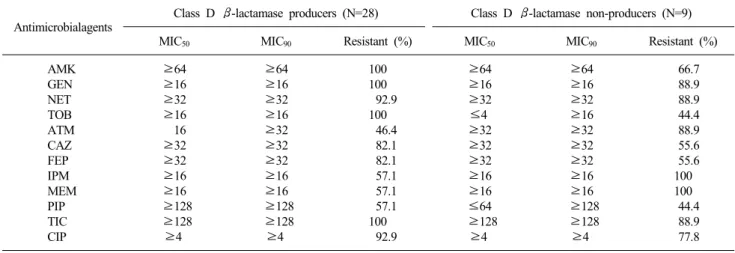
Table 4. Comparison of the antimicrobial resistance (%) between the class D β-lactamase producers and non-producers
Antimicrobialagents Class D β-lactamase producers (N=28) Class D β-lactamase non-producers (N=9)
MIC50 MIC90 Resistant (%) MIC50 MIC90 Resistant (%)
AMK GEN NET TOB ATM CAZ FEP IPM MEM PIP TIC CIP
≥64
≥16
≥32
≥16 16
≥32
≥32
≥16
≥16 ≥128 ≥128 ≥4
≥64
≥16
≥32
≥16
≥32
≥32
≥32
≥16
≥16 ≥128 ≥128 ≥4
100 100 92.9
100 46.4 82.1 82.1 57.1 57.1 57.1 100 92.9
≥64
≥16
≥32 ≤4
≥32
≥32
≥32
≥16
≥16
≤64 ≥128 ≥4
≥64
≥16
≥32
≥16
≥32
≥32
≥32
≥16
≥16 ≥128 ≥128 ≥4
66.7 88.9 88.9 44.4 88.9 55.6 55.6 100 100 44.4 88.9 77.8 Abbreviations : See Table 2.
Fig. 1. ERIC-PCR patterns of genomic DNA from clinical isolates of multi-drug resistant Pseudomonas aeruginosa harboring blaOXA-10. Lane M is 1 kb DNA size marker. Nineteen strains of OXA-10 β-lactamase producing clinical isolates show A or B pattern.
Ambler class D β-lactamase 유전자 검출을 위해 총 37주의 다제내성 녹농균을 대상으로 PCR을 한 결과 blaOXA-1 blaOXA-2
그리고 blaOXA-10에 대해 각각 2주(5.4%), 7주(18.9%) 및 20주 (54.1%)가 양성반응을 보였다. 이 중 한 주(P17)는 blaOXA-2과 blaOXA-10에 동시에 양성반응을 보였으며, blaOXA-10에 양성반응 을 보인 20주 중에는 blaIMP에 양성을 보인 P23주가 속해있었 다. 그 외 class D에 속하는 blaOXA-23, blaOXA-24 및 blaOXA-58에 대 해서는 대상 균주 모두 음성반응을 보였다. Ambler class A에 속하는 ESBL (blaSHV, blaTEM, blaPER, blaVEB, blaGES)을 검출하 기 위한 PCR에는 양성반응을 보인 균주가 한 주도 없었다 (Table 3).
대상 균주 중 blaIMP유전자 증폭산물은 IMP-1 유전자의 염기 서열과 일치하였다. blaOXA-1, blaOXA-2 및 blaOXA-10 유전자 증폭 산물의 염기서열은 각각 blaOXA-1, blaOXA-2 및 blaOXA-10 유전자 와 염기서열이 일치하였다.
4. Class D β-lactamase 생성균주에 대한 항균제 MIC 특성 OXA형 β-lactamase를 생성하는 균주들이 OXA형 β-lacta- mase를 생성하지 않는 균주들 보다 aminoglycoside계 항균제 (amikacin, gentamicin, netilmicin, tobramycin)와 cephalosporin
계 항균제(ceftazidime 및 cefepime)에 대한 내성율이 각각 평균 26.0%와 26.5% 높았다. 또한 quinolone계 항균제(ciprofloxa- cin)에 대해서도 내성율이 15.1% 높은 것으로 나타났다 (Table 4).
5. ERIC PCR에 의한 역학적 연관성 조사
OXA-10 β-lactamase를 생성하는 녹농균 19주를 대상으로 ERIC PCR을 시험한 결과 1500 bp에서 굵은 밴드를 보인 A 형과 2000 bp 이하의 밴드 여섯 개를 보인 B형이 관찰되었 다(Fig. 1).
고 찰
β-lactam 제제는 가장 널리 사용되고 있는 항균제 중 하나 로, penicillin, cephalosporin, monobactam 및 carbapenem등 다 양한 계열로 분류되며, 현재 150가지 이상의 β-lactam계 항균 제가 임상에서 사용되고 있다[34]. 그러나 이러한 항균제 사용 의 증가는 내성세균의 양산이라는 부작용을 동반하였으며, 이 들 내성세균의 치료를 위해서 새로운 항균제를 개발하여야 하 는 악순환이 되풀이 되어왔다.
그람음성 간균의 β-lactam항균제에 대한 내성은 주로 β-la- ctam항균제를 가수분해하는 β-lactamase 생성에 의해 나타나 는데 특히 획득성 β-lactamase 유전자는 plasmid나 integron에 위치하는 경우가 많아 항균제 내성 유전자의 수평전달을 유도 하여 항균제 내성을 급격히 확산시키는 요인이 된다.
본 연구에서는 다제내성 녹농균을 대상으로 획득성 β-lacta- mase의 유전형을 분석하였는데 검출된 β-lactamase의 대부분 이 class D인 OXA형 β-lactamase들이었다. OXA형 β-lactama- se는 oxacillin과 cloxacillin에 대해 강한 활성을 가지는 효소로 녹농균에서 빈번하게 검출되며, 이 효소로부터 유래한 ESBL을 생성하는 세균은 oxyimino cephalosporins에 대해 내성을 갖는 다[35]. 본 연구에서는 narrow-spectrum β-lactamase인 OXA- 10이 가장 높은 빈도(51.4%)로 검출되었으며 그 다음으로 OXA-2 β-lactamase (13.5%)가 많았다. 반면 OXA형 ESBL은 하나도 검출되지 않았다. 2005년도에 국내에서 분리된 녹농균 을 대상으로 조사한 결과에서도[9] class A β-lactamase들에 비 해 class D OXA β-lactamase들이 빈번하게 검출이 되었고 그 중 OXA-10의 검출율이 제일 높았으며(13.5%) 그 다음으로 OXA-4 (4.4%), OXA-2 (2.3%) 및 OXA-30 (2.0%)이었다. 반면 대상균주 중 1주(0.3%)만이 OXA형 ESBL을 생성하여 본 연구 와 유사한 결과를 보였다. 2005년 터키에서도 녹농균을 대상으 로 OXA형β-lactamase들의 빈도를 조사한 결과 OXA-10 β- lactamase의 빈도가 가장 높았던 반면 OXA형 ESBL은 검출되 지 않았다고 했다[36]. 그러나 2006년에 대만에서 분리된 OXA 형 β-lactamase들을 생성하는 녹농균의 경우 OXA형 ESBL인 OXA-17을 가장 많이 생성했으며 최근 들어 그 비율이 감소하 고 있는 중이라고 했다[37]. 녹농균에서 OXA형 β- lactamase 의 분리양상은 지역적, 시간적으로 차이를 보이며 국내에서는 OXA형 ESBL의 검출율이 비교적 낮은 것으로 나타났다.
OXA형 β-lactamase 생성주를 대상으로 항균제의 MIC 측정 결과 대상 항균제 중 aztreonam과 carbapenem계 항균제를 제외 한 대부분의 항균제에 대해 높은 내성율을 보였다. 특히 ami- noglycoside계 항균제에 대한 내성율은 다른 항균제들에 비해 월등하게 높았는데 이는 2006년도에 대만에서[38] 분리된 녹농 균에서 보여진 결과와 일치하였다. 또한 국내에서도 class D β- lactamase를 생성하는 녹농균의 경우 aminoglycoside와 quino- lone계 항균제에 대해 교차내성을 보인다는 보고가 있다[9].
가장 높은 빈도로 검출된 OXA-10 β-lactamase 생성주를 대 상으로 역학적 연관성을 조사하기 위해 ERIC PCR을 실행한 결과 두 개의 pattern이 관찰되었다. 총 19주 중 5주가 A형을 나타냈으며 나머지 14주가 B형을 나타내었는데 이 결과는 이 들이 각각 동일한 감염원에서 유래되었음을 추측하게 한다.
다제내성 녹농균이 생성하는 획득성 β-lactamase중 가장 높 은 빈도를 차지한 것이 OXA형 β-lactamase인 반면 carbapene- mase에 속하는 OXA-23, OXA-24, 및 OXA-58 β-lactamase는
검출되지 않았다. 이들 OXA형 carbapenemase는 Acinetobacter baumannii에서는 흔히 생성되는 것으로 알려져 있고 국내에서 도 많이 보고가 되었으나[19] 녹농균에서는 드물게 보고가 되 고 있다. 국내에서는 2005년에 OXA-23 β-lactamase가 처음으 로 녹농균에서 분리된 바 있다[20].
본 연구에서 분리된 획득성 β-lactamase중에 class A에 속하 는 β-lactamase는 발견되지 않았다. 2006년도에 국내에서 처음 으로 SHV-12 β-lactamase를 생성하는 녹농균이 보고되었으나 [39] 그 이외의 class A에 속하는 β-lactamase는 보고된 적이 없다. 녹농균이 TEM형 혹은 SHV형 ESBL을 생성하는 경우는 드문 것으로 알려졌는데, 이는 이들 세균이 광범위 β-lactam 항 균제에 대한 내성을 획득하는데 plasmid성 TEM형 혹은 SHV 형 ESBL을 생성하는 것보다 탈억제에 의해서 염색체성 cepha- losporinase를 과량 생성하는 것이 더 손쉬운 방법이고[40], 또 한 이들 세균이 class D의 OXA형 ESBL을[37] 흔히 생성하기 때문에 TEM 혹은 SHV형 ESBL의 필요성이 장내세균에 비해 상대적으로 낮기 때문인 것으로 추측한다.
한편, IPD방법을 이용한 MBL 생성검사에서 P23만이 양성 반응을 보였고 이 균주가 IMP-1형 MBL을 생성함이 밝혀졌다.
일본에서는 IMP-1을 생성하는 그람음성세균의 분리가 흔한 것 으로 알려진데 반하여[41], 국내에서의 IMP-1 생성균주의 분리 는 흔하지 않았으나 2005년 Yoon 등에 의해 IMP-1형 MBL이 imipenem에 내성인 녹농균 사이에서 확산되고 있음이 보여졌 다[20]. 본 연구에서는 총 37주의 다제내성 녹농균중 1주만이 MBL을 생성하였는데, 이는 다제내성의 원인이 MBL 생성에 이외의 다른 요인들에 의한 것임을 추측하게 한다[9]. 최근 일 본에서 다제내성 녹농균을 대상으로 분자생물학적 특성을 조 사한 결과에 의하면 다제내성이 MBL 및 RND 유출펌프 생성 에 의해 유도되기도 하지만 그 보다는 오히려 더 많은 경우가 porin단백의 발현 감소 및 염색체성 cephalosporinase를 과량생 성과 같은 다른 기전들에 의해 유도된다고 했다[42]. 본 연구에 서도 이를 뒷받침하는 결과를 보여주었다.
이상의 결과에서 충청지역의 한 대학병원에서 분리된 다제 내성 녹농균에 가장 광범위하게 확산되어 있는 획득성 β-lacta- mase는 OXA 형 β-lactamase임을 확인하였다. 또한 OXA 형 β-lactamase 유전자가 aminoglycoside 또는 quinolone계통의 항균제에 대한 내성유전자와 동시에 존재 할 수 있음을 시사했 다. 그러나 본 연구에서 검출된 β-lactamase는 모두 narrow spectrum의 β-lactamase이었으며 P23균주를 제외하고는 carba- penemase도 검출되지 않았다. 이는 녹농균의 다제내성이 획득 성 β-lactamase 생성보다는 그 이외의 다른 요인들 즉 염색체 성 cephalosporinase의 과량생성, 항균제의 유출(efflux), 또는 porin단백의 발현 감소로 인한 세포막의 투과성 감소 등에 의 해 유도되는 것임을 추측하게 한다. 따라서 다제내성 녹농균의 내성기전을 밝히기 위해서는 추가적인 연구가 필요할 것이다.
감사의 글
본 연구는 산업자원부 지방기술혁신사업의 지역 R&D 클러 스터사업(B000935) 지원으로 수행되었음.
참 고 문 헌
1. Bergogne-Berezin E. Pseudomonas and miscellaneous gram- negative bacilli. In: Cohen J and Powerly WG, eds. Infectious Diseases. 2nd ed, New York; Mosby, 2003;2203-17.
2. Song W, Woo HJ, Kim JS, Lee KM. In vitro activity of β-lactams in combination with other antimicrobial agents against resistant strains of Pseudomonas aeruginosa. Int J Antimicrob Agents 2003;21:8-12.
3. Lee K, Park KH, Jeong SH, Lim HS, Shin JH, Yong D, et al., KONSAR group. Further increase of vancomycin-resistant Enterococcus faecium, amikacin- and fluroquinolone-resistant Klebsiella pneumoniae, and imipenem-resistant Acinetobacter spp.
in Korea: 2003 KONSAR surveillance. Yonsei Med J 2006;47:43-54.
4. McGowan JE Jr. Resistance in nonfermenting gram-negative bacteria: multidrug resistance to the maximum. Am J Infect Control 2006;34:S29-S37.
5. Weldhagen GF, Poirel L, Nordmann P. Ambler class A extended spectrum β-lactamases in Pseudomonas aeruginosa: novel developments and clinical impact. Antimicrob Agents Chemother 2003;47:2385-92.
6. Poirel L, Naas T, Guibert M, Chaibi EB, Labia R, Nordmann P.
Molecular and biochemical characterization of VEB-1, a novel class A extended-spectrum β-lactamase encoded by an Escherichia coli integron gene. Antimicrob Agents Chemother 1999;43:573-81.
7. Nordmann P, Ronco E, Naas T, Duport C, Michel-Briand Y, Labia R. Characterization of a novel extended-spectrum β-lactamase from Pseudomonas aeruginosa. Antimicrob Agents Chemother 1993;37: 962-9.
8. Chen HY, Yuan M, Livemore DM. Mechanisms of resistance to β- lactam antibiotics amongst Pseudomonas aeruginosa isolates collected in the UK in 1993. J Med Microbiol 1995;43:300-9.
9. Lee S, Park YJ, Kim M, Lee HK, Han K, Kang CS, et al.
Prevalence of Ambler class A and D β-lactamases among clinical isolates of Pseudomonas aeruginosa in Korea. J Antimicrob Chemother 2005;56:122-7.
10. Poirel L, Weldhagen GF, Naas T, De Champs C, Dove MG, Nordmann P. GES-2, a class A β-lactamase from Pseudomonas aeruginosa with increased hydrolysis of imipenem. Antimicrob Agents Chemother 2001;45:2598-603.
11. Watanabe M, Iyobe S, Inoue M, Mitsuhashi S. Transferable imipenem resistance in Pseudomonas aeruginosa. Antimicrob Agents Chemother 1991;35:147-51.
12. Riccio ML, Franceschini N, Boschi L, Caravelli B, Cornaglia G, Fontana R, et al. Characterization of the metallo-β-lactamase determinant of Acinetobacter baumannii AC-54/97 reveals the existence of blaIMP allelic variants carried by gene cassettes of different phylogeny. Antimicrob Agents Chemother 2000;44:
1229-35.
13. Lauretti L, Riccio ML, Mazzariol A, Cornaglia G, Amicosante G, Fontana R, et al. Cloning and characterization of blaVIM, a new
integron-borne metallo-β-lactamase gene from a Pseudomonas aeruginosa clinical isolate. Antimicrob Agents Chemother 1999;43:
1584-90.
14. Lee K, Lim JB, Yum JH, Yong D, Chong Y, Kim JM, et al.
blaVIM-2 cassette-containing novel integrons in metallo-β-lac- tamase-producing Pseudomonas aeruginosa and Pseudomonas putida isolates disseminated in a Korean hospital. Antimicrob Agents Chemother 2002;46:1053-8.
15. Toleman MA, Simm AM, Murphy TA, Gales AC, Biedenbach DJ, Jones RN, et al. Molecular characterization of SPM-1, a novel metallo-β-lactamase isolated in Latin America: report from the SENTRY antimicrobial surveillance programme. J Antimicrob Chemother 2002;50:673-9.
16. Castanheira M, Toleman MA, Jones RN, Schmidt FJ, Walsh TR.
Molecular characterization of a β-lactamase gene, blaGIM-1, encoding a new subclass of metallo-β-lactamase. Antimicrob Agents Chemother 2004;48:4654-61.
17. Lee K, Yum JH, Yong D, Lee HM, Kim HD, Docquier JD, et al.
Novel acquired metallo-β-lactamase gene, bla(SIM-1), in a class 1 integron from Acinetobacter baumannii clinical isolates from Korea. Antimicrob Agents Chemother 2005;49:4485-91.
18. Donald HM, Scaife W, Amyes SG, Young HK. Sequence analysis of ARI-1, a novel OXA β-lactamase, responsible for imipenem resistance in Acinetobacter baumannii 6B92. Antimicrob Agents Chemother 2000;44:196-9.
19. Bou G, Oliver A, Martinez-Beltran J. OXA-24, a novel class D β- lactamase with carbapenemase activity in an Acinetobacter baumannii clinical strain. Antimicrob Agents Chemother 2000;44:
1556-61.
20. Yoon WS, Lee BY, Bae IK, Kwon SB, Jeong SH, Jeong TJ, et al.
Prevalence of imipenem-resistant Pseudomonas aeruginosa isolates and mechanisms of resistance. Korean J Clin Microbiol 2005;8:
26-33.
21. Timurkaynak F, Can F, Azap OK, Demirbilek M, Arslan H, Karaman SO. In vitro activities of non-traditional antimicrobials alone or in combination against multidrug-resistant strains of Pseudomonas aeruginosa and Acinetobacter baumannii isolated from intensive care units. Int J Antimicrob Agents 2006;27:224-8.
22. Clinical and Laboratory Standards Institute. Performance standards for antimicrobial susceptibility testing; sixteenth informational supplement. M100-S10(M2). Wayne, Pensylvania; CLSI, 2006.
23. Oh EJ, Lee S, Park YJ, Park JJ, Park K, Kim SI, et al. Prevalence of metallo-β-lactamase among Pseudomonas aeruginosa and Acinetobacter baumannii in a Korean university hospital and comparison of screening methods for detecting metallo-β-lac- tamse. J Microbiol Methods 2003;54:411-8.
24. Kang JH, Bae IK, Kwon SB, Jeong SH, Lee J, Lee WG, et al.
Prevalence of ambler class A extended-spectrum β-lactamase- producing Escherichia coli and Klebsiella pneumoniae isolates in Korea. Korean J Clin Microbiol 2005;8:17-25.
25. Naas T, Benaoudia F, Massuard S, Nordmann P. Integron-located VEB-1 extended-spectrum β-lactamase gene in a Proteus mirabilis clinical isolate from Vietnam. J Antimicrob Chemother 2000;
46:703-11.
26. Park JH, Lee SH, Jeong SH, Kim BN, Kim KB, Yoon JD, et al.
Characterization and prevalence of Escherichia coli and Klebsiella pneumoniae isolates producing an extended spectrum β-lactamase from Korean hospitals. Korean J Lab Med 2003;23:18-24.
27. Jeon BC, Jeong SH, Bae IK, Kwon SB, Lee K, Young D, et al.
Investigation of a nosocomial outbreak of imipenem-resistant Acinetobacter baumannii producing the OXA-23-β-lactamase in
Korea. J Clin Microbiol 2005;43:2241-5
28. Aubert D, Poirel L, Chevalier J, Leotard S, Pages JM, Nordmann P. Oxacillinase-mediated resistance to cefepime and susceptibility to ceftazidime in Pseudomonas aeruginosa. Antimicrob Agents Chemother 2001;45:1615-20.
29. De Champs C, Poirel L, Bonnet R, Sirot D, Chanal C, Sirot J, et al. Prospective survey of β-lactamases produced by ceftazidime- resistant Pseudomonas aeruginosa isolated in a French hospital in 2000. Antimicrob Agents Chemother 2002;46:3031-4.
30. Heritier C, Dubouix A, Poirel L, Marty N, Nordmann P. A nosocomial outbreak of Acinetobacter baumannii isolates ex- pressing the carbapenem-hydrolysing oxacillinase OXA-58. J Antimicrob Chemother 2005;55:115-8.
31. Mendes RE, Kiyota KA, Monteiro J, Castanheira M, Andrade SS, Gales AC, et al. Rapid detection and identification of metallo-β- lactamase-encoding genes by multiplex real-time PCR assay and melt curve analysis. J Clin Microbiol 2007;45:544-7.
32. Versalovic J, Koeuth T, Lupski JR. Distribution of repetitive DNA sequences in eubacteria and application to fingerprinting of bacterial genomes. Nucleic Acids Res 1991;19:6823-31.
33. Park KO, Son HC, Bae IK, Jeong SH. Molecular epidemiology of infection caused by OXA-23 or IMP-1 β-lactamase-producing Acinetobacter baumannii. Korean J Lab Med 2005;8:121-9.
34. Yao JDC and Moellering RC Jr. Antibacterial agents. In: Murray PR, Baron EJ, et al, eds. Manual for Clinical Microbiology. 7th ed.
Washington: American Society for Microbiology, 1999;1474-504.
35. Danel F, Hall LM, Duke B, Gur D, Livermore DM. OXA-17, a further extended-spectrum variant of OXA-10 β-lactamase, isolated
from Pseudomonas aeruginosa. Antimicrob Agents Chemother 1999;43:1362-6.
36. Aktaş Z, Poirel L, Salcioğlu M, Ozcan PE, Midilli K, Bal C, et al.
PER-1- and OXA-10-like β-lactamases in ceftazidime-resistant Pseudomonas aeruginosa isolates from intensive care unit patients in Istanbul, Turkey. Clin Microbiol Infect 2005;11:193-8.
37. Poirel L, Girlich D, Naas T, Nordmann P. OXA-28, an extended-spectrum variant of OXA-10 β-lactamase from Pseudomonas aeruginosa and its plasmid- and integron-located gene. Antimicrob Agents Chemother 2001;45:447-53.
38. Yan JJ, Tsai SH, Chuang CL, Wu JJ. OXA-type β-lactamases among extended-spectrum cephalosporin-resistant Pseudomonas aeruginosa isolates in a university hospital in southern Taiwan. J Microbiol Immunol Infect 2006;39:130-4.
39. Oh SJ, Lee SU, Hwang HY, Bae IK, Jo HS, Lee BH, et al.
Prevalence of class a extended-spectrum β-lactamases in clinical isolates of Acinetobacter baumannii and Pseudomonas aeruginosa.
Korean J Lab Med 2006;26:14-20.
40. Nordmann P and Guibert M. Extended-spectrum β-lactamases in Pseudomonas aeruginosa. J Antimicrob Chemother 1998;42:128-31.
41. Ito H, Arakawa Y, Ohsuka S, Wacharotayankun R, Kato N, Ohta M. Plasmid-mediated dissemination of the metallo-β-lactamase gene blaIMP among clinically isolated strains of Serratia marcescens. Antimicrob Agents Chemother 1995;39:824-9.
42. Ohara M, Kouda S, Onodera M, Fujiue Y, Sasaki M, Kohara T, et al. Molecular characterization of imipenem-resistant Pseudomonas aeruginosa in Hiroshima, Japan. Microbiol Immunol 2007;51:
271-7.
=국문초록=
임상검체에서 분리된 다제내성 녹농균의 획득성 β-lactamase 유전형 특성
1삼성서울병원 건강의학센터, 2충남대학교 의과대학 진단검사의학교실 정선양1, 성지연2, 권계철2, 박종우2, 고지선2, 신소연2, 송정훈2, 구선회2
배경: 최근 cefepime이나 carbapenem계 항균제에도 내성을 보이는 다제내성 녹농균이 증가하고 있다. 저자들은 충청지역 에서 분리된 다제내성 녹농균을 대상으로 Ambler class A, B 그리고 D 에 속하는 β-lactamase와 그들의 광범위 활성 유도 체의 빈도를 조사하고 대표적인 유전형들을 규명하고자 하였다.
방법: 2006년 3월부터 2007년 5월까지 충남대학교 병원 환자의 임상검체에서 분리된 다제내성 녹농균을 대상으로 하였 다. Metallo-β-lactamase (MBL) 생성은 inhibitor-potentiated disk diffusion 시험으로 확인하였으며 Ambler Class A, B, 그리 고 D에 해당하는 β- lactamase 유전자를 검출하기 위해 중합연쇄반응과 염기서열 분석을 하였다. 또한 돌발감염이 있었 는지를 알아보기 위해서 enterobacterial repetitive intergenic consensus (ERIC)-PCR을 수행하였다.
결과: 시험기간 중 총 37주의 다제내성 녹농균이 환자의 임상검체에서 분리되었다. 37주의 녹농균 중 29주가 blaOXA-10
(56.8%), blaOXA-2 (18.9%), 또는 blaOXA-1 (5.4%)를 가지고 있는 것으로 나타났다. IMP-1을 생성하는 균주는 단 한 주였으며 blaOXA-1도 가지고 있었다. Ambler class A β-lactamase와 class D carbapenemase는 검출되지 않았다. OXA형 β-lactamase를 가지고 있는 균주의 경우 그렇지 않은 균주 보다 aminoglycoside계 항균제에 대한 내성율이 더 높은 것으로 나타났다.
ERIC-PCR 결과 OXA-10을 생성하는 19주는 유전적으로 매우 밀접한 것으로 나타났다.
결론: 충청지역의 한 대학병원에서 분리된 다제내성 녹농균에 가장 광범위하게 확산되어 있는 획득성 β-lactamase는 OXA형 β-lactamase였다. 그리고 OXA형 β-lactamase를 갖고 있는 균주들은 β-lactam계 항균제뿐 아니라 aminoglycosie 계 항균제와 qunolone계 항균제등에 대해 내성 높은 내성율을 보였다. [대한임상미생물학회지 2008;11:98-106]
교신저자 : 구선회, 301-721, 대전광역시 중구 대사동 640 충남대학병원 진단검사의학과
Tel: 042-280-7798, Fax: 042-257-5365 E-mail: [email protected]