Characteristics and Antibiotic Susceptibility of Imipenem-Resistant Clinical Isolates Producing Carbapenemase
Han Na Choe1, Chul Park1,2, Hyung Rak Kim1,2, Keun Sik Baik1, Se Na Kim1,3 and Chi Nam Seong1*
1Department of Biology, Sunchon National University, Suncheon 540-742, Korea
2Department of Laboratory Medicine, Saint Garlo Medical Center, Suncheon 540-718, Korea
3Korea Basic Science Institute Sunchon Center, Suncheon 540-742, Korea Received May 28, 2010 /Accepted July 20, 2010
Imipenem-resistant bacteria were isolated from clinical specimens taken from hospitalized patients in Suncheon, Korea. Fifty-four isolates were phylogenetically analyzed based on 16S rRNA gene and gyrB gene sequence comparisons. Isolates were affiliated with Pseudomonas aeruginosa (30 strains;
55.6%), Acinetobacter baumannii (21; 38.9%), Enterobacter hormaechei (2) and Pseudomonas putida (2).
Twenty-two isolates produced metallo-β-lactamase (MBL); 12 Acinetobacter baumannii strains, 7 Pseudomonas aeruginosa strains, 2 P. putida strains and 1 Enterobacter hormaechei strain. Antibiotic sus- ceptibility of the isolates was determined using the disc diffusion method and Vitek system. Strains producing metallo-β-lactamase (type IMP & VIM) were more resistant to antibiotics ceftazidime, az- treonam, amikacin and gentamicin than to strains producing OXA and SHV type of β-lactamase.
Key words : Imipenem-resistant, 16S rRNA gene, Acinetobacter baumannii, metallo-β-lactamase, antibiotic susceptibility
*Corresponding author
*Tel:+82-61-750-3613, Fax:+82-61-750-5459
*E-mail : [email protected]
서 론
Carbapenem은 세포 투과성이 높아 β-lactam제에 내성인 세균에 의한 감염 치료에 유용하게 사용되어 왔다[6,18]. 그러 나 최근 carbapenem 의 사용이 빈번해지면서 Pseudomonas aeruginosa, Acinetobacter baumannii, Serratia marcescens 및 Enterobacter cloacae 등에서 carbapenemase 를 생산하는 세균 의 분리가 증가하고 있다. 이 항생제에 대한 내성 기작은 세포 막의 penicillin binding protein (PBP)의 변화, 항생제의 투과 성 감소 그리고carbapenemase에 의한 항생제의 불활성화 등 이 있는데, 이중에 가장 중요한 것은 미생물들이 carbapene- mase를 생산하여 carbapenem을 불활성화 시키는 것이다[16].
Carbapenemase에는 class A, B, D 등이 있으며 이 중 효소 활성이 가장 높은 것은 class B이며 효소의 활성을 위해 zinc와 같은 금속 이온이 필요하기 때문에 metallo-β-lactamase (MBL)로 명명되었다[20].
현재까지 MBL은 전 세계적으로 5종류(IMP, plasmid- mediated metallo-β-lactamase; VIM, Verona integron-en- coded metallo-β-lactamase; SPM, São Paulo metallo-β -lactamase; GIM, metallo-β-lactamase GIM; SIM, metallo-β -lactamase SIM)의 유전자형이 보고 되었으며[2,14,15,23] 그 중 가장 많은 변이형은 IMP와 VIM 유전자형으로 각각 17개와 10개의 변이형이 보고 되었다[4]. 그 중에서도 VIM-2형과
IMP-1형이 Pseudomonas와 Acinetobacter 에서 주로 분리되고 있으며 국내 또한 분리된 대부분의 MBL 유전형은 VIM-2 형 이며, IMP-1 형도 보고되고 있다[10,12].
Carbapenem계 항생제 중 가장 먼저 개발된 대표적인 항생 제가 imipenem이다. Imipenem에 내성을 지닌 미생물의 출현 은 1985년 영국에서 원내 감염균인A. baumannii[17]가 처음으 로 보고되었으며 이후P. aeruginosa[19]를 비롯한 다른 종 들이 출현하였으며 최근에는 전 세계적으로 내성 미생물의 분리 빈도가 증가하고 있다.
본 연구는 2007년 3월부터 2008년 2월까지 순천 S병원의 환자 검체로부터 imipenem에 내성을 지닌 세균을 분리하여 동정을 하였다. 그리고, 분리균의 β-lactamase유전형의 분석 과 항생제에 대한 내성 양상을 조사하였다.
재료 및 방법 Imipenem 내성 균주 분리
2007년 3월부터 2008년 2월까지 병원 환자 검체로부터 우점 하는 그람음성 간균들을 분리하였다. 분리된 균주들은 디스크 확산법으로 imipenem에 내성인 균주를 일차선별하고 다시 Vitek 32 (bioMeriex, France)를 이용하여 imipenem의 MIC가 16 μg/ml 이상임을 확인 한 후 동일 환자로부터 반복 분리된 균주를 제외한 54 균주를 실험에 사용하였다. 미생물 분리와 디스크 확산법의 실시는 Mueller Hinton II 한천(MHA;
Becton Dickinson) 배지를 이용하여 37oC 에서 16-18시간 배양 하여 사용하였다.
Fig. 1. Detection of β-lactamase genotype from clinical isolates. M, 1 kb plus DNA ladder; Lanes 1, A. baumannii IR128 (IMP);
2,A. baumannii IR127 (VIM); 3,A. baumannii IR144 (IMP); 4,A. baumannii IR146 (IMP); 5, P. monteiliiIR105 (VIM); 6,A.
baumanniiIR151 (IMP); 7,A. baumanniiIR125 (OXA-23); 8,P. putidaIR111 (VIM); 9,P. aeruginosaIR139 (IMP); 10,A. baumannii IR153 (IMP); 11, P. aeruginosaIR108 (SHV); 12, E. hormaechei IR156 (OXA-1); 13, E. hormaechei IR156 (IMP).
생화학적 특성을 이용한 세균 동정
순수 분리된 세균의 동정은 TSI (triple sugar iron) 시험과, 황화수소 생성능, indol생성능, 운동성 유무와, MR (methyl red) 반응, VP (Vogas-Proskauer) 반응, citrate 이용능과 oxi- dase 시험을 실시하였다[11,22]. 그리고 Vitek 32 GNI kit를 이용하여 동정을 실시하였다. MHA 배지에 자란 세균 집락을 0.45% (w/v) 식염수에 혼탁하여 GNI 카드에 접종한 후 배양 시켰다. 1시간 간격으로 균의 증식을 확인 하며 반응 결과를 Vitek 32의 database를 이용하여 세균을 동정 하였다.
DNA 추출
MHA배지에 자란 세균집락 1 loop를 Lysis buffer [10 mM Tis-HCl (pH 8.0), 1 mM EDTA, 10 mM NaCl, 2% SDS] 100 μl와 2 small spoon의 glass bead (size: 0.4 mm) 혼합체에 넣고 10분간 TOMY mixer (TOMY, USA)에 혼합하였으며, 1× TE buffer 200 μl와 phenol : chloroform : isoamyl alcohol (25:24:1) 300 μl를 넣고, 3분간 TOMY mixer에 다시 혼합 한 후 원심분리 (12,000 rpm, 4 min)하였다. 상등액을 새로운 tube 에 옮긴 후 RNase A (20 mg/ml) 3 μl을 넣고 37oC에 30분간 배양하였고, 0.1 volume의 3 M sodium acetate (pH 5.2)와 2 volume의 100% ice ethanol을 넣고 DNA를 침전 시킨 후 원심분리(12,000 rpm, 10 min, 4oC) 하였다. 차가운 70% etha- nol로 세척 한 후 건조하여 멸균된 증류수에 녹여 실험에 사용 할 때까지 -20oC에 냉동 보관하였다.
계통분류학적 연구
16S rRNA 유전자를 증폭하기 위해 27F (5'-AG AGTTT GATCMTGGCTCAG-3')와 1492R (5'-GGYTACCT TGTTA CGACTT-3') primer를 사용하였다[4]. PCR 반응액의 조성 및 증폭조건은 Baik [1]의 방법을 이용하였다. DNA gyrase (gyrB) 유전자를 증폭하기 위해 UP-1 (5'-GAA GTC ATC ATG ACC GTT CTG CAY GCN GGN GGN AAR TTY-3')와 UP-2r (5'-AGC AGG GTA CGG ATG TGC GCC RTC NAC RTC NGC RTC NGT CAT-3') primer 를 사용하였다[25]. PCR 반응
액의 조성 및 증폭 조건은 Yamamoto 등[25]의 방법으로 PCR thermal cycler TP600 (TAKARA Bio Inc., Japan)을 이용하여 증폭하였다. 염기서열 분석은 제노텍(Korea)에 의뢰하였다.
결정된 16S rRNA 유전자와gyrB 유전자 염기서열의 종간 유사도는 BLAST을 이용하여 GenBank 데이터베이스와 비교 ㆍ검색하였다. 계통수 작성은 neighbor-joining[21]방법을 이 용하였으며 진화거리는 Jukes와 Cantor [9]의 식을 이용하였 다. 계통수의 신뢰도는1000 회 반복을 통한 bootstrap 분석[7]
을 실시하여 확인하였다.
항생제 감수성 검사
분리균의 항생제 감수성 조사는 각각의 항생제가 함유된 디스크(Table 4)를 사용하여 실시하였다. McFarland 0.5관에 맞춘 세균현탁액을 MHA배지에 접종한 후 항생제 디스크를 올려놓고 37oC 에서 16-18시간 배양한 후 억제대의 직경을 측 정하였다. 감수성, 중간내성, 저항성 기준은 CLSI [3] 기준으로 하였으며 매 시험마다 대조 균주로 Pseudomonas aeruginosa ATCC 27853를 사용하였다. 항생제의 최소억제 농도 측정은 Vitek GNS-433 card (bioMeriex, France)로 측정 하였다.
Metallo-β-lactamase (MBL) 검증
분리균이 MBL을 생성하는지 여부는 Hodge 변법과 imipe- nem-EDTA 디스크 상승 효과 시험을 통해 확인하였다.
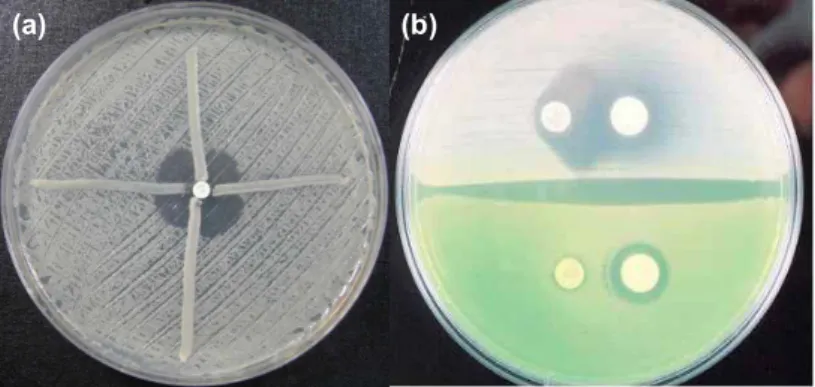
Hodge 변법의 시험은 다음과 같다.E. coli ATCC 2592를 생리 식염수에 희석하여 McFarland 0.5관 탁도로 맞추어 MHA평 판배지에 접종하였다. 물기가 마른 후 배지 중앙에imipenem 디스크를 올려놓은 후 중앙으로부터 배지 접시 가장 자리를 향해 시험 세균을 획선 접종 하였다. 37oC에서 16-20시간 배양 하여 시험 균주 접종 선 중앙쪽 말단부가 다른 부위에 비해 더 넓게 증식 되면 양성으로 판정 하였다[12] (Fig. 2a).
Imipenem-EDTA 디스크 상승 효과 시험에서는 시험 균주 를 생리식염수에 McFarland 0.5관 탁도로 맞추어 MHA배지 에 접종한 후 10 μg imipenem 디스크와 0.5 mM EDTA 10 μl가 함유된 디스크를 10 mm 거리가 되게 올려놓고 16-18시간
(a) (b) Fig. 2. Modified Hodge test (a) and EDTA double disk synergy test (b). (a): Upper and right are imipenem-hydrolyzing strains which dis- torted the inhibition zone. Left and low are imipenem-non-hydrolyzing strains with no effect on the zone (negative control). (b): The right disc contains 5 mM EDTA and the left disc contains 10 μg imipenem. Upper is MBL producing strain. Lower is non-MBL produc- ing strain.
Table 1. Primers used for sequencing of the β-lactamasegene and for detection of MBL genes
Class Primer Sequence (5'→3') Target
β-lactamase Amplicon size (bp) A SHV-FSHV-R CCG GGT TAT TCT TAT TTG TCG CTTAG CGT TGC CAG TGC TCG SHV-1 & derivative 831 B
IMP-F GCT ACC GCA GCA GAG TCT TTG IMP 657
IMP-R CCT TTA ACC GCC TGC TCT AAT G
VIM-F GTT TGG TCG CAT ATC GCA AC VIM 581
VIM-R AGA CCG CCC GGT AGA CC
D
OXA-1F AGC CGT TAA AAT TAA GCC C OXA-1 908
OXA-1R CTT GAT TGA AGG GTT GGG CG
OXA-2F GCC AAA GGC ACG ATA GTT GT OXA-2 700
OXA-2R GCG TCC GAG TTG ACT GCC GG
OXA-10F TCT TTC GAG TAC GGC ATT AGC OXA-10 760
OXA-10R CCA ATG ATG CCC TCA CTT TCC
OXA-23F GAT GTG TCA TAG TAT TCG TCG OXA-23, 27, 49 1058
OXA-23R TCA CAA CAA CTA AAA GCA CTG
OXA-24F GTA CTA ATC AAA GTT GTG AA OXA-24, 25, 26, 40, 72 825
OXA-24R TTC CCC TAA CAT GAA TTT GT
OXA-58F CGA TCA GAA TGT TCA AGC GC OXA 58 528
OXA-58R ACG ATT CTC CCC TCT GCG C
Abbrivation: F, forward; R, reverse.
동안 배양한 후 억제대의 확장현상이 관찰되면 양성으로 판정 하였다[12] (Fig. 2b).
PCR을 이용한 β-lactamase 유전자형 분석
β-Lactamase 유전자형을 검사하기 위해 기존에 알려진 pri- mer를 이용(Table 1)하여 PCR로 증폭하였다[13]. PCR 반응액 은 dNTP (각 2.5mM), MgCl22 mM, primer 각 20 pmol,Taq DNA polymerase (Bioneer, Korea) 0.5 U, genomic DNA 100 ng및 반응완충용액(10 mM Tris-HCl, 40 mM KCl, 1.5 mM MgCl2)에 총 부피가 50 μl가 되도록 증류수를 첨가하였다.
PCR 반응은 PCR thermal cycler TP 600를 이용하였으며 PCR 반응 조건은 95oC에서 5분간 초기 denaturation 시키고, 95oC 에서 30초, 59oC에서 30초, 72oC에서 40초의 cycle을 30회 반복 한 후 마지막으로 72oC에서 10분 동안 반응 시켰다. PCR 산물 은 2.5% agarose gel에 전기영동한 후 확인하였다.
결 과 균주의 분리
Imipenem에 내성을 지닌 총 54균주는 중환자실 환자 35명 (64.8%)과 병동환자 19명(35.2%)의 임상검체로부터 분리되었 다. 분리원 별로는 객담으로부터 35균주로 가장 높게 분리되 었으며, 그 다음으로는 소변, 창상감염 및 농으로부터 각각 6균주, 4균주 그리고 3균주가 분리되었다. 담즙, 혈액 그리고 기관지 세척액으로부터는 각각 2균주가 분리되었다.
분리균의 특성 및 동정
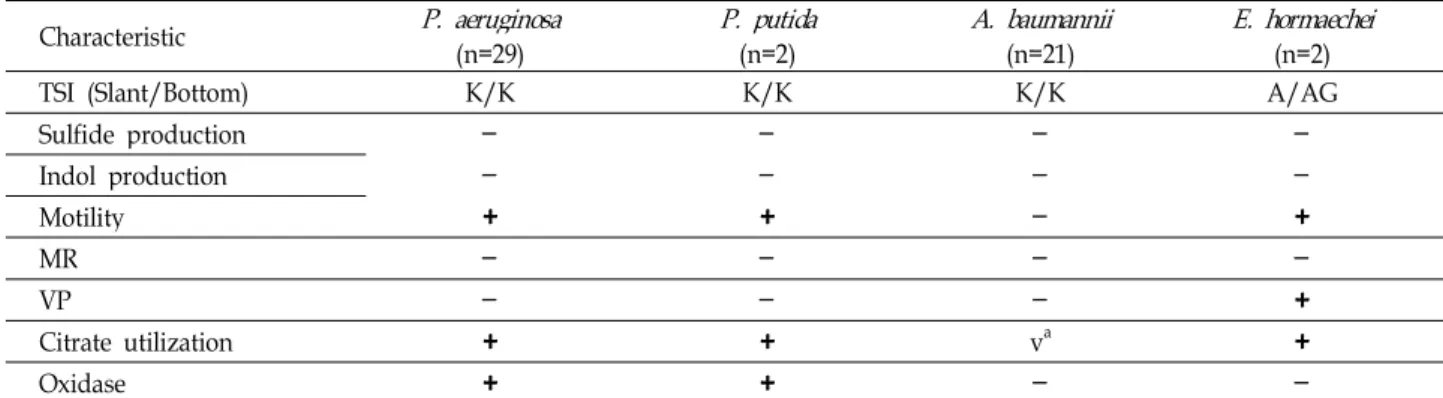
전통적인 생화학적 검사 방법과 Vitek 32를 이용한 균주 동정결과는Pseudomonas aeruginosa 2균주, Acinetobacter bau- mannii 21균주, Pseudomonas spp. 2균주 그리고 Enterobacter cloacae 2균주로 동정되었으며 생리적 특성은 Table 2에 나타
Table 2. Biochemical characteristics of the isolates identified by Vitek kit
Characteristic P. aeruginosa
(n=29) P. putida
(n=2) A. baumannii
(n=21) E. hormaechei
(n=2)
TSI (Slant/Bottom) K/K K/K K/K A/AG
Sulfide production - - - -
Indol production - - - -
Motility + + - +
MR - - - -
VP - - - +
Citrate utilization + + va +
Oxidase + + - -
Abbrivation : TSI, triple sugar iron; SIM, sulfide indol motility; MR, methyl red; VP, Vogas-Proskauer; K, alkaline; A, acidic; AG acidic and gas.
+, Positive; -, negative; v, variable (10-90% positive).
aThree strains are positive.
0.02
Pseudomonas antarctica DSM 15318T(AJ537601) Pseudomonas fluorescens IAM 12022T(D84013) Pseudomonas chlororaphis DSM 50083T(Z76673)
Pseudomonas syringae ATCC 19310T(D84026) Pseudomonas putida IAM 1236T(D84020)
IR105
Pseudomonas putida JCM 6156 (D37924) IR111
Pseudomonas monteilii CIP 104883T(AB021409) Pseudomonas plecoglossicida ATCC 700383T(AB009457)
Pseudomonas flavescens NCPPB 3063T(U01916) Pseudomonas lubricans RS1 (DQ842018)
Pseudomonas mendocina LMG 1223T(Z7666) Pseudomonas pseudoalcaligenes JCM 5968T(AB021379)
Pseudomonas alcaligenes LMG 1224T(Z76653) Pseudomonas stutzeri CCUG 11256T(U26262) Pseudomonas nitroreducens IAM 1439T(D84021) 29 IR strains
Pseudomonas aeruginosa LMG 1242T(Z76651) Pseudomonas otitidis DSM 17224T(AY953147)
Pseudomonas resinovorans ATCC 14235T(AB021373) Pseudomonas indica DSM 14015T(AF302795)
Escherichia coli ATCC 11775T(X80725)
67 99 65 100 52
65 98
100 69 56
0.05
IR118, 135
Pseudomonas aeruginosa IFO 12689T(AB039386) IR100, 104, 110, 114, 121, 122, 142, 148, 113 IR106, 108
IR107
Pseudomonas aeruginosa ATCC 27853 (EF064840) IR101, 109, 119, 131, 139
IR102, 103, 112, 116, 117, 126, 134, 140 IR132, 133
Pseudomonas nitroreducens IAM 1439T(AB176844) Pseudomonas mendocina IMV B-171 (AB039480)
Pseudomonas indica MTCC 3713T(AB176837) Pseudomonas pseudoalcaligenes KF707 (DQ844807) Pseudomonas stutzeri IFO 14165T(AB039393) Pseudomonas lubricans RS1 (EF675630) Pseudomonas alcaligenes IFO 14159T(AB039388)
IR105
Pseudomonas putida JCM 6156 (D37926) Pseudomonas putida PpG7 (D86008) Pseudomonas putida ATCC 11172 (D86006)
IR111
Pseudomonas fluorescens ATCC 17467 (AB039382) Pseudomonas fluorescens IAM 12022T(D86016) Pseudomonas putida NCIMB 9816 (D86013) Pseudomonas putida ATCC 17522 (D86009) Pseudomonas chlororaphis IFO 3904T(D86019)
Escherichia coli ATCC 25922 (AB083953)
77
99
51
57 90
100
100 100 89 94
99 69 90 94
(a) (b)
Fig. 3. Neighbor-joining trees based on partial 16S rRNA gene (a) and gyrB gene (b) sequences showing relationships between clinical isolates and genus of thePseudomonas. The percentage at the nodes are the levels of bootstrap support >50% based on neighbor-joining analyses of 1000 resampled data sets. The sequence ofEscherichia coliATCC 11775T(X80725) was used as an outgroup. Bar, 0.02 and 0.05 nucleotide substitution per position.
나 있다.Pseudomonas spp. 2균주는 16S rRNA 유전자와 gyrB 유전자의 염기서열 분석을 이용한 계통분류학적 분석에 의해 P. putida으로 동정 되었다(Fig. 3). 그러나 Enterobacter cloacae 2균주는 유전자 염기서열 분석 결과E. hormaechei으로 동정되 었다. 나머지 균주는 전통적인 생화학적 검사 및 Vitek 32 검사 와 16S rRNA 및gyrB 유전자 염기서열 분석과 동일하게 동정 되었다.
MBL생성 검증
Imipenem 내성 균주가 MBL을 생성하는지 여부를 알아보 는 Hodge 변법 시험결과 29균주(53.7%)가 양성반응을 보였
고, imipenem-EDTA 상승효과시험에서는 22균주(40.7%)가 양성반응을 보였다. Imipenem-EDTA 상승효과시험에 양성인 균주는 모두 Hodge 변법 시험결과에서 양성 반응을 나타냈다 (Table 3). 따라서 MBL 를 생성하는 균주는 22균주로A. bau- mannii 12균주와, P. aeruginosa 7균주, P. putida 2균주 그리고 E. hormaechei 1균주가 속했다.
PCR을 통한 β-lactamase 유형 분석
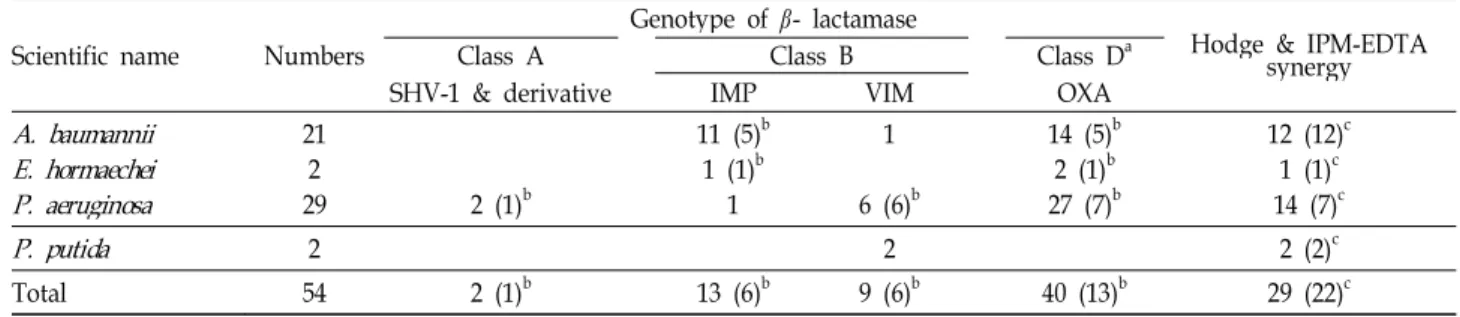
Class A β-lactamase 인 SHV-1 와 유도체 유전자는P. aeru- ginosa 2균주에서 검출되었다. Class B β-lactamase (MBL) 중 IMP 유전자는A. baumannii 11균주와 Enterobacter hormaechei
Table 3. Detection of metallo β -lactamase and genotypes of β -lactamases in clinical isolates
Scientific name Numbers Genotype of β- lactamase
Hodge & IPM-EDTA synergy
Class A Class B Class Da
SHV-1 & derivative IMP VIM OXA
A. baumannii E. hormaechei P. aeruginosa
21 2
29 2 (1)b
11 (5)b 1 (1)b
1
1 6 (6)b
14 (5)b 2 (1)b 27 (7)b
12 (12)c 1 (1)c 14 (7)c
P. putida 2 2 2 (2)c
Total 54 2 (1)b 13 (6)b 9 (6)b 40 (13)b 29 (22)c
aClass D : OXA- 1, 2, 10, 23, 24, 25, 26, 40, 72, 58.
bNumbers of combined genotypes were expressed in parentheses.
cNumbers of positive results both in two tests were expressed in parentheses.
Table 4. Rate of antibiotic resistant clinical isolates Antibiotic/Species
A. baumannii P. aeruginosa P. putida E. hormaechei Total (n=12)MBL Da
(n=9) Total Ab
(n=2) MBL
(n=7) D
(n=20) Total MBL
(n=2) MBL
(n=1) D
(n=1) Total (n=54) Ampicillin 100.0 100.0 100.0 100.0 100.0 100.0 100.0 100.0 100.0 100.0 100.0 100.0 Ceftriaxone 100.0 100.0 100.0 100.0 85.7 85.0 86.2 100.0 100.0 100.0 100.0 92.6 Cefmetazole 100.0 100.0 100.0 100.0 100.0 100.0 100.0 100.0 100.0 100.0 100.0 100.0
Cefotaxime 100.0 100.0 100.0 50.0 100.0 85.0 86.2 100.0 100.0 100.0 100.0 92.6
Ceftazidime 100.0 100.0 100.0 0.0 85.7 25.0 37.9 100.0 100.0 100.0 100.0 66.7
Cefepime 100.0 100.0 100.0 50.0 85.7 45.0 55.2 100.0 100.0 0.0 50.0 74.0
Aztreonam 83.3 77.8 81.0 0.0 71.4 30.0 37.9 100.0 100.0 100.0 100.0 59.3
Ticarcillin/clavulanic acid 100.0 100.0 100.0 50.0 85.7 75.0 75.9 100.0 100.0 100.0 100.0 87.0
Ciprofloxacin 83.3 100.0 100.0 50.0 85.7 75.0 75.9 100.0 100.0 0.0 50.0 85.2
Amikacin Gentamicin
58.3
83.3 33.3 100.0 47.6
90.5 50.0 100.0 85.7
85.7 30.0 60.0 44.8
69.0 50.0
100.0 0.0 100.0 0.0
0.0 0.0 50.0 44.4
77.8
Colistin 0.0 0.0 0.0 0.0 0.0 0.0 0.0 0.0 0.0 0.0 0.0 0.0
aD: OXA-1, 2, 10, 23, 24, 25, 26, 40, 72, 58.
bA: SHV-1 & derivative.
및P. aeruginosa 각각 1균주씩에서 검출되었다. VIM 유전자는 P. aeruginosa 6균주와 P. putida 2균주 그리고 A. baumannii 1균 주에서 검출되었다. Class D β-lactamase인 OXA-1, OXA-2, OXA-10과 OXA-23 유전자는 각각 25균주, 20균주, 5균주 그리 고2균주에서 검출되었다. 6개 균주에서는 2종류 이상의 OXA 유전자형이 검출 되었으며, 13개의 균주에서는 class A나 class B유전자형과 OXA 유전자가 동시에 검출되었다(Table 3).
항생제 감수성
Ampicillin, cefmetazole, ceftriaxone, cefotaxime, ceftazi- dime, cefepime, aztreonam 등 광범위한 β-lactam항생제에 대 한 내성을 지닌 분리 균주의 비율이 각각 100%, 100%, 92.6%, 92.6%, 66.7%, 74.0% 및 59.3% 였다. β-Lactamase억제제가 혼 합된 ticarcillin/clavulanic acid에 대한 내성 균주의 비율도 85.2%로 높았다. Quinolone계열의 ciprofloxacin에 대해서도 85.2%의 균주가 내성을 보였으며, amikacin, gentamicin 등 aminoglycoside 계통의 항생제에 대한 내성 균주 비율은 44.4% 및 77.8%로 나타났다. 그러나 colistin에 대해서는 모든
균주가 감수성을 나타냈다(Table 4).A. baumannii균주들은 P.
aeruginosa 균주들은에 비해 cefepime, ceftazidime, aztreonam 과 gentamicin에 대한 내성 비율이 높았다.A. baumannii균주 들은 MBL 유전자 보유 여부가 amikacin에 대한 내성율에서 만 차이가 나타났을 뿐 다른 항생제에 대해서는 큰 차이가 나타나지 않았다. 그러나P. aeruginosa 의 경우 MBL 유전자 보유 균주들이 다른 class 의 유전자 보유 균주들에 비해 cefta- zidime, cefepime, aztreonam 등 광범위한 β-lactam항생제에 에 대한 내성율이 높았다. 특히 MBL 유전자를 보유한P. puti- da 2균주는 amikacin과 colistin을 제외한 보든 시험 항생제에 대해 내성을 나타냈다.
고 찰
지금까지 보고된 β-lactamase 생성과 항생제 내성에 관한 연구는 대부분 단일 균종에 대한 연구가 주로 많이 있었다.
본 연구에서는 비교적 다양한 균종을 대상으로 연구를 진행 하였으며 carbapenem의 대표적 제제인 imipenem에 내성을
가진 54균주를 실험에 사용했다.
Class A와 D에 속하는 carbapenemase는 serine carbapene- mase로서 carbapenem의 가수분해 능력이 미약하다고 알려져 있다[24]. 본 실험에서 2개의Pseudomonas aeruginosa 균주 만 이 class A에 속한 SHV 유전자형을 갖고 있었다. 이 중 1개 균주는 class D에 속한 OXA 유전자형을 동시에 가지고 있었 으며 SHV 유전자형 만 보유한 1개의 균주(IR108)는 az- treonam, cefepime, ciprofloxacin, cefotaxime, ceftazidime, ti- carcillin/clavulanic acid, amikacin, colistin에 대해 감수성을 보였다. 한편 40균주는 class D에 속한 OXA 유전자형을 가지 고 있었으며 이 중 13균주는 class B 유전자를, 1개 균주는 class A 유전자를 동시에 가지고 있었다. 따라서 OXA 형 유전 자 만을 보유한 균주는 27개였다.
MBL 유전자 보유 여부가 항생제에 대한 내성빈도와 연관 성은A. baumannii 균주에서는 aminoglycoside 계통의 항생제 인 amikacin에서만 나타났을 뿐 β-lactam항생제에서는 차이 가 나타나지 않았다.A. baumannii 균주에 비해 항생제에 대한 내성율이 낮은P. aeruginosa에서는 MBL 생성 균주들이 다른 class 의 유전자를 보유한 균주들에 비해 광범위한 β-lactam항 생제에 대한 내성율이 높았다.P. putida와 E. hormaechei의 경 우 시험 균주 수가 적어 비교하기 어려웠다.
Imipenem 내성 균주 중 22균주가 Hodge 변법, imipe- nem-EDTA 상승효과 시험 그리고 유전자형 검사에 의해 MBL 유전자(VIM 또는 IMP)를 보유하고 있음을 확인하였다. 한편 국내 병원에서 분리한 imipenem 내성 균주의 β-lactamase 유 전형의 출현빈도는 다음과 같다. 2000-2001년 까지 분리된A.
baumannii 는 267균주 중 38(1.2%), 그리고 Pseudomonas 속 387 균주 중 44(11.4%;P. aeruginosa 42균주, P. putida 2균주) 만이 MBL을 보유하고 있었다[13]. 2004년에 분리된A. baumannii 의 경우 9균주 중 2 (22.2%) 균주만이 MBL을 보유하고 있으며 7개는 OXA 형을 보유하고 있었다[8]. 한편 MBL 생성 균주에 서도 IMP형을 보유하고 있는 균주는 2000년 까지는 1개의P.
aeruginosa와 A. baumannii 3균주 만이 분리되었으며 대부분 VIM 형이 분리된다고 하였다[13]. 본 실험에서 사용한 균주는 2007년 3월부터 1년간 분리된 균주를 사용하였다. Imipenem 에 내성 균주 중 MBL 생성균의 비율이 40.7%에 이르며 특히 A. baumannii 균주는 54.6%에 달했다. 특히 1개 균주를 제외한 11개 균주는 IMP 형의 MBL을 생성하고 있음을 확인하였다.
기존의 결과와 비교할 경우 MBL을 생성하는 imipenem 내성 P. aeruginosa와 A. baumannii 균주의 분리 빈도가 높아지는 현상 외에 점차 MBL생성 균주 또한 분리율이 높아지고 있으 며 점차 IMP 형 MBL 생성 균주의 출현이 증가하고 있음을 확인하였다.
References
1. Baik, K. S. 2005. Prokaryotic Diversity of Woopo Wetland
Estimated by Phylogenetic Analysis. Ph. D. Thesis. Sunchon National University. Korea.
2. Castanheira, M., M. A. Toleman, R. N. Jones, F. J. Schmidt, and T. R. Walsh. 2004. Molecular characterization of aβ-lac- tamase gene,blaGIM-1, encoding a new subclass of metallo-β -lactamase. Antimicrob. Agents Chemother. 48, 4654-4661.
3. CLSI. 2003. Performance standards for antimicrobial disk susceptibility tests, 8th edn. Approved Standard M2-A8.
Wayne, PA: Clinical Laboratory Standards Institute.
4. Cohen, S. N., A. C. Y. Chang, and L. Hsu. 1972.
Nonchromosomal antibiotic resistance in bacteria: Genetic transformation of Escherichia coli by R- factor DNA. Proc.
Natl. Acad. Sci. 69, 2110-2114.
5. Crespo, M. P., N. Woodfood, A. Sinclair, M. E. Kaufmann, J. Turton, J. Glover, J. D. Velez, C. R. Castaneda, M. Recalde, and D. M. Livermore. 2004. Outbreak of Carbapenem- ResistantPseudomonas aeruginosasProducing VIM-8, a Novel Metallo-β-Lactamas, in a Tertiary Care Center in Cali, Colombia. J. Clin. Microbiol. 42, 5094-5101.
6. Edwards, J. R., P. J. Turner, and C. Wannop. 1989.In vitro antibacterial activity of SM-7338, a carbapenem antibiotics with stability to dehydropeptidase I. Antimicrob. Agents Chemother. 33, 215-222.
7. Felsenstein, J. 1985. Confidence limits on phylogenies: an approach using the bootstrap. Evolution 39, 783-791.
8. Jeong, S. H., K. Lee, Y. Chong, J. H. Yum, S. H. Lee, H.
J. Choi, Y. M. Kim, K. H. Park, B. H. Han, S. W. Lee, and T. S. Jeong. 2003. Characterization of a new integron con- taining VIM-2, a metallo-β-lactamase gene cassettes, in a clinical isolate of Enterobacter cloacae. J. Antimicrob.
Chemother. 51, 397-400.
9. Jukes, T. H. and C. R. Cantor. 1969. Evolution of protein molecules. In Mammalian protein metabolism, pp. 21-132.
Edited by H. N. Munro. New York: Academic Press.
10. Kim, I. S., W. I. Oh, J. H. Song, and N. Y. Lee. 2004. Screening and identification of metallo-β-lactamase gene in clinical isolates of imipenem-resistant Pseudomonas aeruginosa. Korean J. Lab. Med. 24, 177-182.
11. Kovacs, N. 1956. Identification ofPseudomonas pyocyaneaby the oxidase reaction. Nature (London)178, 703.
12. Lauretti, L., M. I. Ricco, A. Mazzriol, G. Cornaglia, G.
Amicosante, R. Fontana, and M. Rossolini. 1999. Cloning and characterization ofblaVIM, a new integron-borne metallo- β-lactamase gene form a Pseudomonas aeruginosa clinical isolate. Antimicrob. Agents Chemother. 43, 1584-1590.
13. Lee, K., W. G. Lee, Y. Uh, G. Y. Ha, J. Cho, Y. Chong, and the Korean Nationwide Surveillance of Antimicrobial Resistance Group. 2003. VIM- and IMP-type metallo-β -lactamase producing Pseudomonas spp. and Acinetobacer spp. in Korean Hospitals. Emerg. Infect. Dis. 9, 868-871.
14. Lee, K., J. H. Yum, D. Yong, H. M. Lee, H. D. Kim, J. D.
Docquier, G. M. Rossolini, and Y. Chong. 2005. Novel ac- quired metallo-β-lactamase gene, blaSIM-1, in a class 1 in- tegron from Acinetobacter baumannii clinical isolates from Korea. Antimicrob. Agents Chemother. 49, 4485-4491.
15. Lee, S., Y. J. Park, M. Kim, H. K. Lee, K. Han, C. S. Kang,
and M. W. Kang. 2005. Prevalence of Ambler class A and Dβ-lactamases among clinical isolates ofPseudomonas aeru- ginosa in Korea. J. Antimicrob. Chemother. 56, 122-127.
16. Livingstone, D., M. J. Gill, R. Wise. 1995. Mechanism of re- sistance to the carbapenems.J. Antimicrob. Chemother.35, 1-5.
17. Paton. R., R. S. Miles, J. Hood, S. G. Amyes, R. S. Miles, and S. G. Amyes. 1993. ARI 1:β-lactamase-mediated imipe- nem resistance inAcinetobacter baumannii.Int. J. Antimicrob.
Agents. 2, 81-87.
18. Pournaras, S., A. Tsakris, M. Maniati, L. S. Tzouvelekis, and A. N. Maniatis. 2002. Novel variant (blaVIM-4) of the metallo- β-lactamase geneblaVIM-1in a clinical strain ofPseudomonas aeruginosa. Antimicrob. Agents Chemother. 46, 4026-4028.
19. Quinn, J. P., E. J. Dudek, C. A. DiVincenzo, D. A. Lucks, and S. A. Lerner. 1986. Emergence of resistance to imipenem during therapy for Pseudomonas aeruginosa infections. J.
Infect. Dis. 154, 289-294.
20. Rasmussen, B. A., Y. Gluzman, and E. P. Tally. 1990. Cloning and sequencing of the class Bβ-lactamases gene (ccrA) from Bacteroides fragilis TAL3636. Antimicrob. Agents Chemother.
34, 1590-1592.
21. Saitou, N. and M. Nei. 1987. The neighbor-joining method:
초록:Carbapenemase를 생산하는 imipenem 내성 세균의 특성 및 항생제 감수성 최한나1․박 철1,2․김형락1,2․백근식1․김세나1,3․성치남1*
(1순천대학교 생물학과, 2성가롤로병원 진단검사의학과, 3한국기초과학지원연구원 순천센터)
대한민국 순천의 병원 입원 환자의 검체로부터 imipenem 내성 세균을 분리하였다. 54개의 분리균을 16S rRNA 유전자와 gyrB 유전자 염기서열 비교를 기초로 하여 계통분류학적으로 동정하였다. 분리균들은 Pseudomonas aeruginosa (30균주; 55.6%), Acinetobacter baumannii (21; 38.9%), Enterobacter hormaechei (2)와 Pseudomonas putida (2)에 속했다. 22개의 균주가 metallo-β-lactamase (MBL)를 생산하였으며 종별 구성은 다음과 같다; Acinetobacter baumannii 12균주, Pseudomonas aeruginosa 7균주, P. putida 2균주 그리고 Enterobacter hormae- chei 1균주. 분리균들의 항생제 감수성은 디스크 확산법과 Vitek 을 이용하여 조사하였다. IMP 와 VIM 형의 met- allo-β-lactamase를 생산하는 균주들은 OXA 와 SHV 형 β-lactamase를 생산하는 균주들에 비해 ceftazidime, az- treonam, amikacin과 gentamicin에 대한 내성율이 높았다.
a new method for reconstructing phylogenetic trees. Mol.
Biol. Evol. 4, 406-425.
22. Smibert, R. M. and N. R. Krieg. 1994. General characterization. In Methods for General and Molecular Bacteriology, pp. 607-654. Edited by P. Gebhardt, R. G. E.
Murray, W. A. Wood & N. R. Krieg. Washington, DC:
American Society for Microbiology.
23. Toleman, M. A., A. M. Simm, T. A. Murphy, A. C. Gales, D. J. Biedenbach, R. N. Jones, and T. R. Walsh. 2002.
Molecular characterization of SPM-1, a novel metallo-β -lactamase isolated in Latin America: report from the SENTRY antimicrobial surveillance programme. J.
Antimicrob. Chemother. 50, 673-679.
24. Walsh, T. R., M. A. Toleman, L. Poirel, and P. Nordmann.
2005. Metallo-β-lactamases: the quiet before the storm?.Clin.
Microbiol. Rev. 18, 306-325.
25. Yamamoto, S. and S. Harayama. 1995. PCR amplification and direct sequencing ofgyrBgenes with universal primers and their application to the detection and taxonomic analy- sis of Pseudomonas putida strains. Appl. Environ. Microbiol.
61, 1104-1109.