Vol. 21, No. 7 (2011)
396
†Corresponding author
E-Mail : [email protected] (J. Yu)
Preparation of Nano-Sized Tin Oxide Powder from Tin Chloride Solution by Spray Pyrolysis Process
Jaekeun Yu
†and Donghee Kim*
Department of Advanced Materials Engineering, Hoseo University, Asan 336-795, Korea
*Department of Anesthesiology, Dankook University, Cheonan 330-714, Korea
(Received April 27, 2011 : Received in revised form May 12, 2011 : Accepted June 24, 2011)
Abstract
In this study, by using tin chloride solution as a raw material, a nano-sized tin oxide powder with an average particle size below 50 nm is generated by a spray pyrolysis process. The properties of the generated tin oxide powder depending on the inflow speed of the raw material solution are examined. When the inflow speed of the raw material solution is 2 ml/min, the majority of generated particles appear in the shape of independent polygons with average size above 80-100 nm, while droplet-shaped particles show an average size of approximately 30 nm. When the inflow speed is increased to 5 ml/min, the ratio of independent particles decreases, and the average particle size is approximately 80-100 nm. When the inflow speed is increased to 20 ml/min, the ratio of droplet-shaped particles increases, whereas the ratio of independent particles with average size of 80-100 nm decreases. When the inflow speed is increased to 100 ml/min, the average size of the generated particles is around 30-40 nm, and most of them maintain a droplet shape. With a rise of inflow speed from 2 ml/min to 5 ml/min, a slight increase of the XRD peak intensity and a minor decrease of specific surface area are observed. When the inflow speed is increased to 20 ml/min, the XRD peak intensity falls dramatically, although a significant rise of specific surface area is observed. When the inflow speed is increased to 100 ml/min, the XRD peak intensity further decreases, while the specific surface area increases.Key words
tin chloride solution, spray pyrolysis process, nano-sized tin oxide powder, average particle size, inflow speed of raw material solution.1. Introduction
Spray pyrolysis method
1-6)is well known to be very effective in manufacturing high-quality functional powder.
The engineering advantages of this method include the following: 1) the manufacture processes, such as the mixing, calcination, and milling of solid powder, can be omitted; 2) the properties of the particles can be controlled by adjusting the conditions of the pyrolysis reaction. Also, since it is much easier to remove the impurities in solution state than in solid state, pyrolysis reaction is very suitable for manufacturing high purity powder.
Along with the rapid development of information and telecommunication industry, several types of flat panel dis- play, such as LCD (liquid crystal display), ELD (electro- luminescent display) and FED (field emission display), have become applicable in many industrial fields, e.g. the manufactures of television set, mobile phone, office ma- chine, etc. For the manufacture of these flat panel displays, a transparent electrode must be utilized, and this electrode is required to have high visible light transmissivity, perfect
electrical conductivity, and excellent electromagnetic wave shielding capacity. ITO (Indium Tin Oxide) film made from ITO target by sputtering method can satisfactorily serve this purpose. Generally, a transparent electromagnetic wave shielding material is required to have the shielding capacity above 20db, and the optical transmissivity above 60%
within the visible spectrum (380~780 nm).
7-9)ITO exhibits an optical transmissivity above 80% and excellent electrical conductivity. Consequently, research activities related to the manufacture of ITO film and its property enhancement are being conducted actively.
7-9)However, there hasn’t been too much research effort regarding the mass production of indium oxide powder
10)and tin oxide powder with average particle size below 50 nm and uniform particle size dis- tribution. In particular, there has been hardly any research activity related to the manufacture of nano-size tin oxide powder due to the engineering difficulties.
The purpose of this study is to develop a technology for
the mass production of nano-sized tin oxide powder with
uniform particle size and average particle size below
50 nm in a spray pyrolysis reaction device by using tin
chloride solution as the raw material. The properties of the
generated tin oxide powder depending on the of the inflow
speed of raw material solution are also examined.
2. Experimental Procedure
In this study, a tin oxide powder with average particle size below 50 nm is manufactured from the tin chloride solution with the presence of tetravalent tin ions by using spray pyrolysis process. First, tin powder with purity above 99.9% made by Aldrich company is dissolved into the hydrochloric acid solution of 25% till the tin concentration is adjusted to 400 g/l. Since the tin component of this solu- tion is mainly in the form of divalent ion, it’s impossible to generate solid-phase tin oxide by using spray pyrolysis process. Hence, a certain amount of hydrogen peroxide is added in the tin chloride solution so as to oxidize all the divalent tin ions into tetravalent ones. Next£¨the solution is heated to 100
oC so that the tin concentration is accurately adjusted to 400 g/l. Then, the solution is filtered triply through filter paper, and the purified solution is utilized as the raw material of the spray pyrolysis process. The concentrations of silicon dioxide, phosphorus, calcium, chromium and copper in this solution are below 100ppm.
This solution is diluted by distilled water so that the tin concentration is adjusted to 150 g/l.
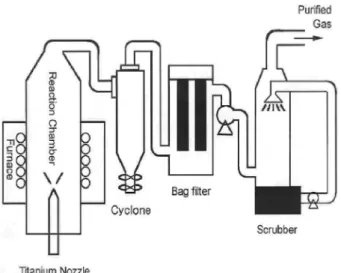
In order to generate the nano-sized tin oxide powder with uniform particle size and average particle size below 50 nm, a spray pyrolysis system is specially designed and built for this study. The schematic diagram of this system is shown in Fig. 1.
In this study, the raw material solution is micronized into ultra fine droplets through a nozzle made of titanium, and is in turn sprayed into a reaction furnace with the inside temperature maintained at 900
oC. Subsequently, tin oxide powders with the particle size below 50 nm are generated, and are collected by a bag filter. The raw material solution is fed into an inlet of the nozzle by a metering pump with the inflow speed adjustable from 2 ml/min to 100 ml/min,
while the pressurized air supplied by an air compressor is fed into the other inlet of the nozzle with pressure of 3 kg/
cm
2so that the solution can be micronized. Given various inflow speeds of the solution, the properties of the corres- pondingly generated powder are examined by TEM (JEM- 2100F, JEOL Ltd.) analysis (whether there is the generation of single crystal particles), SEM (Quanta 200, FEI Ltd.) analysis (particle size distribution and particle shape), XRD (D/Max-2500V, Rigaku Ltd.) analysis (powder phase and composition), and the measurement of specific surface area (ASAP 2020, micromeritics Ltd.).
3. Results and Discussion
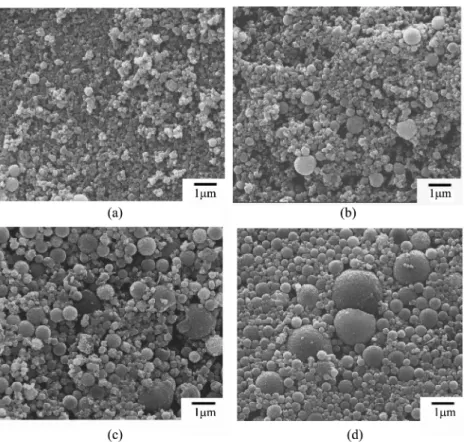
Fig. 2 is the 30,000 times magnified image of the gen- erated powder under SEM, which shows the property of the generated powder relative to the inflow speed of the raw material solution rising from 2 ml/min to 100 ml/min, given that the reaction temperature is kept at 900
oC, the tin concentration of the raw material solution at 150 g/l, the nozzle tip size at 2 mm, and the air pressure at 3 kg/
cm
2. Fig. 3 is the 200,000 times magnified image of the generated powder under SEM, which shows the property change of the generated powder under the same reaction conditions with Fig. 2.
Generally, the average size of the liquid droplets formed through a dual-fluid nozzle can be calculated according to equation (1).
6)(1) where X is the average particle size,
σ is the surface tension of the solution, ρ is the density,
υ is the spraying speed, µ is the viscosity,
Q
lis the amount of the solution, Q
ais the amount of air.
While the inflow speed of the raw material solution is at a very low level of 2 ml/min, the size of micronized droplets is extremely small, and there is expected to be no droplet bursts during the pyrolysis process. In this study, when the inflow speed is at 2 ml/min, the evaporation of solvent at droplet surface starts rapidly as soon as the micronized droplets flow into the reaction zone. On the other hand, when the reaction temperature is at 900
oC, there are severe droplet bursts at the initial stage of pyrolysis reaction. Because the inflow speed is at a very low level, not only the size of micronized droplets is very small, but also the droplets becomes very small after the evaporation of solvent, and there is no significant difference of concentration between the surface and the center of
X 585 σ
υ σ--- 579 µ υ σρ---
⎝ ⎠
⎛ ⎞0.451000Ql Qa ---1.5 +
=
Fig. 1. Schematic diagram of spray pyrolysis system.
Fig. 3. SEM photographs of produced powder according to inflow speed of the solution at 900oC, raw material solution of 150 g/l Sn, 2 mm nozzle tip size and 3 kg/cm2 air pressure. (× 200,000) (a) 2 ml/min, (b) 5 ml/min, (c) 20 ml/min and (d) 100 ml/min.
Fig. 2. SEM photographs of produced powder according to inflow speed of the solution at 900oC, raw material solution of 150 g/l Sn, 2 mm nozzle tip size and 3 kg/cm2 air pressure. (× 30,000) (a) 2 ml/min, (b) 5 ml/min, (c) 20 ml/min and (d) 100 ml/min.
droplets till the evaporation of solvent inside the droplets ends completely. As a result, there is no severe droplet bursts during the pyrolysis reaction. As shown in Fig. 2(a), a certain amount of powders generated by pyrolysis reac- tion maintain the spherical shape of droplets micronized at the initial stage of pyrolysis reaction, and most of them appear in the shape of independent particles. According to Fig. 3(a), some of the droplet-shaped powders shown in Fig. 2(a) are nano particles with mutual cohesion and the average size of 30 nm, but most of them are independent particles which appear in the form of crystallized polygons with average size ranging from 80 nm to 100 nm. In case that the size of micronized droplet is small and there are a large amount of droplets, the mutual cohesion between droplets becomes increasingly severe, and the speed of cohesion also becomes faster. In equation (2),
7)assuming that Brown movement is the cause of the collisions bet- ween droplets, and that β is a constant, the possibility of cohesion between the preliminarily micronized droplets increases considerably along with the reduction of droplet size.
(Nt/No) = 1/(1 + t/ τ
c) (2)
where No is the amount of preliminarily micronized droplets,
Nt is the amount of droplets at the time of t, τ
cis 2/ β, β is a constant of cohesion speed.
Therefore, before the start of pyrolysis reaction, small- sized droplets resulting from the slow inflow speed of the solution and enlarged droplets resulting from the cohesion between droplets are expected to coexist, and the particle size distribution of the powder generated by pyrolysis reaction is expected to be extremely irregular. For the case of this study, the average particle size of the generated powder is not only affected by lessened droplet bursts resulting from small droplet size, but also affected by cohesion between particles.
As the inflow speed increases up to 5 ml/min, as shown in formula (1), the size of micronized droplets increases significantly compared with that at the inflow speed of 2 ml/min. Along with the progress of pyrolysis reaction, the solvent inside the droplets cannot pass through the solidified surface layer of droplets. Consequently, due to the continuously elevated interior pressure, the droplets eventually burst up, and the particle size distribution be- comes more irregular. As shown in Fig. 2(b), the droplets appear in comparatively irregular form. According to Fig.
3(b), among the droplets shown in Fig. 2(b), the ratio of the nano particles with the average size around 30 nm increases compared with that at the inflow speed of 2 ml/min. On the other hand, the ratio of independent particles decreases, the average size is around 80-100 nm, which is almost the same as that at 2 ml/min, and the particles become slightly
less compact. The reason for this result is as follows: along with the rise of inflow speed, the evaporation of solvent takes longer time to complete, and the evaporation heat of solvent also increases; as a result, the sintering reaction after the generation of powders does not carry on suffi- ciently. As the inflow speed increases up to 20 ml/min, the size of micronized droplets increases significantly com- pared with that at 5 ml/min. Along with the progress of pyrolysis reaction, the residual solvent inside the droplets cannot pass through the solidified surface layer of droplets.
Consequently, due to the continuously elevated interior pressure, there are severe droplet bursts, and as shown in Fig. 2(c), the droplets appear in more irregular form. On the other hand, the evaporation of solvent takes much longer time to end, and the evaporation heat of solvent also increases significantly. As a result, the effect of droplet burst is offset, the sintering reaction after the generation of powders does not carry on sufficiently, and the ratio of independent particles decreases significantly. According to Fig. 3(c), the droplets shown in Fig. 2(c) are comprised of nano particles with the average size around 30 nm.
Compared with those generated at 2 ml/min and 5 ml/min, the particles become less compact. The reason for this result is as follows: along with the significant rise of inflow speed, the droplet size increases, and the droplet bursts become severer; as a result, the average size of the individual par- ticles that constitute the droplets does not increase greatly;
however, as a result of the extending evaporation time and the increasing evaporation heat of solvent inside the droplets, the particle surface becomes less compact. The average size of independent particles is around 80 nm-100 nm, and there is no remarkable difference compared with those at 2 ml/
min and 5 ml/min. The reason for this result, as above- mentioned, results from the complex effects of the following processes: 1) along with the rise of inflow speed, the droplet bursts become increasingly severe; 2) the evaporation heat of solvent increases; and 3) the evaporation of solvent takes longer time.
As the inflow speed of the solution increases up to 100 ml/min, the size of micronized droplets increases more remarkably compared with that at 20 ml/min. Resultingly, along with the progress of pyrolysis reaction, the interior pressure of droplets continues to climb up, and eventually there are much severer droplet bursts. As shown in Fig.
2(d), the distribution of droplet size becomes more irregular, the droplet surface becomes less compact, and part of the droplets maintain the shape resulting from severe bursts.
The evaporation of solvent inside the droplets takes much longer time, and the evaporation heat increases significantly.
Hence, the sintering reaction after the generation of powders
does not carry on sufficiently. As a result, most of the
particles appear in the form of droplets, there is no com-
pact cohesion between particles, and independent particles
almost do not exist. According to Fig. 3(d), the droplets shown in Fig. 2(d) are comprised of nano particles with average size around 30-40 nm, whereas the cohesive tightness between particles become significantly lessened.
The reason for this result is as follows: along with the significant rise of inflow speed, the droplet bursts become much severer; as a result, the average size of the particles that constitute the droplets does not increase significantly;
on the other hand, as a result of the extending evaporation time and the increasing evaporation heat of solvent inside the droplets, the compactness of particle surface is greatly lessened. The reason for almost no existence of inde- pendent particles is as follows: along with the rise of inflow speed, the evaporation heat of solvent increases, the evaporation of solvent takes longer time, and the influences of these two mechanisms become more remarkable.
Fig. 4 is the result of TEM analysis, which shows the structural property of the generated powder, and the diffraction patterns of individual particles for identifying the generation of single crystal. Because there are similar patterns for other particles, the compact single crystal struc- ture of the generated powders can be confirmed by this analysis.
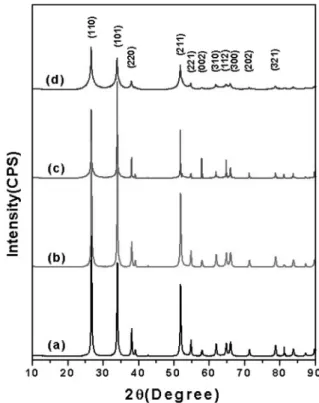
Fig. 5, the results of XRD analysis under the same reac- tion conditions as in Fig. 2, shows the chemical forms of the generated powder at different inflow speeds and the corresponding Miller Index of each peak. It can be seen from Fig. 5 that, regardless of the inflow speed, tin oxide is the only existing form of the generated powders, and that the corresponding Miller Indexes of individual peaks main- tain at a fixed level. When the inflow speed is at 100 ml/
min, there is no unreacted tin chloride. This suggests that the pyrolysis reaction has carried on sufficiently. As the inflow speed rises from 2 ml/min to 5 ml/min, not only the intensity of primary peaks but also those of secondary and tertiary peaks increases slightly. This result can be ex-
plained as follows: there is a combined effect of the following phenomena: a) the droplet size further increases;
and b) the droplet bursts become severer, hence the compactness of particles is lessened; but between these two phenomena, the rising droplet size plays the dominant role;
resultingly, the size of generated powder increases slightly.
When the inflow speed increases up to 20 ml/min, the miller indexes corresponding to primary, secondary and tertiary peaks respectively appear as (101), (110) and (211), and there is a great fall of the intensity of each peak. This result, as shown in Fig. 2 and Fig. 3, is owing to the following phenomena: a) along with the significant rise of inflow speed of the raw material solution, the size of droplets increases remarkably, and the droplet bursts also become severer; and b) as a result of the extending evaporation time and the increasing evaporation heat of solvent inside the droplets, the sintering after the generation of powders does not carry on sufficiently. When the inflow speed increases up to 100 ml/min, the miller indexes cor- responding to primary, secondary and tertiary peaks respect- ively appear as (110), (101) and (211). Compared with those at 20 ml/min, the intensities of peaks also drop significantly. As shown in Fig. 2 and Fig. 3, along with the significant rise of inflow speed to 100 ml/min, the droplet size increases remarkably, and the influence of droplet bursts becomes stronger. Furthermore, inside the droplets,
Fig. 4. TEM photographs of produced powder and selective diffractionpattern of single particle at reaction temperature of 900oC, raw material solution of 150 g/l Sn, 20 ml/min. inlet speed of solution, 2 mm nozzle tip size and 3 kg/cm2 air pressure. (a) TEM photographs of produced powder and (b) Selective diffraction pattern of single particle.
Fig. 5. XRD patterns of powder according to inflow speed of the solution at 900oC, raw material solution of 150 g/l Sn, 2 mm nozzle tip size and 3 kg/cm2 air pressure. (a) 2 ml/min, (b) 5 ml/min, (c) 20 ml/min and (d) 100 ml/min.
the rising evaporation time and evaporation heat of solvent become much more effective. As a result, most of the particles do not appear in independent shape, and there is no tight cohesion between the particles that constitute the droplets.
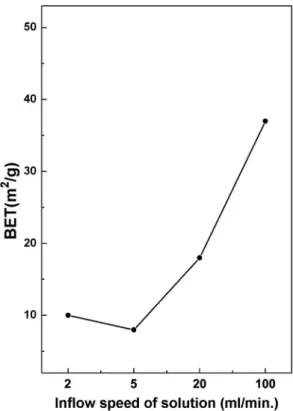
Fig. 6 shows the specific surface area of the generated powder depending on the inflow speed of the solution. It can be seen from Fig. 6 that, as the inflow speed increases from 2 ml/min to 5 ml/min, the specific surface area slight- ly decreases. This result, consistent with the SEM analysis shown in Fig. 2 and Fig. 3, is owing to the following facts:
a) along with the rise of inflow speed, the droplet size increases; and b) the droplet bursts become severer, and the compactness of particles is lessened; but between these two mechanisms, the rising droplet size plays a more dominant role. When the inflow speed increases up to 20 ml/min, the specific surface area rather increases significantly. This result is owing to the following facts: along with the further rising inflow speed, the droplet size increase remarkably, while the droplet bursts and the rising evaporation heat of solvent become more effective; as a result, the average size of independent particles is almost the same as those at 2 ml/min and 5 ml/min, the ratio of independent particles decreases, and the ratio of droplets that are comprised of nano particles with the average size of 30 nm increases significantly. When the inflow speed increases up to 100 ml/min, the specific surface area further increases by a
large margin. This result is owing to the following facts: a) along with the significant rise of inflow speed, the droplet bursts become much severer; and b) as a result of the extending evaporation time and the increasing evaporation heat of solvent inside the droplets, the sintering reaction after the generation of powders does not carry on sufficiently, most of the generated particles maintain the droplet shape with no compact cohesion between particles, and there is almost no existence of independent particles.
4. Conclusion
In this study, by using tin chloride solution as the raw material, a nano-sized tin oxide powder with the average particle size below 50 nm is generated by spray pyrolysis reaction. The properties of the generated tin oxide powder depending on the inflow speed of raw material solution are examined.
When the inflow speed of raw material solution is at 2 ml/min, the majority of generated particles appear in the shape of independent polygon with the average size above 80-100 nm, while the droplet-shaped particles show an average size of approximately 30 nm, and there are mutual cohesion between these particles. When the inflow speed increases up to 5 ml/min, the ratio of independent particles decreases, and the average particle size is around 80- 100 nm. When the inflow speed increases up to 20 ml/min, the ratio of droplet-shaped particles increases, whereas the ratio of independent particles with the average size of 80- 100 nm decreases. When the inflow speed increases up to 100 ml/min, the average size of the generated particles is around 30-40 nm, and most of them maintain the droplet shape. Along with the rise of inflow speed from 2 ml/
min to 5 ml/min, there are a slight increase of XRD peak intensity and a minor decrease of specific surface area.
When the inflow speed increases up to 20 ml/min, there is a large fall of XRD peak intensity, though a great rise of specific surface area. When the inflow speed increases up to 100 ml/min, the XRD peak intensity further decreases, while the specific surface area further increases.
Acknowledgements
This work was performed with the support of Hoseo University in Korea.
References
1. J. K. Yu, S. G. Kang, K. C. Jung. J. S. Han and D. H. Kim, Mater. Trans., 48, 249 (2007).
2. J. K. Yu, G. H. Kim, T. S. Kim and J. Y. Kim, Mater.
Trans., 46, 1695 (2005).
3. D. Majumdar, T. A. Shefelbine, T. T. Kodas and H. D.
Fig. 6. Specific surface areas of powder according to inflow speed of the solution at 900oC, raw material solution of 150 g/l Sn, 2 mm nozzle tip size and 3 kg/cm2 air pressure.
Glicksman, J. Mater. Res., 11, 2861 (1996).
4. M. A. A. Elmasry, A. Gaber and E. M. H. Khater, Powder Tech., 90, 165 (1997).
5. T. C. Pluym, T. T. Kodas, L. -M. Wang and H. D.
Glicksman, J. Mater. Res., 10, 1661 (1995).
6. G. L. Messing, S. C. Zhang and G. V. Jayanthi, J. Am.
Ceram. Soc., 76, 2707 (1993).
7. A. Antony, M. Nisha, R. Manoj and M. K. Jayaraj, Appl.
Surf. Sci., 225, 294 (2004).
8. L. R. Cruz, C. Legnani, I. G. Matoso, C. L. Ferreira and H. R. Moutinho, Mater. Res. Bull., 39, 993 (2004).
9. Y. Hu, X. Diao, C. Wang, W. Hao and T. Wang, Vacuum, 75, 183 (2004).
10. J. K. Yu, S. G. Kang, J. B. Kim, J. Y. Kim, J. S. Han, J.
W. Yoo, S. W. Lee and Z. S. Ahn, Mater. Trans., 47, 1838 (2006).