시설 및 노지 재배 오디의 숙기에 따른 기능성 성분 함량 분석
⁃연구노트⁃
김하윤1․이지영2․황인국1․한혜민1․박보람1․한귀정1․박종태3
1농촌진흥청 국립농업과학원 농식품자원부
2창원대학교 대학원 생명공학협동과정
3충남대학교 식품공학과
Analysis of Functional Constituents of Mulberries (Morus alba L.) Cultivated in a Greenhouse and Open Field during Maturation
Ha Yun Kim1, Ji Young Lee2, In Guk Hwang1, Hye Min Han1, Bo Ram Park1, Gui Jung Han1, and Jong Tae Park3
1Department of Agrofood Resources, National Academy of Agricultural Science, Rural Development Administration
2Interdisciplinary program in Biotechnology, Graduate School, Changwon National University
3Department of Food Science and Technology, Chungnam National University
ABSTRACT Contents of phenolic acids, flavonoids, and anthocyanins of mulberries (Morus alba L.) cultivated in a greenhouse (GH) and open field (OF) were evaluated by HPLC during maturation. In the case of phenolic acids, caffeic acid (96.37∼824.00 μg/g), coumaric acid (19.45∼68.23 μg/g), ferulic acid (4.50∼18.66 μg/g), and sinapic acid (15.61∼29.27 μg/g) were detected. The major phenolic acid was caffeic acid, and its content increased in the initial stage and decreased in the last stage. The phenolic acid content of OF mulberries was higher than that of GH mulberries. Contents of two major flavonoids, quercetin, and kaempferol, were 44.17∼1,661.73 μg/g and 108.67∼
360.20 μg/g, respectively. Quercetin content decreased with maturation stage, whereas kaempferol content remained constant in GH mulberries but increased in OF mulberries. In the case of cultivation methods, quercetin content of OF mulberries was higher than that of GH mulberries. Contents of cyanidin, delphinidin, malvidin, and pelargonidin were 30.43∼6,443.88 μg/g, 0∼52.10 μg/g, 1.06∼1,650 μg/g, and 1.92∼401.97 μg/g, respectively. Anthocyanin content increased with maturation stage, and anthocyanin content of OF mulberries was higher than that of GH mulberries.
OF mulberries in the last stage of maturation had higher contents of functional substances than other conditions.
Key words: mulberry, greenhouse, open field, ripening stage, functional constituent
Received 3 August 2015; Accepted 7 October 2015
Corresponding author: Ha Yun Kim, Department of Agrofood Resources, National Academy of Agricultural Science, Rural Development Administration, Jeonbuk 55365, Korea
E-mail: [email protected], Phone: +82-63-238-3565
서 론
항산화 물질(antioxidants)은 생체 내에서 만들어지는 여 러 가지 ROS(reactive oxygen species)가 유발하는 지질 과산화 반응을 억제하고, 지방 산화과정에서 나타나는 free radical과 지질 과산화물을 제거하여 지질의 산패를 낮추는 효과를 가지고 있어서 암, 고혈압, 당뇨 염증 및 노화를 지연 시키는 생리활성 물질로 주목을 받고 있다(1). 최근 천연 식 품에 포함되어 있는 항산화 물질을 포함하여 기능성 생리활 성 물질을 밝혀 이를 이용하여 부가가치를 향상시킬 수 있는 소재 및 식품을 개발하기 위한 연구가 활발하게 진행되고 있다. 폴리페놀 화합물(polyphenolics)은 다양한 식물자원
에서 발견되는 천연색소로 주로 세포 내에서 결합형이나 유 리형, 에스테르형이 있으며(2) phenolic acids, anthocya- nins, flavonoids, pro(antho)cyanidins, resveratrols, li- gnans 및 tannins 등이 있다(3).
뽕나무는 뽕나무과(Moraceae), 뽕나무속(Morus)에 속 하는 식물자원으로 열대지방부터 온대지역에 걸쳐 널리 분 포하고 있다. 오디는 이 뽕나무의 열매로 anthocyanin 계통 의 색소를 다량 함유하고 있으며(4), 유기산 및 페놀성 화합 물이 풍부한 과실로(5,6) 각광을 받으면서 소비와 재배면적 이 지속적으로 증가하는 추세이다(7). 지금까지 밝혀진 오디 의 생리활성 기능으로는 항암, 항염증, 항산화, 항당뇨 등이 있으며 이로 인해 기능성 식품의 원료로 주목을 받고 있다 (8-11).
과수는 노지 재배로 많이 재배되나 최근에는 하우스 재배 를 이용하여 조기 출하 및 안정적인 생산을 도모하는 농가가 많이 증가하고 있다. 과수의 시설 재배는 온도 조절을 통해 동해 방지 등의 재해 예방 효과와 강우량의 조절을 통해 안
정적인 생산이 가능하며, 보온 및 가온을 이용하여 생육 및 과일의 숙기를 조절함으로써 조기 생산이 가능하다. 시설 재배는 포도의 비가림 재배(12) 및 감귤 하우스 재배(13) 등이 많이 사용되고 있다. 노지 재배와 비교했을 때 작물의 환경이 크게 달라지는데 주요 요인으로는 온도와 광질 등을 들 수 있다. 비트, 쌈추(14) 및 블루베리(15)의 생리활성 물 질이 시설 재배와 노지 재배를 비교했을 때 차이가 있음이 보고되었고, 필름에 따른 광질의 차이에 의해 참외의 수량 및 성분 물질이 달라짐이 보고되었다(16). 특히 자외선의 유 무 및 종류에 따른 복숭아, 파슬리, 쑥갓, 상추, 시금치 등의 기능성 성분 변화가 보고된 바 있다(17-20). 오디의 경우 시설 재배와 노지 재배에 따른 숙기별 기능성 성분 함량을 비교한 결과는 아직 보고된 바가 없다. 본 연구에서는 시설 및 노지 재배된 오디를 대상으로 숙기별 폴리페놀, 플라보노 이드, 안토시아닌의 성분 함량을 조사하여 오디를 이용한 기능성 제품 개발에 대한 기초자료를 제공하고자 하였다.
재료 및 방법
재료
본 실험에 사용한 오디(mulberry)는 과상 2호 품종으로 2014년 7월에 전라북도 부안지역 농가에서 시비, 관수 등 동일한 조건 하에 시설 및 노지에서 재배된 것을 육안을 통 한 색깔로 구분하여 숙도별 5단계(녹색, 주황색, 밝은 적색, 어두운 적색, 흑색)로 나누어 수확한 후 시료로 사용하였다.
수확한 오디는 즉시 아이스 팩을 채운 아이스박스에 넣어 밀봉하고 실험실로 이동, 동결 건조시켜 분쇄한 후 기능성 성분 함량을 측정하였다.
Phenolic acid 함량 분석
오디의 phenolic acid 조성은 Abdel-Aal과 Rabalski (21)의 방법을 변형하여 Ultimate 3000 HPLC system (Dionex, Sunnyvale, CA, USA)으로 분석하였다. 동결 건 조된 시료 0.1 g에 2.6 M NaOH 53% methanol 6 mL를 첨가하고 상온에서 20시간 추출하였다. 이를 원심분리 후 상등액 2 mL를 취하고 여기에 1 M HCl을 첨가하여 샘플의 pH를 pH 2로 조절하였다. 시료를 0.2 μm Nylon filter (Advantec, Tokyo, Japan)를 이용하여 여과한 후 분석하였 다. 주입량은 10 μL, 칼럼은 Triart C18 column(100×2 mm, 12 μm, YMC, Koyto, Japan), 온도는 35°C 및 유속은 0.35 mL/min으로 하였다. 이동상으로는 0.1% formic acid(용매 A)와 methanol(B 용매)을 12분간 25:75의 비율로 흘려주 었다. 검출기는 photodiode array detector(Dionex)를 이 용하여 330 nm에서 측정하였다.
Flavonoid 함량 분석
오디의 flavonoid 함량은 Shin 등(22), Kim 등(23)의 방 법을 변형하여 다음과 같이 Ultimate 3000 HPLC system
(Dionex)을 이용하여 측정하였다. 동결 건조된 오디 분말 0.1 g을 취하여 62.5% methanol 4 mL를 가한 후 ultra- sonicator(Jeiotech, Daejeon, Korea)에서 15분 추출하였 다. 추출액에 8 M HCl 1 mL를 가한 후 90℃ water bath에 서 3시간 반응시켰다. 원심분리 하여(17,000 rpm, 15분) 얻어진 상층액을 0.45 μm Nylon filter(Advantec)를 이용 하여 여과한 다음 Ultimate 3000 HPLC system(Dionex) 을 이용하여 함량을 측정하였다. 주입량은 10 μL, 칼럼은 Triart C18 column(4.6×250 mm, 5 μm, YMC), 온도는 30°C 및 유속은 0.6 mL/min으로 하였다. 이동상으로는 0.1% formic acid(용매 A)와 methanol(B 용매)을 0~20분 은 50:50, 20~30분은 35:65, 30~35분은 0:100, 35~45분 은 50:50으로 설정하였다. 검출기는 photodiode array de- tector(Dionex)를 이용하여 360 nm에서 측정하였다.
Anthocyanin 함량 분석
오디의 anthocyanin 구성 성분의 함량은 Lee 등(24)의 방법을 변형하여 Ultimate 3000 HPLC system(Dionex)을 이용하여 측정하였다. 동결 건조된 오디 분말 0.1 g을 취하여 2 M HCl 50% methanol을 4 mL 가한 후 ultrasonicator에 서 20분 추출하였다. 100°C water bath에서 1시간 반응시 키고, 원심분리(17,000 rpm, 15분) 하여 얻어진 상층액을 0.45 μm Nylon filter(Advantec)를 이용하여 여과한 다음 Ultimate 3000 HPLC system(Dionex)을 이용하여 함량을 측정하였다. 주입량은 10 μL, 칼럼은 XTerra MS C18 col- umn(3.9×150 mm, 5 μm, Waters, Milford, MA, USA), 온도는 30°C 및 유속은 0.6 mL/min으로 하였다. 이동상으 로는 0.5% trifluoroacetic acid(용매 A)와 acetonitrile(B 용매)을 0~2분은 100:0, 2~4분은 86:14, 4~7분은 73:17, 7~9분은 72:28, 9~11분은 64:36, 11~12.5분은 40:60, 12.5~15분 100:0의 비율로 설정하였다. 검출기는 photo- diode array detector(Dionex)를 이용하여 520 nm에서 측 정하였다.
통계처리
통계분석은 SPSS 통계프로그램(Statistical Package for the Social Science, Ver. 12.0, SPSS Inc., Chicago, IL, USA)을 이용하여 각 측정군의 평균과 표준편차를 산출하고 처리군 간의 차이 유무를 one-way ANOVA(analysis of variation)로 분석한 뒤 Duncan's multiple range test를 이용하여 P<0.05 수준에서 유의성을 검정하였다. 또한 재배 방법별 차이를 알아보기 위하여 t-test를 실시하였다.
결과 및 고찰
Phenolic acid 함량 비교
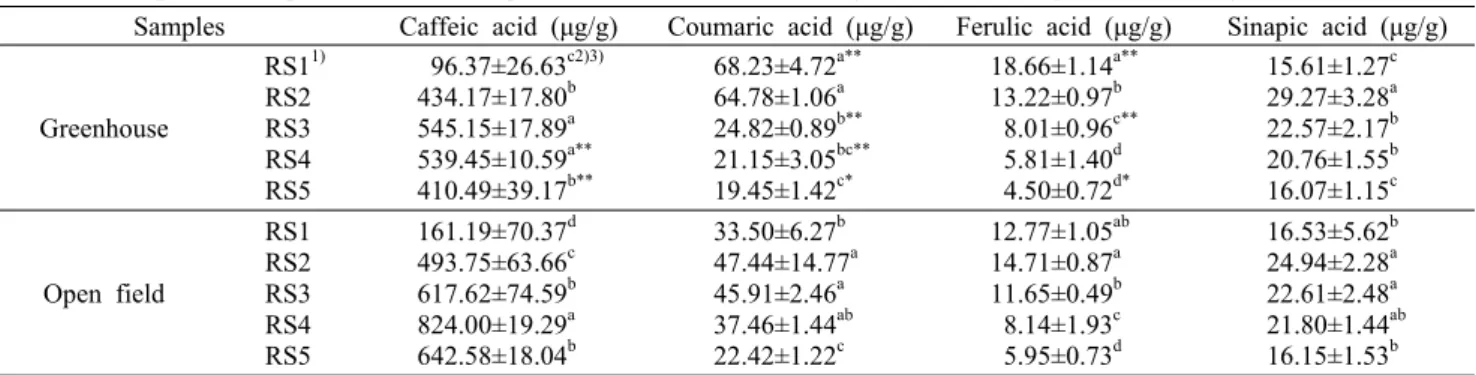
각 시료의 phenolic acid 조성을 HPLC로 분석한 결과는 Table 1과 같다. 모든 시료에서 caffeic acid, coumaric acid,
Table 1. Comparison of phenolic acids compositions of mulberries from greenhouse and open field during maturation Samples Caffeic acid (μg/g) Coumaric acid (μg/g) Ferulic acid (μg/g) Sinapic acid (μg/g)
Greenhouse
RS11) RS2 RS3 RS4 RS5
96.37±26.63c2)3) 434.17±17.80b 545.15±17.89a 539.45±10.59a**
410.49±39.17b**
68.23±4.72a**
64.78±1.06a 24.82±0.89b**
21.15±3.05bc**
19.45±1.42c*
18.66±1.14a**
13.22±0.97b 8.01±0.96c**
5.81±1.40d 4.50±0.72d*
15.61±1.27c 29.27±3.28a 22.57±2.17b 20.76±1.55b 16.07±1.15c
Open field
RS1 RS2 RS3 RS4 RS5
161.19±70.37d 493.75±63.66c 617.62±74.59b 824.00±19.29a 642.58±18.04b
33.50±6.27b 47.44±14.77a 45.91±2.46a 37.46±1.44ab 22.42±1.22c
12.77±1.05ab 14.71±0.87a 11.65±0.49b 8.14±1.93c 5.95±0.73d
16.53±5.62b 24.94±2.28a 22.61±2.48a 21.80±1.44ab 16.15±1.53b
1)RS1∼5 indicate 5 ripening stages of mulberries from unripened state to ripen stage.
2)Values are mean±SD (n=3).
3)Values with different letters in same column indicate significant difference (P<0.05) by Duncan's multiple range test.
*P<0.05 and **P<0.01 indicate significant differences between greenhouse and open field by t-test.
ferulic acid, sinapic acid가 확인되었고, 각각 96.37~
824.00 μg/g, 19.45~68.23 μg/g, 4.50~18.66 μg/g, 15.61
~29.27 μg/g 범위 수준을 나타내었다.
주요 phenolic acid는 caffeic acid로 나타났고, 함량은 노지와 시설 모두 숙기 후기로 갈수록 증가하는 경향을 보였 으나 마지막 단계에서 줄어드는 경향을 보였다. 재배법별로 보면 숙기 1~3기에서는 유의적인 차이를 보이지 않았으나, 4~5기에서는 유의적으로(P<0.01) 노지 오디가 높게 나타 났다. Coumaric acid는 노지의 경우 4기까지 유의적인 차이 를 보이지 않았으나 마지막 단계에서 유의적으로 감소하였 다(P<0.05). 시설의 경우 숙기에 따라 유의적으로(P<0.05) 감소하는 경향을 보였다. 시설 유무로 보면 숙기 초기에는 시설 오디의 함량이 유의적으로(P<0.05) 높았으나 숙기가 진행될수록 노지 오디의 함량이 더 높게 나타났다. Ferulic acid는 숙기가 진행될수록 유의적으로(P<0.05) 감소하는 경향을 보였고, 시설 유무로는 숙기 초기에는 시설 오디의 함량이 높았으나 말기에는 노지 오디의 함량이 높게 나타났 다. Sinapic acid는 숙기가 진행될수록 증가하였다가 감소 하는 경향을 보였고, 노지와 시설 오디의 함량 간 유의적인 차이는 없었다.
Jun 등(25)은 vanillic acid, syringic acid 및 ferulic acid 등의 phenolic acid가 소량 검출되었으나 gallic acid, p- coumaric acid 및 rosmarinic acid는 검출되지 않는 경우도 있다고 보고하였으며, 이 차이는 품종과 추출방법에서 기인 한 것으로 보인다. 같은 품목은 아니나 Whang(26)은 사과 의 발육과정 중 phenolic acid의 성분이 전체적으로 감소하 였으나 그 변화의 폭은 매우 완만하였다고 보고하였으며, 이는 본 연구의 결과와 유사한 경향이었다. 페놀계 물질은 shikimic acid pathway와 같은 탄소화합물의 생합성 경로 를 통해 제2차 대사산물로 만들어지며, 식물체 품종에 따라 페놀계 함량과 분포가 달라진다(27). Coseteng과 Lee(28) 는 사과의 숙성과정에 따른 페놀계 물질과 PPO의 활성 변화 를 보고하였고, 숙성되는 동안 전분이나 hemicellulose와 같은 고분자들이 단순당과 같은 저분자로 분해되므로 pH와
soluble solid가 증가하고 페놀 함량과 PPO의 활성이 감소 함을 보고하였다. 감소된 페놀계 물질은 성숙과정 중 어느 시기가 되면 계속해서 감소되지 않고 일정한 함량치를 유지 하였다고 보고하였는데, 본 연구에서는 성숙기에 도달함에 따라 추가로 증가하지 않은 경향은 유사하였으나 소량 감소 하는 경향을 나타냈다.
Dixon과 Paiva(29)는 식물이 환경 스트레스를 받게 되면 항산화 물질의 축적이 많아진다고 보고하였다. 온도의 영향 을 보고한 결과로 Rivero 등(30)은 토마토의 경우 저온에서 총 페놀 함량이 높아지고 생체중이 감소함을 보고하였고, Lattanzio(31)는 사과를 저온 저장하는 동안 페놀성 물질 함량이 증가함을 보고하였다. 광질에 따른 영향으로는 Son 등(32)은 상추에 LED를 이용하여 다양하게 광질을 처리하 여 청색광 처리 시 총 페놀 함량이 높음을 보고하였고, Tsormpatsidis 등(33)은 자외선 투과율이 높은 피복재에서 상추의 생육은 감소하나 페놀화합물은 증가하는 경향을 보 고하였다. 이러한 연구를 살펴볼 때 노지 재배의 경우 시설 재배에 비하여 온도가 낮고 자외선이 투사되는 영향으로 인 해 페놀성 성분의 함량이 높게 나타난 것으로 보인다.
Flavonoid 함량 비교
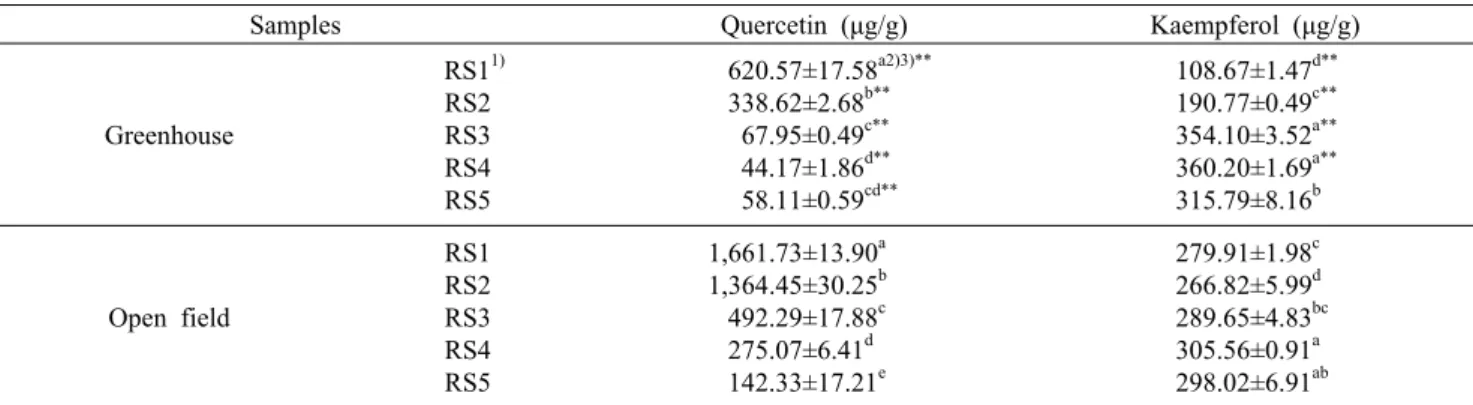
오디가 함유한 flavonoid 성분 중 quercetin과 kaemp- ferol의 함량 분석 결과는 Table 2와 같고, 각각 44.17~
1,661.73 μg/g 및 108.67~360.20 μg/g의 범위 수준을 나 타내었다. Quercetin은 숙기가 진행됨에 따라 점차 감소하 는 경향을 보였다. 노지 재배 오디의 경우 모든 단계에서 유 의적으로(P<0.05) 감소하는 경향이 명확히 나타났다. 시설 재배 오디의 경우 감소하는 경향을 보였으나 숙기 중 감소한 후 큰 차이를 보이지 않고 일정량을 유지하는 경향을 보였 다. 시설 유무로는 노지 재배 오디의 quercetin 함량이 시설 재배 오디에 비하여 모든 숙기 단계에서 유의적으로(P<
0.01) 높게 나타났다. Kaempferol은 숙기가 진행됨에 따라 노지 재배 오디의 경우 큰 차이 없이 일정한 양을 유지하는 경향을 보였으나, 시설 재배 오디의 경우 숙기 후기로 갈수
Table 2. Comparison of flavonoid compositions of mulberries from greenhouse and open field during maturation
Samples Quercetin (μg/g) Kaempferol (μg/g)
Greenhouse
RS11) RS2 RS3 RS4 RS5
620.57±17.58a2)3)**
338.62±2.68b**
67.95±0.49c**
44.17±1.86d**
58.11±0.59cd**
108.67±1.47d**
190.77±0.49c**
354.10±3.52a**
360.20±1.69a**
315.79±8.16b
Open field
RS1 RS2 RS3 RS4 RS5
1,661.73±13.90a 1,364.45±30.25b 492.29±17.88c 275.07±6.41d 142.33±17.21e
279.91±1.98c 266.82±5.99d 289.65±4.83bc 305.56±0.91a 298.02±6.91ab
1)RS1∼5 indicate 5 ripening stages of mulberries from unripened state to ripen stage.
2)Values are mean±SD (n=3).
3)Values with different letters in same column indicate significant difference (P<0.05) by Duncan's multiple range test.
**P<0.01 indicate significant differences between greenhouse and open field by t-test.
록 유의적으로(P<0.05) 증가하는 경향을 보였다. 재배법별 로는 노지 재배 오디의 함량이 시설 재배 오디에 비하여 1~2단계에서는 높았으나 3~4단계에서는 낮았으며, 마지 막 단계에서는 유의적인 차이가 없는 것으로 나타났다.
식물체 내 flavonoid 화합물의 조성은 식물의 성장에 따 라 함량의 변화가 심하다(34,35). 일반적으로 quercetin과 kaempferol을 포함하는 flavonoid는 배당체 형태로 식물체 내에 대부분 존재하며, 이들의 함량은 농산물의 품종, 재배 조건 및 숙성 정도 등에 따라 달라짐이 보고되었다(36). Kim 등(5)은 품종별 오디의 quercetin 함량을 6.14~10.09 mg
% 수준으로 보고하였으며, Chae 등(37)은 뽕잎의 플라보노 이드 성분 함량을 18.2~82.6 mg% 수준으로, 생육시기가 진행될수록 함량이 점차 줄어드는 것으로 보고하여 본 연구 결과와 유사하였다. Lee 등(38)은 어성초의 quercetin 함량 이 생육 초기 높아지고 이후 감소하였으며 개화기 이후에 증 가하는 것으로 보고하였고, Lee 등(39)은 삼백초의 quer- cetin 함량이 노지 재배 시 더 높은 것으로 보고하여 본 연구 결과와 유사한 경향이었다.
식물은 온도와 자외선 스트레스의 영향으로 2차 대사 물 질을 증가시키는 경향이 있음이 보고되었다(40). Oh 등(41) 은 상추를 저온 처리하면 quercetin과 luteolin 함량이 증가 함을 고찰하였다. 식물의 표피조직과 액포에 존재하는 플라 보노이드는 가시광선 영역은 흡수하지 않고 자외선 영역만 을 흡수하여 자외선으로 보호하는 역할을 한다고 알려져 있 다(42). Caldwell과 Britz(20)는 자외선 조사에 의해 베타카 로틴과 루테인의 함량이 증진된다고 보고하였고, Yao 등 (43)은 항산화 물질의 증가는 자외선 스트레스에 따른 활성 산소종의 제거를 위한 것이라고 보고하였다. 이를 통해 노지 재배의 플라보노이드 함량 성분이 높은 원인은 저온 및 자외 선 스트레스가 더 크기 때문인 것으로 보인다.
Anthocyanin 함량 비교
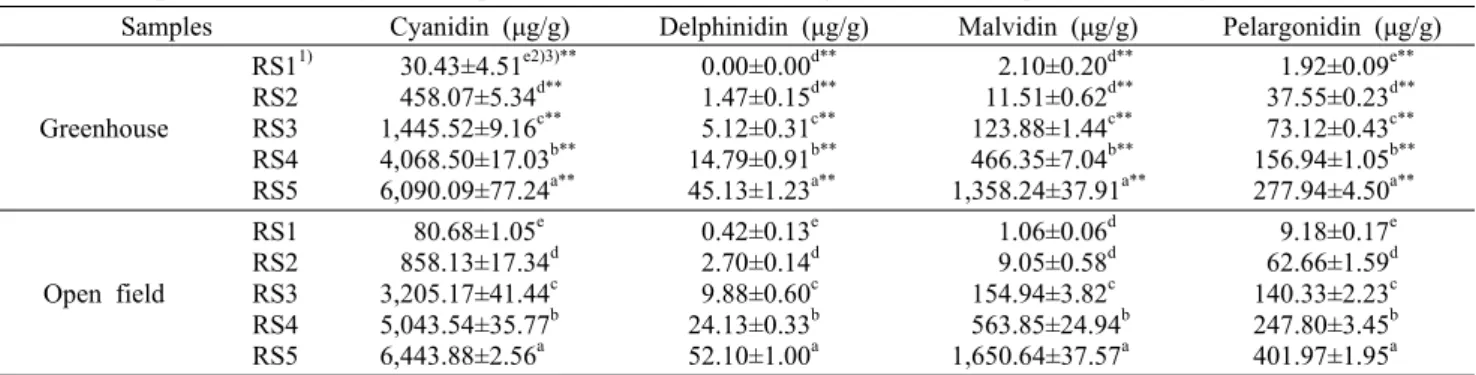
오디의 anthocyanin 중 주요 성분은 cyanidin, delphini-
din, malvidin 및 pelargonidin으로 확인되었으며, 함량은 Table 3과 같다. 각각의 함량은 30.43~6,443.88 μg/g, 0~
52.10 μg/g, 1.06~1,650.64 μg/g, 1.92~401.97 μg/g 범위 수준으로 나타났다. Cyanidin, delphinidin, pelargonidin 모두 숙기 단계가 진행될수록 유의적으로(P<0.05) 증가하 는 경향을 보였고, 재배방법별로는 노지 재배 오디의 함량이 모든 단계에서 유의적으로(P<0.05) 시설 재배 오디의 함량 보다 높게 나타났다. Malvidin은 1~2단계에서 유의적인 차 이가 없었으나, 나머지 단계에서 점차 증가하는 경향을 보였 다. 시설 유무로는 1~2단계에서 시설 오디의 함량이 높았으 나, 나머지 단계에서는 노지 재배 오디의 함량이 유의적으로 (P<0.01) 높게 나타났다.
Kim 등(5)은 오디의 품종별 anthocyanin 구성 성분 함량 을 C3G 및 C3R이 각각 223.20~788.26 mg% 및 94.63
~407.12 mg% 범위로 보고하여, 마지막 단계 오디의 함량 과 유사한 연구 결과였다. Jun 등(25)은 오디의 anthocya- nin 성분을 cyanidin-3-glucoside, cyanidin-3-rutino- side를 주요 성분으로 분석하였으며, 함량은 각각 121.6 mg%, 31.4 mg%로 보고하여 본 연구 결과와 상이하였는데, 이는 품종과 추출방법의 차이에서 기인한 것으로 생각된다.
Anthocyanin 색소의 발현 기작은 극히 복잡하여 유전적 요 소뿐만 아니라 여러 가지 환경조건에 의해서도 크게 좌우된 다. 광, 온도, 체내 질소 함량 및 수분상태 등이 모두 antho- cyanin의 색소의 생성에 영향을 미친다고 보고된 바 있다.
일반적으로 광은 anthocyanin 형성 발현에 대하여 촉진적 으로 작용한다. Joo와 Lim(44)은 광합성에 의해 체내에 탄 수화물을 증가시킴으로써 색소의 형성을 촉진시키는 것으 로 보고하였다. 청색 및 적색 필름 처리구에서 안토시아닌을 거의 형성하지 못하는 것으로 보고하여 광질의 차이가 안토 시아닌 형성에도 크게 관여한다고 보고하였는데, 이와 관련 하여 본 연구에서는 시설 재배 시 사용된 필름이 투과되는 광질에 영향을 미쳐 anthocyanin의 함량이 적게 나타난 것 으로 보인다.
Table 3. Comparison of anthocyanin compositions of mulberries from greenhouse and open field during maturation
Samples Cyanidin (μg/g) Delphinidin (μg/g) Malvidin (μg/g) Pelargonidin (μg/g)
Greenhouse
RS11) RS2 RS3 RS4 RS5
30.43±4.51e2)3)**
458.07±5.34d**
1,445.52±9.16c**
4,068.50±17.03b**
6,090.09±77.24a**
0.00±0.00d**
1.47±0.15d**
5.12±0.31c**
14.79±0.91b**
45.13±1.23a**
2.10±0.20d**
11.51±0.62d**
123.88±1.44c**
466.35±7.04b**
1,358.24±37.91a**
1.92±0.09e**
37.55±0.23d**
73.12±0.43c**
156.94±1.05b**
277.94±4.50a**
Open field
RS1 RS2 RS3 RS4 RS5
80.68±1.05e 858.13±17.34d 3,205.17±41.44c 5,043.54±35.77b 6,443.88±2.56a
0.42±0.13e 2.70±0.14d 9.88±0.60c 24.13±0.33b 52.10±1.00a
1.06±0.06d 9.05±0.58d 154.94±3.82c 563.85±24.94b 1,650.64±37.57a
9.18±0.17e 62.66±1.59d 140.33±2.23c 247.80±3.45b 401.97±1.95a
1)RS1∼5 indicate 5 ripening stages of mulberries from unripened state to ripen stage.
2)Values are mean±SD (n=3).
3)Values with different letters in same column indicate significant difference (P<0.05) by Duncan's multiple range test.
**P<0.01 indicate significant differences between greenhouse and open field by t-test.
요 약
시설 및 노지에서 재배된 오디를 숙기별로 분획하여 phe- nolic acid, flavonoid, anthocyanin의 구성성분 함량을 HPLC를 이용하여 측정하였다. 주요 phenolic acid로 caf- feic acid, coumaric acid, ferulic acid, sinapic acid가 확 인되었고, 각각 96.37~824.00 μg/g, 19.45~68.23 μg/g, 4.50~18.66 μg/g, 15.61~29.27 μg/g 범위 수준을 나타내 었다. 시설 및 노지 오디의 caffeic acid 및 sinapic acid의 함량은 숙기 초기에는 증가하는 경향을 보였으나 점차 감소 하는 경향을 보였다. Coumaric acid는 일정 함량을 유지하 였다가 마지막 단계에서 감소하였으며, ferulic acid는 숙기 가 진행됨에 따라 감소하는 경향을 보였다. 시설 및 재배 방법 간에는 전체적으로 노지 재배 오디의 phenolic acid의 함량이 높은 경향을 보였다. Flavonoid 성분 중 quercetin 과 kaempferol의 함량은 각각 44.17~1,661.73 μg/g 및 108.67~360.20 μg/g의 범위 수준을 나타내었다. Querce- tin은 숙기가 진행됨에 따라 감소하는 경향을 보였고, kaempferol은 노지 재배 오디의 경우 일정량을 유지하였으 나 시설 재배 오디의 경우 점차 증가하는 경향을 보였다.
재배방법 간에는 quercetin이 노지 재배 오디의 함량이 전 체적으로 높게 나타났으나, kaempferol은 노지 재배 오디 의 함량이 초기에는 높았다가 중간 단계에서는 낮았고 마지 막 단계에서는 차이가 없었다. Anthocyanin 중 주요성분은 cyanidin, delphinidin, malvidin, pelargonidin이 검출되었 으며, 각각의 함량은 30.43~6,443.88 μg/g, 0~52.10 μg/
g, 1.06~1,650 μg/g, 1.92~401.97 μg/g 범위 수준으로 나 타났다. Anthocyanin은 숙기가 진행됨에 따라 증가하는 경 향을 보였고, 재배방법별로는 노지 재배 오디의 함량이 유의 적으로 높게 나타났다. 숙성되었거나 숙성 전단계의 오디가 활성성분이 가장 많이 함유되어 있으며, 시설 재배보다는 노지 재배 오디의 성분 함량이 더 높은 것으로 나타났다.
이를 통해 기능성 성분이 풍부한 함량을 가진 숙기 단계를 고려하여 오디를 수확한다면 기능성 소재로서 활용성이 더
욱 높아질 것으로 기대된다.
감사의 글
본 연구는 농촌진흥청 공동연구사업(과제번호: PJ009440) 의 지원에 의해 이루어진 것으로 이에 감사드립니다.
REFERENCES
1. Branen AL. 1975. Toxicology and biochemistry of butylated hydroxyanisole and butylated hydroxytoluene. J Am Oil Chem Soc 52: 59-63.
2. Naczk M, Shahidi F. 2003. Phenolic compounds in plant foods: chemistry and health benefits. Nutraceuticals & Food 8: 200-218.
3. D'Archivio M, Filesi C, Di Benedetto R, Gargiulo R, Gio- vannini C, Masella R. 2007. Polyphenols, dietary sources and bioavailability. Ann Ist Super Sanita 43: 348-361.
4. Park SW, Jung SW, Ko SW. 1997. Quantitative analysis of anthocyanins among mulberry cultivars and their pharmaco- logical screening. Kor J Hort Sci Technol 38: 722-724.
5. Kim EO, Lee YJ, Leem HH, Seo IH, Yu MH, Kang DH, Choi SW. 2010. Comparison of nutritional and functional constituents, and physicochemical characteristics of mul- berrys from seven different Morus alba L. cultivars. J Korean Soc Food Sci Nutr 39: 1467-1475.
6. Kim HB, Kim AJ, Kim SY. 2003. The analysis of functional materials in mulberry fruit and feed product development trends. Food Science and Industry 36(3): 49-60.
7. Ministry of Agriculture, Food and Rural Affairs. 2013. Agri- culture, food and rural affairs statistics yearbook. Food and Rural Affairs, Seoul, Korea.
8. Kim TW, Kwon YB, Lee JH, Yang IS, Youm JK, Lee HS, Moon JY. 1996. A study on the antidiabetic effect of mul- berry fruits. Korean J Seric Sci 38: 100-107.
9. Kim SY, Park KJ, Lee WC. 1998. Antiinflammatory and antioxidative effects of Morus spp. fruit extract. Korean J Medicinal Crop Sci 6: 204-209.
10. Kim HJ, Cha JY, Choi ML, Cho YS. 2000. Antioxidative activities by water-soluble extracts of Morus alba and Cudra- nia tricuspidata. J Korean Soc Agric Chem Biotechnol 43:
148-152.
11. Lee SH, Kim HG. 2008. Inhibitory effect of mulberry ex-
tracts on angiogenesis in porcine pulmonary artery endothe- lial cells. J Life Sci 18: 653-659.
12. Jang MH, Ahn SY, Kim DY, Kim SH, Yun HK. 2010. Char- acteristics of grapevine growth under rain-cut cultivation system in the vineyard. Kor J Hort Sci Technol 28: 94-95.
13. Moon YE, Kim YH. 2005. Effects of heating temperature at maturing stage on fruit quality of citrus tangor (Shiranuhi, Kiyomi, and Tsunokaori) in the plastic film house. Kor J Hort Sci Technol 23: 49.
14. Lee SG, Choi CS, Lee HJ, Jang YA, Lee JG. 2015. Effect of air temperature on growth and phytochemical content of beet and SSamchoo. Kor J Hort Sci Technol 33: 303-308.
15. Kim JG, Jo JG, Kim HL, Ryou MS, Kim JB, Hwang HS, Hwang YS. 2011. Growth and fruit characteristics of blue- berry 'Northland' cultivar as influenced by open field and rain shelter house cultivation. J Bio-Environment Control 20: 387-393.
16. Shin SS, Yeon IK, Do HW, Lee JE, Seo YJ, Kang CK, Choi CD, Chun H, Choi YH, Chung DS, Park JS. 2007.
Effect of different greenhouse film on growth and yield in oriental melon (Cucumis melo L. var makuwa Makino). J Bio-Environment Control 16: 338-343.
17. Kataoka I, Beppu K. 2004. UV irradiance increases develop- ment of red skin color and anthocyanins in 'Hakuho' peach.
Hort Sci 39: 1234-1237.
18. Jabben M, Shanklin J, Vierstra RD. 1989. Red light-induced accumulation of ubiquitin-phytochrome conjugates in both monocots and dicots. Plant Physiol 90: 380-384.
19. Yun HK, Kim YC, Seo TC, Lee SG, Kim KY, Lee JG. 2003.
Effect of various kinds of ultraviolet irradiation on growth and antioxidant contents of some leafy vegetables. Kor J Hort Sci Technol 21: 94-97.
20. Caldwell CR, Britz SJ. 2006. Effect of supplemental ultra- violet radiation on the carotenoid and chlorophyll composi- tion of green house-grown leaf lettuce (Lactuca sativa L.) cultivars. J Food Compos Anal 19: 637-644.
21. Abdel-Aal ESM, Rabalski I. 2008. Bioactive compounds and their antioxidant capacity in selected primitive and mod- ern wheat species. Open Agric J 2: 7-14.
22. Shin YW, Lee SK, Kwon YJ, Rhee SJ, Choi SW. 2005.
Radical scavenging activities of phenolic compounds iso- lated from mulberry (Morus spp.) cake. J Food Sci Nutr 10: 326-332.
23. Kim JS, Ha TY, Ahn JY, Kim HK, Kim S. 2008. Composi- tion and quantitative analysis of stilbenoids in mulberry (Morus alba L.) leaves and fruits with DAD/UV HPLC.
J Korean Soc Food Sci Nutr 37: 124-128.
24. Lee JY, Park HR, Moon SO, Kwon YJ, Rhee SJ, Choi SW.
2004. Identification and quantification of anthocyanins and flavonoid in mulberry (Morus sp.) cultivars. Food Sci Bio- technol 13: 176-184.
25. Jun HI, Kim YA, Kim YS. 2014. Antioxidant activities of Rubus coreanus Miquel and Morus alba L. fruits. J Korean Soc Food Sci Nutr 43: 381-388.
26. Whang HJ. 1999. Changes of phenolic compounds in Korean apple (Fuji) during maturation. Korean J Food & Nutr 12:
364-369.
27. Harborne JB. 1989. Plant phenolics. In Methods in Plant Biochemistry. Academic Press, London, UK. Vol 1, p 329-
335.
28. Coseteng MY, Lee CY. 1987. Changes in apple polyphenol- oxidase and polyphenol concentrations in relation to degree of browning. J Food Sci 52: 985-989.
29. Dixon RA, Paiva NL. 1995. Stress-induced phenylpropanoid metabolism. Plant Cell 7: 1085-1097.
30. Rivero RM, Ruiz JM, García PC, López-Lefebre LR, Sán- chez E, Romero L. 2001. Resistance to cold and heat stress:
accumulation of phenolic compounds in tomato and water- melon plants. Plant Sci 160: 315-321.
31. Lattanzio V. 2003. Bioactive polyphenols: their role in qual- ity and storability of fruit and vegetables. J Appl Bot 77:
128-146.
32. Son KH, Park JH, Kim DI, Oh MM. 2012. Leaf shape index, growth, and phytochemicals in two leaf lettuce cultivars grown under monochromatic light-emitting diodes. Kor J Hort Sci Technol 30: 664-672.
33. Tsormpatsidis E, Henbest RGC, Davis FJ, Battey NH, Hadley P, Wagstaffe A. 2008. UV irradiance as a major influence on growth, development and secondary products of commer- cial importance in Lollo Rosso lettuce 'Revolution' grown under polyethylene films. Environ Exp Bot 63: 232-239.
34. Kang GS, Youm JR, Kang SS. 1993. Seasonal variations of the flavonol glycoside content from Ginkgo biloba leaves.
Kor J Pharmacogn 24: 47-53.
35. Park JC, Kim SH. 1995. Seasonal variation of flavonoid contents in the leaves of Cedrela sinensis. J Korean Soc Food Sci Nutr 24: 578-581.
36. Kim DS, Kozukue N, Han JS, Kim MH. 2004. The changes of components by maturity stage of tomato Ⅱ. Korean J Food Culture 19: 605-610.
37. Chae JY, Lee JY, Hoang IS, Whangbo D, Choi PW, Lee WC, Kim JW, Kim SY, Choi SW, Rhee SJ. 2003. Analysis of functional components of leaves of different mulberry cultivars. J Korean Soc Food Sci Nutr 32: 15-21.
38. Lee ST, Lee YH, Choi YJ, Shon GM, Lee HJ, Heo JS. 2002.
Comparison of quercetin and souble tannin in Houttuynia cordata THUNB. according to growth stages and plant parts.
Korean J Medicinal Crop Sci 10: 12-16.
39. Lee ST, Lee YH, Choi YJ, Lee YH, Cho JS, Heo JS. 2001.
Yield and bioactive component on different compost amounts and cultural methods of Saururus chinensis BAILL. Korean J Medicinal Crop Sci 9: 220-224.
40. Kakani VG, Reddy KR, Zhao D, Mohammed AR. 2003.
Effects of ultraviolet-B radiation on cotton (Gossypium hir- sutum L.) morphology and anatomy. Ann Bot 91: 817-826.
41. Oh MM, Trick HN, Rajashekar CB. 2009. Secondary metab- olism and antioxidants are involved in environmental adap- tation and stress tolerance in lettuce. J Plant Physiol 166:
180-191.
42. Kim HY, Cho MS. 2001. Effects of enhanced ultraviolet-B radiation on plants. J Bio-Environ Con 10: 197-206.
43. Yao Y, Yang Y, Ren J, Li C. 2006. UV-spectra dependence of seedling injury and photosynthetic pigment change in Cucumis sativus and Glycine max. Environ Exp Bot 57: 160- 167.
44. Joo MK, Lim JS. 2002. Effect of light and temperature on yield, chlorophyll and anthocyanin contents of leaf lettuce (Lactuca sativa L.). Kor J Intl Agri 14: 105-112.