• 검색 결과가 없습니다.

The Effect of Proton Conductivity of SPEEK Composite Membrane with Organic Compounds for DMFC

N/A
N/A
Protected

Academic year: 2021

Share "The Effect of Proton Conductivity of SPEEK Composite Membrane with Organic Compounds for DMFC"

Copied!
6
0
0

로드 중.... (전체 텍스트 보기)

전체 글

(1)

− 167

The Effect of Proton Conductivity of SPEEK Composite Membrane with Organic Compounds for DMFC

S. K. You, H. J. Kim, H. S. Shin

, J. S. Kim

, W. K. Choi

††

, and S. G. Park

†††,

*

(Received March 18, 2009 : Accepted April 28, 2009)

PureEChem Co., Ltd., 406 Industrial Technology Research Park Chungbuk National University, Chungbuk, 361-763, Korea

Techwin Co., Ltd., 66-26, Songjeong-dong, Heungduk-gu, Cheongju-si, Chungbuk, 361-290, Korea

††

School of Engineering, Dankook University, San 29, Anseo-dong Cheonan-si, Chungnam, 330-714, Korea

†††
Department of Industrial Chemical Engineering, Chungbuk National University, Chungbuk, 361-763, Korea Direct methanol fuel cells(DMFCs) are receiving significant attention in the portable power source

and electric vehicular transportation because of its high energy efficiency as liquid fuel, low cost, and no requirement of fuel reforming process. In this study, we synthesized the Sulfonated poly(ether ether ketone) (SPEEK) to evaluate the possibility of use as a proton exchange mem- brane for DMFC. And poly(vinylidienedifluoride) (PVDF) was used to increase proton conductivity in SPEEK and simultaneously to prevent methanol transport through the cross linked mem- brane. Furthermore, in order to improve the electrical composite properties for DMFC applications.

keywords : SPEEK, PVDF, Nafion, DMFC

1. Introduction

Today, the protecting of the global environment becomes an emergent matter and will give great benefit to human being in the future. Thus, research on fuel cells as emission free devices has hereby gained more and more concern. The direct methanol fuel cell (DMFC,) a kind of fuel cells using polymer electro- lytes, converts the chemical energy of liquid fuels directly into electrical energy. Currently it is consid- ered as one of the most promising candidate power sources for vehicular and portable applications.

However, DMFC development still provides con- siderable technical challenges, such as poor kinetics of methanol electro-oxidation and methanol crossover through the polymer electrolyte. Membrane methanol crossover from the anode to the cathode not only lowers fuel utilization, but also causes cathode depolarization.

Hydrated perfluorosulfonic acid membranes, such as Nafion

®

, are typically used as the electrolyte in fuel cells because of their excellent chemical, mechanical and in addition to their high conductivities.

The Nafion

®

membrane is suitable for fully humid- ified hydrogen fuel cells, but has an unacceptably high rate of methanol crossover for DMFC application. Thus, a less methanol-permeable membrane is desired to im- prove fuel utilization and electrochemical performance.

1,2)

In order to reduce the methanol crossover, several new membranes materials have been proposed. (a) synthesis of new polymers, including sulfonated poly(ether ether ketone),

3)

polysulfone,

4)

and polyimide,

5)

and (b) modifi- cation of existing polymers by introductionof a methanol barrier component. These modifications include incorporation of inorganic particles (e.g., silicon oxide,

6)

titanium oxide,

7)

zeolites

8)

and montmorillonite clay

9)

) intoNafion

®

, and blending poly (vinylidene fluo- ride),

10)

poly(vinyl alcohol),

11)

poly (1-vinylimida- zole),

12)

polypyrrole,

13)

and poly-benzimidazile

14)

with Nafion

®

. Among them membranes based on the aromatic poly(ether ether ketone) (PEEK) are promis- ing for DMFC applications as they possess good ther- mal stability and mechanical properties, and the proton conductivity can be controlled by the degree of sulfona- tion. According to the work of Kreuer, membranes based on SPEEK may help to alleviate the problems associated with high methanol crossover in DMFCs.

15)

*E-mail: [email protected]

(2)

2. Experimental 2.1. Chemicals and Materials

PEEK 450PF was purchased from Victrex

®

, sulfuric acid (95-98% pure), 5 wt.% Nafion Solution was supplied by Sigma Aldrich, PVDF-CO-HFP was supplied by Kynar Flex Dimethylformamide (DMF) was supplied by Banbury, Oxon.

2.2. Preparation of composite Membranes 2.2.1. Preparation of sulfonated PEEK

Earlier reports by Lei et al . Ref . indicate that a SPEEK polymer, with a degree of sulfonation above 60% is not suitable for DMFC application. Therefore, Poly(ether ether ketone)(SPEEK) was sulfonated up to a degree of 57% according to the procedure reported elsewhere Reference. The PEEK to be sulfonated is the PEEK 450PF supplied by Victrex in powder form.

It was dried in a vacuum oven at 100

o

C overnight.

Concentrated sulfuric acid (98% extra pure, as received) was heated to 55

o

C. An amount of 60 g of PEEK powder was dissolved carefully by adding small portions to one liter of the stirred acid. The reaction mixture was stirred for up to 7 hours at controlled temperature to achieve the desired conversion. Then the reaction ressel was immersing in an ice bath to stop the reaction. The polymer is precipitated in deionized water of at 5

o

C and washed until the pH was nearly 7. Then the polymer was subsequently dried on the lab table and in an oven at 100

o

C. The degree of sulfonation (the fraction of repeat units bearing − SO3H groups) of SPEEK was determined by titration: 1-2 grams of SPEEK was kept in 0.5 M aqueous NaOH for 1 day and then was back titrated with 1M HCl using phenolphthalene as an indicator.

2.2.2. Preparation of Nafion Resin

Evaporation of the Nafin solution at 60

o

C for 12 h till the Nafion solution became solid resin, and re- dissolve the Nafion resin with a desired volume of DMF(the volume ratio of DMF/Nafion is approxi- mately 15~25).

16)

2.2.3. Membrane Preparation

Dried SPEEK powder was mixed with DMF to make a 10 wt.% solution in an ultrasonic bath to which a Nafion DMF solution were mixed and under ultra- sonicate processing for 20 min to ensure complete

mixing. And 5 wt.% of Poly(vinylidene fluoride) (PVDF) powder was added, the slurry was cast over a glass substrate heated to 70

o

C for solvent evaporation.

Then, the membranes were stored in a vacuum oven for 7 h at 100

o

C and 24 hr at 140

o

C. The thickness of the prepared membranes was 100 μ m.

2.3. Characterization Methods

2.3.1. FT-IR spectroscopy and TG analysis The FT-IR spectra were recorded using a BRUKER IFS-66 FT-IR spectrometer with membrane samples.

A TA Instrument simultaneous Thermal Analyzer was employed to study the thermal stabilities of Nafion, SPEEK, Nafion-SPEEK and Nafion-SPEEK/PVDF samples. All the samples were heated from room temperature to 800

o

C under oxygen atmosphere at 5

o

C/min.

17)

2.3.2. Membrane Morphology

The membrane morphology was investigated by field emission scanning electron microscopy using JEOL 6400F equipment. The samples were coated with carbon for observation under a microscope.

2.3.3. Liquid Uptake measurements

Liquid uptake measurements were performed in batch process at room temperature. Before measurements, the membranes were dried in a vacuum oven at 120

o

C for 24 h. Weighed films with an area of 10 mm × 10 mm were immersed in deionized water and methanol (0.5~1.5 M) at room temperature for 24 h. The membranes were saturated with moisture until no further weight gain was observed. The liquid on the surface of wetted membranes was removed using tissue paper before weighing. The change in the weight of films was recorded. The percentage weight gain with respect to the original membrane weight was taken as liquid uptake. Each sample was tested with three specimens, omit taking the average of three tabulated test results.

2.3.4. Conductivity Measurement

The proton conductivities of the samples were

measured by AC impedance spectroscopy over a

frequency range of 10-107 Hz with a 50-500 mV

oscillating voltage, using an Impedance analyzer. Films

having a 10 mm × 20 mm, sandwiched between two

stainless steel electrodes with a contacting area of

100 mm

2

, connected from the FRA, were horizontally

(3)

to press the membrane to be tested.? The measured temperature was controlled from room temperature.

The conductivity was calculated from the impedance data, using the relation

σ = l / RS (1)

where l and S are the thickness and area of the membrane, respectively, and R was derived from the low intersect of the high frequency semi circle on a complex impedance plane with the Re(z) axis.

2.3.5. Methanol Permeability Measurements Methanol permeability coefficients were evaluated from measurements using a differential refractometer at room temperature with a 1 M methanol solution.

The permeability P was calculated from the slope of the straight-line plot of methanol concentration vs. permeation time. The water methanol selectivity of the composite membranes was obtained as the ratio between water and methanol permeability coefficients. Prior to all meas- urements, samples were immersed in deionized water at room temperature for 3 days.

3. Results and discussion

3.1. FT-IR spectroscopy and TG analysis characterization

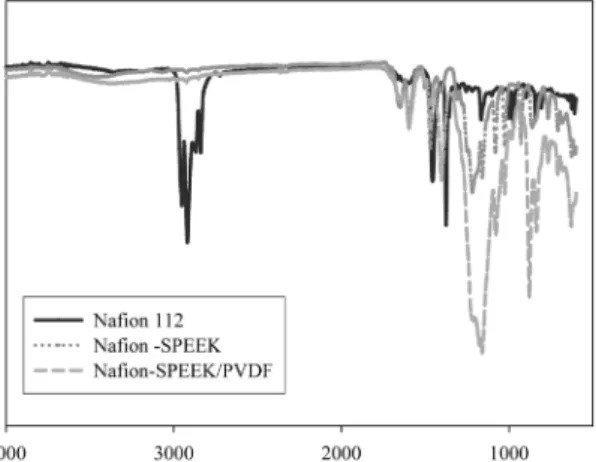
Fig. 1 shows the FT-IR spectra of Nafion, Nafion- SPEEK and Nafion-SPEEK/PVDF composite mem- brane. The brands at 1204, 1129, 1052 and 980 cm

−1

are ascribed to characteristic functional groups in Nafion.

18)

The brands 1595 cm

−1

(v(C = C)), 1432 cm

−1

( δ (CH2)), 739 cm

−1

( γ (= CH)) are attributed to char- acteristic vibrations of the benzene group(4). Fig. 2 shows the TGA curve of Nafion, SPEEK, Nafion- SPEEK and Nafion-SPEEK/PVDF samples. The initial weight loss around 100

o

C for all sample was due to the evaporation of water molecules absorbed in the samples.

The first weight loss occurring at 260

o

C or higher which is associated mainly with the loss of sulfonic acid groups and the second weight loss step starting at about 400

o

C, which is related to decomposition of the main chain. All sodium salt form SPEEK showed higher thermal stability (Td>400

o

C).

19)

3.2. Membrane Morphology

The membranes representative cross-sectional images of the samples are shown in Fig. 3, where in Fig. 3(a) shows Nafion 112, Fig 3(b) and 3(c) shows the composite membrane Nafion-SPEEK and Nafion- SPEEK/PVDF. From the SEM images, the PVDF particles can be considered as homogeneous and dense.

Higher magnification electron microscope shows good adhesion between organic fillers and polymer matrix in lower levels of filler and agglomeration of particles in higher levels of filler contact in polymer.

3.3 Liquid uptake Measurement

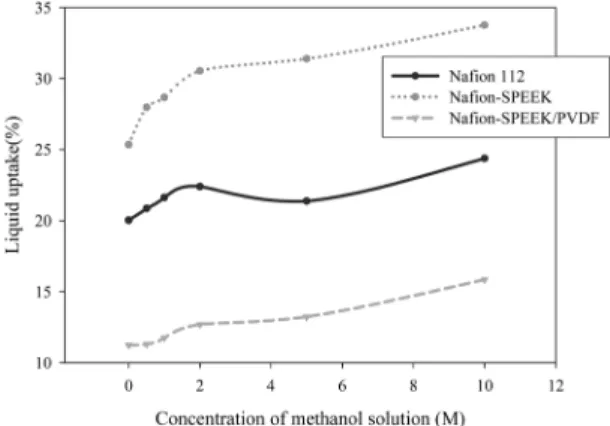
The water and methanol content of the SPEEK composite membranes and the Nafion membranes are shown in Fig. 4. The water content of the Nafion membrane in our experiments was 15.24%. The sul- fonated composite membranes showed higher water and methanol content than the Nafion membrane, pre- sumably due to the higher sulfonic acid content with its strong affinity to water and methanol. The water and methanol content of the composite membranes decreased Fig. 1. FT-IR spectra of SPEEK composite Membrane.

(a) Nafion 112, (b) Nafion-SPEEK, (c) Nafion-SPEEK/PVDF.

Fig. 2. Thermal-gravimetric analysis (TGA) of SPEEK

composite membrane and Nafion.

(4)

with PVDF particles incorporation, because organic particles reduces the membrane free volume and the swelling ability These results indicate that the water content, which greatly influences the methanol cross- over, can be controlled by the addition of PVDF particles. The uptake of SPEEK shows a decrease in methanol solution and an increase in water upon the sulfonation degree. Another phenomenon interesting us is that the uptake decreased in methanol solution when

the methanol concentration increased; the adsorptions of SPEEK in methanol solution were all higher than that in water. The particular investigations on this phe- nomenon are being conducted in our following research.

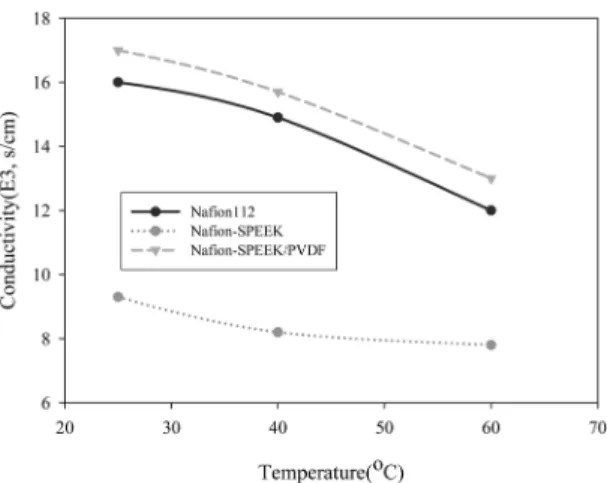
Comparing the liquid uptake studies and the cor- responding proton conductivity (Fig. 5), higher liquid uptake leads to higher proton conductivity, showing the importance of absorbed water in the proton conduc- tivity of sulfonated membranes.

3.4. Proton conductivity Measurement

Fig. 5 shows the effects of the PVDF particles in the SPEEK polymer. The conductivity of the composite membranes decreases with organic content, it can be observed that proton transport resistance increases with Fig. 3. SEM image of SPEEK composite Membrane, (a) Nafion 112, (b) Nafion-SPEEK, (c) Nafion-SPEEK/PVDF.

Fig. 4. Liquid uptake of SPEEK composite membrane as a function of methanol concentration.

Table 1. Liquid uptake of SPEEK composite membrane as a function of methanol concentration

Con (M) Nafion 112 Nafion-SPEEK Nafion-SPEEK /PVDF

0.0 18.54 30.99 10.65

0.5 18.70 28.45 10.87

1.0 20.05 27.53 10.05

1.5 22.19 25.21 10.93

(5)

the amount of organic filler. It is worth noting that for the membrane with the highest content of organic incorporation the resistance becomes very high. It would thus, be useful to explore experimentally how much each membranes can absorb water and how the proton conductivity in the composite membranes is affected by the amount of liquid uptake. It was reported that the proton conductivity is related to the ion cluster formation and liquid uptake content.

20)

However, lower liquid uptake content in composite membranes can also decrease methanol crossover. And the decrease of the proton conductivity with increase in filler content, is believed to derive mainly from the increased barrier properties of the membranes due to the incorporation of organic fillers.

3.5. Methanol permeability measurement Permeability measurements at room temperature showed previously that the membranes for the liquid uptake and proton conductivity properties, at PVDF particles the effects in the permeability coefficients of methanol are much more pronounced. Consequently, the barrier properties increases with the PVDF particles,

which can be assumed as an advantage for DMFC applications because it reduces the reactant loss and increases the overall fuel cell efficiency. Nevertheless, the verified proton conductivity decreases with the increase in the organic content should also be taken in account. The measured methanol permeability of Nafion

®

112 membrane is 0.19 × 10

−6

cm

2

/s at 2 h, It is important to note that the methanol permeability of composite membranes is in between

0.092×10

−7

to 0.17×10

−6

cm

2

/s, which is considerably smaller than that of Nafion

®

112 membrane.

4. Conclusion

The results showed that adding the PVDF particles in the SPEEK composite membranes leads to a decrease of the reactants permeability coefficients. The reason for these results is related with the increasing amount of organic filler in the membranes, which increases the membranes barrier properties in terms of mass transport.

These features are advantages for the direct methanol fuel cell performance because they prevent reactants loss and increase the PEM long-term stability. However, the results showed that the PVDF particles incorpo- ration has the detrimental effect of decreasing the proton Fig. 5. Proton conductivity of SPEEK composite membrane

as a function of temperature.

Table 2. Proton conductivity of SPEEK composite membrane as a function of temperature

Tem (

o

C) Nafion 112 Nafion-SPEEK Nafion-SPEEK /PVDF

25 17 7.8 16

40 15.7 8.2 14.9

60 13 7.8 12

Fig. 6. Methanol permeability of SPEEK composite Membrane as a function of methanol concentration.

Table 3. Methanol permeability of SPEEK composite Membrane as a function of methanol concentration

Time (hr) Nafion 112 Nafion-SPEEK Nafion-SPEEK /PVDF

1 0.1 0.23 0.092

2 0.19 0.57 0.099

3 0.59 0.91 0.12

4 1.2 1.35 0.17

(6)

conductivity. The micrographs obtained by scanning electron microscopy showed a good adhesion between inorganic particles domains and the polymer matrix.

Furthermore, the different contents of PVDF particle in the SPEEK polymer inorganic matrix enabled the preparation of composite membranes with a wide range of properties concerning proton conductivity, liquid uptake and methanol and water permeation.

Acknowledgments

This work was supported by the research grant of the Chungbuk National University in 2007.

References

1. Suzhen Ren, Gongquan Sun, Chennan Li, Zhimou Wu, Wei Jin, Weimin Chen, Qin Xin, and Xuefeng Yang- Materials Letters 60 , 44 (2006)

2. Ruichun Jiang, H. Russell Kunz, and James M. Fenton - Journal of Membrane Science 272 , 116 (2006)

3. P. Xing, G. P. Robertson, M. D. Guiver, S. D. Mikhailenko, and S. Kaliaguine, Macromolecules 37 , 7960 (2004).

4. N. Y. Arnett, W. L. Harrison, A. S. Badami, A. Roy, O.

Lane, F. Cormer, L. Dong, and J. E. McGrath, J. Power Sources 172 , 20 (2007).

5. N. Asano, M. Aoki, S. Suzuki, K. Miyatake, H. Uchida, and M. Watanabe, J. Am. Chem. Soc. 128 , 1762 (2006).

6. D. H. Jung, S. Y. Cho, D. H. Peck, D. R. Shin, and J. S.

Kim, J. Power Sources 106 , 173 (2002).

7. V. Baglio, A. Di Blasi, A. S. Arico, V. Antonucci, P. L.

Antonucci, F. S. Fiory, S. Licoccia, and E. Traversa, J. New Mater. Electrochem. Syst. 7 , 275(2004).

8. V. Tricoli and F. Nannetti, Electrochim. Act. 48 , 2625 (2003).

9. D. H. Jung, S. Y. Cho, D. H. Peck, D. R. Shin, and J. S.

Kim, J. Power Sources 118 , 205 (2003).

10. F. A. Landis, R. B. Moore, Macromolecules 33 , 6031 (2000).

11. N. W. DeLuca, Y. A. Elabd, J. Power Sources 163 , 386 (2006).

12. B. Bae, H. Y. Ha, and D. Kim, J. Electrochem. Soc. 152 , A1366 (2005).

13. H. S. Park, Y. J. Kim, W. H. Hong, Y. S. Choi, H. K. Lee, Macromolecules 38 , 2289 (2005).

14. L. Gubler, D. Kramer, J. Belack, O. Unsal, T. J. Schmidt, and G. G. Scherer, J. Electrochem. Soc. 154 , B981 (2007).

15. Suzhen Ren, Chennan Li, Xinsheng Zhao, Zhimo Wu, Suli Wang, Gongquan Sun, Qin Xin, and Xuefeng Yang - Journal of Membrane Science 247 , 59 (2005).

16. Chennan Li, Gongquan sun, Suzhen Ren, Jin Lin, Qi Wang, Zhimou Wu, Hai Sun, and Wei Jin - Journal of Membrane Science 272 , 50(2006).

17. Song Xue and Geping Yin - European Polymer Journal

42 , 776 (2006).

18. G. Luneau, A. Denoyelle, J. Y. Sanchez, and C. Poinsignon Electrochem. Acta 37 , 1615 (1992).

19. Peixiang Xing and Gilles P. Robertson, Michael D. Guiver, Serguei D. Mikhailenko, Serge Kaliaguine - Polymer 46 , 3257 (2005).

20. Lei Li, Li Xu, and Yuxin Wang-Materials Letters 57 ,

1406 (2003).

수치

Fig. 2. Thermal-gravimetric analysis (TGA) of SPEEK composite membrane and Nafion.
Fig. 4. Liquid uptake of SPEEK composite membrane as a function of methanol concentration.
Table 2. Proton conductivity of SPEEK composite membrane as a function of temperature

참조

관련 문서

• 이명의 치료에 대한 매커니즘과 디지털 음향 기술에 대한 상업적으로의 급속한 발전으로 인해 치료 옵션은 증가했 지만, 선택 가이드 라인은 거의 없음.. •

After choosing the type of bike, the next step is the right bike size. the right size for you from

44 글의 첫 번째 문장인 The most important thing in the Boat Race is harmony and teamwork.을 통해 Boat Race에서 가장 중요한 것은 조 화와 팀워크임을

Now that you have the right bike for you, it is important to learn the right riding position.. A poor riding position can lead to injuries

44 글의 첫 번째 문장인 The most important thing in the Boat Race is harmony and teamwork.을 통해 Boat Race에서 가장 중요한 것은 조 화와 팀워크임을

Modern Physics for Scientists and Engineers International Edition,

If both these adjustments are considered, the resulting approach is called a bootstrap-BC a -method (bias- corrected-accelerated). A description of this approach

③ A student who attended Korean course at KNU Korean Language Program and holds TOPIK Level 3 or a student who completed Korean course Level 4 at the KNU Korean Language