R E V I E W Open Access
Recent advances in dental implants
Do Gia Khang Hong and Ji-hyeon Oh
*Abstract
Dental implants are a common treatment for the loss of teeth. This paper summarizes current knowledge on implant surfaces, immediate loading versus conventional loading, short implants, sinus lifting, and custom implants using three-dimensional printing. Most of the implant surface modifications showed good osseointegration results.
Regarding biomolecular coatings, which have been recently developed and studied, good results were observed in animal experiments. Immediate loading had similar clinical outcomes compared to conventional loading and can be used as a successful treatment because it has the advantage of reducing treatment times and providing early function and aesthetics. Short implants showed similar clinical outcomes compared to standard implants. A variety of sinus augmentation techniques, grafting materials, and alternative techniques, such as tilted implants, zygomatic implants, and short implants, can be used. With the development of new technologies in three-dimension and computer-aided design/computer-aided manufacturing (CAD/CAM) customized implants can be used as an alternative to conventional implant designs. However, there are limitations due to the lack of long-term studies or clinical studies. A long-term clinical trial and a more predictive study are needed.
Keywords: Dental implants, Osseointegration, Immediate dental implant loading, Sinus floor augmentation, Computer-aided design
Background
The most common cause of teeth loss is periodontitis, and other causes include dental caries, trauma, develop- mental defects, and genetic disorders [1]. The use of dental implants to rehabilitate the loss of teeth has in- creased in the last 30 years [2]. Before dental implants, dentures and bridges were used, but dental implants have become a very popular solution due to the high success rate and predictability of the procedure, as well as its relatively few complications [1, 3].
Many studies related to dental implants have been published and some are in progress. In this paper, current knowledge of dental implants is summarized in each section (implant surface, immediate loading versus conventional loading, short implant, sinus lifting, and custom implant using three-dimensional printing).
Review Implant surface
Modification of the implant surface has been studied and applied to improve biological surface properties favoring
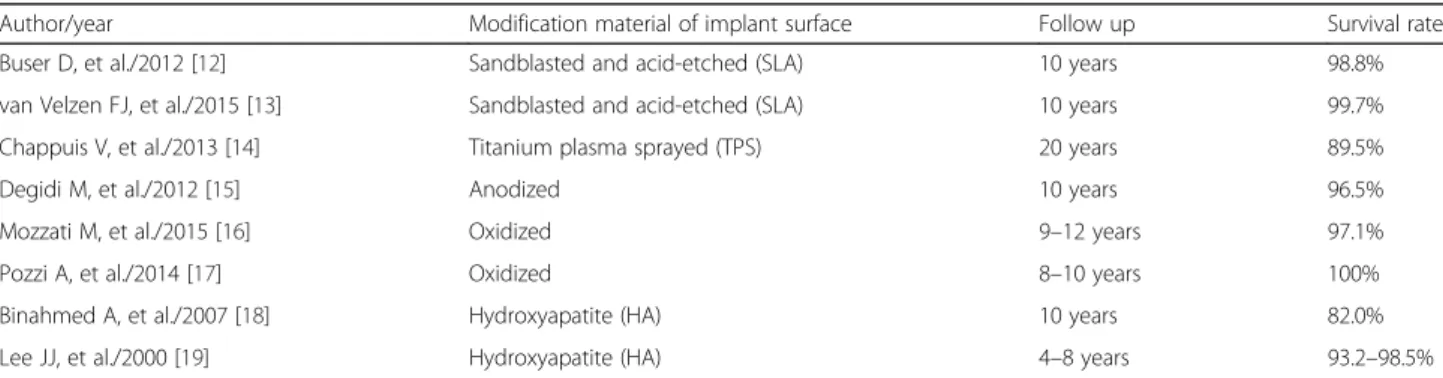
osseointegration [4]. The surface roughness of implants has been increased by various methods such as machining, plasma spray coating, grit blasting, acid etching, sandblasted and acid etching (SLA), anodizing, and biomimetic coating [3 –6]. The key factor in implant osseointegration is surface roughness, which shows increased osteoblast activity at 1 to 100 μm of the surface roughness compared to a smooth sur- face [6]. It is believed that rough surfaces have better osseointegration than smooth surfaces, but the results of the research have been diverse and it is not clear that multiple treatments provide better predictive results [7].
The machined implant surface is the first-generation im- plant surface design with a turned surface implant [4, 7].
Plasma spray coating generally forms a thick layer of depos- ition such as hydroxyapatite (HA) and titanium by spraying a material dissolved in heat on the surface of the implant [5]. Grit-blasting is a process of spraying particles onto the surface of the implant using ceramic material or silica.
Sand, HA, alumina or titanium dioxide (TiO
2) particles are used and acid etching is performed to remove the remaining blasting particles [5]. Acid-etching is the rough- ening of the titanium implant surfaces using strong acids such as hydrofluoric acid (HF), nitric acid (HNO
3), and sulfuric acid (H
2SO
4) or combinations of these acids [5].
* Correspondence: [email protected]
Department of Oral and MaxilloFacial Surgery, Dental Hospital,
Gangneung-Wonju National University, Gangneung-si, Gangwon-do, Korea, Republic of
© The Author(s). 2017 Open Access This article is distributed under the terms of the Creative Commons Attribution 4.0 International License (http://creativecommons.org/licenses/by/4.0/), which permits unrestricted use, distribution, and reproduction in any medium, provided you give appropriate credit to the original author(s) and the source, provide a link to the Creative Commons license, and indicate if changes were made.