pISSN 1229-5418 eISSN 2671-6623
Implantology 2019; 23(4): 196-204 https://doi.org/10.32542/implantology.2019016
Received: November 26, 2019 Revised: December 26, 2019 Accepted: December 26, 2019 ORCID
Se-Jin Park
https://orcid.org/0000-0003-2206-805X Sang-Hoon Kang
https://orcid.org/0000-0003-3335-3040 Copyright © 2019. The Korean Academy of Oral &
Maxillofacial Implantology
This is an Open Access article distributed under the terms of the Creative Commons Attribution Non-Commercial License (http://creativecommons.
org/licenses/by-nc/4.0/) which permits unrestricted non-commercial use, distribution, and reproduction in any medium, provided the original work is properly cited.
OPEN ACCESS
Purpose: We introduce a technique using a monopolar electrocautery unit to eliminate failed dental implant fixtures. The goal of this research was to establish a protocol of electrocautery settings when removing dental implants.
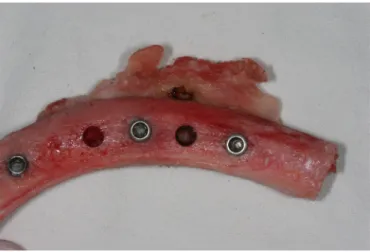
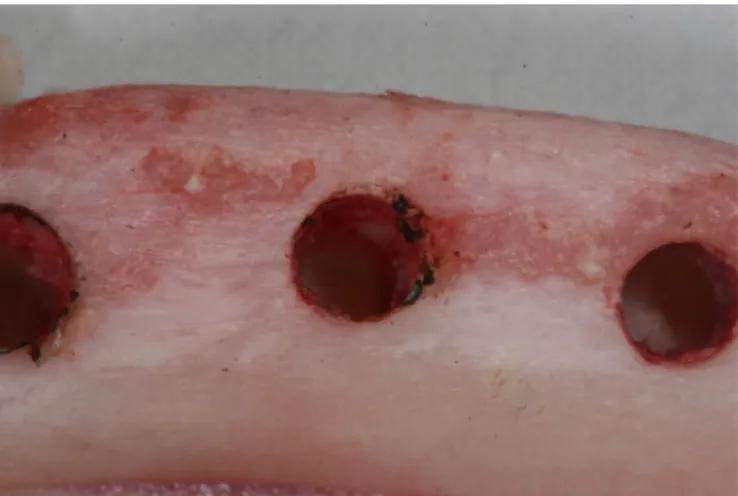
Materials and Methods: The study was conducted on fresh pork ribs. Implantium implants sized Ø4.5 × 10 mm were used. They (n = 45) were categorized into three groups according to the monopolar electric cautery power (coagulation mode) and adapted time as follows: 30 watt and 20 second (n = 15), 40 watt and 40 second (n = 15), and control group (n = 15). The torque in the removal of the implant fixtures, after monopolar electro cauterization directly inside the implant fixture, was also measured.
Results: The mean torque [unit; N·mm] during removal of the dental implant fixtures with an Elcomed implant engine, after monopolar electrocauterization directly inside the implant fixture, for each group was 296 in the 30 watt and 20 second group and 184 in the 40 watt and 40 second group.
The mean torque of removal of the dental implant fixtures was 279 N·mm in the control group. The mean torque was significantly lower in the 40 watt and 40 second group than in the other groups (p
= 0.006).
Conclusion : This method employs the principle of thermo-necrosis of the surrounding bone and weakening of the bone-implant interface. Monopolar electrocautery can be considered as an alternative method for the removal of failed or poorly positioned dental implants without the need of grinding the bony tissue surrounding the implant fixture.
Keywords: Dental implant, Electrocautery
Abstract
A Preliminary Report
Se-Jin Park, DDS
1, Sang-Hoon Kang, DDS, PhD
2*1
Resident, Department of Oral and Maxillofacial Surgery, National Health Insurance Service Ilsan Hospital, Goyang, Korea
2