• 검색 결과가 없습니다.

Supradiaphragmatic Heterotopic Liver Presenting as a Pleural Mass: A Case Report

N/A
N/A
Protected

Academic year: 2021

Share "Supradiaphragmatic Heterotopic Liver Presenting as a Pleural Mass: A Case Report"

Copied!
5
0
0

로드 중.... (전체 텍스트 보기)

전체 글

(1)

Tuberc Respir Dis 2010;69:191-195

CopyrightⒸ2010. The Korean Academy of Tuberculosis and Respiratory Diseases. All rights reserved.

Supradiaphragmatic Heterotopic Liver Presenting as a Pleural Mass:

A Case Report

Jungsuk An, M.D.

1

, Joungho Han, M.D.

2

, Kyung Soo Lee, M.D.

3

, Yong Soo Choi, M.D.

4

1

Department of Pathology, Gachon University Gil Hospital, Incheon, Departments of

2

Pathology,

3

Radiology,

4

Thoracic Surgery, Samsung Medical Center, Sungkyunkwan University School of Medicine, Seoul, Korea

Abnormally located liver tissue has been described in the vicinity of the liver proper, near anatomical structures such as the gallbladder, the umbilical fossa, the adrenal gland, the pancreas, and the spleen. Supradiaphragmatic ectopic liver is a rare finding, but has been reported to have been found in the intrathoracic cavity and in the pericardium. In the majority of supradiaphragmatic ectopic liver cases, there was an accompanying transdiaph- ragmatic pedicle of the main liver body into the abdominal cavity. In a minority of supradiaphramatic ectopic liver cases, the liver was completely separated from the abdominal cavity without a connection between the thorax and the abdomen, with accompanying diaphragmatic anomalies. We describe one case of intrathoracic ectopic liver in a patient with a previous history of lower chest wall trauma, and a brief review of the English-language medical literature on this topic.

Key Words: Liver; Thorax; Diaphragm

Address for correspondence: Joungho Han, M.D.

Department of Pathology, Samsung Medical Center, Sungkyunkwan University School of Medicine, 50, Ilwon- dong, Gangnam-gu, Seoul 135-710, Korea

Phone: 82-2-3410-2800, Fax: 82-2-3410-0025 E-mail: [email protected]

Received: Feb. 14, 2010 Accepted: Jun. 18, 2010

Introduction

Abnormally positioned liver tissue has been described commonly in the vicinity of liver proper such as the gallbladder, umbilical fossa, adrenal gland, pancreas and the spleen

1,2

. Supradiaphragmatic ectopic liver is a rare finding, which has been reported in the intra- thoracic cavity and pericardium

1-14

. In a majority the su- pradiaphragmatic ectopic liver was accompanied by a transdiaphragmatic pedicle into the main body of liver in the abdominal cavity

4-6,9-11

. In other cases supra- diaphramatic ectopic liver was completely separated from the abdominal cavity without a connection be- tween the thorax and the abdomen, and diaphragmatic anomalies

1,2,7

. We describe one case of intrathoracic ec- topic liver in a patient with previous history of trauma

on the lower chest wall and a brief review of the English literature.

Case Report

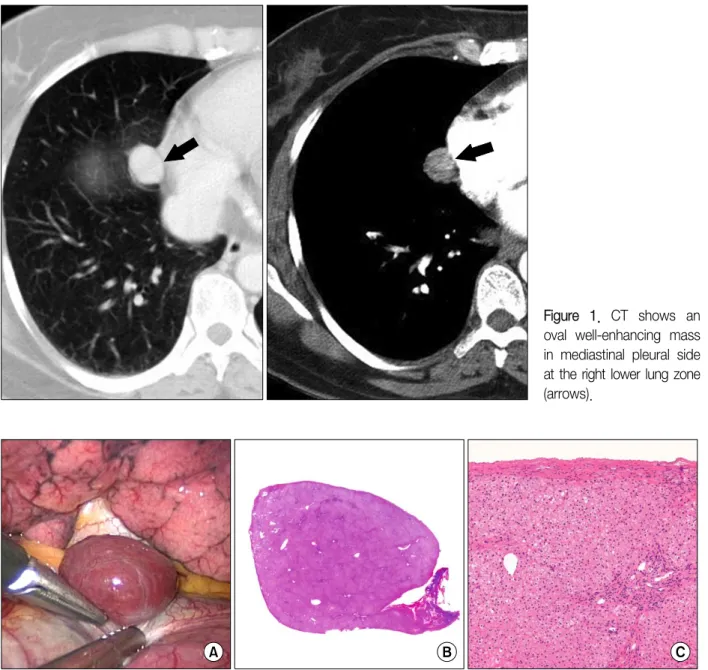
A 48-year-old woman was refered to our center due to a right supradiaphragmatic, pleural mass. Approxi- mately 9 years ago, the patient had an injury on the right lower chest wall by car accident, and underwent closed thoracostomy. After the treatment in duration of about one week, the patient had no sequent problem.

One month ago, the patient visited a local clinic due

to cough and dyspnea. A computed tomography (CT)

scan performed, which showed an oval well-enhancing

mass in the mediastinal pleural side at the right lower

lung zone, abutting the inferior portion of the right ma-

jor fissure (Figure 1). On the clinical impression of be-

nign fibrous tumor of the pleura or peripheral lung car-

cinoid tumor, the patient underwent a video-assisted

thoracoscopic surgery. The operative field showed a 2

cm-sized oval mass based on the right hemidiaphragm

close to the mediastinum, but the mass was not attached

(2)

Figure 1. CT shows an oval well-enhancing mass in mediastinal pleural side at the right lower lung zone (arrows).

Figure 2. (A) The operative field shows a 2 cm-sized oval mass based on the right hemidiaphragm close to the media- stinum, but the mass is not attached to the lung and liver. (B) The mass have a well defined fibrous capsule (H&E stain, ×1). (C) Microscopically, the mass shows normal liver tissue consisting of polygonal hepatocytes without significant pathologic abnormality (H&E stain, ×40).

to the lung and liver (Figure 2A). Neither otherwise ab- normal structure such as pedicle nor defect of the sur- rounding organs including the diaphragm and lung was identified. The mass was separated with easy by ex- cision using electrocautery. The cut surface of the mass was homogenously solid and brown in color with well defined fibrous capsule (Figure 2B). Microscopically, the mass showed normal liver tissue consisting of polyg-

onal hepatocytes without significant pathologic abnor- mality (Figure 2C).

Discussion

Ectopic liver have been classified into four types by

Collan et al.

15

. These consist of 1) an accessory lobe

of the liver of considerable size and with a connecting

(3)

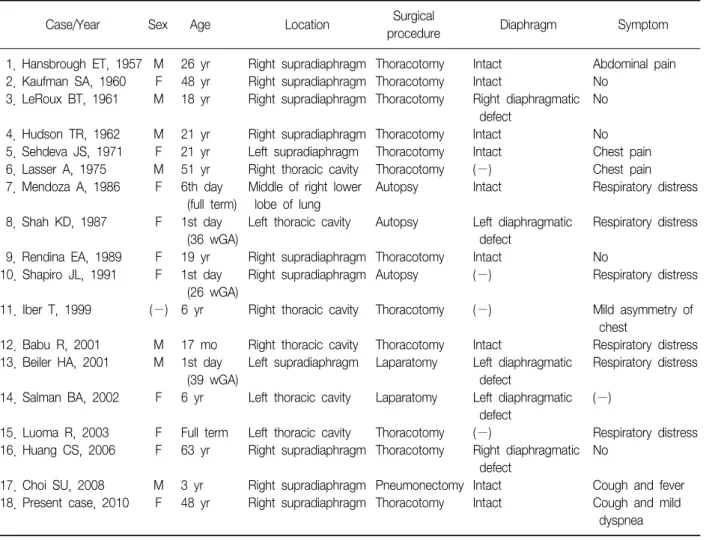
Table 1. Literature review of published cases

Case/Year Sex Age Location Surgical

procedure Diaphragm Symptom

1. Hansbrough ET, 1957 M 26 yr Right supradiaphragm Thoracotomy Intact Abdominal pain 2. Kaufman SA, 1960 F 48 yr Right supradiaphragm Thoracotomy Intact No

3. LeRoux BT, 1961 M 18 yr Right supradiaphragm Thoracotomy Right diaphragmatic No defect

4. Hudson TR, 1962 M 21 yr Right supradiaphragm Thoracotomy Intact No 5. Sehdeva JS, 1971 F 21 yr Left supradiaphragm Thoracotomy Intact Chest pain 6. Lasser A, 1975 M 51 yr Right thoracic cavity Thoracotomy (−) Chest pain 7. Mendoza A, 1986 F 6th day Middle of right lower Autopsy Intact Respiratory distress

(full term) lobe of lung

8. Shah KD, 1987 F 1st day Left thoracic cavity Autopsy Left diaphragmatic Respiratory distress

(36 wGA) defect

9. Rendina EA, 1989 F 19 yr Right supradiaphragm Thoracotomy Intact No

10. Shapiro JL, 1991 F 1st day Right supradiaphragm Autopsy (−) Respiratory distress (26 wGA)

11. Iber T, 1999 (−) 6 yr Right thoracic cavity Thoracotomy (−) Mild asymmetry of chest

12. Babu R, 2001 M 17 mo Right thoracic cavity Thoracotomy Intact Respiratory distress 13. Beiler HA, 2001 M 1st day Left supradiaphragm Laparatomy Left diaphragmatic Respiratory distress

(39 wGA) defect

14. Salman BA, 2002 F 6 yr Left thoracic cavity Laparatomy Left diaphragmatic (−) defect

15. Luoma R, 2003 F Full term Left thoracic cavity Thoracotomy (−) Respiratory distress 16. Huang CS, 2006 F 63 yr Right supradiaphragm Thoracotomy Right diaphragmatic No

defect

17. Choi SU, 2008 M 3 yr Right supradiaphragm Pneumonectomy Intact Cough and fever 18. Present case, 2010 F 48 yr Right supradiaphragm Thoracotomy Intact Cough and mild

dyspnea wGA: weeks' gestational age; (−): not mentioned.

stalk to the liver, 2) a small accessory lobe of the liver attached to the liver, 3) ectopic liver located without connection to the liver, and 4) microscopic ectopic liver tissue. Ectopic liver mostly occurs in the intraabdominal cavity as the first or second type, but rare cases of su- pradiaphragmatic ectopic were reported in the litera- ture. The case we described herein belongs to the third of these categories.

A search of the medical literature worldwide dis- closed 17 fully described cases of supradiaphragmatic heterotopic liver (Table 1). The first case was described in 1957 by Hansbrough and Lipin

3

. In all of the cases published so far, including our one, the age at initial diagnosis varied 26 weeks’ gestational age to 63 years and male to female ratio was 1.43:1. The sizes of the

lesion varied from 0.3 to 12 cm in the largest dimension. The adult patients usually showed no specif- ic symptom. The most common symptoms in the pedia- tric patients were respiratory distress and chest pain. In one case, the patient presented with thoracic pain caused by an incomplete torsion of an intrathoracic ec- topic liver lobe

5

.

Intrathoracic heterotopic liver usually is found in-

cidentally in chest X-ray as a radiopaque mass

14

.

Although, high-resolution CT is useful for evaluating in-

trathoracic masses, hetertopic liver cannot be diagnosed

using imaging alone. In some cases, the patient was di-

agnosed as having tumor of pleura, diaphragm or me-

diastinum on preoperative CT

5,6,12

. Like these, accurate

preoperative diagnosis of intrathoracic heterotopic liver

(4)

is difficult due to its rarity. However, ultrasonography or CT-guided biopsy may be helpful to establish a cor- rect diagnosis. In one case, supradiaphragmatic hetero- topic liver was misdiagnosed as the pulmonary seques- tration

13

. Color Doppler ultrasonography or angiography may show a feeding vessel and also contribute to differ- entiate pulmonary sequestrations from heterotopic liv- er

10

.

According to the literature, several possible mecha- nisms for development of heterotopic liver were proposed. In pediatric and young adult patients present- ing supradiaphramatic liver with a connection such as a transdiaphragmatic pedicle into the liver proper and/or diaphragmatic hernia, the cause could be ex- plained by anomaly in the development of diaphragm and liver bud

4,6

. Embryologically, the hepatic bud origi- nating from the forgut grows into the mesenchyme of the septum transversum around the fourth week of ges- tation and then proliferates actively. At the approx- imately same time, the diaphragm develops centrally from the septum transversum and peripherally from the right and left pleuroperitoneal membranes. Normally the pleuroperitoneal cavity closes between the sixth and seventh week of gestation. A small portion of proliferat- ing hepatic tissue may grow into the thoracic cavity be- fore complete closure of the diaphragmatic membrane and the defect in fusion of the diaphragmatic mem- branes may allow the sequestration of hepatic tissue.

As a result, supradiaphramatic liver could develop with atrophy or regression of the original connection to the abdominal liver

2

. Other possibility could be the devel- opment of an entirely separate liver bud independent of the main hepatic diverticulum without any prior con- nection

2

. This mechanism might explain the patho- genesis of the supradiaphragmatic liver without a pedi- cle into the liver proper.

Another explainable mechanism for minority of cases in the literature was related with previous trauma history. In two previously reported cases, heterotopic liver in the right thoracic cavity were detected following a trauma on the lower chest in patients who were 51 and 63 years old

1,12

. The heterotopic liver presented as

a newly detected supradiaphramatic mass in both cases and were considered as acquired rather than congenital by the authors. According to one of these reports, the most plausible explanation was that during the previous trauma a fragment of liver parenchyma was introduced into the thoracic cavity, followed by through subsequent regeneration and development of a nodular mass

1

. This mechanism seems to be more possible in cases of mid- dle-aged or old patients who had not represented any abnormality in the diaphragm and the liver in their childhood and young adulthood and underwent later traumatic injury on the lower chest or/and upper abdomen. The pathogenesis in our case can be also ex- plained by the last proposed mechanism, and that a tiny fragment of liver parenchyme might be sequestered in to the right thoracic cavity during the injury by car acci- dent in nine years ago.

In reviewing all reported cases of supradiaphragmatic heterotopic liver to date, the surgery has been straight- forward with excellent prognosis. Heterotopic tissue, al- though extremely rare, should be taken in consideration into differential diagnosis of a supradiaphragmatic mass.

To the best of our knowledge, this is not only a rare case of supradiaphragmatic heterotopic liver, but also a third case of patient having this entity with a previous trauma history in English literature. We believe that awareness and understanding pathogenesis of this entity is helpful in preoperative evaluation and a correct intra- operative diagnosis of a supradiaphragmatic mass.

References

1. Lasser A, Wilson GL. Ectopic liver tissue mass in the thoracic cavity. Cancer 1975;36:1823-6.

2. Mendoza A, Voland J, Wolf P, Benirschke K. Supradia- phragmatic liver in the lung. Arch Pathol Lab Med 1986;110:1085-6.

3. Hansbrough ET, Lipin RJ. Intrathoracic accessory lobe of the liver. Ann Surg 1957;145:564-7.

4. Le Roux BT. Heterotopic mediastinal thyroid. Thorax 1961;16:192-6.

5. Sehdeva JS, Logan WD Jr. Heterotopic (supradiaphrag- matic) liver. Ann Thorac Surg 1971;11:468-71.

6. Rendina EA, Venuta F, Pescarmona EO, Martelli M,

(5)

Ricci C. Intrathoracic lobe of the liver: case report and review of the literature. Eur J Cardiothorac Surg 1989;

3:75-8.

7. Shapiro JL, Metlay LA. Heterotopic supradiaphragmatic liver formation in association with congenital cardiac anomalies. Arch Pathol Lab Med 1991;115:238-40.

8. Kinnunen P, Kulmala P, Kaarteenaho-Wiik R, Vuopala K. Ectopic liver in the human pericardium. Histopa- thology 1997;30:277-9.

9. Iber T, Rintala R. Intrapulmonary ectopic liver. J Pediatr Surg 1999;34:1425-6.

10. Babu R, Van der Avoirt A. Ectopic intrathoracic liver.

Pediatr Surg Int 2001;17:461-2.

11. Luoma R, Raboei E. Supradiaphragmatic accessory liv-

er: a rare cause of respiratory distress in a neonate.

J Pediatr Surg 2003;38:1413-4.

12. Huang CS, Hsu WH, Hsia CY. Supradiaphragmatic ec- topic liver: delayed traumatic hepatic hernia mimics pulmonary tumor. Thorac Cardiovasc Surg 2007;55:

277-8.

13. Choi SU, Kim HK, Kim J. Heterotopic supradiaphrag- matic liver combined with intralobar pulmonary seque- stration. Ann Thorac Surg 2008;85:1809-10.

14. Hudson TR, Brown HN. Ectopic (supradiaphragmatic) liver. J Thorac Cardiovasc Surg 1962;43:552-5.

15. Collan Y, Hakkiluoto A, Hästbacka J. Ectopic liver. Ann

Chir Gynaecol 1978;67:27-9.

수치

Figure  1.  CT  shows  an  oval  well-enhancing  mass  in  mediastinal  pleural  side  at the right lower lung zone (arrows).
Table  1.  Literature  review  of  published  cases

참조

관련 문서

There are few studies reporting cases of gastric mucormycosis in patients with liver cirrhosis, and even fewer reporting the successful treatment of invasive gastric mucormycosis

Although the majority of studies showed that an interval growth of FNH is uncommon, there are occasional re- ports of FNH cases with interval regression (5, 10). Mathieu et al.

14,15 And many cases consid- ered PLNET, especially in the past, were patient with metastatic disease from occult gastrointestinal NET, as consequence of this, the main

In two cases of hep- atitis due to poisoning by drugs and one case of liver cirrhosis, long-term administration of MCWG pharmacopuncture yielded significant changes in AST and