• 검색 결과가 없습니다.

Intrathoracic Desmoid Tumor Mimicking Pleural Mass: A Case Report

N/A
N/A
Protected

Academic year: 2021

Share "Intrathoracic Desmoid Tumor Mimicking Pleural Mass: A Case Report"

Copied!
5
0
0

로드 중.... (전체 텍스트 보기)

전체 글

(1)

Tuberc Respir Dis 2009;67:449-453

CopyrightⒸ2009. The Korean Academy of Tuberculosis and Respiratory Diseases. All rights reserved.

Intrathoracic Desmoid Tumor Mimicking Pleural Mass: A Case Report

Departments of

1

Pathology,

2

Thoracic Surgery,

3

Internal Medicine, Gachon University Gil Hospital, Incheon, Korea

Na Rae Kim, M.D.

1

, Dong-Hae Chung, M.D.

1

, Jae-Ik Lee, M.D.

2

, Sung Hwan Jeong, M.D.

3

, Seung-Yeon Ha, M.D.

1

Desmoid tumor (fibromatosis) is a histologically benign fibrous neoplasm showing locally infiltrating growth. This type of tumor commonly occurs in the abdomen, but intrathoracic desmoid tumor is uncommon. To date, 12 cases of intrathoracic desmoid tumor protruding into the pleural cavity, radiologically mimicking pleural masses, have been reported. Here, we report on a case of intrathoracic desmoid tumor protruding into the pleural cavity, and partially covered by parietal pleura. The main preoperative differential diagnoses included pleural solitary fibrous tumor, inflammatory pseudotumor or malignant mesothelioma. A near-total mass excision was performed. Pathol- ogically, the tumor was composed of a paucicellular arrangement of spindle-shaped cells with fibromyxoid stroma.

The resection margin was partially involved with spindle cells present. On histochemical staining, the spindle cells were strongly positive for vimentin and negative for CD34, consistent with a desmoid tumor. The patient was stable without further adjuvant treatment during 6-years of follow-up.

Key Words: Fibromatosis, Abdominal; Pleura

Address for correspondence: Seung-Yeon Ha, M.D.

Department of Pathology, Gachon University Gil Hospital, 1198, Guwol-dong, Namdong-gu, Incheon 405-760, Korea Phone: 82-32-460-3078, Fax: 82-32-460-3073

E-mail: [email protected] Received: Aug. 26, 2009 Accepted: Oct. 6, 2009

Introduction

Desmoid tumors are uncommon tumors accounting for less than 0.03% of all neoplasms. They show infil- trating growth of well-differentiated fibroblasts or myofi- broblasts, and tend to recur locally without metastasis

1

. Alternatively, the term “ aggressive fibromatosis ” has of- ten been employed to emphasize the frequently ag- gressive behavior of these tumors. Desmoid tumors are most commonly intraabdominal, and the most common extraabdominal sites include the chest wall, shoulder girdle, thigh, and head and neck. True intrathoracic des- moid tumors are rare with most cases actually represent- ing intrathoracic extension of chest wall tumors. Out of the reported intrathoracic desmoid tumors, of which a

few extended into abdominal cavities

2

. Twelve cases occurred in the pleura, including one Korean case

3-11

. Here, we report on a case of intrathoracic desmoid tumor protruding into the pleural cavity, and discuss its differential diagnoses along with a review of the lit- erature.

Case Report

A 40-year-old male presented with progressive and marked weight loss of 13 kg over one year and dizzi- ness for three weeks. The patient appeared to be chron- ically ill with a weight of 50 kg and height of 170 cm.

He had 30 pack years (1.5 packs per day for 20 years) and had worked in printing and handled chemicals for six years. He showed no remarkable laboratory profiles, including a normal blood glucose level. Chest com- puted tomography (CT) revealed an oval mass of 2.0 cm in size in the left upper anterior field (Figure 1).

At the base, the tumor appeared to invade into the left

chest wall. Solitary fibrous tumor (SFT), primary or

metastatic pleural tumor was radiologically suspected.

(2)

Figure 1. A chest CT scan reveals a low density thoracic wall mass (arrows) protruding into the pleural cavity.

Figure 2. (A) Hypocellular spindle cells have small in- distinct nucleoli and weakly eosinophilic cytoplasm in the fibromyxoid backgro- und (H&E stain, ×200). (B) Spindle cells are stained with vimentin (vimentin im- munostain, ×400).

Thoracoscopic surgery using three ports was performed.

The main mass, measuring 0.5 cm, protruded into the pleural cavity with a short stalk, having a base in the left second intercostal muscle. No pleural adhesion, ef- fusion, or tumor seeding was found. Thoracoscopic near total excision of the protruded mass was per- formed. During post-operative follow up, the patient ’ s marked weight loss was proved to be ascribed to hyper- thyroidism. No additional treatment was administered.

Neither recurrence, nor metastasis was found during 6 years of follow up.

1. Pathologic findings

A needle biopsy taken from the mass by ultrasound- guidance revealed paucicellular fibrous tissue admixed with a few small capillaries. Spindle cells in the pauci- cellular fibrous tissue were immunoreactive for vimentin (V9; Dako, Glostrup, Denmark, prediluted), and neg- ative for pancytokeratin (AE1/AE3; Dako, prediluted), and CD34 (QBEnd10; Dako, prediluted).

Grossly, the excised mass measured 2.5×2.0 cm.

The external surface of the mass was smooth and glis-

tening, covered by parietal pleura. The gray-tan, trabe-

culated cut surface was homogeneously solid without

hemorrhage or necrosis. Microscopically, the mass was

composed of a hypocellular arrangement of spindle-

shaped cells in a massive collagenous background

(Figure 2A). Spindle cells had small indistinct nucleoli

and fine nuclear chromatin, and weakly eosinophilic

cytoplasm. Mitosis or necrosis was not observed. Small

capillary-sized vessels were contained in some areas. A

hemangiopericytomatous vascular arrangement was not

observed. The resection margin of the stalk was focally

involved by the spindle cells. Immunohistochemistry

was performed using an avidin-biotin peroxidase com-

plex method. The cytoplasm of the spindle cells was

strongly positive for vimentin (Figure 2B), while totally

negative for CD34, pancytokeratin, S-100 protein (poly-

clonal; Dako, prediluted), CD68 (PG-M1; Dako, pre-

diluted), muscle specific actin (HHF35; Dako, pre-

(3)

diluted), desmin (D33; Dako, prediluted), progesterone receptor (PgR636; Dako, prediluted), estrogen receptor (SP1; Dako, prediluted), and p53 (DO-7; Dako, pre- diluted). The immunohistochemical stainability of Ki-67 (MIB-1; Dako, prediluted) was investigated using a qu- antitative manual counting method i-Solution 7.5 (IMT i-Solution company, Coquitlam, Canada). Maximum Ki- 67 labeling index was less than 0.1%.

Discussion

The cause of desmoid tumor is uncertain. For patho- genesis, previous trauma including surgical scars, hor- monal factors, and genetic factors such as Gardner's syndrome or familial adenomatous polyposis have been postulated. History of trauma can be considered first due to the fact that cases of desmoid tumor in operative scars of mastectomy and thoracotomy have been re- ported

1

. Endocrinologic hormonal etiology has been suggested due to the fact that desmoid tumor most com- monly appears in young women during or after preg- nancy, and may regress after menopause, or after ta- moxifen treatment

12

. Molecular studies have revealed a high incidence of adenomatous polyposis coli (APC) and β- catenin gene mutations in desmoid tumors, re- sulting in nuclear accumulation of β-catenin proetin

13

. Nuclear staining patterns for β-catenin in desmoid tu- mors are shared with those of pleural SFT, suggesting that pleuropulmonary desmoid tumor and SFT might have somewhat overlapping pathogenetic pathways.

In pathologic differential diagnoses of intrathoracic desmoid tumor, pleural SFT is a primary consideration.

Pleural SFT is an uncommon but increasingly recog- nized neoplasm derived from mesenchymal cells lo- cated in the submesothelial lining of the pleural space, and usually forming a pedunculated or non-peduncu- lated tumor from the parietal or visceral pleurae

1

. Typi- cal pathology of pleural SFT shows a disorderly config- uration of bipolar spindle cells and collagen fibers in a pattern-less arrangement, with abundant stag-horn shaped vessels that are hemangiopericytomatous in ap- pearance. Desmoid tumor is composed of bland-look-

ing spindle shaped nuclei and keloid-like connective tis- sue, with absence of hemangiopericytomatous vessels.

Spindle cells of desmoid tumor show immunonegativi- tity for CD34 and immunopositivity for vimentin, varia- ble reactions for smooth muscle actin, S-100 protein, or desmin, whereas SFT shows characteristic dual immun- oreactivity for vimentin and CD34. Other pathologic dif- ferential diagnoses include inflammatory pseudotumor (inflammatory myofibroblastic tumor), low-grade fibro- myxoid sarcoma, malignant fibrous histiocytoma and malignant mesothelioma after needle biopsy. Inflamma- tory pseudotumor is a tumor-like mass composed of fi- brous spindle cells or granulation tissue infiltrated by in- flammatory cells. Malignant fibrous histiocytoma shows a stroriform arrangement of atypical spindle cells with occasional pleomorphic stromal cells, for which a defin- able line of differentiation has not been found. Immno- histochemically, these spindle cells are usually reactive for vimentin, α1-antitrypsin, α1-antichymotrypsin, and CD68, and vary in their reactivity for actin, desmin, and lysozyme. Malignant mesothelioma commonly appears as a diffuse extension along the pleural surface, but oc- casionally shows a localized growth pattern. Localized type mesothelioma shows epithelioid features in small areas, even in the case of a sarcomatous type of malig- nant mesothelioma. Immunohistochemically, tumor cells showing positivity for low molecular weight cytokeratin and calretinin confirm malignant mesothelioma. Low- grade fibromyxoid sarcoma is rare, and benign looking, but local recurrences are frequent. Microscopically, low- grade fibromyxoid sarcoma displays a mixture of hypo- cellular, collagen-rich areas and more cellular, myxoid areas. Whorling growth patterns of spindle cells are helpful in the distinction from desmoid tumor.

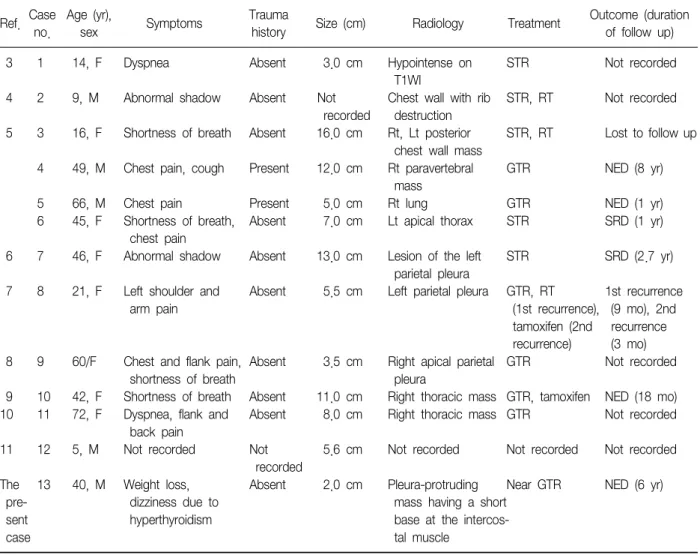
Review of the previously reported thirteen cases of

intrathoracic pleural desmoid tumors including the pres-

ent case showed a preponderance of females (8 females

vs. 5 males)

3-11

. Age ranged 5 to 72 years. The size of

intrathoracic pleural desmoid tumors ranged from 2.0

cm up to 16.0 cm. The most common presentation was

dyspnea or shortness of breath (6/13, 46.2%), followed

by chest pain (4/13, 30.8%), abnormal chest shadow

(4)

Table 1. Clinicopathological summary of intrathoracic desmoid tumors including the present case

Case Age (yr), Trauma Outcome (duration

Ref. Symptoms Size (cm) Radiology Treatment

no. sex history of follow up)

3 1 14, F Dyspnea Absent 3.0 cm Hypointense on STR Not recorded

T1WI

4 2 9, M Abnormal shadow Absent Not Chest wall with rib STR, RT Not recorded recorded destruction

5 3 16, F Shortness of breath Absent 16.0 cm Rt, Lt posterior STR, RT Lost to follow up chest wall mass

4 49, M Chest pain, cough Present 12.0 cm Rt paravertebral GTR NED (8 yr) mass

5 66, M Chest pain Present 5.0 cm Rt lung GTR NED (1 yr)

6 45, F Shortness of breath, Absent 7.0 cm Lt apical thorax STR SRD (1 yr) chest pain

6 7 46, F Abnormal shadow Absent 13.0 cm Lesion of the left STR SRD (2.7 yr) parietal pleura

7 8 21, F Left shoulder and Absent 5.5 cm Left parietal pleura GTR, RT 1st recurrence

arm pain (1st recurrence), (9 mo), 2nd

tamoxifen (2nd recurrence recurrence) (3 mo) 8 9 60/F Chest and flank pain, Absent 3.5 cm Right apical parietal GTR Not recorded

shortness of breath pleura

9 10 42, F Shortness of breath Absent 11.0 cm Right thoracic mass GTR, tamoxifen NED (18 mo) 10 11 72, F Dyspnea, flank and Absent 8.0 cm Right thoracic mass GTR Not recorded

back pain

11 12 5, M Not recorded Not 5.6 cm Not recorded Not recorded Not recorded

recorded

The 13 40, M Weight loss, Absent 2.0 cm Pleura-protruding Near GTR NED (6 yr)

pre- dizziness due to mass having a short

sent hyperthyroidism base at the intercos-

case tal muscle

Ref: number of reference; M: male; F: female; Rt: right; Lt: left; GTR: gross total resection; STR: subtotal resection; RT: radiation therapy; FU: follow up; SRD: stable with residual disease; NED: no evidence of disease.

(4/13, 30.8%) and cough (2/13, 15.4%), flank or back pain (2/13, 15.4%), shoulder and arm pain (1/13, 7.7%).

Radiologic findings show desmoid tumor variability;

high signal intensity on T2-weighted images and low to isointensity on T1-weighted images with respect to mus- cle

14

. These nonspecific clinicoradiologic features shar- ed with those of the more common pleural SFT. The present case showed severe weight loss and dizziness, but were caused by incidentally accompanying hyper- thyroidism. Clinicoradiologic summaries are shown in Table 1.

Treatment of intrathoracic desmoid tumor is challeng- ing because this disease does not respect the usual sur- gical rules relating to resection and recurrence. Com-

plete excision with clear margins is the mainstay of

treatment. Due to the high local recurrence rate, ad-

juvant therapy may be conducted. Radiotherapy has

been traditionally directed at known positive margins

and in inoperable cases. Antiestrogen hormone therapy

and cytotoxic chemotherapy have also been used for

unresectable or recurrent disease, however, such experi-

ences have been limited, and results have been incon-

clusive

2

. Like extraabdominal desmoid tumor of other

sites, the natural course of intrathoracic desmoid tumor

is widely variable, ranging from spontaneous remission

to multiple recurrences, regardless of treatment modal-

ity

12

. Adjuvant radiotherapy can be reserved for the mi-

nority with a high risk of recurrence, particularly those

(5)

with residual bulk disease or multiple previous recur- rences. Despite controversies over adjuvant therapy, a desmoid tumor in an unusual location, preventing wide excision margins, may favor early consideration of ad- juvant therapy, particularly in premenopausal women.

Albeit rare, malignant transformation of extra-abdominal desmoid tumor may occur

15

. To date, no malignant trans- formation, including that of pleural mass, has been de- scribed among intrathoracic cases. The present case was focally involved by the tumor with no recurrence during the follow up period, suggesting pleural desmoid tu- mors might take more favorable prognosis than do non- pleural desmoid tumors. Due to lack of accumulated ex- perience, intrathoracic desmoid tumors, including pleu- ral masses, should be under long term follow-up.

References

1. Weiss SW, Glodblum JR. Chapter 9. Fibromatoses. In:

Weiss SW, Glodblum JR, editors. Enzinger and Weiss’s soft tissue tumors. 5th ed. St. Louis: Mosby; 2008. p.

227-56.

2. Kim KH, Seo YH, Kuh JH, Kim MH. Huge intra- abdominal and thoracic desmoid tumor: surgical expe- rience in one case. Korean J Thorac Cardiovasc Surg 2003;36:623-6.

3. Winer-Muram HT, Bowman LC, Parham D. Intrathora- cic desmoid tumor: CT and MRI appearance. South Med J 1994;87:1007-9.

4. Okamura H, Murayama S, Murakami J, Kawanami T, Zaizen Y, Ohgami H, et al. CT manifestations of pedia- tric intrathoracic desmoid tumors. Pediatr Radiol 1995;

25 Suppl 1:S202-4.

5. Wilson RW, Gallateau-Salle F, Moran CA. Desmoid tu-

mors of the pleura: a clinicopathologic mimic of lo- calized fibrous tumor. Mod Pathol 1999;12:9-14.

6. Takeshima Y, Nakayori F, Nakano T, Shimizu K, Yamashita Y, Toge T, et al. Extra-abdominal desmoid tumor presenting as an intrathoracic tumor: case report and literature review. Pathol Int 2001;51:824-8.

7. Dosios TJ, Angouras DC, Floros DG. Primary desmoid tumor of the posterior mediastinum. Ann Thorac Surg 1998;66:2098-9.

8. Iqbal M, Rossoff LJ, Kahn L, Lackner RP. Intrathoracic desmoid tumor mimicking primary lung neoplasm. Ann Thorac Surg 2001;71:1698-700.

9. Meyerson SL, D'Amico TA. Intrathoracic desmoid tu- mor: brief report and review of literature. J Thorac On- col 2008;3:656-9.

10. Kim MJ, Park KJ, Sun JS, Kim JH, Choi H. Intrathoracic desmoid tumor: a case report and radiological evalu- ation. J Korean Radiol Soc 2007;57:31-5.

11. Andino L, Cagle PT, Murer B, Lu L, Popper HH, Galateau-Salle F, et al. Pleuropulmonary desmoid tu- mors: immunohistochemical comparison with solitary fibrous tumors and assessment of beta-catenin and cy- clin D1 expression. Arch Pathol Lab Med 2006;130:

1503-9.

12. Skene AI, Barr L, A'Hern RP, Fisher C, Meirion Thomas J. Multimodality treatment in the control of deep mus- culoaponeurotic fibromatosis. Br J Surg 1998;85:655-8.

13. Tajima S, Hironaka M, Oshikawa K, Bando M, Ohno S, Saito K, et al. Intrathoracic sporadic desmoid tumor with the beta-catenin gene mutation in exon 3 and acti- vated cyclin D1. Respiration 2006;73:558-61.

14. Lee JC, Thomas JM, Phillips S, Fisher C, Moskovic E.

Aggressive fibromatosis: MRI features with pathologic correlation. AJR Am J Roentgenol 2006;186:247-54.

15. Schwickerath J, Kunzig HJ. Spontaneous malignant

transformation of extra-abdominal fibromatosis to fibro-

sarcoma. Geburtshilfe Frauenheilkd 1995;55:173-5.

수치

Figure 1. A chest CT scan reveals a low density thoracic wall  mass  (arrows)  protruding  into  the  pleural  cavity.
Table  1.  Clinicopathological  summary  of  intrathoracic  desmoid  tumors  including  the  present  case

참조

관련 문서

To focus our discussion on inverse kinematics, we wifi assume that the necessary transformations have been performed so that the goal point is a specification of the

The G-kSP placement algorithm proposed here aims to work around the complexity of the formulated ILP. Here, we assume that a network supports a constant number of network

This maturing market has been typified by a very rapid sales growth, an increased preference for and availability of quality products, continued entry of

Through our Cocoa Plan we work to improve the lives of farmers and address the root causes of child labor in our cocoa supply chain.

The economies of the world will remain highly interdependent through trade, investment and fi nancial system linkages, driving the need for stronger global policy

미국은 최초 도입 시부터 내부회계관리제도 감사를 적용하였고, 그에 따라 수많은 시행착오와 어려움을 거쳐 상당한 변화와 실질적인 발전을 이뤄냈다.

Histogram shows the difference of pleural effusion volume depending on the experimental conditions in freshwater group... Youn Shin

Finally the reason for the cosmetic consumption tendency dependent on the containers used was proposed.. According to a statistical report, a quarter of