• 검색 결과가 없습니다.

Predictors of Recovery of Left Ventricular Systolic Dysfunction after Acute Myocardial Infarction: From the Korean Acute Myocardial Infarction Registry and Korean Myocardial Infarction Registry

N/A
N/A
Protected

Academic year: 2022

Share "Predictors of Recovery of Left Ventricular Systolic Dysfunction after Acute Myocardial Infarction: From the Korean Acute Myocardial Infarction Registry and Korean Myocardial Infarction Registry"

Copied!
7
0
0

로드 중.... (전체 텍스트 보기)

전체 글

(1)

Korean Circulation Journal

Introduction

The left ventricular ejection fraction (LVEF) is the most important predictor of morbidity and mortality after acute myocardial infarc- tion (MI).

1-3)

The left ventricular systolic dysfunction during the ear- ly phase of acute MI may be sustained or progressively aggravated by the process of ventricular remodeling, which is related to the risk

Print ISSN 1738-5520 • On-line ISSN 1738-5555

Predictors of Recovery of Left Ventricular Systolic Dysfunction

after Acute Myocardial Infarction: From the Korean Acute Myocardial Infarction Registry and Korean Myocardial Infarction Registry

Pyung Chun Oh, MD 1 *, In Suck Choi, MD 1 *, Taehoon Ahn, MD 1 , Jeonggeun Moon, MD 1 , Yeonjeong Park, MD 1 , Jong Goo Seo, MD 1 , Soon Yong Suh, MD 1 , Youngkeun Ahn, MD 2 , and Myung Ho Jeong, MD 2

1

Division of Cardiology, Department of Internal Medicine, Gil Hospital, Gachon University, Incheon,

2
Division of Cardiology, Department of Internal Medicine, Chonnam National University, Gwangju, Korea

Background and Objectives: We investigated the predictors of the recovery of depressed left ventricular ejection fraction (LVEF) in pa- tients with moderate or severe left ventricular (LV) systolic dysfunction after acute myocardial infarction (MI).

Subjects and Methods: We analyzed 1307 patients, who had moderately or severely depressed LVEF (<45%) on echocardiography soon after acute MI and who underwent a follow-up echocardiography, among 27369 patients from the Korea Working Group on the Myocar- dial Infarction Registry. Patients were categorized into two groups according to recovery of LVEF: group I with consistently depressed LVEF (<45%) at the follow-up echocardiography and group II with a recovery of LVEF (≥45%).

Results: Recovery of LV systolic dysfunction was observed in 51% of the subjects (group II, n=663; ΔLVEF, 16.2±9.3%), whereas there was no recovery in the remaining subjects (group I, n=644; ΔLVEF, 0.6±7.1%). In the multivariate analysis, independent predictors of recovery of depressed LVEF were as follows {odds ratio (OR) [95% confidence interval (CI)]}: moderate systolic dysfunction {LVEF ≥30% and <45%;

1.73 (1.12-2.67)}, Killip class I-II {1.52 (1.06-2.18)}, no need for diuretics {1.59 (1.19-2.12)}, non-ST-segment elevation MI {1.55 (1.12-2.16)}, lower peak troponin I level {<24 ng/mL, median value; 1.55 (1.16-2.07)}, single-vessel disease {1.53 (1.13-2.06)}, and non-left anterior descending (LAD) culprit lesion {1.50 (1.09-2.06)}. In addition, the use of statin was independently associated with a recovery of LV systolic dysfunction {OR (95% CI), 1.46 (1.07-2.00)}.

Conclusion: Future contractile recovery of LV systolic dysfunction following acute MI was significantly related with less severe heart failure at the time of presentation, a smaller extent of myonecrosis, or non-LAD culprit lesions rather than LAD lesions. (Korean Circ J 2013;43:

527-533)

KEY WORDS: Acute myocardial infarction; Ventricular ejection fraction; Prognosis.

Received: May 14, 2013 / Revision Received: July 24, 2013 / Accepted: August 1, 2013

Correspondence: Taehoon Ahn, MD, Division of Cardiology, Department of Internal Medicine, Gil Hospital, Gachon University, 21 Namdong-daero 774beon-gil, Namdong-gu, Incheon 405-760, Korea

Tel: 82-32-460-3054, Fax: 82-32-469-1906, E-mail: [email protected]

*These authors contributed equally to this work.

• The authors have no financial conflicts of interest.

This is an Open Access article distributed under the terms of the Creative Commons Attribution Non-Commercial License (http://creativecommons.org/licenses/

by-nc/3.0) which permits unrestricted non-commercial use, distribution, and reproduction in any medium, provided the original work is properly cited.

of congestive heart failure and death.

4)5)

However, improvements in left ventricular function can be apparent after acute MI, through mechanisms such as the gradual recovery of myocardial stunning or hibernation, and may have a beneficial effect on patient survival.

6)7)

Thus, it is important to determine which patient may have a sus-

tained left ventricular dysfunction or which variables can predict a

change in the LVEF. Predictors of a change in the LVEF may have

(2)

prognostic significance and important implications for the thera- peutic approach to use. The aim of this study is, therefore, to deter- mine the clinical, therapeutic, and angiographic predictors of recov- ery of depressed LVEF in patients with moderate or severe left ven- tricular systolic dysfunction following acute MI.

Subjects and Methods

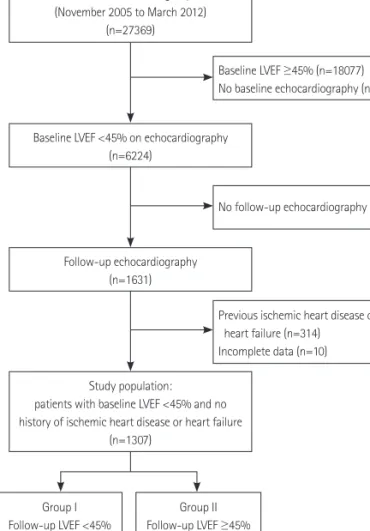
From November 2005 to March 2012, a total of 1307 patients with moderate or severe left ventricular systolic dysfunction after the first acute MI from the Korean Acute Myocardial Infarction Re- gistry (KAMIR) and Korean Myocardial Infarction (KorMI) registry were enrolled. The KAMIR and KorMI registry is a prospective, obser- vational, multi-center registry reflecting current practices of man- agement, risk factors, and clinical outcomes in Korean patients with acute MI. The registry was supported by the Korean Working Group of Acute Myocardial Infarction. Participating centers included 53 community and teaching hospitals with facilities for primary percu- taneous coronary intervention and on-site cardiac surgery. A well- trained study coordinator collected the data based on standard pro- tocol. Each ethics committee of the participating hospitals approved the study protocol. Fig. 1 shows the flow chart of this study. Moder- ate or severe systolic dysfunction was defined as the LVEF <45% or

<30%, respectively, based on the current guidelines of the American Society of Echocardiography and European Society of Echocardio- graphy.

8)

Patients with a history of ischemic heart disease or heart failure were excluded. Patients with the first acute MI, who had mo- derately or severely depressed LVEF less than 45% on echocardiog- raphy at the hospital-stay and who underwent serial echocardiog- raphy after discharge, were selected and constituted the eligible 1307 patients of the 27369 total registered patients. Patients were categorized into two groups according to the recovery of LVEF: gr- oup I (n=644, 49.3%) with consistently depressed LVEF less than 45%

at the follow-up echocardiography, and group II (n=663, 50.7%) with a recovery of LVEF more than or equal to 45%. Demographic data, laboratory values including cardiac enzymes, therapeutic data, angiographic and procedural details were available. Two-dimension- al echocardiography was performed at the hospital-stay and follow- up period. Baseline echocardiography was performed at 1.2±1.3 days (median, 1.0 days; interquartile range, 0.0-2.0 days) from ad- mission. Mean interval between serial echocardiography was 221.9±

148.7 days (median, 208.0 days; interquartile range, 114.0-297.0 days).

Statistical analysis

All continuous variables were presented as mean±standard de- viation for the normally distributed data or median (interquartile range) for the skewed data. Categorical variables were described

with absolute and relative (percentage) frequencies. The two groups were compared with respect to the patients’ clinical characteristics, and baseline echocardiographic and angiographic data using the unpaired t-test for continuous and Pearson’s χ

2

test for categorical variables were employed. Multivariate logistic regression analysis was used to examine the predictors of recovery of depressed LVEF.

A p less than 0.05 was considered statistically significant. Analyses were performed with the Statistical Package for the Social Sciences (SPSS) version 18.0 statistical package (SPSS Inc., Chicago, IL, USA).

Results

Clinical characteristics

Table 1 shows the clinical characteristics of patients between both groups. There were no significant differences in age, gender, and body mass index between the two groups. Other cardiovascu- lar risk factors, including smoking, diabetes mellitus, hypertension, and dyslipidemia, were not significantly different in both groups.

Complaints of dyspnea or frank pulmonary edema and cardiogenic

KAMIR and KorMI registry (November 2005 to March 2012)

(n=27369)

Baseline LVEF ≥45% (n=18077) No baseline echocardiography (n=3068)

No follow-up echocardiography (n=4493)

Previous ischemic heart disease or heart failure (n=314)

Incomplete data (n=10)

Group I Follow-up LVEF <45%

(n=644)

Group II Follow-up LVEF ≥45%

(n=663) Baseline LVEF <45% on echocardiography

(n=6224)

Follow-up echocardiography (n=1631)

Study population:

patients with baseline LVEF <45% and no history of ischemic heart disease or heart failure

(n=1307)

Fig. 1. The flow chart of the study. KAMIR: Korean Acute Myocardial Infarc-

tion Registry, KorMI: Korean Myocardial Infarction, LVEF: left ventricular ejec-

tion fraction.

(3)

shock (Killip class III-IV) during acute MI was significantly more pre- valent among group I patients, compared with those in group II.

Systolic blood pressure (BP) and diastolic BP were not significantly different between both groups, although systolic BP tended to be lower in group I than in group II. However, there were more patients with systolic BP less than 90 mm Hg in group I than in group II (6.6%

vs. 3.5%, p=0.009). Heart rate was significantly faster in group I than in group II (87.0±21.1 vs. 82.4±19.1, p<0.001). In addition, there were significantly more patients with ST-segment elevation MI (73.8% vs. 66.1%, p=0.001) in group I, compared with that of group

II. Regarding discharge medications, loop diuretics were more fre- quently prescribed in group I (47.5% vs. 35.1%, p<0.001) and β-blo- cker or statin was more frequently prescribed in group II (71.8% vs.

78.3%, 69.3% vs. 76.3%, respectively, p<0.01 for both). There was no significant difference in the frequency of prescription of angio- tensin-converting enzyme inhibitors or angiotensin II receptor blo- ckers in both groups.

Laboratory data

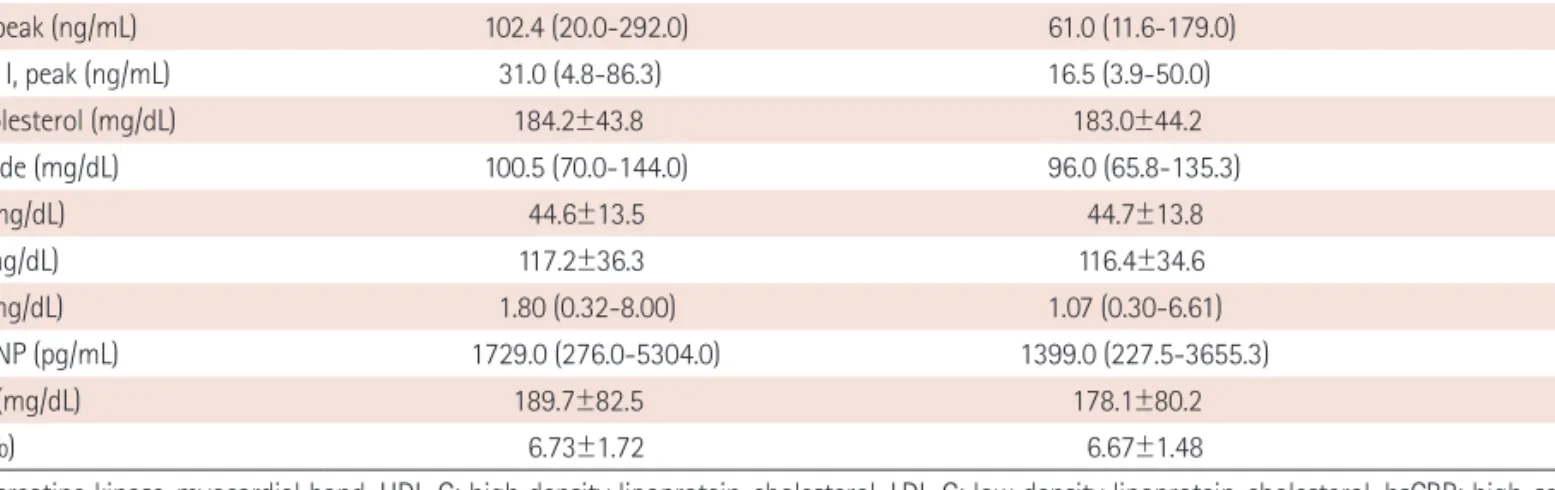
Table 2 illustrates the laboratory data, including myonecrosis bio- Table 1. Clinical characteristics of the two individual groups

Group I (n=644) Group II (n=663) p

Age (years) 63.2±12.4 62.7±12.4 0.438

Men, n (%) 464 (72.2) 453 (68.4) 0.140

Body mass index (kg/m

2

) 23.4±3.2 23.7±3.3 0.142

Symptoms, n (%)

Chest pain 519 (82.5) 509 (78.4) 0.066

Dyspnea 225 (36.3) 189 (29.5) 0.011

Vital signs

Systolic BP (mm Hg) 124.5±28.2 127.4±26.5 0.057

Systolic BP <90 (mm Hg), n (%) 42 (6.6) 23 (3.5) 0.009

Diastolic BP (mm Hg) 77.0±17.1 78.5±15.9 0.107

Heart rate (per minute) 87.0±21.1 82.4±19.1 <0.001

Killip class, n (%) <0.001

I 337 (54.2) 429 (67.1)

II 117 (18.8) 100 (15.6)

III 120 (19.3) 76 (11.9)

IV 48 (7.7) 34 (5.3)

Risk factors, n (%)

Current or previous smoking 371 (58.2) 365 (55.3) 0.286

Diabetes 205 (31.9) 183 (27.7) 0.101

Hypertension 303 (47.2) 304 (46.0) 0.663

Dyslipidemia 52 (8.2) 46 (7.0) 0.411

Diagnosis, n (%) 0.002

NSTEMI 169 (26.2) 225 (33.9)

STEMI 475 (73.8) 438 (66.1)

Prescribed medications, n (%)

β-blocker 454 (71.8) 510 (78.3) 0.007

ACEI 402 (62.4) 422 (63.7) 0.646

ARB 113 (17.5) 140 (21.1) 0.102

Statin 446 (69.3) 506 (76.3) 0.004

Nitrate 254 (40.7) 251 (39.0) 0.529

Diuretics 298 (47.5) 227 (35.1) <0.001

Spironolactone 61 (9.8) 44 (6.9) 0.057

BP: blood pressure, NSTEMI: non-ST-segment elevation myocardial infarction, STEMI: ST-segment elevation myocardial infarction, ACEI: angiotensin-con-

verting enzyme inhibitor, ARB: angiotensin II receptor blocker

(4)

markers or metabolic parameters. The peak level of creatine kinase- myocardial band and troponin I were significantly higher in group I than in group II {102.4 ng/mL (20.0-292.0) vs. 61.0 ng/mL (11.6- 179.0), 31.0 ng/mL (4.8-86.3) vs. 16.5 ng/mL (3.9-50.0), respectively, p<0.001 for both}. Group I had significantly higher levels of N-ter- minal pro-B-type natriuretic peptide, compared with that of group II {1729.0 pg/mL (276.0-5304.0) vs. 1399.0 pg/mL (227.5-3655.3), p=0.031}. In addition, group I had significantly higher levels of glu- cose on admission (189.7±82.5 mg/dL vs. 178.1±80.2 md/dL, p=

0.011) and had a tendency of higher levels of high-sensitivity C-re- active protein {1.80 mg/dL (0.32-8.00), 1.07 mg/dL (0.30-6.61), p=

0.075}, compared with those of group II.

Coronary angiographic characteristics and echocardiographic parameters

Group I had more left anterior descending (LAD) culprit lesions than group II (72.7% vs. 65.5%, p=0.037). Multivessel disease or ba- seline Thrombolysis in Myocardial Infarction flow grade 0 of infarct- related artery was more prevalent in group I than in group II (66.9%

vs. 56.6%, 57.5% vs. 45.4%, respectively; p<0.001 for both) (Table 3).

The LVEF at the baseline echocardiography was significantly lower in group I, compared with that in group II (35.3±6.7% vs. 38.0±

5.8%, p<0.001) (Table 4). In addition, group I had a more dilated left ventricle than group II at the baseline. The change of LVEF was 0.6±

7.1% and 16.2±9.3% in group I and group II, respectively (p<0.001).

At the follow-up echocardiography, the left ventricular end-diastolic and end-systolic volumes were significantly increased from the ba- seline by 11.7±38.8 mL and 7.1±29.5 mL in group I, and were signif- icantly reduced from the baseline by 3.7±31.8 mL and 15.4±24.9 mL in group II, respectively (p<0.01 for both).

Predictors of recovery of depressed left ventricular ejection fraction

The predictors of recovery of depressed LVEF were as listed in Table 5. By multivariate logistic regression analysis, moderate systolic dysfunction (LVEF ≥30% and <45%) was the independent predic- tor for the recovery of depressed LVEF with an odds ratio (OR) of 1.73 {95% confidence interval (CI), 1.12-2.67, p=0.013}. Non-ST-seg- ment elevation MI, peak troponin I level less than 24 ng/mL (medi- an value), and Killip class I-II were also independently associated with the recovery of systolic dysfunction {OR (95% CI), 1.55 (1.12- 2.16), 1.55 (1.16-2.07), 1.52 (1.06-2.18), respectively; p<0.05 for all}.

Single-vessel disease and non-LAD culprit lesions were indepen- dent predictors for contractile recovery {OR (95% CI), 1.53 (1.13- 2.06), 1.50 (1.09-2.06), respectively; p<0.05 for both}. In addition, Table 2. Biochemical markers of the two individual groups

Group I (n=644) Group II (n=663) p

Creatinine (mg/dL) 1.00 (0.90-1.30) 1.00 (0.80-1.20) 0.023

CK-MB, peak (ng/mL) 102.4 (20.0-292.0) 61.0 (11.6-179.0) <0.001

Troponin I, peak (ng/mL) 31.0 (4.8-86.3) 16.5 (3.9-50.0) <0.001

Total cholesterol (mg/dL) 184.2±43.8 183.0±44.2 0.630

Triglyceride (mg/dL) 100.5 (70.0-144.0) 96.0 (65.8-135.3) 0.169

HDL-C (mg/dL) 44.6±13.5 44.7±13.8 0.923

LDL-C (mg/dL) 117.2±36.3 116.4±34.6 0.703

hsCRP (mg/dL) 1.80 (0.32-8.00) 1.07 (0.30-6.61) 0.075

NT-proBNP (pg/mL) 1729.0 (276.0-5304.0) 1399.0 (227.5-3655.3) 0.031

Glucose (mg/dL) 189.7±82.5 178.1±80.2 0.011

HbA1

C

(%) 6.73±1.72 6.67±1.48 0.702

CK-MB: creatine kinase-myocardial band, HDL-C: high density lipoprotein-cholesterol, LDL-C: low density lipoprotein-cholesterol, hsCRP: high-sensitivity C-reactive protein, NT-proBNP: N-terminal pro-B-type natriuretic peptide, HbA1

C

: hemoglobin A1c

Table 3. Angiographic characteristics of the two individual groups Group I

(n=644)

Group II

(n=663) p

Infarct related artery, n (%) 0.037

Left main 19 (3.1) 23 (3.6)

LAD 439 (72.7) 413 (65.5)

LCX 55 (9.1) 64 (10.1)

RCA 91 (15.1) 131 (20.8)

Number of involved vessels, n (%) <0.001

Single-vessel disease 202 (33.1) 274 (43.4) Multivessel disease 409 (66.9) 357 (56.6)

Baseline TIMI flow grade, n (%) <0.001

0 332 (57.5) 276 (45.4)

I 46 (8.0) 86 (14.1)

II 86 (14.9) 104 (17.1)

III 113 (19.6) 142 (23.4)

LAD: left anterior descending artery, RCA: right coronary artery, LCX: left

circumflex artery, TIMI: Thrombolysis in Myocardial Infarction

(5)

the lack of need for diuretics at discharge and the use of statin were significantly related with the recovery of depressed LVEF {OR (95%

CI), 1.59 (1.19-2.12), 1.46 (1.07-2.00), respectively; p<0.05 for both}.

The independent predictors of improvement of LVEF more than or equal to 10% in terms of absolute value were as shown in Table

6. As the results of multivariate analysis for recovery of depressed LVEF, peak level of troponin I less than 24 ng/mL, use of statin, and non-ST-segment elevation MI were also independent predictors of improvement of LVEF more than or equal to 10%. However, con- trary to the independent predictors of recovery of depressed LVEF, severe systolic dysfunction (LVEF <30%) was the independent pre- dictor of improvement of LVEF more than or equal to 10% with an OR of 2.41 (95% CI, 1.58-3.67, p<0.001). In Pearson’s correlation analysis, the change of LVEF (follow-up LVEF-baseline LVEF) was negatively correlated with the baseline LVEF (r=-0.236, p<0.001).

Discussion

Among the study subjects who had a baseline LVEF of less than 45% soon after acute MI, left ventricular systolic dysfunction was recovered (follow-up LVEF ≥45%) in almost 50% (group II) after a median follow-up of 222 days, which was comparable to a previous study.

9)

By multivariate analysis, several variables, as follows, were Table 4. Echocardiographic parameters of the two individual groups

Baseline Follow-up

Group I Group II p Group I Group II p

LVEF (%) 35.3±6.7 38.0±5.8 <0.001 35.9±6.9 55.1±19.3 <0.001

LVEDD (mm) 54.0±7.9 51.9±6.2 0.001 56.6±7.5 50.4±7.3 <0.001

LVESD (mm) 43.6±8.5 40.5±7.2 <0.001 46.3±8.4 36.2±7.3 <0.001

LVEDV (mL) 114.8±43.3 105.0±36.0 0.036 127.5±44.6 100.6±32.8 <0.001

LVESV (mL) 74.7±30.5 65.0±25.5 0.006 81.7±31.3 49.7±19.8 <0.001

LVEF: left ventricular ejection fraction, LVEDD: left ventricular end-diastolic dimension, LVESD: left ventricular end-systolic dimension, LVEDV: left ventricu- lar end-diastolic volume, LVESV: left ventricular end-systolic volume

Table 5. Predictors of recovery (follow-up LVEF ≥45%) of depressed LVEF in patients with moderate or severe systolic dysfunction (baseline LVEF <45%) by univariate and multivariate logistic regression analysis

Variables Univariate analysis Multivariate analysis

OR (95% CI) p OR (95% CI) p

No complaint of dyspnea 1.36 (1.07-1.72) 0.011

Killip class I-II 1.78 (1.36-2.33) <0.001 1.52 (1.06-2.18) 0.025

Systolic BP ≥90 mm Hg 1.97 (1.17-3.32) 0.011

Peak troponin I <24 ng/mL (median value) 1.55 (1.21-1.98) <0.001 1.55 (1.16-2.07) 0.003

NSTEMI 1.44 (1.14-1.83) 0.002 1.55 (1.12-2.16) 0.009

Moderate systolic dysfunction (basal LVEF ≥30% and <45%) 2.13 (1.53-2.96) <0.001 1.73 (1.12-2.67) 0.013

Single-vessel disease 1.55 (1.23-1.96) <0.001 1.53 (1.13-2.06) 0.006

Non-LAD culprit lesion 1.40 (1.10-1.79) 0.006 1.50 (1.09-2.06) 0.012

Baseline TIMI flow grade II-III 1.29 (1.02-1.63) 0.034

Use of β-blocker 1.42 (1.10-1.83) 0.007

No need for diuretics 1.67 (1.34-2.09) <0.001 1.59 (1.19-2.12) 0.002

Use of statin 1.43 (1.12-1.83) 0.004 1.46 (1.07-2.00) 0.017

LVEF: left ventricular ejection fraction, BP: blood pressure, NSTEMI: non-ST-segment elevation myocardial infarction, LAD: left anterior descending, TIMI:

Thrombolysis in Myocardial Infarction, OR: odds ratio, CI: confidence interval Table 6. Predictors of improvement of LVEF ≥10% (absolute value) in pa- tients with moderate or severe systolic dysfunction (baseline LVEF <45%) by multivariate logistic regression analysis

Variables Multivariate analysis

OR (95% CI) p

Severe systolic dysfunction

(basal LVEF <30%) 2.41 (1.58-3.67) <0.001 Peak troponin I <24 ng/mL

(median value) 1.70 (1.27-2.27) <0.001

Use of statin 1.52 (1.10-2.09) 0.011

NSTEMI 1.47 (1.07-2.00) 0.017

LVEF: left ventricular ejection fraction, NSTEMI: non-ST-segment elevation

myocardial infarction, OR: odds ratio, CI: confidence interval

(6)

identified as independent predictors of contractile recovery, which were closely related with less severe heart failure or a small extent of myonecrosis: moderate systolic dysfunction, Killip class I-II, no need for diuretics, lower peak level of troponin I, non-ST-segment eleva- tion MI, single-vessel disease, and non-LAD culprit lesions. In addi- tion, the use of statin was independently associated with the con- tractile recovery of the left ventricle.

The specific predictors of potential contractile recovery have prog- nostic significance and important implications for the therapeutic approach used. However, previous studies in literature have not sug- gested consistent predictors sufficient to forecast contractile recov- ery. Ongoing with our results, two studies demonstrated an associa- tion between contractile recovery and a higher baseline left ventri- cular systolic function.

10)11)

Leclercq et al.

10)

revealed that contractile recovery was independently associated with higher LVEF, the pres- ence of collateral blood flow, and dobutamine responsiveness at the dobutamine echocardiography. Furthermore, Abdel-Salam and Nam- mas

11)

observed that higher LVEF and a lower wall motion score index at the baseline echocardiography were significantly related to myo- cardial contractile recovery after percutaneous coronary interven- tion. More severe left ventricular systolic dysfunction most likely im- plicates larger infarct size and wider expansion of the infarcted zone.

The larger infarct size is significantly correlated with a higher peak level of myonecrosis biomarkers.

12)

The peak creatine kinase level was the independent predictor of the functional recovery of the left ventricle, probably indicating viable myocardium.

13)14)

Absolute in- farct size measured by gadolinium contrast-enhanced magnetic res- onance imaging was larger in the ST-segment elevation MI than in the non-ST-segment elevation MI.

15)

In addition, patients with more severe left ventricular systolic dysfunction may present more symp- toms or signs of heart failure, including pulmonary congestion (Killip class III) or cardiogenic shock (Killip class IV), and may be prescribed less frequently with β-blockers or more diuretics. In our study, sev- eral independent predictors of the recovery of systolic dysfunction were closely related to less severe heart failure at the time of pre- sentation and a smaller extent of myonecrosis, including non-ST- segment elevation MI, lower Killip class (I-II), lower peak troponin I level, or the frequency of prescribed medications such as the lower need for diuretics.

Nonetheless, other studies were unable to demonstrate a relation- ship between contractile recovery and baseline LVEF.

9)16)17)

Auerbach et al.

17)

found no relation between contractile recovery and the basal LVEF, but demonstrated that myocardial viability detected by posi- tron emission tomography could predict the improvement of left ventricular function in patients with ischemic cardiomyopathy. Ot- tervanger et al.

9)

assessed clinical variables associated with the re- covery of left ventricular function measured by radionuclide ventric-

ulography at day 4 and after 6 months in 600 patients with acute MI, all treated by primary percutaneous coronary intervention. They demonstrated that anterior MI, single-vessel disease, and initially depressed LVEF less than or equal to 40% were independently as- sociated with the recovery of left ventricular function, suggesting stunning might be prolonged in larger infarcts. However, these re- sults may be applied to patients with ST-segment elevation MI who achieved early and complete patency of infarct-related artery and may be affected by the time at which baseline LVEF was measured.

In the multivariate analysis and correlation analysis, initially de- pressed LVEF less than 30% was independently related with an im- provement of LVEF more than or equal to 10% (absolute value) and there was a negative correlation between the change of LVEF and the baseline LVEF. Therefore, the baseline LVEF as a predictor of an improvement or recovery of LVEF may be dependent on the index of contractile recovery.

In this study, the prescription of statin was also an independent predictor of the recovery of systolic dysfunction after acute MI. St- atin treatment improved survival in patients with not only acute MI but also ischemic and non-ischemic heart failure.

18)19)

In addition, the risk of developing ischemic heart failure was reduced in patients with coronary artery disease by statin treatment.

20)21)

Sola et al.

22)

demonstrated that atorvastatin improved LVEF and attenuated ad- verse left ventricular remodeling in patients with non-ischemic heart failure, decreasing the level of pro-inflammatory markers. Many pleiotropic effects of statin, such as improving endothelial function and providing plaque stabilization and anti-inflammatory effects, might be effective in improving myocardial function, and also in re- tarding the progression of heart failure. However, a large randomiz- ed prospective study is required to determine the role of statin in the recovery of left ventricular systolic dysfunction following acute MI.

This study has several limitations. First, the follow-up echocar- diography was performed only among one quarter of the patients with depressed LVEF, giving rise to a selection bias. Second, the base- line and follow-up echocardiography were performed at a variety of time intervals after index MI, which might have underestimated the recovery of LVEF or might not have reflected the true recovery of each subject during the follow-up period. Third, in our study, adverse events, such as re-infarction or revascularization during the follow- up period, were not considered, which may affect the change of left ventricular systolic function. Fourth, we had no data on left ven- tricular diastolic function or regional wall motion abnormalities.

Moreover, we had no data on the extent of functionally viable myo- cardium, such as stunned or hibernating myocardium.

In conclusion, future contractile recovery of LV systolic dysfunc-

tion following acute MI was significantly predicted by less severe

heart failure at the time of presentation, the smaller extent of myo-

(7)

necrosis, or non-LAD culprit lesions rather than LAD lesions.

References

1. Risk stratification and survival after myocardial infarction. N Engl J Med 1983;309:331-6.

2. White HD, Norris RM, Brown MA, Brandt PW, Whitlock RM, Wild CJ.

Left ventricular end-systolic volume as the major determinant of sur- vival after recovery from myocardial infarction. Circulation 1987;76:

44-51.

3. St John Sutton M, Pfeffer MA, Plappert T, et al. Quantitative two-di- mensional echocardiographic measurements are major predictors of adverse cardiovascular events after acute myocardial infarction. The protective effects of captopril. Circulation 1994;89:68-75.

4. Gaudron P, Eilles C, Kugler I, Ertl G. Progressive left ventricular dys- function and remodeling after myocardial infarction. Potential mecha- nisms and early predictors. Circulation 1993;87:755-63.

5. Bolognese L, Cerisano G, Buonamici P, et al. Influence of infarct-zone viability on left ventricular remodeling after acute myocardial infarc- tion. Circulation 1997;96:3353-9.

6. Christian TF, Behrenbeck T, Pellikka PA, Huber KC, Chesebro JH, Gibbons RJ. Mismatch of left ventricular function and infarct size demonstrated by technetium-99m isonitrile imaging after reperfusion therapy for acute myocardial infarction: identification of myocardial stunning and hyperkinesia. J Am Coll Cardiol 1990;16:1632-8.

7. Wijns W, Vatner SF, Camici PG. Hibernating myocardium. N Engl J Med 1998;339:173-81.

8. Lang RM, Bierig M, Devereux RB, et al. Recommendations for chamber quantification: a report from the American Society of Echocardiogra- phy’s Guidelines and Standards Committee and the Chamber Quantifi- cation Writing Group, developed in conjunction with the European As- sociation of Echocardiography, a branch of the European Society of Cardiology. J Am Soc Echocardiogr 2005;18:1440-63.

9. Ottervanger JP, van‘t Hof AW, Reiffers S, et al. Long-term recovery of left ventricular function after primary angioplasty for acute myocar- dial infarction. Eur Heart J 2001;22:785-90.

10. Leclercq F, Messner-Pellenc P, Moragues C, et al. Myocardial viability assessed by dobutamine echocardiography in acute myocardial infarc- tion after successful primary coronary angioplasty. Am J Cardiol 1997;

80:6-10.

11. Abdel-Salam Z, Nammas W. Predictors of myocardial contractile recov- ery after coronary revascularization in patients with prior myocardial infarction. Cardiovasc Revasc Med 2010;11:2-7.

12. Gibbons RJ, Valeti US, Araoz PA, Jaffe AS. The quantification of infarct size. J Am Coll Cardiol 2004;44:1533-42.

13. Solomon SD, Glynn RJ, Greaves S, et al. Recovery of ventricular func- tion after myocardial infarction in the reperfusion era: the healing and early afterload reducing therapy study. Ann Intern Med 2001;134:

451-8.

14. Bauters C, Fertin M, Delhaye C, et al. Late recovery in left ventricular systolic function after discharge of patients with a first anterior myo- cardial infarction. Arch Cardiovasc Dis 2010;103:538-45.

15. Steen H, Futterer S, Merten C, Jünger C, Katus HA, Giannitsis E. Relative role of NT-pro BNP and cardiac troponin T at 96 hours for estimation of infarct size and left ventricular function after acute myocardial in- farction. J Cardiovasc Magn Reson 2007;9:749-58.

16. Eitzman D, al-Aouar Z, Kanter HL, et al. Clinical outcome of patients with advanced coronary artery disease after viability studies with posi- tron emission tomography. J Am Coll Cardiol 1992;20:559-65.

17. Auerbach MA, Schöder H, Hoh C, et al. Prevalence of myocardial viabil- ity as detected by positron emission tomography in patients with isch- emic cardiomyopathy. Circulation 1999;99:2921-6.

18. Stenestrand U, Wallentin L; Swedish Register of Cardiac Intensive Care (RIKS-HIA). Early statin treatment following acute myocardial infarc- tion and 1-year survival. JAMA 2001;285:430-6.

19. Horwich TB, MacLellan WR, Fonarow GC. Statin therapy is associated with improved survival in ischemic and non-ischemic heart failure. J Am Coll Cardiol 2004;43:642-8.

20. Kjekshus J, Pedersen TR, Olsson AG, Faergeman O, Pyörälä K. The ef- fects of simvastatin on the incidence of heart failure in patients with coronary heart disease. J Card Fail 1997;3:249-54.

21. Aronow WS, Ahn C. Frequency of congestive heart failure in older per- sons with prior myocardial infarction and serum low-density lipopro- tein cholesterol > or = 125 mg/dl treated with statins versus no lipid- lowering drug. Am J Cardiol 2002;90:147-9.

22. Sola S, Mir MQ, Lerakis S, Tandon N, Khan BV. Atorvastatin improves

left ventricular systolic function and serum markers of inflammation

in nonischemic heart failure. J Am Coll Cardiol 2006;47:332-7.

수치

Table 1 shows the clinical characteristics of patients between  both groups. There were no significant differences in age, gender,  and body mass index between the two groups
Table 2 illustrates the laboratory data, including myonecrosis bio-bio-Table 1. Clinical characteristics of the two individual groups
Table 3. Angiographic characteristics of the two individual groups Group I
Table 5. Predictors of recovery (follow-up LVEF ≥45%) of depressed LVEF in patients with moderate or severe systolic dysfunction (baseline LVEF &lt;45%)  by univariate and multivariate logistic regression analysis

참조

관련 문서

Revascularization for Patients with Multivessel Coronary Artery Disease and Left Ventricular Systolic Dysfunction in Drug-Eluting Stent Era.. We aimed to investigate that

Conclusion: Severe LV systolic dysfunction and diffuse pattern of LV wall motion impairment significantly affected in-hospital mortality in patients with septic shock. Conventional

Although acute diastolic and systolic dysfunction after AMI may improve with the successful restoration of coronary blood flow by means of a percutaneous coronary intervention, some

Left ventricular free wall rupture (LVFWR) is reported to occur in 2-6% of acute myocardial infarction (MI) cases. LVFWR is presumed responsible for as much as 20-80%

Change of regional wall motion score (RWMS) between initial and follow-up after anterior wall acute myocardial infarction.. 따라서 자연 재관류가 일어나거나 측부순환이

group 1(less than 10% increase of LV volume at follow-up compared to intial echocardiographic exam) and group 2(more than 10% increase of left ventricular volume). We compared the

This study was conducted as a single center, retrospective, ob- servational study. We analyzed 119 patients with acute STEMI who underwent DES-based primary PCI at Kangnam Sacred

Coronary Flow Reserve in the Remote Myocardium Predicts Left Ventricular Remodeling Following Acute Myocardial Infarction.. Rongchao Cheng, 1 Guoqian Wei, 1 Longhao Yu, 1