INTRODUCTION
Spatial hearing refers to the ability to understand speech and identify sounds in various environments. Spatial hearing in- cludes sound localization, understanding speech in a noisy background, and estimating the distance of the sound origin.1,2
There are many factors that affect spatial hearing, including the severity and symmetry of a hearing impairment. Basic charac- teristics, such as age, can affect spatial hearing, even in normal hearing children, because of developmental difference.3 The interaural time difference and interaural level difference can also affect spatial hearing.4 Spatial processing problems can be caused by peripheral hearing loss, central hearing loss, and im- paired cognitive function.5-7
The Spatial Hearing Questionnaire (SHQ) is a 24 question self-report with eight subscales. The subscales test male, fe- male, and children’s voices; music in quiet; source localization;
understanding speech in quiet; understanding speech in noise with target and noise sources from the front; and understand- ing speech in noise with spatially separate target and noise sources.2
Although there are many subjective questionnaires that as- sess spatial hearing, the Speech Spatial and Qualities of Hearing
Validation of the Korean Version of the Spatial Hearing Questionnaire for Assessing the Severity and Symmetry of Hearing Impairment
Tae Hoon Kong, Yoon Ah Park, Jeong Pyo Bong, and Sang Yoo Park
Department of Otorhinolaryngology-Head and Neck Surgery, Yonsei University Wonju College of Medicine, Wonju, Korea.
Purpose: Spatial hearing refers to the ability to understand speech and identify sounds in various environments. We assessed the validity of the Korean version of the Spatial Hearing Questionnaire (K-SHQ).
Materials and Methods: We performed forward translation of the original English SHQ to Korean and backward translation from the Korean to English. Forty-eight patients who were able to read and understand Korean and received a score of 24 or higher on the Mini-Mental Status Examination were included in the study. Patients underwent pure tone audiometry (PTA) using a standard pro- tocol and completed the K-SHQ. Internal consistency was evaluated using Cronbach’s alpha, and factor analysis was performed to prove reliability. Construct validity was tested by comparing K-SHQ scores from patients with normal hearing to those with hearing impairment. Scores were compared between subjects with unilateral or bilateral hearing loss and between symmetrical and asym- metrical hearing impairment.
Results: Cronbach’s alpha showed good internal consistency (0.982). Two factors were identified by factor analysis: There was a significant difference in K-SHQ scores for patients with normal hearing compared to those with hearing impairment. Patients with asymmetric hearing impairment had higher K-SHQ scores than those with symmetric hearing impairment. This is related to a low- er threshold of PTA in the better ear of subjects. The hearing ability of the better ear is correlated with K-SHQ score.
Conclusion: The K-SHQ is a reliable and valid tool with which to assess spatial hearing in patients who speak and read Korean. K- SHQ score reflects the severity and symmetry of hearing impairment.
Key Words: Sound localization, questionnaire, validity, hearing impairment
pISSN: 0513-5796 · eISSN: 1976-2437
Received: December 22, 2016 Revised: March 5, 2017 Accepted: April 4, 2017
Corresponding author: Dr. Sang Yoo Park, Department of Otorhinolaryngology- Head and Neck Surgery, Yonsei University Wonju College of Medicine, 20 Ilsan-ro, Wonju 26426, Korea.
Tel: 82-33-741-0642, Fax: 82-33-732-8287, E-mail: [email protected]
•The authors have no financial conflicts of interest.
© Copyright: Yonsei University College of Medicine 2017
This is an Open Access article distributed under the terms of the Creative Com- mons Attribution Non-Commercial License (http://creativecommons.org/licenses/
by-nc/4.0) which permits unrestricted non-commercial use, distribution, and repro- duction in any medium, provided the original work is properly cited.
Yonsei Med J 2017 Jul;58(4):842-847 https://doi.org/10.3349/ymj.2017.58.4.842
Scale (SSQ) is a representative questionnaire.8 However, the SSQ consist of 49 questions, compared to 24 questions in the SHQ, and the SSQ takes more time than the SHQ. Furthermore, there is a high degree of correlation between SHQ and SSQ scores,9,10 suggesting the possibility of extrapolating the results from one questionnaire to the other. Also, the SHQ has sub- scales that focus on important listening situations. To create a Korean language spatial hearing scale, we concluded that the SHQ was a better choice than the SSQ.
Although the original version of the SHQ was developed in English, the SHQ has been translated and validated in other languages, including Dutch, Persian, French, and Chinese.11-14 In this study, we assessed the validity of a Korean version of the SHQ (K-SHQ) and compared the results of the K-SHQ to different classifications of hearing loss.
MATERIALS AND METHODS
The Korean version of Spatial Hearing Questionnaire The original English version of the SHQ consists of 24 ques- tions. Each item is scored from very difficult (0) to very easy (100). With the SHQ, a higher score reflects a better ability to hear. An English-Korean bilingual otologist performed for- ward translation from English to Korean. The naive Korean version of SHQ was then reviewed by a doctor of Korean liter- ature. Next, the questionnaire was back translated into Eng- lish by a different English-Korean bilingual otologist. A doctor of English literature reviewed the back-translated question- naire, comparing it to the original version of the SHQ and rec- ommended minor changes. Finally, the K-SHQ was developed (Supplementary Table 1, only online).
Subjects
Power analysis was performed to determine the sample size (ef- fect size 0.810, alpha value 0.05, power 0.8). Forty-eight patients who visited the Yonsei University Wonju Severance Christian Hospital and completed the pure tone audiometry (PTA) test were enrolled in the study. All patients independently answered each question in the K-SHQ. There was no reported difficulty, and participants received no help in answering questions. Pa- tients who use hearing aids were instructed to answer to each question as if they were not using their hearing aid(s).
Since altered cognitive function can affect spatial hearing, patients also completed the Mini-Mental State Examination (MMSE). Patient with an MMSE score of less than 24 were ex- cluded from the study. Patients who could not read and under- stand the Korean-language were also excluded. Demographic information, including academic background, was collected.
Information from medical records, including hypertension, diabetes, pulmonary or cardiac disease, cerebrovascular acci- dent, chronic kidney disease, liver disease, and otologic sur- gery, was also collected. Previous exposure to noise in a job
environment and hearing aid use were noted.
The Institutional Review Board of Yonsei University Wonju Severance Christian Hospital approved this study (YWMR-15- 1-109).
Auditory evaluation
Patients underwent auditory testing using PTA, at the Depart- ment of Otorhinolaryngology-Head and Neck Surgery. Testing was performed in a double walled, single room audio booth us- ing established standards (ANSI 3.6 type 1 pure tone audiome- ter, 1989; IEC 645-1 type 1 pure tone audiometer, 1992).
Pure-tone thresholds were obtained for air conduction at 250, 500, 1000, 2000, 4000, and 8000 Hz. Audiologic data were reported in accordance with the methods recommended by the Hearing Committee of the American Academy of Otolar- yngology Head and Neck Surgery. The average PTA was calcu- lated using the following formula: [(500 Hz+1000 Hz+2000 Hz+4000 Hz)/4].
Statistical analysis
Statistical analysis was performed using the Statistical Package for Social Sciences Software (SPSS 22.0 for Windows; SPSS Inc., Chicago, IL, USA). Cronbach’s alpha and item-total correlation were measured to evaluate internal consistency. We used the Kaiser-Meyer-Olkin (KMO) test to measure sampling adequa- cy. A KMO value is considered good if it is greater than 0.70 and excellent if it is greater than 0.90. When the KMO value is good, factor analysis can be performed. We performed factor analysis, and the number of factors was determined using the eigenval- ue and scree plot curve. Varimax rotation was used to simplify the interpretation of data.
To compare continuous variables, an independent t-test and correlation analysis were performed. Chi-square or Fisher’s exact test were performed to analyze categorical variables. All p values less than 0.05 were considered significant.
RESULTS
Reliability
For the K-SHQ, Cronbach’s alpha was 0.982, suggesting good internal consistency in the Korean-language questionnaire. We also assessed item-total correlation coefficients, which ranged from 0.686 to 0.910 (Supplementary Table 2, only online).
Factor analysis
Factor analysis was used to group questionnaire items with similar features. The KMO value was 0.839, indicating that fac- tor analysis was appropriate for this data.
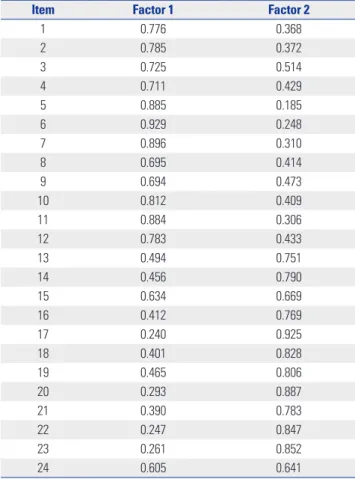
The number of factors was determined using eigenvalues and a scree plot curve. Two factors had eigenvalues greater than 1 (Supplementary Table 3, only online) and explained 70.60% and 9.97% of all items of K-SHQ. Factor 1 included 12 items, ques-
tions number 1 to 12 from the questionnaire. These items are re- lated to understanding speech and music in a quiet and in a noisy environment. Factor 2 included another 12 items, from questions number 13 to 24. These items are related to under- standing and locating the origin of sound when the origin can-
not be seen (Table 1).
The communality values, which describe the amount of vari- ance of an item as predicted by the loading factor, ranged from 0.654 to 0.924. It is generally considered that each item loads well on a factor when the value of communality is greater than 0.45 (Supplementary Table 4, only online).
Construct validity
Construct validity was assessed by comparing K-SHQ scores from patients with normal hearing to those with a hearing im- pairment. Of the 48 patients, 17 patients had normal hearing, and 31 patients were hearing impaired. Baseline characteristics are shown in Table 2. Mean hearing threshold was significantly different in the hearing-impaired patients, compared to those with normal hearing. There were no other differences in patient baseline characteristics. Table 3 also shows there were no dif- ferences in patient medical characteristics. The mean SHQ score and all subscale scores were significantly different when patients with normal hearing were compared to those with hearing impairment (Table 4).
We divided patients with a hearing impairment into unilater- al and bilateral hearing loss. Of the 31 patients with a hearing impairment, 12 had unilateral hearing loss, and 19 had bilateral hearing loss. Since patients with unilateral hearing loss benefit from the ability to hear normally in one ear, they were expected to have better K-SHQ scores than those with bilateral hearing loss. There was a significant difference in average scores for K- SHQ and all subscales between patients with unilateral and bi- lateral hearing loss (Table 5).
Since spatial hearing is associated with not only the severity of hearing impairment but also with binaural hearing, we di- vided patients with hearing impairment into two groups based on the symmetry of hearing function. We defined hearing sym- Table 1. Two K-SHQ Factors Identified by a Rotated Component Matrix
Item Factor 1 Factor 2
1 0.776 0.368
2 0.785 0.372
3 0.725 0.514
4 0.711 0.429
5 0.885 0.185
6 0.929 0.248
7 0.896 0.310
8 0.695 0.414
9 0.694 0.473
10 0.812 0.409
11 0.884 0.306
12 0.783 0.433
13 0.494 0.751
14 0.456 0.790
15 0.634 0.669
16 0.412 0.769
17 0.240 0.925
18 0.401 0.828
19 0.465 0.806
20 0.293 0.887
21 0.390 0.783
22 0.247 0.847
23 0.261 0.852
24 0.605 0.641
K-SHQ, Korean version of the Spatial Hearing Questionnaire.
Table 2. Baseline Characteristics of the Study Participants
Characteristic Normal hearing (n=17) Hearing impairment (n=31) p value
Age (yr) 60.12±12.83 63.55±12.83 0.380
Sex, M/F 8 (47.1)/9 (52.9)
Educational status (last school) 0.583†
No education 2 (11.8) 1 (3.2)
Elementary school 4 (23.5) 11 (35.5)
Middle school 4 (23.5) 7 (22.6)
High school 3 (17.6) 8 (25.8)
College or more 4 (23.5) 4 (12.9)
MMSE, score average 27.59±2.48 27.03±2.43 0.459
BMI (kg/m2) 26.72±1.65 26.42±1.83 0.583
Mean hearing threshold (dB HL)
Right 24.26±9.01 55.32±26.33 <0.001*
Left 23.68±10.43 71.17±27.84 <0.001*
BMI, body mass index; dB HL, decibel hearing level; MMSE, Mini-Mental State Examination.
Values are expressed as mean±standard deviation or as n (%). Mean hearing thresholds were calculated using the following formula: [(500 Hz+1000 Hz+2000 Hz+4000 Hz)/4].
*p value<0.05, †Fisher’s exact test.
metry as an interaural difference of less than 15 dB of the aver- age value of PTA. If the differences between the two ears was greater than 15 dB, it was considered asymmetric. Sixteen pa- tients had symmetric hearing and 15 patients had asymmetric hearing (Table 6). Patients with asymmetric hearing loss had significantly better spatial hearing ability, compared to patients with symmetric hearing loss.
DISCUSSION
A measurement of internal consistency, such as Cronbach’s al- pha, is required to validate the translation of a questionnaire.10 Dutch, French, Chinese, and Persian versions of the SHQ re- ported Cronbach’s alpha of 0.98 or greater.11-14 In our study, Cronbach’s alpha was 0.982, suggesting good internal consis- tency.
The item-total correlation coefficients of K-SHQ ranged Table 3. Medical Characteristics of the Study and Control Groups
Characteristic Normal hearing (n=17)
Hearing impairment
(n=31) p value
HTN 7 (41.2) 11 (35.5) 0.697
DM 4 (23.5) 7 (22.6) 0.940
Lung Dz 2 (11.8) 7 (22.6) 0.359
CAR Dz 2 (11.8) 3 (9.7) 0.821
CVA 2 (11.8) 1 (3.2) 0.242
CKD 2 (11.8) 2 (6.5) 0.524
Liver Dz 3 (17.6) 1 (3.2) 0.084
Oto OP 2 (11.8) 4 (12.9) 0.909
Noise exposure 2 (11.8) 2 (6.5) 0.524
Hearing aid 2 (11.8) 13 (41.9) 0.031*
HTN, hypertension; DM, diabetes mellitus; Lung Dz, lung disease; CAR Dz, cardiologic disease; CVA, cerebrovascular accident; CKD, chronic kidney dis- ease; Liver Dz, liver disease; Oto OP, otologic operation.
Values are expressed as n (%).
*p value<0.05.
Table 4. Mean Scores of the K-SHQ and K-SHQ Subscales in the Study and Control Groups
K-SHQ No hearing impairment
(n=17)
Hearing impairment
(n=31) p value
K-SHQ, mean 68.18±14.87 44.48±26.62 <0.001*
K-SHQ, subscales
Male voice 66.00±18.05 43.83±26.32 0.003*
Female voice 67.78±15.35 45.03±27.33 0.001*
Children’s voice 69.36±17.36 43.52±28.79 <0.001*
Music 65.98±17.26 44.98±27.94 0.002*
Sound localization 69.09±15.61 43.06±28.94 <0.001*
Understanding in quiet 82.25±19.13 58.43±30.67 0.002*
Understanding target and noise from the front 59.14±20.69 40.57±29.18 0.014*
Understanding with spatially separate target and noise 60.44±17.80 38.69±28.99 0.002*
K-SHQ, Korean version of the Spatial Hearing Questionnaire.
Values are expressed as mean±standard deviation.
*p value<0.05.
Table 5. Mean Scores of the K-SHQ and K-SHQ Subscales for Participants with Unilateral and Bilateral Hearing Loss
K-SHQ Unilateral Hearing impairment
(n=12)
Bilateral Hearing impairment
(n=19) p value
K-SHQ, mean 64.32±24.47 31.95±19.68 <0.001*
K-SHQ, subscales
Male voice 66.73±21.21 29.36±17.57 <0.001*
Female voice 66.08±22.90 31.73±21.02 <0.001*
Children’s voice 62.93±25.39 31.25±24.03 0.002*
Music 63.50±26.47 33.28±22.36 0.002*
Sound localization 60.68±31.40 31.93±21.33 0.005*
Understanding in quiet 81.27±19.94 44.00±27.52 <0.001*
Understanding target and noise from the front 64.47±21.52 25.47±22.68 <0.001*
Understanding with spatially separate target and noise 58.13±29.64 26.41±21.27 0.002*
K-SHQ, Korean version of the Spatial Hearing Questionnaire; PTA, pure tone audiometry.
Unilateral hearing impairment: mean hearing threshold (dB HL) of 40 decibels with four-frequency average of PTA in one ear. Bilateral hearing impairment: 40 dB HL of four-frequency average of PTA in both ears. Values are expressed as mean±standard deviation.
*p value<0.05.
from 0.686 to 0.910. This indicates that all individual items cor- related well with the total score.11-14 The item-total correlation coefficients for the other language versions of the SHQ were similar to those of our study: Dutch (0.65 to 0.90), French (0.63 to 0.88), Chinese (0.75 to 0.92), and Persian (0.84 to 0.92).11-14 The original English SHQ reported item-total correlation coef- ficients from 0.41 to 0.88.2
Factor analysis was used to assess the internal structure of the K-SHQ, and two factors were identified according to ei- genvalues. Each factor consisted of 12 items from the ques- tionnaire, with a serial rule. Factor 1 included understanding speech and music in quiet and in noise, while factor 2 included understanding and locating the origin of sound when the ori-
gin cannot be seen. In the other language versions of the SHQ, scores loaded on two to four factors, and in the original version of SHQ, scores loaded on three factors.2,11-14 Since it is important to assess a patient’s spatial hearing in specific conditions, the original SHQ was developed with 8 subscales, and the mean score of each subscale is a useful clinical tool.
The average K-SHQ score in patents with a hearing impair- ment was lower than that for patients with normal hearing. We also determined that if a patient with a hearing impairment had normal hearing in one ear, the patient had better spatial hear- ing. The K-SHQ score for patients with unilateral hearing im- pairment was higher than the score for patients with bilateral hearing impairment.
Table 6. Mean Scores of the K-SHQ and K-SHQ Subscales for Participants with Symmetric and Asymmetric Hearing Loss
K-SHQ Symmetrical hearing
impairment (n=16)
Asymmetrical hearing
impairment (n=15) p value
K-SHQ, mean 34.37±21.19 55.26±28.22 0.026*
K-SHQ, subscales
Male voice 33.67±20.97 54.65±27.73 0.024*
Female voice 34.86±21.91 55.87±29.02 0.030*
Children’s voice 32.61±21.03 55.14±31.96 0.027*
Music 34.78±23.98 55.87±28.48 0.033*
Sound localization 33.29±22.77 53.49±31.83 0.050*
Understanding in quiet 49.98±29.55 67.43±30.20 0.115
Understanding target and noise from the front 28.61±25.35 53.33±28.25 0.016*
Understanding with spatially separate target and noise 27.77±22.59 50.33±31.18 0.028*
K-SHQ, Korean version of the Spatial Hearing Questionnaire; PTA, pure tone audiometry.
Symmetric hearing impairment: The difference between the two ears is less than 15 dB of the average value of PTA. Asymmetric hearing impairment: the differ- ences between the two ears is greater than 15 dB of the average value of PTA. Values are expressed as mean±standard deviation.
*p value<0.05.
Fig. 1. Correlation of the mean K-SHQ score and hearing features of the better ear. (A) Hearing ability of the better ear is well correlated with the mean K-SHQ score. The worse the hearing ability of the better ear, the lower the K-SHQ score. (B) PTA difference between ears is not well correlated with K-SHQ score. PTA, pure tone audiometry; K-SHQ, Korean version of the Spatial Hearing Questionnaire.
100
80
60
40
20
0
K-SHQ average
R2 linear=0.450
0 20 40 60 80 100 Better ear
A
100
80
60
40
20
0
K-SHQ average
R2 linear=0.020
0 20 40 60 80 100 PTA difference
B y=-0.81*χ + 84.15
y=0.13*χ + 49.89
Spatial hearing is co-influenced by many factors, including the severity and symmetry of the hearing impairment.6,7 It is expected that the more severe the hearing loss, the lower the K-SHQ. In addition, asymmetric hearing loss was expected to lower K-SHQ scores, since impaired interaural time and level differences can affect spatial hearing. However, in our results, patients with asymmetric hearing loss had higher K-SHQ scores than patients with symmetric hearing loss. This is in contrast to previous reports.12,14 Potvin, et al.12 reported that patients with asymmetric hearing loss had lower SHQ scores than pa- tients with symmetric hearing loss. No significant difference in Fletcher index (FI) was found when patients with the best hearing were compared to patients with the poorest hearing.
However, the FI of the worst ear was significantly lower in pa- tients with asymmetrical hearing loss, when compared to those with symmetric hearing loss.12 In our study, the mean thresh- old of PTA in patients with asymmetric hearing impairment was lower in the better ear and higher in the worse ear, indicat- ing a wide gap in hearing threshold between both ears, when compared to those with symmetric hearing impairment. This difference was significant (in the better ear: asymmetric=39.73±
19.14 vs. symmetric=56.71±16.29; in the worse ear: asymmet- ric=92.25±26.03 vs. symmetric=62.66±17.38; p<0.005). Our study suggests that the hearing ability of the better ear is a more important factor than the difference in hearing ability be- tween ears. Fig. 1 shows that the better the hearing ability of the less impaired ear, the higher the K-SHQ score. However, lower K-SHQ scores did not differ significantly in relation to hearing ability between ears.
Generally, both hearing loss severity and bilateral symmetry are considered similarly important factors, and the relative im- portance of each might depend on listening situations, degree of hearing loss, and degree of asymmetry. The effect of hearing asymmetry on spatial hearing is manifested when the hearing ability of better ears are similar. However, we did not deter- mine the contribution of the severity of hearing impairment and hearing asymmetry on spatial hearing.
Binaural hearing is important in sound localization and sp- eech perception in a noisy environment. However, binaural hearing is less important in understanding in a quiet back- ground.15 In this study, understanding in quiet was the only construct that was not statistically different between patients with symmetrical and asymmetrical hearing loss.
In conclusion, the K-SHQ is a reliable and valid tool with which to assess spatial hearing in people who can read the Ko- rean language. The K-SHQ accurately reflects the severity and symmetry of hearing impairment. In patients with hearing im-
pairment, the mean PTA of the better ear correlates more with spatial hearing than with asymmetry of hearing. However, bi- lateral symmetry of hearing is also considered an important factor of spatial hearing. Further study is needed to identify how the severity and asymmetry of hearing impairment contribute to spatial hearing.
REFERENCES
1. Glyde H, Cameron S, Dillon H, Hickson L, Seeto M. The effects of hearing impairment and aging on spatial processing. Ear Hear 2013;34:15-28.
2. Tyler RS, Perreau AE, Ji H. Validation of the Spatial Hearing Ques- tionnaire. Ear Hear 2009;30:466-74.
3. Schafer EC, Beeler S, Ramos H, Morais M, Monzingo J, Algier K.
Developmental effects and spatial hearing in young children with normal-hearing sensitivity. Ear Hear 2012;33:e32-43.
4. Banh J, Singh G, Pichora-Fuller MK. Age affects responses on the Speech, Spatial, and Qualities of Hearing Scale (SSQ) by adults with minimal audiometric loss. J Am Acad Audiol 2012;23:81-91.
5. Ahlstrom JB, Horwitz AR, Dubno JR. Spatial separation benefit for unaided and aided listening. Ear Hear 2014;35:72-85.
6. Cameron S, Glyde H, Dillon H. Listening in Spatialized Noise-Sen- tences Test (LiSN-S): normative and retest reliability data for ado- lescents and adults up to 60 years of age. J Am Acad Audiol 2011;22:
697-709.
7. Lunner T. Cognitive function in relation to hearing aid use. Int J Audiol 2003;42 Suppl 1:S49-58.
8. Gatehouse S, Noble W. The Speech, Spatial and Qualities of Hear- ing Scale (SSQ). Int J Audiol 2004;43:85-99.
9. Zhang J, Tyler R, Ji H, Dunn C, Wang N, Hansen M, et al. Speech, Spatial and Qualities of Hearing Scale (SSQ) and Spatial Hearing Questionnaire (SHQ) changes over time in adults with simultane- ous cochlear implants. Am J Audiol 2015;24:384-97.
10. Jun HJ, Yoo IW, Hwang SJ, Hwang SY. Validation of a Korean ver- sion of the Tinnitus Handicap Questionnaire. Clin Exp Otorhino- laryngol 2015;8:198-201.
11. Moulin A, Richard C. Validation of a French-language version of the Spatial Hearing Questionnaire, cluster analysis and comparison with the speech, spatial, and qualities of hearing scale. Ear Hear 2016;37:412-23.
12. Potvin J, Punte AK, Van de Heyning P. Validation of the Dutch ver- sion of the Spatial Hearing Questionnaire. B-ENT 2011;7:235-44.
13. Delphi M, Zamiri Abdolahi F, Tyler R, Bakhit M, Saki N, Nazeri AR. Validity and reliability of the Persian version of Spatial Hear- ing Questionnaire. Med J Islam Repub Iran 2015;29:231.
14. Ou H, Wen B, Perreau A, Kim E, Tyler R. Validation of the Chinese translation of the Spatial Hearing Questionnaire and its short form.
Am J Audiol 2016;25:25-33.
15. Vannson N, James C, Fraysse B, Strelnikov K, Barone P, Deguine O, et al. Quality of life and auditory performance in adults with asym- metric hearing loss. Audiol Neurootol 2015;20 Suppl 1:38-43.