• 검색 결과가 없습니다.

Clinical Effect of Left Ventricular Dysfunction in Patients with Mitral Stenosis after Mitral Valve Replacement

N/A
N/A
Protected

Academic year: 2021

Share "Clinical Effect of Left Ventricular Dysfunction in Patients with Mitral Stenosis after Mitral Valve Replacement"

Copied!
6
0
0

로드 중.... (전체 텍스트 보기)

전체 글

(1)

ISSN: 2233-601X (Print) ISSN: 2093-6516 (Online)

This article was presented at the 46th autumn scientific meeting of The Korean Society for Thoracic and Cardiovascular Surgery.

Received: July 20, 2015, Revised: May 18, 2016, Accepted: May 19, 2016, Published online: October 5, 2016

Corresponding author: Kwon Jae Park, Department of Thoracic and Cardiovascular Surgery, Dong-A University Medical Center, Dong-A University College of Medicine, 26 Daesingongwon-ro, Seo-gu, Busan 49201, Korea

(Tel) 82-51-240-5195 (Fax) 82-51-231-5195 (E-mail) [email protected]

© The Korean Society for Thoracic and Cardiovascular Surgery. 2016. All right reserved.

This is an open access article distributed under the terms of the Creative Commons Attribution Non-Commercial License (http://creativecommons.org/

licenses/by-nc/4.0) which permits unrestricted non-commercial use, distribution, and reproduction in any medium, provided the original work is properly cited.

Clinical Effect of Left Ventricular Dysfunction in Patients with Mitral Stenosis after Mitral Valve Replacement

Kwon Jae Park, M.D., Jong Soo Woo, Ph.D., Jong Yoon Park, M.D., Jae Hwa Jung, M.D.

Department of Thoracic and Cardiovascular Surgery, Dong-A University College of Medicine

Background: Mitral stenosis (MS) remains one of the important heart diseases. There are many factors that influence the clinical outcomes, and little is known about how left ventricular (LV) dysfunction clinically af- fects the prognosis of the patient with MS after mitral valve replacement (MVR). We reviewed our clinical experiences of MVR in patients with MS who had LV dysfunction. Methods: Between January 1991 and January 2013, 110 patients with MS who underwent MVR were analyzed and divided into two groups ac- cording to ejection fraction (EF). Group 1 (EF≤45%) included 13 patients and group 2 (EF>45%) included 97 patients. Results: Thromboembolism occurred in 8 patients after MVR (group 1: n=3, 23.1%; group 2: n=5, 5.2%) and its incidence was significantly higher in group 1 than in group 2 (p=0.014). There were 3 deaths each in groups 1 and 2 during follow-up. The overall rate of cardiac-related death in group 1 was signifi- cantly higher than in group 2 (group 1: n=3, 23.1%; group 2: n=3, 3.1%; p=0.007). The cumulative survival rate at 1 and 15 years was 83.9% and 69.9% in group 1 and 97.9% and 96.3% in group 2 (p=0.004). The Cox regression analysis revealed that survival was significantly associated with postoperative stroke (p=0.011, odds ratio=10.304). Conclusion: This study identified postoperative stroke as an adverse prognostic factor in patients with MS after MV R, and as more prevalent in patients with LV dysfunction. Postoperative stroke should be reduced to improve clinical outcomes for patients. Preventive care should be made in multiple ways, such as management of LV dysfunction, atrial fibrillation, and anticoagulation.

Key words: 1. Mitral valve

2. Mitral valve stenosis 3. Heart failure 4. Stroke

Introduction

Mitral stenosis (MS) remains one of the major mi- tral valve diseases, although its incidence rate has gradually been reduced in developed countries. The main pathology of MS is a mechanical stenosis of the mitral valvular orifice. Pressure in the left atrium (LA) is chronically elevated and inappropriate pre-

load in the left ventricle (LV) is due to the stenosis

between the LA and the LV. As a result, these lead to

pulmonary hypertension and heart failure, both ad-

versely influencing the clinical course of the patient

[1-3]. It is generally accepted that the LV function is

usually spared in patients with MS due to a rela-

tively low preload. However, patients with MS who

have LV dysfunction are frequently encountered in

http://dx.doi.org/10.5090/kjtcs.2016.49.5.350

(2)

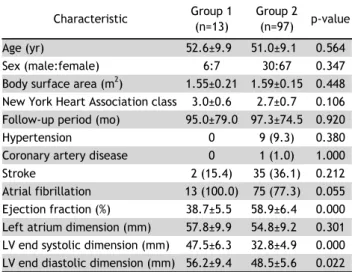
Table 1. Preoperative patient characteristics Characteristic Group 1

(n=13)

Group 2 (n=97) p-value

Age (yr) 52.6±9.9 51.0±9.1 0.564

Sex (male:female) 6:7 30:67 0.347

Body surface area (m

2

) 1.55±0.21 1.59±0.15 0.448 New York Heart Association class 3.0±0.6 2.7±0.7 0.106 Follow-up period (mo) 95.0±79.0 97.3±74.5 0.920

Hypertension 0 9 (9.3) 0.380

Coronary artery disease 0 1 (1.0) 1.000

Stroke 2 (15.4) 35 (36.1) 0.212

Atrial fibrillation 13 (100.0) 75 (77.3) 0.055 Ejection fraction (%) 38.7±5.5 58.9±6.4 0.000 Left atrium dimension (mm) 57.8±9.9 54.8±9.2 0.301 LV end systolic dimension (mm) 47.5±6.3 32.8±4.9 0.000 LV end diastolic dimension (mm) 56.2±9.4 48.5±5.6 0.022 Values are presented as mean±standard deviation or number (%).

LV, left ventricle.

Table 2. Operative data

Variable Group 1 Group 2 p-value Cardiopulmonary bypass time

(min)

94.8±24.4 99.1±26.3 0.594

Aortic cross clamp time (min) 66.0±24.8 71.7±23.5 0.432 Mechanical valves

(Carbomedic:OnX:TEKNA:others)

8:3:3 51:10:6:30

Concomitant procedure

Maze 7 (53.8) 32 (33.0) 0.140

Tricuspid annuloplasty 4 (30.8) 40 (41.2) 0.469 Left atrium thrombectomy 9 (69.2) 29 (29.9) 0.010 Values are presented as mean±standard deviation or number (%).

the clinical field, and little is known about how the clinical course of the p atient following mitral valve replacement (MVR) is affected. The objectives of this study were to evaluate the clinical outcomes of MVR in patients with MS who have LV dysfunction.

Methods

1) Patients

A total of 110 patients with MS underwent MVR at Dong-A University Hospital between January 1991 and January 2013. The patients’ ages ranged from 25 to 67 years (mean 51.2±9.2 years). Seventy-four pa- tients were female (67.6%) and the mean follow-up period was 76.8±62.5 months. Patients who under- went MVR with a bioprosthesis or concomitant aortic valve replacement were excluded because of ad- vanced age and small number of cases. Based on the ejection fraction (EF), 110 patients were divided into two groups: group 1 (EF≤45%, n=13), group 2 (E F>45%, n=97). A value of EF 45% was used for the definition of LV dysfunction because the left ven- tricular end diastolic dimension (LVEDD) increased at this point (LVEDD >55 mm). All patients were put on anticoagulation therapy after MVR in keeping with regular monitoring of the prothrombin time–interna- tional normalized ratio (PT-INR; maintained within the range of 2.0 and 3.0). The preoperative patient characteristics are summarized in Table 1.

2) Surgical technique

Standard median sternotomy was performed and cardiopulmonary bypass was established with as- cending aortic cannulation and bicaval cannulation.

Cold blood cardioplegia was administered for heart arrest and protection. The mitral valve was exposed through a left atriotomy in the interatrial groove and examined, and the anterior leaflet was excised with preservation of the posterior leaflet. The mechanical valve was then implanted. Concomitant procedures included a maze procedure with LA appendectomy, tricuspid annuloplasty, and LA thrombectomy (Table 2).

3) Statistical analysis

All data were analyzed with IBM SPSS ver. 21.0 (IBM Co., Armonk, NY, USA). Continuous values were expressed as mean±standard deviation and catego- rical values as percentages. Categorical values were compared by the chi square test and continuous val- ues by the Student unpaired t-test. The Kaplan-Meier test was used to estimate the rates of survival and freedom from reoperation as well as from post- operative thromboembolism. The log-rank test was used to determine statistical differences between groups. Significance on late death was assessed by Cox regression analysis.

Results

The median follow-up p eriod was 59 months (group

1, 52 months; group 2, 70 months). Both groups

were similar with respect to age, New York Heart

Association class, and follow-up p eriod, but statisti-

cally different in the incidence of preoperative atrial

fibrillation (AF). The male ratio was higher in group

(3)

Table 3. Echocardiographic parameters before and after the op- eration

Variable Preoperative Postoperative p-value Group 1

EF (%) 36.8±5.7 50.9±14.3 0.011

LVESD (mm) 47.3±6.8 38.9±7.9 0.019

LVEDD (mm) 54.7±9.5 51.8±6.2 0.389

LAD (mm) 55.7±10 47.9±6.7 0.008

Group 2

EF (%) 58.8±5.9 59.8±5.7 0.186

LVESD (mm) 33.0±4.8 33.0±6.6 0.982

LVEDD (mm) 48.8±5.5 48.7±6.6 0.915

LAD (mm) 55.3±9.7 50.0±10.0 0.000

Values are presented as mean±standard deviation.

EF, ejection fraction; LVESD, left ventricular end-systolic dimension;

LVEDD, left ventricular end-diastolic dimension; LAD, left atrial dimension.

Fig. 2. The actuarial survival rate of group 1 and group 2. EF, ejection fraction.

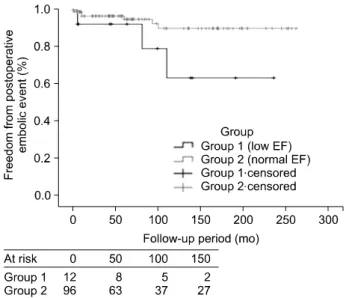
Fig. 1. Actuarial freedom from thromboembolic events. EF, ejec- tion fraction.

1 than in group 2 (Table 1).

Transthoracic echocardiography was performed in all patients preoperatively, as well as postoperatively, before discharge. All parameters except the LVEDD improved substantially in all patients in group 1 af- ter MVR, while the parameters in group 2 were un- changed (Table 3).

There were a total of 9 p ostop erative thromboem- bolic events in 9 patients. Each of these 9 cases de- veloped cerebral infarction, which in one case was accompanied by a concomitant superior mesenteric artery thrombosis. Two patients in group 1 showed a low EF p ostop eratively (27%, 43%) and died due to cerebral infarctions. The occurrence of postoperative thromboembolic events was significantly higher in group 1 than in group 2 (3 in group 1, 23.1%; 6 in group 2, 6.2%; p=0.019). The actuarial freedom from postoperative thromboembolic events at 1, 5, and 10 years was 92%, 92%, and 63% in group 1 and 97%, 95%, and 90% in group 2; these were statistically different between the two groups (log-rank test, p=0.049) (Fig. 1).

Cardiac-related death occurred in 3 patients each in group s 1 and 2. The causes of death in group 1 were cerebral infarction in 2 patients (no maze pro- cedure) and heart failure in 1 patient. The causes of death in group 2 were constrictive p ericarditis in 1 patient, intracerebral hemorrhage in 1 patient, and subdural hematoma in 1 patient. Actuarial overall survival rate at 1, 5, and 10 years was 83.9%, 83.9%, and 69.9% in group 1 and 97.9%, 96.3%, and 96.3%

in group 2 with a significant difference between the two groups (log-rank test p=0.004) (Fig. 2).

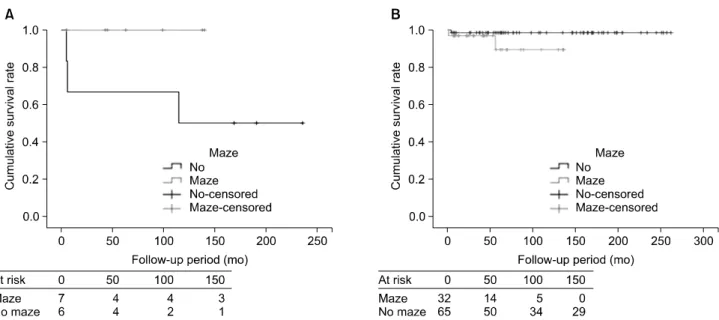
To estimate the survival effect of the maze proce- dure, the survival rate was obtained for each group.

In group 1, the actuarial overall survival rate at 1

and 10 years was 66.7% and 50.0%, respectively, in

patients who did not undergo maze procedure and

100% and 100% in patients who did undergo the

procedure. The survival rate in patients who under-

went the maze procedure was more favorable than

(4)

Fig. 3. Survival effect of the maze procedure for each group. (A) Survival functions in group 1. (B) Survival functions in group 2.

Fig. 4. Actuarial freedom from reoperation. EF, ejection fraction.

in patients who did not undergo the maze procedure;

however, there was no statistical difference between the two groups (log-rank test p=0.095). In group 2, the actuarial overall survival rate at 1 and 10 years was 98.5% and 98.5% in patients who did not un- dergo the maze procedure and 96.9% and 89.4%, re- spectively, in patients who did. There was no sig- nificant survival difference between the two groups (log-rank test p=0.144) (Fig. 3).

To further evaluate the concomitant maze proce- dure, patients were divided according to that proce- dure, irrespective of group membership (i.e., group 1 and group 2). Excluding 22 patients who had no pre- operative AF, 39 patients underwent the maze proce- dure (maze procedure group) and 49 did not (no maze procedure group). Postoperative thromboem- bolic events developed less frequently in patients who underwent the maze procedure (maze proce- dure 2, 4.1%; no maze procedure 7, 7.9%; p=0.021).

There were 5 postoperative episodes of anticoagu- lation-related hemorrhage (0 in group 1, 5 in group 2). The reasons for hemorrhage were trauma in 3 patients and over-anticoagulation in 2 patient. Subdu- ral hematomas developed in 4 patients who experi- enced hemorrhage. This included 2 p atients (maze p ro- cedure group) who experienced syncope during fol- low-up care, which caused a fall and subsequent head injury that developed into a subdural hematoma.

A total of 5 patients required reoperation (1 in

group 1, 4 in group 2). Reasons for reoperation were valve thrombosis in 2 patients and stuck valve by remnant tissue or growth in Pannus ingrowth in 3 patients. The actuarial freedom from reoperation at 1, 10, and 15 years was 100%, 100%, and 66.7% in group 1 and 100%, 96.4%, and 93.5% in group 2, re- spectively; there was no significant statistical differ- ence between the two groups (log-rank test p=0.567) (Fig. 4).

Cox regression analyses revealed that a patient`s

survival was significantly associated with postopera-

(5)

tive stroke (p=0.011, odds ratio=10.304), but was not significantly associated with low EF, LA >60 mm, pulmonary hypertension, age >60 years, or maze operation.

Discussion

MS is one of the most common forms of heart valve disorder and a major reason for MVR. Cardiac output is usually reduced in the patients with MS not by LV myocardial dysfunction but by inappropriate preload and irregular heart rhythm, which are ex- pected to improve after MVR. It is usually under- stood that LV function is spared in patients with MS due to relatively low p reload, comp ared with mitral regurgitation. However, impaired LV function is fre- quently encountered in patients with MS in clinical situations; little is known about how the impaired LV function clinically affects the p rognosis of the p atient with MS after MVR. Rheumatic carditis and chronic low preload or reactive high afterload and enlarge- ment of right ventricle may be the causes of im- paired LV function [4-6]. In this series, the patients with LV dysfunction had a generally enlarged LV and no history of hypertension, ischemic heart disease, or right ventricular enlargement. Therefore, rheumatic carditis and primary myocardiopathy were considered to be the most likely causes of impaired LV function.

Systemic thromboembolism is one of the major causes of death in patients with MS [3] and the in- cidence rate is relatively high even after MVR be- cause AF and a large LA remain. Its development may be closely related to impaired LV function. It has been reported that heart failure and AF cooper- ate with each other to cause occurrence and ag- gravation of systemic thromboembolism [7]. AF is more prevalent in cases of heart failure, and con- sequently, systemic thromboembolism increases [7].

Therefore, LV dysfunction can be recognized as a risk factor of systemic thromboembolism. This report confirms that AF was more prevalent and systemic thromboembolism occurred more frequently in pa- tients with impaired LV function after MVR than in patients without impaired LV function. AF that re- mained postoperatively in patients with LV dysfunc- tion caused postoperative stroke and affected pa- tients’ survival. Even if impaired LV function is not a direct cause of postoperative thromboembolism, it

might p artially influence the develop ment of p ost- operative thromboembolism. Although oral anti- coagulants are effective in reducing stroke risk in AF, some patients still sustain stroke despite receiving oral anticoagulant therapy. The risk factors that con- tribute to stroke risk in AF include old age, moderate and severe renal impairment, previous stroke, hyper- tension, heart failure, and diabetes mellitus (DM) [8].

Because the patients in this study had few of those risk factors, AF and LV dysfunction played a more critical role in the development of postoperative sys- temic thromboembolism than other risk factors. In order to prevent systemic thromboembolism, it is crucially imp ortant to manage AF. Maze op eration has been reported to decrease the incidence of cere- brovascular accidents (CVA) in patients with AF [9,10]. In this study, systemic thromboembolism oc- curred more frequently in patients who did not un- dergo the maze operation than in patients who did.

The maze op eration p lays an imp ortant role in the prevention of systemic thromboembolism after MVR.

When it comes to clinical effects of survival after maze procedure, the survival rate in patients with LV dysfunction who underwent the maze procedure was better than in patients with LV dysfunction who did not undergo the maze procedure; however, the dif- ference does not reach statistical significance because of the small study population. With these consid- erations, when patients with MS and AF undergo MVR, it is essential to perform a maze procedure to achieve better long- term results.

Anti-coagulation related hemorrhage is one of the most frequent valve-related complications. It usually develops within 6 months postoperatively when the PT-INR is beyond the therapeutic level; intracerebral hemorrhage is the most fatal [11]. In this series, two patients died due to intracerebral hemorrhage and subdural hematoma more than 6 months postopera- tively with therapeutic levels of anticoagulation. Thus, for the prevention of subsequent hemorrhages when anticoagulants are maintained within therap eutic range, every effort should be made to prevent inadvertent traumatic injury to patients.

Redo-MVR sometimes is required and may affect

clinical outcomes according to its causes. Infective

endocarditis and paravalvular leakage are known as

the main causes of reoperation [12-14]. In this series,

however, there were no cases of redo-MVR caused

(6)

by infective endocarditis or paravalvular leakage. All redo-MVRs were performed due to valve thrombosis or stuck valve; we did not find a definite relationship between LV dysfunction and redo-MVR.

The risk factors that affect the clinical outcomes in patients who undergo MVR vary. They include age, emergency based on surgery, DM, CVA, respiratory insufficiency, infective endocarditis, anticoagulation- related hemorrhage, and heart failure [15]. In our study, we found that p ostop erative stroke is one of the most important risk factors and affected survival in p atients with MS. Postop erative stroke occurred in patients who showed no EF improvement rather than in patients with normal LV function after MVR. To reduce risk of a p ostop erative stroke, the maze op er- ation should be performed. Heart rate and symptoms should be closely monitored to avoid postoperative syncope that may provoke traumatic complications. A careful management of heart failure is also needed.

This study is a retrospective analysis with all of its associated weaknesses. A larger sample size, espe- cially a population with more cases with impaired LV dysfunction, would be necessary for a more con- firmative clinical assessment. Data of late follow-up echocardiography were not included in our study due to incomplete follow-up of the patients.

In conclusion, postoperative stroke in patients with MS was one of the p oor p rognostic factors after MVR and was closely associated with AF and LV dysfunc- tion. For survival, and to gain better outcomes, it is crucially important to prevent systemic thromboemb- olism in patients with LV dysfunction and postopera- tive AF after MVR. Management of heart failure is al- so necessary.

Conflict of interest

No p otential conflict of interest relevant to this ar- ticle was reported.

Acknowledgments

This study was sup p orted by a Grant of the Samsung Vein Clinic Network (Daejeon, Anyang, Cheongju, Cheonan; Fund No. KTCS04-054).

References

1. Ward C, Hancock BW. Extreme pulmonary hypertension caused by mitral valve disease. Natural history and results of surgery. Br Heart J 1975;37:74-8.

2. Rowe JC, Bland EF, Sprague HB, White PD. The course of mitral stenosis without surgery: ten- and twenty-year per- spectives. Ann Intern Med 1960;52:741-9.

3. Olesen KH. The natural history of 271 patients with mitral stenosis under medical treatment. Br Heart J 1962;24:

349-57.

4. Klein AJ, Carroll JD. Left ventricular dysfunction and mi- tral stenosis. Heart Fail Clin 2006;2:443-52.

5. Wisenbaugh T, Essop R, Middlemost S, Skoularigis J, Sareli P. Excessive vasoconstriction in rheumatic mitral stenosis with modestly reduced ejection fraction. J Am Coll Cardiol 1992;20:1339-44.

6. Surdacki A, Legutko J, Turek P, Dudek D, Zmudka K, Dubiel JS. Determinants of depressed left ventricular ejection fraction in pure mitral stenosis with preserved sinus rhy- thm. J Heart Valve Dis 1996;5:1-9.

7. Anter E, Jessup M, Callans DJ. Atrial fibrillation and heart failure: treatment considerations for a dual epidemic.

Circulation 2009;119:2516-25.

8. Albertsen IE, Rasmussen LH, Overvad TF, Graungaard T, Larsen TB, Lip GY. Risk of stroke or systemic embolism in atrial fibrillation patients treated with warfarin: a sys- tematic review and meta-analysis. Stroke 2013;44:1329-36.

9. Cox JL, Ad N, Palazzo T. Impact of the maze procedure on the stroke rate in patients with atrial fibrillation. J Thorac Cardiovasc Surg 1999;118:833-40.

10. Bando K, Kobayashi J, Sasako Y, Tagusari O, Niwaya K, Kitamura S. Effect of maze procedure in patients with at- rial fibrillation undergoing valve replacement. J Heart Valve Dis 2002;11:719-24.

11. Emery RW, Krogh CC, Arom KV, et al. The St. Jude Medical cardiac valve prosthesis: a 25-year experience with single valve replacement. Ann Thorac Surg 2005;79:776-82.

12. Potter DD, Sundt TM 3rd, Zehr KJ, et al. Risk of repeat mi- tral valve replacement for failed mitral valve prostheses.

Ann Thorac Surg 2004;78:67-72.

13. Vohra HA, Whistance RN, Roubelakis A, et al. Outcome af- ter redo-mitral valve replacement in adult patients: a 10-year single-centre experience. Interact Cardiovasc Thorac Surg 2012;14:575-9.

14. Mazzucco A, Milano A, Mazzaro E, Bortolotti U. Reopera- tion in patients with a bioprosthesis in the mitral posi- tion: indications and early results. J Heart Valve Dis 1993;

2:646-8.

15. Edwards FH, Peterson ED, Coombs LP, et al. Prediction of

operative mortality after valve replacement surgery. J

Am Coll Cardiol 2001;37:885-92.

수치

Table 2. Operative data
Table 3. Echocardiographic parameters before and after the op- op-eration
Fig. 3. Survival effect of the maze procedure for each group. (A) Survival functions in group 1

참조

관련 문서

The present study was aimed to compare clinical characteristics and one-year outcomes of patients having LV systolic dysfunction after acute MI with normal and

Results: Among the 298 heart failure patients who underwent both 2D echocardiography and cardiac MRI, a total of 80 patients (male 52, age 59±14 years) with potential

While the clinical importance of LV mechanical dyssyn- chrony is mainly described in heart failure patients, 5-7) its sig- nificance in patients with MI was less well

Differences in systolic pulmonary arterial pressure, the diameter of the left main pulmonary artery, and the time interval between previous surgery and CT scan- ning between

complication risk and exclusion of other cause of LVSD. A low-dose dobutamine stress echocardiography can be used to clarify low-flow AS or to identify pseudo-stenosis from true

In our study, 48 (27%) patients had a low gradient severe AS, and these patients had a high rate of clinical events during follow-up; 50% and 41.7% of patients had

All pediatric patients with clinical signs of left heart failure, an enlarged heart shadow on chest radiographs, and left ven- tricular dysfunction with an ejection fraction below

Material and Method: Between March 2000 and February 2004, 177 consecutive patients underwent the modified maze procedure with the use of cryoablation concomitant with mitral