© 2010 The Korean Academy of Medical Sciences.
This is an Open Access article distributed under the terms of the Creative Commons Attribution Non-Commercial License (http://creativecommons.org/licenses/by-nc/3.0) which permits unrestricted non-commercial use, distribution, and reproduction in any medium, provided the original work is properly cited.
pISSN 1011-8934 eISSN 1598-6357
© 2010 The Korean Academy of Medical Sciences.
This is an Open Access article distributed under the terms of the Creative Commons Attribution Non-Commercial License (http://creativecommons.org/licenses/by-nc/3.0) which permits unrestricted non-commercial use, distribution, and reproduction in any medium, provided the original work is properly cited.
pISSN 1011-8934 eISSN 1598-6357
Successful Resection of a Giant Left Ventricular Pseudoaneurysm Developed Later after Mitral Valve Replacement
We present a case of successful surgical resection of a giant left ventricular (LV) pseudoaneurysm that developed 5 yr after mitral valve replacement (MVR). A 59-yr-old female was admitted with exertional chest pain radiating to left arm and back. 64-slice multidetector computed tomography (MDCT) revealed significant stenosis on the ostium of the first diagonal branch of the left anterior descending coronary artery and also a huge pseudoaneurysm compressing the right atrium and the inferior vena cava. She underwent resection of the pseudoaneurysm, and the pseudoaneurysm tunnel was repaired from the inside of LV cavity by removing the previously inserted prosthetic valve, followed by redo MVR together with coronary arterial bypass grafting (CABG) for a single-vessel disease. At the 6-month follow-up, the patient continued to do well without any complications.
Key Words: Aneurysm, False; Postoperative Complications; Mitral Valve Sun Kyung Min1, Jung-Ju Sir2,
Jong-Chun Nah2, and Yong-In L. Kim1 Cardiovascular Center, Departments of
Cardiovascular and Thoracic Surgery1, Cardiology2, Inje University Seoul Paik Hospital, Seoul, Korea Received: 28 April 2009
Accepted: 9 July 2009 Address for Correspondence:
Yong-In L. Kim, M.D.
Department of Cardiovascular and Thoracic Surgery, Inje University Seoul Paik Hospital, 5 Mareunnae-gil, Jung-gu, Seoul 100-032, Korea
Tel: +82.2-2270-0948, Fax: +82.2-2270-0038 E-mail: [email protected]
DOI: 10.3346/jkms.2010.25.7.1080 • J Korean Med Sci 2010; 25: 1080-1082
CASE REPORT
Cardiovascular Disorders
INTRODUCTION
LV pseudoaneurysm is very rare as well as difficult to diagnose clinically (1). It has been defined as a rupture of the myocardi- um involved in pericardial adhesions or the epicardial wall of LV (2, 3). The myocardial infarction is known as the most com- mon cause of it (4). Inferior infarcts are almost twice as com- mon as anterior infarcts (5). One-third of them results from a surgical procedure, mostly MVR (3). We report a successful re- section of a giant LV pseudoaneurysm developed as a delayed complication after MVR.
CASE REPORT
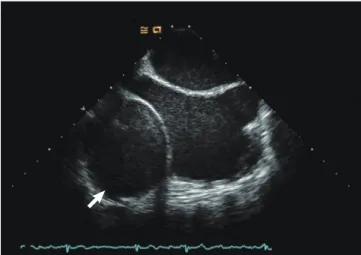
A 57-yr-old woman had undergone a mitral valve replacement (MVR) with mechanical prosthesis 5 yr ago. At 3 yr after the op- eration, an echocardiogram at a regular follow-up did not show any specific abnormalities. The patient was admitted with exer- tional chest pain radiating to the left arm and back, which de- veloped in the past 6 month. Physical examination revealed normal prosthetic valve heart sounds and systolic murmur at left parasternal area. Echocardiography revealed good mitral valve function, mild to moderate tricuspid regurgitation, and a huge LV pseudoaneurysm (Fig. 1). Transthoracic and trans- esophageal echocardiogram demonstrated a defect of LV wall and a systolic turbulent flow from LV into the pseudoaneurysm.
64-slice MDCT (Toshiba, Aquillion, Tokyo Japan) revealed a gi- ant pseudoaneurysm with partially calcified wall, 11×7×6 cm in
dimension, compressing the right atrium and inferior vena cava (Figs. 2, 3). Cardiac magnetic resonance imaging (MRI) (ACHIE- VA 1.5T, Phillips) confirmed a huge LV pseudoaneurysm (size, approximately 10×12 cm) located on the inferior side of the heart. Coronary angiography revealed significant proximal ste- nosis of the diagonal artery. In light of the patient’s conditions, we opted for surgical resection of this LV pseudoaneurysm.
The patient underwent single-vessel CABG by anastomosis of left internal mammary artery to the diagonal artery, followed by repair of the LV pseudoaneurysm through the re-sternotomy and under the cardiopulmonary bypass (CPB). The large LV pseudoaneurysm leaked through a tunnel-like structure below the mitral valve (Fig. 3). Therefore, repair and removal of the pseudoaneurysm sac was performed after removal of the me- chanical prosthesis that had been replaced previously. MVR was redone using a Sorin Bicarbon valve (27 mm), and tricus- pid valve annuloplasty was performed using an Edward Cos- grove ring (26 mm). Weaning from the CPB was uneventful.
Aortic cross time was 193 min. and total CPB time, 284 min. The postoperative course was in normal. Postoperative echocar- diography revealed a good functioning of the mitral mechani- cal valve and no tricuspid regurgitation with well-preserved LV function. Tissue biopsy results showed that the pseudoaneu- rysmal sac was composed of degenerated fibromyxoid tissue and multifocal dystrophic calcifications.
At the 6-month follow-up, the patient was doing well without any complications.
Min SK, et al. • Left Ventricular Pseudoaneurysm after Mitral Valve Replacement
DOI: 10.3346/jkms.2010.25.7.1080 http://jkms.org 1081
DISCUSSION
LV pseudoaneurysm is a clinically rare condition that is difficult to diagnose (1). It is defined as rupture of the myocardium in- volved in pericardial adhesions or the epicardial wall (2, 3). The most common etiology of LV pseudoaneurysm is myocardial infarction (4). Inferior infarcts are approximately twice as com- mon as anterior infarcts (5). One-third of pseudoaneurysms re- sult from a surgical procedure, most often MVR (3).
In this case, the pseudoaneurysm is not considered to be caused by only a single-vessel lesion with proximal diagonal ar- tery stenosis but also by myocardial infarcts. The ischemic le- sion was located far from the LV pseudoaneurysm and patient had no evidence of myocardial infarcts. Therefore, this LV pseu- doaneurysm was thought to have resulted from the previous
MVR. Further, pseudoaneurysm was not detected on echocar- diographic examination that was performed 2 yr ago, and chest pain and dyspnea developed in the past 6 months. Therefore, we presumed that this LV pseudoaneurysm had developed re- cently and enlarged rapidly. Surgical treatment is usually rec- ommended for LV pseudoaneurysm because of the possibility of its rapid expansion and rupture (3).
The neck of LV pseudoaneurysmal sac in this case was locat- ed inferior to the prosthetic mitral valve and connected to the LV cavity with a tunnel-shaped structure. Repair of the LV pseu- doaneurysm was possible only after removal of the previously placed mechanical valve. Therefore, we had to replace mitral valve although the previous valve had good function.
Coronary angiography is usually necessary before surgery. In fact, angiography of the LV is the best available test for diagnos- Fig. 1. Two-dimensional transesophageal echocardiographic view of the left
ventricular pseudoaneurysm (arrow). Fig. 2. Reconstructed 3D-computed tomography. The left ventricular pseudoaneurysm is indicated by an arrow.
Fig. 3. Left ventricular pseudoaneurysm (arrow) from medial aspect of MVR site through tortuous tract.
LAF LAF
RPF RPF
Min SK, et al. • Left Ventricular Pseudoaneurysm after Mitral Valve Replacement
DOI: 10.3346/jkms.2010.25.7.1080
1082 http://jkms.org
ing LV pseudoaneurysm (3). However, because of its cost and invasiveness, a reasonable alternative for the first evaluation is transthoracic echocardiography (2, 3, 6).
Further, more information about the location and the rela- tionship between LV pseudoaneurysm and other organs can be obtained by reconstructed computed tomography and cardiac MRI. This data could be very helpful to the surgeon in order to plan the surgical procedure (2, 7-9).
In conclusion, we successfully resected a giant LV pseudoan- eurysm developed 5 yr after MVR together with CABG, redo MVR, and tricuspid annuloplasty through the median re-ster- notomy.
REFERENCES
1. Miura T, Yamazaki K, Kihara S, Saito S, Miyagishima M, Aomi S, Kuro- sawa H. Transatrial repair of submitral left ventricular pseudoaneu- rysm. Ann Thorac Surg 2008; 85: 643-5.
2. Schreurs M, Herregods MC, Bogaert J, Troost E, Budts W. Pseudoaneu- rysm of the left ventricle with moderate left-to-right shunt. Int J Cardiol
2008; 130: 11-3.
3. Frances C, Romero A, Grady D. Left ventricular pseudoaneurysm. J Am Coll Cardiol 1998; 32: 557-61.
4. Amasyali B, Cansel M, Kose S, Kursaklioglu H, Genc C, Isik E. Giant pseudoaneurysm of the left ventricle presenting 15 years after blunt chest trauma with high lateral myocardial infarction due to diagonal artery compression. Int J Cardiol 2007; 119: e51-2.
5. Kollar A, Byrd BF 3rd, Lui HK, Drinkwater DC Jr. Mitral valve replace- ment and endocavitary patch repair for a giant left ventricular pseudoa- neurysm. Ann Thorac Surg 2001; 71: 2020-2.
6. Hong JH, Choi JW, Moon JH, Lim SH. Pseudoaneurysm of left ventricu- lar apex caused by a left ventricular venting catheter through the right superior pulmonary vein. J Thorac Cardiovasc Surg 2007; 134: 229-30.
7. Karas TZ, Gregoric ID, Frazier OH, Reul RM. Delayed left ventricular pseudoaneurysms after left ventricular aneurysm repairs with the Cor- Restore patch. Ann Thorac Surg 2007; 84: 266-9.
8. Tuan J, Kaivani F, Fewins H. Left ventricular pseudoaneurysm. Eur J Echocardiogr 2008; 9: 107-9
9. Biyikoglu SF, Guray Y, Turkvatan A, Boyaci A, Katircioglu F. A serious complication late after mitral valve replacement: left ventricular rupture with pseudoaneurysm. J Am Soc Echocardiogr 2008; 21: 1178.e1-3.