66
Modafinil의 주의력결핍 과잉행동장애 치료효과에 대한 체계적 문헌 고찰
이유정
숙명여자대학교 임상약학대학원
(2010년 3월 17일 접수·2010년 4월 12일 수정·2010년 6월 4일 승인)
Modafinil for the Treatment of Attention Deficit Hyperactivity Disorder: A Systematic Review
Yu Jeung Lee
Graduate School of Clinical Pharmacy, Sookmyung Women’s University, Seoul, Korea (Received March 17, 2010·Revised April 12, 2010·Accepted June 4, 2010)
주의력결핍 과잉행동장애는 미국에서 약 200만 명의 어린이에게 나타나는 심각한 만성 신경행동학적 장애이다. 주의 력결핍 과잉행동장애 치료의 중심은 약물요법이다. 그러나 현재 환자의 약 30%는 주의력결핍 과잉행동장애를 적응증 으로 갖도록 허가된 의약품들을 사용해도 적절한 치료효과를 얻지 못하고 있는 상황이다. Modafinil은 methylphenidate나 amphetamines와 같은 각성제와는 다른 약리학적 기전으로 중추신경계를 항진시킨다. 본 연구는 modafinil의 주의력결핍 과잉행동장애 치료효과에 대한 최신 지견을 얻고자, 1990년부터 2010년 3월까지 MEDLINE 에 등재된 논문을 ADHD와 Modafinil이라는 MeSH terms로 검색하여 추출한 자료 중에서 대조군이 사용된 무작위 배정 및 이중맹검 임상연구 사례만을 선별하여 임상적 유용성을 평가하였다. 현재 modafinil은 주의력결핍 과잉행동 장애 치료제로 허가된 의약품은 아니지만 최근 여러 국가에서 시행된 연구들은 modafinil이 안전하고 효과적인 주의 력결핍 과잉행동장애 치료제일 수 있다는 결과를 보여주고 있다.
□ Key words - Attention deficit hyperactivity disorder; Modafinil
Attention deficit hyperactivity disorder (ADHD) is the most common neurobehavioral disorder of childhood.1) ADHD is characterized by symptoms including difficulties with attention, impulsivity, and hyperactivity. It is estimated that between 3 and 5 percent of children have ADHD, or approximately 2 million children in the United States.
ADHD places a considerable burden on society regarding financial cost. The direct cost of medical care for patients with ADHD is double that of the cost of medical care for the rest of the population.2)
Pharmacotherapies used for ADHD include stimulants (methylphenidate and amphetamines) and atomoxetine.3-5) While these medications are effective in patients with ADHD, approximately 30% of all patients do not respond adequately to stimulants or experience poor tolerability.6)
Thus there is a need for effective and well tolerated agents in patients with ADHD. Modafinil, currently marketed as Provigil, is approved in the United States to improve wakefulness in adults with excessive sleepiness associated with narcolepsy, obstructive sleep apnea/hypopnea syndrome, and shift-work sleep disorder. Modafinil has not yet been approved for the treatment of ADHD. However, recent studies have suggested that modafinil may be effective in the treatment of ADHD with fewer adverse effects than agents currently approved for ADHD.7-11) The purpose of this article is to evaluate published literature concerning the use of modafinil for the treatment of ADHD. A MEDLINE search (from January 1990 to March 2010) was conducted using a combination search term ADHD and modafinil with limits of randomized controlled trials and humans.
MODAFINIL
Modafinil is a wakefulness-promoting agent. The chemical name for modafinil is 2-[(diphenylmethyl)sulfinyl]acetamide.
Correspondence to : Yu Jeung Lee
Graduate School of Clinical Pharmacy, Sookmyung Women’s University, Seoul, Korea Tel: +82-2-2077-7545, Fax: +82-2-3477-7343 E-mail: [email protected]
The molecular formula is C15H15NO2S and the molecular weight is 273.36.12) Modafinil’s precise mechanism of action is not known.13) Unlike the wakefulness induced by traditional stimulants, modafinil induced wakefulness appears not to be mediated by dopamine. Modafinil induced wakefulness is not blocked by dopamine antagonists and does not affect the firing rates of dopaminergic or noradrenergic neurons.14-15) Increase the brain’s expression of the gene c-fos is a marker of neuronal activation. Diffuse areas of the brain are activated after amphetamine administration, while modafinil produces a more localized c- fos activation, especially the anterior hypothalamus.16-17) Clinical studies and postmarketing surveillance have shown that modafinil has a low potential for abuse.18) Modafinil is readily absorbed, reaching maximum plasma concentrations at 2-4 hours after oral administration. The elimination half- life of modafinil is approximately 12-15 hours, with the primary route of elimination being metabolic, mainly in the liver.13)
LITERATURE REVIEW
Taylor FB and Russo J conducted a randomized, double- blind, placebo-controlled, three phase, crossover study to compare the efficacy of modafinil, dextroamphetamine, and placebo in adults with ADHD.7) This study included 22 people more than 21 years old from a single local community. They were assessed for ADHD by the Diagnostic and Statistical Manual of Mental Disorders, 4th edition (DSM-IV) criteria. The DSM-IV ADHD Behavior Checklist for Adults was also used to select study subjects.
To be eligible for this study, patients were required to score above 93rd percentile of severity for at least one subtype of ADHD on both the childhood and adult versions of this scale. Two week drug treatment phases were separated by 4 day washout periods between phases. Study medications were given twice daily to patients, and titrated to doses of optimum efficacy selected within 4 to 7 days. Treatments at the fixed doses were maintained for another 7 to 10 days.
One patient was dropped from the study after enrollment but before drug trials began due to an emergent hyperthyroid condition. The mean daily doses of modafinil and dextroamphetamine were 206.8 mg and 21.8 mg. Scores on the DSM-IV ADHD Behavior Checklist were significantly improved over the placebo condition following modafinil and dextroamphetamine treatments (P<0.001).
Insomnia, irritability, muscle tension, and appetite suppression were the most common adverse effects, but no patients discontinued treatment with either modafinil or dextroamphetamine. There are limitations in this study. The treatment period of this study was short and the number of subjects was small. Therefore, large and long-term studies should be conducted to use modafinil for the treatment of ADHD in clinical practice.
In 2003, a randomized, double-blind, placebo-controlled study was conducted to test the hypothesis that modafinil significantly improves clinical features affecting children with ADHD.8) Twenty-four children who met the DSM-IV criteria for ADHD were included in this study. They were randomized to receive modafinil or placebo. Two children were excluded from data analysis because of repeated emesis and untoward social circumstances (house fire), respectively before the first postmedication evaluation.
Among 22 patients who completed this study, 11 patients had received modafinil and 11 had received placebo.
Researchers used flexible doses titrated to effect. Once the dose was stable for at least 5 days, the study was concluded that no further upward titration was indicated or no further upward titration was desired. Statistical review of the demographic information and pretreatment values comparing the modafinil group with the placebo group showed no statistically significant differences. The primary outcome measurements were the Test of Variables of Attention (TOVA) ADHD z score and the Conners DSM-IV ADHD total scale. The placebo group manifested a slight decline of the ADHD score with an average difference of - 1.02, whereas the modafinil group exhibited improvement with an average difference of +2.53 (P≤ 0.02). On the Conners DSM-IV ADHD total scale, the children receiving modafinil exhibited greater post treatment improvement from 76.6 to 68.2 than the children receiving placebo from 77.7 to 76.0 (P <0.05). All adverse effects were minor and transient with only one patient requiring discontinuation of modafinil because of repeated emesis. The most common adverse event was delayed onset of sleep, but the incidence was equal for modafinil and placebo groups. This study did not use an intent-to-treat analysis. Treatment period was also short and the number of subjects was small.
In the United Kingdom, a double-blind, randomized, placebo-controlled crossover study was conducted to assess the positive effects of modafinil in adult patients with ADHD.9) Twenty patients (7 female) with a DSM-IV
diagnosis of ADHD were included in this study. Their mean age was 28±9 years. The researchers randomized 10 patients to receive a single dose of placebo first, followed by 200 mg modafinil, and 10 patients to receive the drug first, followed by placebo. Blood pressure and pulse were measured for the physiologic effects of modafinil. Modafinil increased both diastolic blood pressure (p=0.034) and systolic blood pressure (p=0.058) compared to placebo.
Patients who received modafinil had feeling more excited compared to patients who received placebo in visual analog scales (p=0.012). Using the one-touch Tower of London spatial planning task (NTOL), patients with modafinil were significantly better in obtaining a correct solution than with placebo (p=0.009). Patients given modafinil had greater capacity to inhibit responding compared to patients given placebo (p=0.028) when measured with the stop-signal reaction time task (STOP). The researchers did not report the adverse effects of modafinil. This study evaluated the effects of a single dose of modafinil. Therefore, studies with multiple doses should be needed to examine a full clinical effect of modafinil on ADHD.
Another study evaluated a new formulation of modafinil (modafinil film-coated tablets) in children and adolescents with ADHD.10) The researchers conducted a 9-week, multicenter, randomized, double-blind, placebo-controlled, flexible-dose study. Patients with a DSM-IV diagnosis of ADHD who were 6 to 17 years of age were included in this study. Patients were randomly assigned at a ratio of 2:1 to receive 9 weeks of modafinil (164 patients) or placebo (82 patients). Efficacy was measured using the School and Home Versions of the Attention-Deficit/
Hyperactivity Disorder Rating Scale-IV (ADHD-RS-IV).
Patients with modafinil significantly improved the core symptoms of ADHD with greater reductions in the ADHD- RS-IV School Version mean total scores (-15.0 in modafinil group versus -7.3 in placebo group, p < 0.0001). The ADHD-RS-IV Home Version also showed similar differences in the improvement of ADHD symptoms between two groups (-14.3 in modafinil group versus -7.0 in placebo group, p < 0.0001). In modafinil-treated patients, the most common adverse effects were insomnia, headache, and decreased appetitie. However, no patients was dropped from this study due to these adverse effects. The rates of discontinuation as a result of adverse effects were similar in both modafinil group and placebo group (3% in modafinil group versus 4% in placebo group). Limitations of this study were as follows. This study excluded patients well
treated with stimulants who might be responsive to modafinil treatment. Study duration was also short.
In Iran, a 6 week double-blind, randomized clinical trial was conducted to study the efficacy of modafinil for ADHD in children and adolescents as compared to methylphenidate.19) This study enrolled 60 outpatients between the ages of 6 to 15 with a DSM-IV diagnosis of ADHD. They were randomized in a 1:1 ratio to take modafinil or methylphenidate. Modafinil and methylphenidate were titrated up during the study. The Parent and Teacher ADHD Rating Scale-IV was used to measure outcome.
Both modafinil-treated patients and methylphenidate-treated patients showed a significant improvement in ADHD symptoms during this study. There is no significant difference on the reduction of the Parent and Teacher ADHD Rating Scale between baseline and end-point (p=0.62 and p=0.75, respectively). Adverse effects observed over the study were mild to moderate, and tolerable. In methylphenidate-treated patients, decreased appetite and difficulty falling asleep were observed more frequently (p=0.03 and p=0.05, respectively). This study had a small number of subjects and short study duration. So further studies are needed.
Kahbazi M, Ghoreishi A, Rahiminejad F, et al conducted a study to evaluate the efficacy of modafinil for ADHD in children and adolescents.20) This 6 week randomized, double-blind, placebo-controlled study included 46 outpatients. They were between the ages of 6 to 15 with a DSM-IV diagnosis of ADHD. The researchers randomly assigned the patients to receive modafinil or placebo. Using the Parent and Teacher ADHD Rating Scale, there were significant difference on the reduction of scores (p<0.001).
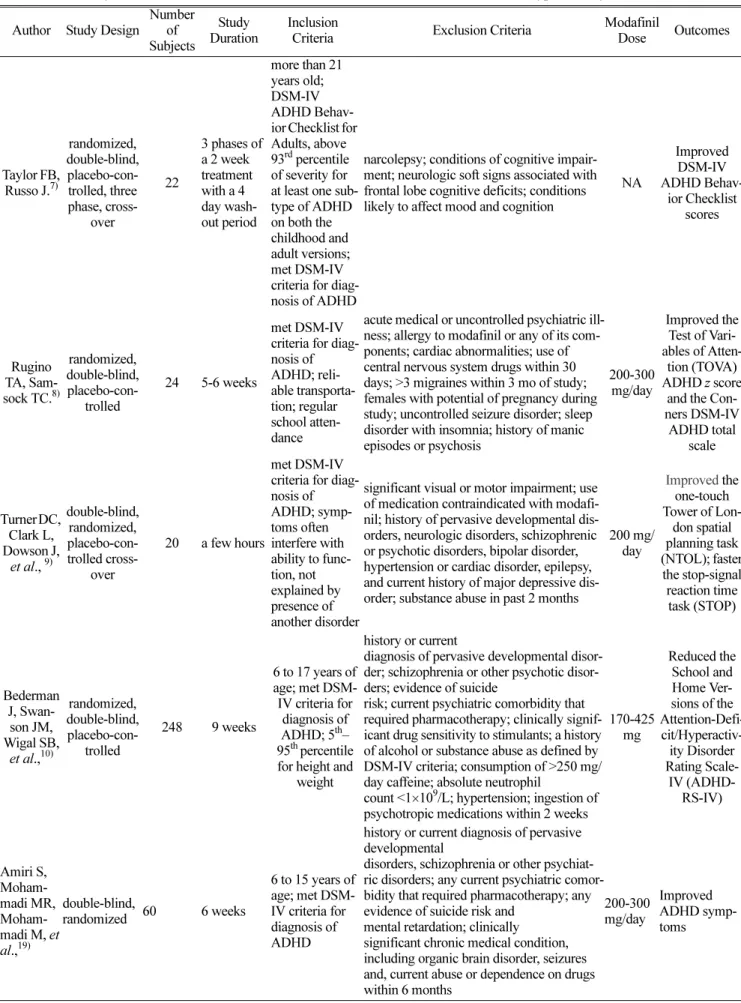
In terms of adverse effects, decreased appetite was observed more often in modafinil-treatment patients (p=0.05). Similar to other studies above, the number of subjects was small and study duration was short in this study(Table 1).
SUMMARY
The results from six randomized controlled studies demonstrate that modafinil is effective in the treatment of ADHD symptoms with tolerable adverse effects.7-10,19-20)
However, there are limitations in the above studies. In most studies, the number of subjects was relatively small. Three of the six randomized controlled studies had only less than 25 subjects included. With such small subjects, it’s hard to
Table 1. Summary of clinical studies of modafinil for the treatment of attention deficit hyperactivity disorder
Author Study Design
Number of Subjects
Study Duration
Inclusion
Criteria Exclusion Criteria Modafinil
Dose Outcomes
Taylor FB, Russo J.7)
randomized, double-blind, placebo-con- trolled, three phase, cross-
over
22
3 phases of a 2 week treatment with a 4 day wash- out period
more than 21 years old;
DSM-IV ADHD Behav- ior Checklist for Adults, above 93rd percentile of severity for at least one sub- type of ADHD on both the childhood and adult versions;
met DSM-IV criteria for diag- nosis of ADHD
narcolepsy; conditions of cognitive impair- ment; neurologic soft signs associated with frontal lobe cognitive deficits; conditions likely to affect mood and cognition
NA
Improved DSM-IV ADHD Behav-
ior Checklist scores
Rugino TA, Sam- sock TC.8)
randomized, double-blind, placebo-con-
trolled
24 5-6 weeks
met DSM-IV criteria for diag- nosis of ADHD; reli- able transporta- tion; regular school atten- dance
acute medical or uncontrolled psychiatric ill- ness; allergy to modafinil or any of its com- ponents; cardiac abnormalities; use of central nervous system drugs within 30 days; >3 migraines within 3 mo of study;
females with potential of pregnancy during study; uncontrolled seizure disorder; sleep disorder with insomnia; history of manic episodes or psychosis
200-300 mg/day
Improved the Test of Vari- ables of Atten-
tion (TOVA) ADHD z score
and the Con- ners DSM-IV
ADHD total scale
Turner DC, Clark L, Dowson J,
et al., 9)
double-blind, randomized, placebo-con- trolled cross-
over
20 a few hours
met DSM-IV criteria for diag- nosis of ADHD; symp- toms often interfere with ability to func- tion, not explained by presence of another disorder
significant visual or motor impairment; use of medication contraindicated with modafi- nil; history of pervasive developmental dis- orders, neurologic disorders, schizophrenic or psychotic disorders, bipolar disorder, hypertension or cardiac disorder, epilepsy, and current history of major depressive dis- order; substance abuse in past 2 months
200 mg/
day
Improved the one-touch Tower of Lon-
don spatial planning task (NTOL); faster
the stop-signal reaction time task (STOP)
Bederman J, Swan-
son JM, Wigal SB,
et al.,10)
randomized, double-blind, placebo-con-
trolled
248 9 weeks
6 to 17 years of age; met DSM- IV criteria for diagnosis of ADHD; 5th– 95th percentile for height and
weight
history or current
diagnosis of pervasive developmental disor- der; schizophrenia or other psychotic disor- ders; evidence of suicide
risk; current psychiatric comorbidity that required pharmacotherapy; clinically signif- icant drug sensitivity to stimulants; a history of alcohol or substance abuse as defined by DSM-IV criteria; consumption of >250 mg/
day caffeine; absolute neutrophil
count <1×10⁹/L; hypertension; ingestion of psychotropic medications within 2 weeks
170-425 mg
Reduced the School and Home Ver- sions of the Attention-Defi- cit/Hyperactiv- ity Disorder Rating Scale- IV (ADHD-
RS-IV)
Amiri S, Moham- madi MR, Moham- madi M, et al.,19)
double-blind,
randomized 60 6 weeks
6 to 15 years of age; met DSM- IV criteria for diagnosis of ADHD
history or current diagnosis of pervasive developmental
disorders, schizophrenia or other psychiat- ric disorders; any current psychiatric comor- bidity that required pharmacotherapy; any evidence of suicide risk and
mental retardation; clinically
significant chronic medical condition, including organic brain disorder, seizures and, current abuse or dependence on drugs within 6 months
200-300 mg/day
Improved ADHD symp- toms
apply the results of above studies to clinical practice. Also, no studies conducted for the chronic modafinil treatment of ADHD. A 9 week study was the longest one among above studies. Therefore, large and long-term clinical studies should be conducted to use modafinil for the treatment of ADHD in clinical practice.
REFERENCES
1. American Academy of Pediatrics. Committee on Quality Improvement, Subcommittee on ADHD. Clinical practice guideline: diagnosis and evaluation of the child with attention-deficit/hyperactivity disorder. Pediatrics. 2000;
105: 1158-1170.
2. Birnbaum HG, Kessler RC, Lowe SW. Costs of attention deficit-hyperactivity disorder (ADHD) in the US: excess costs of persons with ADHD and their family members in 2000. Curr Med Res Opin. 2005; 21: 195-206.
3. Brown RT, Amler RW, Freeman WS, et al., Gender effects on attention-deficit/hyperactivity disorder in adults, revisited. Pediatrics. 2005; 115: e749-e757.
4. Kelsey DK, Sumner CR, Casat CD, et al., Once-daily atomoxetine treatment for children with attention-deficit/
hyperactivity disorder, including an assessment of evening and morning behavior: a double-blind, placebo- controlled trial. Pediatrics. 2004; 114: e1-e8.
5. Michelson D, Allen AJ, Busner J, et al., Once-daily atomoxetine treatment for children and adolescents with attention deficit hyperactivity disorder: a randomized, placebo-controlled study. Am J Psychiatry. 2002; 159:
1896-1901.
6. Biederman J, Spencer T, Wilens T. Evidence-based pharmacotherapy for attention-deficit hyperactivity disorder. Int J Neuropsychopharmacol. 2004; 7: 77-97.
7. Taylor FB, Russo J. Efficacy of modafinil compared to dextroamphetamine for the treatment of attention deficit hyperactivity disorder in adults. J Child Adolesc Psychopharmacol. 2000 ;10: 311-320.
8. Rugino TA, Samsock TC. Modafinil in children with attention-deficit hyperactivity disorder. Pediatr Neurol.
2003; 29: 136-142.
9. Turner DC, Clark L, Dowson J, et al., Modafinil improves cognition and response inhibition in adult attention-deficit/hyperactivity disorder. Biol Psychiatry.
2004; 55: 1031-1040.
10. Biederman J, Swanson JM, Wigal SB, et al., Efficacy and safety of modafinil film-coated tablets in children and adolescents with attentiondeficit/hyperactivity disorder:
results of a randomized, double-blind, placebo-controlled, flexible-dose study. Pediatrics. 2005; 116: e777-e784.
11. Wigal SB, Biederman J, Swanson JM, et al., Efficacy and safety of modafinil film-coated tablets in children and adolescents with or without prior stimulant treatment for attention-deficit/hyperactivity disorder: pooled analysis of 3 randomized, double-blind, placebo-controlled studies. Prim Care Companion J Clin Psychiatry. 2006; 8: 352-360.
12. Provigil prescribing information. Cephalon, Inc. 2004.
13. Robertson PJr, Hellriegel ET. Clinical pharmacokinetic profile of modafinil. Clin Pharmacokinet. 2003; 42: 123- 137.
14. Lin JS, Roussel B, Akaoka H, et al., Role of catecholamines in the modafinil and amphetamine induced wakefulness, a comparative pharmacological study in the cat. Brain Res. 1992; 591: 319-326.
15. Ferraro L, Antonelli T, O'Connor WT, et al., Modafinil:
an antinarcoleptic drug with a different neurochemical profile to d-amphetamine and dopamine uptake blockers.
Biol Psychiatry. 1997; 42: 1181-1183.
16. Lin J-S, Hou Y, Jouvet M. Potential brain neuronal targets for amphetamine-, methylphenidate-, and modafinil-induced Table 1. Summary of clinical studies of modafinil for the treatment of attention deficit hyperactivity disorder(continued)
Kahbazi M, Ghoreishi
A, Rahimine-
jad F, et al.,20)
randomized, double-blind, placebo-con-
trolled
46 6
weeks
6 to 15 years of age; met DSM-IV criteria for diag- nosis of ADHD
history or current diagnosis of pervasive developmental disorders, schizophrenia or other psychiatric disorders; any current psychiatric comorbid- ity that required pharmacother- apy; any evidence of suicide risk and
mental retardation; clinically significant chronic medical condition, including organic brain disorder, seizures and, current abuse or dependence on drugs within 6 months; hyper- tension; consumption of >250 mg/day caffeine
200-300 mg/day
Improved the Teacher and Parent ADHD Rat-
ing Scale-IV
wakefulness, evidenced by c-fos immunocytochemistry in the cat. Proc Natl Acad Sci USA. 1996; 93: 14128-14133.
17. Engber TM, Koury EJ, Dennis SA, et al., Differential patterns of regional c-Fos induction in the rat brain by amphetamine and the novel wakefulness-promoting agent modafinil. Neurosci Lett. 1998; 241: 95-98.
18. Myrick H, Malcolm R, Taylor B, et al., Modafinil:
preclinical, clinical, and post-marketing surveillance--a review of abuse liability issues. Ann Clin Psychiatry.
2004; 16: 101-109.
19. Amiri S, Mohammadi MR, Mohammadi M, et al., Modafinil as a treatment for Attention-Deficit/Hyperactivity Disorder in children and adolescents: a double blind, randomized clinical trial. Prog Neuropsychopharmacol Biol Psychiatry. 2008; 32:
145-149.
20. Kahbazi M, Ghoreishi A, Rahiminejad F, et al., A randomized, double-blind and placebo-controlled trial of modafinil in children and adolescents with attention deficit and hyperactivity disorder. Psychiatry Res. 2009;
168: 234-237.