Introduction
Attention-deficit hyperactivity disorder (ADHD) is a very common disease in 3–5% of school-age children. The dis- ease is characterized by the symptoms of inattention and hy- peractivity-impulsivity due to various causes. The cause of ADHD is still unknown. In previous studies, probandwise concordance rates of ADHD have ranged from 50% to 80%
for monozygotic twins and have been approximately 30%
for dizygotic twins, and the study by Biederman and Fara- one
1)estimated the average hereditary ratio to be 0.77. De- spite the well-known high contribution of hereditary factors,
attention continues to be paid to the environmental factors of ADHD. Nigg
2)stated that the cause of this is the increased medical, systematic, and customers’ interest in the environ- mental factors that affect pediatric diseases such as obesity, asthma, cancer, learning disabilities, and behavioral disor- ders in modern society. Another cause of the interest in the environmental factors of ADHD is the emphasis on the inter- play between genes and the environment, in which environ- mental factors affect the onset of genetic diseases.
2)The en- vironmental factors that affect ADHD such as drinking, sm- oking, exposure to environmental toxic substances, perinatal complications, accumulations of heavy metals, mineral defi- ciency, and various food additives during pregnancy have been studied.
Among the environmental factors of ADHD, the risk of in- creased concentration of lead in the body is well known, and has long been studied. Lead was widely used as an ingredient of gasoline additives and paint in the past, but its use has
The Relationship between Hair Zinc and Lead Levels and Clinical Features of Attention-Deficit Hyperactivity Disorder
Dong-Won Shin, M.D., Ph.D.
1), Eun-Ji Kim, M.D.
2), Kang-Seob Oh, M.D., Ph.D.
1), Young-Chul Shin, M.D., Ph.D.
1), and Se-Won Lim, M.D., Ph.D.
1)1)
Department of Psychiatry, Kangbuk Samsung Hospital, Sungkyunkwan University School of Medicine, Seoul, Korea
2)
Dr. Lee’s Clinic, Seoul, Korea
Objectives:The goal of this study was to examine the association between zinc and lead level and symptoms of attention- deficit hyperactivity disorder (ADHD) among Korean children.
Methods:A total of 89 clinic-referred children participated in the study (ADHD group=45, control group=44). The partici- pants were 5–15 years old, and were mainly from urban areas of Seoul, Korea. ADHD was diagnosed using the Kiddie-Schedule for Affective Disorders and Schizophrenia-Present and Lifetime Version. We excluded children with a comorbid psychiatric dis- order, medical illness requiring medication, or a prior history of taking ADHD medication. In order to evaluate the severity of ADHD symptoms, parents’ Korean ADHD Rating Scale (K-ARS) was used. The ADHD diagnostic system (ADS) was used for evaluation of the severity of inattention and impulsivity. All participants completed the intelligence test and hair mineral analysis.
Multiple regression analysis was used to examine the effect of hair zinc and lead levels on the K-ARS and ADS. We measured the predictive ability of the zinc and lead levels using logistic regression analysis.
Results:The lead level explained the score for omission errors, commission errors, and response time SD in visual ADS in the ADHD group (adjusted R
2=.243, p<.01, adjusted R
2=.362, p<.01, and adjusted R
2=.275, p<.01), the score for omission errors of auditory ADS in ADHD group (adjusted R
2=.407, p<.01) and the entire group (adjusted R
2=.292, p<.01). Zinc was significantly explanatory for the K-ARS scores for the entire group (adjusted R
2=.248, p<.001) and the ADHD group (adjusted R
2=.247, p<.05).
Conclusion:These findings suggest a possible role of zinc and lead in ADHD. Lead concentration in hair samples affected the ADS scores, and this was more prominent in children with ADHD. Children with ADHD had a lower zinc concentration in their hair, and the zinc concentration in hair showed negative correlation with the K-ARS score.
KEY WORDS : Attention-Deficit Hyperactivity DisorderㆍZinc and LeadㆍADSㆍHair Analysis.
Received : November 6, 2013 / Revised : January 16, 2014 Accepted : January 18, 2014
Address for correspondence:Eun-Ji Kim, M.D., Dr. Lee’s Clinic, 488 Seongsan- ro, Seodaemun-gu, Seoul 120-160, Korea
Tel : +82.2-393-7746, Fax : +82.2-393-7746
E-mail : [email protected]
gradually been limited as the renal toxicity of lead, its corre- lations to lung cancer, reproductive functions, and mental re- tardation in children have been reported.
3)In 1985, the Cen- ters for Disease Control and Prevention specified that the blood lead level should be less than 25µg/dL, but they de- creased it to less than 10µg/dL in 1991. However, as there are research reports that show that there is a correlation between pediatric mental retardation and impulsivity even at the plas- ma concentration of lead that is less than 10µg/dL, opinions that advise re-examination of the limits of plasma concentra- tions of lead are dominant.
4)In 2006, Braun et al.
5)conducted a study on 4,704 children from the age of 4 to 15 years in the USA, and reported that the incidence of ADHD was higher by a factor of 4.1 (95% confidence interval 1.2–14) when the blood lead concentration exceeded 2µg/dL. This study once again aroused awareness that the current limits of blood lead concentration were not appropriate.
There is increasing concern about the adverse effects of heavy metals and mineral deficiencies on pediatric cognitive functions as more children are diagnosed with ADHD and learning disabilities in Korea. Reports about the effects of environmental hormones, food additives, and heavy metals in toys and school supplies feature commonly in the mass media. A recent study analyzed the correlation between the internal lead concentration and ADHD in Korean children.
In the study by Ha et al.
6)in 2008, blood lead and mercury concentrations were measured in 1,778 elementary school stu- dents from 6 cities, and their correlation with the Conners Parents Rating Scale (CPRS) was investigated. The results showed no correlation between mercury and CPRS scores, but lead showed significant correlation with CPRS scores.
This study was a large-scale research on children in the com- munity, and had the advantage of considering confounding variables such as gender, age, region, parent’s education lev- el, economic level, and parent’s psychiatric disorders. How- ever, this study relied on the parent’s assessment of the symp- toms and did not control for or consider intelligence or co- existing diseases.
6)To assess the effects of lead on cognitive functions more objectively, studies have been conducted using neuropsycho- logical tests such as the Continuous Performance Test (CPT), stopping tasks, and digit span. Walkowiak et al.
7)in 1998, Chiodo et al.
8)in 2007, and Nicolescu et al.
9)in 2010 used CPT for impulsivity and attention to analyze the effects of lead on cognitive functions. Walkowiak et al.
7)measured CPT and blood lead concentration in 384 6-year-old children, and reported on the correlation between the blood lead level and false alarm error. However, the study by Chiodo et al.
8)did
not find any correlation between blood lead concentration and impulsivity, and the study by Nicolescu et al.
9)showed a small degree of correlation.
In addition to lead-related problems in ADHD, mineral de- ficiencies are also getting attention as a cause of ADHD. Zinc is the most actively studied chemical, and children with AD- HD have consistently been reported to have a lower zinc con- centration in the blood compared to control groups. There are study reports on zinc affecting the emission of lead, and that zinc and lead concentrations in the blood are inversely proportional. This has led to suggestions that injections of high doses of zinc should be given to groups with high lead concentrations.
10)For the measurement of heavy metals and minerals, the blood, saliva, urine, hair, bones, and nails can be used. Hair testing has increased gradually from 1980, and the US Envi- ronmental Protection Agency reported its significance as a measurement of heavy metal contamination in humans. In pediatric psychiatry, there are studies that measured the lead levels by using hair samples from children with autism and ADHD.
11,12)Hammer et al.
13)pointed out that hair sampling is appropriate for long-term lead exposure research because lead accumulates more in the bones or hair than in the blood, and it tightly couples with the protein chiol (-SH) in hair fol- licles. Recently, hair samples are being used for the mea- surement of zinc and magnesium since hair reflects the nutri- tional status of a relatively long period of time, and it is pre- ferred in the studies on children, in whom blood sampling is difficult.
The purpose of this study was to find the clinical characte- ristics associated with the accumulation of zinc and lead de- ficiency in children with ADHD who visited the pediatric psychiatry department. According to previous studies, the levels of heavy metals and minerals depend on race, age, gen- der, and regional differences. In order to minimize these dif- ferences, this study was conducted on Koreans whose age and gender were controlled for, to measure the heavy metal and mineral concentrations in the hair, and the patient group was compared to the control group.
Methods
1. Subjects 1) Patient group
For this study, children between the ages of 5 and 15, who
had been diagnosed with ADHD by pediatric psychiatrists,
were recruited as subjects. The children were diagnosed with
ADHD using the Diagnostic and Statistical Manual of Men- tal Disorder, fourth edition (DSM-IV), Kiddie-Schedule for Affective Disorders and the Schizophrenia-Present and Life- time Version-Korean version (K-SADS-PL-K), and the se- verity of the ADHD symptoms were measured by the Korean ADHD Rating Scale (K-ARS) for parents. K-SADS-PL-K was performed to evaluate any coexisting diseases, and the computerized ADHD Diagnostic System (ADS) was used to evaluate attention and inhibitory control. In order to elimi- nate the influence of intelligence, the Wechsler intelligence scale for children (WISC-III) was used, and children with an intelligence quotient (IQ) of 70 or less were excluded from the study. Children with psychiatric disorders in addition to major physical illnesses, convulsive disorders, psychosis, pervasive developmental disorder, and who had been medi- cally treated for ADHD within 6 months after the research participation had begun were also excluded from the study.
For an accurate hair test, subjects who had dyed hair or had gotten a perm within the last 3 weeks, and the subjects who were taking supplements that contain minerals were also ex- cluded. The patients (children or their parents) recruited for this study signed the informed consent form before the hair mineral test and psychological tests, and they were informed that the test materials were being utilized for statistical re- search purposes only. A total of 45 ADHD children were re- cruited, but 2 of them did not meet the criteria of the study, and the other 2 did not complete the psychological testing, and therefore they were excluded from the analysis.
2) Healthy control group
The healthy control group was recruited through advertis- ing (hospital website and posters). Subjects were children be- tween the ages of 5 and 15, with no psychiatric disease or ma- jor physical diseases. Subjects were recruited considering their age, gender, and region. Participants were identified with no psychiatric disorders and major physical disorders by the psychiatrist’s interview and K-SADS-PL-K. In order to elim- inate the influence of intelligence, the WISC-III was per- formed by clinical psychology professionals, and children with an IQ of less than 70 were excluded. For an accurate hair test, subjects who had dyed or permed their hair within the recent 3 weeks and the ones taking supplements that contain minerals were excluded from the study. The K-ARS for par- ents or ADS and the hair mineral test were performed by the recruited healthy control group, and an informed consent form about the use of the intelligence test data and statistical data for research purposes was signed. A total of 44 healthy subjects were recruited, but 2 of them were excluded because
they did not complete psychological testing due to the geo- graphical distance of their location.
The institutional review board approved this study, and a total of 41 children with ADHD and 42 healthy control sub- jects were included for the analysis.
2. Research tool 1) K-SADS-PL-K
The Korean translated version of the K-SADS-PL, the orig- inal of which was developed by Kaufman et al.,
14)is a semis- tructured interview designed to evaluate the current and life- long conditions of 32 child and adolescent psychiatric diseases that are based on the DSM-IV. Its reliability and validity have been reported for ADHD, hostile defiance disorder, tic disorders, depressive disorders, and anxiety disorders. Each question is rated with 0 point for ‘no information’, 1 point for
‘none’, 2 points for ‘below threshold’, and 3 points for ‘th- reshold’.
2) Korean ADHD Rating Scale (K-ARS)
This study used the K-ARS for the evaluation of children’s inattention and hyperactivity/impulsivity symptoms of ADHD.
K-ARS was developed by Du Paul
15)in 1991, and was designed to evaluate the symptoms of ADHD in school-age children.
There are 18 redeveloped questions that correspond to the ADHD diagnostic criteria of the DSM-IV. Each question is rated with 0 point for ‘never or not true’, 1 point for ‘some- times’, 2 points for ‘often’, and 3 points for ‘very often’. The questions in odd numbers measured carelessness, and the even numbered questions measured hyperactivity-impulsivi- ty. The ARS was translated into Korean, and So et al.
16)stud- ied the reliability and validity of the ADHD evaluation scale for parents and teachers.
3) ADHD Diagnostic System (ADS)
The use of two types of continuous performance tests (CPT), the visual and auditory CPT, increases the accuracy of diag- nosis of ADHD for children. ADS are composed of visual and auditory tests because children with ADHD have difficulty in visual or auditory information processing. The basic vari- ables measured in ADS were as follows.
- Omission error : measures inattention (carelessness), and
refers to when the subject did not respond to a target stimulus
- Commission error : measures impulsivity and disinhibition,
and occurs when the subject responds to a non-target stimulus
- Response time : the time to accurately respond to a target
stimulus (msec). People with ADHD problems take a longer
time to respond to the target stimuli compared to normal peo- ple. This variable is very important in diagnosing ADHD.
- Standard deviation (SD) of the response time : this is the SD of the time to accurately respond, and it measures the in- consistencies of the response. People with ADHD problems can concentrate for a short time, but their response becomes inconsistent with a longer time interval.
3. Hair mineral test
This study used the hair mineral test to measure zinc and lead levels in hair. For the hair mineral test, participating children and their parents were asked to refrain from dying or perming the child’s hair for 3 weeks before the study, to not wash the hair or use any type of hair products within 3 hours before visiting. To reduce anxiety and improve the chil- dren’s cooperation during the hair sampling, their caregivers were asked to stay with them. Hair was sampled from the head in the length of 3cm from the hair root, and in the weight of 0.15gm by using stainless steel scissors, and a scale was used to weigh the sample. A hair mineral analysis firm called TEI (Trace Elements Inc., Addison, TX, USA) was commis- sioned for the analysis.
The procedure of the hair sample processing was as follows.
The sample was cut in the size of 3mm or below, weighed, then inserted in a 50mL acid-washed polypropylene centri- fuge. Then, ultrapure trace-metal grade HNO
3was added.
After 5 minutes of centrifugation, the samples were placed in a CEM Mars 5 Plus Microwave Digestion apparatus. The sample was allowed to stand for 20 minutes at 70°C, and then the temperature was increased up to 115°C for another 15 mi- nutes. Then the samples were cooled at room temperature, then were diluted with a deionized water/gold solution and
mixed well. The mineral content was analyzed by using ICP- MS [inductive coupled plasma-mass spectrometry (SciexElan 6100, Perkin-Elmer, Houston, TX, USA)].
4. Data analysis
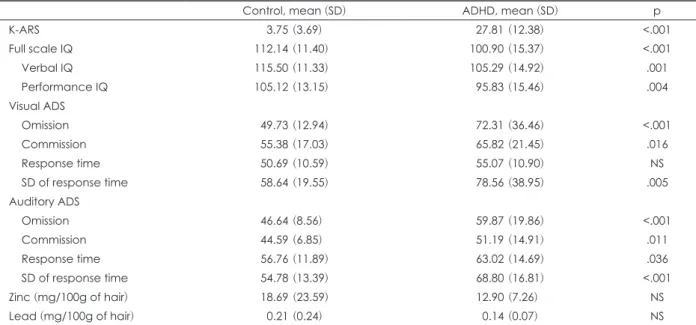
The demographic variables, zinc and lead levels in hair, the K-ARS score, the ADS score and intelligence between the ADHD group and control group were analyzed through the chi-square test, Fisher’s exact test, t-test and analysis of vari- ance (ANOVA). Also a partial correlation analysis was con- ducted to examine the relationship between zinc and lead lev- els in hair, the K-ARS score, the ADS score and intelligence.
Based on the variables extracted through the analysis ab- ove, we carried out the analysis as follows. First, we perform- ed a logistic regression analysis to analyze which factor had a risk of causing ADHD. After that, multiple regression anal- ysis was conducted to see how much the zinc and lead levels could explain the K-ARS score and ADS score. In the case of the multiple regression analysis, we set both the K-ARS score and ADS score as dependent variables, and lead, zinc, age, gender, intelligence and body mass index (BMI) percentage as independent variables. Gender was processed as a dummy variable.
Statistical Package for the Social Sciences (SPSS) 18.0 ver- sion (SPSS Inc., Chicago, IL, USA) was used for the statisti- cal analysis. The significance level was set at p<.05.
Results
1. Demographic characteristics of children with ADHD and the control group
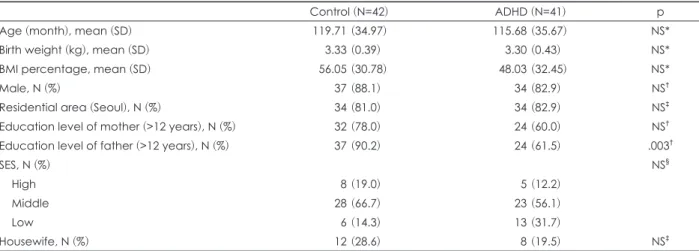
There was no statistically significant difference in age, gen-
Table 1. Sample summary statistics for ADHD and controls : demographic variables
Control (N=42) ADHD (N=41) p
Age (month), mean (SD) 119.71 (34.97) 115.68 (35.67) NS*
Birth weight (kg), mean (SD) 3.33 (0.39) 3.30 (0.43) NS*
BMI percentage, mean (SD) 56.05 (30.78) 48.03 (32.45) NS*
Male, N (%) 37 (88.1) 34 (82.9) NS
†Residential area (Seoul), N (%) 34 (81.0) 34 (82.9) NS
‡Education level of mother (>12 years), N (%) 32 (78.0) 24 (60.0) NS
†Education level of father (>12 years), N (%) 37 (90.2) 24 (61.5) .003
†SES, N (%) NS
§High 8 (19.0) 5 (12.2)
Middle 28 (66.7) 23 (56.1)
Low 6 (14.3) 13 (31.7)
Housewife, N (%) 12 (28.6) 8 (19.5) NS
‡* : statistical significance is based on t-test, as appropriate,
†: statistical significance is based on Fisher’s exact test, as appropriate,
‡