대한감각통합치료학회지 제12권 제1호
The Journal Korean Academy of Sensory Integration 2014 Vol. 12, No. 1
주의력결핍과잉행동장애 아동의 중재방법과 측정도구에 관한 체계적 고찰 : 국제 기능·장애·건강 분류 모델의 분류기준에 근거하여
이나핼*, 김경미**
*조선대학교 보건과학대학 작업치료과, **인제대학교 의생명공학대학 작업치료학과
국문초록
목적: 본 연구는 주의력결핍과잉행동장애(Attention Deficit Hyperactivity Disorder: ADHD) 아동의 중재방법과 측정도구를 ICF모델의 분류기준인 기능과 장애영역 그리고 배경요인으로 분류하여, 건강과 장애와 관련된 ADHD 아동의 중재방법과 측정도구를 알아보고자 한다.
연구방법 : 본 연구는 체계적 고찰방법을 사용하였다. 2000년 1월부터 2013년 7월까지 학회지에 게재된 논문을 MEDLINE/PubMed, Sciencedirect, Ovid를 통해 검색하였다. 주요 검색어는 ‘ADHD, Children, intervention, outcome measure’으로 하였으며, 최종적으로 8개의 논문을 분석하였다.
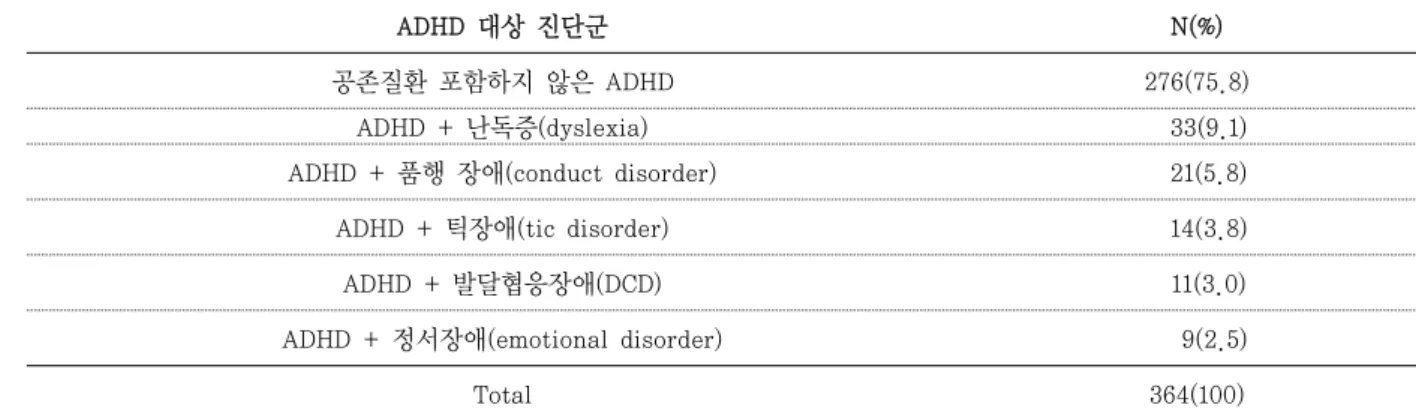
결과 : 1. 본 연구에서 제시된 ADHD 아동은, 순수 ADHD가 75.8%로 가장 많았으며, 그 다음으로 ADHD 공존장애는 난독증(dyslexia), 품행장애(conduct disorder), 틱 장애(tic disorder), 발달협응장애(DCD), 마지막으로 정서장애(emotional disorder) 순이었다.
결과 : 2. ADHD아동의 중재방법은 기능과 장애영역에서 80%이고, 배경요인은 20%이다. 기능과 장애영역의 신체 기능과 구조의 관한 중재(NF training, computer training program)는 60%로 가장 많았고, 활동은 10%, 참여도 10%이다. 배경요인은 환경적 요인이 20%이고, 개인적 요인은 없었다.
결과 : 3. ADHD아동에게 사용된 측정 도구는 기능과 장애영역은 80.5%이고, 배경요인은 19.5%이다. 신체구조와 기능영역(아동의 문제행동과 특성의 변화)에서 70.8%로 가장 많았으며, 활동영역은 7.3%, 그리고 참여영 역은 2.4%이었다. 배경요인은 환경적 요인에서 19.5%이고 개인적 요인은 없었다.
결론 : ADHD아동의 중재방법과 측정도구를 ICF모델의 분류기준에 근거하여 체계적 고찰을 하였다. 이는 건강과 장애와 관련된 ADHD아동의 중재와 측정방법을 이해하고 사용하는데 기초자료 될 것이다.
주제어 : 주의력결핍과잉행동장애, 중재방법, 측정도구
교신저자: 김경미 ([email protected])
Ⅰ. 서 론
주의력결핍과잉행동장애(Attention Deficit Hyperacti-
vity Disorder: ADHD)는 학령기에 가장 일반적으로 발생하는 장애 중에 하나이며, 유병률은 3~5%에 이른 다(American Psychiatric Association, 2000). ADHD는
주의산만, 과잉행동/충동성의 어려움을 보이고, ADHD 의 40~70%는 품행장애, 반항성 장애, 주요 우울장애, 양극성장애, 뚜렛 장애, 불안장애, 학습 장애와 언어장애 등을 동반한다(Brook, Duan, Zhang, Cohen, & Brook, 2008).
ADHD의 핵심 중재는 약물치료이며, 주의력, 충동 조 절, 학습능력과 부모-교사에 대한 순응도 등이 호전되는 것으로 보고된다(Rapport, Denney, DuPaul, & Gardner, 1994). 그러나 ADHD아동의 약 30%는 치료 효과가 불분 명하거나 심각한 부작용으로 인해 약물치료를 중단하게 된다(Castellanos et al., 1997). 약물 치료의 부작용은 모두 공통적이지 않으며 어떤 아동들은 약물 치료 없이 도 충분히 치료를 받을 수 있다(김해란, 2004). 약물치료 외에는 인지행동치료, 사회기술훈련, 부모교육, 예술치 료와 환경조성 등의 중재방법이 있고, 약물사용의 빈도 는 줄이고 ADHD증상을 줄이는 방법에 대한 연구가 일어 나고 있다(Majewicz-Hefley & Carlson, 2007).
ADHD의 중재효과를 정확히 알기위해서 측정도구가 필요하다(Geyh, Cieza, Kollerits, Grimby, & Stucki, 2007). 측정도구는 중재가 대상자에게 어떠한 영향을 미 쳤는지 알 수 있으며, 어떤 중재가 적절했는지도 알 수 있다(Rogers & Holm, 1994). 측정도구는 표준화된 평 가도구를 중심으로 점수로 표기하고, 환자의 수행 혹은 건강상태를 수량화한다(Jette, Halber, Iverson, Miceli,
& Shah, 2009). 측정도구는 치료적 중재에 따른 환자의 상태의 변화를 평가하기 위해 사용된다(Kirsten, George, Yasser, & Jane, 2011). 따라서 측정도구를 통해 ADHD 의 중재방향에 대해 알 수 있다.
세계 보건 기구(World Health Organization, 2001) 는 건강과 장애에 대한 이해를 위해 새로운 분류 모델인 국제 기능·장애·건강 분류(International Classification of Functioning, Disability and Health: ICF)를 개발 하였다. ICF 모델은 기능과 장애 측면에서 신체기능 (Body function)과 구조(Body strcture), 활동과 참여 (Activity and participation)로 분류되고, 배경요인으로 환경요인(Environmental factors)과 개인요인(Personal factors)으로 분류한다(WHO, 2001). ICF는 의학적 관 점, 사회적인 관점을 모두 포함하는 의학, 심리학, 사회 학 관점(bio-psycho-social view)의 평가 체계라고 말 할 수 있다(Stucki & Grimby, 2004). 또한 다양한 분야
에서 건강과 장애와 관련된 요소를 표준화하고 통일된 언어로 제공하고, 타 분야간의 이해를 높일 수 있다(정혜 영, 김경미와 장문영, 2009).
체계적 고찰은 연구주제에 적합한 정보를 제공하고, 개별 연구 결과를 통합하여 신뢰성 있는 정보를 제공할 수 있어 임상 서비스에 대한 과학적 근거를 제공한다 (Evans, 2001; Greenhalgh, 1997). 또한 현재 근거를 제시하기 위해 가장 많이 사용하는 연구방법이다(Law &
Macdermid, 2008).
ADHD아동의 중재방법에 관한 체계적 고찰 연구는 약 물치료 중심(Black, Milam, & Sussman, 2009; Sonuga- Bark et al., 2013)으로 이루어졌다. ADHD아동의 중재 방법과 측정도구의 분석결과를 ICF 모델의 분류기준에 근거하여 분석한 연구는 전무하다. 따라서 ADHD아동에 게 적용되는 비 약물적 중재는 무엇인지, 중재의 효과를 알아보기 위한 측정도구는 무엇이 있는지 알아보고 이를 통합적인 근거를 제시하기 위해 체계적 고찰연구가 필요 하다. 그리고 그 결과를 ICF모델의 분류기준에 따라 분 류하여 건강과 장애와 관련된 ADHD아동의 중재방법과 측정도구가 무엇인지 알 수 있다.
본 연구는 ADHD 아동의 중재방법과 측정도구를 체계 적 고찰을 통해 알아보고, 그 결과를 ICF 모델의 분류 기준에 근거하여 기능과 장애 그리고 배경적 요인으로 분석하였다. 이를 통해 건강과 장애와 관련된 ADHD아 동의 중재방법과 측정도구가 무엇이 있는지 이해하고, ADHD아동을 중재하는 치료사에게 ICF모델 분류 기준 에 맞게 중재목표를 설정하고 측정도구를 사용하는데 도 움이 될 것이다.
Ⅱ. 연구 방법 1. 검색 방법 및 연구대상
검색에 사용된 데이터베이스는 MEDLINE/PubMed, Sciencedirect, Ovid이었다. 대상논문의 범위는 2000년 1월부터 2014년 7월까지로 하였다. 포함조건은 대상아 동이 순수 ADHD아동(APA, 2000기준)과 공존질환이 포 함된 ADHD아동으로 5세에서 13세 이하인 경우, 비약물
연도 연구저자 연구제목 근거수준 2002 Miranda, Presentacion, &
Sorian.
Effectiveness of a school-based multicomponent program for the treatment of children with ADHD I 2005 Klingberg et al. Computerized training of working memory in children with
ADHD-a randomized, controlled trial I 2005 Corkum, McKinnon, &
Mullane.
The effect of involving classroom teachers in a parent training program for families of children with ADHD I
2007 Chu, & Reynolds.
Occupational therapy for children with attention deficit hyperactivity disorder (ADHD), part 2: a multicenter evaluation of
an assessment and treatment package
III
2007 Shalev, Tsal, & Mevorch. Computerized progressive attentional training (CPAT) program:
effective direct intervention for children with ADHD I 2009 Gevensleben et al. Distinct EEG effects related to neurofeedback training in children
with ADHD: a randomized controlled trial I 2010 Gevensleben et al. Neurofeedback training in children with ADHD: 6-month
follow-up of a randomised controlled trial I 2011 Prins, Dovis, Ponsioen,
Brink, & Oord.
Does computerized working memory training with game elements enhance motivation and training efficacy in children with ADHD? I 표 1. 분석대상논문
근거수준 연구 설계 및 방법 논문 수(%)
I 체계적 고찰, 메타분석, 무작위 임상실험 설계(randomized controlled trials) 7(87.5%)
II 두 그룹 비교연구, 무작위 임상실험이 아님(예: 코호트 , 환자-대조군 실험 설계) 0
II 단일그룹 전후 비교연구, 무작위 임상실험이 아님(예: 중재 전과 중재 후 측정) 1(12.5%)
IV 결과 분석을 포함한 설명적 연구(예: 단일사례 연구, 사례 시리즈) 0
V 사례보고와 전문가 의견(구술적 문헌연구) 0
질적 연구(qualitative studies) 0
Total 8(100%)
표 2. 분석대상논문의 질적 수준
적 중재(카이로 프라틱, 침 중재는 제외)를 사용한 경우, 전문가 집단에 의해 검토된 경우, 논문의 전문을 얻을 수 있는 경우, 영어로 쓰여진 경우, 중재가 이루어지고 결과 측정과 측정도구가 기록된 경우로 하였다. 배제기준은 컨퍼런스 또는 프리젠테이션 논문인 경우, 학위논문, 약 물이 중재로 포함된 논문, 성인을 대상으로 중재한 논문, 사례 보고와 체계적 고찰은 배제 하였다.
검색어는 ‘ADHD, children, intervention, outcome measure’으로 하였다. 검색과정은 각 데이터베이스에서 검색하여 15,687개의 논문이 검색되었다. 그 후 Citation
과 Abstract를 검토하여 기타 포함조건과 배재조건의 논 문을 분석하여 16개의 논문이 연구 주제에 적합하게 포 함되었다. 논문의 전문은 1차적으로 I대학교 도서관을 사 용하여 찾았으며, 2차적으로 google academy 검색엔진 을 사용하여 찾았다. 16개의 논문 중 8개는 전문을 찾지 못하여서 최종적으로 8개의 논문이 분석되었다(표 1).
논문 검색의 신뢰도를 높이기 위해 같은 분야의 전문가 1(작업치료 박사)이 무작위 검색을 통해 독립적으로 검 토하여 본 연구의 연구논문과 일치가 되는지 확인하였 다.
ADHD 대상 진단군 N(%)
공존질환 포함하지 않은 ADHD 276(75.8)
ADHD + 난독증(dyslexia) 33(9.1)
ADHD + 품행 장애(conduct disorder) 21(5.8)
ADHD + 틱장애(tic disorder) 14(3.8)
ADHD + 발달협응장애(DCD) 11(3.0)
ADHD + 정서장애(emotional disorder) 9(2.5)
Total 364(100)
표 3. ADHD 대상 진단군
ADHD: 주의력결핍과잉행동장애(Attention Deficit Hyperactivity Disorder)
2. 연구 근거의 질적 수준
분석대상논문의 연구의 질적 수준을 평가하기 위해 Sackett 등(1996)의 근거수준(Levels of Evidence)을 사용하였다. 근거의 질적 수준은 8개중 가장 높은 수준 I은 7개(87.5%)이고, 수준 III는 1개(12.5%)이었다 (표 2).
3. 분석 내용
1) ADHD 대상군의 특징
ADHD 대상군은 연구논문에 제시된 ADHD 공존질환 에 따라 분류하였다(표 3).
2) 중재방법
ADHD아동의 중재방법은 비 약물적 중재방법으로 각 논문에서 제시된 중재방법을 ICF모델의 분류기준에 맞 춰 분석하였다. 중재방법은 실험군에 사용된 중재를 말 한다(표 4).
(1) 기능과 장애
기능과 장애는 신체기능과 구조, 활동과 참여로 분 류된다.
(2) 배경요인
배경요인은 환경적 요인과 개인적 요인으로 분류 된다.
3) 중재 결과 측정을 위한 측정도구
ADHD아동의 중재결과(outcome)를 측정하기 위해 사용된 측정도구는 대상자 선정 또는 진단을 위해 사용 된 도구는 배제하였다. 그러나 진단도구 중 중재결과를 측정하기 위해 사용된 측정도구는 포함하였다. 측정도구 에 대한 분류는 중재방법과 동일하다(표 5).
Ⅲ. 연구 결과 1. ADHD 대상군의 특징
ADHD 대상 진단군은 표 3과 같다. 연구논문에 제시 된 대상군은 모두 제시하였다. 공존질환이 포함되지 않 은 논문은 5개(62.5%)이었고, 공존질환이 포함된 논문 은 3개(37.5%)이었다. 본 연구 논문에 가장 많은 ADHD 대상 진단군은, 순수 ADHD로 75.8%이었으며, 그 다음 은 난독증(dyslexia)이 있는 ADHD로 9.1%이었으며, 품 행장애(conduct disorder)가 있는 ADHD로 5.8%, 틱장 애(tic disorder)가 있는 ADHD로 3.8%이며, 발달협응 장애(DCD)있는 ADHD가 3.0%이고, 마지막으로 정서장 애(emotional disorder)가 있는 ADHD가 2.5%였다.
2. ADHD 중재 방법
ADHD아동을 대상으로 비 약물적 중재방법을 ICF모
ICF 중재방법(method) N(%)
기능과 장애 (functioning
and disability)
신체 기능/구조 (Body Functions/
structures)
• Neurofeedback (theta/beta training, SCP training)
• Treatment strategies to address any other developmental and functional difficulties, perceptual-motor, handwriting skills
• WM tasks implemented in a computer program developed for this study:
visuospatial 90WM tasks
• Computerized Continuous Performance Task • Simple visuospatial WM training with game • Cognitive behavioral techniques
6(60)
활동(Activities) • Self-care skills 1(10)
참여 (Participation)
• Social skills
• Adaptation of classroom environment and routine 1(10)
배경요인 (contextual
factors)
환경적 요인 (Environmental
Factors)
• Education of ADHD parents and teachers - general knowledge about ADHD
- training on behavior modification procedures - management procedures for students with ADHD
• An integrated behavioral management and sensory diet programme for home and school
2(20)
Total 10
(100) 표 4. ICF의 분류기준에 따른 중재방법
ICF: International Classification of Functioning, Disability and Health
델의 분류기준으로 분석하였다. 기능과 장애영역은 8개 (80%)이고, 배경요인은 2개(20%)로 총 10개(100%)의 중 재방법이 사용되었다. 기능과 장애영역에서 신체 기능과 구조는 6개(60%)로 가장 많았고, 활동은 1개(10%), 참여 도 1개(10%)이다. 배경요인은 환경적 요인이 2개(20%) 이고 개인적 요인은 없었다(표 4). 신체구조와 기능영역의 중재방법은 Neurofeedback (NF) training과 computer training program이 사용되었다. 활동은 자조기술 훈 련을 적용하였고, 참여영역에서는 학급 적응 중재방법을 제시하였다. 환경적인 요인은 ADHD아동의 부모와 선생 님의 지식과 교육적 ž 양육적 태도를 중재시키는 것에 초 점을 맞추었다.
3. 중재결과 측정을 위한 측정도구
ADHD아동의 중재의 효과를 알아보기 위하여 사용된 측정도구는 기능과 장애영역은 33개(80.5%)이고, 배경 요인은 8개(19.5%)로 총 41개(100%)의 측정도구가 사용 되었다. 신체구조와 기능영역에서 70.8%(29개)로 가장
많았으며, 활동영역은 7.3%(3개), 그리고 참여영역은 2.4%(1개)이었다. 배경요인은 환경적 요인에서 19.5%(8 개)이고 개인적 요인은 없었다. 신체구조와 기능영역에 서는 아동의 문제행동과 특성의 변화를 측정하는 도구 들이 가장 많이 사용되었으며, 신경학적 능력을 측정하 는 인지기능측정도구와 뇌파를 분석하기위한 EEG 등이 있었다. 활동영역은 아동의 읽기, 계산 등에 대한 측정도 구로 구성되었다. 참여영역은 아동의 또래와의 관계를 측정하는 도구가 포함되었다. 환경적 요인은 ADHD아동 의 인적 환경인 부모와 선생님의 지식과 교육수준을 측 정하는 평가도구로 구성되었다(표 5).
Ⅳ. 고 찰
ICF의 등장은 의학계에서 질병 치료의학에서 예방 의 학 등이 새로이 더해지는, 단순히 의학의 한 분야가 생긴 것이 아니라 보다 근본적인 큰 틀의 변화이다(나은우와 정한영, 2009). 새로운 변화란 건강의 중심이 치료의학
ICF 평가도구(Outcome measurement tool) N(%)
기능과 장애 (functioning
and disability)
신체 기능/구조 (Body Functions/
structures)
German ADHD rating scale (FBB-HKS)
: ADHD아동의 의학적 진단과 치료효과를 측정하기 위해서
29 (70.8) German Rating Scale for Oppositional Defiant/Conduct Disorders (FBB-SSV) : 반항적 행동과 신체적 공격성을 측정하기 위해
The Strength and Difficulties Questionnaire (SDQ,) :정서적 증상, 품행문제, 과 활동성을 측정
The Home Situations Questionnaire (HSQ,)
: 다양한 가정 내 상황에서 아동의 행동 문제에 대해 16개의 항목에서 문제의 유무와 심한 정도를 측정
The Homework Problem Checklist (HPC)
: 집안일(homework)시 발생할 수 있는 문제 행동을 측정 ADHD Rating Scale - IV Home and School Versions : ADHD아동의 의학적 진단과 치료효과를 측정하기 위해 Demographic Questionnaire : 아동의 의학적 상태 Conners' Parent Rating Scale-Revised (Short Form) : 아동의 행동문제를 측정(부모의 의해)
Conners' Teacher Rating Scale-Revised (Short Form) : 아동의 행동문제를 측정(선생님의 의해)
The Scale of Behavioral Problems (EPC) : 아동행동에 관한 부모 보고 측정 Iowa Conners Teacher Rating Scale : 집중력/과잉행동과 공격성을 측정 Classroom Behavioral Observation : 학생의 교실에서의 행동을 관찰하여 측정 Self-Control Rating Scale (Kendall and Wilcox) : 자기의 행동을 측정
School Problem Inventory (Miranda et al) : 교실에서 문제행동을 측정(선생님에 의해)
The span-board task from the WAIS-RNI testing battery : visuospatial working memory 측정
Digit-span from the WISC-III testing battery : verbal working memory 측정
The Stroop interference task : response inhibition 측정
Raven’s Colored Progressive Matrices : nonverbal reasoning ability를 측정 passage copying
: 다양한 영역의 attention을 측정 EEG recording and processing
: 뇌파를 측정하기 위해(알파/베타/델타 측정) Matching Familiar Figures (MFF) Test : 친숙한 물체 맞추기
Stroop Color Word Test
: 인지적 유연성과 억제 자동적 요소를 측정 (색깔 이름 맞추기) Rey-Osterrieth Complex Figure Drawing
: 계획능력과 시공간-구성 능력을 측정 표 5. ICF 분류기준에 따른 평가도구 분류
Wechsler Intelligence Scale for Children-Revised (WISC-R) Digit span subtest
: immediate verbal memory를 측정 WISC-R Arithmetic subtest : 연산능력 검사
Corsi Block-Tapping Test (CBTT) : 시공간 단기 기억과 작업기억을 측정 WISC-R Coding subtes
: persistence(지속성), visual discrimination, visuo-motor skills, precision(정 교함)을 측정
Visual Closure Subtest (Kirk et al) from the Illinois Test of Psycholinguistic Abilities (ITPA)
: attention과 persistence(지속성)을 측정
Cancellation of Rapidly Recurring Target Figures Test : visual persistence를 측정
활동 (Activity)
math exercises : 산수 능력을 측정
3 (7.3) reading comprehension
: 읽기 이해능력을 측정 Scholastic Achievement
: ADHD아동의 학업적 달성정도를 측정(산수, 언어, 과학적 능력을 기록) 참여
(Participation)
The Strength and Difficulties Questionnaire (SDQ) : 또래 문제, 친사회적 행동을 측정
1 (2.4)
배경요인 (contextual
factors)
환경적 요인 (Environmental
Factors)
Measure of Processes of Care-20 item version (MPOC-20) : 부모가 아동에 관한 지각을 측정
8 (19.5) Demographic Questionnaire
: 부모의 직업 상태와 교육 수준을 측정 Parenting Stress Index (Short Form) : 부모-아동 간에 스트레스 수준을 측정
Knowledge of Behavioral Principles Quiz (KBPQ) : 아동의 기본적 행동 원칙을 이해하는지에 대한 측정 ADHD Knowledge and Opinion Survey-Revised (AKOS-R) : ADHD아동에 관한 부모의 지식을 측정
Client Satisfaction Questionnaire (CSQ) : 서비스 기관에 대한 만족도를 측정 Teacher Feedback Questionnaire (TFQ) : 선생님 교육 요소를 측정
Questionnaire of Knowledge and Management Procedures : ADHD아동에 관한 선생님의 지식수준을 측정
Total 41
(100) ICF: International Classification of Functioning, Disability and Health
에 있다는 기존의 개념에서 이제는 건강과 관련된 모든 분야가 서로 대등한 위치에 있으며 또한 건강은 기능 (functioning)과 장애(disability), 개인과 집단, 그리고
환경을 함께 고려하여야 한다는 것을 강조하고 있다(나 은우와 정한영, 2009). ICF의 이런 이점 때문에 체계적 고찰연구에서 연구결과를 분석하고 분류하기 위해 ICF
분류방법을 사용한다(정혜영, 김경미와 장문영, 2009;
Geyh, Cieza, Kollerits, Grimby, & Stucki, 2007;
Kirchberger, Scheuringer, Wollaars, & Geyh, 2010).
본 연구에서 ADHD아동의 진단군을 분석해 보았을 때 순수한 ADHD아동이 71.9%로 가장 많았다. ADHD아동 의 가장 많은 공존질환은 반항성장애와 품행장애이다 (Johnston & Ohan, 1999). 또한 ADHD아동은 불안장 애, 기분장애, 틱장애 그리고 뚜렛장애 등과 함께 공존한 다(Barkley, 2003). 본 연구는 공존질환 중 난독증 아동 이 9.1%로 가장 많은 대상을 차지하였으며, 그 다음으로 품행장애 아동이 5.8%로 나타나 선행연구 결과와 차이 가 있다. 난독증을 가진 ADHD아동은 심각한 인지적 장 애, 나쁜 신경심리학적, 학업적결과를 보인다(Germano, Gagliano, & Curatolob, 2010).
ADHD아동의 중재방법은 신체구조와 기능영역(5개) 에 관한 중재방법을 가장 많이 사용하였다. 이 영역의 중 재방법은 Neurofeedback(NF) training과 computer training program이 사용되었다. NF training은 세타 (theta)와 베타(beta)의 훈련을 통해 세타활동을 감소시 키고 베타활동을 증가시킨다(Gevensleben et al., 2010). NF training을 ADHD아동에게 적용했을 때 자기 조절능력이 향상되고 뇌를 최적화시켜 안정화시키데 효 과적인 것으로 나타났다(Gevensleben et al., 2010).
Computer training program은 작업기억(working memory)와 집중력(attention)을 훈련시켜, ADHD아동 의 언어적 작업기억이 향상되고 주의력결핍과 과잉행동/
충동성이 모두 감소한 것으로 나타났다(Klingberg et al., 2005). 활동에서는 발달과 기능적 어려움을 중재하 기 위해 자조기술 훈련을 적용하였고, 참여영역에서는 사회적 참여와 학급에서 참여능력을 향상시키기 위해 학 급 적응 중재방법을 제시하였다(Chu & Reynolds, 2007). 환경적인 요소에서는 부모와 선생님을 환경적 요 소로 보고 부모와 선생님의 ADHD아동에 대한 지식과 교 육적 ž 양육적 태도를 훈련시키는 것에 초점을 맞추었다.
이 연구는 부모님만 중재했을 때보다 선생님 중재를 함 께 했을 때 더 효과적인 것으로 나타났다(Corkum, McKinnon, & Mullane, 2005).
본 연구에서 중재의 결과를 알기위해 가장 많이 사용 된 측정도구의 영역은 신체구조와 기능영역이었다. 신체 구조와 기능영역은 신체의 생리학적 기능뿐만 아니라,
심리학적 기능까지 포함하므로(Michael & Jennifer, 2008), ADHD아동의 행동적 특징과 신경심리학적 특징 을 포함하는 측정도구가 포함되었다. ADHD아동의 행동 을 측정하기 위해서는 여러 가지 행동평정척도를 사용하 였는데 대표적인 측정도구가 Conner 척도와 아동행동체 크리스트, ADHD 평정척도이다(Barkley, 2003). 본 연 구에서는 Conner 척도와 ADHD 평정 척도와 집, 학교같 은 다양한 환경에서 ADHD아동의 행동을 측정하는 도구 가 포함되었다. 신경심리학적 검사는 억제, 지구력, 계 획하기, 작동기억, 운동통제와 유창성, 그리고 언어적 유창성과 같은 전전두엽(prefrontal areas)의 기능과 관 련된 검사로 본 연구는 억제, 계획, 작업기억, 언어기억 을 측정하는 도구가 포함되었다(Barkley, 2003). 또한 뇌파기능을 측정하여 ADHD아동의 뇌의 전기활동을 측 정하는 방법을 사용하였다. 환경요소는 부모와 선생님의 ADHD에 대한 지식수준, 스트레스 등을 측정하였다. 부 모의 양육태도와 지식, 그리고 스트레스 등과 같은 심리 사회적 환경적 요인은 ADHD아동의 공격성, 반항성 장 애, 또는 품행장애와 관련이 있는 것으로 나타났다 (Barkley, 2003).
연구의 제한점은 언어를 영어로 한정하였으며, 원문 을 무료로 볼 수 있는 논문과 ADHD아동의 중재방법을 비약물적 중재방법으로 제한하여 분석대상 논문의 수가 부족한 점이다. 앞으로의 연구를 위해 제안할 수 있는 점 은 ADHD아동의 중재방법의 효과를 분석하는 연구가 필 요하며, 전 학령기와 아동기, 청소년, 성인 ADHD의 연 령대별로 중재방법과 측정도구가 차이점이 있는지 알아 보는 연구가 필요하다.
Ⅴ. 결 론
본 연구는 ADHD아동의 중재방법과 측정도구에 관한 체계적 고찰을 통해 분석하였다. 연구를 위해 분석된 논 문은 2000년 1월 부터 2014년 7월까지 출간된 총 8개 논문이었다. 분석결과는 다음과 같다.
1. 본 연구 논문에 가장 많은 ADHD 대상 진단군은, 순수 ADHD로 75.8%이었으며, 그 다음은 난독증 (dyslexia)이 있는 ADHD로 9.1%이었으며, 품행장애
(conduct disorder)가 있는 ADHD로 5.8%, 틱장애(tic disorder)가 있는 ADHD로 3.8%이며, 발달협응장애 (DCD)있는 ADHD가 3.0%이고, 마지막으로 정서장애 (emotional disorder)가 있는 ADHD가 2.5%였다.
2. ADHD아동을 대상으로 약물중재를 제외한 중재방 법을 ICF모델의 분류기준으로 분석하였다. 기능과 장애 영역은 8개(80%)이고, 배경요인은 2개(20%)로 총 10개 (100%)의 중재방법이 사용되었다. 기능과 장애영역에서 신체 기능과 구조는 6개(60%)로 가장 많았고, 활동은 1 개(10%), 참여도 1개(10%)이다. 배경요인은 환경적 요인 이 2개(20%)이고 개인적 요인은 없었다.
3. ADHD아동의 중재결과를 알아보기 위하여 사용된 측정 도구는, 기능과 장애영역은 33개(80.5%)이고, 배 경요인은 8개(19.5%)로 총 41개(100%)의 측정도구가 사 용되었다. 신체구조와 기능영역에서 70.8%(29개)로 가 장 많았으며, 활동영역은 7.3%(3개), 그리고 참여영역은 2.4%(1개)이었다. 배경요인은 환경적 요인에서 19.5%(8 개)이고 개인적 요인은 없었다.
본 연구를 통해 건강과 장애와 관련된 ADHD아동의 중재방법과 측정도구가 무엇이 있는지를 이해하는데 기 초자료로 제공될 수 있다.
참 고 문 헌
김해란.(2004). ADHD의 진단과 치료. 서울: 도서출판 특수교육.
나은우, 정한영. (2009). 장애의 개념과 분류. 대한 의사 협회지, 52(6), 537-544.
정혜영, 김경미, 장문영. (2009). 뇌졸중 환자의 작업 치료 중재 결과를 측정하기 위해 사용된 평가 도구에 관한 체계적 고찰. 대한작업치료학회지, 17(3), 79-95.
America Psychiatric Association. (2000). Diagnostic and statistical manual of mental disorders (4th ed., text revision). Washington, DC: Author.
Barkley, R. A. (2003). Attention-deficit/hyperactivity disorder. In E. J. Mash, & R. A. Barkley (Eds.), Child psychopathology (2nd ed., pp.75-143).
New York, NY: The Guilford Press.
Black, D. S., Milam, J., & Sussman, S. (2009). Sitting- meditation interventions among youth: A review of treatment efficacy. Pediatrics, 124 (3), 532-541.
Brook, J. S., Duan, T., Zhang, C., Cohen, P. R., &
Brook, D. W. (2008). The association between attention deficit hyperactivity disorder in adolescence and smoking in adulthood. The American Journal on Addictions, 17(1), 54–59.
Castellanos, F. X., Giedd, J. N., Elia, J., Marsh, W. L., Ritchie, G. F., & Hamburger, S. D.
(1997). Controlled stimulant treatment of ADHD and comorbid Tourette’s syndrome: Effects of stimulant and dose. Journal of the American Academy of Child & Adolescent Psychiatry, 36 (5), 589-596.
Chu, S., & Reynolds, F. (2007). Occupational therapy for children with attention deficit hyperactivity disorder (ADHD), part 2: A multicenter evaluation of an assessment and treatment package.
British Journal of Occupational Therapy, 70(10), 439-448.
Corkum, P. V., McKinnon, M. M., & Mullane, J. C. (2005).
The effect of involving classroom teachers in a parent training program for families of children with ADHD. Child & Family Behavior Therapy, 27(4), 29-49.
Evans, D. (2001). Systematic reviews of nursing research. Intensive Critical Care Nursing, 17(1), 51-57.
Germano, E., Gagliano, A., & Curatolob, P. (2010).
Comorbidity of ADHD and dyslexia. Develop- mental Neuropsychology, 35(5), 475-493.
Gevensleben, H., Holl, B., Albrecht, B., Schlamp, D., Kratz, O., Studer, P., et al. (2010). Neurofeedback training in children with ADHD: 6-month follow-up of a randomised controlled trial.
European Child & Adolescent Psychiatry, 19(9), 715-724.
Gevensleben, H. G., Holl, B., Albrecht, B., Schlamp, D., Kratz, O., Studer, P., et al. (2009). Distinct EEG effects related to neurofeedback training in children with ADHD: A randomized controlled trial. International Journal of Psychophysiology, 74(2), 149-157.
Geyh, S., Cieza, A., Kollerits, B., Grimby, G., & Stucki, G. (2007). Content comparison of health-related quality of life measures used in stroke based on the international classification of functioning, disability and health (ICF): A systematic review.
Quality of Life Research, 16(5), 833-851.
Greenhalgh, T. (1997). How to read a paper: Papers that summarise other papers (systematic reviews and meta-analysis). British Medical Journal, 315(13), 672-675.
Jette, D. U., Halber, J., Iverson, C., Miceli, E., & Shah, P. (2009). Use of standardized outcome measures in physical therapist practice: Perceptions and applications. Physical Therapy, 89(2), 125-135.
Johnston, C., & Ohan, J. L. (1999). Externalizing disorders. In W. K. Silyerman & T. H. Ollendixk (Eds.), Developmental issues in the clinical treatment of children(pp. 279). Massachusetts, Boston: Allyn and Bacon.
Kirchberger, I., Scheuringer, M., Wollaars, M. M., &
Geyh, S. (2010). Outcome parameters in spinal cord injury research: A systematic review using the International Classification of Functioning, Disability and Health (ICF) as a reference.
Spinal Cord, 48(7), 522-528.
Kirsten, P., George, D. F., Yasser, S., & Jane, S. (2011).
Outcome Measures in Neurological Physical Therapy Practice: Part I. Making Sound Decisions.
Journal of Neurologic Physical Therapy, 35(2), 57-64.
Klingberg, T., Fernell, E., Olesen, P. J., Johnson, M., Gustafsson, P., Dahlstrom, K., et al. (2005).
Computerized training of working memory in children with ADHD-a randomized, controlled
trial. Journal of the American Academy of Child and Adolescent Psychiatry, 44(2), 117-186.
Law, M., & Macdermid, J. (2008). Evidence- based rehabilitation: A Guide to practice. NJ: SLACK Incorporated.
Majewicz-Hefley, A., & Carlson, J. S. (2007). A meta- analysis of combined treatments for children diagnosed with ADHD. Journal of Attention Disorder, 10(3), 239-250.
Michael, E. M., & Jennifer, J. P. (2008). The Spectrum of behavioral outcomes after extreme prematurity:
Regulatory, attention, social, and adaptive dimensions. Seminars in Perinatology, 32(1), 42-50.
Miranda, A., Presentacion, M. J., & Sorian, M.
(2002). Effectiveness of a school-based multicomponent program for the treatment of children with ADHD. Journal of Learning disabilities, 35(6), 546-562.
Prins, P. J. M., Dovis, S., Ponsioen, A., Brink, E.
T., & Oord, S. V. D. (2011). Does computerized working memory training with game elements enhance motivation and training efficacy in children with ADHD? Cyberpsychology, Behavior, and Social Networking, 14(3), 115-122.
Rapport, M. D., Denney, C., DuPaul, G. J., & Gardner, M. J. (1994). Attention deficit disorder and methylphenidate: Normalization rates, clinical effectiveness, and response prediction in 76 children. Journal of the American Academy of Child and Adolescent Psychiatry, 33(6), 882- 893.
Rogers, J. C., & Holm, M. B. (1994). Accepting the challenge of outcome research: Examining the effectiveness of occupational therapy practice.
American Journal of Occupational Therapy, 48(10), 871-876.
Sackett, D. L., Rosenberg, W. M., Gray, J. A., Haynes, R. B., & Richardson, W. (1996). Evidence based medicine: What it is and what it isn't. British
Medical Journal, 312(13), 71-72.
Shalev, L., Tsal, Y., & Mevorch, C. (2007). Computerized progressive attentional training (CPAT) program:
Effective direct intervention for children with ADHD. Child Neuropsychology, 13(4), 382-388.
Sonuga-Barke, E. J. S., Brandeis, D., Cortese, S., Daley, D., Ferrin, M., Holtmann, M., et al.
(2013). Nonpharmacological Interventions for ADHD: Systematic Review and Meta-Analyses of Randomized Controlled Trials of Dietary and
Psychological Treatments. American Journal of Psychiatry, 170(3), 275-289.
Stucki, G., & Grimby, G. (2004). Applying the ICF in medicine. Journal of Rehabilitation Medicine, 44, 5-6.
World Health Organization (WHO). (2001). World health organization international classification of functioning, disability, and health, Geneva:
World Health Organization.
Abstract
The Intervention and Outcome Measurement Tools of Children With Attention Deficit Hyperactivity Disorder: A Systematic Review
Lee, Na-Hael*, Ph.D., O.T., Kim, Kyeong-Mi**, Ph.D., O.T.
*Dept. of Occupational Therapy, College of health Science, Chosun University,
**Dept. of Occupational Therapy, College of Biomedical Science and Engineering, Inje University
Objective : The purpose of this study was to provide for the intervention and outcome measurement tools of children with Attention Deficit Hyperactivity Disorder (ADHD) through ICF model.
Methods : The systematic review methods were used. Papers published in the journal between January, 2000 and July, 2014 were searched through MEDLINE/PubMed, Sciencedirect, Ovid. The main terms searched were ‘ADHD, Children, intervention, outcome measure’, and 8 papers were analyzed.
Results : 1. The subjects of ADHD were pure ADHD (75.8%), ADHD with dyslexia (9.1%), ADHD with conduct disorder (5.8%), ADHD with tic disorder (3.8%), ADHD with DCD (3.0%), ADHD with emotional disorder (2.5%). 2. The nonpharmacologic intervention of ADHD were functioning and disability (80%) and contextual factors (20%). Most frequently used intervention were body function and structure (60%). 3. The outcome measurement tools of ADHD were functioning and disability (80.5%) and contextual factors (19.5%). Most frequently used outcome measurement tools were body function and structure (70.8%).
Conclusion : This study can provide information on the intervention and outcome measurement tools of ADHD.
Key words : Attention Deficit Hyperactivity Disorder (ADHD), intervention, outcome measurement