INTRODUCTION
Attention-Deficit/Hyperactivity Disorder (ADHD) has been accepted undoubtedly as a neurodevelopmental disorder with main symptoms of inattention, hyperactivity and impulsiveness.
Since the 1970’s, a number of studies had been performed on ADHD, which was used as a basis to include the disorder as an Attention Deficit Disorder in the diagnosis manual by DSM-III in 1980 [1].
Since, hyperactivity had been emphasized and included in the di- agnosis criteria as a symptom through amendment, and the name was changed to ADHD. Although the most recently published di- agnosis manual DSM-5 in 2013, did not include major changes in the diagnosis criteria of ADHD, the diagnosis in school-aged chil- dren could be made by when 6 or more symptoms from the diag- nosis criteria are met and 5 or more for adolescents and adults. In addition, as the age in which symptoms started was changed from 7 to 12, the scope was expanded to include adolescents and adults
from the existing diagnosis that only included children [2].
According to the study by Cantwell and Baker and Barkley, 60- 70% of ADHD children continue to have symptoms in adult [3,4].
The prevalence of ADHD in children is estimated to be 3-5%, and assuming 60-70% of these children continue to show the symp- toms after reaching adult, prevalence of ADHD in adults is esti- mated to be around 2-3%. Mick et al. defined cases that do not meet the diagnosis criteria completely as syndromatic remission, those that meet the diagnosis criteria only partially as symptomat- ic remission, and those that experience complete functional recov- ery as functional remission [5]. It was also reported that 60% of ADHD cases between years of 18-20 show syndromatic remission and 20% show symptomatic remission, while only 10% showed functional remission. In a recent study addressing organic causes of ADHD in the brain by Friedmann et al., a low degree of con- nection between the hippocampus and cerebellum on the DTI has been reported [6]. In a group with persisting ADHD symptom, Hanyang Med Rev 2016;36:38-45
http://dx.doi.org/10.7599/hmr.2016.36.1.38 pISSN 1738-429X eISSN 2234-4446
This paper is to review Attention Deficit-Hyperactivity Disorder (ADHD) in the developmen- tal perspective, focusing on clinical features, diagnosis and treatment of ADHD throughout life stage. When diagnosed with ADHD, before entering elementary school early diagnosis and early intervention is encouraged to reduce various impairments that occur during de- velopment. Thirty to eighty percent of school-age ADHD symptoms remain throughout the adolescence or meet the ADHD diagnosis criteria. During adolescence, hyperactivity and impulsiveness from other existing symptoms become less severe but children have in- sufficiency to continue studying or task compared to their peers. Pharmacologic treatment had been shown to be the most effective treatment regimen for adolescents who con- tinue to have ADHD symptoms. In adults, representative symptoms of ADHD, hyperactivity and impulsiveness, often gradually decrease while lack of concentration remains. As Con- ner’s Adult ADHD Diagnostic Interview for DSM-IV (CAADID), a structured interview for the diagnosis of adulthood ADHD has been translated into Korean, it can be applied clinically.
Pharmacological and nonpharmacological treatment in adults had been shown to be ef- fective.
Key Words: Attention Deficit-Hyperactivity Disorder; Neurodevelopmental Disorder; Chil- dren; Adolescents; Adults
Life Persistence of Attention-Deficit/
Hyperactivity Disorder
Aran Min, Dong Hyun Ahn
Department of Psychiatry, Hanyang University College of Medicine, Seoul, Korea
Correspondence to: Dong Hyun Ahn Department of Psychiatry and Institute of Mental Health, Hanyang University Seoul Hospital, 222 Wangsimni-ro, Seoul 04763, Korea
Tel: +82-2-2290-8425 Fax:+82-2-2298-2055 E-mail: [email protected]
Received 14 December 2015 Revised 27 January 2016 Accepted 31 January 2016
This is an Open Access article distributed under the terms of the Creative Commons Attribution Non-Commercial License (http://creativecom- mons.org/licenses/by-nc/3.0) which permits un- restricted non-commercial use, distribution, and reproduction in any medium, provided the origi- nal work is properly cited.
general group, and the degree of connection in the group showing remission gradually became closer to the general group through medication.
The objective of this paper is to investigate ADHD in the devel- opmental perspective, focusing on clinical features, diagnosis and treatment of ADHD throughout the life span. In particular, we fo- cused on adolescence, and adulthood, which was not often discussed in the previous studies.
INFANT AND TODDLER PERIOD
Although symptoms of ADHD begin to appear in infancy and toddler period, they are only recognized when children reach the school-age in most cases. When looking for characteristics of AD- HD children retrospectively, they have irregular and unpredictable physiological manifestations such as eating, sleeping and elimina- tion, as well as shorter sleeping time and longer time spent crying or fretting compared to typically developing (TD) children of simi- lar age [7]. Further, children who explore very enthusiastically, have rapidly changing focus of interest instead of one subject and express their resistance by throwing frequent temper tantrums are likely to show symptoms of ADHD in the future. In a study by Jang et al. on the characteristics of ADHD children, they tended to have high level of interest in new or novel things, seek exciting adven- tures, feeling excitement through exploring unfamiliar location or situations and seeking changes [8]. In a study by Song et al., ADHD children showed the tendency of easily showing anger when they were not able to obtain what they wanted immediately, preferring no strict rules or regulations, easily disobeying a law or a rule, and having inability to withstand tedious and uncomfortable situations and therefore avoiding them altogether [9]. Such features of the
continuously. When the carekers are unable to accommodate the children’s personalities sensitively, the level of stress of raising a child increases. Therefore, formation of stable relationship between the children and the caretakers are more important in this period than the diagnosis of fundamental symptoms of ADHD, which will affect the child ADHD prognosis in the future.
PRESCHOOL PERIOD
The characteristics of ADHD children in the preschool period show constantly active and switching of games and playing them for a short period only. As their actions are not well controlled, they appear to not be listening to other people and having low level of safety awareness [10]. During interactions with adults, they are not willing to complaint to physical punishment, logical explana- tion, and persuasion. During interactions with peers, they show aggressiveness and destructive behaviors. Age group-specific symp- toms including pre-school age are shown in Table 1 [11]. Mothers of ADHD children in pre-school report that their level of stress is higher than those parents of normal children or of older ADHD children. In a daycare center or kindergarten, ADHD children roam around classrooms, interfere with other children playing, are loud, and talkative. The more active and aggressive the chil- dren are, they may have to change their kindergarten a number of times until they find the one in which their behaviors are accepted.
In most evaluation tools used for ADHD diagnosis, criteria for children in pre-school age are lacking. Therefore, as it is extremely difficult to evaluate children with the standardized tool, the diag- nosis frequently relies on the indirect or clinical judgement from the developmental perspective. Approximately 40% of a 4-year- old child have severe inattention problems requiring attention from Table 1. Attention-Deficit/Hyperactivity Disorder symptoms from preschool period to adulthood
Inattention Hyperactivity Impulsivity
Preschool period • Lose toys
• Not listening
• Run around a lot
• Touch everything they see
• Talk excessively
• No sense of danger
• Have difficulty waiting for things
School period • Have difficulty maintaining focus on one task
• Distracted easily
• Forget about daily activities
• Tend to daydream
• Restless when calm expected
• Have trouble playing quietly
• Interrupting other children and blurting out answers
• Thoughtless rule breaking
Adolescence • Lack of focus on the details of a task
• Poor planning ahead
• Fidgety • Poor self control
• Reckless risk taking Adulthood • Appointments forgotten
• Change jobs and perform poorly
• Subjective feelings of restlessness • Premature and unwise decision making
• Have trouble controlling their emotions
diagnosed with ADHD in the pre-school age received the same diagnosis in the later childhood or early adolescence [12]. A core factor that determines the continuity of symptoms is the level of chronicity. Pre-school children having persistent problems over 1 year are more likely to have behavioral problems in the future and be diagnosed with ADHD in mid-childhood [7]. When diagnosed with ADHD before entering elementary school may cause difficul- ty in learning and may affect development during the childhood and adolescence. To reduce various symptoms that occur during development, early diagnosis and early intervention is encouraged worldwide.
Nonpharmacological interventions are preferentially recom- mended for pre-school children with ADHD treatment, and par- ent behavior training had been reported to be effective in particu- lar [13]. While various studies on pharmacologic interventions in pre-school children are ongoing, the Preschool ADHD Treatment Study (PATS) is a long-term clinical study that has been ongoing since 2001 by the National Institute of Health in the US [14]. This study showed the effectiveness and safety of methylphenidate in 303 children aged between 3 to 5.5 years, while also showing to be effective in the long term of 1 year.
SCHOOL PERIOD
As children of this age start elementary school and are subjected to education that require following rules as a group than an indi- vidual, and continuous attentiveness, their problems are further emphasized. At close observation, ADHD children are forgetful and distracted and their activities appear unskilled. In addition to the lack of concentration, as the children are not able to complete a task in an organized manner, difficulties in remembering and learning arise [15,16]. Furthermore, difficulty in abstraction or moral development may also encounter. Their hyperactivity and impulsiveness appear in behaviors such as inability to stay quiet during class, moving from their seats, and difficulty in following rules. In peer relationship, they are often recognized as rude or ag- gressive as they interrupt activities of their peers and carry out their thoughts into action. About half of ADHD children experi- ence social rejection due to their inappropriate social behaviors such as interrupting others [3]. While some develop low self-es- teem from difficulties in peer relationships, some criticize others with the lack of self-awareness. Parents experience difficulty as
home, require continuous monitoring for self care activities such as clothes wearing or bath, throw temper tantrums, and show im- mature behavioral patterns [12]. Thirty to fifty percent of ADHD children show mild conduct behavior such as lying or lifting around 7-10 years of age, and over 25% show problems such as fighting [7].
As such, many ADHD children have complications with either conduct disorder or learning disorder. ADHD children only show the most flavor outcome, only experiencing difficulties in academ- ic performance during adolescence [3].
The diagnosis of ADHD during school age requires close inves- tigation of the overall development in order to understand the rea- son for such problem. Children with high intellectuality may not generally face intelligent significant until they reach grade 3. How- ever, difficulties may increase when they reach grade 4 as school work proceeds into a higher levels from simple tasks to indepen- dent work. Furthermore, children may have difficulties during gym class as they may be unable to wait for their turns, follow or- ders and get frequent warnings due to lack of attention. They may also have difficulties in controlling hand-eye coordination or ex- ercise management. In addition, they may cause problems in peer relationships at this stage or experience damage in self-esteem or social competence. Therefore, evaluation of such areas in children at this stage of development is important. An ADHD diagnosis tool for children at this stage is summarized in Table 2 [1].
Major approach of treatment for children diagnosed with ADHD is psychoeduction for children, parents and teachers [17]. Most of ADHD children were receiving stimulant medication and more than half were receiving some type of individual therapy or family therapy. About one third of the children were receiving support of special education. Childhood ADHD is typically treated with med- ication for 1-3 years [1]. Every 6 months to 1 year, improved behav- ior is divided from the difficulty causing behaviors and are thor- oughly evaluated. The treatment is continued only when the ad- vantages of pharmacological treatment therapy outweighs the dis- advantages. Looking at the combined results 351 study result anal- ysis conducted worldwide from 1980 to 2010 by a research group in the US, receiving continuous pharmacological treatment for over 2 years leads to improvement in various areas of adulthood such as learning, self-esteem, career, social behavior, driving hab- its and addictive behavior [18]. Aforementioned treatment options for ADHD at different life stages are shown in Fig. 1 [19].
ADOLESCENCE
Klein et al. showed in their longitudinal study since the 1970’s for 33 years, that symptoms from childhood continues into ado- lescence and have an influence in many areas [20]. Thirty to eighty percent of school-age ADHD symptoms remain throughout the adolescence or meet the ADHD diagnosis criteria [21]. During ad- olescence, hyperactivity and impulsiveness from other existing symptoms become less severe but children have insufficiency to
continue task compared to their peers. These adolescents tend to wiggle their bodies during class. Generally, adolescents at this age form wider and deeper relationships with their peers, but adoles- cents with ADHD have few close friends and are often ostracized [22]. As adolescents’ enter middle or high school, the number of subjects and the amount of learning requirements increases and their ability to systemically organize their time and tasks become important. Adolescents with ADHD may feel greater difficulties as they have weak planning and organization skills. Hence, likeli- hood of discontinuing education is 8 times higher in adolescents with ADHD compared to the general group, and the risk of con- duct disorder, antisocial behavior, and substance abuse and mis- use becomes greater [3]. As many adolescents with ADHD have difficulties in achieving independence and responsibilities, they may show low self-esteem as well as emotional difficulties.
Retaining information on the symptoms during school age or of the past is important for ADHD diagnosis in adolescents. School reports may provide useful information in such case. Symptoms of ADHD are diagnosed by collecting information from the ado- lescents themselves, parents, homeroom teachers and teachers from private institutions or tutors. When diagnosis is made using self-reports, prevalence of ADHD is approximately 5% in hyper- active adolescents, showing no significant difference with the gen- eral population [1]. However, when diagnosis is made based on the reports from parents, 46% of hyperactive adolescents or 1.4% of the general adolescents are diagnosed with ADHD and the preva-
Scale Abbreviation Developer Quality Korean available*
Academic Performance Rating Scale APRS Barkley, 1990 Academic performance, 19 items V
ADHD Rating Scale-IV ADHD-RS-IV DuPaul, 1998 DSM-IV diagnostic criteria, 18 items V
Brown ADD Rating Scale Brown ADD-RS Brown, 2001 Including executive function
Child Behavior Checklist-Teacher Rating Form CBCL/TRF Achenbach, 1991 General function scale V
Conners Parents Rating Scale-Revised CPRS-R Conners, 1997 4 subscales; oppositional, cognitive, hyperactivity, ADHD index
Conners Teacher Rating Scale-Revised CTRS-R Conners, 1997
Conners-Wells’ Adolescent Self-Report Scale CASS Conners & Wells, 1997 87 items, Family, Conduct, Anger control, Emotional, Cognitive problems, Hyperactive-impulse, DSM-IV symptoms, ADHD index
V
Home Situation Questionnaire-Revised HSQ-R Barkley, 1990 Family problem, 14 items School Situation Questionnaire-Revised SSQ-R Barkley, 1987 School problem
IOWA Conners Teacher Rating Scale IOWA CTRS Loney & Milich, 1982 Differential diagnosis from ODD, 10 items V Swanson, Nolan and Pelham-IV Questionnaire SNAP-IV/SKAMP Swanson, 1992/Wigal, 1998 DSM-IV diagnostic criteria 26 items, Family and School
problem 10 items
Vanderbilt ADHD Teacher/Parent Rating Scale VADTRS/VADPRS Wolraich, 2003 Teacher-ADHD symptoms and performance impairment Parent-School performance and social functioning
*Korean available; Translation of this interview or scale was performed and available in Korean. Ref. 1 with permission from Hakjisa publishing limited.
100 90 8070 60 50 40 30 20 10 0
0-3 4-6
(kindergarten) 7-12 (elementary
school)
13-17 (middle & high
school) (%)
Medication Parent education Social skills training Play therapy
Speech-language therapy
Cognitive-behavioral therapy Neurofeedback
Learning disabilities treatment Counselling
Fig. 1. Usually applied treatment modalities in treating children and adolescents with ADHD in South Korea. ADHD, Attention-Deficit/Hy- peractivity Disorder. Ref. 19 with permission from Korean Academy of Child and Adolescent Psychiatry publishing limited.
interviews with the adolescents is likely to lead to under-estimated diagnosis. As various yardsticks exist for ADHD diagnosis and adolescents can express their difficulties with the development of cognitive abilities, information can be obtained through interviews or self-reports unlike previous stages. However, standardized rat- ing scales for ADHD diagnosis in adolescents in South Korea is not available. Unlike school age, adolescence ADHD can be con- fused with the symptoms of anxiety disorders, depressive disor- ders and bipolar disorders. Such confusion should be considered, as well as the possibility of comorbidity with anxiety disorders or mood disorders.
Pharmacological treatment had been shown to be the most ef- fective treatment regimen for children who continue to have ADHD symptoms in adolescence [20]. Effectiveness of methylphenidate and atomoxetine has been proved in adolescence ADHD. Howev- er, according to Steinhoff’s study, discontinuing medication dur- ing adolescence was the most frequent [24]. Brinkman et al. at- tempted to understand the pharmacological treatment decisions of adolescents through discussion by dividing 44 adolescents aged between 13-18 years into 7 focus groups [25]. Adolescents increase their responsibility in drug management and develop insights into effects of ADHD and drugs as they grew. Furthermore, insights were often obtained by comparing when taking or not taking the drugs. Their learning, social interactions and relationships, cre- ativity, and driving ability were generally affected, but this may not be the case for everyone. Adolescents talked about strategies to achieve autonomy in taking medication and different roles in sub- stance management. Often, side effects contributed to negativity towards medication, which led some to take medication selective- ly. Many adolescents expressed worries in uncertain future of the medication. Such points to an important factor in changing the treatment subjects of ADHD, from school-aged children to ado- lescents and adults. Bussing et al. also investigated attitudes in ac- cepting treatments for ADHD [26]. Over half of the adolescents did not continuously take medication although they experienced many impairments. A group investigated on the awareness of ADHD treatment and opinions on potential undesirable effects of 2 drugs (an immediate-release drug and an extended-release drug) and 3 psychosocial treatments (ADHD education, behavior thera- py and counseling) in 4 groups (adolescents, parents, health care professionals and teachers). Willingness was closely related to the respondent (lower in adolescents than in adults) knowledge reten-
rassment, race/gender and SES were not. In particular, no treat- ment was well-accepted by the teenagers, and thus better treat- ment options for the treatment of adolescent ADHD needs to be developed. In cases where the symptoms remain, the most opti- mal option is to maintain pharmacological treatment to reduce difficulties and taper drugs at an appropriate period based on their progress after discussion with a professional. Nonpharmacologi- cal treatment in adolescents had been shown to be effective [27].
Behavior treatment showed effectiveness close to pharmacological treatment and social skill training was effective for those with in- experienced interpersonal skills and cognitive behavior therapy accompanied with depression and anxiety symptoms.
ADULTHOOD
Recently, number of patients visiting with suspected adult ADHD has gradually increased. In adults, representative symptoms of ADHD, hyperactivity and impulsiveness, often gradually decrease while lack of concentration remains [1]. These adults are unable to look at study details or work materials, often forget their commit- ments, and lack the ability to predict future events [28,29]. They have difficulty in planning, are poor at decision-making, and are impatient. As they have impulsive personality, alcohol abuse, anti- social personality disorder, impulsive personality disorder, marital discord, reckless money management without plans, illegal activi- ties, frequent job changes and job loss are commonly observed, causing difficulty in daily tasks, marriage, and social adjustment.
According to Barkley et al. (1990), prevalence of conduct disorder in ADHD group and the general group was 27% and 8%, and 16%
and 3% for substance abuse respectively [3]. Studies on middle- aged adults with ADHD are very rare. Das et al. in Australia ap- plied WHO-Adult Self-Report Screener (ASRS) to 2091 middle- aged local residents and diagnosed 6.2% of them as ADHD, show- ing no gender differences [30]. Through multiple regression analy- sis, quantitative correlation was observed between ADHD symp- toms and depression/anxiety, while negative correlation was ob- served between ADHD symptoms and employment, financial stress, relationship and health and well-being measures. Inatten- tion, rather than hyperactivity, was still significant after control- ling depression/anxiety [31]. Elders diagnosed with ADHD at similar late ages (average age at diagnosis=57 years) with an aver- age age of 66 years (n= 24) was investigated for their quality of life
ing comorbid psychological problems (63%), they also experienced accumulated lifetime burden of illness, financially less well off, lower educational achievement, job performance and greater so- cial isolation with ADHD [32]. Based on the results, adult ADHD can be divided into three different types [1]. First is a group that went through adulthood relatively well and does not show signifi- cant difference with the general group. Second is a group that have intermediate level of difficulties in concentration and social, emo- tional and impulsive problems. They show lowered self-esteem, impulsiveness, sensitivity to stimulation, anxiety and emotional variability. Most study subjects belonged to this group. Third group shows severe psychological or antisocial problems. Individuals in this group experience severe depression, attempt suicide or show antisocial behavior such as alcohol or drug abuse. However, the percentage of individuals experiencing such negative prognosis was low. Adulthood ADHD and childhood ADHD are not differ- ent fundamentally. As it is a neurodevelopmental disorder, it oc- curs for the first time in childhood and continues throughout adulthood or improved in some cases. Differences in the individu- als who improve and those who continue are yet to be studied.
For diagnosis of adulthood ADHD, it is important a process of discovering ADHD-related symptoms display in the childhood
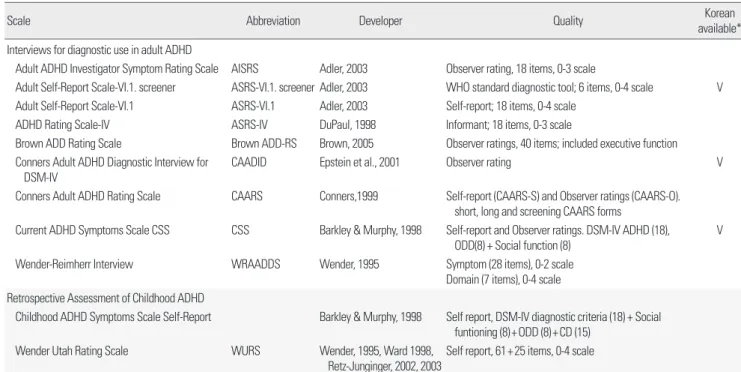
continued until present is evaluated and the severity of the symp- toms and their effect on daily life are also evaluated. Presence or absence of other problems accompanying adulthood ADHD must be confirmed and when present, the process of diagnosis and treat- ment may become more difficult. As Conner's Adult ADHD Di- agnostic Interview for DSM-IV (CAADID), which is developed by Epstein et al., a structured interview for the diagnosis of adulthood ADHD has been translated into Korean, it can be applied clinical- ly [33]. The CAADID is comprised of part I revolving around dis- ease history and part II involving symptoms experienced current- ly during adulthood and during childhood, centered around the DSM-IV criteria. It takes approximately 90 minutes to complete the survey. Neuropsychological test on ADHD is useful but not sufficient to diagnose adult ADHD. Of those, asssessment tools developed by Conners, Brown and Barkley correspond to this, as shown in Table 3 [34]. Such survey is useful for measuring the fre- quency or the severity of the symptoms and monitoring changes that occur during the follow-up period. ASRS-v1.1 (ADHD Self Rating Scale) is a useful test developed to screen adulthood ADHD [35]. As mentioned, using DSM-5, it is important to confirm that more than 5 symptoms regarding attention deficiency, hyperac- tivity and impulsiveness are met in the ADHD diagnosis criteria.
Table 3. The interviews and scales for the assessment of adult Attention-Deficit/Hyperactivity Disorder
Scale Abbreviation Developer Quality Korean
available*
Interviews for diagnostic use in adult ADHD
Adult ADHD Investigator Symptom Rating Scale AISRS Adler, 2003 Observer rating, 18 items, 0-3 scale
Adult Self-Report Scale-VI.1. screener ASRS-VI.1. screener Adler, 2003 WHO standard diagnostic tool; 6 items, 0-4 scale V Adult Self-Report Scale-VI.1 ASRS-VI.1 Adler, 2003 Self-report; 18 items, 0-4 scale
ADHD Rating Scale-IV ASRS-IV DuPaul, 1998 Informant; 18 items, 0-3 scale
Brown ADD Rating Scale Brown ADD-RS Brown, 2005 Observer ratings, 40 items; included executive function Conners Adult ADHD Diagnostic Interview for
DSM-IV CAADID Epstein et al., 2001 Observer rating V
Conners Adult ADHD Rating Scale CAARS Conners,1999 Self-report (CAARS-S) and Observer ratings (CAARS-O).
short, long and screening CAARS forms
Current ADHD Symptoms Scale CSS CSS Barkley & Murphy, 1998 Self-report and Observer ratings. DSM-IV ADHD (18),
ODD(8) + Social function (8) V
Wender-Reimherr Interview WRAADDS Wender, 1995 Symptom (28 items), 0-2 scale
Domain (7 items), 0-4 scale Retrospective Assessment of Childhood ADHD
Childhood ADHD Symptoms Scale Self-Report Barkley & Murphy, 1998 Self report, DSM-IV diagnostic criteria (18) + Social funtioning (8)+ODD (8)+CD (15)
Wender Utah Rating Scale WURS Wender, 1995, Ward 1998,
Retz-Junginger, 2002, 2003
Self report, 61+25 items, 0-4 scale
*Korean available; Translation of this interview or scale was performed and available in Korean. Ref. 1 with permission from Hakjisa publishing limited.
During the interview, it would be helpful to discuss efforts made to overcome ADHD symptoms, such as making habits or taking notes, their advantages and areas of interest, in addition to the symptoms. Furthermore, comorbid disorders along with ADHD symptoms are often shown in adulthood, most of which are learn- ing disorder, anxiety disorder, mood disorder or substance use disorder. Adulthood ADHD in individuals at mid-20’s accompany the tendency to have discontinued education and low-income jobs.
They also experience difficulties from persistent low self-esteem and lacking in social skills. Furthermore, the proportion of indi- viduals with antisocial personality and drug abuse was higher compared to the general group.
After the diagnosis of adulthood ADHD, the individuals may have increased concentration on pharmacological treatment and stabilized life style. Stimulants therapy of ADHD had long-term beneficial effects and is well tolerated [32]. Through cognitive be- havioral therapy, they can learn how to organize, systematically manage their thoughts, express anger through words, and to con- trol anger when they experience at difficulties in controlling emo- tion through emotion adjustment therapy. Self-care management options include developing habits to manage daily schedules by using an agenda or electronic scheduler and getting hobbies through which they can release their energy. Aforementioned treatment options for ADHD at different stages are shown in Table 4 [28].
CONCLUSION
In this review, clinical views on ADHD at different life stages from developmental perspectives were summarized. Recently,
ADHD has been understood and approached as a chronic-illness model. It is important to start the treatment early in life if various symptoms of ADHD cause difficulties in children and interfere with their development. In addition, the treatment needs to be continued if various problems persist into adolescence or adult- hood. To date, studies on pre-school, adolescence and adulthood ADHD are largely in need. Studies on the diagnosis and treatment of ADHD in all age groups except the school-age group will be able to provide realistic help on the 60-70% of ADHD children, whose symptoms persist into the adulthood.
REFERENCES
1. Hong KE. Korean Textbook of Child Psychiatry. Seoul: Hakjisa; 2014:60- 2. Diagnostic and Statistical Manual of Mental Disorders (DSM-5). 5th ed. 70.
Arlington (VA): American Psychiatric Association; 2013:59-66.
3. Barkley RA, Fischer M, Edelbrock CS, Smallish L. The adolescent out- come of hyperactive children diagnosed by research criteria: I. An 8 year prospective follow-up study. J Am Acad Child Adolesc Psychiatry 1990;
29:546-57.
4. Barkley RA, Anastopoulos AD, Guevremont DG, Fletcher KF. Adoles- cents with attention deficit hyperactivity disorder: patterns of behavioral adjustment, academic functioning, and treatment utilization. J Am Acad Child Adolesc Psychiatry 1991;30:752-61.
5. Mick E, Faraone SV, Biederman J, Spencer TJ. The course and outcome of attention- deficit/hyperactivity disorder. Prim Psychiatry 2004;11:42- 6. Friedman LA, Rapoport JL. Brain development in ADHD. Curr Opin in 48.
Neurology 2015;30:106-11.
7. Wenar C. Handbook of developmental psychology. 3th ed. New York (NY): McGraw-Hill; 1998:181-207.
8. Jang WS, Hong SD, Joung Y. Temperament and character patterns of pa-
Severity 4-5 years of age 6-11 years of age 12-18 years of age
Mild to moderate • Psychoeducation
• Parent training programs
• Teacher administered behav- ior therapy
• If no improvement and symp- toms are severe, consider methylphenidate
• Parent training programs and CBT
• If no access to CBT and in severe cases with uncomplicated ADHD:
stimulants or atomoxetine
• If no response: add stimulants or atomoxetine (first line medications)
• If no adequate response or significant side effects: switch to another first line medication (e.g., from methylphenidate to dexamphetamine or to atomoxetine)
• If no response and significant comorbidity: try second line medications
• Stimulants or atomoxetine
• If no response: add CBT
• If no adequate response or significant side effects: switch to another first line medica- tion (e.g., from methylphenidate to dexam- phetamine or to atomoxetine)
• If no response and significant comorbidity:
try second line medications
Severe • Stimulants or atomoxetine, if possible combined with CBT
• If no adequate response or significant side effects: switch to another first line medication (e.g., from methylphenidate to dexamphetamine or to atomoxetine)
• If no response and significant comorbidity: try second line medications
• Stimulants or atomoxetine, if possible combined with CBT
• If no adequate response or significant side effects: switch to another first line medica- tion (e.g., from methylphenidate to dexam- phetamine or to atomoxetine)
• If no response and significant comorbidity First line medications: stimulants, atomoxetine. Second line medications: extended release guanfacine. Third line medications: extended release clonidine, tricyclic antidepres- sants, bupropion. Ref. 28 with permission from IACAPAP publishing limited.
chiatr Assoc 2006;45:77-82.
9. Song YM, Lee KS, Han DH, Lee YS, Min KJ, Park JY, et al. Psychopathol- ogy, temperament and character factors of adults with childhood atten- tion-deficit hyperactivity symptoms. J Korean Acad Child Adolesc Psy- chiatry 2013;24:191-8.
10. Harpin VA. The effect of ADHD on the life of an individual, their family, and community from preschool to adult life. Arch Dis Child 2005;90 Suppl1:i2-7.
11. Taylor E, Sonuga-Barke E. Disorders of attention and activity. In Rutter M, Bishop D, Pine D, Scott S, Stevenson J, Taylor E, eds. Rutter’s Child Ado- lescent Psychiatry. Hoboken (NJ): Wiley-Blackwell; 2008:522.
12. Campbell LR. Management of attention deficit hyperactivity disorder (ADHD) a continuing dilemma for physicians and educators. Pediatr 1990;29:190-3.
13. Alice C, Patricia C, Steven F, Muhammad UA, Julianna B, Choon GL. In- terventions for preschool children at high risk for ADHD: a comparative effectiveness review. Pediatrics 2013;131:e1584-604.
14. Posner K, Melvin GA, Murray DW, Gugga SS, Fisher P, Skrobala A. Clin- ical presentation of attention-deficit/hyperactivity disorder in preschool children: the preschoolers with attention-deficit/hyperactivity disorder treatment study (PATS). J Child Adolesc Psychopharmacol 2007;17:547- 15. Kang WY. The educational program of attention deficit hyperactivity 62.
disorder. DU press; 1998.
16. Ahn DH. Attention deificit hyperactivity disorder. J Korean Med Assoc 1995;38:1000-7.
17. Ahn DH, Hong KE. Management of the child with attention deificit -hy- peractivity disorders (ADHD). Korean J Child & Adol Psychiatr 1990;1:
77-88.
18. Shaw M, Hodgkins P, Caci H, Young S, Kahle J, Woods AG, et al. A sys- tematic review and analysis of long-term outcomes in attention deficit hyperactivity disorder: effects of treatment and non-treatment. BMC Medicine 2012;10:99.
19. Jung KH, Ahn DH, Kim JY, Bang YW. A practice of patterns of child and adolescent psychiatrists in South Korea. J Korean Acad Child Adolesc Psychiatry 2014;25:6-13.
20. Klein RG, Mannuzza S, Olazagasti MA, Roizen E, Hutchison JA, Lashua EC, et al. Clinical and functional outcome of childhood attention-deficit/
hyperactivity disorder 33 years later. Arch Gen Psychiatry 2012;69:1295- 1303.
21. Barkley RA. Attention-deficit hyperactivity disorder: a handbook for di- agnosis and treatment. 3rd ed. New York: Guilford Press; 2006.
chiatry. Seoul: Sigma Press; 2012:90-101.
23. Barkley RA. Psychosocial treatments for attention-deficit/hyperactivity disorder in children. J Clin Psychiatry 2002;63 Suppl 12:36-43.
24. Steinhoff KW. Special issues in the diagnosis and treatment of ADHD in adolescent. Postgrad Med 2008;120:60-8.
25. Brinkman WB, Sherman SN, Zmitrovich AR, Visscher MO, Crosby LE, Phelan KJ, et al. In their own words: adolescent views on ADHD and their evolving role managing medication. Acad Pediatr 2012;12:53-61.
26. Bussing R, Zima BT, Mason DM, Meyer JM, White K, Garvan CW. AD- HD knowledge, perceptions, and information sources: perspectives from a community sample of adolescents and their parents. J Adolesc Health 2012;51:593-600.
27. Sibley MH, Kuriyan AB, Evans SW, Waxmonsky JG, Smith BH. Pharma- cological and psychosocial treatments for adolescents with ADHD: an updated systematic review of the literature. Clin Psy Rev 2014;34;218-32.
28. Moriyama TS, Cho AJ, Verin RE, Fuentes J, Polanczyk VP. Attention def- icit hyperactivity disorder. In Rey JM, ed. IACAPAP Textbook of child and adolescent mental health. Section D: Extenalizing disorders. Geneva:
IACAPAP; 2015:1-23.
29. Vincent A. Book for adult with ADHD- My brain still needs glasses. 1st Engl ed. Ahn DH, translator. Seoul: Hanulim Special; 2013.
30. Das D, Cherbuin N, Butterworth P, Anstey KJ, Easteal S. A population-based study of attention deficit/hyperactivity disorder symptoms and associated with impairment in middle-aged adults. PLoS ONE 2012;7:e31500.
31. Brod M, Schimitt E, Goodwin M, Hodgkins P, Niebler G. ADHD burden of illness in older adults: a life course perspective. Qual Life Res 2012;21:
795-9.
32. Fredrikson M, Halmoy A, Faraone SV, Haavik J. Long-term efficacy and safety of treatment with stimulants and atomoxetine in adult ADHD: a review of controlled and naturalistic studies. Eur Neuropsychopharma- cology 23; 508-27.
33. Epstein JN, Johnson DE, Conners CK. Conners adult ADHD diagnostic interview for DSM-IV. North Tonawanda, NY: Multi-Health Systems;
1999.
34. Rosler M, Retz W, Thome J, Schneider M, Stieglitz RD, Falkai P. Psycho- pathological rating scales for diagnostic use in adults with attention-defi- cit/hyperactivity disorder (ADHD). Eur Arch Psychiatry Clin Neurosci 2006;256 Suppl 1:i3-11.
35. Kessler RC, Adler L, Ames M, Demler O, Faraone S, Hiripi E. The world health organization adult ADHD self-report scale (ASRS): a short screen- ing scale for use in the general population. Psychol Med 2005;35:245-56.