서 론
주의력결핍 과잉행동장애(attention-deficit hyperactivity disorder, ADHD)는 주의력의 결핍 및 과잉행동과 충동성 등의 증상을 특징적으로 나타내는 질환으로, 주로 소아기에 발병하여 성인기까지 지속되어 대인관계, 학업성취도 및 정신 건강에 영향을 미친다.1-3) ADHD 아동의 치료 중 근거 중심
치료(evidence based treatment)로 가장 널리 사용되는 방법 은 약물 치료이다. 그중에서도 메틸페니데이트(methylpheni- date) 등의 정신자극제에 반응하는 ADHD 아동이 전체의 70% 이상으로, 이는 그 효과성이 많은 연구들에서 입증되어 왔다.4-7) 이외에도 아토목세틴(atomoxetine), 제2형 알파 수 용체 효현제(alpha 2 agonist), 부프로피온(bupropion), 삼환 계 항우울제(tricyclic antidepressant) 등의 비 정신자극제 또한 ADHD 아동과 청소년들을 위한 치료제로 사용되고 있 고 그 효과가 입증되었다.8-10)
그러나 전체 ADHD 환자의 20-30%에서는 정신자극제의 효과가 미미하거나 충분하지 못하며, 식욕 부진, 수면의 질 저 하 등의 부작용을 나타내고 있다.10,11) 또한 부모들은 자녀에게 향정신성약물을 복용하게 하는 것을 일종의 낙인 효과로 간 주하여 약물 복용을 주저하는 경향이 있다. ADHD의 치료
주의력결핍 과잉행동장애에서 오메가-3의 효과에 대한 고찰
박소영
1)
・이소영2)
・이문수1)
고려대학교 의과대학 정신건강의학교실 소아청소년정신과,1)
순천향대학교 의과대학 순천향대학교 부천병원 정신건강의학교실2)
Review on the Efficacy of Omega-3 in the Treatment of Attention-Deficit Hyperactivity Disorder
So-Young Park, M.D.
1), Soyoung Irene Lee, M.D., Ph.D.
2), and Moon-Soo Lee, M.D., Ph.D.
1)1)
Division of Child and Adolescent Psychiatry, Department of Psychiatry, Korea University College of Medicine, Seoul, Korea
2)
Department of Psychiatry, Soonchunhyang University Bucheon Hospital, Soonchunhyang University College of Medicine, Bucheon, Korea
Pharmacotherapy is considered the first line therapy in attention-deficit hyperactivity disorder (ADHD). Many patients also choose complementary medicine such as dietary supplements. Omega-3 has shown some efficacy for improving ADHD symptoms in several studies. The goal of this review is to integrate the previous research findings on omega-3 and understand the issues worth considering in the treatment of ADHD. The terms “attention deficit disorder with hyperactivity”, “omega-3”, and “dietary supple- ments” were searched on PubMed, Cochrane, and Google scholar. The search was further limited to clinical trials, reviews, and meta-analyses. Trials that examined treatments for ADHD, used randomized design, and placebo-controlled trials were included.
Eighteen clinical trials with a total of 1,141 participants were included in this review. Fifteen trials had parallel designs, comparing an omega-3/6 polyunsaturated fatty acid (PUFAs) or a combination of both to a placebo and three compared omega-3/6 PUFAs to a placebo and psycho-stimulants. Seven of the included trials showed significant improvements in groups receiving omega-3/6 PUFAs compared to placebo groups, however, 11 trials showed no significant differences. Evidence that PUFAs supplementa- tion provides benefits for ADHD was yet limited. Mixed results were due to selection variability criteria, variability of supple- mentation, and short follow-up intervals.
KEY WORDS
: ADHDㆍOmega-3ㆍPolyunsaturated Fatty Acids.Date received: October 23, 2015 Date of revision: January 12, 2016 Date accepted: January 14, 2016
Address for correspondence: Soyoung Irene Lee, M.D., Ph.D., Department of Psychiatry, Soonchunhyang University Bucheon Hospital, Soonchunhyang University College of Medicine, 170 Jomaru-ro, Wonmi-gu, Bucheon 14584, Korea
Tel: +82.32-621-5017, Fax: +82.32-621-6950 E-mail: [email protected]
http://dx.doi.org/10.5765/jkacap.2016.27.1.31
J Korean Acad Child Adolesc Psychiatry 2016;27(1):31-38
에 있어 약물의 효과 크기가 명백하게 제시되었음에도 불구
하고,4-7,12-14) 앞서 언급한 부모들의 우려들로 인해 약물 치료
가 필요한 경우에서조차 비약물학적 개입에만 의존하거나 대 체요법 등에 의지하려는 경우가 자주 있다.15,16) 여기에는 그 효 과가 입증된 인지행동 치료나17-19) 부모 교육 등의20,21) 심리사회 적 치료가 적용되는 경우도 있으나,18) 아직까지 그 효과에 대 한 근거가 분명하지 않은 다양한 일반 식품이나 건강보조식 품 혹은 약초 등도 쓰이고 있는 것이 안타까운 현실이다.7,18)
뇌의 기능과 구조에 식품이 영향을 줄 수 있다는 가설에서 출발해서, 최근에는 소위 “brain food”라는 어휘가 생길 정도 로, 식품 섭취를 통한 정신적인 또는 기능적인 향상을 기대하 는 수요층이 점점 늘어나고 있다.22,23) 국내외에서 많이 이용되 고 있는 건강보조식품으로는 아연, 철, 오메가-3, L-아세틸 카르니틴(L-acetyl carnitine), 멜라토닌, 각종 비타민과 미네 랄 등의 미량영양소(micronutrient), 그리고 각종 한약 및 약 초 등과 함께 여러 복합 식품 등이 있다.24-26)
이 중에서도 오메가-3는 과거 일부 연구들에서 ADHD 아 동에서 정신자극제와 함께 혹은 단독으로 사용하였을 때 중 등도 정도의 효과를 나타낸다는 보고들이 있어 왔다.27-33) 하 지만 이와는 반대로, 오메가-3의 복용이 위약군과 큰 차이를 보이지 않았다는 연구 결과와34-41) 오히려 위약에 비해 떨어 졌다는 보고도42) 있어, 현재까지 ADHD에서 오메가-3의 효 과에 대한 근거가 부족한 실정이다. 본 고찰의 첫 번째 부분 에서 오메가-3에 대한 일반적인 이해와 ADHD에서의 작용기 전에 대해 살펴보고, 두 번째 부분에서는 ADHD 아동에서 오메가-3의 효과에 대해 알아보고자 한다. 이를 위해 ADHD 환자들에서 오메가-3를 단독 투여하여 치료한 군과 위약군 을 비교한 연구와 기존 치료제와 오메가-3의 복용을 비교한 연구들을 검토하고 분석하여 현시점에서의 ADHD 아동에 서의 오메가-3 사용에 관한 제언을 하고자 한다.
오메가-3에 대한 일반적인 이해
흔히 대중적으로 오메가-3(n-ω 3 fatty acid)라고 불리는 알파 리놀렌산(alpha-linolenic acid, ALA)은 오메가-6(n- ω 6 fatty acid), 즉 리놀렌산(linolenic acid, LA)과 함께 필 수 불포화 지방산(polyunsaturated fatty acids, PUFAs)의 한 종류이다. 필수 불포화 지방산은 인간의 생체 내에서는 합 성되지 않으며 주로 생선 오일이나 옥수수, 해바라기 등의 식 이를 통해서 섭취가 가능하다.43) 식이를 통해 섭취된 필수 지 방산들은 불포화과정(desaturation)과 신장과정(elongation) 을 거쳐서 아라키돈 산(arachnoid acid, AA), 즉 오메가-6 지방산과 에이코사펜타엔 산(eicosapentanoic acid, EPA),
즉 오메가-3 지방산으로 변형되며, 특히 EPA는 이후에 대사를 거쳐서 도코사헥사엔 산(docosahexanoic aicd, DHA)으로도 변형된다. 흔히, 이 AA, EPA, DHA를 모두 통틀어서 긴 사슬 다가 불포화 지방산(long chain polyunsaturated fatty acids, LC-PUFAs)이라고 부른다. 여기서 오메가-3와 오메가-6의 비율의 균형이 중요한데, 전형적인 서양식에는 오메가-3보다 는 오메가-6의 비율이 높은 편이어서 현대인의 일반적인 식 이 생활상, 오메가-3를 불충분하게 섭취하게 된다.44,45) 체내 오메가-6의 비율이 높아지면 세포막 성분의 변화가 일어나 고 염증성 매개물질의 생산이 증가하는 것으로 알려져 있다.
이는 오메가-6가 세포막에서 프로스타글란딘(prostaglandin), 트롬복산(thromboxanes)과 같은 염증성 아이코사노이드(ei- cosanoids)의 전구체인 AA로 작용하기 때문이다.46) 반면 오 메가-3는 항 염증 작용을 하는 것으로 알려져 있는데, 오메 가-3의 비율이 높은 식이를 하면 중추신경계의 세포막의 유 동성(fluidity)과 인지질(phospholipid) 구성 비율이 변화되어 단백질의 구조와 기능이 변화될 수 있다.46) 이러한 기전과 관 련하여 세포막에서 오메가-3의 비율이 높은 경우 세로토닌과 도파민의 신경전달에 영향을 줄 것으로 예상된다.
오메가-3의 ADHD에서의 작용기전
몇몇의 이전 연구들에서 ADHD 환아들에서 혈중 및 적혈 구 막에서 오메가-3의 구성이 일반 아동들과 차이가 난다고
밝혔고,47,48) 또한 오메가-3의 복용이 생체 내 세포막의 구성
을 변화시킬 수 있다는 연구 결과가 지속적으로 발표되고 있 다.35,49)
동물 실험을 기반으로 한 연구에서, 오메가-3의 비율과 결 핍 정도가 신경전달 과정 및 실행 등의 뇌의 주요 기능에 중 요한 역할을 한다고 밝혀져 왔는데, 오메가-3의 결핍 혹은 오메가-3/오메가-6의 불균형이, 특히 뇌의 전전두엽(prefr- ontal area)에서의 도파민과 세로토닌 등의 모노아민(monoa- mine)들에 영향을 주는 것으로 보고되고 있다.50) 이러한 모 노아민들의 변형이 결국에는 유전자 발현이나 전사와도 관계 하여, 도파민, 세로토닌 시스템과 연계하여 나타나는 주의력 (attention), 동기(motivation), 감정(emotion) 등과 함께 뇌의 성숙에도 영향을 줄 것으로 예상된다.46,50) 사람을 대상으로 실시한 연구에서도 LC-PUFAs 복용이 뇌 성숙 및 발달에 관 여한다는 사실을 알 수 있었는데,51,52) 모체의 모유 수유로부 터 자연적인 LC-PUFAs를 복용한 영아들과 분유를 복용한 영아들 사이에서의 뇌 성숙을 비교한 연구에서 모유 수유를 한 영아들의 지능 및 수용성 언어의 발달과의 상관관계를 밝 혔다.52)
이러한 연구 결과들은 ADHD의 병태생리를 이해하는 데 효과적으로 적용된다. 즉, 오메가-3는 ALA의 형태로 섭취된 후, 효소를 통한 신장(enzymatic elongation)을 통해서 EPA, DHA의 순서대로 전환하게 되고, 최종적으로 긴 사슬 불포 화 지방산(LC-PUFAs)의 형태가 된다.43) 하지만 ADHD 아동 들에서는 이러한 대사와 전환과정에서 유전적인 차이가 있 는 것으로 생각되며, 이에 적절한 식이상의 섭취와 흡수에도 불구하고, 혈중 EPA와 DHA 농도가 낮아 도파민과 세로토 닌의 신경전달에 문제를 일으키게 되고, 결국에는 ADHD의 핵심 증상, 즉 주의력의 결핍으로 나타나게 되는 것으로 가 정할 수 있다.
ADHD에서 오메가-3의 효과
본 연구에서 ADHD에서의 오메가-3의 효과에 대한 연구 들을 검색하기 위해 PubMed, Cochrane, Google scholar에 서 기간 설정을 별도로 두지 않고, “attention deficit disorder with hyperactivity” and “omega-3” or “dietary supplements”
단어를 검색하였다. 검색된 총 258편의 논문들 중 clinical trials만을 선택한 후, 다음 기준에 충족되는 경우만 분석에 포함하였다: 1) 연구 대상이 ADHD 환자를 대상으로 한 임상 연구일 것, 2) 연구 대상이 소아, 그리고/또는 청소년일 것, 3) 무작위 연구일 것, 4) 환자-대조군 연구(placebo controlled trial)일 것. 그 결과 최종적으로 총 18개의 연구들이 확인되 어 분석에 포함되었다.
각 연구는 최소 16명에서 최대 147명까지의 대상군을 포함 하였고, 18개 연구에 포함된 총 환자 수는 1,141명이다. 연령 으로는 가장 어린 4세에서부터 18세까지 포함되어 있으며 각 연구의 기간은 최소 4주에서 최대 6개월까지였다. 각 연구에 서 ADHD 증상의 효과 변화를 측정하는 도구로는 Conners’
Rating Scale(CRS)이 총 10개의 논문에서 사용되어 가장 많 이 이용되었고, 이외에 Abbreviated Symptom Questionnaire, Childhood Behavior Check List, ADHD Scale, Continuous Performance Assessment(CPA) 등의 척도 및 검사가 이용 되었다.
18개의 연구 중 비타민 등의 위약과 오메가-3/오메가-6의 복용 효과를 비교한 논문이 15개였고, 리탈린(ritaline: me- thylphenidate), 덱스트로 암페타민(dextro-anphetamine) 등 의 ADHD 치료제와 오메가-3/오메가-6, 그리고 위약 간의 효과를 비교한 연구가 3개였다.41,53,54)
1. ADHD 아동에서 오메가-3/오메가-6(PUFAs) 치료군과 위약군의 비교 연구
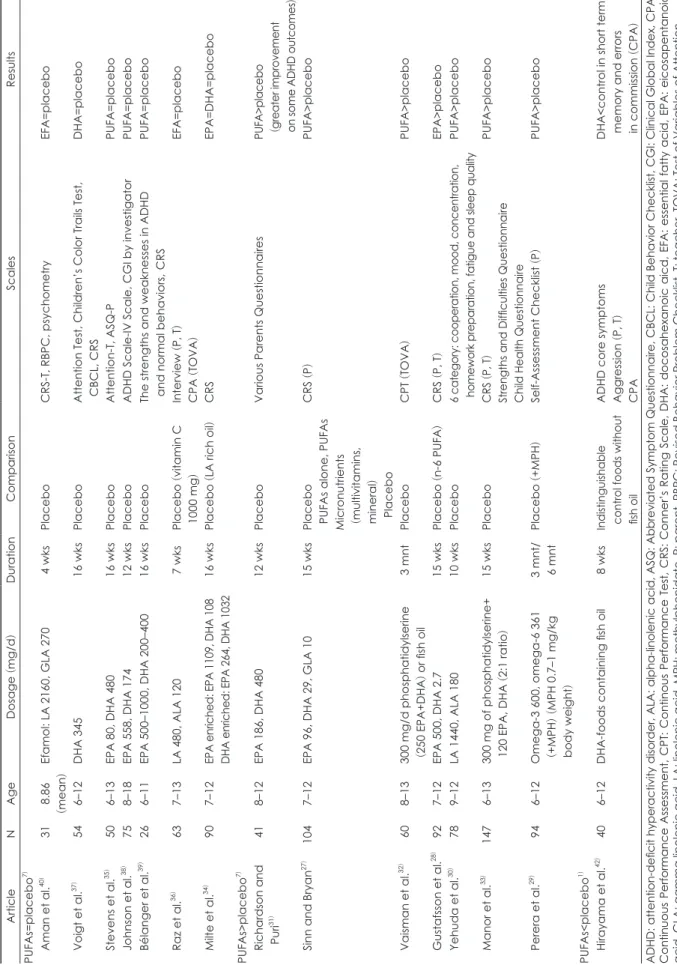
PUFAs와 위약군을 단독 투여로 비교한 총 15개의 논문은 Table 1에 요약되어 있다. 약물 치료 여부와 관계없이 오메 가-3와 위약군 간의 차이를 확인한 논문과,29,35,42) 메틸페니데 이트로 6개월 이상 치료하였으나 효과가 없었던 약물 치료 불응성 환자들에서 부가 요법으로 오메가-3/오메가-6를 복 용하도록 한 연구,29) 그리고 대상자들이 전혀 약물 치료를 하 지 않는 13개를 포함한 총 14개의 논문 중에서 오메가-3/오메 가-6가 위약군보다 효과적으로 나온 연구는 총 7개였고,27-33) 두 군 간의 유의한 차이가 없었다는 연구가 7개,34-40) 그리고 위약군에서 더 나은 효과를 보인 연구는 1개였다(Table 1).42)
일찍이 Aman 등40)은 ADHD 환아들을 대상으로 불포화 필수 지방산(efamol: primrose oil) 복용 전에 혈중 필수 지방 산의 농도(essential fatty acid, EFA)를 측정하고, 연구 대상 자를 지방산 치료군과 대조군으로 나누어 4주간 복용시킨 후, ADHD 증상의 변화 및 복용 후의 혈중 필수 지방산 농 도(EFA)를 비교하는 연구를 진행하였다. 총 8개의 검사와 세 종류의 설문지(부모, 교사)를 시행하였고, 그중 단기 기억력 검 사(short term memory task)의 정확도(accuracy)에서 대조 군에 비해 지방산 치료군이 유의하게 높게 나타났고, 다른 검 사들에서는 차이가 없었다. 지방산 복용 전후로 혈중 EFA 농 도의 변화는 확인하였으나, 치료 전 기저의 EFA의 정도가 치 료와 어떻게 연관되는지에 대해서는 밝히지 못하였다.
Stevens 등35)이 2003년에 실시한 연구에서는 50명의 ADHD 환아를 대상으로 필수 지방산 복용군과 위약군의 증상의 호 전을 비교하였고, 반항행동을 포함한 다양한 부모 보고 결과 들에서 전반적으로 필수 지방산 복용군에서 위약군보다 호 전을 보였지만, 통계적으로 유의할 정도는 아니었다. Stevens 등35)의 연구에는 메틸페니데이트, 항우울제를 포함한 약물 치 료를 받고 있는 환아들도 무작위로 포함이 되었지만, 이 연구 에서는 약물 복용의 기준을 따로 두지 않았고, 결과 분석 시에 도 약물 복용에 따른 차이를 분석하지 않았다.
총 7개의 논문에서 ADHD 아동들 중, 위약군과 비교하여 PUFAs를 복용한 치료군에서 ADHD 증상의 호전에 유의한 차이를 가져온다고 밝혔다(Table 1, 2).
2002년에 Richardson과 Puri31)는 ADHD 증상이 있으면서 난독증 등의 특수 학습장애를 동반하는 102명의 환아들에 게 오메가-3와 오메가-6를 복용하게 하여 위약군과 비교하 였다. 오메가-3와 오메가-6를 12주간 복용한 군에서 ADHD 의 핵심 증상이 전반적으로 호전되는 추세를 보였으나, 통계 적으로 유의한 수준에 이르지는 않았다. 다만 인지적 문제와 전반적 행동 문제 항목에서 오메가-3와 오메가-6 복용군에
Table 1. Randomized, placebo-controlled trials of polyunsaturated fatty acids (PUFAs
)
15)Article N Age Dosage
(mg/d
) Duration Comparison Scales Results PUFAs=placebo
7)Aman et al.
40)31 8.86
(mean )
Efamol: LA 2160, GLA 270 4 wks Placebo CRS-T, RBPC, psychometry EFA=placebo Voigt et al.
37)54 6–12 DHA 345 16 wks Placebo Attention Test, Children’s Color Trails Test, CBCL, CRS DHA=placebo Stevens et al.
35)50 6–13 EPA 80, DHA 480 16 wks Placebo Attention-T, ASQ-P PUFA=placebo Johnson et al.
38)75 8–18 EPA 558, DHA 174 12 wks Placebo ADHD Scale-IV Scale, CGI by investigator PUFA=placebo Bélanger et al.
39)26 6–11 EPA 500–1000, DHA 200–400 16 wks Placebo The strengths and weaknesses in ADHD and normal behaviors,
CRS
PUFA=placebo Raz et al.
36)63 7–13 LA 480, ALA 120 7 wks Placebo
(vitamin C
1000 mg ) Interview
(P, T
) CPA
(TOVA
) EFA=placebo Milte et al.
34)90 7–12 EPA enriched: EPA 1109, DHA 108 DHA enriched: EPA 264, DHA 1032 16 wks Placebo
(LA rich oil
) CRS EPA=DHA=placebo PUFAs>placebo
7)Richardson and Puri
31)41 8–12 EPA 186, DHA 480 12 wks Placebo Various Parents Questionnaires PUFA>placebo ( greater improvement on some ADHD outcomes ) Sinn and Bryan
27)104 7–12 EPA 96, DHA 29, GLA 10 15 wks Placebo PUFAs alone, PUFAs Micronutrients ( multivitamins, mineral ) Placebo
CRS
(P ) PUFA>placebo
32)Vaisman et al. 60 8–13 300 mg/d phosphatidylserine ( 250 EPA+DHA
) or fish oil
3 mnt Placebo CPT
(TOVA
) PUFA>placebo Gustafsson et al.
28)92 7–12 EPA 500, DHA 2.7 15 wks Placebo
(n-6 PUFA )
CRS
(P, T
) EPA>placebo Yehuda et al.
30)78 9–12 LA 1440, ALA 180 10 wks Placebo 6 category: cooperation, mood, concentration, homework preparation, fatigue and sleep quality PUFA>placebo Manor et al.
33)147 6–13 300 mg of phosphatidylserine+ 120 EPA, DHA
(2:1 ratio )
15 wks Placebo CRS
(P, T
) Strengths and Difficulties Questionnaire Child Health Questionnaire
PUFA>placebo Perera et al.
29)94 6–12 Omega-3 600, omega-6 361 ( +MPH ) ( MPH 0.7–1 mg/kg body weight )
3 mnt/ 6 mnt Placebo
(+MPH
) Self-Assessment Checklist
(P ) PUFA>placebo
1)PUFAs<placebo
42)Hirayama et al. 40 6–12 DHA-foods containing fish oil 8 wks Indistinguishable control foods without fish oil
ADHD core symptoms Aggression
(P, T
) CPA
DHA<control in short term memory and errors in commission
(CPA
) ADHD: attention-deficit hyperactivity disorder, ALA: alpha-linolenic acid, ASQ: Abbreviated Symptom Questionnaire, CBCL: Child Behavior Checklist, CGI: Clinical Global Index, CPA: C on tin uo us Pe rfo rm an ce A sse ssm en t, C PT : C on tin ou s Pe rfo rm an ce T est , C RS : C on ne r’s Rat in g Sc ale , DHA : d oc osah ex an oic aic d , EF A : e sse nt ial fat ty ac id , EP A : e ic osape nt an oic acid, GLA: gamma linolenic acid, LA: linolenic acid, MPH: methylphenidate, P: parent, RBPC: Revised Behavior Problem Checklist, T: teacher, TOVA: Test of Variables of Attention
서 유의한 호전을 나타내어 ADHD 아동의 학습 영역에서는 효과를 기대해 볼 수 있다고 시사하였다. 그러나 이 연구는 연구 대상자 수가 41명(치료군 22명, 대조군 19명)으로 다소 적다는 제한점이 있었다.
2007년에 Sinn과 Bryan27)이 104명의 ADHD 아동들을 대 상으로 한 연구에서 PUFAs를 복용한 군이 위약군에 비해서 CRS로 확인되는 인지적 문제 및 부주의, 과잉행동/충동성의 ADHD 핵심 증상에서 중등도 이상의 호전을 보여주었다.
2008년의 Vaisman 등32)의 연구에서 EPA, DHA를 포함한 PUFAs를 복용한 ADHD 아동군에서 위약군과 비교하여 혈중 필수 지방산의 변화와 함께 지속적 주의력을 검사하는 CPA인 Test of Variables Attention상에서 유의한 효과를 확 인한 바 있다. Gustafsson 등28)의 2010년 연구에서도 EPA와 DHA를 포함한 오메가-3를 복용한 치료군에서 위약군에 비 해 CRS의 부주의 영역과 인지 영역에서 유의한 차이를 보였 다. 특히, 이 연구에서 ADHD 아동들 중, 반항적 행동장애를 동시에 진단받은 아동의 그룹에서는 CRS 전체 점수상에서 유의한 차이를 보였고, 그중에서도 교사가 보고한 반항적 행 동 및 부주의/인지 영역에서 위약군에 비하여 유의한 차이를 보이며 향상된 것으로 보고되었다.
Yehuda 등30)은 2011년에 실시한 수면 문제가 있는 78명의 ADHD 환아들과 ADHD가 아닌 일반 22명의 아동들을 대 상으로 PUFAs와 위약을 복용하여 10주간의 관찰 연구에서 자체 설문지상에서 수면의 질과 집중력 향상 및 피로도에서 PUFAs를 복용한 군에서 유의한 효과를 확인하였다.
2012년에 Perera 등29)은 기존에 메틸페니데이트를 복용하 던 ADHD 환아들 중에서 6개월 이상의 표준 치료법에도 호 전을 보이지 않은 치료 저항성 아동들을 대상으로 오메가-3/
오메가-6를 병합하여 복용하도록 하는 부가 치료에 대한 연 구를 진행하였다. 오메가-3와 오메가-6 병합군에서 부모가 보고한 평정서에서 안절부절감(restlessness), 공격성(aggres- siveness), 수행 완료(completing work), 학업 수행 능력(aca- demic performance) 영역에서 유의한 차이를 보였다. 하지만 부주의, 충동성, 협동심 영역에서는 대조군과 유의한 차이가 없었다.
2004년의 Hirayama 등42)의 연구에서 40명의 ADHD 아 동들을 무작위로 할당하여 2달간 DHA를 복용한 군과 복용 하지 않은 대조군을 비교하였다. 이 연구에서는 이전 연구들 과 다른 결과를 보여주었는데, CPA 검사상 시각적 단기 기억 (visual short term memory)과 수행 오류(commission error) 에서 치료군에 비해 대조군에서 유의하게 호전을 보였다. 연 구자들은 대조군에서 보인 호전은 시간에 따른 학습 효과의 결과로 설명하면서, DHA 복용군에서, 순수 DHA(pure DHA)
의 복용으로 인한 혈중 노르아드레날린(noradrenaline)의 감 소로, 결국 정신자극제와 정반대의 역할, 즉 주의력을 악화시 켜 오히려 학습 효과를 둔화시킨 것은 아닌가 하고 가설을 제 시하고 있다. 이는 오메가-3 중에서도 DHA의 복용과 EPA의 복용이 어떻게 다른 효과를 가지는지에 대한 추후 연구가 필 요함을 시사하였다(Table 1).
2. ADHD 아동에서의 오메가-3/오메가-6 치료군, 약물 치료 군, 그리고 위약군과의 비교 연구
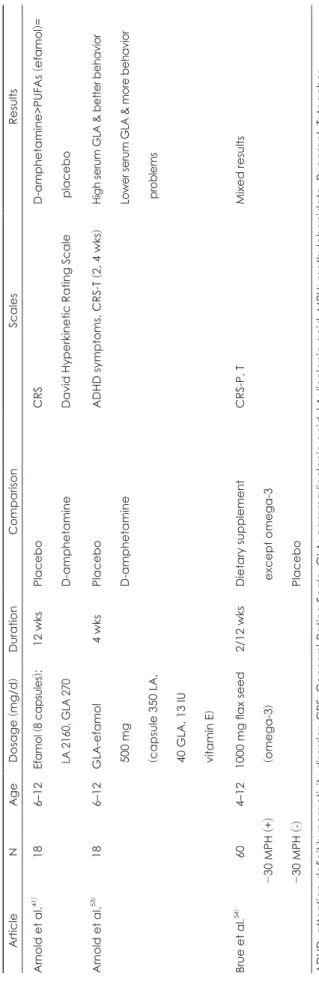
Arnold 등41,53)은 1989년과 1994년에 논문 2편을 발표하였 는데, 전자에서는 필수 지방산 복용군, 메틸페니데이트 복용 군, 위약군으로 나누어 필수 지방산 복용군에서 전반적으로는 위약군보다 효과적이고 메틸페니데이트 복용군보다는 덜 효 과적이라는 결과를 보였으나, 과잉행동 영역을 제외하고는 통 계상의 유의성은 증명하지 못하였다. 후자에서는 이 환아들 을 대상으로 혈중 gamma linolenic acid(GLA)의 농도가 낮 을수록 문제 행동들이 더 많은 것을 밝혔지만, GLA의 전구 체인 LA와의 상관관계는 나타나지 않았다. 이러한 각 단계별 인지질의 농도와 ADHD 증상의 상관관계를 고려할 때, ADHD 증상이 식이 습관이나 아동의 대사로 인한 것이 아니 라는 점을 시사한다. 즉 필수 지방산의 대사 과정 중 반응률 제한 단계(rate limiting step), 즉 LA에서 GLA로 변환하는 과정에 필요한 탄산효소 delta-6-desaturase 결핍이 ADHD 증상의 발현에 중요할 것이라는 점에 대하여 언급하였다.
Brue 등54)의 2001년 연구에서, 총 60명의 ADHD 아동들 중, 30명은 리탈린(ritaline: methylphenidate)을 복용하는 군, 30명은 리탈린을 복용하지 않는 군을 모집하였고, 이들 을 대상으로 오메가-3와 징코 빌로바(ginko biloba) 등을 포 함한 건강보조식품, 그리고 위약을 복용하도록 하여 각 2주와 12주째에 부모와 교사로 하여금 환아들의 행동 변화에 대하 여 평가하였다. 건강보조식품만을 복용하는 치료 그룹과 위 약 복용 그룹을 비교하는 첫 번째 연구와, 오메가-3를 건강보 조식품과 함께 복용하는 그룹과 건강보조식품만을 복용하는 그룹을 비교하는 두 번째 연구로 나누어져 진행되었다. 첫 번 째 연구에서 두 군 간의 차이는 없었으나, 두 번째 연구에서는 리탈린을 복용하는 대상자들 중, 오메가-3와 건강보조식품 을 복용하는 군에서 건강보조식품만을 복용하는 군에 비해 부주의 행동에서의 호전이 확인되었고, 리탈린을 복용하지 않는 대상자들 중, 오메가-3와 건강보조식품을 복용하는 군 에서 과잉행동/충동성 행동이 줄었지만, 교사들은 그 반대 를 보고하였다.
결 론
오메가-3의 ADHD 아동에서의 효과를 연구한 위의 논문 들의 결과는 다소 상충되고 일관성이 부족하다. 그 이유는 오 메가-3의 종류, 즉 오메가-3 단독 혹은 오메가-6 병합 여부, DHA와 EPA의 함유량, 일일 복용량 등이 모두 다르고, 복용 기간 또한 최소 4주에서 최대 12주까지 다양하였던 데서 기인 한 것으로 추정된다. 연구 대상자인 ADHD 아동들의 기존의 혈중 EFA 농도 또한 대사 및 증상의 호전에 영향을 주었을 것으로 예상되는데, 이러한 점을 연구 초반에 제어하지 못한 점 또한 제한점으로 생각된다. 아직까지는 ADHD 아동들에 서 불포화 지방산의 대사가 일반 아동들과 어떻게 다른지 확 실하게 밝혀지지 않았으므로, 이에 대한 추가적인 연구들이 필요할 것으로 생각된다. 또한 방법론적으로 ADHD 증상의 호전을 대개 부모나 교사에 의한 주관적인 평정에 의존하여 실시하였기 때문에 보다 객관적인 검사 도구를 이용하는 등의 보완이 필요할 것으로 생각된다.
이번 고찰을 통해, 현재까지 ADHD의 치료에 있어서 오메 가-3 및 DHA, EPA의 효과는 여전히 논란의 여지가 있으며, 단독 치료제로서 그 효과를 입증하기에는 아직까지 증거가 부족하다고 생각된다. 몇몇의 신뢰할 만한 연구들에서 오메 가-3의 복용이 ADHD 증상의 호전에 있어 보통 정도 크기의 효과가 있는 것으로 나타났고, 이는 오메가-3에 대한 긍정적 인 기대를 하게 한다. 하지만 그 효과가 오메가-3의 제형 중 DHA, EPA의 함량에 따라 결과들이 상이하게 나타나므로, 어떤 성분이 ADHD와 직접적인 연관성이 있는지, 또한 다른 약물과의 병합 시에 부가적으로 나타나는 것인지 아니면 단 독으로 효과가 있는 것인지에 대한 비교 연구가 현재로써는 부족한 실정이다.
또한 ADHD 증상의 심각도에 따른 오메가-3의 복용에 따 른 차이에 대한 연구가 없어 ADHD 치료에서 오메가-3 복용 군을 설정하거나 치료 가이드 라인에 포함시키는 것은 무리가 있다. 또한 오메가-3가 ADHD 치료에서 나타내는 효과는 전 통적인 정신자극제 치료 효과에 비해 상당히 낮다는 점을 염 두에 두어야 한다.
그러나 이러한 제한점들에도 불구하고, 이번 고찰에서 오메 가-3 복용으로 인한 심각한 부작용은 발견되지 않았음을 확 인하였고, 미약한 정도이나 ADHD의 핵심 증상의 호전이 있 었다는 점에 주목할 필요가 있다. 이는 좀 더 구조화된 대규모 의 환자 대조군, 무작위 연구를 통해 오메가-3의 효과가 확인 되어야 할 것이다. 이러한 노력들은 과학적 검증이나 근거 없 이 건강보조식품들이 치료제로 둔갑하여 사용되는 것을 막고
Table 2. Randomized, placebo-controlled trials of polyunsaturated fatty acids
(PUFAs ), with other pharmacotherapy
3)
Article N Age Dosage
(mg/d
) Duration Comparison Scales Results Arnold et al.
41)18 6–12 Efamol
(8 capsules ):
LA 2160, GLA 270
12 wks Placebo D-amphetamine
CRS David Hyperkinetic Rating Scale
D-amphetamine>PUFAs
(efamol )=
placebo Arnold et al.
53)18 6–12 GLA-efamol 500 mg ( capsule 350 LA, 40 GLA, 13 IU vitamin E )
4 wks Placebo D-amphetamine
ADHD symptoms, CRS-T
(2, 4 wks
) High serum GLA & better behavior Lower serum GLA & more behavior problems Brue et al.
54)60 - 30 MPH
(+ ) - 30 MPH
(- )
4–12 1000 mg flax seed ( omega-3 )
2/12 wks Dietary supplement except omega-3 Placebo
CRS-P, T Mixed results ADHD: attention-deficit hyperactivity disorder, CRS: Conners’ Rating Scale, GLA: gamma linolenic acid, LA: linolenic acid, MPH: methylphenidate, P: parent, T: teacher
우리나라 국민들의 보건 의식 향상에 이바지하게 될 것이다.
중심 단어
: 주의력결핍 과잉행동장애・오메가-3・불포화 지방산.
Conflicts of Interest
The authors have no financial conflicts of interest.
References
1) Clinical practice guideline: diagnosis and evaluation of the child with attention-deficit/hyperactivity disorder. American Academy of Pediatrics. Pediatrics 2000;105:1158-1170.
2) Goldman LS, Genel M, Bezman RJ, Slanetz PJ. Diagnosis and treatment of attention-deficit/hyperactivity disorder in children and adolescents. Council on Scientific Affairs, American Medical Association. JAMA 1998;279:1100-1107.
3) Cho SC. Concept and biological study of attention deficit hyper- activity disorder. J Korean Acad Child Adolesc Psychiatry 1990;
1:5-26.
4) Ahn DH, Hong KE. Management of the child with attention - def- icit hyperactivity disorders (ADHD). J Korean Acad Child Ado- lesc Psychiatry 1990;1:77-88.
5) Spencer T, Biederman J, Wilens T, Harding M, O’Donnell D, Grif-
fin S. Pharmacotherapy of attention-deficit hyperactivity disorder
across the life cycle. J Am Acad Child Adolesc Psychiatry 1996;35:409-432.
6) Yang YH, Yoo HJ. Stimulants medication of attention-deficit hy- peractivity disorder. J Korean Acad Child Adolesc Psychiatry 2008;19:61-71.
7) Lewis M. Child and adolescent psychiatry: a comprehensive text- book. Philadelphia, PA: Lippincott Williams & Wilkins;2002.
8) Connor DF, Fletcher KE, Swanson JM. A meta-analysis of cloni- dine for symptoms of attention-deficit hyperactivity disorder. J Am Acad Child Adolesc Psychiatry 1999;38:1551-1559.
9) Cheng JY, Chen RY, Ko JS, Ng EM. Efficacy and safety of atomox- etine for attention-deficit/hyperactivity disorder in children and adolescents-meta-analysis and meta-regression analysis. Psycho- pharmacology (Berl) 2007;194:197-209.
10) Schachter HM, Pham B, King J, Langford S, Moher D. How effi- cacious and safe is short-acting methylphenidate for the treatment of attention-deficit disorder in children and adolescents? A meta- analysis. CMAJ 2001;165:1475-1488.
11) Barkley RA, McMurray MB, Edelbrock CS, Robbins K. Side effects of methylphenidate in children with attention deficit hyperactivity disorder: a systemic, placebo-controlled evaluation. Pediatrics 1990;86:184-192.
12) Swanson JM, Kraemer HC, Hinshaw SP, Arnold LE, Conners CK,
Abikoff HB, et al. Clinical relevance of the primary findings of the
MTA: success rates based on severity of ADHD and ODD symp- toms at the end of treatment. J Am Acad Child Adolesc Psychiatry 2001;40:168-179.13) Yoo HJ, Yang SJ, Shin D, Kang H, Kim BN, Kim JH, et al. The Korean practice parameter for the treatment of attention-deficit hyperactivity disorder(III): pharmacologic treatment. J Korean Acad Child Adolesc Psychiatry 2007;18:16-25.
14) Conners CK, Epstein JN, March JS, Angold A, Wells KC, Klaric J, et
al. Multimodal treatment of ADHD in the MTA: an alternative out-
come analysis. J Am Acad Child Adolesc Psychiatry 2001;40:159-167.15) Berger I, Dor T, Nevo Y, Goldzweig G. Attitudes toward attention- deficit hyperactivity disorder (ADHD) treatment: parents’ and children’s perspectives. J Child Neurol 2008;23:1036-1042.
16) Dunnick JK, Hailey JR. Experimental studies on the long-term ef-
fects of methylphenidate hydrochloride. Toxicology 1995;103:77-84.
17) Pelham WE Jr, Waschbusch DA. Behavioral intervention in atten- tion-deficit/hyperacivity disorder. In: Quay HC, Hogan AE, editors.
Handbook of disruptive behavior disorders. New York: Spring- er;1999. p.255-278.
18) Kim BN, Yoo HK, Kang H, Kim JH, Shin D, Ahn D, et al. The Ko- rean practice parameter for the treatment of attention-deficit hyper- activity disorder (IV): non-pharmacologic treatment. J Korean Acad Child Adolesc Psychiatry 2007;18:26-30.
19) Safren SA, Sprich S, Mimiaga MJ, Surman C, Knouse L, Groves M,
et al. Cognitive behavioral therapy vs relaxation with educational
support for medication-treated adults with ADHD and persistent symptoms: a randomized controlled trial. JAMA 2010;304:875-880.20) Pelham WE Jr, Wheeler T, Chronis A. Empirically supported psy- chosocial treatments for attention deficit hyperactivity disorder. J Clin Child Psychol 1998;27:190-205.
21) Barkley RA, DuPaul GJ, McMurray MB. Comprehensive evaluation of attention deficit disorder with and without hyperactivity as de- fined by research criteria. J Consult Clin Psychol 1990;58:775-789.
22) Bourre JM. Effects of nutrients (in food) on the structure and func- tion of the nervous system: update on dietary requirements for brain. Part 1: micronutrients. J Nutr Health Aging 2006;10:377-385.
23) Fernstrom JD. Can nutrient supplements modify brain function?
Am J Clin Nutr 2000;71(6 Suppl):1669S-1675S.
24) Sarris J, Kean J, Schweitzer I, Lake J. Complementary medicines (herbal and nutritional products) in the treatment of attention defi- cit hyperactivity disorder (ADHD): a systematic review of the evi- dence. Complement Ther Med 2011;19:216-227.
25) Arnold LE, Hurt E, Lofthouse N. Attention-deficit/hyperactivity disorder: dietary and nutritional treatments. Child Adolesc Psy- chiatr Clin N Am 2013;22:381-402, v.
26) Rucklidge JJ, Johnstone J, Kaplan BJ. Nutrient supplementation ap- proaches in the treatment of ADHD. Expert Rev Neurother 2009;9:
461-476.
27) Sinn N, Bryan J. Effect of supplementation with polyunsaturated fatty acids and micronutrients on learning and behavior problems associated with child ADHD. J Dev Behav Pediatr 2007;28:82-91.
28) Gustafsson PA, Birberg-Thornberg U, Duchén K, Landgren M,
Malmberg K, Pelling H, et al. EPA supplementation improves
teacher-rated behaviour and oppositional symptoms in children with ADHD. Acta Paediatr 2010;99:1540-1549.29) Perera H, Jeewandara KC, Seneviratne S, Guruge C. Combined ω3 and ω6 supplementation in children with attention-deficit hyperactiv- ity disorder (ADHD) refractory to methylphenidate treatment: a dou- ble-blind, placebo-controlled study. J Child Neurol 2012;27:747-753.
30) Yehuda S, Rabinovitz-Shenkar S, Carasso RL. Effects of essential fatty acids in iron deficient and sleep-disturbed attention deficit hy- peractivity disorder (ADHD) children. Eur J Clin Nutr 2011;65:1167- 1169.
31) Richardson AJ, Puri BK. A randomized double-blind, placebo-con- trolled study of the effects of supplementation with highly unsaturat- ed fatty acids on ADHD-related symptoms in children with specific learning difficulties. Prog Neuropsychopharmacol Biol Psychiatry 2002;26:233-239.
32) Vaisman N, Kaysar N, Zaruk-Adasha Y, Pelled D, Brichon G, Zwin-
gelstein G, et al. Correlation between changes in blood fatty acid
composition and visual sustained attention performance in children with inattention: effect of dietary n-3 fatty acids containing phos- pholipids. Am J Clin Nutr 2008;87:1170-1180.33) Manor I, Magen A, Keidar D, Rosen S, Tasker H, Cohen T, et al.
The effect of phosphatidylserine containing omega3 fatty-acids on attention-deficit hyperactivity disorder symptoms in children: a double-blind placebo-controlled trial, followed by an open-label ex- tension. Eur Psychiatry 2012;27:335-342.
34) Milte CM, Parletta N, Buckley JD, Coates AM, Young RM, Howe
PR. Eicosapentaenoic and docosahexaenoic acids, cognition, and
behavior in children with attention-deficit/hyperactivity disorder:
a randomized controlled trial. Nutrition 2012;28:670-677.
35) Stevens L, Zhang W, Peck L, Kuczek T, Grevstad N, Mahon A, et
al. EFA supplementation in children with inattention, hyperactivi-
ty, and other disruptive behaviors. Lipids 2003;38:1007-1021.36) Raz R, Carasso RL, Yehuda S. The influence of short-chain essen- tial fatty acids on children with attention-deficit/hyperactivity disorder: a double-blind placebo-controlled study. J Child Adolesc Psychopharmacol 2009;19:167-177.
37) Voigt RG, Llorente AM, Jensen CL, Fraley JK, Berretta MC, Heird
WC. A randomized, double-blind, placebo-controlled trial of doc-
osahexaenoic acid supplementation in children with attention-def- icit/hyperactivity disorder. J Pediatr 2001;139:189-196.38) Johnson M, Ostlund S, Fransson G, Kadesjö B, Gillberg C. Ome- ga-3/omega-6 fatty acids for attention deficit hyperactivity disor- der: a randomized placebo-controlled trial in children and adoles- cents. J Atten Disord 2009;12:394-401.
39) Bélanger SA, Vanasse M, Spahis S, Sylvestre MP, Lippé S, L’heureux
F, et al. Omega-3 fatty acid treatment of children with attention-
deficit hyperactivity disorder: a randomized, double-blind, place- bo-controlled study. Paediatr Child Health 2009;14:89-98.40) Aman MG, Mitchell EA, Turbott SH. The effects of essential fatty acid supplementation by Efamol in hyperactive children. J Ab- norm Child Psychol 1987;15:75-90.
41) Arnold LE, Kleykamp D, Votolato NA, Taylor WA, Kontras SB,
Tobin K. Gamma-linolenic acid for attention-deficit hyperactivity
disorder: placebo-controlled comparison to D-amphetamine. Biol Psychiatry 1989;25:222-228.42) Hirayama S, Hamazaki T, Terasawa K. Effect of docosahexaenoic acid-containing food administration on symptoms of attention- deficit/hyperactivity disorder - a placebo-controlled double-blind study. Eur J Clin Nutr 2004;58:467-473.
43) Raz R, Gabis L. Essential fatty acids and attention-deficit-hyperac- tivity disorder: a systematic review. Dev Med Child Neurol 2009;
51:580-592.
44) Hawkey E, Nigg JT. Omega-3 fatty acid and ADHD: blood level analysis and meta-analytic extension of supplementation trials.
Clin Psychol Rev 2014;34:496-505.
45) Simopoulos AP. Omega-3 fatty acids in health and disease and in growth and development. Am J Clin Nutr 1991;54:438-463.
46) Simopoulos AP. Omega-3 fatty acids in inflammation and auto- immune diseases. J Am Coll Nutr 2002;21:495-505.
47) Stevens LJ, Zentall SS, Deck JL, Abate ML, Watkins BA, Lipp SR,
et al. Essential fatty acid metabolism in boys with attention-deficit
hyperactivity disorder. Am J Clin Nutr 1995;62:761-768.48) Antalis CJ, Stevens LJ, Campbell M, Pazdro R, Ericson K, Burgess
JR. Omega-3 fatty acid status in attention-deficit/hyperactivity dis-
order. Prostaglandins Leukot Essent Fatty Acids 2006;75:299-308.49) Joshi K, Lad S, Kale M, Patwardhan B, Mahadik SP, Patni B, et al.
Supplementation with flax oil and vitamin C improves the out- come of attention deficit hyperactivity disorder (ADHD). Prosta- glandins Leukot Essent Fatty Acids 2006;74:17-21.
50) Chalon S. Omega-3 fatty acids and monoamine neurotransmis- sion. Prostaglandins Leukot Essent Fatty Acids 2006;75:259-269.
51) Drane DL, Logemann JA. A critical evaluation of the evidence on the association between type of infant feeding and cognitive de- velopment. Paediatr Perinat Epidemiol 2000;14:349-356.
52) Belfort MB, Rifas-Shiman SL, Kleinman KP, Guthrie LB, Bell-
inger DC, Taveras EM, et al. Infant feeding and childhood cogni-
tion at ages 3 and 7 years: effects of breastfeeding duration and exclusivity. JAMA Pediatr 2013;167:836-844.53) Arnold LE, Kleykamp D, Votolato N, Gibson RA, Horrocks L. Po- tential link between dietary intake of fatty acids and behavior: pi- lot exploration of serum lipids in attention-deficit hyperactivity disorder. J Child Adolesc Psychopharmacol 1994;4:171-182.
54) Brue AW, Oakland TD, Evans RA. The use of a dietary supple- ment combination and an essential fatty acid as an alternative and complementary treatment for children with attention-deficit/hy- peractivity disorder. Sci Rev Altern Med 2001;5:187-194.