INTRODUCTION
Adverse childhood experiences (ACEs) are known to affect neurodevelopment and the endocrine and immune systems, thus increasing cognitive, social, and emotional dysfunctions [1-3]. Furthermore, people with many ACEs have many phys- ical or mental problems and a high premature mortality rate [4]. A recent meta-analysis reported that the impact of ACEs is transmitted down to generations and is closely linked to the risk of ACEs (violence, mental illness, substance abuse) in the next generation [3], and parents’ ACEs have an adverse im-
pact on the socioemotional growth of their children [5]. In particular, the presence of four or more ACEs in parents was associated with hyperactivity in their offspring [6].
Attention-deficit/hyperactivity disorder (ADHD) is a neu- rodevelopmental disorder that is understood as a brain mat- urational delay caused by an interaction among various fac- tors, including, biological, environmental, and psychosocial risk factors [7]. Because antepartum health risks can have a detrimental impact on fetal brain development, studies have investigated antepartum health risks associated with ADHD.
Currently, the identified antepartum health risks associated with ADHD include maternal smoking, antepartum stress, preterm birth, low birth weight, and pregnancy-related com- plications [8,9].
This is an Open Access article distributed under the terms of the Creative Commons Attribution Non-Commercial License (https://creativecommons.org/licenses/by-nc/4.0) which permits unrestricted non-commercial use, distribution, and reproduction in any medium, provided the original work is properly cited.
Association between Maternal Adverse Childhood
Experiences and Attention-Deficit/Hyperactivity Disorder in the Offspring: The Mediating Role of Antepartum
Health Risks
Duk-Soo Moon
1*, Su-Jeong Bong
2*, Bung-Nyun Kim
3, and Na Ri Kang
1,41Department of Psychiatry, Jeju National University Hospital, Jeju, Korea
2Medical Course, Jeju National University School of Medicine, Jeju, Korea
3Department of Psychiatry, Seoul National University School of Medicine, Seoul, Korea
4Department of Psychiatry, Jeju National University School of Medicine, Jeju, Korea
Objectives:
This study aimed to examine the effect of maternal adverse childhood experiences (ACEs) on the attention-deficit/hyper- activity disorder (ADHD) symptoms in the offspring and to examine the mediating role of antepartum health risk on the intergenera- tional transmission of maternal ACEs.
Methods:
The participants consisted of 461 mother-child dyads. Mothers completed the ACEs questionnaire and Diagnostic Predictive Scales. Multivariate logistic regression analysis was used to estimate the risk of ADHD symptoms in the offspring of mothers with ACEs and the mediating effect of antepartum health risks by path analysis.
Results:
In all, 35.4% (n=163) had at least one maternal ACE, and 11.1% (n=51) had three or more. Compared to the non-ADHD symp- tom group, the group of offspring with ADHD symptoms showed a significant association with maternal ACE score (p<0.001) and an- tepartum health risks (p<0.001). Multivariate analysis further showed a significant association between the sum of maternal ACEs [odds ratio (OR)=1.264, 95% confidence interval (CI)= 1.060–1.516, p=0.009], antepartum health risks (OR=1.236, 95% CI=1.036–1.475, p=
0.019), and ADHD symptoms in the offspring. In the mediation model in which the mother’s ACE score affected the offspring’s ADHD symptoms, partial mediation through antepartum health risks was found to be significant (B=0.041, 95% CI=0.011–0.124).
Conclusion:
Maternal ACEs are significantly related to the incidence of ADHD symptoms in the offspring and antepartum health risks exert an indirect effect. These findings suggest that maternal ACEs have a negative impact on the offspring’s brain development through intergenerational transmission, resulting in neurodevelopmental disorders such as ADHD.
Key Words:
Adverse childhood experiences; Attention-deficit/hyperactivity disorder; Antepartum health risks.
Received: October 16, 2020 / Revision: November 25, 2020 / Accepted: November 27, 2020
Address for correspondence: Na Ri Kang, Department of Psychiatry, Jeju National University School of Medicine, 15 Aran 13-gil, Jeju 63238, Korea Tel: +82-64-717-1850, Fax: +82-64-717-1849, E-mail: [email protected]
*These authors contributed equally to this work.
J Korean Acad Child Adolesc Psychiatry 2021;32(1):28-34 https://doi.org/10.5765/jkacap.200041
According to previous studies, ACEs are positively corre- lated with antepartum health risks, and people with ACEs have difficulty controlling their emotions and seek strong compensatory strategies to mitigate negative emotions dur- ing pregnancy. This alters the neurobiological circuit and in- creases the risk of binge drinking during pregnancy [10], and mothers with a high number of ACEs exhibited a high risk for pregnancy diabetes, preeclampsia, low birth weight in- fants, and short gestation period [5]. Furthermore, chronic stress caused by ACEs elevates risky health behaviors, such as smoking, drinking, and binge eating, which are likely to lead to adverse birth outcomes, such as miscarriage and pre- term birth [11].
While studies on the mediators of the impact of maternal ACEs on offspring’s ADHD are lacking, based on previous findings, maternal ACEs are likely to increase antepartum health risks and thus have an adverse impact on children’s neural development. Thus, this study aimed to investigate the effects of maternal ACEs and antepartum health risks on the incidence of ADHD in the offspring and the mediating role of antepartum health risks in the intergenerational trans- mission of maternal ACEs in the form of ADHD.
METHODS
Participants and methods
This study involved mothers and their children aged 6–18 years who had continuously been attending school for at least 6 months in Jeju Island. Data were collected using a question- naire, which was distributed and retrieved by mental health staff trained on the background of the study and contents of the questionnaire. A total of 461 participants were enrolled, and written informed consent was obtained from the moth- ers and their offspring. Data were collected from September to December 2017. This study was approved by the Institu- tional Review Board of Jeju National University Hospital (2018-08-004).
Instruments
Adverse childhood experiences questionnaire
The ACEs questionnaire retrospectively surveys adverse experiences in childhood before the age of 18 years, includ- ing child abuse (emotional abuse, physical abuse, sexual abuse), child neglect (physical neglect, emotional neglect), and dysfunctional family environment (domestic violence, parents’ divorce or separation, family member’s substance abuse, mental illness, and incarceration) [12]. A “yes” response is scored 1 point, and “no” response, 0. The total score is used to indicate the degree of ACE exposure [3]. ACEs are ana-
lyzed in various ways, but the total score is used in most cas- es [13]. In the present study, the cumulative total score was classified into 0, 1, 2, and ≥3, and to examine the impact of each type of ACE on children’s mental health problems, the scores for 3 domains of child abuse, child neglect, and house- hold dysfunction were used.
Diagnostic Interview Schedule for Children Diagnostic Predictive Scales
In this study, ADHD symptoms were assessed using the Di- agnostic Predictive Scales (DPS). It is the primary screening tool of the Diagnostic Interview Schedule for Children (DISC)- IV, a structured interview tool based on the DSM-IV crite- ria. The DPS for parents is a self-reported tool that consists of 92 questions about the symptoms of a mental disorder of the child in the past year and eight questions about mood or behavioral problems the child has at home, school, or with friends. DPS is a brief scale but can be effectively used for DISC- IV diagnosis, with a high reliability [14].
A previous epidemiological survey on Korean children and adolescents [15] added 33 items to the DISC-IV but not the DPS (selective mutism, eating disorder, elimination dis- order, posttraumatic stress disorder, tic disorder, cigarette, pica, and trichotillomania) and removed eight items related to general mood and behavior problems. The same tool was used in this study. We used the cutoff proposed in the study by Cubo for each disorder [16].
Assessment of antepartum health risks
The following 12 items pertaining to antepartum health risks are examined: physical problems, namely problems with fetal location, premature rupture of membranes, severe vaginal bleeding, and mild vaginal bleeding; rubella; pre- eclampsia; seizures in pregnancy; emotional problems requir- ing treatment, serious family problems; accidents or injuries requiring treatment; constipation; low back pain; perineal in- fection; heartburn; and severe psychological stress. These items about antepartum health risks were drawn from ob- stetric evaluation tools [17,18]. In this study, a “yes” response was given 1 point, and the total score was used to represent antepartum health risks.
Statistical analysis
Participants’ demographic factors were analyzed using de-
scriptive statistics and frequency analysis according to the to-
tal ACE score. The differences in maternal demographic fac-
tors, maternal antepartum health risk, and maternal ACEs
according to the offspring’s ADHD symptoms were analyzed
using independent sample t-tests and chi-squared tests. Mul-
tiple logistic regression was performed for two models (ante-
partum health risk and ACE; Model 1: ACE total score, Mod- el 2: ACE score for three domains) to identify the significant predictors of ADHD. The mediating effects were analyzed using Model 4, which is used to test simple mediation mod- els, from the 76 statistical models in the PROCESS macro for SPSS proposed by Hayes [19]. The significance of the indirect effects, direct effects, and total effects were analyzed using bootstrapping, with 5000 samples and 95% confidence in- tervals (CIs). The mediating effects were deemed statistical- ly significant if 0 was not included in the 95% CI. Data were analyzed using SPSS v.18 (SPSS Inc., Chicago, IL, USA) and Process Macro for SPSS v.3.4 software, and statistical signif- icance was set at p<0.05.
RESULTS
Participants’ general characteristics
The mean age of the 461 participants was 42.79±5.68 years;
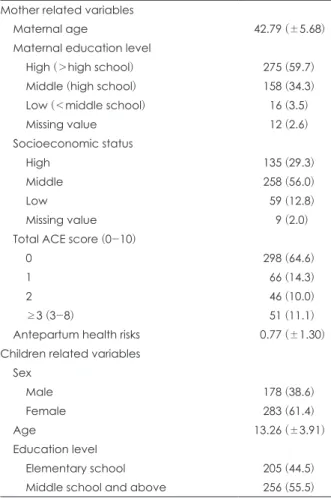
further, 275 participants had graduated from high school or higher (59.7%), and 258 (56.0%) were in the middle class in terms of their socioeconomic status; 35.4% (n=163) had at least one ACE, and 11.1% (n=51) had at least three ACEs. The mean antepartum health risk score was 0.77 (±1.30). The mean age of the children was 13.26 years (±3.91), with 38.6% (n=178) male and 61.4% (n=283) female. A total of 205 children were in elementary school (44.5%), while 256 were in middle school or high school (55.5%) (Table 1).
Comparison of sociodemographic factors, maternal ACE, and antepartum health risks nonbetween the ADHD symptom group and control group
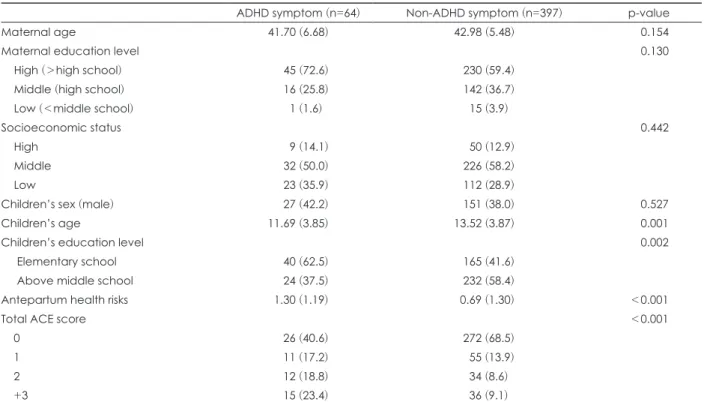
Among the offspring, 13.7% (n=64) had ADHD symptoms.
The ADHD symptom group was younger than the control group (p=0.001). The maternal antepartum health risk score was higher in the ADHD symptom group (p<0.001), with a greater percentage of mothers who had ACEs (p<0.001) (Ta- ble 2). In the ADHD symptom group, 27 were male (42.2%) and 37 were female (57.8%), and there were no significant differences in the ACEs and antepartum health risk scores according to the child’s sex.
Maternal ACEs and antepartum health risks and child’s ADHD symptoms
Multiple logistic regression was performed to examine the impact of total maternal ACE score and maternal antepar- tum health risk on the incidence of ADHD symptoms (Mod- el 1) and the impact of three types of maternal ACEs and an- tepartum health risk on the incidence of ADHD symptoms (Model 2). In Model 1, the odds ratio (OR) of the incidence of ADHD symptoms in the presence of antepartum health risks
after adjusting for socioeconomic status, maternal age and education level, and child’s sex and age was 1.264 (95% CI=
1.060–1.516, p=0.009) and the OR of total maternal ACE score predicting the incidence of ADHD symptoms was 1.236 (95%
CI=1.036–1.475, p=0.019). In Model 2, the OR of antepartum health risks in predicting incidence of ADHD symptoms was significant (OR: 1.275, 95% CI=1.069–1.520, p=0.007), but when the maternal ACE score was divided into three domains (child abuse, child neglect, household dysfunction), the ORs were not significant (Table 3).
Effects of maternal ACEs on incidence of ADHD symptoms through antepartum health risks
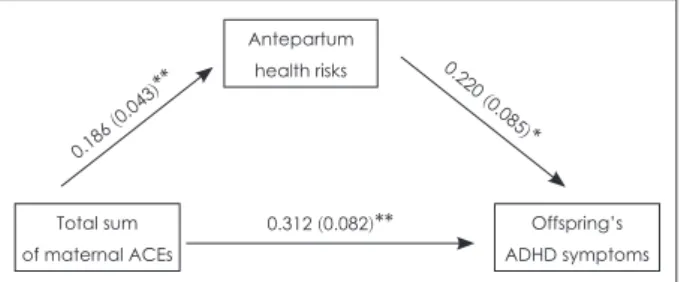
The effects of total maternal ACE score on the incidence of ADHD symptoms in the offspring through antepartum health risks were analyzed using mediation analysis (R
2=0.197, F=18.431, p<0.001). The total maternal ACE score was signifi- cantly associated with the incidence of ADHD symptoms in the offspring (B=0.312, p<0.001) and antepartum health risks (B=0.186, p<0.001), and antepartum health risk was signifi- cantly associated with the incidence of ADHD symptoms (B=
Table 1. Demographic characteristics of the study sample (n=461) Mother related variables
Maternal age 42.79 (±5.68)
Maternal education level
High (>high school) 275 (59.7)
Middle (high school) 158 (34.3)
Low (<middle school) 16 (3.5)
Missing value 12 (2.6)
Socioeconomic status
High 135 (29.3)
Middle 258 (56.0)
Low 59 (12.8)
Missing value 9 (2.0)
Total ACE score (0-10)
0 298 (64.6)
1 66 (14.3)
2 46 (10.0)
≥3 (3-8) 51 (11.1)
Antepartum health risks 0.77 (±1.30)
Children related variables Sex
Male 178 (38.6)
Female 283 (61.4)
Age 13.26 (±3.91)
Education level
Elementary school 205 (44.5)
Middle school and above 256 (55.5) Data are presented as mean±standard deviation or n (%). SD:
standard deviation, ACEs: adverse childhood experiences
0.220, p=0.009) (Fig. 1). In the bootstrapping analysis to de- termine the significance of the direct and indirect effects of the ACE score, the total maternal ACE score had a significant direct effect on incidence of ADHD symptoms (B=0.312, 95%
CI=0.151–0.472) and indirect effect through antepartum health risks (B=0.041, 95% CI=0.011–0.124) (Table 4).
DISCUSSION
Maternal ACEs and antepartum health risk are factors as- sociated with ADHD symptoms in the offspring. In particu- lar, maternal ACEs had significant indirect effects on the risk
of ADHD symptoms in the offspring through antepartum health risks.
The antepartum health risks assessed in this study includ- ed not only major risk factors such as preeclampsia, premature rupture of membrane, and seizures, but also a wide range of physical symptoms, emotional problems, and stress during pregnancy. Our results showed that maternal antepartum health risks significantly affected the risk of ADHD symp- toms in the offspring, similar to previous findings that ADHD diagnosis in children aged 6–12 years is associated with ma- ternal stress life events during pregnancy [20] and that stress- ful life events during pregnancy were associated with the off-
Table 3. Multivariable logistic regression analysis for offspring’ ADHD symptoms by maternal ACEs and antepartum health risks
B SE OR 95% CI p-value
Model 1
Antepartum health risks 0.234 0.090 1.264 1.060-1.516 0.009
Total sum of maternal ACEs 0.212 0.090 1.236 1.036-1.475 0.019
Model 2
Antepartum health risks 0.243 0.090 1.275 1.069-1.520 0.007
Maternal ACE domains
Child abuse 0.252 0.233 1.286 0.815-2.030 0.280
Child neglect 0.090 0.352 1.094 0.549-2.180 0.799
Household dysfunction 0.225 0.180 1.252 0.879-1.782 0.212
Adjusted socioeconomic status, maternal age, maternal education level, offspring’s age and sex. Hosmer-Lemeshow goodness of fit (p=0.969). ADHD: attention-deficit/hyperactivity disorder, ACEs: adverse childhood experiences, B: regression coefficient, SE: stan- dard error of B, OR: odds ratio, CI: confidence interval
Table 2. Comparison of psychosocial variables between ADHD symptom group and non-ADHD symptom group
ADHD symptom (n=64) Non-ADHD symptom (n=397) p-value
Maternal age 41.70 (6.68) 42.98 (5.48) 0.154
Maternal education level 0.130
High (>high school) 45 (72.6) 230 (59.4)
Middle (high school) 16 (25.8) 142 (36.7)
Low (<middle school) 1 (1.6) 15 (3.9)
Socioeconomic status 0.442
High 9 (14.1) 50 (12.9)
Middle 32 (50.0) 226 (58.2)
Low 23 (35.9) 112 (28.9)
Children’s sex (male) 27 (42.2) 151 (38.0) 0.527
Children’s age 11.69 (3.85) 13.52 (3.87) 0.001
Children’s education level 0.002
Elementary school 40 (62.5) 165 (41.6)
Above middle school 24 (37.5) 232 (58.4)
Antepartum health risks 1.30 (1.19) 0.69 (1.30) <0.001
Total ACE score <0.001
0 26 (40.6) 272 (68.5)
1 11 (17.2) 55 (13.9)
2 12 (18.8) 34 (8.6)
+3 15 (23.4) 36 (9.1)
Data are presented as mean±standard deviation or n (%). ADHD: attention-deficit/hyperactivity disorder, ACEs: adverse child- hood experiences
spring’s ADHD symptoms in a prospective cohort study of 2900 participants [21].
The result that the cumulative ACE score, as opposed to the domains of ACE, has an adverse impact on the offspring’s ADHD symptoms suggests that there is a dose-response re- lationship in the intergenerational transmission of mental health problems from parents to offspring, as observed in a previous study where cumulative risk was detrimental to child development [22].
Maternal ACE is significantly associated with antepartum health risk [11], and mothers with four or more ACEs have a two-fold increased biomedical risk during pregnancy [5].
Similar to our study, a previous study reported that maternal health risks in pregnancy and maternal ACEs led to adverse development outcomes in 12-month-old children [23]. Fur- ther, compared to children of mothers without childhood abuse experience, those of mothers with childhood abuse experience ACE showed a significantly high prevalence of ADHD, and adverse perinatal factors increased the risk of ADHD by 8.6% [24].
Prenatal stress has a direct impact on fetal neurodevelop- ment, such as delay in progenitor migration and reduction in forebrain proliferation [25]. Moreover, adverse environmen- tal factors during pregnancy, such as prenatal stress, exposure to toxic substances, and infection, contribute to neurodevel-
opmental impairment by inducing epigenetic changes relat- ed to gene expression in the fetus [26]. Genetic heritability ac- counts for 70–80% of ADHD cases [27], and such antepartum health risks are highly likely to contribute to the etiology of ADHD by increasing or facilitating the genetic liability of neu- rodevelopmental disorders [7,28]. In addition, ACEs, such as child abuse, lead to an imbalance in the hypothalamic-pitu- itary-thyroid axis and immune functions [1,2], which is in turn associated with ADHD, language and cognitive devel- opmental delay, and externalizing behaviors in the offspring [29]. Therefore, maternal biological dysregulation during preg- nancy is likely to serve as an important mechanism under- lying the elevated risk of ADHD in the children.
The results of this study suggest that maternal ACEs can contribute to neurodevelopmental disorders such as ADHD by affecting fetal brain development through biological me- diators during pregnancy. Similar to our findings, a prior study on autism reported that mothers with childhood abuse expe- rience more commonly experienced gestational diabetes, pre- eclampsia, smoking and drinking behaviors during pregnan- cy, miscarriage, and preterm births, with a significantly higher risk of their children being autistic, than mothers without such experience [30].
This study has a few limitations. First, this study was con- ducted in a single center and considering that the prevalence of ACE varies across regions and cultures, the findings can- not be generalized, necessitating large-scale prospective stud- ies. Second, we used a self-reported screening tool to diagnose ADHD instead of a clinical diagnostic or structured diagnos- tic tool based on the DSM-5. Third, we did not include all the possible antepartum health risks in our questionnaire. How- ever, various antepartum physical and emotional problems were included in this study. Fourth, the ACE questionnaire asks the respondent whether he/she has undergone specific experiences and it is not a screening scale that determines the presence of clinical symptoms based on a cutoff. Howev- er, this scale is yet to be standardized for the South Korean population.
Nevertheless, this study is the first study to propose that maternal ACEs are associated with ADHD symptoms in their offspring through the mediation of antepartum health risks. Maternal ACEs can influence fetal neurodevelopmen- tal, resulting in disorders such as ADHD via intergenera- tional transmission.
CONCLUSION
Maternal ACEs and antepartum health risks are both sig- nificant predictors of ADHD symptoms in the offspring, and maternal ACEs also indirectly influence the ADHD symp-
Table 4. The bootstrap results for the indirect effect of maternal ACEs on offspring’s ADHD symptoms via antepartum health risks
Path B SE 95% CI
Direct effect
Total sum of maternal ACEs → Offspring’s ADHD symptoms
0.312 0.082 0.151-0.472
Indirect effect
Total sum of maternal ACEs → Antepartum health risks → Offspring’s ADHD symptoms
0.041 0.028 0.011-0.124
ADHD: attention-deficit/hyperactivity disorder, ACEs: adverse childhood experiences, B: regression coefficient, SE: standard error of B, CI: confidence interval
Antepartum health risks
Total sum of maternal ACEs
Offspring’s ADHD symptoms 0.186
(0.043 )**
0.312 (0.082)**
0.220 (0.085
)*
Fig. 1. Diagrams to test for mediation effect. Mediation model with a X (total sum of maternal ACEs), M (antepartum health risks), and Y (offspring’s ADHD symptoms). Standardized path coeffi- cients and standard errors are presented. *p<0.05, **p<0.01.
ADHD: attention-deficit/hyperactivity disorder, ACEs: adverse childhood experiences.
toms through antepartum health risks. This suggests that in addition to the well-known impact of maternal ACEs on the offspring’s emotional development, maternal ACEs neg- atively influence fetal brain development, contributing to neurodevelopmental disorders such as ADHD through in- tergenerational transmission. Future studies should exam- ine the mediators and mechanisms through which maternal ACEs contribute to various neurodevelopment disorders oth- er than ADHD in the offspring through intergenerational transmission.
Acknowledgments
This work was supported by a research grant from the Jeju Nation- al University Hospital (Grant No. 2018-08-004) Development Fund in 2018.
Conflicts of Interest
The authors have no potential conflicts of interest to disclose.
Author Contributions
Conceptualization: Na Ri Kang, Duk-Soo Moon, Bung-Nyun Kim.
Formal analysis: Na Ri Kang, Su-Jeong Bong. Investigation: Na Ri Kang, Duk-Soo Moon, Bung-Nyun Kim. Writing—original draft: Su-Jeong Bong, Duk-Soo Moon. Writing—review & editing: Duk-Soo Moon, Na Ri Kang.
ORCID iDs
Duk-Soo Moon https://orcid.org/0000-0001-7878-3410 Su-Jeong Bong https://orcid.org/0000-0002-4347-5589 Bung-Nyun Kim https://orcid.org/0000-0002-2403-3291 Na Ri Kang https://orcid.org/0000-0002-2086-0927
REFERENCES
1) Sinai C, Hirvikoski T, Nordström AL, Nordström P, Nilsonne A, Wilczek A, et al. Hypothalamic pituitary thyroid axis and exposure to interpersonal violence in childhood among women with border- line personality disorder. Eur J Psychotraumatol 2014;5:23911.
2) Fagundes CP, Glaser R, Kiecolt-Glaser JK. Stressful early life ex- periences and immune dysregulation across the lifespan. Brain Be- hav Immun 2013;27:8-12.
3) Hughes K, Bellis MA, Hardcastle KA, Sethi D, Butchart A, Mik- ton C, et al. The effect of multiple adverse childhood experiences on health: a systematic review and meta-analysis. Lancet Public Health 2017;2:e356-e366.
4) Bellis MA, Hughes K, Leckenby N, Hardcastle KA, Perkins C, Lowey H. Measuring mortality and the burden of adult disease as- sociated with adverse childhood experiences in England: a nation- al survey. J Public Health (Oxf) 2015;37:445-454.
5) Madigan S, Wade M, Plamondon A, Maguire JL, Jenkins JM. Ma- ternal adverse childhood experience and infant health: biomedical and psychosocial risks as intermediary mechanisms. J Pediatr 2017;
187:282-289.e1.
6) Schickedanz A, Halfon N, Sastry N, Chung PJ. Parents’ adverse childhood experiences and their children’s behavioral health prob- lems. Pediatrics 2018;142:e20180023.
7) Barkley RA. Etiologies of ADHD. In: Barkley RA, editor. Atten- tion-deficit hyperactivity disorder: a handbook for diagnosis and treatment. New York: The Guilford Press; 2015. p.356-390.
8) Rommel AS, James SN, McLoughlin G, Brandeis D, Banaschewski T, Asherson P, et al. Association of preterm birth with attention-defi-
cit/hyperactivity disorder–like and wider-ranging neurophysiologi- cal impairments of attention and inhibition. J Am Acad Child Ad- olesc Psychiatry 2017;56:40-50.
9) Sciberras E, Mulraney M, Silva D, Coghill D. Prenatal risk factors and the etiology of ADHD—review of existing evidence. Curr Psy- chiatry Rep 2017;19:1.
10) Currie CL, Sanders JL, Swanepoel LM, Davies CM. Maternal ad- verse childhood experiences are associated with binge drinking during pregnancy in a dose-dependent pattern: findings from the All Our Families cohort. Child Abuse Negl 2020;101:104348.
11) Racine N, Madigan S, Plamondon A, Hetherington E, McDonald S, Tough S. Maternal adverse childhood experiences and antepar- tum risks: the moderating role of social support. Arch Womens Ment Health 2018;21:663-670.
12) Felitti VJ, Anda RF, Nordenberg D, Williamson DF, Spitz AM, Ed- wards V, et al. Relationship of childhood abuse and household dys- function to many of the leading causes of death in adults. The Ad- verse Childhood Experiences (ACE) Study. Am J Prev Med 1998;14:
245-258.
13) Ford DC, Merrick MT, Parks SE, Breiding MJ, Gilbert LK, Ed- wards VJ, et al. Examination of the factorial structure of adverse childhood experiences and recommendations for three subscale scores. Psychol Violence 2014;4:432-444.
14) Lucas CP, Zhang H, Fisher PW, Shaffer D, Regier DA, Narrow WE, et al. The DISC Predictive Scales (DPS): efficiently screening for diagnoses. J Am Acad Child Adolesc Psychiatry 2001;40:443-449.
15) Cho SC, Go BJ, Kim BN, Kim JW, Shin MS, Yoo HI, et al. The 2005 Seoul child and adolescent mental health survey. Seoul: Child and Adolescent Mental Health Center;2006.
16) Cubo E, Velasco SS, Benito VD, Villaverde VA, Galín JM, Santid- rián AM, et al. Psychometric attributes of the DISC predictive scales. Clin Pract Epidemiol Ment Health 2010;6:86-93.
17) Kim BN. Pregnancy, delivery and perinatal risk factors associated with symptoms of attention deficit/hyperactivity disorder: commu- nity study. J Korean Neuropsychiatr Assoc 2002;41:263-273.
18) Hong YM, Oh EY. An association of ADHD and their risk factors in pregnancy, delivery, perinatal stage. J Korean Neuropsychiatr Assoc 2000;39:1083-1092.
19) IsaacMustapha M. The art of effective research: a study utilizing multiple regression analysis (Hayes process macros for SPSS).
London: SAGE Publications Ltd;2019.
20) Grizenko N, Shayan YR, Polotskaia A, Ter-Stepanian M, Joober R.
Relation of maternal stress during pregnancy to symptom severity and response to treatment in children with ADHD. J Psychiatry Neu- rosci 2008;33:10-16.
21) Ronald A, Pennell CE, Whitehouse AJ. Prenatal maternal stress associated with ADHD and autistic traits in early childhood. Front Psychol 2011;1:223.
22) Evans GW, Li D, Whipple SS. Cumulative risk and child develop- ment. Psychol Bull 2013;139:1342-1396.
23) Racine N, Plamondon A, Madigan S, McDonald S, Tough S. Ma- ternal adverse childhood experiences and infant development. Pe- diatrics 2018;141:e20172495.
24) Roberts AL, Liew Z, Lyall K, Ascherio A, Weisskopf MG. Associa- tion of maternal exposure to childhood abuse with elevated risk for attention deficit hyperactivity disorder in offspring. Am J Epide- miol 2018;187:1896-1906.
25) Stevens HE, Su T, Yanagawa Y, Vaccarino FM. Prenatal stress de- lays inhibitory neuron progenitor migration in the developing neo- cortex. Psychoneuroendocrinology 2013;38:509-521.
26) Kundakovic M, Jaric I. The epigenetic link between prenatal ad- verse environments and neurodevelopmental disorders. Genes (Ba- sel) 2017;8:104.
27) Brikell I, Kuja-Halkola R, Larsson H. Heritability of attention-defi- cit hyperactivity disorder in adults. Am J Med Genet B Neuropsy-
chiatr Genet 2015;168:406-413.
28) Hinshaw SP. Attention deficit hyperactivity disorder (ADHD): con- troversy, developmental mechanisms, and multiple levels of analy- sis. Annu Rev Clin Psychol 2018;14:291-316.
29) Ghassabian A, Henrichs J, Tiemeier H. Impact of mild thyroid hor- mone deficiency in pregnancy on cognitive function in children:
lessons from the Generation R Study. Best Pract Res Clin Endocri- nol Metab 2014;28:221-232.
30) Roberts AL, Lyall K, Rich-Edwards JW, Ascherio A, Weisskopf MG. Association of maternal exposure to childhood abuse with el- evated risk for autism in offspring. JAMA Psychiatry 2013;70:508- 515.