Agric. Chem. Biotechnol.48(4), 222-225 (2005) Note
An Antifungal Activity of Streptomyces sp. against Cryphonectria parasitica
Sang Hyun Lee
1, Kyung Hee Kim
1, Jae Pil Lee
1, Yong Sub Yi*, Hyesook Kim
2and Yoongho Lim
2Department of Computer Application and Technology, Seoul University of Venture and Information, Seoul 135-070, Korea
1Department of Forest Diseases and Pests, Korean Forest Research Institute, Seoul, Korea
2Bio/Molecular Informatics Center, Konkuk University, Seoul 143-701, Korea Received November 8, 2005; Accepted November 29, 2005
Strains showing antifungal activity against Cryphonectria parasitica were isolated from coast soil of Taean , Korea. Of 152 strains isolated, 6 strains showed antifungal activity in vitro against C. parasitica. Ta24 strain showed highest activity with 1.6 cm clean inhibition zone. For strain identification, the morphological characteristic and 16S rDNA sequences were determined. Ta24 strain showed 99%
homology with Streptomyces sampsonii and was identified as Streptomyces sp.
Key words: Streptomyces sp., chestnut blight disease, Cryphonectria parasitica, 16S rDNA, antifungal activity Chestnut blight disease caused by Cryphonectria parasitica
first occurred in New York Zoological Garden in 1904 destroying the chestnut forestry field of East America. Since then , the pathogen has spread to Europe and caused serious damage to the chestnut trees. In Korea, the disease was first reported as chestnut stem blight in 1925.5, 9)
Chestnut trees distributed worldwide are economically important trees, especially in Korea, where the fruits, which contain many nutrients for human health, are exported to Japan. Many chestnut trees were planted from the end of the 1960’s to the middle of the 1970’s in Korea, approximately about 79,000 ha, yielding 10,000 tons per year. Losses in yields caused by Chestnut blight fungus, C. parasitica, has been increasing due to the lack of proper strategy of disease management.
Early attempts at biological control in North America involved the isolation of fungal strains with severely reduced virulence and weakened mycelia growth and sporulation, because they perturb the developmental processes of host.2-4,6-7) However, hypovirulent C. parasitica field isolates exhibit a wide range of variability in the virulence levels. Recently, results of genetic diversity on the hypovirus isolates that hypovirulent C. parasitica was useful and stable as biological control agent at a geographic scale were questoned.8) In Korea, hypovirulent C. parasitica also was proposed as one of attempts to protect chestnut trees from chestnut blight fungus.
But C. parasitica isolated in Korea showed a wide genetic variation that could reduce the effectiveness of biological control. Therefore, in the study attempts were made to isolate bacteria showing antifungal activity for biological control against C. parasitica.
Materials and Methods
Bacteria isolation and Morphology. To isolate strains from soils, serially diluted soil samples were plated on potato dextrose agar plates at 25oC for 3 days, and the resulting colonies were incubated with C.parasitica for determination of antifungal activity. Morphological characteristics were observed by FE-SEM (S-4300, Hitachi, Japan) following the procedure of Williams.11) The strains for SEM observation were cultured on a Petri dish containing Bennet’s medium at 28oC for 7 days. Samples were fixed in 2% paraformaldehyde and 2% glutaraldehyde in 0.05 M sodium cacodylate buffer (pH 7.2) at room temperature for 4 h, followed by washing three times at 4oC for 10 min in 0.05 M sodium cacodylate buffer (pH 7.2). Samples were post-fixed with 1% aqueous
*Corresponding author Phone: 82-2-3470-5273 E-mail: [email protected]
Fig. 1. Effect of Ta24 isolate on growth inhibition in dual culture. Clear zone showing growth inhibition of mycelium is indicated by arrow.
An antifungal activity of Streptomyces sp. 223
osmium tetraoxide in 0.05 M sodium cacodylate buffer (pH 7.2 at 4oC) for 2 h, following two times washing with distilled water. Samples were serially dehydrated in ethanol (30, 50, 70, 80, 90, 100, 100, 100%), treated with isoamyl acetate for 15 min two times, critical point-dried in liquid CO2 using the Balzers CPD 010 (Balzers Instruments, Liechtenstein), mounted on aluminum stubs, and sputter-coated with gold and palladium using the Polaron SEM Coating Unit E5100 (Thermo VG Scientific, Beverly, MA, USA).
16S rDNA sequence analysis. To identify strains showing antifungal activity, genomic DNA was isolated using the genomic DNA extraction kit (QIAGEN, Hilden, Germany) for 16S rDNA analysis. 16S rDNAwas amplified by PCR using a PCR reaction kit (Bioneer, Daejon, Korea). The
primer sequences were: forward, 5'-AGA GTT TGA TCC TGG CTC AG-3'; and reverse, 5'-ACG GCT ACC TTG TTA CGA CTT-3'. Thermal cycle conditions were as follows: 1 cycle of denaturation at 94oC for 5 min; followed by 35 cycles of 94oC for 1 min, 58oC for 1 min, and 72oC for 2 min; and final extension at 72oC for 10 min. The PCR products were cloned using a pGEM-T cloning kit (Promega, Madison, WI, USA) according to the manufacture’s instruction. The cloned fragment was directly sequenced using a TaqDyeDeoxy terminator Cycle Sequencing kit (Applied Biosystems, Foster City, CA, USA)and analyzed with an ABI PRISM 3700 DNA sequencer (Applied Biosystems, Foster City, CA, USA).The internal sequences of the PCR products were determined using four internal primers: p510r 5'-TAT TAC CGC GGC
Fig. 2. BLAST search results (A24 isolated strain; St: Streptomyces sampsonii).
224 Sang Hyun Lee et al.
TGC TG-3', p364f 5'-GGC AGC AGT GGG GAA TAT TG- 3', p783f 5'-TAG ATA CCC TGG TAG TCC AC-3', and p1037f 5'-TCG TCA GCT CGT GTC GTG AG-3'. The determined sequences were analyzed by the homology search of the BLAST program at National Center for Biotechnology Information and aligned with ClustalW software.
Results and Discussion
Strains showing antifungal activities against C. parasitica were isolated from soil of Taean, Korea. Of 152 strains isolated, 6 showed antifungal activities in vitro against C.
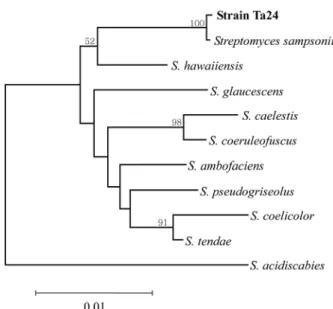
parasitica. The strains were cultured with C. parasitica for growth inhibition assay by dual culture. The results of growth inhibition indicated that the diameters of the clean zones of strains Ta1, Ta3, Ta4, Ta9, Ta16, and Ta24 were 1, 1.5, 1.4, 0.8, 1.3, and 1.6 cm, respectively. Strain Ta 24 showed the highest growth inhibition against the chestnut tree pathogen (Fig. 1). For the identification of the strain, the morphological characteristic and 16S rDNA sequences were determined. The 16S rDNA sequences of strain Ta24 showed 99% homology with Streptomyces sampsonii by the BLAST program (Fig. 2) and strain was thus identified as Streptomyces sp. The phylogenetic relationship based on the 16S rDNA sequences was created by the neighor-joining method (Fig. 3).10) The morphological characterization was obtained by a previous reported method (Fig. 4).
Streptomycetes are widely used in industries due to their ability to produce chemical compound, antibiotics, and anti- tumor agent.1) In particular, S. sampsonii could protect the plants from the disease caused by fungal genus.12) Therefore, strain Ta24 as biological control could be used to protect chestnut trees from C. parasitica.
References
1. Bérdy, J. (1995) Are actinomycetes exhausted as a source of secondary metabolites? Biotechnologia.7-8, 13-34.
2. Chen, B. and Nuss, D. L. (1999) Infectious cDNA clone of hypovirus CHV1-Euro7: a comparative virology approach to investigate virus-mediated hypovirulence of the chestnut blight fungus Cryphonectria parasitica. J. Virol. 73, 985- 3. Elliston, J. E. (1985) Characterization of dsRNA-free and992.
dsRNA-containing strains of Endothia parasitica in rela- tion to hypovirulence. Phytopathology75, 151-158.
4. Enebak, S. A., MacDonald, W. L., Hillman, B. I. (1994) Effect of dsRNA associated with isolates of Cryphonectria parasitica from the central appalachians and their related- ness to other dsRNAs from north America and Europe.
Phytopathology84,528-534.
5. Griffin G. J., Hebard, F. V., Wendt, R. W. and Elkins. J. R.
(1983) Survival of American chestnut trees : Evaluation of blight resistance and virulent in Endothia parasitica. Phyto- pathology73, 1084-1092.
6. Griffin, G. J. (1994) Chestnut blight and its control. Hortic.
Rev.8, 291-336.
7. Heiniger, U. and Rigling, D. (1994) Biological control of chestnut blight in Europe. Annu Rev. Phytopathol. 32,581- 8. Peever, T. L., Liu, Y., Cortesi, P. and Milgroom, G. (2000)599.
Variation in tolerance and virulence in the chestnut blight fungus-hypovirus interaction. Appl. Environ. Microbiol. 66, 4863-4869.
9. Roane, M. K. and Griffin, G. J. (1986) Chestnut blight, other Endothia disease, and the genus Endothia. APS Press.
10. Saitou, N. and Nei, M. (1987). The neighbor-joining method: a new method for reconstucting phylogenetic trees.
Mol. Biol. Evol.4, 406-425.
11. Williams, S. T., Goodfellow, M., Alderson, G., Wellington, E. M. H., Sneath, P. H. A. and Sackin, M. J. (1983).
Numerical classification of Streptomyces and related gen- era. J. Gen. Microbiol.129, 1743-1813.
Fig. 3. Phylogenetic position of strain Ta24 within the genus Streptomyces. The branching pattern was generated by the neighbor-joining method. The value at the inter nodes indi- cates the level of bootstrao support with 1000 replication.
Fig. 4. Scanning electron micrographs showing typical mor- phology of the genus Streptomyces.
An antifungal activity of Streptomyces sp. 225
12. Woo, J., Kitamura, E., Myouga, H. and Kamei, Y. (2002) An antifungal protein from the marine bacterium Streptomy- ces sp. strain AP77 is specific for Pythium porphyrae, a
causative agent of red rot disease in Porphyra spp. Appl.
Environ. Microbiol. 68, 2666-2675.