방울토마토 열매 locular fluid lectin의 항균성과 생화학적 특성
노광수*
계명대학교 생물학과
Antifungal Activity and Biochemical
Characterization of Lectin Isolated from Locular Fluid of Cherry Tomato Fruit
Kwang Soo Roh*
Department of Biology, Keimyung University, Daegu 704-701, Korea
Abstract Lectins are carbohydrate-binding and a cell-agglutinating proteins, and are concerted with a plants defence mechanism. In particular, chitin-binding lectins in locular fluid of cherry tomato fruit seemed to have a role in defending plants against fungi. The antifungal activity using lectin isolated from locular fluid of cherry tomato fruit was measured in the plant pathogen Cladosporium cucumerinum, Monosporascus cannonballus, Fusarium oxysporum, and Rhizoctonia solani. Amoung the four strains, a potent antifungal activity was detected in Cladosporium cucumerinum and Monosporascus cannonballus, not in Fusarium oxysporum, and Rhizoctonia solani. The molecular weight of this lectin isolated as double protein bands by SDS-PAGE was calculated to be 87 kDa and 47 kDa from the relative mobilities compared with those of reference molecular weight markers.
The isolated lectin agglutinated human red blood cells (A, B, AB, O) treated with trypsin, and the most activity was found at B. The optimal temperature of isolated lectin was at 30℃. For the thermal stability, lectin was stable at 20-80℃. The optimal pH of this lectin was at 7.2, and showed complete loss below pH 9.0.
Keywords: Antifungal activity, cherry tomato, Cladosporium cucumerinum, locular fluid lectin, Monosporascus cannonballus
서 론1)
방울토마토는 가지 과의 일년생 초본식물로, 이의 열매 는 채소로서 기호식품과 건강식품으로 각광 받고 있다. 이 열매에는 비타민 A와 C 뿐만 아니라 카로틴, 아데닌, 토마 틴, 코린 등이 많이 함유되어 있어 콜레스테롤 수치와 혈압 을 낮추며, 소염 작용을 하는 것으로 알려져 있다.
자연계에 널리 존재하는 lectin은 당과 결합하는 단백질 로 세포막 표면에 있는 특이한 당수용체와 높은 친화력을 가지고 결합하는 물질로서, 사람의 혈액에 대한 특이성, 휴
*Corresponding author
Tel: +82-53-580-5207, Fax: +82-53-580-5164 e-mail: [email protected]
지기 림프구 자극 분열효과, 종양세포를 선택적으로 응집 하는 능력 등을 갖고 있다.
Lectin의 특이한 성질은 T세포나 B세포를 자극하여 면 역력을 상승시키며, 암세포 표면의 당에 특이적으로 결합 하여 암세포를 파괴시킨다. 또한 분열촉진인자로서 임파구 를 자극하여 생체 내로 이물질인 항원이 들어오게 되면 임파 구의 면역반응을 도와주는 대식세포가 이를 임파구에 전해줌 으로서 그 면역반응이 시작되게 된다. 이와 같이 lectin은 동물의 항체와 비슷한 생체 방어물질로 추측되어 왔다 [1].
동물이나 곤충 protease에 대한 저항성도 가지고 있으 며 [2], 항 바이러스성 [3], 항균성 [4], 항진성 [5], 항충성 [6]
및 고등동물에 대한 독성 [7] 등에 대한 방어단백질로서 식물 성 lectin의 기능이 많이 보고되고 있다. 맥아, 감자 괴경, 땅 콩, 흰독말풀 및 osage orange 종자에서 분리한 lectin [2]과
벼, 쐐기풀에서 분리한 chitin 결합 lectin [6]은 동부콩 바 구미 유충의 발육과 생장을 억제하는 효과가 있다.
작물에 피해를 주는 각종 병원균의 퇴치를 위해 화학적으 로 합성된 유기농약들이 주로 많이 사용되어 왔으나 이들은 식물체나 토양에 잔류되기 때문에 친환경적이지 못하다.
이를 대신하여 식물의 이차대사 산물을 이용하거나 항생물 질을 이용하는 미생물성 농약 등의 친환경적인 대체 농약이 많이 개발되어 사용되고 있는 실정이다.
방울토마토 locular fluid lectin은 chintin 결합 단백질로 서 [8], 곰팡이로부터 식물을 보호하는 기능을 하고 있다 [9].
이에 본 연구에서는 방울토마토 locular fluid lectin을 항균 성 물질로서 개발하기 위한 목적의 일환으로, 방울토마토의 locular fluid 부분에서 lectin을 분리한 다음, 식물에 질병 을 유발하는 Cladosporium cucumerinum, Monosporascus cannonballus, Fusarium oxysporum 및 Rhizoctonia solani에 대한 방울토마토 locular fluid lectin의 항균성을 조사하였 으며, 이 lectin의 생화학적 특성을 밝히기 위해 분자량, 적혈 구 응집력, 혈액특이성, 최적 온도, 열안정성 및 최적 pH를 연구하였다.
재료 및 방법
식물재료와 균주의 배양
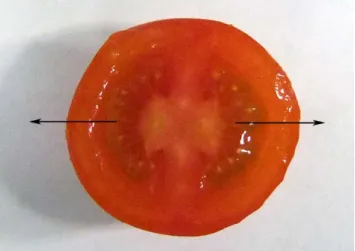
본 실험에 사용된 재료는 대형마트에서 구입한 방울토마 토로서, locular fluid 부분만을 lectin의 분리와 항균성 및 생화학적 특성 실험에 사용하였다 (Fig. 1). 항균성 측정을 위 한 균주로서는 식물성 병원균인 Cladosporium cucumerinum, Monosporascus cannonballus, Fusarium oxysporum 및 Rhizoctonia solani를 사용하였으며, PDA배지 (potato starch 0.4%, dextrose 2%, agar 1.5%, pH 5.1 ± 0.2)에 접종하여 25℃에서 3일간 배양하였다.
Fig. 1. Photograph of cross section of cherry tomato. Arrows indicate the locular fluid.
Locular fluid lectin의 분리
Kilpatrick [10]의 방법에 의해 lectin을 분리하였으며, 모든 과정은 4℃에서 수행하였다. 방울토마토에서 locular fluid를 분리한 다음 1,000 × g에서 10분간 원심분리 한 후, 상등액에 동량의 0.15 M-NaCl / 0.1 M sodium phosphate buffer (pH 7.0)를 넣어 교반시켰다. 여기에 최종 농도가 50%가 되게 (NH4)2SO4를 천천히 넣어 용해시킨 다음 밤새 교반한 후, 40,000 × g에서 1시간 원심분리 하였다. 침전물 을 10 mL neutral saline (Na2HPO4를 사용하여 pH 7.0으로 조절된 0.9% NaCl) 용액에 용해시켜 이를 neutral saline 으로 48시간 투석하였다. 이때 neutral saline은 24시간 마 다 교환하였다.
투석액을 40,000 × g에서 30분간 원심분리하여 얻은 상등 액에 trypsin을 처리한 적혈구를 가하여 실온에서 15분 간 흔들어 주었다. 1,000 × g에서 5분간 원심분리하여 얻은 침전물에 5배의 neutral saline을 가하여 3번 세척한 후, N-acethylglucosamine을 처리하여 실온에서 5분간 흔들어 주었다. 1,000 × g에서 10분간 원심분리하여 상등액을 얻고 침전물에 다시 N-acethylglucosamine을 가하여 위의 과정 을 반복하였다. 얻어진 상등액을 합친다음, neutral saline으 로 24시간 간격으로 교환하면서 5일간 투석하고, 이를 PM 30 membrane filter로 고정된 Amicon cell을 사용하여 ultrafiltration하였다.
Neutral saline으로 평형시킨 Sepadex G-200을 column (36 × 2.5 cm)에 충진하고 위에서 얻은 투석된 용액을 column 에 주입한 다음 neutral saline을 사용하여 0.3 mL/min 유속 으로 각 분획 당 2 mL를 용출시켜 분획하였다. 분리된 분획 은 280 nm에서 흡광도를 측정하여 단백질 농도를 측정하 였으며, lectin 활성은 2% 적혈구를 사용한 혈구 응집반응 으로 측정하였다. 가장 높은 활성을 지닌 분획을 항균성과 생화학적 특성에 대한 연구에 사용하기 위해 0℃ 이하의 냉동고에 저장하였다.
Lectin의 항균성 측정
Micro filter (pore size: 0.2 μm)를 통과시킨 lectin 용액 을 paper disc에 20 μL를 흡수시키고 말린 후 다시 20 μL 를 흡수시켰다. 균주를 배지에 도말하여 균이 부착된 다음, paper disc를 배지위에 올려놓았다. Paper disc에 증류수를 10 μL씩 흡수 시키고, 25℃에서 48시간 배양한 후 결과를 확인하여 항균성을 측정하였다.
SDS-PAGE에 의한 분자량 측정
Laemmli [11]의 방법에 따라, 20% SDS-polyacrylamide gel을 사용하여 40 mA에서 18시간 동안 전기영동하였다.
그 후 gel은 Coomassie brilliant blue R-250으로 염색을 하였으며 7.5% acetic acid로 탈색시켰다.
Weber와 Osborn [12] 방법에 따라 분자량을 측정하였다.
전기영동한 lectin과 표준 단백질에 대한 상대이동도 (Rf) 와 단백질 분자량에 대한 대수값으로 분자량을 구하였으며, 이때 표준 단백질은 rabbit muscle phosphorylase b (97 kDa), bovine serum albumin (66 kDa), chicken egg white ovalbumin (45 kDa), bovine erythrocyte carbonic anhydrase (30 kDa), soybean trypsin inhibitor (20.1 kDa)를 사용하였다.
적혈구 응집력 측정
Takatsy [13]의 방법을 변형시켜 적혈구 응집력을 측정 하였다. Microtiter plate의 각 well에 25 μL neutral saline (pH 7.0)과 분리된 lectin 25 μL를 2배수 희석법 (2-fold serial dilution method)으로 희석한 후, trypsin을 처리한 적혈구 용액 25 μL를 가하여, 37℃에서 15분 반응시킨 다음, 적혈구의 응집 여부를 육안과 현미경 (100 X)을 이용하여 응집력을 측정하였다. 이때 heparin을 처리한 혈액은 0.9%
NaCl을 함유한 neutral saline에 0.25% trypsin을 포함한 용액을 2% 적혈구 부유액을 만들어 사용하였다. Lectin의 활성은 혈구의 최종 응집을 나타내는 최종 희석 배수를 역수 로 하여 응집력 단위로 나타내었다.
혈액의 특이성 조사
분리된 lectin을 neutral saline (pH 7.0)으로 2배수 희석 한 다음, 사람 (A, B, O, AB형)의 혈액을 사용하여 각각의 혈구응집반응을 확인함으로서 어떤 혈액에 특이적으로 반 응하는지 조사하였다.
최적 반응온도의 측정
분리된 lectin의 최적 반응 온도를 조사하고자 온도 변화 에 따른 활성을 측정하였다. 분리된 lectin을 2배수로 희석 하였고 최대 희석 배수를 100%의 residual activity로 하였 다. 항온수조에서 10-80℃ 사이의 각 온도에서의 혈구 응 집 반응을 측정하여 잔존하는 상대적인 lectin의 활성을 조 사하였다.
열 안정성 측정
열안정성을 조사하기 위해 10~90℃ 사이의 각 온도에서 10분간 열처리한 후, 식힌 다음 혈구 응집 반응을 이용하여 잔존하는 상대적인 lectin의 활성을 조사하였다.
최적 pH 측정
pH 변화에 따른 lectin의 활성을 조사하기 위해서 pH 2.0- 10 사이 buffer를 사용하여 4℃에서 4시간 투석시킨 후, 혈구 응집 반응을 이용하여 잔존하는 상대적인 lectin의 활성을
조사하였다. 이때 사용한 완충용액은 0.025 M glycine-HCl buffer (pH 2.2), 0.2 M acetate buffer (pH 3.2, 4.2), 0.1 M phosphate buffer (pH 6.2, 7.0), 0.1 M tris buffer (pH 8.0, 9.1), 0.1 M sodium carbonate-bicarbonate buffer (pH 10)이다.
결 과
Locular fluid lectin의 분리
방울토마토의 locular fluid를 neutral saline, ammonium sulfate 침전, ultrafiltration 과정을 거친 후, 최종적으로 Sepadex G-200을 통과시켜 gel에 결합된 lectin을 neutral saline으로 유출시켜 분리하였다.
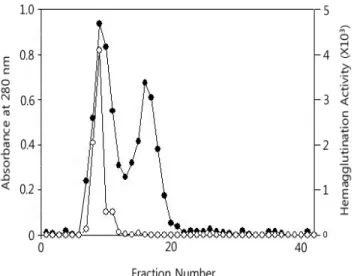
7-21번 분획에서 단백질이 검출되었으나, 7-12번 분획에 서 lectin의 활성이 측정되었다. 이중 가장 높은 단백질 함량 과 활성이 일치한 분획을 (Fig. 2) 사용하여 lectin의 항균 성을 조사하고, 이의 분자량, 적혈구 응집력, 혈액 특이성, 최적 반응온도, 열 안정성 및 최적 pH를 측정하였다.
Fig. 2. Elution profile for protein (●) and hemagglutination activity of lectin (○) isolated from locular fluid of cherry tomato on Sephadex G-200.
Lectin의 항균성
Cladosporium cucumerinum, Monosporascus cannonballus, Fusarium oxysporum 및 Rhizoctonia solani에 대한 방울토 마토 열매의 locular fluid lectin의 항균성을 조사하였다.
Cladosporium cucumerinum과 Monosporascus cannonballus 는 disc주위에 균이 증식하지 않은 선명한 clear zone이 형성되어 항균 활성을 나타내었으며, 두 균주의 항균 활성 정도가 다르게 나타났다. 그러나 Fusarium oxysporum과 Rhizoctonia solani에 대해서는 항균 활성을 나타내지 않 았다 (Fig. 3).
Fig. 3. Antifungal activity of lectin isolated from locular fluid of cherry tomato. Antifungal activity of lectin on strains of Cladosporium cucumerinum (A), Monosporascus cannonballus (B), Fusarium oxysporum (C), and Rhizoctonia solani (D) were examined by paper disc diffusion test.
SDS-PAGE에 의한 lectin의 분자량
분리된 locular fluid lectin을 SDS-PAGE한 결과, 2개의 band로 나타났다. 2개의 band에 대한 분자량을 측정한 결과, 87 kDa와 47 kDa의 분자량을 가지고 있는 것으로 계산되 었다 (Fig. 4).
Fig. 4. SDS-PAGE pattern and determination of molecular weights of lectin isolated from locular fluid of cherry tomato. Arrows and closed black circles (●) indicate lectin isolated on Sepadex G-200. The molecular weight markers (M) were rabbit muscle phophorylase b (A, 97 kDa), bovine serum albumin (B, 66 kDa), chicken egg white ovalbumin (C, 45 kDa), bovine erythrocyte carbonic anhydrase (D, 30 kDa), soybean trypsin inhibitor (E, 20.1 kDa).
응집반응 정도
분리된 lectin을 neutral saline (pH 7.0)으로 2배수 희석 한 다음, trypsin이 처리된 사람의 A, B, O, AB형의 혈액을 사용하여 각각의 혈구응집반응을 측정하였다. A, B, O, AB 형 모두에서 응집반응이 일어났으며, B형 혈액에서는 100%
로 가장 높은 활성을, A와 O형에서는 75%의 활성을, 그리고 AB형에서는 50%로 가장 낮은 활성을 보여 (Table 1), 각 혈액형에 따라 응집반응의 정도가 다르게 나타났다. 본 연구 에서는 가장 높은 활성을 보인 B형 적혈구를 사용하여 최적 반응온도, 열 안정성 및 pH 안정성을 측정하였다.
Table 1. Hemagglutinating activity of human erythrocytes by locular fluid lectin of cherry tomato
Human erythrocytes Residual activity (%) A
B O AB
75 100 75 50
Lectin의 최적 반응 온도
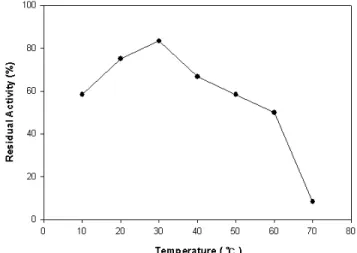
Lectin의 활성에 대한 최적 반응온도를 알아내기 위하여 10-70℃의 온도 범위에서 10분간 반응시켜 활성을 측정하 였다. 분리된 lectin은 20-40℃ 범위에서 60% 이상의 활성 을 보여 안정적인 온도이었으며, 30℃에서 가장 높은 활성 을 나타내었다. 10℃이하와 50℃부터는 활성이 감소하여 70℃에서는 거의 상실되었다. (Fig. 5).
Fig. 5. Effect of temperature on the activity of lectin isolated from locular fluid of cherry tomato. The lectin activity was tested by incubation at 10-80℃.
Lectin의 열 안정성
Lectin의 열 안정성을 측정하기 위하여 10-90℃에서 각각 10분간 열처리한 다음, 적혈구 응집반응으로서 활성을 측정
하였다. Lectin은 20-80℃까지는 비교적 열안정성을 가졌 으며, 30℃에서 가장 높은 활성을 나타내었고, 20℃ 미만 과 90℃ 이상의 온도에서는 활성이 현저히 떨어져 혈구 응집 반응을 보이지 않았다 (Fig. 6).
Fig. 6. Thermal stability of lectin isolated from locular fluid of cherry tomato.
Lectin의 최적 pH
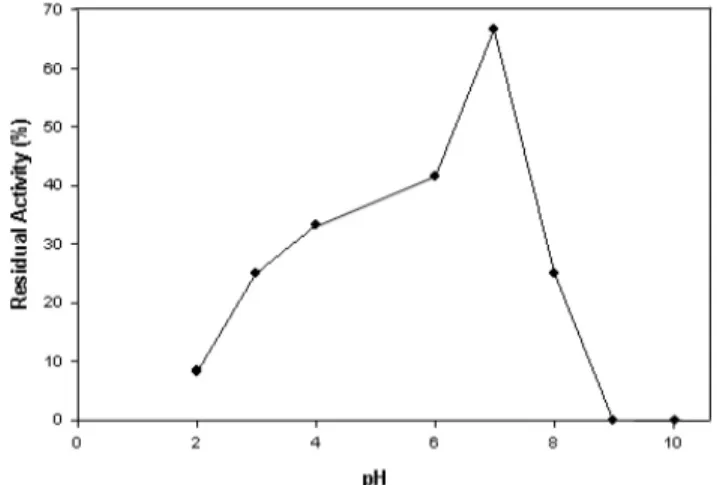
Lectin의 활성에 미치는 pH의 효과를 조사하기 위하여 lectin을 pH 2.0-10에서 4시간 투석 처리한 후 적혈구 응집 반응으로서 활성을 측정하였다. Glycine-HCl buffer의 pH 2.2부터 phosphate buffer의 pH 7.0까지 활성이 증가하여 pH 7.0에서 활성이 가장 높았으며, tris buffer의 pH 8.0부 터 급격히 감소하여 pH 9.1과 10에서는 활성이 완전하게 상실되었다 (Fig. 7). 따라서 본 lectin은 강산과 강염기에 서는 pH 안정성이 떨어지나, 중성에서는 안정성이 강한 것으로 나타났다.
Fig. 7. The pH stability of lectin isolated from locular fluid of cherry tomato Isolated lectin was dialysed in different pH for 4 hr at 4℃. Residual activity was compared to that of the observed standard condition using 0.01 M phosphate buffer (pH 7.0).
고 찰
Lectin은 생명과학분야의 중요한 단백질로서, 세포 간 인 식작용, glycopeptide와 glycoprotein의 분리에 이용되며, 혈액 형 검사 및 암의 치료와 진단에도 응용되고 있으며, 각종 천 연 자원에서 새로운 성질의 lectin을 개발하려는 연구가 활 발히 진행되고 있다.
방울토마토의 어느 부분에 방어단백질로서의 기능을 가지 는 lectin이 존재하는지 알기 위해 적혈구의 응집반응을 측 정한 결과, locular fluid 부분에서 가장 높은 응집반응을 보 였다. 따라서 본 연구에서는 방울토마토의 locular fluid 부분 으로부터 lectin을 분리하고, 이의 항균성과 생화학적 특성 을 조사하였다.
방울토마토의 locular fluid에서 lectin을 분리하는 최종 과정은 PM 30 membrane filter로 고정된 Amicon cell을 사용하여 ultrafiltration을 한 후 Sephadex-G200을 이용하여 시행하였으며, 이때 neutral saline을 사용하여 용출시켜 lectin 을 분리하였다.
자연에 폭 넓게 분포하고 있는 곰팡이 중에 많은 수는 병 원균으로서 여러 종류의 식물에 질병을 일으켜 작물의 수확 에 영향을 미쳐 곡식의 손실을 유발한다 [14]. Lectin은 곰팡 이와 곤충으로부터 식물을 보호하는 기능을 하는데 chitin 결합 lectin이 이 역할을 담당하는 것으로 알려져 있다 [9].
Cladosporium cucumerinum (검은별 무늬병원균)은 호 박, 오이, 참외 등에, Monosporascus cannonballus (검은점 뿌리썩음병원균)는 메론, 수박, 참외, 오이의 박과식물에, Fusarium oxysporum (구근 부패병원균)은 보리, 벼의 작물 에, Rhizoctonia solani (잎집무늬 마름병원균)는 곡류, 관목 류에 감염되면 생장을 저해하여 열매의 상품성을 저하시키 거나 죽게 하는 치명적인 병을 유발한다. 본 연구에 사용한 4개의 곰팡이 균주에 대한 방울토마토 열매의 locular fluid lectin의 항균성을 조사한 결과, Cladosporium cucumerinum 과 Monosporascus cannonballus는 disc주위에 균이 증식 하지 않은 선명한 clear zone이 형성되어 항균 활성을 나타 내었으나, Fusarium oxysporum과 Rhizoctonia solani에 대 해서는 항균 활성을 나타내지 않았다. 따라서 locular fluid lectin은 채소류에 병을 유발하는 곰팡이에는 효과가 있으 나, 곡류에 병을 유발하는 곰팡이에는 효과가 없는 것으로 판단된다. Lectin에 의한 항균성은 곰팡이의 세포벽에 존재 하는 chitin oligomer들과의 상호작용에 의해 포자의 발아 와 세포의 팽창 및 생장을 억제하기 때문이다 [15].
체리 종자로부터 분리한 lectin [16]과 옥수수, 亞麻로부 터 분리한 항균단백질 [14]은 Fusarium oxysporum의 생장 을, 천마 항균단백질 [17]은 Rhizoctonia solani의 생장을 억제한다. Diospyros texana로부터 분리된 항균단백질도 식물성 병원균인 Phytophthora infestans (감자역병원균)의 생장을 억제하며 [14], 쐐기풀 뿌리줄기에서 분리한 쐐기 풀 응집소 [18]는 몇몇 곰팡이에 대해 아주 강한 항균성을 가진다. 이외에도 고무나무 라텍스로부터 분리한 chitin 결합
단백질인 hevein에 의해서도 항균성의 성질을 가진다 [19].
Peumans과 Van Damme [2]는 식물 종에 따라 lectin의 분자구조와 특성이 다르다고 하였다. 저분자량에서부터 고분 자량에 걸쳐 폭 넓은 분자량의 lectin은 일반적으로 dimer 나 tetramer이다 [20]. 사각콩 종자로부터 분리된 lectin의 분자량은 27 kDa으로서 dimer의 형태를 가지며 [21]. 겨우 살이 lectin은 분자량 124 kDa의 tetramer이다 [22]. 본 연구 에서 방울토마토 locular fluid lectin을 전기영동을 한 결과, 2개의 band로 나타났으며, 이들의 분자량은 87 kDa와 47 kDa 로 계산되었다. 토마토 locular fluid lectin은 39와 23 kDa의 분자량을 가진 124 kDa로서 tetramer인 점으로 보아 [23], 분자량이 차이가 있으나 본 연구의 방울토마토 locular fluid lectin은 각각 2개의 소단위로 구성된 268 kDa의 분자량을 가지는 tetramer인 것으로 추정된다. 토마토 종자 lectin은 4와 8 kDa의 소단위가 S-S 결합으로 연결된 12 kDa의 분 자량을 가진다 [24].
같은 식물로부터 분리한 lectin을 서로 다른 종류의 적혈 구와 반응시키면 응집반응 정도가 다르게 나타나는데, 이는 사람의 적혈구 항원에 특이적인 응집소가 들어있어 항원항 체 반응이 일어나기 때문이다 [25]. 이를 이용하여 lectin의 활성을 측정한다. 본 연구에서는 2배수 희석법으로 적혈구 의 응집 여부를 먼저 육안으로 확인한 한 다음 현미경으로 더 이상 응집반응이 일어나지 않는 비 응집 반응 점을 조사 하였다. Trypsin을 처리한 사람의 ABO형의 혈액으로 혈구 응집반응을 조사한 결과, A, B, O, AB형 모두에서 응집반응 이 일어났는데, 이는 locular fluid lectin에 대한 수용체가 사람의 ABO 혈액형의 적혈구에 존재하기 때문이다 [26].
혈액형 중에는 B형 혈액에서 100%로 가장 높은 활성을 나타냈으며, A와 O형에서는 75%, AB형에서는 50%로 가장 낮은 활성을 보였다. 이와 같이 각 혈액형에 따라 응집반응 의 정도가 다르게 나타나는 것은 적혈구 표면에 있는 당 수용 체에 대한 친화력의 차이에 의한 것으로 추측된다 [27].
Moreira 등 [28]은 bread tree 종자 lectin이, Kuku 등 [29]
은 sea bean 종자 lectin이 사람의 ABO형 적혈구 모두에서 응집반응이 일어난다고 보고하여 본 연구 결과와 일치하였 다. 사각콩 종자 lectin은 사람의 혈액 중에서 O형을 제외한 나머지 적혈구와 토끼의 적혈구에서 반응이 일어난다 [21].
작두콩 종자 [30]와 네오레겔리아 잎 [31] lectin은 토끼의 적혈구에는 응집반응이 일어나나 사람의 혈액형에는 반응이 일어나지 않는 반면, 가지 lectin [32]은 사람과 토끼에서는 일어나지 않으나 쥐 적혈구에만 응집반응이 일어난다. 이와 같이 lectin의 응집반응이 다른 것은 혈액 특이성이 있음을 뜻하는 것이다.
Lectin의 활성에 미치는 반응 온도의 효과를 조사하기 위하 여 10-70℃의 범위에서 활성을 측정하였다. 60% 이상의 활 성을 가지는 20-40℃ 범위가 안정적인 온도이었으며, 이 중 30℃에서 가장 높은 활성을 보였다. 10℃이하와 50℃부터 는 활성이 감소하였으며 70℃에서는 거의 상실되었다. 전체 적으로 토마토 locular fluid lectin의 반응온도와 유사한
경향을 보였으나 최적온도는 50℃로서 [23], 본 결과와는 온도 차이를 나타냈다. 작두콩 종자 [30]와 shoot lectin [33]
의 최적 반응 온도는 40도이였으며, 60도 이상에서는 현저 히 활성이 떨어져 응집반응을 전혀 보이지 않았다. Dioclea altissima 종자에서 보는 바와 같이 80℃의 고온에서 안정 한 lectin도 있으나 [34], 본 연구결과와 같이 80℃ 이상 의 온도에서 완전하게 활성이 상실되는 인도계 대추 종자 lectin [35]도 있다.
단백질의 변성 요인 중의 하나가 열이다. 열에 의해 온도 가 상승하면 진동에너지가 커져 단백질 분자내의 3차구조 가 파괴된다. 그러나 대부분의 lectin은 열에 잘 견디는 성질 이 있다 [2]. 본 실험에서 방울토마토 locular fluid lectin의 열 안정성은 20-80℃로서 온도의 범위가 넓어 비교적 열 안정성이 높은 단백질로 판단된다. 30℃에서 가장 높은 활 성을 나타냈으며, 20℃ 미만과 90℃ 이상의 온도에서는 활성 이 현저히 떨어져 거의 혈구 응집반응을 보이지 않았다. 토 마토 locular fluid lectin은 40-80℃의 범위에서 안정하였으 나, 가장 높은 활성은 본 연구 결과와 달리 90℃이었다 [23].
사각콩 lectin의 경우 70℃까지 안정하였고 [21], 80℃에 서는 활성이 소멸되었다. 고무나무 껍질 lectin은 60℃까지 열에 안정하다 [36].
pH가 매우 높거나 낮으면 단백질내의 전하의 일부가 없 어져 활성형 단백질을 안정화시키는 정전기적 상호작용이 많이 줌으로서 변성이 되어 불활성 상태로 되며, 용액내에서 OH기는 pH에 영향을 받는데, OH-이 증가되면 lectin의 이 온화를 유발시켜 lectin과 적혈구 막 사이의 결합력에 영향을 미침으로서 활성의 상실을 유도한다 [37]. 본 연구의 방울 토마토 locular fluid lectin은 glycine-HCl buffer의 pH 2.2부 터 phosphate buffer의 pH 7.0까지 활성이 증가하여 pH 7.0 에서 가장 높은 활성을 나타내었으며, tris buffer의 pH 8.0 부터 급격히 감소하여 pH 9.1과 10에서는 활성이 완전하게 상실되었다. 이 결과는 강산과 강염기에서는 pH 안정성이 떨어지나, 중성에서는 안정성이 강한 lectin임을 증명하는 것으로 해석된다. 작두콩 lectin [30]과 shoot lectin [33])의 경우, pH 9.1에서 활성이 있는 점을 제외하면 본 연구 결 과와 일치하였다. pH 7.0에서의 최대 활성은 땅콩 뿌리 lectin [38]과 Parkia javanica bean lectin [39]에서도 보고 되었다. 본 연구 결과와는 다르게, 사각콩 lectin은 pH 2.2- 10.0까지의 넓은 범위에서 높은 활성을 보였다 [21]. 가지 lectin은 pH 6.2-7.0 사이에서 안정적 이였으나, pH 3.2 이하 와 9.1이상에서는 활성이 완전히 상실되었다 [32]. 결과적 으로, 대부분의 식물성 lectin은 넓은 범위의 pH에 걸쳐 안정 성을 가지는 것으로 보인다 [2].
넓은 온도 범위에 걸쳐 열 안정성이 높고, pH 7.0에서의 안정성을 가지고 있는 방울토마토 locular fluid lectin은 Cladosporium cucumerinum과 Monosporascus cannonballus 에 대하여 항균성을 나타내었으므로, 이 lectin을 개발한다 면 식물성 병원균에 대한 천연적이면서 친환경적인 물질로 활용할 수 있을 것으로 기대된다.
요 약
Lectin은 당 결합 단백질과 세포 응집 단백질로서, 식물 방어의 역할도 하는데 방울토마토 열매의 locular fluid에는 곰팡이로부터 식물의 보호 기능을 하는 것으로 생각되는 chitin 결합 lectin이 들어 있다. 이에 본 연구에서는 방울토 마토의 locular fluid로부터 최종적으로 Sephadex G-200을 통과시켜 lectin을 분리한 다음, 이의 항균성과 분자량, 적혈 구 응집력, 혈액특이성, 최적 온도, 열 안정성 및 최적 pH 등의 생화학적 특성을 연구하였다. 식물성 병원균인 4개의 균주 중 Cladosporium cucumerinum과 Monosporascus cannonballus에 대해서는 항균 활성을 나타내었으나, Fusarium oxysporum과 Rhizoctonia solani에 대해서는 항균 활성을 나타내지 않았다. SDS-PAGE의 결과, 2개의 band로 나타났 으며, 이의 분자량을 표준 단백질을 이용 측정하여 87 kDa 와 47 kDa로 계산되었다. 사람의 A, B, O, AB형의 혈액을 사용하여 각각의 혈구응집반응을 확인한 결과, A, B, O, AB형 모두에서 응집반응이 일어났으며, 이 중 B형 혈액에서 가장 높은 활성을 나타내었다. 분리된 방울토마토 locular fluid lectin의 최적 반응 온도는 30℃이며, 가장 높은 30℃
를 포함하는 20-80℃ 범위에서 열 안정성을 보였고, 최적 pH는 7.0이다.
감 사
본 연구는 2007년도 계명대학교 비사연구기금으로 이루 어졌음. 이에 감사드립니다.
접수:2010년 2월 25일, 게재승인:2010년 6월 24일
REFERENCES
1. Sharon, N. and H. Lis (1972) Lectins: Cell-agglutinating and sugar-specific proteins. Science 177: 949-959.
2. Peumans, W. J. and E. J. M. Van Damme (1995) Lectins as plant defense proteins. Plant Physiol. 109:
347-352.
3. Balzarini, J., J. Neyts, D. Schols, M. Hosoya, E. Van Damme, W. Peumans, and E. De Clercq (1992) The mannose-specific plant lectins from Cymbidium hybrid and Epipactis helleborine and the (N-acetylglucosamine) n-specific plant lectin from Urtica dioica are potent and selective inhibitors of human immunodeficiency virus and cytomegalovirus replication in vitro. Antiviral Res. 18: 191-207.
4. Ayouba, A., H. Causse, E. J. M. Van Damme, W. J.
Peumans, Y. Bourne, C. Cambillau, and P. Rouge
(1994) Interactions of plant lectins with the components of the bacterial cell wall peptidoglycan. Biochemi.
Syst. Ecol. 22: 153-159.
5. Broekaert, W. F., J. Van Parijs, F. Leyns, H. Joos, and W. J. Peumans (1989) A chitin-binding lectin from stinging nettle rhizomes with antifungal properties.
Science 245: 1100-1102.
6. Huesing, J. E., L. L. Murdock, R. E. Shade (1991) Rice and stinging nettle lectins: insecticidal activity similar to wheat germ agglutinin. Phytochem. 30:
3565-3568.
7. Pusztai, A., S. W. B. Ewen, G. Grant, W. J. Peumans, E. J. M. Van Damme, L. Rubio, and S. Bardocz (1990) The relationship between survival and binding of plant lectins during small intestine passage and their effectiveness as growth factors. Digestion 46:
308-216.
8. Nachbar, M. S., J. D. Oppenheim, and J. O. Thomas (1980) Isolation and characterization of a lectin from the tomato (Lycopersicon esculentum). J. Biol. Chem.
255: 2056-2061.
9. Chrispeels, M. J. and N. V. Raikhel (1991) Lectins, lectin genes, and their role in plant defence. Plant Cell 3: 1-19.
10. Kilpatrick D. C. (1980) Purification and some properties of a lectin from the fruit juice of the tomato. Biochem.
J. 185: 269-272.
11. Laemmli, U. K. (1970) Cleavage of structural proteins during the assembly of head of bacteriophage T4.
Nature 227: 680-685.
12. Weber, K. and M. Osborn (1969) The reliability of molecular weight determination by dodecyl sulfate- polyacrylamide gel electrophoresis. J. Biol. Chem.
244: 4406-4412.
13. Takatsy, G. (1967) The use of a microtitrator in serological procedures. In International Symposium on Immunological Method of Biological Study. 4:
275-280.
14. Vu, L. and Q. K. Huynh (1994) Isolation and characterization of a 27 kDa antifungal protein from the fruits of Diospyrus texana, Biochem. Biophys. Res.
Commun. 202: 666-672.
15. Mirelman, D., E. Galun, N. Sharon, and R. Lotan (1975) Inhibition of fungal growth by wheat germ agglutine. Nature 256: 414-416.
16. Freire, M. das G. M., V. M. Gomes, R. E. Corsini, O. L. T. Machado, S. G. De Simone, J. C. Novello, S. Marangoni, and M. L. R. Macedo (2002) Isolation and partial characterization of a novel lectin from Talisia esculenta seeds that interferes with fungal growth. Plant Physiol. Biochem. 40: 61-68.
17. Xu, Q., Y. Liu, X. Wang, H. Gu, and Z. Chen (1998) Purification and characterization of a novel antifungal
protein from Gastrodia elata. Plant Physiol. Biochem.
36: 899-905.
18. Van Parijs, J., H. M. Joosen, W. J. Peumans, and A.
Van Laere (1992) effect of lectin UDA (Urtica dioica agglutinin) on germination and cell wall formation of Phycomyces blakesleeanti Burgeff. Arch Microbiol.
158: 19-25.
19. Van Parijs, J., W. F. Broekaert, I. J. Goldstein, and W. J. Peumans (1991) Hevein: An antifungal protein from rubber tree (Hevea brasiliensis) latex, Planta 183: 258-264.
20. Etzler, M. E. (1986) Distribution and function of plant lectins. In The Lectins: Properties, Functions, and Application in Biology and Medicine. I. E. Liener, and N. Sharon Eds.; Academic Press, New York, pp.
371-435.
21. Higuchi, M. and K. Iwai (1985) Purification and some properties of the basic lectin from winged bean seeds.
Agric. Biol. Chem. 49: 391-398.
22. Chang, C. S., M. J. Oh, and K. S. Roh (1999) Purification and biochemical characterization of lectin from Viscum album. Kor. J. Biotechnol. Bioeng. 14:
578-584.
23. Roh, K. S. (2008) Biochemical properties of locular fluid lectin of tomato. Kor. J. Biotechnol. Bioeng.
23: 48-53.
24. Oguri, S., M. Kamoshida, Y. Nagata, Y. S. Momonoki, and H. Kamimura (2003) Characterization and sequence of tomato 2S seed albumin: a storage protein with sequence similarities to the fruit lectin. Planta 216:
976-984.
25. Ashwell, G. and J. Harford (1982) Carbohydrate-specific receptors of the liver. Ann. Rev. Biochem. 51: 531-554.
26. Dhuna, V., J. S. Bains, S. S. Kamboj, J. S. Shanmugavel, and A. K. Saxena (2005) Purification and characterization of a lectin Arisaema tortuosum Schott having in-vitro anticancer activity against human cancer cell lines. J.
Biochem. Mol. Biology 38: 526-532.
27. Kim, H. S., S. Y. Son, S. Y. Hwang, and B. S. Hong (1999) Purification and characterization of the lectins from mushroom Flammulina velutipes. J. Kor. Soc.
Agric. Chem. 42: 304-309.
28. Moreira, A. R., C. C. Castelo-Branco, A. C. O. Monteiro,
R. O. Tavares, and L. M. Beltramini (1998) Isolation and partial characterization of a lectin from Artocarpus incise seed. Phytochem. 47: 1183-1188.
29. Kuku, A., M. Stoppini, A. Cobianchi, G. Minetti, C.
Balduini, and A. Aboderin (2000) The complete primary structure of a mannose/glucose specific lectin from the seeds of Dioclea reflexa (Hook, F.) Nig. J. Biochem.
Mol. Biol. 15: 115-119.
30. Roh, K. S. and D. J. Lee (2002) Purification and some properties of lectin from Canavalia ensiformis L. Kor.
J. Biotechnol. Bioeng. 17: 484-489.
31. Yagi, F., M. Hidaka, Y. Minami, and K. Tadera (1996) A lectin from leaves of Neoregelia flandria recognizes D-glucose, D-mannose and N-acetyl D-glucosamine, differing from the mannose-specific lectins of other monocotyledonous plants. Plant Cell Physiol. 37:
1007-1010.
32. Roh, K. S (2008) Biochemical properties of egg plant fruit lectin Kor. J. Life Sci. 18: 350-356.
33. Roh, K. S. and N. Y. Park (2005) Characterization of the lectin purified from Canavalia ensiformis shoots.
Biotechnol. Bioproc. Engineer. 10: 334-340.
34. Moreira, A. R., A. C. O. Monteiro, A. C. G. Horta, J. T. A. Oliveira, and B. S. Cavada (1997) Isolation and characterization of Dioclea altissima var. Megacarpa
seed lectin. Phytochem. 46: 139-144.
35. Gupta, N. and P. S. Srivastava (1998) Purification and characterization of a lectin from seeds and cotyledonary callus of Zizyphus mauritiana, Plant Cell Reports 17:
552-556.
36. Wittsuwannakul, R. D., D. Wittsuwannakul, and C.
Sakulborirug (1998) A lectin from the bark of the rubber tree. Phytochem. 47: 183-124.
37. Kuku, A. and O. B. Eretan (2004) Purification and partial characterization of a lectin from the fresh leaves of Kalanchoe crenata (Andr.) Haw. J. Biochem. Mol.
Biol. 37: 229-233.
38. Kalsi, G., H. R. Das, C. R. Babu, and R. H. Das (1992) Isolation and characterization of a lectin from peanut roots. Biochem. Biophys. Acta 1117: 114-119.
39. Utarabhand, P. and P. Akkayanont (1995) Purification of a lectin from Parkia javanica beans. Phytochem.
38: 281-285.