Antifungal Activity of Sporogen AO-1 and p-Hydroxybenzoic acid Isolated from Penicillium sp. AF5
Jae Gon Kang, Jong Hyun Hur, Bong Sik Yun1, Ick Dong Yoo1 and Kyu Young Kang*
Department of Agricultural Chemistry, Division of Applied Life Science, Gyeongsang National University, Jinju 660-701, Korea
1Korea Research Institute of Bioscience and Biotechnology, Yusong, Taejon 305-600, Korea Received January 15, 2003; Accepted February 21, 2003
An antagonistic fungus (AF5) was isolated from greenhouse soil. The fungus exhibited inhibitory activity against several phytopathogens in a dual culture on a potato dextrose agar medium, and was identified as Penicillium sp. based on its mycological characteristics. The antifungal compounds, sporogen AO-1 and p-hydroxybenzoic acid, were isolated from a culture broth of the Penicillium sp. AF5 and purified through solvent partition, silica gel column chromatography, and preparative TLC.
Sporogen AO-1 showed strong activity either on mycelial growth (ED50= <40 ppm)of Phytophthora capsici, Pythium ultimum, and Rhizoctonia solani or zoospore germination of Phytophthora capsici. p- Hydroxybenzoic acid exhibited weak activity.
Key words: Penicillium sp., antifungal activity, sporogen AO-1, p-hydroxybenzoic acid.
The use of agricultural chemicals is essential for increasing food production. However, heavy dosage of pesticides, which has been applied in some cases to maintain a stable production of the crop, can bring about harmful side effects and resurgence of pests due to resistance to the pesticide.
Biological control of disease is one of the means to reduce the potentially harmful fungicide use.1) Recently, there has been increasing interest in research on pest management that exploits beneficial microorganisms to protect plants from phytopathogens.2,3) Direct application of biocontrol agents, such as Aspergillus,4) Trichoderma,4,5) Chaetomium,6) and Penicillium,7) to plant pathogens has already been attempted.
A large number of bioactive metabolites have also been isolated from various microbial sources, such as Actinomycetes, bacteria, and fungi. In addition, secondary metabolites of microbial origin have been discovered and commercialized.8,9) These antibiotics exhibit little toxicity on the environment and plants.
The genus Penicillium is ubiquitous in all environmental niches. The genus gained notice due to its ability to produce antibiotics, namely penicillin.10) Recently, new antifungal antibiotics, such as BE-3140511) and PF1164312), have been isolated from the Penicillium species.
In the present study, we isolated a Penicillium sp.
antagonistic to plant pathogenic fungi and identified two antifungal compounds from a culture broth of the isolate.
Accordingly, taxonomy of the producing strain, fermentation, isolation, physico-chemical properties, and new antifungal activity of sporogen AO-1 and p-hydroxybenzoic acid are
characterized in the current paper.
Materials and Methods
Isolation and taxonomical studies of antifungal fungus.
An antifungal compound-producing strain, AF5, was isolated from a soil sample collected from a greenhouse in Jinju, Korea. Appropriate serial dilutions of the soil suspension in sterile water were spread on a rose-bengal streptomycin agar plate,13) which plate was incubated at 28oC for 7 days. Single colonies inhibiting growth of microorganisms nearby were isolated and screened for antifungal activity using the petri plate assay. The fungus was identified according to the morphological key and species previously described by Pitt.14) Czapek-dox agar (CDA), potato dextrose agar (PDA), and malt extract agar (MEA) were used for growth and identification of the fungus. This strain was maintained on a slant of PDA at 28oC.
Production and isolation of antifungal compounds. The antifungal compounds were isolated from the culture broth of the antagonistic fungus AF5 grown in a modified Czapek-dox medium (CDM), in which asparagine was substituted for KNO3. The fungal strain was cultivated for 7 days at 28oC in a shaking incubator. The culture broth (10 l) was filtered through cheese cloth to remove the fungal mycelia. Two antifungal compounds designated AF5C1 and AF5AE1 were isolated from a culture filtrate. To isolate AF5C1, the filtrate (10 l) was extracted with 10 l of chloroform. The chloroform extract was then combined and concentrated in vacuo to dryness to give a brown residue (ca. 2 g). This extract was applied to a silica gel (230-400 mesh) column (20× 400 mm) and eluted stepwise with hexane-ethyl acetate. Through activity-guided bioassay, the fractions (20 mg) exhibiting
*Corresponding author
Phone: 82-55-751-5468; Fax: 82-55-757-0178 E-mail: [email protected]
antifungal activity were combined and dried in vacuo. The residues were then loaded onto a preparative TLC (60 GF254, 20× 20 cm, 0.25 mm, Merck) and developed with toluene- ethyl acetate (3 : 1, v/v). The band showing antifungal activity was scraped off the plate and eluted with ethyl acetate. The yield was ca. 1 mg from 10 l of culture broth. To isolate AF5AE1, the culture filtrate (10 l) was adjusted to pH 2 with HCl and extracted with ethyl acetate (10 l). The ethyl acetate extract was then concentrated in vacuo to dryness to give a dark brown extract (ca. 3 g). This extract was applied to a column of silica gel and eluted stepwise with hexane-ethyl acetate. The fraction (35 mg) that exhibited antifungal activity was rechromatographed on a silica gel column and eluted with chloroform-methanol step gradients. The active fractions were combined and dried in vacuo to obtain a white solid (ca.
3 mg).
Identification of isolated compounds. UV spectrum of the purified antifungal compounds was obtained in a methanol solution using a Beckman DU-600 spectrophotometer. IR spectra were obtained using a Bruker IFS 66 spectrophotometer for samples in thin films on a KBr window.
Proton and 13C NMR spectra were obtained with a Bruker AW500 spectrometer. The sample was prepared as 20 mg·ml−1 solution in CDCl3 for AF5C1 and in CD3OD for AF5AE1 with tetramethylsilane (Me4Si) as an internal reference. The mass spectrum was obtained on a JEOL JMS- DX300 spectrometer through direct probe method, with electron impact ionization at 70 eV.
Mycelial growth inhibition test. The serially diluted antibiotic was incorporated in 1/5 strength PDA plates at 0 to 200 ppm, and 3 mm agar plugs of five phytopathogenic fungi, Pythium ultimum, Phytophthora capsici, Rhizoctonia solani, Botrytis cinerea, and Fusarium oxysporum were placed on the center of the plates. The diameters of the mycelial growth were measured from three replicates for each treatment. ED50
values of the mycelial growth inhibition were calculated by a probit analysis.15)
Zoospore germination test. Spore suspensions of P.
capsici in distilled water were produced from three-day-old
cultures grown on a V8-juice agar medium. Serial dilutions of the compound in MeOH were made to obtain solutions with concentrations of 200, 100, 20, 4, 0.8, and 0.16 ppm.
Antibiotic solutions (10µl) were added to the zoospore suspension containing 105 zoospore · ml−1. The treated spores (100µl) were loaded onto hole-slide glasses, and placed on moistened paper in a sealed box. The zoospore suspension of P. capsici was incubated for 3 h at 25oC, after which approximately 100 zoospores from each of the three replicates were examined under a light microscope to determine the percentage of germinated zoospores. The results are presented as mean values with a standard deviation.
Results
Isolation and identification of the antagonistic fungus.
Several antagonistic fungi isolated from the greenhouse soil were screened by the petri-plate assay against the five phytopathogenic fungi. One antagonistic fungus (AF5) showing an inhibition zone was selected for identification.
The mycological characteristics of strain AF5 were as follows.
Colonies growing on CDA attained a diameter of 20~25 mm at 28oC in 7 days, were floccose, protuberant at the center, and bright green in color. Conidia formation was good. The bottom sides of the colonies were buff to pale brown. Exudate and soluble pigment were not produced. Colonies on MEA and PDA attained diameters of 15~20 mm at 28oC in 7 days, were also floccose, protuberant at the center, and white to bright green. Conidia formation was moderate. The bottom sides of the colonies were bright gray. Soluble pigment was not produced. When strain AF5 was grown on PDA at 28oC for 7 days, conidiophores were borne from the substrate hyphae, and penicilli were biverticillate. Metulae were 3~5 per stipe. Phialides were amplyform, 3 per metula. Conidia formed chains at the top of phialides, and were globose to subglobose in shape. The above characteristics of strain AF5 indicate that this fungus belongs to the genus Penicillium.
Structure determination of isolated compounds.
Physico-chemical properties of AF5C1 and AF5AE1 are
Table. 1. Physico-chemical properties of sporogen AO-1 and p-hydroxybenzoic acid.
Properties Sporogen AO-1 p-Hydroxybenzoic acid
Appearance Colorless oil White solid
Molecular formula C15H20O3 C7H6O3
EI-MS (m/z)
calcd: 248.14 for C15H20O3 138.03 for C7H6O3
found: 248 (M+) 138(M+)
UV λmax nm (log ε) in MeOH 241 (13072) 254 (23947)
IR νmax (KBr) cm−1 3456, 2931,1667 3449, 1643
Solubility
soluble in CHCl3, EtOAc, MeOH CHCl3, EtOAc, MeOH
insoluble in Hexane, H2O Hexane, H2O
TLC (Rf)a 0.2 0.34
aSilica gel TLC (Merk Art 5715): Toluene-EtOAc=3:1 for sporogen AO-1 and Hexane-EtOAc=4:1 for p-hydroxybenzoic acid
shown in Table 1. The compounds were soluble in most organic solvents such as acetone, ethyl acetate, and methanol, but insoluble in hexane and water. The Rf value of AF5C1 was 0.2 on a silica gel thin layer plate developed with toluene- ethyl acetate (3 : 1, v/v). Another compound AF5AE1 was 0.34 on a silica gel 60 thin layer plate developed with hexane- ethyl acetate (4 : 1, v/v).
Compound AF5C1 was obtained as a colorless oil. The molecular formula for AF5C1 was established as C15H20O3
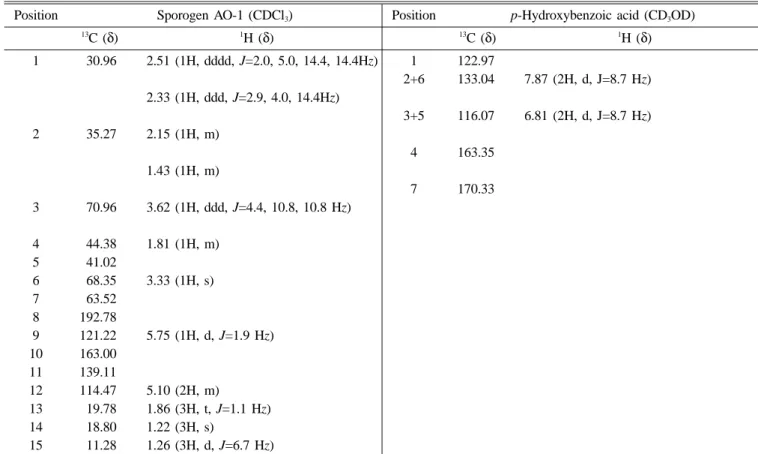
based on its EI-MS and NMR spectra. The IR spectrum showed the presence of a hydroxyl group (3456 cm−1) and α,β-unsaturated carbonyl group (1667 cm−1). 1H and 13C NMR data of AF5C1 are shown in Table 2. 13C NMR data and DEPT experiment revealed the presence of three methyl, three methylene, four methine, and five quaternary carbons, including one carbonyl carbon. Two methine carbons of 3-C (δC 70.96) and 6-C (δC 68.35) were assigned as oxygen- bearing carbons from their chemical shifts. On the other hand,
1H NMR spectrum disclosed the presence of a tertiary methyl group at δH 1.22, a secondary methyl group at δH 1.26, olefinic proton at δH 5.75, secondary hydroxyl group at δH 3.62, and epoxide at δH 3.33. 1H-1H COSY spectrum showed that 13-H (δH 1.86) was correlated to 12-H (δH 5.10), which indicates the presence of an isopropenyl group linked to δC 63.52 in HMBC spectrum. From the above spectral data, the isolated compound, AF5C1, was identified as sporogen AO-1 (Fig. 1).
Compound AF5AE1 was obtained as a white powder. The
molecular formula for AF5AE1 was established as C7H6O3
based on its EI-MS and NMR spectra. Its EI-MS spectrum showed intense fragment ions at m/z 138 (M+), 121 (M+-OH), and 93 (M+-COOH). IR spectrum showed the presence of a hydroxyl group (3449 cm-1) and carbonyl group (1643 cm−1).
1H and 13C NMR data of AF5AE1 are shown in Table 2. Two symmetric methine carbons (δC 116.07 and 133.04) and one carbonyl carbon were observed in the 13C NMR spectrum. 1H NMR spectrum exhibited two symmetric methine protons (δH
7.87 and 6.81). Its proton had ortho interaction as shown by the coupling constant value of 8.7 Hz. This indicates the presence of 1,4-substituted benzene ring. Thus, the isolated compound AF5AE1 was determined as p-hydroxybenzoic acid (Fig. 1).
Mycelial growth inhibition test. The antifungal activities of compounds sporogen AO-1 and p-hydroxybenzoic acid are Table 2. 1H and 13C NMR data for sporogen AO-1and p-hydroxybenzoic acid.a
Position Sporogen AO-1 (CDCl3) Position p-Hydroxybenzoic acid (CD3OD)
13C (δ) 1H (δ) 13C (δ) 1H (δ)
1 30.96 2.51 (1H, dddd, J=2.0, 5.0, 14.4, 14.4Hz) 1 122.97
2+6 133.04 7.87 (2H, d, J=8.7 Hz) 2.33 (1H, ddd, J=2.9, 4.0, 14.4Hz)
3+5 116.07 6.81 (2H, d, J=8.7 Hz)
2 35.27 2.15 (1H, m)
4 163.35
1.43 (1H, m)
7 170.33
3 70.96 3.62 (1H, ddd, J=4.4, 10.8, 10.8 Hz)
4 44.38 1.81 (1H, m)
5 41.02
6 68.35 3.33 (1H, s)
7 63.52
8 192.78
9 121.22 5.75 (1H, d, J=1.9 Hz)
10 163.00
11 139.11
12 114.47 5.10 (2H, m)
13 19.78 1.86 (3H, t, J=1.1 Hz) 14 18.80 1.22 (3H, s)
15 11.28 1.26 (3H, d, J=6.7 Hz)
a 1H and 13C NMR spectra were measured at 500 and 125 MHz, respectively.
Fig. 1. Structures of sporogen AO-1 and p-hydroxybenzoic acid.
shown in Table 3. ED50 values of sporogen AO-1 against P.
capsici, P. ultimum, and R. solani were 6, 39, and 24 ppm, whereas those of p-hydroxybenzoic acid were 136, 106, and over 200 ppm, respectively.
Zoospore germination test. The zoospore germination inhibition activities of sporogen AO-1 and p-hydroxybenzoic acid against P. capsici were evaluated (Fig. 2). The Inhibition of the zoospore germination by sporogen AO-1 was over 80%
at a dosage of 20µg · ml−1, whereas that of p-hydroxybenzoic acid was rather weak.
Discussion
In recent years, biological control of soil-borne pathogens has received increasing attention as a promising alternative to chemical control. Disease suppression by microorganisms in agriculturally important crops has been studied in detail.16-18)
A study on screening and investigation of the antagonistic microorganisms against plant pathogenic fungi in the greenhouse was performed. This paper presents the isolation and characterization of a Penicillium strain AF5 that secrets antifungal compounds against plant pathogenic fungi. The strain AF5 exhibited significant inhibitory activities against P.
capsici, R. solani, P. ultimum, and B. cinerea based on dual culture on potato dextrose agar.
The isolated compound, sporogen AO-1, was active against all fungi tested, except for B. cinerea and F. oxysporum. In
particular, sporogen AO-1 was as potent as metalaxyl in the mycelial growth inhibition of P. capsici (Table 3). The zoospore germination inhibition activity of sporogen AO-1 was excellent over 80% at a dosage of 20µg · ml−1, slightly lower than ED50 of mycelial growth, whereas that of p- hydroxybenzoic acid was weak (Fig. 2).
p-Hydroxybenzoic acid has previously been isolated from P.
patulum19) and used as an intermediate for organic syntheses and fungicides. Sporogen AO-1 has also been isolated from the culture broth of Aspergillus oryzae (NOY-2) and used as a phialospore formation-stimulator.20,21) Sporogen AO-1 exhibited significant sporogenic activity at a dose of 4.4µg per disc against A. oryzae, whereas no activity at 50µg per disc against Penicillium sp. (data not shown). These data suggest that sporogen AO-1 have sporogenic activity against specific strains such as Aspergillus. Accordingly, this is the first report on the isolation of sporogen AO-1 from a culture broth of a Penicillium sp. along with its fungicidal activity against phytopathogenic fungi.
Acknowledgments. This work was supported by a grant from the Province of Gyeongsangnam-do, Republic of Korea.
References
1. Baker, R. (1992) Biological control of disease of crop grown in covered and environmentally controlled struc- tures. In Biological Control of Plant Diseases: Progress and Challenges for the Future, Tjamos, E. C. Papavizas, G. C.
and Cook, R. J. (eds.) pp. 25-39, Plenum Press. New York, USA.
2. Fravel, D. R. (1988) Role of antibiosis in the biocontrol of plant disease. Ann. Rev. Phytopathol. 26, 75-91.
3. Weller, D. M. (1988) Biological control of soilborne plant pathogens in the rhizosphere with bacteria. Ann. Rev. Phyto- pathol. 26, 379-407.
4. Bhuyan, S. A., Das, B. C. and Bora, L. C. (1994) Antago- nistic effect of Trichoderma viride, T. harzianum and Aspergillus terreus on Rhizoctonia solani causing sheath blight of rice. J. Agri. Sci. Soc. North East India 7, 125- 127.
5. Lewis, J. A. and Papavizas, G. C. (1987) Permeability change in hyphae of Rhizoctonia solani induced by germ- Table 3. Antifungal activity of sporogen AO-1 and p-hydroxybenzoic acid.
Phytopathogens ED50 (µg · ml−1)
Sporogen AO-1 p-Hydroxybenzoic acid Metalaxyla
Phytophthora capsici 6 136 2.5
Pythium ultimum 39 106 n.tb
Rhizoctonia solani 24 >200 n.t
Botrytis cinerea >200 >200 n.t
Fusarium oxysporum n.t n.dc n.t
acommercial fungicide for Phytophthora sp.
bnot tested
cnot detected
Fig. 2. Inhibition of zoospore germination of Phytophthora capsici by sporogen AO-1 and p-hydroxybenzoic acid (PHBA).
ling preparations of Trichoderma and Gliocladium. Physiol.
& Biochem. 77, 699-703.
6. Cullen, D. and Andrews, J. H. (1984) Evidence for the role of antibiosis in the antagonism of Chaetomium globosum to the apple scab pathogen, Venturia inaequalis. Can. J. Bot.
62, 1819-1823.
7. Waksman, S. A. (1940) Antagonistic interrelationships among microorganisms. Chron. Bot. 6, 145-148.
8. Isono, K., Ngatsu, J., Kobinata, K., Sasaki, K. and Suzuki, S. (1965) Studies on Polyoxins, antifungal antibiotics. Part I. Isolation and characterization of polyoxin A and B.
Agric. Biol. Chem. 29, 848-854.
9. Isawa, T., Higashide, E., Yamamoto, H. and Shibata, M.
(1970) Studies on validamycins, new antibiotics. II. Produc- tion and biological properties of validamysins A and B. J.
Antibiotics. 23, 595-602.
10. Fleming, A. (1929) On antibacterial action of cultures of Penicillium, with special reference to their use in isolation of B. unfluenzae. British J. Exp. Path. 10, 226-236.
11. Okada, H., Kamiya, S., Shiina, Y., Suwa, H., Nagashima, M., Nakajima, S., Shimokawa, H., Sugiyama, E., Kondo, H., Kojiri, K. and Suda, H. (1998) BE-31405, a new anti- fungal antibiotic produced by Penicillium minioluteum I.
Description of producing organism, fermentation, isolation, physico-chemical and biological properties. J. Antibiotics 51, 1081-1086.
12. Nose, H., Seki, A., Yaguchi, T., Hosoya, A., Sasaki, T., Hoshiko, S. and Shomura, T. (2000) PF1163A and B, new antifungal antibiotics produced by Penicillium sp. I. Taxon- omy of producing strain, fermentation, isolation and biologi- cal activities. J. Antibiotics 53, 33-37.
13. Marin, J. P. (1950) Use of acid, rose bengal and streptomy- cin in the plate methods for estimating soil fungi. Soil Sci.
69, 215-233.
14. Pitt, J. I. and Hocking, A. D. (1997) In Fungi and Food Spoilage (2nd ed.) Blackie Academic and Professional, and imprint of Chapman & Hall, London, UK.
15. Kang, J. G., Hur, J. H., Choi, S. J., Choi, G. J., Cho, K. Y., Ten, L. N. Park, K. H. and Kang, K. Y. (2002) Antifungal activities of N-arylbenzenesulfonamides against phytopatho- gens and control efficacy on wheat leaf rust and cabbage club root diseases. Biosci. Biotechnol. Biochem. 66, 2675- 2680.
16. Baker, R. (1985) Biological control of plant pathogens: Def- initions. In Biological Control in Agricultural IPM Sys- tems, Hoy, M. A. and Herzog, D. C. (eds.) pp. 25-39, Academic Press, Inc., New York, USA.
17. Schroth, M. A. and Hancock, J. G. (1988) Disease-suppres- sive soil and root-colonizing bacteria. Science 216, 1376- 1381.
18. Fravel, D. R. (1988) Role of antibiosis in the biocontrol of plant deseases. Annu. Rev. Phytopathol. 26, 75-91.
19. Tanenbaum and Bassett (1958) A metabolic product of Pen- icillium patulum. Biochim. Biophys. Acta 28, 21.
20. Tanaka, S., Wada, K., Katayama, M. and Marumo, S.
(1984) Isolation of Sporogen AO-1, a sporogenic sub- stance, from Aspergillus oryzae. Agric. Biol. Chem. 48, 3189-3191.
21. Tanaka, S., Wada, K., Marumo, S. and Hattori, H. (1984) Structure of Sporogen AO-1, a sporogenic substance of Aspergillus oryzae. Tetrahedron Letters 25, 5907-5910.