서론
생활과학의 중심은 인간의 삶이며 가계의 일상생활에 중심을 두고 있다[23]. 가계는 자녀를 생산 하고 양육함으로써 가정을 유지케 하는 동시에, 다음 세대를 이어가게 하며, 개인의 사회화 기능을 담당하며, 환경과 상호작용하는 유기체이다[26]. 따라서 가계는 단순하게 분리된 단위가 아닌, 생태 학적 체계의 한 부분으로 이해하는 것이 적합하며, 생활과학 연구는 이러한 가계를 중심으로 이를 둘러싼 환경의 특성과 문화에 대한 이해를 토대로 가계의 복지증진을 지향한다는 점에서 그 중요성 을 가진다고 볼 수 있다.
가계는 사회의 기초 단위로서 인적자원의 형성과 유지 및 보호를 과제로 삼아왔기에 지속가능성
가계의 지속가능한 자연자원 소비에 대한 국내 생활과학 연구 (2000-2013) 고찰
추호정1 · 나종연1 · 백은수2 · 김효정3
서울대학교 1생활과학연구소, 2의류학과, 3소비자학과
Human Ecology Research (2000-2013) on Sustainable Consumption of Natural Resources
Ho Jung Choo1 · Jong-Youn Rha1 · Eunsoo Baek2 · Hyo Jung Kim3
1Research Institute of Human Ecology, 2Department of Textiles, Merchandising, and Fashion Design, 3Department of Consumer Science, Seoul National University, Seoul, Korea
Received: May 20, 2014 Revised: September 1, 2014 Accepted: September 2, 2014
This article was presented at the Research Institute of Human Ecology (RIHE) International Symposium in 2013.
Corresponding Author:
Eunsoo Baek
Department of Textiles, Merchandising, and Fashion Design, 303 Building 222, Seoul National University, 1 Gwanak- ro, Gwanak-gu, Seoul 151-742, Korea Tel: +82-2-880-8769
Fax: +82-2-875-8359 E-mail: [email protected]
Abstract
The purpose of this study is to understand what we have learnt thus far on the sustainable consumption of natural resources by household in Korea. We propose a two-wing model designating households as the main agent of sustainable living where both the production of human resources and the consumption of natural resources take place. In the current study, we focused on the sustainability of natural resource consumption. Undertaking an empirical study, we selected 10 major journals that represent each area of human ecological research and then, identified 120 relevant studies regarding sustainability published since 2000.
First, we classified 381 keywords into three categories: production, consumption, and social environment, and the identified studies were then classified in one of the seven categories created by combinations of the abovementioned three categories: production (P), consumption (C), social environment (S), production- consumption (PC), production-social environment (PS), consumption-social environment (CS), and production- consumption-social environment (PCS). The results showed that the sustainability of natural resources has been mainly investigated in the fields of clothing & textiles and food & nutrition. Further, consumer science research has been conducted in the area of consumption–social environment and consumption-production. The current study indicates that the field of human ecology has created and accumulated knowledge to support sustainable living. In the future, we need to conduct more integrated research across disciplines and methods and promote research interest in the underdeveloped area of sustainability research in human ecology.
Keywords
human ecology, sustainability, production, consumption, social environment
Family and
Environment
Research
(sustainability)이라는 가치를 실현하는 핵심 주체라고 볼 수 있 다[21]. 보다 구체적으로, 가계가 인적 자원의 생산 활동과 자연 자원의 소비 활동에 있어 미래 세대가 그들의 필요를 충족시킬 능 력을 저해하지 않으면서 현 세대의 필요를 충족시킬 수 있는 지속 가능한 삶을 영위하는 것이 곧 지속가능성의 가치를 실현하는 활 동이라 할 수 있다[25].
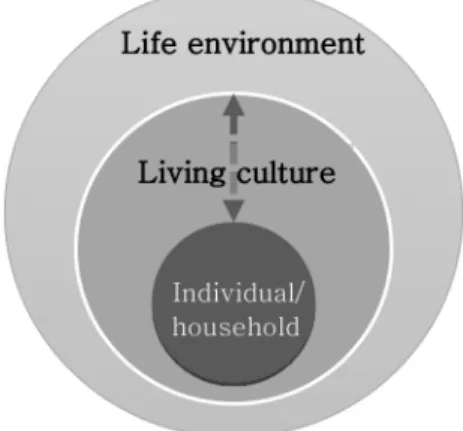
인간을 중심으로 한 생활과학은, 인간의 삶과 인간을 둘러싼 환경조건, 환경으로부터 얻을 수 있는 자원 그리고 인간의 신체 적·심리적 속성 등의 상호작용을 다룬다. 인간의 삶은 그들이 처한 문화적, 자연적 환경조건에 맞추어지고, 이를 통해 얻을 수 있는 자원을 활용하여 그들의 기술수준에 따라 가장 적합한 방식 으로 신체적·심리적 욕구를 충족시킨다. 이러한 과정에서 형성 된 삶의 양식이 문화가 되며 삶과 직접 관련된 생활문화를 중심으
로 생활환경이 형성된다는 개념을 가지고 있다[23] (Figure 1).
생활과학은 기초과학을 중심으로 실생활에 적용 가능한 응용 학문의 성격을 띄고 있는데 이는 크게 의류, 식품영양, 주거, 가 정경영 및 소비자, 가족 및 아동학, 가정학교육 등으로 분류할 수 있다[24]. 이와 같이 인간의 삶과 밀접한 생활과학 각 개별 분야 에 있어서 지속가능성에 대한 관심은 꾸준히 증가되어왔다.
지속가능성은 1980년 International Union for Conservation of Nature and Natural Resources가 지속가능한 개발을 주창하 면서 처음 언급되었다. 지속가능한 개발은 지역과 세대를 아우르 는 생존에 관한 문제이며 생태효율성에 집중하는 환경 개념을 포 함한다[25]. 이는 자본을 공유하는 사회주의와 비슷한 측면으로 파악되기도 한다[2]. 지속가능성의 개념은 분야에 따라 유연한 의 미를 가질 수 있다. 예를 들어 Kwan [13]의 지속가능한 디자인 개념에 따르면, 지속가능성이란 인간 사회의 환경, 경제, 사회적 양상의 연속에 관련된 체계적 개념을 의미하고 환경과 인류의 지 속을 목적으로 한다. 이는 환경오염을 최소화하는 재질 및 기술 개발로 자원의 효율성을 극대화하고 재생 가능한 재료 사용 혹은 변형이 쉽거나 부품 대체가 가능한 상품, 폐기 기간 연장이 가능 한 스타일의 개발 등으로 실제화될 수 있다.
최근 중요성이 강조되고 있는 지속가능성에 대한 담론을 바 탕으로 본 연구에서는 Soussana 등[22]이 제안한 지속가능성의 개념을 이용하여 가계의 자연자원 소비에 있어서의 지속가능성 에 대한 생활과학적 탐구의 노력을 분석하고자 한다. 이를 위해 2000년 이후 생활과학분야에서 이루어진 가계의 지속가능한 소 비와 관련된 연구를 목록화하여 그 내용을 분석하려고 한다. 본 Figure 1. Conceptual framework of human ecology. The relationship between
individuals, culture, and environment. Reprinted from [23] with permission.
Figure 2. Two-wing model. PC, production-consumption; CS, consumption-social environment; PS, production-social environment; PCS, production-consump- tion-social environment.
연구에서는 가계의 지속가능한 자연자원 소비를 인간 삶 또는 생 활의 질에 초점을 맞춘 인적 자원의 생산 활동과 더불어 자원의 생산, 개발, 재생에 초점을 맞추는 자연 자원의 소비 활동이 조화 롭게 이루어지는 것으로 정의하고자 한다[3, 22].
개념 체계
생활과학 연구의 주된 관점인 인간 생태학적 틀은 개인, 가계, 사회가 중심이 되어 자연환경, 사회환경, 문화환경과 상호작용하 는 것을 의미한다[14]. 그러나 인간 생태학적 관점의 통합적 시각 의 유용성에도 불구하고 물리적 환경의 강조로 인해 가계의 역할 이 세분화되거나 지나치게 확대됨으로써 지속가능성에 대한 연구 에 있어 가계가 중요한 연구대상임을 인식하지 못해왔다[8, 14].
이에 본 연구는 가계를 중심으로 인적 자원에 대한 재생산과 자연자원의 소비활동을 통합적으로 고려할 수 있는 양날개모델 (two-wing model, Figure 2)을 제안하고, Figure 2의 날개의 오 른쪽 부분에서 구체화된 자연자원의 소비활동에 초점을 맞추어 생활과학 분야에서 이루어져 온 지속가능성 연구에 대하여 분석 하고자 한다[2].
양날개모델은 가계의 본질적 기능인 재생산과 소비 기능을 중 심으로 지속가능한 생활의 영역을 설명한다. 가계의 재생산 기능 은 사회의 구성원을 출산, 양육의 과정을 통해 공급하는 기능을 의미한다. 사회의 지속가능성을 위해서는 인간 자원에 대한 지속 가능한 관리가 반드시 선행되어야 한다[2].
자연자원의 지속가능성은 가계와 개인의 소비활동을 통해 실 현될 수 있다. 소비활동을 온전히 이해하기 위해서는 자원을 써 서 없앤다는 소비 본연의 개념뿐 아니라, 자원이 생산, 교환되 는 과정과, 이러한 자원의 생산과 교환 및 소비에 영향을 미치 는 공동체, 문화, 교육, 제도 등과 같은 사회적 환경에 대한 이 해가 필수적이라는 것이 생태학적 접근의 전제라 할 수 있다. 이 에 본 연구에서는 자연자원의 지속가능성을 위한 가계의 활동 을 이해하기 위하여 활동의 배경이 되는 생산(production), 소비 (consumption), 그리고 이에 영향을 줄 수 있는 기타 사회적 환 경(social environment)의 영역으로 구분하였다. 서로 상호작용 하는 이 세 가지 영역은 본 연구에서 자연자원의 지속가능성을 설 명하기 위한 개념적 틀이 된다. 이는 Figure 3에서 개념화된 모델 로 제시된다. 각 영역의 하위 구성 체계에 따라 다음과 같이 세분 화하여 제시하였다.
1. 생산
산업 혁명으로 생산과 소비가 분화된 이래로, 20세기 후반에 들어서 생산과 소비 간의 차이는 점점 줄어들고 있다. 판매자 중심 이던 시장의 권력 중심 구도도 위치를 옮겨 이제는 구매자 중심의 시장이 되었고, 이는 하나의 규범으로 형성되었다. 지속가능한 생 산활동은 지속가능한 소비활동에 긍정적으로 영향을 미치고, 지속 가능한 소비는 또한 지속가능한 생산활동에 영향을 미친다. 생산 과 소비가 분리된 후 일반적으로 가계는 소비활동을 담당하고 있 으나 가계의 지속가능한 소비는 지속가능한 생산과 상호 영향을 주고 받으므로 생산 역시 지속가능한 생활에 대한 연구의 대상이 되어 많은 생활과학 연구가 생산의 영역에서도 이루어져 왔다.
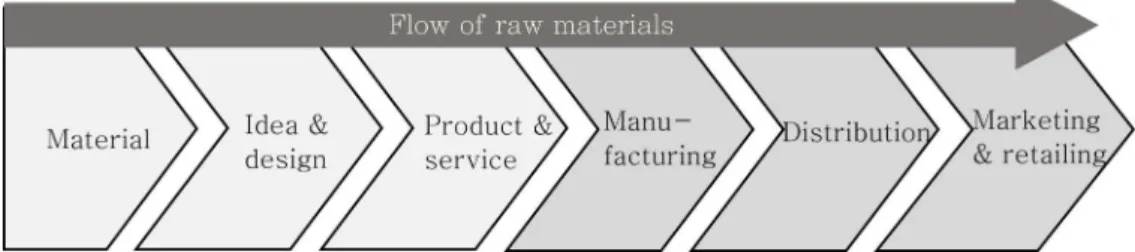
생산 단계에 해당하는 자연 자원의 지속가능성에 대한 분석을 위해 생산과정을 원자재의 흐름에 따라 업스트림에서 다운스트림 까지 단계별로 구분하였다[19]. 생산 단계의 지속가능성을 달성 하기 위해서는 Figure 4에서 제시된 각 생산 단계가 지속가능하 게 설계, 관리되어야 할 뿐 아니라 전체 흐름이 지속가능한 제품 생산을 위해 통합되고 조정되어야 한다.
생산과정에서의 지속가능성을 위해서는 먼저 원자재의 선정에 있어서 환경 안정성이 입증된 원자재나 화학 제품 사용에 주의를 기울어야 할 것이다. 이는 생물학적 대사 속성으로 자연 분해 가 능한 친환경 소재의 사용을 통해 실현될 수 있다. 지속가능한 생 산단계를 위해서는 원자재의 사용에만 제한하기 보다는 제품 디 자인과 제조 및 유통의 전 단계, 즉, 상품의 모든 공급 사슬 단계 를 고려할 필요가 있다. 예를 들어 친환경 소재의 사용이 제조 단 계에 있어 합성소재보다 에너지 효율이 떨어지는 경우 이러한 공 Figure 3. Seven types of sustainable consumption research. PC, production-
consumption; CS, consumption-social environment; PS, production-social envi- ronment; PCS, production-consumption-social environment.
정을 지속가능하다고 하기엔 어려울 수 있기 때문이다[10].
생산 단계에서의 지속가능성이 소비나 사회적 환경과 상호 관 련되어 있는 것은 매우 자명한 바이다. 이는 생산이나 마케팅이 소비환경에 의해 결정되거나, 점점 강해지는 소비자그룹의 파워 가 생산에 직접 영향을 미치기도 한다. 예를 들어 do it yourself (DIY)와 같은 소비주도적 지속가능한 활동이 소비자에 그치지 않고 비즈니스화 되기도 한다. 뿐만 아니라 법규나 사회적 인식, 소비자 운동 등이 제조업자에게 압력을 가하는 등 생산 과정에 영향을 미치기도 하고, 반대로 생산에서 일어나는 기술혁신 등 이 사회 환경에 영향을 미치거나 기업의 사회적 책임(corporate social responsibility, CSR) 등이 사회적 규범으로 발전되기도 한다.
2. 소비
소비자들은 구매 의사 결정의 전 단계에 걸쳐서 지속가능한 영 향을 미치는 결정을 할 수 있다. 본 연구에서는 소비의 단계를 개 인 및 가계의 소비활동 프로세스에 따라 제안한다. 먼저, 소비자 의 활동에 일관된 영향을 미치는 가치 및 태도의 형성이 선행되 고, 소비자의 정보 탐색 활동은 구매로 이어질 수 있으며, 구매 후 사용 및 평가 그리고 폐기의 단계로 나누어볼 수 있다. 또한 특정 구매 단계와 무관하게 이 모든 단계에서 일반적으로 관찰될 수 있 는 환경 행동(environmentally-conscious behavior, ECB)의 범 주도 구분하였다[22] (Figure 5).
대부분의 연구들이 친환경 소비자의 태도와 행동, 친환경 제품 의 사용에 초점을 맞추어 이루어져 왔으나, 자원의 지속가능성을 고려한 소비 활동에 도움이 될 수 있는 지식의 축적, 정보의 제공 등의 측면은 간과해 왔다[5]. 소비의 영역 역시 생산 활동과 사회 적 환경과 상호작용할 수 있다. 예를 들어 제조업자의 제품에 대 한 정확한 정보 전달, 친환경 정보 라벨 부착 등은 소비자들의 친 환경 제품 인식 형성 및 정보의 습득, 구매의도에 영향을 미칠 수 있다. 뿐만 아니라 사회적 제도 측면에서 소비자 교육을 통한 친 환경, 지속가능한 가치에 대한 홍보 등이 이루어질 수 있다.
3. 사회적 환경
본 연구에서는 생산 혹은 소비 활동과 직접적으로 관계 없지 만 간접적으로 영향을 미치는 제 3의 영역을 협의적 의미의 사회 적 환경으로 구분하였다. 사회적 환경이란 사회를 구성하고 있는 개인과 가계의 행동에 영향을 미치는 집단, 문화, 가치관 및 전통 등을 의미한다[15, 17]. 구체적으로 지역적인 단위, 가족구성, 인 구밀도 및 직업이나 근로내용, 주거의 상황이나 수입 등의 생활 정도, 교통시설이나 교육시설, 의료시설 등 문화ㆍ문명의 산물을 광범위하게 포함할 수 있다[12].
사회적 환경은 자연환경(physical environment)에 대응하는 용어로 에코시스템 이외의 영역이지만, 개인과 가족에 매우 밀접 한 환경으로 지속가능한 소비 태도와 행동에 영향을 미치는 것을 알 수 있다. 즉, 개인 및 가계의 생산과 소비 활동에 영향을 미치
Figure 4. Production process: from raw materials to consumers.
Figure 5. Consumption process: from value to disposal.
는 주변 환경을 포괄적으로 지칭하는 영역으로 본 연구에서는 문 화, 교육, 미디어, 제도 등을 사회적 환경의 큰 범위로 제시하고 자 한다(Figure 6).
연구 방법
지속가능성에 대한 연구를 수집하기 위하여 2000년 이후 2013 년까지 생활과학 분야의 대표적 국내 학술지 10편에 게재된 논 문을 전수 조사하여 지속가능한 자원의 활용에 해당하는 연구논 문을 분류하였다(Appendix 1). 생활과학을 대표하는 학문으로 소비자학, 아동가족학, 식품영양학, 의류학 4개 분야로 한정하 였으며, 생활과학분야 전반을 다루는 학회지로 대한가정학회지 (Family and Environment Research), 한국생활과학회지(Korean Journal of Human Ecology) 2개를 비롯하여 각 분야별로 각각 2 개의 학회지를 선정하였다. 각 분야별 학회지로 소비자학 분야는 소비자학연구(Journal of Consumer Studies), 소비자정책교육연 구(Consumer Policy and Education Review), 아동가족학 분야 는 한국가족관계학회지(Journal of Family Relations), 아동학회 지(Korean Journal of Child Studies), 식품영양학 분야로는 한 국영양학회지(Journal of Nutrition and Health), 한국식품영양 과학회지(Journal of the Korean Society of Food Science and Nutrition), 그리고 의류학 분야로 한국의류학회지(Journal of the Korean Society of Clothing and Textiles), 한국의류산업학회지 (Journal of the Korean Society for Clothing Industry)를 대상 으로 하였다. 총 10개의 학회지에서 2000년 이후로 게재된 연구 논문에 대하여 인터넷 사이트 한국교육학술정보원 학술연구정보 서비스(Research Information Sharing Service, RISS), 한국학술
정보(Korean studies Information Service System, KISS), 한국 과학기술정보연구원(Korea Institute of Science and Technology Information, KISTI)을 활용하여 연도별로 전수를 목록화하였다.
연구 논문의 키워드 중 연구자들이 사전에 동의한 ‘지속가능 성’ 관련 주요 키워드가 하나이상 들어간 논문을 분석의 대상으로 삼았다. 지속가능성 관련 키워드는 8명의 생활과학자가 사전에 충분히 논의하여 공유한 생활과학의 지속가능성 정의를 바탕으로
‘자연자원의 생산, 개발 및 사용, 유지에 따른 지속가능성’에 한정 하였다. 따라서 자연자원의 지속가능성 이외의 공정무역, 윤리적 소비 영역은 제외하였으며, 인적자원의 지속가능성(재생산, 정신 건강 등)도 연구의 대상에서 제외하였다. 그 결과, 120개의 선정 된 지속가능성 관련 연구가 최종 분석의 대상으로 선정되었고, 키 워드는 120개 논문으로부터 총 488개로 수집되었다. 전체 키워 드의 빈도 분석 결과 환경, 녹색, 자연, 친환경, 지속가능, 재활용 등으로 나타났다(Figure 7).
생활과학 분야에서 이루어진 지속가능성 연구에서 가장 빈번 하게 쓰여진 키워드는 환경이었으며 녹색(green), 자연(nature, eco-)도 빈도가 높은 것으로 나타났다. 지속가능성은 상대적으로 사용 빈도가 낮았다.
연구결과의 해석 및 논의
생활과학분야 10개의 학술지에 수록된 자연자원의 지속가능 성 연구를 다룬 연구 논문 120편에 대하여 각 분야별 비중은 생 활과학전반 45편, 소비자학 10편, 아동가족학 0편, 식품영양학 9 편, 의류학 56편이었다. 각 학회지별로는 한국의류산업학회와 대 한가정학회, 한국의류학회가 각각 34편, 31편, 22편으로 높은 비 중을 차지했다.
1. 키워드 분석 Figure 6. Social environment of sustainable consumption.
Figure 7. Main keywords of sustainable research.
선정된 120편의 연구논문에 대해 본 연구의 개념틀을 바탕으 로 먼저 키워드 분석을 실시하였다. 학술지의 성격에 따라 국문 키워드가 제공되지 않는 경우가 존재하였기 때문에, 공통적으로 제공되는 영문키워드를 분석에 사용하였다. 영문키워드를 기재하 지 않은 연구 5편을 제외하고 총 115편의 연구에서 488개의 키 워드를 추출하였고 이 중, 연구방법 관련 및 기타 키워드(예를 들 어, SEM, regression 등)을 제외한 총 381개의 키워드를 본 연 구의 개념틀에 따른 내용 분류에 최종적으로 사용하였다. 그 결 과, 381개의 키워드 중 생산 영역에 포함되는 키워드는 204개 (53.6%), 소비 영역에는 117개(30.7%), 사회적 환경에 포함되는 키워드는 60개(15.7%)로 나타났다.
1) 생산
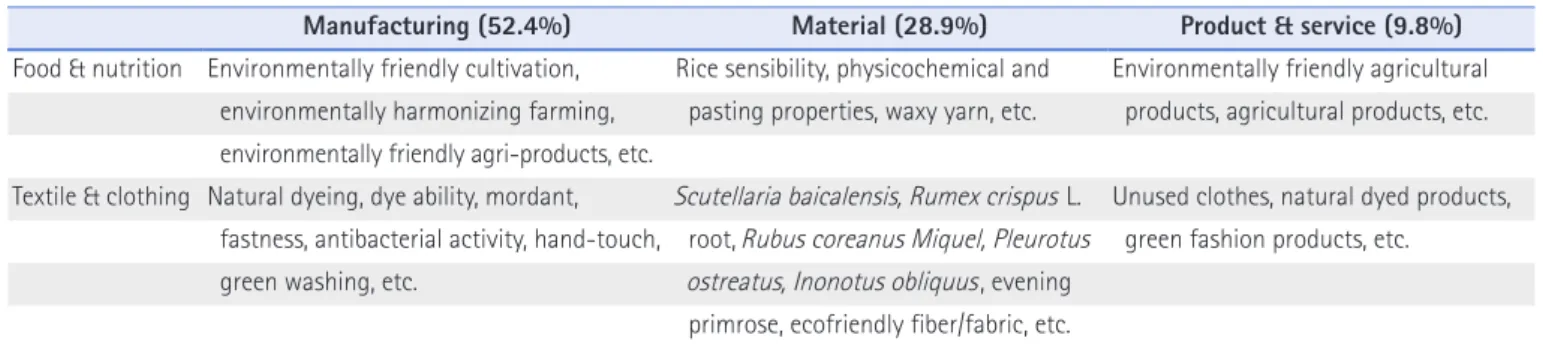
생산의 영역에 해당하는 키워드는 총 204개로써, 앞서 제시 한 생산 영역의 각 단계에 따른 키워드 분포를 살펴본 결과, ‘가공 및 제조’ 107개(52.4%), ‘원재료’ 59개(29%), ‘제품/서비스’ 20개 (9.8%), ‘아이디어/디자인’ 10개(4.9%), ‘마케팅/판매/상점’ 5개 (2.4%), ‘운송 및 유통’ 3개(1.5%) 순으로 나타났다. 키워드 빈도 가 높은 상위 3개의 분야인 원재료, 가공 및 제조, 제품 및 서비스
부분의 키워드를 생활과학 연구 분야별로 살펴본 결과는 분류된 키워드는 Table 1과 같다.
연구 분야별로 아동가족학 및 소비자학 분야를 제외한 식품영 양학, 의류학 등에서 생산 관련 지속가능성 연구들을 많이 시도했 음을 알 수 있다. 생산 관련 키워드의 분포는 주로 제조 단계에서 높게 발견되었는데, 그 예로 식품영양학의 경우 환경 친화적 농산 물(environmentally friendly agri-products)이 될 수 있고, 의류 학의 경우 천연 염색(natural dye)을 다룬 다수의 연구들이 이 부 분에 포함되었다. 원자재 단계로 분류된 키워드의 경우 식품영양 학의 식품의 영양 성분, 의류학의 섬유 및 천연염색의 재료 등이 해당되었다.
2) 소비
소비 영역에 해당하는 키워드는 총 117개로써, 앞서 제시 한 소비 단계별 키워드 분포를 살펴본 결과, ‘가치/태도’ 57 개(48.8%), ‘구매/사용행동’ 25개(21.4%), ‘환경행동’ 14개 (11.9%), ‘폐기’ 12개(10.2%), ‘구매 후’ 6개(5.1%), ‘정보탐색’ 3 개(2.6%) 순으로 나타났다(Table 2).
Table 1. Keywords of Production Process
Manufacturing (52.4%) Material (28.9%) Product & service (9.8%) Food & nutrition Environmentally friendly cultivation, Rice sensibility, physicochemical and Environmentally friendly agricultural
environmentally harmonizing farming, pasting properties, waxy yarn, etc. products, agricultural products, etc.
environmentally friendly agri-products, etc.
Textile & clothing Natural dyeing, dye ability, mordant, Scutellaria baicalensis, Rumex crispus L. Unused clothes, natural dyed products, fastness, antibacterial activity, hand-touch, root, Rubus coreanus Miquel, Pleurotus green fashion products, etc.
green washing, etc. ostreatus, Inonotus obliquus, evening primrose, ecofriendly fiber/fabric, etc.
Table 2. Keywords of Consumption Process (N=117)
Domain n (%) Keywords
Attitudes & value 57 (48.8) Environmentally sustainable, pro-environmental attitude, awareness of environmental problem, environmental awareness, environmental concern, environmental friendliness, environmental consciousness
Purchase/usage 25 (21.4) Environmentally friendly consumption, sustainable consumption, green consumption, green consumption attitude, green consumption behavior, pro-environment good consumption behavior, green usage, clothing reuse, green purchase, purchase or used products, purchase intention, consumer green spending, spending on environmentally friendly agricultural products
Environmental behavior 14 (11.9) Environmental movement, pro-environmental behavior
Post-purchase evaluation 12 (10.2) Product evaluation, post-purchase satisfaction, repurchase intention
Disposal 6 (5.1) Recycled polyester, recycling methods, green disposal, clothing disposition behavior
Information search 3 (2.6) Consumer information needs, green information, information for practicing sustainable energy consumption, information sources, environmental knowledge
(1) 가치/태도
소비자들의 가치/태도에 해당하는 키워드들로는 환경에 대 한 관심, 의식 및 태도와 같이 환경에 직접적으로 해당되는 단어 (environmental-; awareness, concern, friendly, consciousness 등)과 인지된 행동 통제, 이득, 소비자 효과성, 혁신 요소 (perceived-; behavior control, benefit, consumer effectiveness, attributes of innovation) 등과 같이 환경을 대상으로 한 소비자들 의 일반적인 태도나 가치 등 크게 두 종류로 나뉘었다.
(2) 구매/사용행동
소비자들의 구매/사용행동에 해당되는 키워드로는 크게 사용 및 제품의 소비 행동과 구매에 관련된 키워드로 분류될 수 있다.
사용 및 소비에 해당되는 행동으로는 환경친화, 환경 지속가능, 녹색, 친환경, 환경의식 등으로 수식된 소비(consumption), 소비 행동(consumption behavior), 사용(usage) 또는 재사용(reuse) 등으로 제시되었다. 구매에 관련된 키워드는 동일한 형용사에 구 매(purchase), 구매의도(purchase intention), 지출(spending) 등 의 어미 갖는 키워드들이었다.
(3) 환경행동
환경행동은 제품의 구매와 사용과 관련 없는 비소비영역 의 소비자행동이기 때문에 따로 제시하였다. 키워드는 주로 환 경 운동, 친환경 행동, 환경 보존(environmental movement, pro-environmental behavior, environment conservation/
preservation) 등으로 나타났다.
(4) 구매 후 행동
소비자의 구매 후 행동으로 분류된 키워드는 크게 평가 혹 은 만족에 관련된 키워드로 구성되었다(product evaluation, purchase satisfaction).
(5) 폐기
폐기에 해당하는 키워드는 크게 재활용과 폐기로 나뉘었다.
재활용은 재활용 방법이나 특정한 물질을 재활용하는 키워드로 나타났고(recycled polyester, recycling methods). 폐기는 녹 색 폐기, 의복 처리 행동(green disposal, clothing disposition behavior) 등으로 나타났다.
(6) 정보탐색
소비자들의 정보탐색 행동에 해당하는 키워드로는 소비자 정 보 욕구(consumer information needs)를 제외하고는 정보 그 자 체를 의미하거나 이와 관련 있는 녹색 정보(green information), 지속가능한 에너지 소비 실천 정보(information for practicing sustainable energy consumption), 정보원(information sources) 등으로 나타났다.
3) 사회적 환경
사회적 환경의 영역에 해당되는 키워드는 총 60개로 세부 영 역별 키워드를 살펴보면 다음과 같다(Table 3).
정책(policy) 영역으로 분류된 키워드로는 탄소라벨링, 환경규 제, 대기전력 저감 프로그램, 친환경건축물 인증제도, 녹색 성장, 에너지효율관련 표시 등이 있다. 매체(media) 영역으로 분류된 키워드로는 매체 프로그램, 매체 유형이 있고, 교육(education) 영역으로 분류된 키워드로는 가정과교육, 환경교육, 아동 소비자 교육 프로그램, 실과 등이 있었다. 지역사회(community)로 분류 된 키워드로는 생태 도시, 생태 마을, 친환경 아파트 등이 있었 고, 문화(culture)로 분류된 키워드는 녹색소비문화 등이 있었다.
2. 연구 단위별 분석
본 섹션에서는 앞서 분석한 키워드에 대하여 해당 키워드를 포 함하는 개별 연구를 분석의 단위로 하여 연구 단위 별 분석이 시 도되었다. 생산, 소비, 사회적 환경의 3개 영역으로 구성된 개념 틀은 Figure 7와 같이 서로 겹치는 영역을 포함하여 총 7개의 영 역으로 나뉘었다.
Table 3. Keywords of Social Environment
Domain Keywords
Policy Carbon labeling, environmental regulation, e-standby program, green building certification, green growth, labeling systems about energy consumption efficiency, etc.
Media Media program, media type, etc.
Education Home economics education, environmental education, educational program for child consumers, practical arts education/curriculum, etc.
Community Eco city, eco-village, ecological apartment, etc.
Culture Green spending culture, etc.
앞서 시행된 전체 381개의 영역별 키워드 분류에 기반하여, 논문에서 제시하는 키워드가 위치하는 영역에 따라 개별 논문의 분류가 이루어졌다. 한 논문 당 평균적으로 3-5개의 키워드를 포 함하는데, 예를 들어 Hwang [6]의 지속가능한 에너지소비 실천 정보 현황 분석 연구의 경우 지속가능한 소비, 지속가능한 에너지 소비 실천정보, 에너지 효율관련 표시, 에너지 소비효율 등급 표 시, 대기전력 저감 프로그램을 키워드로 제시한다. 각 키워드에 대하여 앞서 제시한 Figure 3의 영역별로 분류한 결과, 지속가능 한 소비는 소비 영역의 구매 및 사용단계, 지속가능한 에너지소 비 실천정보는 소비 영역의 정보탐색 단계로 구분되었고 나머지 에너지효율관련 표시, 에너지소비효율등급표시, 대기전력저감프 로그램은 사회적 환경 영역으로 구분되었다. 따라서 해당 연구는 소비(consumption, C) 영역과 사회적 환경(social environment, S) 영역에 걸쳐 이루어진 소비-사회적 환경(consumption–social environment, CS)에 해당하는 연구라고 볼 수 있다. 이와 같 은 방법으로 120개의 연구를 모두 분류하였다. 그 결과, 생산 (production, P) 영역의 키워드들로만 구성되어있던 논문은 총 45편(39.2%)으로 가장 많았으며, 생산-소비 영역(production- consumption, PC) 20편(17.4%), 소비-사회적 환경 영역(CS) 18 편(15.7%), 소비 영역(C) 12편(10.5%), 생산-소비-사회적 환경 영역(production-consumption-social environment, PCS) 8편, 생산-소비 영역(PC) 8편(6.9%), 사회적 환경 영역(S) 4편(3.4%) 순으로 나타났다(Table 4).
생활과학 연구 분야에 따른 영역별 분포를 확인한 결과, 생활 과학 전반을 다루는 학술지는 소비(C) 영역, 생산-소비(PC) 영 역, 소비-사회적 환경(CS) 영역에서 높은 분포를 보이며 주로 자 연자원의 소비(C)와 관련된 지속가능성 연구를 해왔음을 알 수 있 다. 소비자학의 경우 소비-사회적 환경(CS) 영역에서 비교적 높 은 분포를 보이며 자연자원의 소비, 소비자 및 정책과 관련된 지 속가능성 연구에 중점을 두어왔음을 알 수 있다. 아동가족학 및
식품영양학은 본 연구의 목적에 따라 자연자원이 아닌 인간자원 의 지속가능성으로 분류되었기에 해당되는 연구가 사전에 배제되 어 전반적으로 분포도가 거의 없거나 낮았다. 의류학의 경우 생산 (P) 영역에서 높은 연구의 분포가 나타났고, 생산-소비(PC) 영역 에서도 비교적 높은 연구의 분포를 통해 자연자원의 지속가능성 에 대한 의류학의 연구 경향이 생산 관련 영역에서 주로 이루어져 왔음을 알 수 있다. 생산, 소비, 사회적 환경 각 영역에 걸쳐 상호 교환적으로 이루어진 연구들에 대해 보다 구체적으로 내용분석을 하기 위해 다음 파트에서는 영역별로 구체적인 연구의 예를 제시 하고 설명하고자 한다.
1) 생산ㆍ소비
논문에서 제시하는 키워드가 생산과 소비의 영역에 분포한 연 구로는 Kim과 Kim [9]의 생활과학전반 학술지에 게재된 영남지 역 주부의 식생활 라이프스타일에 따른 친환경 농산물 소비행동 을 분석한 연구와 Song 등[20]의 그린워싱 정보 인식에 따른 소 비자의 행동구매에 대한 연구를 예로 들 수 있다. 첫 번째 연구의 키워드는 식생활 라이프스타일, 친환경 농산물, 소비 행동으로 제 안되었는데, 이 중 친환경 농산물이 생산의 영역에서 제품/서비 스에 해당, 식생활 라이프스타일과 소비 행동은 각각 소비의 영역 에서 가치/태도와 구매/사용행동으로 분류되었다.
다음으로 소비자학 분야에서 Song 등[20]의 그린워싱 정보에 따른 소비자의 구매행동의도 연구 에서 제안하는 키워드는 그린 워싱, 기만광고, 정보인지, 소비자행동, 감정상태, 광고태도, 구 매의도인데, 이들 중 그린워싱과 기만광고는 각각 가공/제조 단 계와 마케팅/판매/상점의 단계에 해당되어 생산(P)의 영역에 해 당된다(Figure 7). 나머지 키워드인 정보인지, 소비자행동, 감정 상태, 광고태도, 구매의도는 소비(C)의 영역에 해당하는 키워드로 분류되었고, 구체적인 소비의 하위 단계에 있어서 정보인지는 정 보탐색의 단계, 소비자행동과 구매의도는 구매/사용 단계에, 감 Table 4. Individual Studies Classified Into Sustainable Consumption Research on PCS Framework
Variable P C S PC CS PS PCS
HUMEC (n=52) 4 11 3 8 11 2 3
Consumer science (n=10) - - 1 2 6 - 1
Child and family (n=0) - - - -
Food and nutrition (n=9) 3 1 - 2 - 1 2
Textile and clothing (n=4) 38 - - 8 1 5 2
Total (N=115) 45 12 4 20 18 8 8
PCS, production-consumption-social environment; P, production; C, consumption; S, social environment; PC, production-consumption; CS, consumption-social environment; PS, production-social environment.
정상태와 광고태도는 태도/가치에 해당된다(Figure 7). 따라서 이 연구는 생산-소비(PC) 유형의 연구로 분석되었다.
2) 소비ㆍ사회적 환경
키워드가 소비(C)와 사회적 환경(S)의 영역에 분포한 연구로 생활과학전반 학술지에 게재된 Song 등[22]의 저탄소 녹색성장 정책과 녹색생활양식, 가족에 대한 실천적 함의와 전망에 대한 연 구, 그리고 Jun과 Jae [7]의 녹색소비 실천교육이 유아의 녹색 소 비 인식 및 행동에 미치는 효과에 대한 연구를 예로 들 수 있다.
Choi와 Sung [1]의 저탄소 녹색성장정책과 녹색생활양식 연구의 키워드 중 본 연구에서 분석에 사용한 키워드는 저탄소 녹색 성장 정책, 녹색 생활양식 총 2개로써 전자는 사회적 환경(S) 영역에서 제도에, 후자는 소비(C) 영역에서 태도 및 가치로 분류된다.
다음으로 Jun과 Jae [7]의 녹색소비 실천교육의 영향에 대한 연구에서 제안한 키워드 중 본 연구에서 분석에 사용된 키워드는 녹색소비, 녹색구매, 녹색사용, 녹색처분, 환경 교육의 총 5개로 써, 환경교육은 사회적 환경(S) 영역에서 교육 분야에 포함되고 나머지는 소비(C)의 영역에 포함된다. 소비영역 내에서 구체적으 로 녹색소비, 녹색구매, 녹색사용은 구매/사용에 해당되고, 녹색 처분은 폐기의 단계에 해당된다.
3) 생산ㆍ사회적 환경
생산과 사회적 환경의 영역에 키워드가 분포된 연구로 주거학 을 포함하는 생활과학 일반지(예, 대한가정학회)에 Seok과 Hong [18]의 친환경건축물인증 아파트의 친환경계획요소 관리 실태에 대한 연구와 Kim과 Kim [11]의 의류학 연구분야에서 녹색성장 을 위한 기능성 재킷의 프로토타입에 관한 연구를 예로 들 수 있 다. 친환경 건축물 인증 아파트의 친환경 계획요소 관리 실태에 대한 논문에서 제시한 키워드 중 본 연구에서 분석 대상으로 사용 한 키워드는 친환경 계획요소, 친환경건축물인증제도, 주택관리 3개이고, 이들 중 친환경 계획요소는 생산의 영역에서 아이디어/
디자인에 해당되고, 나머지는 사회적 환경의 영역에서 제도에 해 당된다.
녹색성장을 위한 기능성 재킷의 프로토타입 연구에서 제시한 키워드 중 본 녹색성장, 기능성 재킷, 프로토타입, 태양전지 및 light-emitting diode (LED)의 5개 키워드를 분석에 사용하였는 데, 녹색 성장은 사회적 환경(S) 중 제도에 해당되었고, 나머지 4 개의 키워드는 생산(P)의 영역에서 제품/서비스(기능성재킷, 태 양전지, LED), 아이디어/디자인(프로토타입)에 해당되었다.
4) 생산ㆍ소비ㆍ사회적 환경
논문에서 분석에 사용된 키워드의 분포가 생산, 소비, 사회적 환경 세 개의 영역에 모두 분포된 연구의 예로는 식품영양학 연 구 중 Nam과 Kim [16]의 마산시 중학교 학부모의 친환경 농산물 학교급식의 인식에 대한 조사, 의류학 분야의 Hong과 Kim [5]의 천연염색 제품 구매 고객의 매체 프로그램 및 정보원 이용 특성에 대한 연구를 예로 들 수 있다.
마산시 중학교 학부모를 대상으로 이루어진 친환경 농산물 학 교급식 인식 조사에서 제시한 키워드 중 본 연구에서 분석에 사용 한 키워드는 중학교 급식 서비스, 인식, 환경 친화적 농산물로써, 각각 사회적 환경(S), 소비(C), 생산(P)에 골고루 분포되어 있다.
중학교 급식 서비스의 경우 사회적 환경(S) 중 교육 또는 제도에 해당되고, 인식은 소비의 영역(C)에서 소비자의 가치/태도에 해 당되며, 환경 친화적 농산물은 생산(P)의 영역에서 제품/서비스 에 해당된다.
천연염색 제품 구매 고객의 매체 프로그램 및 정보원 이용 특 성에 대한 연구에서 분석에 사용한 키워드는 천연 염색 제품, 매 체 유형, 매체 프로그램, 정보원의 4개로써 천연 염색 제품은 생 산(P)의 영역에서 제품/서비스에, 매체 유형과 매체 프로그램은 사회적 환경(S)에서 매체에, 정보원은 소비(C)의 영역에서 정보탐 색의 단계에 해당된다.
결론
생활과학 연구는 인간의 삶과 생활 환경의 지속가능성을 위해 지속적인 관심을 가져왔다. 2000년 이후로 이루어진 생활과학분 야의 지속가능성 관련 연구를 자연자원의 생산, 소비 및 이에 영 향을 미치는 사회적 환경의 개념틀로 분류한 결과, 자연자원의 지 속가능성에 대한 연구가 다양한 분야에서 이루어졌음을 알 수 있 다. 의류학과 식품영양학의 경우 생산 영역에서의 지속가능성에 초점을 맞추어 주로 이루어져 온 반면, 소비자학의 경우 소비 영 역과 사회적 환경, 혹은 소비의 영역과 생산의 영역에 걸쳐서 연 구가 이루어져 왔다.
본 연구의 개념적 개념틀에서 제시한 영역별 연구현황을 살펴 보면, 생산 영역에서 이루어진 자연자원의 지속가능성에 대한 연 구는 주로 제조나 원재료와 관련된 연구가 대부분이었다. 아이디 어/디자인, 마케팅/세일즈/상점 혹은 판매/유통의 단계에서 자원 의 지속가능성을 이해하고 개선하기 위한 연구는 매우 제한적으 로 이루어져 향후 지속가능한 생산 영역 중 이 단계와 관련된 연
구가 요구된다.
소비영역의 경우 가치와 태도, 구매와 사용의 단계에 한정되어 자연자원의 지속가능성에 대한 연구가 이루어져 왔다. 그러나 서 로 상호작용하는 단계로서 정보의 탐색, 구매 후 평가 및 폐기에 있어서는 연구가 많이 이루어지지 않아 이 부분에 대해 향후 연구 에서 관심이 필요할 것이다. 향후 연구에서는 본 연구에서 제안 하는 개념틀에서 상대적으로 부족하게 이루어져온 영역의 연구에 더욱 조명하여 관심을 가져야 할 것이다.
특히 응용과학으로서의 지속가능성에 대한 생활과학 연구는 인간의 생활에 대한 통합적 이해라는 생활과학의 소명에 맞도록 생산, 소비, 사회적 환경 간 관계의 규명을 통한 지속가능한 가계 의 생활에 대한 탐색이 이루어져야 한다. 사회의 기초 생활 단위 로서의 가계의 자연자원소비활동은 소비되는 재화를 조달하는 생 산과정과 소비활동에 직접, 간접적 영향을 미치는 사회환경에 의 해 영향을 주고받고 있다. 이에 개인과 가계의 생활에 영향을 주 고 받는 모든 이해 관계자간의 소통과, 다양한 융합적 연구방법의 개발 및 적용이 요구된다.
본 연구에서는 선별된 120개의 연구에 대해 개념적으로 제안 하는 지속가능한 삶 모델을 기반으로 하여 주제어별, 분야별로 연 구 비중 경향을 다루었는데 향후 연구에서는 생활과학 철학에 기 반한 통합적인 시각의 지속가능한 삶 모델의 개발이 이루어져야 함을 제안한다. 이는 개념적인 정의, 검증 가능한 가설로 이루어 지고 궁극적으로는 가계의 ‘지속가능한 삶’을 촉진하고 인식을 도 울 수 있는 적용점을 찾을 수 있게 해줄 것이다. 향후 연구에서 지 속가능한 삶 모델 개발 및 타당성 검증을 통해 생활과학분야의 지 속가능성 연구들이 도출하는 주요결과를 반영하고 트렌드를 분석 할 수 있는 개념체계를 제공할 수 있을 것이다. 나아가 지속적인 연구를 통해 실증적으로 타당성이 검증된 지속가능한 생활의 개 념 모델을 바탕으로 정책을 개발하여 개인과 가계의 지속가능한 삶을 지원할 수 있을 것이다.
Declaration of Conflicting Interests
The authors declared that they had no conflicts of interest with respect to their authorship or the publication of this article.
Acknowledgments
This study was supported by Research Institute of Human Ecology,
Seoul National University (350-20130016) and the SRC/ERC program of MOST/KOSEF (R11-2005-065).
References
1. Choi, Y., & Sung, M. (2011). The low carbon & green growth policy and green life-style, the practical implication and vision on family.
Journal of the Korean Home Economics Association, 49(1), 79-91.
http://dx.doi.org/10.6115/khea.2011.49.1.079
2. Choo, H. J., Rha, J., Baek, E., & Kim, H. J. (2013, November). HUMEC research on sustainability: What have we learned since 2000?
Paper presented at the 2013 Research Institute of Human Ecology International Symposium, Seoul, Korea.
3. Hawkins, R. L. (2005). From self-sufficiency to personal and family sustainability: A new paradigm for social policy. Journal of Sociology
& Social Welfare, 32(4), 77-92.
4. Hong, B. S., Lee, E. J., & Chu, Y. J. (2010). The effect of environmental values of fashion consumers on purchase satisfaction and repurchase intention of eco-friendly fashion products. Journal of the Korean Society for Clothing Industry, 12(4), 431-438. http://
dx.doi.org/10.5805/KSCI.2010.12.4.431
5. Hong, H. S., & Kim, G. E. (2010). Differences between purchasers and non-purchasers of naturally dyed-products: Usages of media, media programs, and information sources. Journal of the Korean Society of Clothing and Textiles, 34 (1), 79-91. http://dx.doi.org/10.5850/
JKSCT.2010.34.1.79
6. Hwang, E. (2009). Study on analyzing information for practicing sustainable energy consumption: Focused on labeling systems about energy consumption efficiency. Consumer Policy and Education Review, 5(4), 85-109.
7. Jun, Y. H., & Jae, M. K. (2012). The effects of green consumption practice program for young children. Korean Journal of Human Ecology, 21 (3), 527-537. http://dx.doi.org/10.5934/
KJHE.2012.21.3.537
8. Kim, H. A., & Yoo, T. M. (1995). A study on the confronting problems of home economics in Korea and its historical and philosophical causing background. Journal of the Korean Home Economics Association, 33(1), 1-18.
9. Kim, H. C., & Kim, M. R. (2010). Analysis on consumption behaviors regarding environment-friendly agricultural products according to the food-related lifestyles of housewives in Yeungnam region.
Korean Journal of Human Ecology, 19(6), 1103-1113. http://dx.doi.
org/10.5934/KJHE.2010.19.6.1103
10. Kim, J., Park, C. H., & Yun, C. (2013, November). Towards a
comprehensive sustainability index. Paper presented at the 2013 Research Institute of Human Ecology International Symposium, Seoul, Korea.
11. Kim, M. H., & Kim, S. Y. (2011). A study of a prototype functional jacket for green growth. Journal of the Korean Society of Clothing and Textiles, 35(1), 104-114.
12. Korean Society of Nursing Science. (1996). The great encyclopedia of nursing science. Seoul: Korean Dictionary Research.
13. Kwan, J. S. (2012). Based on the perspective of sustainability, the characteristics of upcycle fashion design. Journal of the Korean Society for Clothing Industry, 14(1), 13-23. http://dx.doi.org/10.5805/
KSCI.2012.14.1.013
14. Lee, K., Kim, Y., & Song, H. (2010). Proposing missions and alternatives for integrity and practicality of human ecology. Journal of Korean Family Resource Management Association, 14(2), 21-33.
15. Lipson, H. A., & Darling, J. R. (1971). Introduction to marketing: An administrative approach (pp. 198-199). New York, NY: Wiley.
16. Nam, Y. S., & Kim, H. A. (2012). Parents’ perception on middle school foodservice using environment friendly agricultural products (EFAP) in Masan area. Korean Journal of Nutrition, 45(2), 181-191. http://
dx.doi.org/10.4163/kjn.2012.45.2.181
17. Oh, C. J., & Baek, M. S. (1990). A study on the relationship between clothing buying behavior and socio-environmental factors.
Chungnam Journal of Human Ecology, 3(1), 47-65.
18. Seok, H. J., & Hong, H. O. (2011). A study on the management of environmentally friendly planning features in condominiums with green building certification. Journal of the Korean Home
Economics Association, 49 (1), 41-53. http://dx.doi.org/10.6115/
khea.2011.49.1.041
19. Seuring, S. (2004). Integrated chain management and supply chain management comparative analysis and illustrative cases. Journal of Clear Production, 12(8-10), 1059-1071. http://dx.doi.org/10.1016/
j.jclepro.2004.02.006
20. Song, E., Li, J., Kim, K. H., & Yoo, H. J. (2011). Consumers’ purchase behavior intention after the greenwashing perception. Journal of Consumer Studies, 22(1), 315-339.
21. Song, H. R., & Cho, B. E. (2008, January). Changes in household and welfare education. Paper presented at the 2007 Winter Conference of Korean Home Economics Education Association, Seoul, Korea, 31-52.
22. Soussana, J. F., Fereres, E., Long, S. P., Mohren, F. G., Pandya-Lorch, R., Peltonen-Sainio, P., et al. (2012). A European science plan to sustainably increase food security under climate change. Global Change Biology, 18(11), 3269-3271. http://dx.doi.org/10.1111/j.1365- 2486.2012.02746.x
23. Textbook Development Committee, Seoul National University College of Human Ecology. (2005). Understanding human ecology. Seoul:
Seoul National University Press.
24. The Academy of Korean Studies. (1991). Encyclopedia of Korean Culture: Vol. 8. Seongnam: The Academy of Korean Studies.
25. World Commission on Environment and Development. (1987). Our common future. Oxford, UK: Oxford University Press.
26. Yim, J. B., Chi, Y. S., Moon, S. J., Lee, K. Y., & Lee, Y. S. (2005). Home management. Seoul: Shinjeong Publishers.
Appendix 1. Lists of Reviewed Articles
No. Journal Year Title
1 1 2011 The low carbon & green growth policy and green life-style, the practical implication and vision on family
2 1 2010 The relevance of the area of home economics in practical arts (technology & home economics) curriculum to green growth education 3 1 2005 A study on the practices of clothing reuses and clothing attitudes by the green store users
4 1 2011 A study on the management of environmentally friendly planning features in condominiums with green building certification 5 1 2005 Design factors for Korean style ecological apartment according to locality
6 1 2005 Pro-environmental housing consciousness and behavior of housewives in Ulsan 7 1 2001 The role of residents for the sustainable ecopolis and ecovillage
8 1 2000 Pro-environmental food consumption behavior pattern
9 1 2000 A study on the direction of the environmental movement for the improvement of welfare 10 1 2000 A mother’s influence on her children regarding environmental preservation
11 1 2002 A study on environmental and recycling consciousness and behavior of consumers’ recycling
12 1 2009 A study on disposal of food waste and food service management by elementary school lunch program manager in Seoul and Incheon 13 1 2005 The influence of materialism and environment consciousness on recycling attitude and behavior of clothing
14 1 2005 Effects of an early childhood environmental education program on knowledge, emotional
15 1 2004 The influences of adolescent’s environmental education experience and peer group on pro-environmental consumption behavior 16 1 2004 The effects of urban housewives’ environmental knowledge and family resource management attitude on fashion resource management behavior 17 1 2004 The effect of consumers’ environmental conservation behavior on the purchase of pro-environmental and used products
18 1 2004 The life style of urban employed wives and pro-environmental behavior
19 1 2004 A study on the development of environment education program based on consumer information needs by pro-environmental consumer attitude and behavior
20 1 2004 A study on consumers’ demand for environmentally sustainable home electrical goods 21 1 2004 A direction of the environmental movement based on voluntary simplicity life style
22 1 2003 Effects of an early childhood environmental education program on knowledge, emotional attitude, perceived behavior control, and behavioral intention toward environmental pollution
23 1 2003 A study on housewives’ pro-environmental behavior and its determinants in urban area 24 1 2003 A study on environment-friendly consumption of adolescents consumer
25 1 2003 A study on the determinants of pro-environmental attitude and water consumption of urban households 26 1 2006 Investigation into consumers’ shopping experience in internet used-item markets -focused on “I-baby”
27 1 2007 Improving UV-cut ability of natural dyed fabrics: Focused on cellulose fabrics dyed with safflower yellow colorants 28 1 2002 Natural dyeing and antimicrobiology of nylon fabrics
29 1 2005 Caesalpinia sappan natural dyeing using cemellia ash solution and rice straw ash solution as mordants 30 1 2007 Dyeing protein fiber to green color using natural mugwort and indigo
31 1 2007 The purchasing behavior of natural dyed apparel products according to clothing benefits sought 32 2 2007 Degradation of natural dyed silk fabrics under ultraviolet light (UV): Focused on gardenia and sappanwood 33 2 2003 Natural dyeing using the colorants extracted from American fleabane (I): Dyeing properties on wool 34 2 2004 Natural dyeing using the colorants extracted from American fleabane (part II): Dyeing properties on cotton 35 2 2006 A preliminary study on natural dyeing by a Delphi method (part II): With the focus of key issues and the view 36 2 2006 A preliminary study on natural dyeing by the Delphi method (part III): Developing valuation of natural dyes 37 2 2009 Natural dyeing of cotton fabrics with rumex crispus l. Root
38 2 2008 Perceived risks and benefits to natural dyeing product: The role of product knowledge
39 2 2010 Differences between purchasers and non-purchasers of naturally dyed-products: Usages of media, media programs, and information sources 40 2 2010 Natural dyeing absorption properties of chitosan and nano silver composite non-woven fabrics: focus on chrysanthemum indicum linn 41 2 2011 Natural dyeing with evening primrose
42 2 2011 Analysis of the conditions and products of natural dyeing shopping malls in Japan
43 2 2012 Effect of colorimetric characteristics and tone combination on color emotion factors of naturally dyed color combination fabrics: Focus on yellowish and reddish fabrics
44 2 2012 A study on the up-cycling trend in fashion for environment-friendly design
45 2 2004 A study on the attitude in recognition of environmental pollution and safety of laundry detergents: Centering around Jeonju, Gunsan
Appendix 1. Continued
No. Journal Year Title
46 2 2006 Fashion design of denim inspired by the butterfly motif: Based on the concept of naturalism 47 2 2012 A comparative study of Korean and British consumers for the diffusion of green fashion products 48 2 2007 Sustainable slow design in contemporary fashion design
49 2 2009 A study on the correlation between sustainable slow design and contemporary fashion
50 2 2011 LOHAS marketing strategy of fashion company for sustainable image positioning: Focus on domestic and foreign case analysis 51 2 2006 Sustainable development: An application to apparel supply chain management
52 2 2004 A study on the practices of clothing reuses and clothing attitudes by the green store users 53 2 2011 A study of a prototype functional jacket for green growth
54 3 2000 The study of natural dyes on the flowers (I): The tyeability and antimicrobial activity of sophora japonica 55 3 2004 A study on the computer textile pattern design using modeling element of natural dyeing works 56 3 2004 Natural dyeing of cotton fabrics using charcoal
57 3 2006 Natural dyeing of silk fabric dyed with rubus coreanus miquel extract 58 3 2008 Natural dyeing of chitosan crossinked cotton fabrics (I): Clove 59 3 2008 Natural dyeing of chitosan crossinked cotton fabrics (II): Gallnut 60 3 2008 Natural dyeing of chitosan crossinked cotton fabrics(III): Amur cork tree 61 3 2008 A study on natural dyeing of polyester(i): Ginseng microcapsules
62 3 2008 A study on the well-being technique natural dyeing with natural resources (1): Natural dyeing of cotton fabric using perilla frutescens var. Acuta 63 3 2008 The persimmon dye experiment of changing concentration and iron-dye process, its application possibility for textile design
64 3 2008 Natural dyeing of polyester fabric with microcapsules (II): Scutellaria baicalensis 65 3 2009 Natural dyeing of silk fabrics with rumex crispus l. Root
66 3 2009 Basic research about natural dyeing experience program conditions and participants' characteristics 67 3 2009 Technology trends related with the natural dyeing by patent analysis
68 3 2010 Evaluation of clothing comfort and anti-atopy properties by human wear test: Focused to inner wear natural dyed with bamboo charcoal 69 3 2010 A study on the well-being technique natural dyeing with natural resources (2): Effect of monazite treatment on the cotton fabric with
natural dyeing using perilla frutescens var. Acuta
70 3 2010 Natural dyeing of chitosan crossinked cotton fabrics (IV): Cochineal 71 3 2011 Natural dyeing of silk fabric with rheum undulatum l.
72 3 2011 Natural dyeing of fabrics with guava (Psidium guajava l.) Leaf extract: Characteristics of guava (Psidium guajava l.) Leaf extract and dyeability with silk fabrics
73 3 2012 A study on the purchase appraisal standard and post-purchase satisfaction of natural dyeing products 74 3 2012 Natural dyeing of chitosan crossinked cotton fabrics: Gromwell
75 3 2012 Natural dyeing of fabrics with guava (Psidium guajava l.) Leaf extract II: Dyeability and functional property of cotton fabrics 76 3 2004 The effects of personal value orientation on the purchasing behavior of natural dyes
77 3 2006 Natural dyeing properties and antibacterial activity of nylon fabric dyed with cochineal
78 3 2010 The effect of environmental values of fashion consumers on purchase satisfaction and repurchase intention of eco-friendly fashion products 79 3 2012 Sensibility preference of eco-friendly fabric products and trust reliability
80 3 2012 Development of eco-friendly woven floor mat with high resilience II: Characterization of TPU coating yarn and floor mat 81 3 2010 The change of comfort properties of cotton and Hanjee fabrics with natural dyeing and functional mineral treatment 82 3 2012 Natural dyeing of silk fabric with Scutellaria baicalensis
83 3 2007 An analysis of environmentally conscious consumers' features and their awareness of green fashion products: Focusing on female residents of Seoul (comparison between 1999 and 2007)
84 3 2005 Review : Recent trends development for the human and environmentally friendly natural fibers 85 3 2012 Based on the perspective of sustainability, the characteristics of upcycle fashion design
86 3 2008 Study on the well-being technique natural dyeing with natural resources (1): Natural dyeing of cotton fabric using Perilla frutescens var. Acuta 87 3 2010 A study on the well-being technique natural dyeing with natural resources (2): Effect of monazite treatment on the cotton fabric with
natural dyeing using Perilla frutescens var. Acuta
88 4 2013 Perception of eco-friendly agricultural products and food service satisfaction of elementary and middle school students according to eco-friendly food service day in Chungnam
Appendix 1. Continued
No. Journal Year Title
89 4 2011 Chemical components and quality characteristics of waxy corns cultured by conventional and environmentally-friendly methods 90 4 2010 Comparison of rice properties between rice grown under conventional farming and one grown under eco-friendly farming using hairy vetch 91 4 2010 Comparative analysis of price sensitivity for using environmental-friendly agricultural products in university foodservices between
Jeonnam and Gyeongnam areas in Korea
92 4 2008 Purchase behavior of environment-friendly agricultural products by housewives in Seoul area
93 4 2008 Perceptions on environment and environment-friendly agricultural products of college students in Seoul and Incheon area 94 4 2000 Pro-environmental food consumption behavior: Comparison of house keeper and cook
95 4 2000 Studies on oyster mushroom (Pleurotus ostreatus) packed in various environmental friendly trays
96 5 2012 Parents’ perception on middle school foodservice using environment friendly agricultural products (EFAP) in Masan area
97 6 2013 A case study to develop an educational program for child consumers through action learning: based on ethical (green) consumption 98 6 2012 The effects on the green consumption behavior of university students
99 6 2011 A contents analysis of the ‘green’ concept through a review of 21 Korean laws
100 6 2011 Treatise on the awareness of carbon record dating products and the factors influencing consumer patterns 101 6 2011 Study on the environmental problem perceptions and consumption values of adolescent consumers 102 6 2010 Green consumption competency: A conceptual model of its framework and components
103 6 2010 Estimating consumer’s willingness to pay for green cosmetics
104 6 2009 Study on analyzing information for practicing sustainable energy consumption -focused on labeling systems about energy consumption efficiency 105 7 2012 University students awareness of eco-friendly textile fiber
106 7 2012 The effects of green consumption practice program for young children 107 7 2011 Green consumption behavior according to the lifestyles of college students
108 7 2011 The consumption behavior and perceptions of environmentally-friendly agricultural products according to the lifestyles of housewives in the Jeonbuk area
109 7 2011 A study on the utilization, recognition, and satisfaction of environment–friendly agricultural products in school food services according to the type of food service in Jeonbuk area
110 7 2010 Analysis on consumption behaviors regarding environment-friendly agricultural products according to the food-related lifestyles of housewives in Yeungnam region
111 7 2010 Consumer knowledge and attitude to spending on environment-friendly agricultural products 112 7 2009 Fashion textile planning by eco-friendly fabrics with traditional pattern
113 7 2009 The effects of consumers’ environmental consciousness and perception of environmental marketing of fast food companies on their purchasing intention
114 7 2008 Development of golf-wear design depicted on natural image used by natural dyeing
115 7 2006 A study on university student’s clothing disposition behavior depending on their personality and environmental consciousness 116 7 2005 The determinants of consumers’ pro-environmental behavior in the stage of purchase, usage, and disposal
117 7 2004 The style of consumers’ purchase, consumers’ attitudes toward environment and pro-environmental behavior
118 7 2002 Pro-environmental consumer and environmentally conscious citizen behavior tendency of university students in Cheongju 119 8 2013 Effects of consumer’s eco-mark perception on product evaluation
120 8 2011 Consumers’ purchase behavior intention after the greenwashing perception
1, Family and Environment Research; 2, Journal of the Korean Society of Clothing and Textiles; 3, Journal of the Korean Society for Clothing Industry; 4, Journal of the Korean Society of Food Science and Nutrition; 5, Journal of Nutrition and Health; 6, Consumer Policy and Education Review; 7, Korean Journal of Human Ecology;
8, Journal of Consumer Studies.