식품안전에서 LC-MS의 응용
Liquid Chromatography-mass Spectrometry in Food Safety
하상근 | 신소재연구단
Sang Keun Ha | Neo Food Resources Research Group
Vol.24, No.1, pp. 44-52
서 론
수십 년간 식품안전은 세계적으로 중요한 이슈가 되고 있다. 최근 유제품에 사용된 멜라민, 땅콩에서 의 살모넬라균 검출 등 많은 식품 관련 사고들이 발 생하고 있다. 이러한 사고들은 소비자들에게 식품 조성물에 대한 신뢰를 떨어뜨리게 만드는 요인이 다. 이러한 의혹을 극복하기 위해 정부에서는 식품 안전에 대한 법규를 정비하여 강화하고 있으며 세 계시장에서는 식품의 안전과 질에 대한 관심이 지 속적으로 증가하고 있는 추세이다. 현재 원료 취득 에서 생산 공정, 제품 출하에 이르기까지 전 과정에 걸친 시설 및 인력 관리 기준을 망라하며 의약품, 화장품, 식품 등의 제조 및 품질관리 기준인 우수제 조관리기준(GMP)이 시행 중이다. 또한 식품의 원재 료 생산에서부터 제조, 가공, 보존, 조리, 유통 단계 를 거쳐 최종 소비자가 섭취하기 전까지 각 단계에 서 위해물질이 혼입되거나 오염되는 것을 사전에 방지하기 위한 위생관리시스템인 위해요소중점관 리기준(HACCP)도 식품안전을 위해 시행되고 있다.
LC-MS/MS는 텐뎀 질량분석법(tandem mass spectrometry, MS/MS)으로 HPLC에 연결하여 단 시간 내에 좋은 분리능을 가지며, 이온원에서 형성된 이온 들 중 모이온(precursor ion)에 대해 다시 토막이온 을 만들고 이때 형성된 토막이온들을 분석함으로써 분석의 선택성을 높일 수 있다. 또한 모이온에서 생성 된 특정 토막이온들은 모이온의 구조적 특성에 의해 만들어진 것이므로 화합물의 구조 분석에 유용하다.
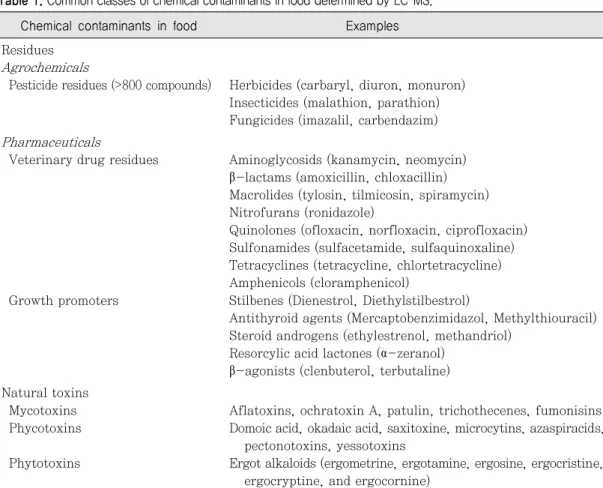
LC-MS는 의학 실험실에서 중요하게 사용되고 있 는 장비이며, 식품 안전성을 테스트하기 위한 용도로 도 응용이 되고 있다. 특히 LC-MS는 식품오염물질을 분석하기에 적합하다. Table 1에서는 LC-MS를 사용 하여 분석 가능한 주요 식품오염물질을 표시하였다.
잔류농약
잔류농약의 분석은 금지된 농약 성분들이 많기 때문에 복잡하다. 10년 전부터 LC-MS를 잔류농약 분석에 이용하였으며, 지난 몇 년간 폭발적으로 사
해외 기술
Table 1. Common classes of chemical contaminants in food determined by LC–MS.
Chemical contaminants in food Examples
Residues Agrochemicals
Pesticide residues (>800 compounds) Herbicides (carbaryl, diuron, monuron) Insecticides (malathion, parathion) Fungicides (imazalil, carbendazim) Pharmaceuticals
Veterinary drug residues Aminoglycosids (kanamycin, neomycin) β-lactams (amoxicillin, chloxacillin) Macrolides (tylosin, tilmicosin, spiramycin) Nitrofurans (ronidazole)
Quinolones (ofloxacin, norfloxacin, ciprofloxacin) Sulfonamides (sulfacetamide, sulfaquinoxaline) Tetracyclines (tetracycline, chlortetracycline) Amphenicols (cloramphenicol)
Growth promoters Stilbenes (Dienestrol, Diethylstilbestrol)
Antithyroid agents (Mercaptobenzimidazol, Methylthiouracil) Steroid androgens (ethylestrenol, methandriol)
Resorcylic acid lactones (α-zeranol) β-agonists (clenbuterol, terbutaline) Natural toxins
Mycotoxins Phycotoxins
Phytotoxins
Aflatoxins, ochratoxin A, patulin, trichothecenes, fumonisins Domoic acid, okadaic acid, saxitoxine, microcytins, azaspiracids,
pectonotoxins, yessotoxins
Ergot alkaloids (ergometrine, ergotamine, ergosine, ergocristine, ergocryptine, and ergocornine)
용이 늘어나고 있다. 또한 잔류농약 분석의 최근 경향은 80가지 이상의 물질을 동시 분석할 수 있는 방법의 개발이다. QqQ, QLT, TOF-MS를 사용한 LC-MS/MS를 통해 여러 성분들을 동시에 분석 가능 하다. QqQ를 사용한 LC-MS/MS의 경우 동시에 분 석할 수 있는 물질의 수에 제한이 있다(scan speed/
dwell time에 따라 100~150개까지). 일반적인 QqQ 장비는 적절한 민감도를 가진 상태에서 약 10~20개 transitions의 최대 동시 기록이 가능하다.
Fast-switching QqQ-MS 장비는 민감도의 손실 없이 각 transition에 대한 dwell time을 줄일 수 있는 장비
이다. 이 장비는 짧은 selected reaction monitoring (SRM) dwell time에서도 높은 signal-to-noise(S/N) 비율을 생성할 수 있고 초고성능 액체크로마토그래 피(ultra-performance liquid chromatography, UPLC) 와 적절히 결합될 수 있다.
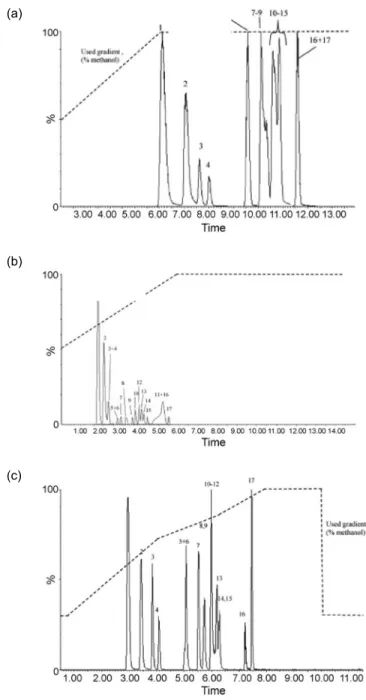
C18 컬럼을 사용한 일반적인 LC는 잔류농약 검사 에 중요한 역할을 하며, 2 μm 이하의 입자로 충진 된 C18 컬럼을 사용한 UPLC는 분석시간과 민감도 를 증가시킬 수 있다. Kovalczuk 등은 LC와 UPLC 를 사용한 LC-MS/MS 시스템에서 17개의 반극성 농약 성분의 비교 분석 실험을 수행하였다. UPLC
방법은 농약성분들에 대한 낮은 검출한계를 보여 주었다. Fig. 1에 LC-MS/MS와 UPLC-MS/MS를 사 용한 17개 반극성 농약 성분의 크로마토그램을 표 시하였다. UPLC-MS/MS 통해서 농약성분을 분석 했을 때 분석시간의 감소로 인해 유기용매를 적게 소비하였다.
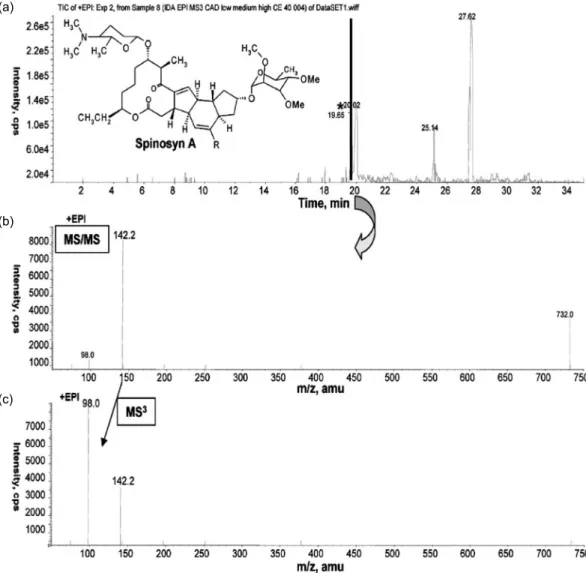
최근에 소개된 hybrid QLT 장비 또한 MS/MS와 함께 사용되고 있다. 이 장비는 정성 ․ 정량분석을 위 한 QqQ mode(SRM mode, neutral loss scan)를 유 지하고 있고 분석물질의 확인이나 미지의 시료 특 성을 분석하기위해 sensitive ion trap과 함께 사용 될 수 있다. Hybrid quadrupole-linear ion trap (QqLIT) 분석기는 MS/MS를 사용한 연구에서 민감 도의 증가를 나타내며 2 SRM transition을 통해 200 개의 물질까지 분석할 수 있다. 작동 mode(증가된 product ion과 MS3)에서는 높은 SRM ratio에 기인 하는 QqQ 장비에 의해 쉽게 확인할 수 없는 낮은 농도에서 빈약한 fragmentation을 갖는 농약성분 들의 확인에 유용하게 사용될 수 있다. 여기에 해 당하는 농약성분 중 하나는 25 SRM ratio를 갖는 spinosyn A이다. 가능성 있는 대안은 증가된 product ion mode 혹은 MS3 mode(linear ion trap으로서 장 비를 사용하는)에서 또 다른 survey scan으로 SRM mode에서 획득된 survey scan을 결합하는 게 타당 하도록 추가적인 survey scan을 발생시킬 수 있는 information-dependent acquisition 실험의 사용이 다. 그래서 하나의 SRM transition은 정량과 분석물 의 확인을 위해 사용될 수 있는 ion trap 장비를 사용하여 얻어진 구조 정보를 위해 사용될 수 있다.
예를 들어 Fig. 2에 spinosyn A를 information- dependent acquisition 실험을 통해 분석한 결과를 표시하였다.
TOF는 full-scan mode로 작동하기 때문에 물질 의 수에 제한이 없는 장점이 있다. UPLC-TOF-MS 는 target databases에 기초하여 정확한 mass 분석과 screening에서 비용 효율이 높고 편리한 방법이다.
TOF-MS 장비의 다른 주요 특징은 비록 SRM mode 로 작동되는 QqQ 장비만큼 sensitive하지는 않지 만 full-scan mode에서 높은 민감도를 보여주는 것이다. 잔류농약 성분들은 TOF-MS를 사용하여 복잡한 matrix에서 pico그램 단위까지 검출될 수 있다. TOF-MS의 민감도는 현재 식품안전에서 요구하는 기준을 충족시킨다. 또한 물질의 식별, 정량, 그리고 동시에 여러 물질의 분석에 응용할 수 있다.
동물용 의약품 및 성장촉진제
식품 생산에 사용되는 동물용 약에는 일반적으로 항생제, 성장촉진제 등이 있다. 가축을 사육할 때 항생제와 성장촉진제를 투여하는 경우가 많아 다양 한 종류의 항생제와 성장촉진제를 동시적으로 분 석할 수 있는 방법에 대한 관심이 증대되고 있다.
LC-MS는 항생제와 성장촉진제 분석에 잘 사용되는 방법으로 Sulfonamides, tetracyclines, quinolones 등 의 항생제 분석에 많이 응용되고 있다. LC-QqQ-MS 는 분석물의 동시 분석 방법의 개발에 시작점이다.
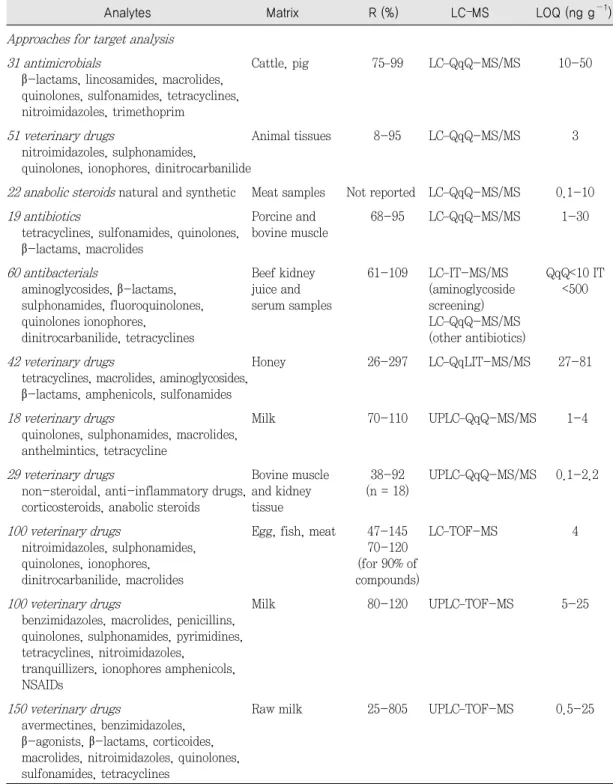
Tandem mass spectrometry 방법을 사용하여 항생 제와 성장촉진제를 분석한 몇 가지 예를 Table 2에 표시하였다. 대부분이 QqQ 방법을 이용하였으며 aminoglycoside residues를 분석하기 위해서만 ion trap 방법을 사용하였다. Ion trap을 사용한 연구에 서도 다른 antibacterials 분석은 QqQ를 사용해서 정
(a)
(b)
(c)
Fig. 1. Chromatogram of apple crude extract spiked with 17 (semi) polar pesticides based on the quantifying MS/MS transitions obtained by (a) HPLC–MS/MS, (b) UPLC–MS/MS when using the same gradient as for HPLC–
MS/MS and (c) UPLC–MS when using a optimized gradient. For illustration, used gradient (% of methanol) is also shown. Peak identification: 1=Carbendazim, 2=Thiabendazole, 3=Carbofuran, 4=Carbaryl, 5=Linuron, 6=Methiocarb, 7=Epoxiconazole, 8=Flusilazole, 9=Diflubenzuron, 10=Tebuconazole, 11=Imazalil, 12=Propiconazole, 13=Triflumuron, 14=Bitertanol, 15=Prochloraz, 16=Teflubenzuron, 17=Flufenoxuron.
(a)
(c) (b)
Fig. 2. Application of LC–MS/MS for the confirmation of spinosyn A, a pesticide with low CID fragmentation in a triple quadrupole, using a hybrid triple quadrupole linear ion trap instrument: (a) total ion chromatogram; (b) enhanced product ion scan mode; and (c) MS3 mode. The combination of survey scans using the SRM, enhanced product ion scan mode, and MS3 modes by means of information-dependent acquisition experiments is very useful for confirmatory purposes.
량하였다. Ion trap을 사용했을 때 검출한계가 QqQ 방법보다 50배 이상 높았다.
관련 없는 부류의 약물은 fast-switching QqQ-MS/
MS와 QqLIT 방법을 통해 분석이 가능하다. 빠른 속도
때문에 UPLC와 fast-switching QqQ-MS/MS의 결합 은 분석시간을 줄이는데 있어 상당한 주목을 받고 있다. LC-MS system은 동물용 의약품, 비스테로이 드성 소염진통제, 스테로이드, 항생제 같은 다른 종
Table 2. Selected LC–MS procedures to determine veterinary drugs and growth promoting agents.
Analytes Matrix R (%) LC–MS LOQ (ng g−1)
Approaches for target analysis 31 antimicrobials
β-lactams, lincosamides, macrolides, quinolones, sulfonamides, tetracyclines, nitroimidazoles, trimethoprim
Cattle, pig 75–99 LC–QqQ-MS/MS 10-50
51 veterinary drugs
nitroimidazoles, sulphonamides, quinolones, ionophores, dinitrocarbanilide
Animal tissues 8-95 LC–QqQ-MS/MS 3
22 anabolic steroids natural and synthetic Meat samples Not reported LC–QqQ-MS/MS 0.1-10 19 antibiotics
tetracyclines, sulfonamides, quinolones, β-lactams, macrolides
Porcine and bovine muscle
68-95 LC–QqQ-MS/MS 1-30
60 antibacterials
aminoglycosides, β-lactams, sulphonamides, fluoroquinolones, quinolones ionophores,
dinitrocarbanilide, tetracyclines
Beef kidney juice and serum samples
61-109 LC–IT-MS/MS (aminoglycoside screening) LC–QqQ-MS/MS (other antibiotics)
QqQ<10 IT
<500
42 veterinary drugs
tetracyclines, macrolides, aminoglycosides, β-lactams, amphenicols, sulfonamides
Honey 26-297 LC–QqLIT-MS/MS 27-81
18 veterinary drugs
quinolones, sulphonamides, macrolides, anthelmintics, tetracycline
Milk 70-110 UPLC–QqQ-MS/MS 1-4
29 veterinary drugs
non-steroidal, anti-inflammatory drugs, corticosteroids, anabolic steroids
Bovine muscle and kidney tissue
38-92 (n = 18)
UPLC–QqQ-MS/MS 0.1-2.2
100 veterinary drugs
nitroimidazoles, sulphonamides, quinolones, ionophores, dinitrocarbanilide, macrolides
Egg, fish, meat 47-145 70-120 (for 90% of compounds)
LC–TOF-MS 4
100 veterinary drugs
benzimidazoles, macrolides, penicillins, quinolones, sulphonamides, pyrimidines, tetracyclines, nitroimidazoles,
tranquillizers, ionophores amphenicols, NSAIDs
Milk 80-120 UPLC–TOF-MS 5-25
150 veterinary drugs
avermectines, benzimidazoles, β-agonists, β-lactams, corticoides, macrolides, nitroimidazoles, quinolones, sulfonamides, tetracyclines
Raw milk 25-805 UPLC–TOF-MS 0.5-25
류의 약물 동시 분석에 성공적으로 응용이 되고 있다.
또한 full-scan MS(TOF, LTQ-FTICR 혹은 orbitrap) 의 사용이 주목을 받고 있다. 가장 일반적인 방법 은 TOF-MS이다. 한번의 작동으로 100개 이상의 물 질 분석이 가능하다. 더 powerful한 UPLC-TOF-MS 방법도 항생제와 성장촉진제의 분석에 이미 응용 되고 있으며, 그뿐만 아니라 잔류농약, 진균 독소, 식물 독소 같은 유기오염물질의 분석에도 유용한 툴이 될 수 있다.
자연독
자연독은 식물, 동물, 미생물에 의해 생성되는 천연 유래의 유독 물질이다. 그 중 미생물은 식품부 패와 식품매개질환의 주요한 원인이 되므로 자연 독의 검출은 식품의 질과 안전을 보장하는데 있어 중요한 요소이다. Mycotoxins, marine biotoxins, alkaloid biotoxins 등과 같은 자연독소 검출에 LC-MS가 응용되고 있으나 여전히 UV나 형광검출 기를 함께 이용한다. LC-MS 방법은 잔류농약, 동물 용 의약품, 성장촉진제에 비해 발전이 더딘 편이다.
LC-MS 방법을 이용한 mycotoxins, phycotoxins, alkaloids 등의 자연 독소를 분석한 예를 Table 3에 표시하였다.
Mycotoxins는 많은 종의 fungi에 의해 생성되기 때문에 종류가 다양하다. LC-MS 방법은 구조적 다 양성을 가지는 mycotoxins를 한 번의 작동으로 분 석하는데 있어 적합하다. 주로 LC와 결합된 QqQ 장비가 이용된다. 이 시스템을 사용하여 고구마, 달 걀, 올리브 오일, 곡류, 과일, 야채, 치즈 등에서 trichothecenes (nivalenol, deoxynivalenol, 3-acetyl-
deoxynivalenol, 15-acetyldeoxynivalenol, neo- solaniol, fusarenon-X, diacetoxyscirpenol, HT-2 toxin, T-2 toxin), aflatoxins (aflatoxin-B1, afla- toxin-B2, aflatoxin-G1, aflatoxin-G2), Alternaria toxins (alternariol, alternariol methyl ether and altenuene), fumonisins (fumonisin-B1, fumonisin- B2, fumonisin-B3), ochratoxin A, zearalenone, beauvericin, sterigmatocystin을 포함하는 86가지의 mycotoxins 동시분석 방법이 개발되었다. 또한 15 분 내에 분석 할 수 있는 장점 때문에 QqQ-MS/MS 와 연결된 UPLC 시스템이 인기를 끌고 있다.
LC-TOF-MS는 mycotoxins이 식품에서 낮은 농 도로 존재하고 있기 때문에 LC-QqQ-MS/MS 방 법보다 덜 사용되고 있다. LC-TOF-MS를 정확한 mycotoxins의 분석에 기초하여 fungal 대사체 분 석에 사용한 예가 있다. 또한 mycotoxins를 포함하 는 여러 가지 유기 오염물의 분석에 적합한 범용 추 출방법을 이용해서 UPLC-TOF-MS가 사용되었다. 검 출한계는 0.01~0.05 mg/kg으로 일반적으로 이 수 치는 식품안전을 평가하기 위한 기준치보다 낮다.
Marine toxins는 주로 편모조류에 의해 생성이 되나 조개류, 홍합, 가리비, 굴, 대합조개 등은 소화 기관 내에 많은 양의 독소를 축적하여 식품안전에 큰 위협이 되고 있으며 증상에는 건망증, 설사, 마 비, 신경성 패독 등이 있다. 조개류와 물고기에서 이러한 독소들의 축적은 인체에 심각한 위해를 끼 친다. LC-MS/MS는 domonoic acid, azaspiracids, okadaic acid, dinophysistoxin-2, microcystins, tetradotoxin 등의 phycotoxins의 분석에 적합한 방 법으로 phycotoxins의 제한된 표준품 이용성과 다양 한 종류의 조개류에서 독소들의 동시발생은 분석을 까다롭게 하는 요인이다.
Table 3. Selected LC–MS procedures to determine natural toxins in food.
Analytes Matrix R (%) LC–MS LOQ (ng g−1)
Mycotoxins
8-prenylnaringenin, zearalenone, zearalenol and β-zearalenol
Beer 72.8-107 LC–MS 0.8-38.6
Fusarium mycotoxins, beauvericin and enniatins (A, A1, B, B1)
Eggs 48-79 LC–QqQ-MS/MS 0.01-22.4
Aflatoxins (AFs) B1, B2, G1, and G2 Olive oil 92-107 LC–QqQ-MS/MS 0.04-0.12 Multi-mycotoxin, trichothecenes,
aflatoxins, Alternaria toxins, fumonisins, ochratoxin A, zearalenone, beauvericin, sterigmatocystin
Sweet pepper - LC–QqQ-MS/MS 0.32
12 mycotoxins
Deoxynivalenol, Aflatoxins B1, B2, G1, G2 and M1, Fumonisins B1 and B2, Ochratoxin A, HT-2 and T-2 toxin, Zearalenone
Cereals 70-108 UPLC-QqQ-MS/
MS
0.03-6.30
Several mycotoxins and other food contaminants
Fruits and vegetables
45-100 LC–TOF-MS 1.0-10
Phycotoxins
Azaspiracids Shellfish - LC–QqQ-MS/MS -
Microcystins Cyanobacteria,
Spirulina food products
- LC–QqQ-MS/MS 0.5
Tetradotoxin Marine
gastropod
- LC–IT-MS/MS 100
Domonoic acid Shellfish 81-95 LC–QqQ-MS/MS 0.2
Odakaic acid, dinophysistoxin-2 Mussels - LC–QqQ-MS/MS -
Alkaloids
Pyrrolizidine alkaloids and their N-oxides
Honey - LC–IT-MS 1
Ergot alkaloids Cereal products 62-97 LC–QqQ-MS/MS 0.1-1.0
식품, 사료, 식물에서 존재하는 alkaloid bio- toxins에 대한 관심이 증가하고 있다. 가장 일반적인 alkaloid biotoxins는 ergot, tropane, pyrrolidizine alkaloids 등으로 민감도와 특이성을 갖춘 GC-MS 와 LC-MS를 이용하여 pyrrolidizine alkaloids를
검출한 예가 있다. 그러나 GC-MS는 pyrrolidizine N-oxides의 열적 불안정성 때문에 LC-MS가 적합한 방법으로 인식되고 있다. 곡류에 존재하는 alkaloid 계열 독소인 ergot도 LC-MS/MS 방법으로 분석이 가능하다.
본 내용은 자료출처의 원문을 번역 기술한 것입니다.
결 론
식품 오염물의 분석에 있어 진보된 LC-MS 기술 의 응용은 민감도, 선택성, 특이성에 있어 넓은 범 위에서 이용되고 있다. 그 결과 LC-MS는 식품 오염 물과 잔여물의 분석으로 식품안전에 있어 포괄 평 가 시스템으로 이용되고 있다. 사람의 건강에 나쁜 영향을 주는 식품 오염물이 증가하고 있는 추세에 서 이러한 LC-MS 시스템 응용에 의한 식품 오염물 성분의 검출 및 특성은 식품안전에 있어 중요한 요 소이다. 가장 중요한 경향 중의 하나는 여러 종류 의 매질로부터 잔류농약, 식물 독소, 곰팡이 독소, 동물용 약품 등의 많은 오염물을 추출하고 동시에 검출할 수 있는 범용 방법을 개발하는 것이다.
● 자료출처 ●
Malik AK, Blasco C, Picó Y, Liquid chromato- graphy-mass spectrometry in food safety, J Chromatogr A, 1217(25), 4018-4040, 2010
하 상 근 의과학박사 소 속 :
전 문 분 야 : E - m a i l : T E L :
한국식품연구원 신소재연구단 천연물화학
[email protected] 031-780-9358