Kor. J Appl. Microbiol. Biofech Vol. 18, No. 2, 159-164 β99ω
호알카리 성 Bacillus 속 균주가 생산하는 Alkaline Protease 의 특성
김태호
•박성희
•이동선
•권택규
•김종국
•흥순덕*
경북대학교 자연과학대학 미생물학과
Properties of Alkaline Protease Produced by an Alkalopbilic Bacillus Sp.
Kim Tae-Ho, Sung-Hee Park, Dong-Sun Lee, ’faeg-Kyu Kwon, Jong-Kuk Kim and Soon-Duck Hong *
Department of Microbiology, College of Natural Science, Kyung-Pook, National University, Taegu 702-701 Korea
A bacterial strain no. K-9
,
which was capable of producing alkaline protease in the alkaline culture conditions, was isolated from soil. The isolated strain was identified to belong to the genus Bacillus.The range of pH and temperature for growth was between 8 and 11.5, and up to 450C, respectively.
The enzyme was purified about 20 folds with 12% yields by the following continous treatment of 60%
ammonium sulfate precipitation, DEAE-cellulose, Bio-gel P-150 chromatography. The optimal pH and temperature of the enzyme was 10 and 60oC
,
respectively.•The stable range of pH was from 8 to 11.Enzyme activity was lost up to 40% on heating at 600C for 30 minutes. The activation energy calculated by Arrhenius equation was 12.15 kcallmole, and Km value for casein was 10 mg/ml. Ag+ and Hg+ + among metal ions inhibited the enzyme in the final concentration of 1 mM, but Cu + + promoted at 1 mM.
미생물의 대부분은 상온에서 약산성 내지 중성뱅위에 서 잘 생육하고 있다는 것이 오래 전부터 잘 알려져 왔 고, 그 생 산물도 이와 같은 조건에서 만들어진 것이 대 부분이 다. 그러 나, 알카리성 미생울이 생산하는 새로운 형태의 효소검색과 그 이용에 대한 연구가 진행됨에 따 라 종래의 효소와는 상이한 성질을 가진 많은 효소 (1-4) 를 발견하게 되었다. 단백 질 분해효소는
cheese제조,
식육의 연 화, 주류의 흔탁방지 , 피혁가공 , 제빵공업 등 여러 목적에 이용되고 있으며 , 특히 알카리성
protease는 주로 세제 빛 피혁공업에 널리 이용되고 있다. 단백 질 분해 효소는 그 활성과 기능적 연에서 분류한
Hartly (5)분류법 에 의하면
seríne protease, thíol-protease, metal protease등으로 분류되며
,그 작용
pH영역에 따 라 삭성 , 중성 및 알카라성 protease 로 분류된다. 알차 리 성 protease 는 반응 최적 pH 가 알카리 영역인 효소
Key words: Protease, alkaline protease, alkalophilic bacillus sp.
*Corresponding author
159
플 말하며 , 호알카라성 세균에 의한 알카리성
protease는
1971년
Horíkoshí등 (6) 이 최초로 보고하였고 이 어 서
1972년
Aunstrup등
(7)이 보고한 이 래 많은 종류의 세균 (8
)빛 방선균 (9 ,
10)등에서 보고되고 있으며 , 그 중요성이 날로 증대되고 있다. 본 실험에서는 알카라 성 protease 를 분비하는 미생물을 분리하여 동정하고 그 특 성을 검토하였으며, 효소의 생성조건 벚 생성된 효소의 부분정제와 효소의 성질을 검토하였다.
재료 및 방법
사용배지
알카리성
protease생성균의 분리에는 I 배지의
polypeptone대신에
skimmilk 를 넣어 시용하였다 . Na 2 C0 3 는 따로 잘균하여 배지에 첨가하였다.
알카리성
protease를 분비하는 호알카리성 세균의 분
리
160
알카리성
protease생성균을 분리하기 위하여 토양 및 폐수를 균 분리용 시료로 채취하여 agar 를
1.5%첨가한
I배지십써1 도말하여 30'C 에서 배양한 후, 투명대의 크기 로 선별하여 K-9 이라 명명하였다.
선정 균의 균학적 성상
선정균의 형태적, 생리적, 배양에 대한 성상을 기초로 하여 분류 (11 ,
12),동정하였다.
효소활성의 측정
효소활성 의 측 정 은 1.
5% Hammarsten casein (pH 10.4)1.0ml 에 효소액
0.1 ml 플가하고 58'C 에서 30 분 간 반응시킨 후
0.4 MTCA
2.0ml 를 가하여 반응을 정 지시켰다. 미분해 casem 의 침전생성을 위해 20 분간 방 치한 후, 원심분리하여 .J.J-등액 0.5ml 와
O.4M Na2C032.5ml 플 흔합한 후, Folin-ciocalteu 액 0.5ml 를 첨가 하여 40'C 에서 20 분간 발색시켜 660nm 에서 흡광도를 측정하였다. Blank 는 상법에 준하여 효소와 침전시약의 첨가순서를 역으로 하였다. 효소역가는 위의 조건에서 casem 으로부터 l 분당 반응액 1. 0ml 에 lμg 의
tyrosine을 유리하는데 필요한 효소의 양으로 규정하였 으며, 벼활성도는 단백질 mg 당 효소의 umt 로 표시하 였다.
단백질의 정량
Bovine serum albumin
을 표준단백질로 하여
Lowry등 (13) 의 방법에 따라 정량하였으며,
chromatography과정 (14) 에서는 280nm 에서의 흡광도후 나타내었다.
효소의 정 제
Ammonium sulfate 침
전
: 배양액을 원심분리한후 상 둥액에
ammonium sulfate를
60%포화되 게 넣고
4'C에서 5 시간방치한후 1O,000rpm 에서 10 분간 원심분리 하였다. 이상에서 얻은 침전울을 소량의 완충액
(20mM Tris-HCl, pH8.8) 으로 용해시킨 후
cellophanetube 에 넣고,
3 mM Tris-HCl완충액 (pH8.8)~로 4'C 에서
48시간 투석하였다. 이 때
cellulase에 의 한 투석막의 분해 는관찰되지 않았다.
DEAE-cellulose chromatography :
투석 한 효소액을
20 mMTris-HCl완충액 (pH8.8) 으로 평형화한
DEAE- cellulose column (2.3 cmX 30cm) 에 넣고 동일 완충액 부로 비흉착 단백질을 충분히 씻어낸 후, 흡착 단백질 부분을
0.05M빛
O.lMNaCl 을 포함한 완충액으로 순 차적으호용출하였다.
Kor. ]. Appl. Microbiol. Biotech.
Bio-gel P-150 column chromatography: D EAE-cel.
lulose column chromatography 로 분획한 효소액을
농 축한 후
20 mM Tris-HCl완충액 (pH8. 8)~로 평형 화시 킨
Bio-gel P-150column(2cmX60cm) 에 넣고 용출하 였다.
결과 및 고찰
분리균의 균학적 성상
분리균 K-9 은 간형이고 호기성이며 포자를 형성하였 고
, Gram양성이며 운동성이 있었다. 또한 starch 와 gelatin 을 액화하였고 catalase 와 oxidase 를 생산하였 다. 위의 결과로 보아
Bacillus속에 속하는 세균인 것A 로 추정된다. 이 세균의 주된 특정은 알카리 배지에서 생육이 특히 양호하며, 생육최척 pH 는 10 부근이었다.
pH7.0 에서는 생육이 불가능하나,
NaCl첨가시 생육이 촉진되었으며,
4%첨가시 생육이 가장 촉진되었다. 이 와 같은 결과는
Horikoshi등이 보고한 내용과 같았다.
그외의 여러 가지 성질은
Table1 과 2 에 나타내었다.
Table 1. Morphological and cultural characteristics of the-isolated strain K-9.
1. Morphological characteristics
Forrn Rods
Motility Motile
Gram strain +
Spore +
2. Culture characteristics
pH7 pH 10.4a
Nurient broth ++
Nurient agar slant + ++
Peptone water ++
Glucose nutrient broth +
Glucose nutrient agar slant + Glucose asparagine agar
I medium ++
I mediwn containing 7.5% NaCl ++ ++
3. pH and temperature for growth
pH for growth in I-mediumb pH 8 to pH 11.5
Temperature for growth in I-mediwn, up to 450C at pH 10.4 a NazC03 (1 %) was added to the media.
b pH in the I-medium was adjusted by adding 5 N NaOH.
- indicate no growth: +, poor growth: + +, normal growth.
161
0.4 E 잉 ζ〉
0.3 g;j Q
。 낌
0.2
핑
。
」
A
0.1 Vol.‘ 18, No. 2
Table 2. Physiological characteristics of the isolated strain K-9.
80
40
-g~→m
〕겸섭 -갑’〉강。」
R0
20 40 60
Fraction No. (3 mlltube)
Fig. 2. Elution pattern of alkaline protease on Bio-Gel P-150 gel filtration.
e_; activity, 0밍 ; protein 0
Positive Positive Negative Netative Negative Positive Positive Positive Not clear Negative Positive Positive Hydrolysis of gelatin and casein
Hydrolysis of starch
Utilization of citrate on simmons citrate citrate agar
Production of ammonia from peptone Reduction of nitrate to nitrite
Anaerobic production of gas from nitrate Production of indole
Production of hydrogen sulfide Catalase and oxidase
Urease
Voges_proskauer test Methyl red test
높은 분획 (No. 1l-40) 을 모아 동결건조한 후, 소량의
20 mM Tris-HCl완충액 (pH8.8) 으로 녹여
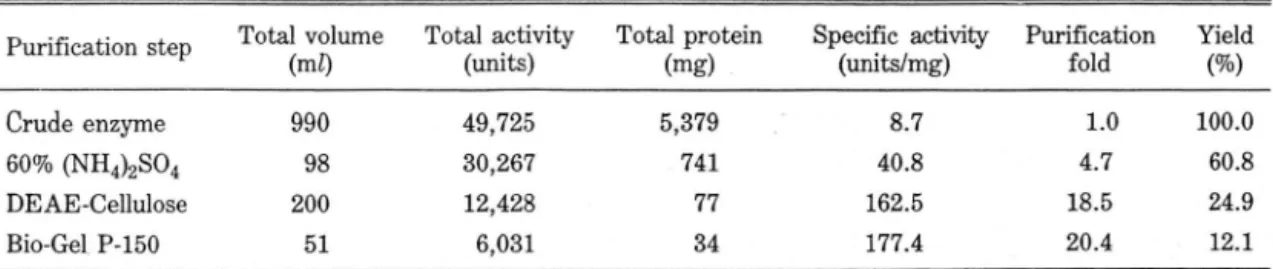
Bio-gel P-150 column 에 넣고 chromatography 한 결괴는 Fig.2 와같다. 이 결과에서 활성단백질은 분획 25-45 벤에서 용 출되었다. 이상의 정제과정을 요약하면
Table 3 과같 다. 효소의 비활성도는 약 20 배 증가하였으며, 회수율 은 12% 였다.
0.8 g
다
06
§
Q 0.4 s2- g : O2 £ 0.05MNaCl
m@
때
딩〔ζ강성딩【
--Ea
〉김。jR효소적특성
pH 의 영향
: 본 효소의 활성에미치는 pH 의 영 i>J-을 조사하기 위하여 반응액의 pH 를 변화시켜 효소활성을 측정한 결과 반응의 최척 pH 는 10 부근이었다. 또한 효 소의 안정성에 마치는 pH 의 영 i>J-을 조사하기 위하여 효 소액을 여러 pH 의 완충액과 동량 혼합하여 4'C에서
6시간 방치한 후, 그 잔존 활성을 측정한 결과 pH8 에서
11 까지비교적 안정하였다 (Fig.
3).온도의 영향
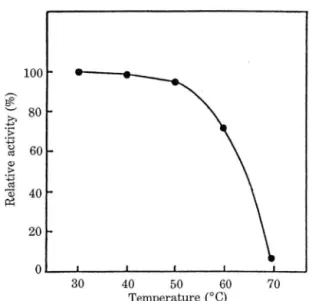
: 효소활성에 대한 최척온도를 조사하기위하여 반응액의 pH 를 10.4 로 조절하고, 각 온도별로
020 40 60 80
Fraction No. (10 ml!tube)
강
Fig. 1. Ëlution pattern of alkaline
prote잃e
on DEAE- c;ellulose colurnn chromatography.e _ ; activity, 0--{)~ protein 0
효소의 부분정제
DEAE-cellulose
column 에 흡착된 단백질은
0‘05M및
O.lM NaCl을 포항한
20 mM Tris-HCl완충액
(pH8.8) 으로 순차적으로 용출시킨 결과
0.05M NaCl농도에 서 활성단백질이 용출되었다 (Fig.l)
.이 중에서 활성이
Table 3. Summary of purification procedure of alkaline protease.
Yield (%) Purification
fold Specific acti띠ty
(units/mg) Total protein
(mg) Total activity
(units) Total volume
(ml) Purification step
Crude enzyme 60% (NH4)zS04 DEAE-Cellulose Bio-Gel P-150
100.0 60.8 24.9 12.1 1.0
4.7 18.5 20.4 8.7
40.8 162.5 177.4 5,379
741 77 34 49,725
30,267 12,428 6,031 990
98 200 51
162
100
숱 80
••
+공〉5여」1
60여월。φ40
20 0
5 6 7 8 9 10 11 12
pH
Fig. 3. Optimal pH and pH stability of the alkaline pro- tease. pH 5; Citrate buffer, pH 6; Phosphate buffer, pH 7-9; Tris-HCl buffer, pH 10-13; Glycine-NaOH buffer.
e _ ; Optimal pH
@깅
; pH stability100
80
Ë、
을+〉ζg영j‘
60.여‘φaCq」엉 40
20
0
30 40 50 60 70
Temperature (OC)
Fig.4. Effect of temperature on the activity of alkaline protease.
The reaction was carried out under standard assay condi.
tion except that reaction temperature was varied.
효소활성을 측정한 결과 효소의 반응 최적온도는 60
0C 부 근이었다 (Fig.
4).또한 안정성에 미치는 온도의 영향을 조사하기 위하여
0.1 M Glycine-NaOH완충액
(pH 10.4)과 효소액을 동량 혼합하여 각 온도에서 30 분간 처리한 후 냉각하여 그 잔존활성을 측정한 결과 50
0C 까지는 비 교적 안정하였으나, 60
0C 에서는
40%청도, 70
0C 에서는 대부분 실활되었다 (Fig.
5).효소활성에 미치는 금속이온의 영향
: 여 러 금속이온을Kor. j. Appl. Microbiol. Biotech
100
응)(
80.++〉s§→」、
60휩4a〉C」Sj
4020
0
30 40 50 60 70
Temperature (oC)
Fig. 5. Effect of temperature on the stability of alkaline protease.
Enzyme solution in 0.5 M Glycine-NaOH buffer (pH 10.4) was heated at various temperatures for 30 minutes. After heating, the remaining activities were determined under the standard assay condition‘
Table 4. Effect of metal ions on protease activity.
Metal ions Relative
(1 mM) activity (%)
None 100.0
Ca2+ 110.6
Mg2+ 107.3
C02+ 107.3
Fe2+ 88.3
Ba2+ 105.8
K+ 98.9
Na+ 100.5
Hg2+ 56.4
Cu2+ 121.6
Ni2+ 106.2
Li+ 97.9
Ag+ 78.4
Metal ions were added to the final concentration of 1 mM and were used as chloride salts except for Ag+, nitrate, Fe2+, sulfate.
최종농도가
1mM이 되도록 반응액에 첨가하여 효소활 성을 측정한 결과, Hg++와 Ag+는 각각
44%와
22%를 저해하였으며, Cu++는 다소 촉진시키는 결과를 나타
내였으며, 그외의 금속이온은 별다은 영힘t을 미치지 못
Vol. 18, No. 2
Table 5. Substrate specificity of alkaline protease.
Substrate Relative
acti꺼ty
(%)Casein 100
Hemoglobin 57
Egg albumin 8
Bovine albumin 51
Substrate specificity was measured on 1.5% of each substrate and expressed as relative activity to that of casem.
<1>
김 CIl
。 ι에
E녁
〉、0.15
bJl 0.10 ì:: ~
E E
1>
0.05-0.1 0 0.1 0.2 0.4
표 (mllmg)
10.8
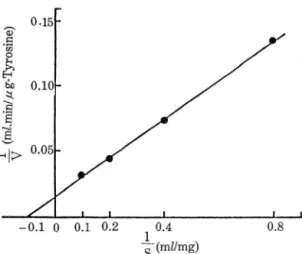
Fig. 6. Lineweaver-Burl
‘
plot of various concentrations of casein on the enzyme reaction rate.Velocity (V) was expressed in μg-Tyrosine per ml of en zyme solution at 580C per minute.
했다
(Table 4). EDTA와 같은 금속
chelating agent 나 p-chloromercuribenzoate 와같은
thiol agent에 의 한 저해를 받지 않A나 senne 말단과 작용하는
diisopropyl phosphorofluoridate (DFD)에 강한 저
해작용을 받기 때문에
senne잔기를 갖고 있음을 알 수 있
다. 지금까지 연구된 거의 모든 알카라 성
protease는
senne말단과 작용하는
PMSF (phenylmethyl sul- phonyl fluoride)빛 DFD 에 의하여 활성을 소실하므후
。l 단백질의 활성부위의 중앙에
senne기를 가지고 있다 고알려져 있다.
기질 특이성
·본 효소의 기질 특이성을 조사하기 위하 여
1.5%농도의 각종 기 질에 대하여 효소활성을 측정한 결과 casem 을 가장 잘 분해하였다 (Table
5).기질농도의 영향
:Casein 을
기질로하여 기질농도에 따른 효소활성을 측정하여 Lineweave
r -Burk방법
(15,16) 에 따라 plot 한 결과 casem 에 대한 Km치는
10163
mg/ml
이었다 (Fig.6) .
요 약
알카리성 protease 를 강력히 분비하는 호알카라성
세 균을분리 하여 Bacillμs
sp로 동정하였다.
0] 균의증
식 가능pH 는
8-11.5정도。l 며,
pHlO 부근에서증식이 가장 양호하였다. 또한,
NaCl첨가시 생육이 촉진되었 으며
, 7%의 농도에서도 생육이 가능하였다. 효소의 성 질을 검토하기 위하여
60% ammonium sulfate칭천,
DEAE-cellulose
및
Bio-gel P-150 column chromato-graphy 를 통하여 정제하였다. 이 때 비활성도는 20 배 증가하였으며, 수율은 약
12% 였다. 이 효소의 최적온도 맞 pH 는 각각 60
0C 와
pHlO 부근이었으며, pH 안정성은
8-11까지 비교적 안정하였다. 열에 대한 안전성은
pH
10.4에서
600C,30 분의 열처리로 약 40% 의 활성이 감소하였다. 금속염 중
Hg++와Ag+는
lmM농도에서 각각 약 44% 와 22% 를 저해하였으며 Cu++에 의해서 는 약간의 활성저해를 보였다. Casein 에 대한 Km치는
lOmg/ml이 었다.
참고문헌
1. Horikoshi, K. and T. Akiba: “Alkalophilic microorganisms", Springer -Verlag, Heidelberg (1982).
2. Horikoshi, K.: Agric. Biol. Chem., 36, 286-293 (1972).
3. Fumiyasu, F., K. Toshiaki and K. Horikoshi: J. Gen.
Microbiol., 131, 3330-3335 (1976)
4. Takasaki, S., T. Akiba and K. Horikoshi: Agric. Biol.
Chem., 40, 1363-1367 (1976).
5. Hartly, B.S.: Ann. Rev. Biochem., 29,459 (1960) 6. Horikoshi, K.: Agric. Biol. Chem., 35, 1407 (1971) 7. Aunstrup, K., H. Outtrup, O. Anderson and C. Damb-
mann: Proceeding 01 the 4th International Fermentation Symposium, p.229 (1972).
8. Sadanobu, T., T. Takami, Y. Horose and K. Mitsugi: Agric. Biol. Chem.
,
39,
1749-1755 (1975).9. Toshihiro, N., Y. Matsumura, N. Minamura and T.
Yamamoto: Agric. Biol. Chem., 38, 37-44 (1974).
10. Kiyoshi, M. and F. Yoshida: J. Biol. Chem., 33, 6978-6984 (1972).
11. Gordon, R.E., W.C. Haynes and C.H.N. Pang: “The Genus Bacillus'’, United States Department of Agriculture, Washinton D.C. (1973).
12. Krieg, N.R. and J.G. Holt: “Bergey’s manual of systematic bacteriology", Vol.lI (1984).
13. Lowry, O.H., N.J. Rosenbrough, A.L. Farr and R.J.
Randall: J. Biol. Chem.
,
193,
265-275 (1951).164 Kor. J Appl. Mùγ"Obiol. Biotech‘
14. Cooper, T.G.: “The tools of Biochemistry", John Wiley 16. Lineweaver, H. and D. Burk: J. Amer. Chem. Soc .• 56,
and Sons, New York (1977). 658-666 (1934).
15. Segal, I.H.: “Biologica1 ca1culation", 2nd ed., John (Received February 7,
1옛깨)
Wiley and Sons, New York (1975).