75
비피도박테리움 롱검의 기능성과 치즈 제조에 활용
김현욱․정석근․함준상* 농촌진흥청 국립축산과학원
Functional Properties of Bifidobacterium longum and Their Incorporation into Cheese Making Process
Hyoun Wook Kim, Seok Geun Jeong and Jun-Sang Ham* National Institute of Animal Science, RDA, Wanju 55365, Korea
Abstract
Members of the genus Bifidobacterium are prevalent in the human colon and represent up to 90% of all bacteria in fecal samples of breast-fed infants, and 3~5% of adult fecal microbiota. Bifidobacteria produce organic acids, thus reducing the colon pH to a level inhibitory for pathogenic bacteria. They can also detoxify a number of toxic compounds and adhere to the colon mucosa, thus preventing the adherence of pathogens and induction of colon cancer. Recently, we identified a novel Bifidobacterium longum subsp. longum strain, KACC 91563, in a fecal sample of a Korean neonate, and demon- strated its functional properties. We showed that B. longum KACC 91563 alleviates food allergy through mast cell suppression and produces antioxidative and antihypertensive peptides by casein hydrolysis. Dairy products are considered as an ideal food system for the delivery of probiotic cultures to the human gastrointestinal tract. Cheese affords protection to probiotic microbes during gastric transit due to its relatively high pH, more solid consistency, higher fat content, and higher buffering capacity. Incorporation of B. longum KACC 91563 into cheese making is currently under study.
Keywords: Bifidobacterium longum subsp. longum, probiotics, cheese
* Corresponding author: Jun-Sang Ham, National Institute of Animal Science, RDA, Wanju 55365, Korea. Tel: +82-63- 238-7366, Fax: +82-63-238-7397, E-mail: [email protected]
서 론
Bifidobacterium 속은 인체 장내 우점균으로 모유 수유아
분변의 최대 90%, 성인에서는 3~5%를 차지한다(Harmsen et al., 2002; Harmsen et al., 2000). Bifidobacterium 속에는 32종이 알 려져 있고(Balleste and Blanch, 2011). 이들 중 Bif. longum은 모유 수유아의 우점종으로 알려져 있다(Favier et al., 2003;
Favier et al., 2002). Bif. longum, Bif. infantis, 그리고 Bif. suis 는 Bif. longum으로 통합이 주장되었으나(Sakata et al., 2002), Mattarelli 등(2008)은 subspecies를 사용하여 Bif. longum subsp.
longum, Bif. longum subsp. infantis, 그리고 Bif. longum subsp.
suis로 분류할 것을 주장하였다. 비피도박테리아는 대장에서 바람직한 변화를 유발하기 때문에 프로바이오틱스로 간주되 고 있다. 비피도박테리아는 유기산을 생산하여 병원균을 억 제하는 수준으로 대장의 pH를 낮춘다(Ballongue, 1998). 또한, 여러 가지 독성 화합물의 독성을 제거할 수 있고(Ballongue, 1998; Hartemink et al., 1996), 대장 점막에 부착하여 병원균 부착과 대장암 발생을 방지한다(Ballongue, 1998; Gallaher and Khil, 1999; Hartemink et al., 1996; Van Laere et al., 1999). 최 근 비피도박테리아에 대한 관심 증가는 비피도박테리아의 존재가 건강한 미생물 균총과 관련이 있는 여러 가지 건강 기능성 때문이며, 이러한 건강증진 박테리아를 기능성 식품 에 활용하는데 많은 관심이 있다(Rezzonico et al., 2007). 비록 많은 건강 주장이 과학적으로 확증되지 않았지만, 몇몇 연구 는 비피도박테리아의 섭취가 건강에 유익할 수 있다고 제안
한다. 유익한 효과를 얻기 위해서는 소비시에 식품내에 높은 수자가 살아있어야 한다. 일본에서 발효유와 유산균 협회는 제품 1그람당 최소 107 생균수를 권장한다(Mc Brearthet al.,
2001). 비피도박테리아 관련 잠재적 건강주장은 스트레인에
따라 다르며(Roy, 2005), 스트레인이 제품의 제조공정과 유 통기한동안 살아남는 것이 중요하다. 비피도박테리아가 유제 품에 프로바이오틱스로 사용될 때 산소 노출, 기계적 교반, 온도 변화, 그리고 pH 변화와 같은 스트레스를 받게 된다. 최 종 제품에서 비피도박테리아의 생존은 비피도박테리아의 스트레 인, 저장 온도, 그리고 보존 방법에 따라 달라진다(Blanchette
et al., 1995). 냉장온도에서 유제품 내 비피도박테리아의 생존
성 유지는 많은 발효유제품에서 문제가 되고 있다(Corbo et
al., 2001). 비피도박테리아가 강화된 치즈의 생산은 발효유보
다 적절하고 가능성 있는 대안이 될 것이라 제안한바 있다 (Stanton et al., 1998). 비피도박테리아를 치즈 제조에 활용하 면 가공 및 숙성중 비피도박테리아의 장기 생존에 바람직한 pH, 지질 함량, 산소 수준, 그리고 저장 조건이 되어 생존성 이 개선될 수 있다(Dinakar and Mistry, 1994; Stanton et al., 1998; Boylston et al., 2004). 게다가, 숙성 중 치즈는 거의 산 소가 없는 상태가 되어 비피도박테리아와 같은 혐기성 미생물 의 생존에 좋은 조건이 될 수 있다고 하였다(van den Tempel et al., 2002). 본 고에서는 한국인 신생아에서 분리한 Bif. longum subsp. longum KACC 91563(Ham et al., 2011)의 기능성을 소 개하고, 비피도박테리아를 이용한 치즈 제조 관련 연구를 고 찰하고자 한다.
본 론
1. 케이신을 분해하여 항산화 펩타이드 생산
케이신과 유청 단백질과 같은 우유 단백질이 유산균의 단 백질분해 시스템에 의해 생리활성 펩타이드를 생산하는 전 구 단백질이라는 것은 잘 알려져 있으며, 유산균에 의한 우유 유래 생리활성 펩타이드 생산은 잘 보고되어 있다(Hayes et al., 2007; Sadat-Mekmene et al., 2011; Chang et al., 2012; Miclo
et al., 2012). 생리활성 펩타이드 중에서 항산화 특성은 활성
산소 수준 증가가 암, DNA 손상, 당뇨, 심혈관질환, 알레르기 및 노화를 일으키므로 중요하다(Wolff et al., 1991; Beckman and Ames, 1998; Agerholm-Larsen et al., 2000). 비피도박테리 아에 의한 생리활성 펩타이드는 거의 보고되지 않았다. Bif.
animalis ssp. lactis strain Bb12로 발효시킨 케이신 분해물과 Bif. psedocatenulatum G4(또는 Bifidobacterium longum BB536) 함유 요구르의 콜레스테롤 저감효과가 보고된바 있으며(Alhaj et al., 2010; Al-Sheraji et al., 2012), Chang 등(2013)이 Bif.
longum KACC 91563의 발효에 의해 케이신에서 항산화 펩타
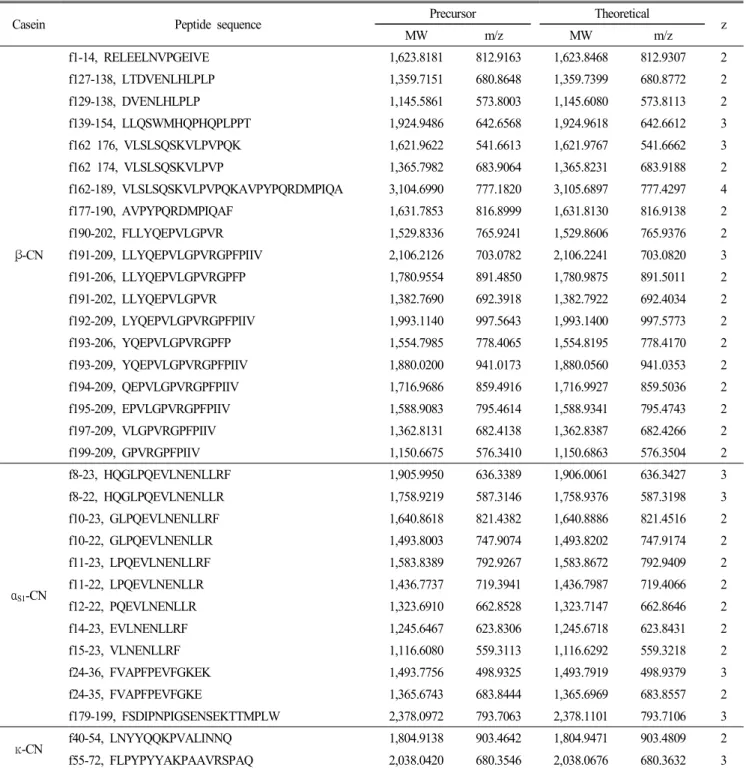
이드 생산 가능성을 보고하였다. Bif. longum KACC 91563을 케이신 단백질과 배양시 3 kDa 이하 분획에서 높은 항산화 활성을 나타내어 다양한 펩타이드를 동정하였다(Table 1). 이중 VLSLSQSKVLPVPQK와 VLSLSQSKVLPVPQKAVPYPQRDMPIQA 이 β-케이신에서 유래한 항산화 펩타이드로 동정되었다.
2. 우유 단백질을 분해하여 항고혈압 펩타이드 생산
Bif. longum Bl 536의 생리활성 펩타이드가 In vitro ACE (Angiotensin I-converting enzyme) 억제 활성을 나타내었다고 보고된바 있으나(Donkor et al., 2007), 펩타이드는 동정되지 않았다. ACE가 angiotensin I에서 angiotensin II로의 전환이나 bradykinin 가수분해에 의해 혈압을 증가시키므로(Gobbetti et al., 2000; Miguel et al., 2009; Petrillo and Ondetti, 1982), ACE 활성의 억제는 고혈압 환자의 치료에 중요한 요소로 간주되 고 있다. 최근에 LVYPFP를 포함하는 새로운 ACE 억제 펩타 이드가 Bif. bifidum에서 발견되었고(Gonzalez-Gonzalez et al., 2013), Bif. longum KACC 91563에 대하여 Ha 등(2015)이 보 고하였다. Bif. longum KACC 91563으로 환원 탈지유를 발효 시 3 kDa 이하 분획에서 62.3%의 ACE 억제 활성을 나타내어 Bif. longum Bl 536(Donkor et al., 2007)의 63.7%와 유사한 활 성을 나타내었으며, 3 kDa 이하 분획에서 3개의 ACE 억제활 성 펩타이드(YQEPVLGPVRGPFPIIV, QEPVLGPVRGPFPIIV, GPVRGPFPIIV)(Yamamoto et al., 1994; Gobbetti et al., 2002;
Gomez-Ruiz et al., 2002)가 동정되었다. 높은 ACE 억제활성 을 갖는 펩타이드는 C-terminal 말단에 Trp, Phe, Tyr, 또는 Pro, N-terminal 말단에 Ala, Val, Ile 및 Ser을 함유한다는 보고(Jao et al., 2012)에서와 같이 이들 펩타이드가 함유되어 있었다.
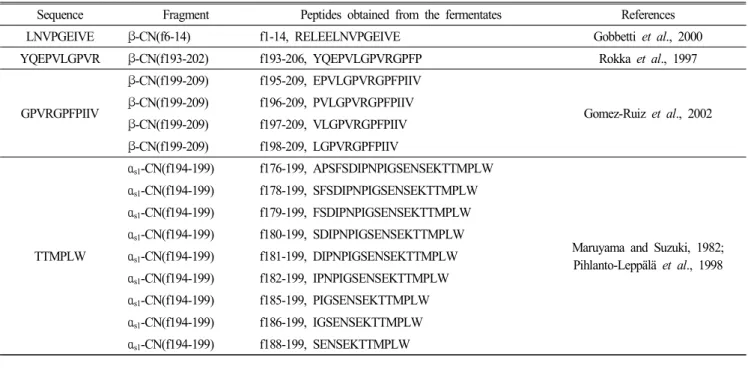
또한, 기존에 보고된 항산화 펩타이드 서열을 함유하여 ACE 억 제 활성을 나타낼 가능성이 있는 수 있는 15개의 펩타이드를 동 정하였다(Table 2). 이중 SDIPNPIGSENSEKTTMPLW는 우유내 에 자연적으로 존재하는 항고혈압 펩타이드로 보고된바 있 다(Islam et al., 2014).
3. 식품 알레르기 경감
식품 알레르기는 식품이나 식품 첨가물에 비정상적 면역 반응에 의해 발생되는 잠재적으로 심각한 질환으로 최근 식 품 알레르기로 인한 병원 방문이 급격히 증가하고 있다 (Branum and Lukacs, 2009). 비록 땅콩, 우유, 조개류, 그리고 밀 등이 식품 알레르기를 유발한다는 것은 오래전부터 알려 졌지만, 발생 요인들은 명확하게 구명되지 못했다(Sicherer and Sampson, 2009). 알레르기 발생식품의 회피가 가장 널리 사 용되는 치료법이나(Sampson, 1999), 프로바이오틱스에 의한 치료도 시도되고 있다(Bermi et al., 2012). 최근 연구에서 프 로바이오틱 박테리아는 숙주 면역체계에 영양을 미쳐 염증
Casein Peptide sequence Precursor Theoretical
MW m/z MW m/z z
β-CN
f1-14, RELEELNVPGEIVE 1,623.8181 812.9163 1,623.8468 812.9307 2
f127-138, LTDVENLHLPLP 1,359.7151 680.8648 1,359.7399 680.8772 2
f129-138, DVENLHLPLP 1,145.5861 573.8003 1,145.6080 573.8113 2
f139-154, LLQSWMHQPHQPLPPT 1,924.9486 642.6568 1,924.9618 642.6612 3
f162 176, VLSLSQSKVLPVPQK 1,621.9622 541.6613 1,621.9767 541.6662 3
f162 174, VLSLSQSKVLPVP 1,365.7982 683.9064 1,365.8231 683.9188 2
f162-189, VLSLSQSKVLPVPQKAVPYPQRDMPIQA 3,104.6990 777.1820 3,105.6897 777.4297 4
f177-190, AVPYPQRDMPIQAF 1,631.7853 816.8999 1,631.8130 816.9138 2
f190-202, FLLYQEPVLGPVR 1,529.8336 765.9241 1,529.8606 765.9376 2
f191-209, LLYQEPVLGPVRGPFPIIV 2,106.2126 703.0782 2,106.2241 703.0820 3
f191-206, LLYQEPVLGPVRGPFP 1,780.9554 891.4850 1,780.9875 891.5011 2
f191-202, LLYQEPVLGPVR 1,382.7690 692.3918 1,382.7922 692.4034 2
f192-209, LYQEPVLGPVRGPFPIIV 1,993.1140 997.5643 1,993.1400 997.5773 2
f193-206, YQEPVLGPVRGPFP 1,554.7985 778.4065 1,554.8195 778.4170 2
f193-209, YQEPVLGPVRGPFPIIV 1,880.0200 941.0173 1,880.0560 941.0353 2
f194-209, QEPVLGPVRGPFPIIV 1,716.9686 859.4916 1,716.9927 859.5036 2
f195-209, EPVLGPVRGPFPIIV 1,588.9083 795.4614 1,588.9341 795.4743 2
f197-209, VLGPVRGPFPIIV 1,362.8131 682.4138 1,362.8387 682.4266 2
f199-209, GPVRGPFPIIV 1,150.6675 576.3410 1,150.6863 576.3504 2
αS1-CN
f8-23, HQGLPQEVLNENLLRF 1,905.9950 636.3389 1,906.0061 636.3427 3
f8-22, HQGLPQEVLNENLLR 1,758.9219 587.3146 1,758.9376 587.3198 3
f10-23, GLPQEVLNENLLRF 1,640.8618 821.4382 1,640.8886 821.4516 2
f10-22, GLPQEVLNENLLR 1,493.8003 747.9074 1,493.8202 747.9174 2
f11-23, LPQEVLNENLLRF 1,583.8389 792.9267 1,583.8672 792.9409 2
f11-22, LPQEVLNENLLR 1,436.7737 719.3941 1,436.7987 719.4066 2
f12-22, PQEVLNENLLR 1,323.6910 662.8528 1,323.7147 662.8646 2
f14-23, EVLNENLLRF 1,245.6467 623.8306 1,245.6718 623.8431 2
f15-23, VLNENLLRF 1,116.6080 559.3113 1,116.6292 559.3218 2
f24-36, FVAPFPEVFGKEK 1,493.7756 498.9325 1,493.7919 498.9379 3
f24-35, FVAPFPEVFGKE 1,365.6743 683.8444 1,365.6969 683.8557 2
f179-199, FSDIPNPIGSENSEKTTMPLW 2,378.0972 793.7063 2,378.1101 793.7106 3
κ-CN f40-54, LNYYQQKPVALINNQ 1,804.9138 903.4642 1,804.9471 903.4809 2
f55-72, FLPYPYYAKPAAVRSPAQ 2,038.0420 680.3546 2,038.0676 680.3632 3
1MW = molecular weight; m/z = mass to change ratio, where z = number of positively charged ions.
Table 1. Casein-derived peptides identified in the <3 kDa fraction of the casein hydrolysate obtained by fermentation of Bifidobacterium longum KACC 91563 (Chang et al., 2013)
과 알레르기 반응을 억제한다고 제안한다. 예를 들어, Bif.
breve는 IL-10 생산 TRl 세포 유도를 통해 장내 항상성을 증
진하고, 8종의 유산균을 혼합한 VSL#3는 면역반응을 TH2에
서 TH1으로 전환하여 식품알레르기를 억제한다고 보고되었
다(Schiavi et al., 2011). 그런데, Kim 등(2016)은 Bif. longum KACC 91563을 약 한 달간 급여 시 알레르기 발생이 감소하였 는데, 이는 Bif. longum KACC 91563의 EV(extracellular vesicles) 가 활성화된 비만세포(Mast cell)의 사멸(apoptosis)을 일으켰기
Sequence Fragment Peptides obtained from the fermentates References
LNVPGEIVE β-CN(f6-14) f1-14, RELEELNVPGEIVE Gobbetti et al., 2000
YQEPVLGPVR β-CN(f193-202) f193-206, YQEPVLGPVRGPFP Rokka et al., 1997
GPVRGPFPIIV
β-CN(f199-209) f195-209, EPVLGPVRGPFPIIV
Gomez-Ruiz et al., 2002 β-CN(f199-209) f196-209, PVLGPVRGPFPIIV
β-CN(f199-209) f197-209, VLGPVRGPFPIIV β-CN(f199-209) f198-209, LGPVRGPFPIIV
TTMPLW
αs1-CN(f194-199) f176-199, APSFSDIPNPIGSENSEKTTMPLW
Maruyama and Suzuki, 1982;
Pihlanto-Leppälä et al., 1998 αs1-CN(f194-199) f178-199, SFSDIPNPIGSENSEKTTMPLW
αs1-CN(f194-199) f179-199, FSDIPNPIGSENSEKTTMPLW αs1-CN(f194-199) f180-199, SDIPNPIGSENSEKTTMPLW αs1-CN(f194-199) f181-199, DIPNPIGSENSEKTTMPLW αs1-CN(f194-199) f182-199, IPNPIGSENSEKTTMPLW αs1-CN(f194-199) f185-199, PIGSENSEKTTMPLW αs1-CN(f194-199) f186-199, IGSENSEKTTMPLW αs1-CN(f194-199) f188-199, SENSEKTTMPLW
Table 2. Potential antihypertensive peptides generated by fermentation with Bifidobacterium longum KACC 91563 (Ha et al., 2015)
Fig. 1. Suppression of food allergy responses through ESBP, a major protein of B. longum KACC 91563-derived EVs (Kim et al., 2016).
A, Proteins of B. longum KACC 91563 and its EVs were analyzed by using SDS-PAAGE. ESBP and ASBP were identified through proteomic analysis. B, Experimental schedule for food allergy induction and administration of ESBP or ASBP in mice.
C, Abilities of GST-tagged recombinant ESBP or ASBP (50 μg) to suppress allergic diarrhea (OVA+GST vs OVA+ESBP:
***p<.001, n=approximately 6~22 mice per group). Recombinant GST protein-treated mice were used as a positive control. Data are combined from 3 independent experiments. D, Paraffin-embedded sections ofjejunum were stained for mast cells (original magnification ×400). E, The number of mast cells was counted in 4 different fields and represented by a bar graph (n=4 mice per group). Statistical analysis was performed by using 1-way ANOVA with the Newman-Keuls posttest. *p<.05. F, Levels of MCPT-1 in serum (n=approximately 3~6 per group). Data are representative of 2 independent experiments. i.g., Intragastric; i.p., intraperitoneal (Kim et al., 2016)
때문이며, EV에서 분리한 ESBP(Family 5 extracellular solute- binding protein)을 2회 주사 시 알레르기 발생이 40% 감소함 을 보고하였다(Fig. 1).
4. 비피도박테리아를 이용한 치즈 제조
유제품은 프로바이오틱스를 인체에 공급하는 이상적인 식 품 체계로 고려된다(Ross et al., 2002). 치즈 제조에 프로바이 오틱스를 강화하려는 시도로 페타(Kailasapathy and Masondole, 2005), 베야즈(터키식 백색 치즈)(Gursoy and Kinik, 2010; Ozer et al., 2009; Yilmaztekin et al., 2004)와 이란식 백색 치즈 (Mahmoudi et al., 2012) 등 백색염지 치즈(white brined cheese) 에서 많은 연구가 있었다. Dinakar와 Mistry(1994)는 체다치 즈에 비피도박테리아를 첨가하여도 단백질분해 패턴에 영향 이 없었고, 고다 치즈 제조 시에는 비피도박테리아에 의한 아 세트산 생성으로 치즈 풍미에 부정적인 영향이 있다고 보고 된바 있다(Gomes et al., 1995; Gomes and Malcata, 1998). 여 러 가지 형태의 치즈에서 비피도박테리아의 생존성 평가 시 Bif. bifidum과 Bif. longum은 가공 및 저장중 좋은 생존성을 나타내었다(Boylston et al., 2004). Gursoy 등(2014)은 백색 염 지 치즈의 90일 숙성 시 Bif. longum은 치료용 최소 수준(106~ 107 cfu/g 치즈)보다 높은 수준(>107 cfu/g 치즈)으로 생존할 수 있었고, 상업용 치즈 스타터에 포함된 Streptococcus spp.
치즈의 생존에 부정적 영향이 없어 Bif. longum을 첨가한 백 색 염지 치즈가 Bif. longum 섭취에 적절한 식품이라고 주장 하였다.
결 론
비피도박테리아 속은 인체 장내 우점균으로 모유 수유아 분변의 최대 90%, 성인에서는 3~5%를 차지한다고 알려지고 있으며, 유기산을 생산하여 병원균을 억제하는 수준으로 대 장의 pH를 낮춘다. 또한, 여러 가지 독성 화합물의 독성을 제 거할 수 있고, 대장 점막에 부착하여 병원균 부착과 대장암 발생을 방지한다고 알려지고 있다. 최근에 한국인 신생아에 서 분리한 Bif. longum subsp. longum KACC 91563은 ESBP (Family 5 extracellular solute-binding protein)를 생산하여 식 품알레르기를 저감할 뿐만 아니라, 우유 단백질을 분해하여 항산화, 항고혈압 펩타이드를 생산하는 기능성을 나타내었 다. 유제품은 프로바이오틱스를 인체에 공급하는 이상적인 식품 체계로 고려되며, 특히 치즈는 상대적으로 높은 pH, 지 방함량, 버퍼 완충능 등으로 위장 통과 시 프로바이오틱 미생 물 보호효과가 기대되므로 Bif. longum subsp. longum KACC 91563을 이용한 치즈 제조를 진행 중이다.
참고문헌
1. Agerholm-Larsen, L., Raben, A., Haulrik, N., Hansen, A.
S., Manders, M. and Astrup, A. 2000. Effect of 8 weeks intake of probiotic milk products on risk factors for cardio- vascular diseases. Eur. J. Clin. Nutr. 54:288-297.
2. Balleste, E. and Blanch, A. R. 2011. Bifidobacterial diversity and the development of new microbial source tracking indicators. Appl. Environ. Microbiol. 77:3518-3525.
3. Ballongue, J., 1998. Bifidobacteria and probiotic action. In:
Salminen, S., von Wright, A. (Eds.), Lactic acid bacteria— microbiology and functional aspects. Marcel Dekker, New York, pp. 519-587.
4. Beckman, K. B. and Ames, B. N. 1998. The free radical theory of aging matures. Physiol. Rev. 78:547-581.
5. Berni Canani, R., Nocerino, R., Terrin, G., Coruzzo, A., Cosenza, L., Leone, L. and Troncone, R. 2012. Effect of Lactobacillus GG on tolerance acquisition in infants with cow’s milk allergy: A randomized trial. J. Allergy Clin.
Immunol. 129:580-582, e1-5.
6. Blanchette, L., Roy, D. and Gauthier, S. F. 1995. Production of cultured cottage cheese dressing by bifidobacteria. J.
Dairy Sci. 78:1421-1429.
7. Boylston, T. D., Vinderola, C. G., Ghoddusi, H. B. and Reinheimer, J. A. 2004. Incorporation of bifidobacteria into cheeses: Challenges and rewards. Int. Dairy J. 14:375-387.
8. Branum, A. M. and Lukacs, S. L. 2009. Food allergy among children in the United States. Pediatrics 124:1549- 1555.
9. Chang, O. K., Perrin, C., Galia, W., Saulnier, F., Miclo, L., Roux, E., Driou, A., Humbert, G. and Dary, A. 2012.
Release of the cellenvelope protease PrtS in the growth medium of Streptococcus thermophilus 4F44. Int. Dairy J.
23:91-98.
10. Chang, O. K., Seol, K.-H., Jeong, S.-G, Oh, M.-H., Park, B.-Y, Perrin, C. and Ham, J. S. 2013. Casein hydrolysis by Bifidobacterium longum KACC 91563 and antioxidant acti- vities of peptides derived therefrom. J. Dairy Sci. 96:5544- 5555.
11. Corbo, M. R., Albenzio, M., De Angelis, M., Sevi, A. and Gobbetti, M. 2001. Microbiological and biochemical properties of Canestrato Pugliese hard cheese supplemented with bifidobacteria. J. Dairy Sci. 84:551-561.
12. Dinakar, P. and Mistry, V. V. 1994. Growth and viability
of Bifidobacterium bifidum in Cheddar cheese. J. Dairy Sci.
77:2854-2864.
13. Donkor, O. N., Henriksson, A., Singh, T. K., Vasiljevic, T.
and Shah, N. P. 2007 ACE-inhibitory activity of probiotic yoghurt. Int. Dairy J. 17:1321-1331.
14. Favier, C. F., de Vos, W. M. and Akkermans, A. D. L. 2003.
Development of bacterial and bifidobacterial communities in feces of newborn babies. Anaerobe. 9:219-229.
15. Favier, C. F., Vaughan, E. E., De Vos, W. M. and Akkermans, A. D. L. 2002. Molecular monitoring of succession of bac- terial communities in human neonates. Appl. Environ.
Microbiol. 68:219-226.
16. Gallaher, D. G. and Khil, J., 1999. The effect of synbiotics on colon carcinogenesis in rats. J. Nutr. 129:1483S-1487S.
17. Gobbetti, M., Ferranti, P., Smacchi, E., Goffredi, F. and Addeo, F. 2000. Production of angiotensin-I-converting-enzyme- inhibitory peptides in fermented milks started by Lactobacillus delbrueckii subsp. bulgaricus SS1 and Lactococcus lactis subsp. cremoris FT4. Appl. Environ. Microbiol. 66:3898- 3904.
18. Gobbetti, M., Stepaniak, L., De Angelis, M., Corsetti, A.
and Di Cagno, R. 2002. Latent bioactive peptides in milk proteins: Proteolytic activation and significance in dairy processing. Crit. Rev. Food Sci. Nutr. 42:223-239.
19. Gomes, A. M. P. and Malcata, F. X. 1999. Bifidobacterium spp. and Lactobacillus acidophilus: Biological, biochemical, technological and therapeutical properties relevant for use as probiotics. Trends Food Sci. Technol. 10:139-157.
20. Gomes, A. M. P., Malcata, F. X., Claver, F. A. M. and Grande, H. G. 1995. Incorporation of Bifidobacterium sp.
strain Bo and Lactobacillus acidophilus strain Ki in a cheese product. Neth. Milk Dairy J. 49:71-95.
21. Gomez-Ruiz, J. A., Ramos, M. and Recio, I. 2002. Angiotensin- converting enzyme-inhibitory peptides in Manchego cheeses manufactured with different starter cultures. Int. Dairy J.
12:697-706.
22. Gonzalez-Gonzalez, C., Gibson, R. and Jauregi, P. 2013.
Novel probiotic-fermented milk with angiotensin I-converting enzyme inhibitory peptides produced by Bifidobacterium bifidum MF 20/5. Int. J. Food Microbiol. 167:131-137.
23. Gursoy, O. and Kinik, O. 2010. Incorporation of adjunct cultures of Enterococcus faecium, Lactobacillus paracasei subsp. paracasei and Bifidobacterium bifidum into white cheese. J. Food Agric. Environ. 8:107-112.
24. Gursoy, O., Gokce, R., Con, A. H. and Kinik, O. 2014.
Survival of Bifidobacterium longum and its effect on phy- sicochemical properties and sensorial attributes of white brined cheese. Int. J. Food Sci and Nutr. 65(7):816-820.
25. Ha, G. E., Chang, O. K., Jo, S. M., Han, G. S., Park, B.
Y., Ham, J. S. and Jeong, S. G. 2015. Identification of antihypertensive peptides derived from low molecular weight casein hydrolysates generated during fermentation by Bifido- bacterium longum KACC 91563. Korean J. Food Sci. An.
35(6):738-747.
26. Ham, J. S., Lee, T., Byun, M. J., Lee, K. T., Kim, M. K., Han, G. S., Jeong, S. K., Oh, M. H., Kim, D. H. and Kim, H. 2011. Complete genome sequence of Bifidobacterium longum subsp. longum KACC 91563. J. Bacteriol. 193(18):
5044.
27. Harmsen, H. J. M., Raangs, G. C., He, T., Degener, J. E.
and Welling, G. W. 2002. Extensive set of 16S rRNA- based probes for detection of bacteria in human feces. Appl.
Environ. Microbiol. 68:2982-2990.
28. Harmsen, H. J. M., Wildeboer-Veloo, A. C., Raangs, G. C., Wagendorp, A. A., Klijn, N., Bindels, J. G. and Welling, G. W. 2000. Analysis of intestinal flora development in breast-fed and formula-fed infants by using molecular iden- tification and detection methods. J. Pediatr. Gastroenterol.
Nutrition 30:61-67.
29. Hartemink, R., Kok, B. J., Weenk, G. H. and Rombouts, F. M. 1996. Raffinose-Bifidobacterium (RB) agar, a new selective medium for bifidobacteria. J. Microbiol. Methods 27:33-43.
30. Hayes, M., Ross, R. P., Fitzgerald, G. F. and Stanton, C.
2007. Putting microbes to work: Dairy fermentation, cell factories and bioactive peptides. Part II: Bioactive peptide functions. Biotechnol. J. 2:435-449.
31. Islam, M. A., Alam, M. K., Islam, M. N., Khan, M. A. S., Ekeberg, D., Rukke, E. O. and Vegarud, G. E. 2014. Principal milk components in Buffalo, Holstein Cross, Indigenous cattle and Red Chittagong cattle from Bangladesh. Asian-Aust. J.
Anim. Sci. 27:886-897.
32. Jao, C. L., Huang, S. L. and Hsu, K. C. 2012. Angiotensin converting enzyme inhibitory peptides: Inhibition mode, bioavailability, and antihypertensive effects. Biomedicine 2:
130-136.
33. Kailasapathy, K. and Masondole, L. 2005. Survival of free and microencapsulated Lactobacillus acidophilus and Bifido-
bacterium lactis and their effect on texture of Feta cheese.
Aust. J. Dairy Technol. 60:252-258.
34. Kim, J. H., Jeun, E. J., Hong, C. P., Kim, S. H., Jang, M.
S., Lee, E. J., Moon, S. J., Yun, C. H., Im, S. H., Jeong, S. G., Park, B. Y., Kim, K. T., Seoh, J. Y., Kim, Y. K., Oh, S. J., Ham, J. S., Yang, B. G. and Jang M. H. 2016.
Extracellular vesicle-derived protein from Bifidobacterium longum alleviates food allergy through mast cell suppression.
J. Allergy Clin. Immunol. 137:507-516.
35. Mahmoudi, M, Asl, A. K. and Zomorodi, S. 2012. The influence of probiotic bacteria on the properties of Iranian white cheese. Int. J. Dairy Technol. 65:561-567.
36. Mattarelli, P., Bonaparte, C., Pot, B. and Biavati, B. 2008.
Proposal to reclassify the three biotypes of Bifidobacterium longum as three subspecies: Bifidobacterium longum subsp.
longum subsp. nov., Bifidobacterium longum subsp. infantis comb. nov. and Bifidobacterium longum subsp. suis comb.
nov. Int. J. Syst. Evol. Microbiol. 58(4):767-72.
37. Mc Brearty, S., Ross, R. P., Fitzgerald, G. F., Collins, J.
K., Wallace, J. M. and Stanton, C. . 2001. Influence of two commercially available bifidobacteria cultures on Cheddar cheese quality. Int. Dairy J. 11:599-610.
38. Miclo, L., Roux, E., Genay, M., Brusseaux, E., Poirson, C., Jameh, N., Perrin, C. and Dary, A. 2012. Variability of hydrolysis of β-, αs1-, and αs2-caseins by 10 strains of Streptococcus thermophilus and resulting bioactive peptides.
J. Agric. Food Chem. 60:554-565.
39. Miguel, M., Contreras, M. M., Recio, I. and Aleixandre, A.
2009. ACE-inhibitory and antihypertensive properties of a bovine casein hydrolysate. Food Chem. 112:211-214.
40. Mirzaei, H., Pourjafar, H. and Homayouni, A. 2012. Effect of calcium alginate and resistant starch microencapsulation on the survival rate of Lactobacillus acidophilus La5 and sensory properties in Iranian white brined cheese. Food Chem. 132:1966-1970.
41. Ozer, B., Kirmaci, H. A., Senel, E., Atamer, M. and Hayaloglu, A. 2009. Improving the viability of Bifidobacterium bifidum BB-12 and Lactobacillus acidophilus LA-5 in white-brined cheese by microencapsulation. Int. Dairy J. 19:22-29.
42. Petrillo, E. W. and Ondetti, M. A. 1982. Angiotensin-converting enzyme inhibitors: Medicinal chemistry and biological actions.
Med. Res. Rev. 2:1-41.
43. Rezzonico, E., Lariani, S., Barretto, C., Cuanoud, G., Gilberti, G., Delley, M., Arigoni, F. and Pessi., G. 2007. Global
transcriptome analysis of the heat shock response of Bifido- bacterium longum. FEMS Microbiol. Lett. 271:136-145.
44. Ross, R. P., Fitzgerald, G., Collins, K. and Stanton, C. 2002.
Cheese delivering biocultures—probiotic cheese. Aust. J.
Dairy Technol. 57:71-78.
45. Roy, D. 2005. Technological aspects related to the use of bifidobacteria in dairy products. Lait. 85:39-56.
46. Sadat-Mekmene, L., Jardin, L., Corre, C., Molle, D., Richoux, R., Delage, M. M., Lortal, S. and Gagnaire, V. 2011.
Simultaneous presence of PrtH and PrtH2 proteinases in Lactobacillus helveticus strains improves breakdown of the pure αs1-casein. Appl. Environ. Microbiol. 77:179-186.
47. Sakata, S., Kitahara, M., Sakamoto, M., Hayashi, H., Fukuyama, M. and Benno, Y. 2002. Unification of Bifidobacterium infantis and Bifidobacterium suis as Bifidobacterium longum.
Int. J. Syst. Evol. Microbiol. 52(6):1945-1951.
48. Sampson, H. A. 1999. Food allergy. Part 2: Diagnosis and management. J. Allergy Clin. Immunol. 103:981-989.
49. Schiavi, E., Barletta, B., Butteroni, C., Corinti, S., Boirivant, M. and Di Felice, G. 2011. Oral therapeutic administration of a probiotic mixture suppresses established Th2 responses and systemic anaphylaxis in a murine model of food allergy.
Allergy 66:499-508.
50. Sicherer, S. H. and Sampson, H. A. 2009. Food allergy:
recent advances in pathophysiology and treatment. Annu.
Rev. Med. 60:261-277.
51. Stanton, C., Gardiner, G., Lynch, P. B., Collins, J. K., Fitzgerald, G. and Ross, R. P. 1998. Probiotic cheese. Int. Dairy J.
8:491-496.
52. Van den Tempel, T., Gundersen, J. K. and Nielsen, M. S.
2002. The microdistribution of oxygen in Danablu cheese measured by a microsensor during ripening. Int. J. Food Microbiol. 75:157-161.
53. Van Laere, K. M. J., Hartemink, R., Beldman, G., Pitson, S., Dijkema, C., Schols, H. A. and Voragen, A. G. J., 1999.
Transglycosidase activity of Bifidobacterium adolescentis DSM 20083 -galactosidase. Appl. Microbiol. Biotechnol.
52:681-688.
54. Wolff, S. P., Jiang, Z. Y. and Hunt, J. V. 1991. Protein gly- cation and oxidative stress in diabetes mellitus and ageing.
Free Radic. Biol. Med. 10:339-352.
55. Yamamoto, N., Akino, A. and Takano, T. 1994. Antihypertensive effect of peptides derived from casein by an extracellular proteinase from Lactobacillus helveticus CP790. J. Dairy
Sci. 77:917-922.
56. Yilmaztekin, M, Ozer, B. H. and Atasoy, A. F. 2004. Sur- vival of Lactobacillus acidophilus LA-5 and Bifidobacterium bifidum BB-02 in white-brined cheese. Int. J. Food Sci.
Nut. 55:53-60.
Received May 8, 2016 Revised May 27, 2016 Accepted June 2, 2016