Comparison of the Birth Statistics between Multi-cultural and Korean Families in Korea (2015)
Since 2002, the number of marriages, births, and family members among multi-cultural families (MCFs) has increased. Beginning in 2006, the government initiated a planned management for such families and has implemented the MCF policy basic plan since 2010.
In 2015, with multiple socio-economic and medical support initiatives for MCF being available, we analyzed the statistics for several factors related to birth, to determine whether there are significant adverse birth outcomes in MCF. We analyzed the birth data of MCFs in 2015, from Statistics Korea. This study compared the birth data of MCF and Korean families (KF) by geography, neonatal birth weight (BW), gestational age (GA), birth order of the neonates, place of delivery, cohabitation period of parents before the first child, and parental education level. The distribution of BW and the prevalence of low BW (< 2,500 g) or very low BW (< 1,500 g) were similar between both groups. The incidence of preterm birth was lower in the MCF group (6.5% vs. 7.0%, P = 0.015) than in the KF group. In the MCF group, parental education level was lower, and incidence of out-of- hospital births was higher than that of the KF group. Adverse birth outcomes, such as preterm birth and low BW in MCF are similar or better than KF. This study could be a good basis to present the status of MCF birth and newborn care in 2015.
Keywords: Korea; Multi-cultural Society; Birth Outcomes; Birth Weight; Gestational Age;
Health Disparities Sung-Hoon Chung and Chong-Woo Bae
Department of Pediatrics, Kyung Hee University Hospital at Gangdong, Kyung Hee University School of Medicine, Seoul, Korea
Received: 4 April 2017 Accepted: 28 May 2017 Address for Correspondence:
Chong-Woo Bae, MD
Department of Pediatrics, Kyung Hee University Hospital at Gangdong, Kyung Hee University School of Medicine, 892 Dongnam-ro, Gangdong-gu, Seoul 05278, Korea E-mail: [email protected]
https://doi.org/10.3346/jkms.2017.32.8.1312 • J Korean Med Sci 2017; 32: 1312-1318
INTRODUCTION
According to the Korean ‘Multicultural Family Support Act’ 2012, the definitions of multi-cultural family (MCF) are: 1) marriage- based immigrants under the Basic Act on the Treatment of For- eigners, 2) men acquiring Korean nationality after marriage ac- cording to the Nationality Act, and 3) all members getting Kore- an nationality for other reasons. Marriage-based immigrants are persons acquiring naturalization as members of MCF, ac- cording to the Basic Act on the Treatment of Foreigners in Ko- rea or the Nationality Act (1). Based on these definitions, the number of MCF individuals is the sum of marriage-based im- migrants, men getting Korean nationality after marriage, and all members getting Korean nationality for other reasons. The mem- bers of MCF family include an MCF member, spouse, and their children (Table 1).
The number of MCFs in Korea has increased rapidly after 2002. The major increase is from marriage-based immigrants, due to the inability of a high number of single male farmers and low-income men in the city in procuring a spouse. The numbers have increased over a period of time: 142,015 in 2007, 221,548 in 2010, 281,295 in 2013, and 294,663 in 2015 (2). The numbers of all members of MCF have increased from 328,000 in 2007, 564,000 in 2010, 754,000 in 2013, to 889,000 in 2015 (marriage-
based immigrants and men acquiring Korean nationality after marriage, 295,000; children under 8 years old, 198,000; other family members including spouse, 396,000). The number is ex- pected to increase further and the total number of MCFs is ex- pected to increase to a million (2,3). Hence, a social policy for their management is necessary.
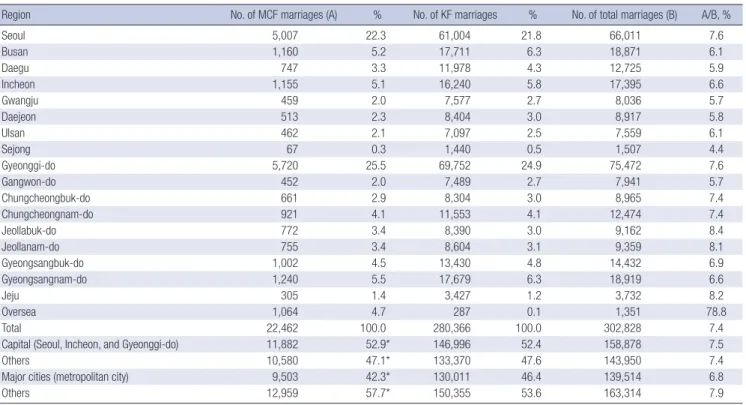
The number of marriages in MCF and the percentage in the total number of marriages in Korea has shown a decline: 36,629 (11.2%) in 2008, 29,224 (8.9%) in 2012, 22,462 (7.4%) in 2015.
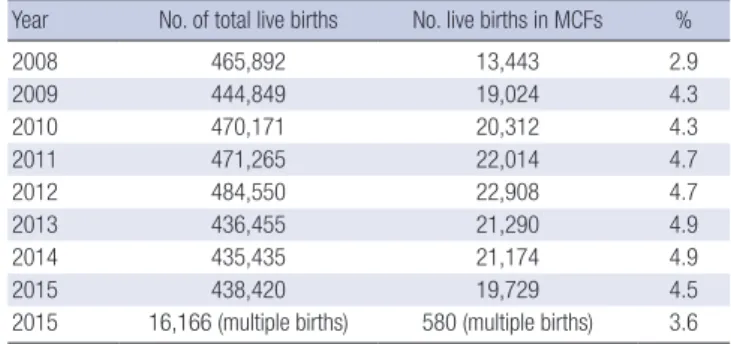
The number of births in MCF increased from 13,443 in 2008 to 20,312 in 2010, and hit a new high of 22,908 in 2012. However, it declined to 21,174 in 2014 and 19,729 in 2015. MCF births con- tribute significantly to the total number of births in Korea: 2.9%
in 2008, 4.3% in 2010, 4.9% in 2014, 4.5% in 2015. The numbers of MCF births are about 1/20th of the total births in Korea (4).
It was in 2006 that Korea initiated setting up and implement- ing MCF support policies. The Multicultural Family Support Act was enacted in 2008 and amended in 2012 (1). Since marriage- based immigrants (25,623 males and 119,649 females in 2015) and married naturalized person (10,308 males and 82,941 fe- males in 2015) in MCF are mostly females (2), the socio-eco- nomic and medical support system currently in operation, was included under the Ministry of Gender Equality and Family from 2010. The first MCF support policy was rolled out from 2010 to ORIGINAL ARTICLE
Pediatrics
2017-03-16 https://crossmark-cdn.crossref.org/widget/v2.0/logos/CROSSMARK_Color_square.svg
2012 (5), and the second MCF supporting policy for 2013 to 2017 (6) from the ministry of Gender Equality and Family is currently operational.
This study is a statistical analysis of MCF birth factors in 2015.
It surveyed MCF births’ data from Statistics Korea. Of the total numbers of births in 2015, the number of MCF births was 19,729 (4.5%) and the number of births in Korean families (non-MCFs or KFs) was 418,691 (95.5%) (7).
The objective of this study is to determine the number and frequency of MCF births in Korea, and to compare the birth distribution by regional groups. We hypothesized that there is a higher number of adverse outcomes in MCF births compared to KF births. We compared the 2 groups with respect to birth weight (BW), gestational age (GA), birth order, place of delivery, cohabitation period before birth of the first child, and parental education level. Besides, the objective of this study was to pro- vide the statistical data of MCF births in 2015, which will help in planning MCF obstetric and neonatal medical care in Korea for the future.
MATERIALS AND METHODS
We extracted the data of MCF births in 2015 from Statistics Korea, and the number of KF births was considered as total births ex- cluding MCF (7,8). Of the total number of births in 2015 (438,420), the number of MCF births was 19,720 (4.5%) and the number of non-MCF (KF) births was 418,691 (95.5%). The research sub- jects are the people in the MCF births group and the control group includes the people in the KF births group.
We ascertained the percentage of MCF births per year from 2008 to 2015. The statistical data of birth between 2 groups (MCF vs. KF) were compared with respect to the geography, number of marriages by region, BW (very low BW infant [VLBWI] with BW < 1.5 kg; low BW infant [LBWI] with BW < 2.5 kg; normal BW infant [NBWI] with BW 2.5–3.9 kg; high BW infant [HBWI]
with BW ≥ 4.0 kg), GA, birth order, place of delivery, cohabita- tion period of parents before the first child, and parental educa- tion level. We analyzed if the MCF group has higher adverse outcomes compared to the KF group.
Statistical analysis
The χ2 test was used to compare the proportions of adverse birth outcomes between MCF and KF. All analyses were performed using STATA software version 12.1 (StataCorp, College Station, TX, USA), P values of < 0.050 were considered statistically sig- nificant.
RESULTS
The mean GA was same at 38.6 ± 1.7 weeks, and mean BW was 3,207 ± 470 and 3,204 ± 470 grams in the MCF and KF respec- tively, with no statistically significant difference.
Number of MCF births in Korea (2015)
The number and percentage of MCF births among the total births was 13,443 (2.9%) in 2008, 22,908 (4.7%) in 2012, and 19,729 (4.5%) in 2015. It showed a decline in total number from 2012 to 2015, but the percentage has remained constant (4.3% → 4.9% → 4.5%) from 2008 to 2015 (Table 2).
Number of MCF births by region in Korea (2015)
The number of MCF births by region was in the following order (Table 3); Gyeonggi-do, Seoul, Gyeongsangnam-do, Incheon, Gyeongsangbuk-do, and Busan. In the case of KF births were in the following order; Gyeonggi-do, Seoul, Gyeongsangnam-do, Busan, Incheon, and Gyeongsangbuk-do.
Comparing the 2 groups by region, the proportion of births in the capital area (Seoul, Incheon, and Gyeonggi-do) was 49.9%
in MCF group and 50.7% in KF group, whereas outside the capi- tal, it was 50.1% in the MCF group and 49.3% in KF group (P = 0.038). The proportions of births in the MCF and KF groups were 39.7% and 44.1% in major cities, and 60.4% and 55.9% in non- major cities, respectively (P < 0.001).
However, the percentage of MCF births in total number of live births by region showed a different trend from the number of MCF births. The percentage of MCF births by region was in the following order; Jeollanam-do, Jeju, Jeollabuk-do, Chung- cheongnam-do, Chungcheongbuk-do, Gangwon-do, and Gyeong- Table 1. Definition of MCF according to the Korean Multicultural Family Support Act
(2012)
Term Definition
The No. of MCFs Marriage based immigrants AND
Men getting Korean nationality after marriage according to the Nationality Act AND
All members getting Korean nationality for other reasons The No. of people
in MCFs One’s own self of MCF Spouse AND Children AND Other family members MCF = multi-cultural family.
Table 2. Total number of live births, the number and frequency of live births in MCFs in Korea (2008–2015)
Year No. of total live births No. live births in MCFs %
2008 465,892 13,443 2.9
2009 444,849 19,024 4.3
2010 470,171 20,312 4.3
2011 471,265 22,014 4.7
2012 484,550 22,908 4.7
2013 436,455 21,290 4.9
2014 435,435 21,174 4.9
2015 438,420 19,729 4.5
2015 16,166 (multiple births) 580 (multiple births) 3.6 Data adapted from Statistics Korea.
MCF = multi-cultural family.
Table 3. Number and percentage of multi-cultural births by geography in Korea (2015)
Region No. of MCF births (A) % No. of KF birth % No. of total live births (B) A/B, %
Seoul 3,745 19.0 79,260 18.9 83,005 4.5
Busan 1,020 5.2 25,625 6.1 26,645 3.8
Daegu 645 3.3 18,793 4.5 19,438 3.3
Incheon 1,080 5.5 24,411 5.8 25,491 4.2
Gwangju 447 2.3 11,994 2.9 12,441 3.6
Daejeon 482 2.4 13,292 3.2 13,774 3.5
Ulsan 406 2.1 11,326 2.7 11,732 3.5
Sejong 62 0.3 2,646 0.6 2,708 2.3
Gyeonggi-do 5,022 25.5 108,473 25.9 113,495 4.4
Gangwon-do 525 2.7 10,404 2.5 10,929 4.8
Chungcheongbuk-do 658 3.3 12,905 3.1 13,563 4.9
Chungcheongnam-do 976 4.9 17,628 4.2 18,604 5.2
Jeollabuk-do 880 4.5 13,207 3.2 14,087 6.2
Jeollanam-do 1,001 5.1 14,060 3.4 15,061 6.6
Gyeongsangbuk-do 1,070 5.4 21,240 5.1 22,310 4.8
Gyeongsangnam-do 1,357 6.9 28,180 6.7 29,537 4.6
Jeju 353 1.8 5,247 1.3 5,600 6.3
Total 19,729 100.0 418,691 100.0 438,420 4.5
Capital area (Seoul, Incheon, and Gyeonggi-do) 9,847 49.9* 212,144 50.7 221,991 4.4
Others 9,882 50.1* 206,547 49.3 216,429 4.6
Major cities (metropolitan city) 7,825 39.7† 184,701 44.1 192,526 4.1
Others 11,904 60.4† 233,990 55.9 245,894 4.8
Data adapted from Statistics Korea.
MCF = multi-cultural family, KF = Korean family.
*P = 0.038; †P < 0.001.
Table 4. Number and percentage of MCF marriages by geography in Korea (2015)
Region No. of MCF marriages (A) % No. of KF marriages % No. of total marriages (B) A/B, %
Seoul 5,007 22.3 61,004 21.8 66,011 7.6
Busan 1,160 5.2 17,711 6.3 18,871 6.1
Daegu 747 3.3 11,978 4.3 12,725 5.9
Incheon 1,155 5.1 16,240 5.8 17,395 6.6
Gwangju 459 2.0 7,577 2.7 8,036 5.7
Daejeon 513 2.3 8,404 3.0 8,917 5.8
Ulsan 462 2.1 7,097 2.5 7,559 6.1
Sejong 67 0.3 1,440 0.5 1,507 4.4
Gyeonggi-do 5,720 25.5 69,752 24.9 75,472 7.6
Gangwon-do 452 2.0 7,489 2.7 7,941 5.7
Chungcheongbuk-do 661 2.9 8,304 3.0 8,965 7.4
Chungcheongnam-do 921 4.1 11,553 4.1 12,474 7.4
Jeollabuk-do 772 3.4 8,390 3.0 9,162 8.4
Jeollanam-do 755 3.4 8,604 3.1 9,359 8.1
Gyeongsangbuk-do 1,002 4.5 13,430 4.8 14,432 6.9
Gyeongsangnam-do 1,240 5.5 17,679 6.3 18,919 6.6
Jeju 305 1.4 3,427 1.2 3,732 8.2
Oversea 1,064 4.7 287 0.1 1,351 78.8
Total 22,462 100.0 280,366 100.0 302,828 7.4
Capital (Seoul, Incheon, and Gyeonggi-do) 11,882 52.9* 146,996 52.4 158,878 7.5
Others 10,580 47.1* 133,370 47.6 143,950 7.4
Major cities (metropolitan city) 9,503 42.3* 130,011 46.4 139,514 6.8
Others 12,959 57.7* 150,355 53.6 163,314 7.9
Data adapted from Statistics Korea.
MCF = multi-cultural family, KF = Korean family.
*P < 0.001.
sangbuk-do. The percentage of MCF births was significantly high- er in non-major cities than major cities.
Number of MCF marriage by region in Korea (2015) The numbers of MCF marriages by region were as follows (Ta-
ble 4): 5,720 in Gyeonggi-do, 5,007 in Seoul, and 1,240 in Gyeong- sangnam-do. The order of frequency are as follows; Gyeonggi- do, Seoul, Gyeongsangnam-do, Busan, and Incheon in MCF group, and Gyeonggi-do, Seoul, Busan, Gyeongsangnam-do, and Incheon in KF group.
Comparative statistics of MCFs and KFs in Korea (2015) The details of BW in the MCF and KF groups are shown in Table 5. Based on BW classification as VLBWI, LBWI, NBWI, and HBWI, there was no significant difference between MCF and KF groups:
VLBWI (0.6% vs. 0.7%, P = 0.092), LBWI (5.5% vs. 5.8%, P < 0.168),
and NBWI (90.6% vs. 91.0%, P = 0.342). However, there was a significant difference between the 2 groups in HBWI cases (3.6%
vs. 3.2%, P = 0.001). The data indicates that no adverse outcomes related to BW in the MCF group.
The data of GA in both groups are shown in Table 6. The pro- portion of births according to GA between the MCF and KF groups were as follows: (< 37 weeks; 6.5% vs. 7.0%, P = 0.015), (37–39 weeks; 65.1% vs. 64.8%, P = 0.138), and (≥ 40 weeks; 28.0% vs.
28.1%, P = 0.840) respectively. In fact, the proportion of preterm babies in the KF group was higher rather than those in the MCF group. Thus, no adverse outcomes related to GA was seen in the MCF group.
Table 5. Number of births by BW in MCFs in Korea (2015) BW, kg Multicultural
families % KFs % Total %
< 1.5 117 0.6 2,915 0.7 3,032 0.7
1.5–1.9 176 0.9 4,023 1.0 4,199 1.0
2. 0–2.4 793 4.0 17,159 4.1 17,952 4.1
2.5–2.9 4,365 22.1 91,298 21.8 95,663 21.8
3.0–3.4 9,026 45.7 195,925 46.8 204,951 46.7
3.4–3.9 4,486 22.7 93,589 22.4 98,075 22.4
4.0–4.4 659 3.3 12,524 3.0 13,183 3.0
≥ 4.5 55 0.3 905 0.2 960 0.2
Unknown 52 0.3 353 0.1 405 0.1
Total 19,729 100.0 418,691 100.0 438,420 100.0
VLBWI 117 0.6* 2,915 0.7 3,032 0.7
LBWI 1,086 5.5† 24,097 5.8 25,183 5.7
NBWI 17,877 90.6‡ 380,812 91.0 398,689 90.9
HBWI 714 3.6§ 13,429 3.2 14,143 3.2
Data adapted from Statistics Korea.
BW = birth weight, MCF = multi-cultural family, VLBWI = very low BW infant (BW <
1.5 kg), LBWI = low BW infant (BW < 2.5 kg), NBWI = normal BW infant (BW 2.5–
3.9 kg), HBWI = high BW infant (BW ≥ 4.0 kg).
*P = 0.092; †P < 0.168; ‡P = 0.342; §P = 0.001.
Table 6. Number of births by GA in MCFs in Korea (2015)
GA, wk MCFs % KFs % Total %
≤ 23 9 0.1 192 0.1 201 0.1
24–27 36 0.2 952 0.2 988 0.2
28–31 101 0.5 2,267 0.5 2,368 0.5
32–35 529 2.7 11,873 2.8 12,402 2.8
36 606 3.1 13,888 3.3 14,494 3.3
37 1,812 9.2 40,793 9.7 42,605 9.7
38 5,207 26.4 111,351 26.6 116,558 26.6
39 5,820 29.5 119,210 28.5 125,030 28.5
40 4,537 23.0 96,953 23.2 101,490 23.2
41 917 4.6 20,233 4.8 21,150 4.8
42 54 0.3 532 0.1 586 0.1
≥ 43 7 0 48 0 55 0
Unknown 94 0.5 399 0.1 493 0.1
Total 19,729 100.0 418,691 100.0 438,420 100.0
< 37 1,281 6.5* 29,172 7.0 30,453 6.9
37–39 12,839 65.1† 271,354 64.8 284,193 64.8
≥ 40 5,515 28.0‡ 117,766 28.1 123,281 28.1
Data adapted from Statistics Korea.
GA = gestational age, MCF = multi-cultural family, KF = Korean family.
*P = 0.015; †P = 0.138; ‡P = 0.840.
Table 7. Number of births by birth order in MCFs in Korea (2015)
Birth order MCFs % KFs % Total %
1st 10,448 53.0 218,165 52.1 228,613 52.1
2nd 7,431 37.7 158,699 37.9 166,130 37.9
3rd 1,506 7.6 35,603 8.5 37,109 8.5
4th 192 1.0 4,197 1.0 4,389 1.0
5th 43 0.2 672 0.2 715 0.2
6th 10 0.1 157 0 167 0
7th 2 0 52 0 54 0
≥ 8th 1 0 21 0 22 0
Unknown 96 0.5 1,125 0.3 1,221 0.3
Total 19,729 100.0 418,691 100.0 438,420 100.0
1st 10,448 53.2* 218,165 52.3 228,613 52.3
2nd 7,431 37.9 158,699 38.0 166,130 38.0
≥ 3rd 1,754 8.9 40,702 9.8 42,456 9.7
Data adapted from Statistics Korea.
MCF = multi-cultural family, KF = Korean family.
*P = 0.019.
Table 8. Number of births by place of delivery in MCFs in Korea (2015)
Birth place MCFs % KFs % Total %
Home 294 1.5* 2,184 0.5 2,478 0.6
Hospital 19,309 97.9† 415,173 99.2 434,482 99.1
Others 112 0.6‡ 1,059 0.3 1,171 0.3
Unknown 14 0.1 275 0.1 289 0.1
Total 19,729 100.0 418,691 100.0 438,420 100.0 Data adapted from Statistics Korea.
MCF = multi-cultural family, KF = Korean family.
*,†,‡P < 0.001.
Table 9. Number of births by cohabitation period of parents before the first child in MCFs in Korea (2015)
Cohabitation
period, yr MCFs % KFs % Total %
< 1 3,432 17.6* 84,356 20.4 87,788 20.3
1–2 7,342 37.7 141,708 34.3 149,050 34.4
2–3 5,630 28.9 117,517 28.4 123,147 28.4
≥ 3 8,722 44.7 187,487 45.3 196,209 45.3
≥ 4 6,163 31.6 133,185 32.2 139,348 32.2
Data adapted from Statistics Korea.
MCF = multi-cultural family, KF = Korean family.
*P < 0.001.
The distribution of births by birth order in MCF and KF is shown in Table 7. The percentage of 1st babies in MCF was high- er than in KF (53.2% vs. 52.3%, P = 0.019). The percentage of 2nd, 3rd, 4th, 5th, 6th, 7th, and 8th babies showed no difference between the 2 groups.
The distribution of births by place of birth in MCF and KF is shown in Table 8. The percentage of home deliveries in MCF was higher than that in KF (1.5% vs. 0.5%, P < 0.001) and the percentage of hospital deliveries was lower than in KF (97.9%
vs. 99.2%, P < 0.001). They showed same results in “other” de- livery, not home nor hospital (0.6% vs. 0.3%, P < 0.001). Thus, the rate of non-institutional delivery in MCF was higher than in KF.
The distribution of births by period of cohabitation in MCF and KF is shown in Table 9. The percentage of births in a cohab- itation period of < 1 year was 17.6, 20.4% in MCF and KF re- spectively, with a statistically significant difference (P < 0.001).
However, there was no difference in the proportion of births following a cohabitation period of 1 or more years, between the 2 groups.
The distribution of births by level of parental education in MCF and KF is shown in Table 10. Among both, fathers and mothers, the education level in MCF was lower than in KF. The percent- age of uneducated mothers was 0.53% in MCF, and 0.03% in KF, with a statistically significant difference (P < 0.001). The paren- tal education up to the elementary and middle school level was also lower in MCF compared to the KCF (P < 0.001).
DISCUSSION
In the early 1990s, international marriages accounted for only 1% of total marriages in the Korean society. Since the mid-1990s, the number of international marriages increased and marriages of MCFs accounted for more than 10% of the total marriages since the mid-2000s. In 2006, ‘the social integration support plan for the female marriage immigrants’ family and people of mixed blood and immigrants was announced. Twenty-one mar- riage immigrant family support centers (currently multicultural family support centers) were established nationwide. In 2007, the Basic Act on the Treatment of Foreigners in Korea was en- acted, and in March 2008, ‘The Multicultural Family Support Act’ was enacted. In November 2008, ‘measures to strengthen customized support for each life cycle of multicultural families’
were announced, and in 2009, the Multicultural Family Policy Committee (Chairperson: Prime Minister) was set up. In 2010, the Prime Minister’s Office and related ministries jointly estab- lished and announced the 1st Multicultural Family Support Pol- icy Basic Plan (2010–2012) (5). In February 2012, through the revision of the Multicultural Family Support Act (1), the Multi- cultural Family Support Policy Basic Plan has acquired a legal status. The Multicultural Family Support Policy Basic Plan has become a statutory plan that is revised every 5 years, and inclu- des matters relating to basic direction, development policies, and evaluation by sector, system improvement, and financial Table 10. Number of births by parental education level in MCFs in Korea (2015)
Parental education MCFs % KFs % Total %
Father
Uneducated 43 0.2 130 0 173 0
Elementary school 263 1.3 555 0.1 818 0.2
Middle school 1,034 5.2 3,715 0.9 4,749 1.1
High school 8,455 42.9 91,651 21.9 100,106 22.8
University 7,967 40.4 277,214 66.2 285,181 65.0
Advanced degree 1,561 7.9 39,789 9.5 41,350 9.4
Unknown 406 2.1 5,637 1.3 6,043 1.4
Total 19,729 100.0 418,691 100.0 438,420 100.0
< High school 1,340 6.9 4,400 1.1 5,740 1.3
High school 8,455 43.8 91,651 22.2 100,106 23.2
≥ University 9,528 49.3 317,003 76.8 326,531 75.5
Mother
Uneducated 104 0.5 133 0.0 237 0.1
Elementary school 572 2.9 503 0.1 1,075 0.2
Middle school 2,464 12.5 3,567 0.9 6,031 1.4
High school 7,557 38.3 88,559 21.2 96,116 21.9
University 7,277 36.9 292,029 69.7 299,306 68.3
Advanced degree 1,345 6.8 31,931 7.6 33,276 7.6
Unknown 410 2.1 1,969 0.5 2,379 0.5
Total 19,729 100.0 418,691 100.0 438,420 100.0
< High school 3,140 16.3 4,203 1.0 7,343 1.7
High school 7,557 39.1 88,559 21.3 96,116 22.0
≥ University 8,622 44.6 323,960 77.7 332,582 76.3
Data adapted from Statistics Korea, all variables P < 0.001.
MCF = multi-cultural family, KF = Korean family.
resources and allocation, etc. The 2nd Multicultural Family Sup- port Policy Basic Plan (2013–2017) was finalized in December 2012 (6).
There are reports on the health and medical status of preg- nant women in MCFs before year 2009. Kim et al. (9) published a report from the results of a questionnaire-based survey, about the experience and level of support for pregnancy and child- birth of female marriage immigrants, health and public health care status, and policy tasks of MCFs. Only 35.9% of pregnant women received support for pregnancy and childbirth. The need for support among female marriage immigrants, for pregnancy and childbirth related support services, was reported as very necessary by 30.5% of MCF females, generally required by 14.9%, usually required by 12.5%, and scarcely required by 19.6%, indi- cating that about half of them were in need of support (10, 11).
The report presented that among the challenges for married immigrant women, the first was maternal, and child health, es- pecially delayed first antenatal care. The second challenge was maternal and child nutrition, with a high number of low nutri- tional status and anemic women, and the third challenge was health care and nurturing of the baby (12). It was suggested that there is a high need to strengthen maternal immigrant women’s support and education, and access to information for maternal, child health, and perinatal care. In 2012, Lee et al. (13) suggest- ed the need for a special management system for MCFs, for sup- port during perinatal, obstetric, neonatal, pediatric, and ado- lescent periods, through statistical review and policy framework.
The plan to support maternal and child health services for in- ternational marriage immigrant women, and the 1st Multicul- tural Family Support Policy Basic Plan (2010–2012) (5), and 2nd Multicultural Family Support Policy Basic Plan (2013–2017).
Multicultural family support centers were created for improv- ing the health and medical care of pregnant women, women during childbirth, and newborn infants. From our results in 2015, neonatal BW and GA in MCF birth showed no adverse outcomes compared to KF birth, and preterm births were lower in MCF than in KF. In BW and GA of newborn infants, MCF has no ad- verse birth outcomes compared to KF. Many factors such as uterine malnutrition, socio-economic factors, medical risks be- fore or during gestation, and maternal race/ethnicity may con- tribute to birth outcomes (14,15). Maternal body weight at the time of becoming pregnant and the early development of the placenta determine the fetal growth (16). The proportion of pre- mature and low BW babies has been rising in Korea due to ad- vanced maternal age and multiple pregnancy or assisted con- ception (17). This situation in Korea may have affected the birth outcomes regardless of the nutritional status of Koreans.
The number of MCF marriages and the percentage of total marriages in Korea have decreased from 36,629 (11.2%) in 2008 to 22,462 (7.4%) in 2015 (4). Among MCF, marriage between Korean men and international women was the highest at 62.6%,
followed by Korean women married to international men (22.9%), and others including the naturalized people (14.6%) in 2015. In 2015, among men with multicultural marriage, 22.7% were in the age group of 45 years and above, 21.8% were in their early thirties and 19.1% were in their late 30s. While the ratio of men over 45 has declined, the ratio of those in their late 20s and early 30s is increasing. Among women who married in a multicultural society, 29.8% were in their late 20s, followed by early 30s (21.2%) and early 20s (18.7%). The percentage of those over 35 years old is declining, and the proportion of those in their late 20s and early 30s shows an increasing trend. In 2015, the average age of first marriage was 35.4 years for men and 27.9 years for women.
The average age gap at first marriage between men and women who married in MCFs was 7.5 years. In multicultural marriage, male-seniority couples accounted for 77.5%, female-seniority couples accounted for 16.5%, and matching age couples account- ed for 6.0%. The number of multicultural marriages was in the following order: Gyeonggi-do (5,720 cases), Seoul (5,007 cases), and Gyeongnam-do (1,240 cases). Among the male foreign na- tionals in multicultural marriages, China had the highest na- tionality (9.7%), followed by the United States (7.3%) and Japan (3.6%), and among women, China also had the highest nation- ality of 27.9%, followed by Vietnam (23.1%) and the Philippines (4.7%).
The number of multicultural births and the multicultural per- centage among total births increased from 13,443 (2.9%) in 2008 to 22,908 (4.7%) in 2012, to 21,290 (4.9%) in 2013, and the total number and percentage decreased to 19,729 (4.5%) in 2015.
Among the multicultural births, the first child accounted for 53.0%, followed by 37.7% for the second, and 9.6% for the third or above. In terms of births by multicultural type, Korean father and mother of foreign nationality accounted for 65.2%, followed by others (19.6%), and father with foreign nationality and Kore- an mother (15.2%). In multicultural births, the proportion of births by mother’s age was: 25–29 years, 31.6%; 30–34 years, 30.0%;
and 20–24 years, 20.1%. The proportion of persons under 25 years of age showed a steady decline, while the proportion of people in their 30s increased. The average age at birth of the mother in multicultural birth was 29.0 years for the first child, 30.1 years for the second child, and 32.0 years for the third child or above.
Multicultural parents had a marriage period of 2.1 years until birth of the first child and 65.5% of the children who had mar- ried life less than 2 years until the first birth. The number of mul- ticultural births by region was 5,222 births in Gyeonggi-do, 3,745 births in Seoul, and 1,357 births in Gyeongnam-do. According to births by parents’ nationality, China as foreign nationality of the father was 6.7%, followed by the US (4.9%) and Japan (1.9%), and for foreign nationality of the mother, Vietnam was the high- est (32.6%), followed by China (23.6%) and the Philippines (8.4%).
The number of children (aged 18 or younger) in MCFs incre- ased from 44,258 persons in 2007 to 207,693 persons in 2014
and decreased to 197,550 persons in 2015 (2). In 2015, the dis- tribution of children by age group was 116,068 (58.7%) under 6 years of age, 61,625 (31.2%) between 7–12 years, 12,567 (6.4%) between 13–15 years, 7,290 persons (3.7%). Thus, the propor- tion of children lower than the age for elementary school en- rollment is 58.7%, indicating that the average age is low.
The limitation of this study is the rate of disease prevalence and mortality and/or neonatal mortality were not calculated due to incomplete data on diseases and deaths. Comparing the prevalence of disease between MCF and KF and the mortality rate or neonatal mortality rate by diseases could be the objec- tive of further studies in future.
In conclusion, this study compared several birth related fac- tors between MCF and KF in 2015, based on the recent status of MCF marriages and births in Korea. The hypothesis that MCF has higher proportion of adverse neonatal outcomes compared to that of KF was proved untrue. The average BW and GA in MCF and KF groups were similar, while the frequency of preterm birth classified as high risk, was less in MCF despite the low ed- ucation level of parents and high frequency of out-of-hospital deliveries. This is due to the government support for perinatal medical system through implementation of the basic plan of family support policy, including measures to strengthen cus- tomized support for each MCF based on the stage of life cycle.
This study provides important basic data on the births in MCF and the situation in neonatal care in 2015. Subsequent studies on the infantile disease and neonatal death among MCF births are necessary.
DISCLOSURE
The authors have no potential conflicts of interest to disclose.
AUTHOR CONTRIBUTION
Conceptualization: Chung SH, Bae CW. Data curation: Chung SH, Bae CW. Formal analysis: Chung SH, Bae CW. Investigation:
Chung SH, Bae CW. Writing - original draft: Chung SH. Writing - review & editing: Bae CW.
ORCID
Sung-Hoon Chung https://orcid.org/0000-0002-0352-9722 Chong-Woo Bae https://orcid.org/0000-0002-0965-5674
REFERENCES
1. Multicultural Family Support Law in Korea. No. 11284 (Feb. 1, 2012).
2. Ministry of Gender Equality and Family (KR). Multicultural Family Statis- tics by Year in Korea: 2016. Seoul, Ministry of Gender Equality and Fami- ly, 2016.
3. Ministry of Gender Equality and Family (KR). The 2nd Multicultural Fam- ily Policy Basic Plan (2013–2017): Enforcement Plan for 2015. Seoul, Min- istry of Gender Equality and Family, 2015.
4. Statistics Korea. 2015 statistics of multicultural population dynamics [In- ternet]. Available at http://kostat.go.kr/portal/korea/kor_nw/2/2/1/in- dex.board?bmode=read&aSeq=357476&pageNo=&rowNum=10&amSe q=&sTarget=&sTxt [accessed on 20 March 2017].
5. Multicultural Family Policy Council (KR). Multicultural Family Policy Ba- sic Plans (2010–2012). Seoul, Multicultural Family Policy Council, 2010.
6. Ministry of Gender Equality and Family (KR). The 2nd Multicultural Fam- ily Policy Basic Plan (2013–2017). Seoul, Ministry of Gender Equality and Family, 2012.
7. Statistics Korea. Raw Data from Birth Statistics in 2015. Daejeon, Statistics Korea, 2016.
8. Korean Statistical Information Service. Birth statistics in 2015 [Internet].
Available at http://kosis.kr/ [accessed on 20 March 2017].
9. Kim SK, Kim YK, Cho AJ, Kim HR, Lee HK, Seol DH, Jung KS, Shim IS. The Study of a National Survey on Multicultural Families 2009. Seoul, Minis- try of Health and Welfare, 2010.
10. Kim YK. Welfare needs of multicultural families and policy implications.
Health Welf Policy Forum 2010; 165: 58-73.
11. Kim HR, Paik SH, Jung HW, Lee AR, Kim E. Survey on Dietary Behaviors and Needs for Nutrition Services, and Development Contents of Nutri- tion Education for Female Immigrants in Multicultural Families in Korea.
Seoul, Korea Institute for Health and Social Affairs, 2011.
12. Kim HR. Maternal health and nutritional status of marriage-based wom- en immigrants in Korea and policy directions. Health Welf Policy Forum 2009; 155: 50-64.
13. Lee JH, Hahn MH, Chung SH, Choi YS, Chang JY, Bae CW, Kim YK, Kim HR. Statistic observation of marriages, births, and children in multi-cul- tural families and policy perspectives in Korea. Korean J Perinatol 2012;
23: 76-86.
14. Fulda KG, Kurian AK, Balyakina E, Moerbe MM. Paternal race/ethnicity and very low birth weight. BMC Pregnancy Childbirth 2014; 14: 385.
15. Gold KJ, DeMonner SM, Lantz PM, Hayward RA. Prematurity and low birth weight as potential mediators of higher stillbirth risk in mixed black/
white race couples. J Womens Health (Larchmt) 2010; 19: 767-73.
16. Rössner S, Ohlin A. Maternal body weight and relation to birth weight.
Acta Obstet Gynecol Scand 1990; 69: 475-8.
17. Shim JW, Jin HS, Bae CW. Changes in survival rate for very-low-birth-wei- ght infants in Korea: comparison with other countries. J Korean Med Sci 2015; 30 Suppl 1: S25-34.