D I A B E T E S & M E T A B O L I S M J O U R N A L
This is an Open Access article distributed under the terms of the Creative Commons At- tribution Non-Commercial License (http://creativecommons.org/licenses/by-nc/3.0/) which permits unrestricted non-commercial use, distribution, and reproduction in any medium, provided the original work is properly cited.
Ruboxistaurin for the Treatment of Diabetic Peripheral Neuropathy: A Systematic Review of Randomized
Clinical Trials
Dipika Bansal1, Yogesh Badhan1, Kapil Gudala1, Fabrizio Schifano2
1Clinical Research Unit, Department of Pharmacy Practice, National Institute of Pharmaceutical and Education Research, Mohali, India,
2Clinical Pharmacology and Therapeutics, University of Hertfordshire, Hertfordshire, UK
Background: Diabetic peripheral neuropathy (DPN) is a common complication of diabetes mellitus. Protein kinase C (PKC) in- hibitor’s has been thought to be a potential disease modifying drug’s in DPN as it slows or reverse neuropathy’s progression. To assesses the efficacy and safety of ruboxistaurin on the progression of symptoms, signs, or functional disability in DPN.
Methods: A systematic review of the literature databases like PubMed, ProQuest, EBSCO, EMBASE, and Cochrane Central was performed up to August 2012. We included randomized controlled trials (RCTs) comparing PKC inhibitor ruboxistaurin (RBX) with control and lasting at least 6 months. Our primary outcome measure was change in neurological examination, measured by neurological total symptom score (NTSS) and vibration detection threshold (VDT). Secondary outcome measures were total quality of life (QoL), skin microvascular blood flow and others.
Results: Six RCTs were included in review. Change in neurological function assessed by NTSS was reported in six studies, out of which significant difference between the RBX and placebo group seen in four studies favouring treatment group while remain- ing two studies reported no significant difference. VDT was assessed in only one study in which no significant difference seen between RBX and placebo group. Two studies reported significant improvement in QoL data. Safety data was reported in only two studies in which none of side effect was related to RBX.
Conclusion: RBX had effects on DPN in some studies, but the evidence is not enough for meta-analysis and firm conclusion.
Keywords: Diabetic peripheral neuropathy; Protein kinase C inhibitor; Ruboxistaurin
Corresponding author: Dipika Bansal
Clinical Research Unit, Department of Pharmacy Practice, National Institute of Pharmaceutical Education and Research, Sector 67, S.A.S. Nagar, Mohali 160062, India
INTRODUCTION
Neuropathy is the one of the most common and debilitating long term complication of diabetes affecting up to 50% of pa- tients [1-4]. Diabetic peripheral neuropathy (DPN) is defined in the clinical practice as the presence of symptoms and/or signs of peripheral nerve dysfunction in people with diabetes after the exclusion of other causes [5]. Prevalence of DPN may vary from 30% to 40% in type 1 and 2 diabetic patients [6].
Signs and symptoms of DPN vary depending on fiber type in- volved, with large fiber disease impairing proprioception and light touch. Small fiber disease impairs pain and temperature perception, leading to paresthesias, dysesthesias, and/or neu- ropathic pain. DPN may cause muscle weakness and dimin- ished or absent deep-tendon reflexes, especially the Achilles tendon reflex. More advanced disease may lead to foot defor- mities like hammer toes, collapse of the mid foot, ulceration or neuroarthropathy (Charcot joints) of the foot may occur [7].
http://dx.doi.org/10.4093/dmj.2013.37.5.375 pISSN 2233-6079 · eISSN 2233-6087
Symptoms may go unnoticed for a long period. Spread of the untreated infection to bone may lead to amputation. The im- mense physical, psychological, and economic cost of diabetic neuropathy underscore the need for causally targeted thera- pies [7].
Several pathogenetic mechanisms have been proposed for diabetic neuropathy (DN) like polyol pathway, glycation, myo- inositol, oxidative stress, nerve hypoxia, and protein kinase C (PKC), etc. [8]. The classes of drugs used to treat DPN based on these mechanisms are aldose reductase inhibitor (ARI) [9], vasodilators, PKC-β inhibitors [10], and others [8]. The pre- vention of the onset or modifying the natural history of DPN by targeting known pathogenetic mechanisms is mostly in ex- perimental stages and not therefore available for clinical usage at present.
ARIs like sorbinil, tolrestat, ponalrestat, zopolrestat, zenare- stat, epalrestat, ranirestat, and fidarestat have been found to be acting on the progression of DN [9]. Recent Cochrane review of 32 clinical trials (n=4,970) revealed no statistically signifi- cant overall benefit of ARI in DN [11]. Only one ARI molecule epalrestat is approved for clinical use in Japan [12].
Another important class of drug to be used in DPN is PKC- β inhibitors. The putative mechanism is that intracellular hy- perglycaemia cause increase in diacylglycerol (DAG) levels, activating PKC formation, leading to multiple pathogenetic consequences including altered expression of endothelial ni- tric oxide synthetase and angiogenic protein vascular endo- thelial growth factor (VEGF). This leads to the development of diabetic complications like neuropathy. PKC pathway activa- tion alters vasoconstriction and capillary permeability, and can cause hypoxia, angiogenesis, basement membrane thick- ening, and endothelial proliferation. These changes in neuro- vascular blood flKC are the likely source of PKC’s role in neu- ropathy. Thus PKC inhibitor has been thought to be a poten- tial disease modifying drug in DPN [10].
Ruboxistaurin (RBX) is an orally active PKC-β inhibitor. It binds to the active site of PKC-β, thus interfering with adenos- ine triphosphate binding and inhibiting phosphorylation of substrates. RBX gets metabolized by CYP3A4 to its main equi- potent metabolite, N-desmethyl RBX [13]. The half-life of RBX and its metabolite combined is 24 hours, thereby allow- ing once daily dosing. Studies showed that the primary excre- tion route in humans for these substances was faecal with re- nal elimination playing a minor role. Thus, renal impairment does not preclude its use [14]. RBX can also be used for other
diabetic complications like retinopathy, nephropathy, and heart failure.
Treatments that could prevent, improve, or even slow the progression of DPN would result in decreased morbidity, cost and improved quality of life (QoL) of patients with diabetes mellitus. RBX is therefore considered a valuable target mole- cule for therapeutic intervention. The present systematic re- view assesses the efficacy and safety data available of RBX on the progression of symptoms, signs or functional disability in DPN.
METHODS
Search strategy
We searched for randomized controlled clinical trials on RBX in databases PubMed, ProQuest, EBSCO, EMBASE, and Cochrane Central up to August 2012. Keywords included: ‘Ruboxistaurin, PKC inhibitor, LY 333531 AND Neuropathy, DPN, Diabetic polyneuropathy’ where we kept limits namely ‘Human’ and
‘Clinical trials.’ We have also searched on American Diabetes Association website for conference proceedings. We also searched electronic registers of ongoing trials such as the Cur- rent Controlled Trials register (http://www.controlled-trials.
com/). Bibliographies of the identified randomized trials were also searched. We also tried to contact the authors to identify additional published or unpublished data. We also searched (http://www.clinicaltrials.gov/) and found two registered clini- cal trials with clinical trial registry number NCT00044408 and NCT00044395; full published studies regarding these trials could not be retrieved.
We included randomized controlled trials (RCTs), regard- less of publication status, language, or period of patient inclu- sion. Intervention used was PKC inhibitor, i.e., RBX and com- pared with placebo and/or active comparator. As rate of pro- gression of DPN is slow, any short-duration intervention will not produce a detectable effect. Therefore, only trials with treat- ment lasting at least 6 months and in which criteria for diagno- sis of DPN was mentioned clearly with appropriate investiga- tions to rule out other causes of neuropathy were included.
Data collection and analysis Selection of studies
An initial inclusion/exclusion form was used to assess study inclusion in the review. The titles and abstracts of every record retrieved by the searching process were scanned. The citations
were divided alphabetically by first author and each citation was assessed for inclusion independently by two review au- thors. Discrepancies between assessments were resolved by discussion and when necessary, in consultation with the third review author. If disagreements could not be resolved at this stage, the full article was collected and assessed. If a trial was excluded at any time after this point, a record of both the arti- cle and exclusion criteria was kept in record.
Data extraction and management
The methodological details and data from publications or un- published study reports were extracted independently by two reviewers. The data extraction sheet included details of: 1) pub- lication type and date; 2) study design including use of placebo;
3) duration and dose of treatment; 4) duration of follow-up; 5) details of the inclusion and exclusion criteria of the participants, numbers of participants, number of withdrawals, and reasons for withdrawals; 6) baseline characteristics; 7) outcome mea- sures of study; 8) results of study; and 9) adverse drug reaction.
Assessment of risk of bias in included studies
Each included study was evaluated for the methodological quality. The characteristics assessed were; randomization meth- ods, adequacy of allocation concealment, methods of patient and observer blinding. Each characteristic was graded as ade- quate, unclear, inadequate, or not done. Differences in grading by the evaluators were discussed and resolved by consensus.
Measures of treatment effect
Improvement of sensory symptoms and nerve function were considered to be important end points [15]. For our review we considered assessment of change in neurological examination as a primary outcome. This can be done by measuring sensory symptoms and nerve function, for which neurological total symptom score scale (NTSS-6) [16] and vibration detection threshold (VDT) [17] are used respectively. As secondary out- come measure, change in neurological impairment score (NIS) [18], skin microvascular blood flow (SkBF) [19], QoL [20], safety profile and tolerability were considered.
For assessment of QoL self administered 47 item Norfolk- DN questionnaire used to measure relationship between symp- tomatic DN and QoL from the perspective of patient. It is com- posed of two parts: questions related to symptoms experienced by patient and questions related to the impact of patient’s neu- ropathy on activities of daily life [18].
Statistical analysis
No meta-analysis or quantitative analysis was possible due to significant heterogeneity between included studies in terms of study size, data reports, and procedure. Further, the inconsis- tencies in outcomes reported and the paucity of statistical data prevented quantitative meta-analysis. The review therefore consists of a qualitative assessment and narrative analysis to compare the studies. For the assessment of risk of bias in the included studies, analyses were undertaken using Review Man- ager 5 (RevMan; The Nordic Cochrane Centre, Copenhagen, Denmark). RevMan is the Cochrane collaboration’s software for preparing and maintaining Cochrane reviews. Age of par- ticipant’s at baseline of three studies has been compared using independent t-test using GraphPad Instat Demo 3 statistical software (GraphPad InStat Software, San Diego, CA, USA).
RESULTS
Search result
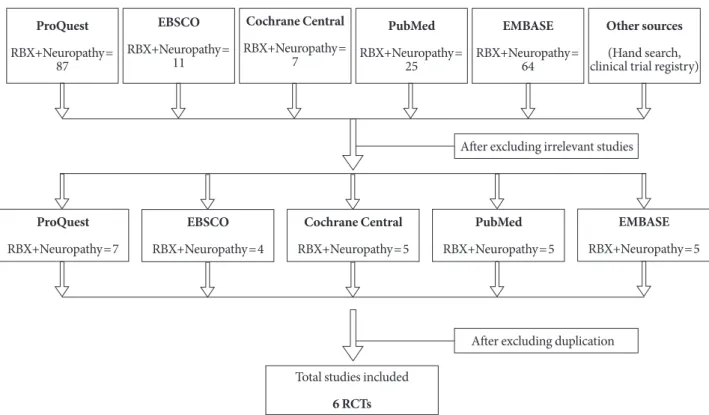
Of the 296 studies retrieved from the literature databases, two conference abstracts [21,22] and four full text articles [17,19,20, 23] met the inclusion criteria (Fig. 1). Six of these described RCTs were of at least six months duration. A study by Tesfaye et al. [24] was excluded as no intervention was administered and patients were only followed to understand the natural pro- gression of DPN.
We found three studies (one full text and two conference ab- stracts) [19,21,22] by same author name Carolina M. Casellini.
We tried to find out whether those studies were done on same population by comparing the trial results. But study samples in- cluded in studies were found to be different and all three studies were included in our review. Casellini et al. [22] was performed as pilot study.
Description of studies Interventions
Participants in the included studies received RBX (32 mg/day) or placebo as oral tablets for the specified duration of the study.
In one study, Vinik et al. [17] two arms of RBX were used in which one received 32 mg/day and other received 64 mg/day dose of RBX.
Study design
The included studies were all randomized and double blind ex- cept for two full text studies by Boyd et al. [20] and Casellini et al.
[22] in which information regarding randomization and blind- ing was not reported (Table 1). Most studies lasted for 6 to 12 months and involved comparison of RBX (32 or 64 mg/day) and placebo. However, in study by Boyd et al. [20], topiramate (100 mg/day) was also used and compared with placebo. Diag- nostic criterion for diabetes was not explicitly stated in most studies. Criteria for the diagnosis of DPN and the severity of the neuropathy, varied considerably from study to study. In most studies there was a reasonable attempt to exclude other causes of neuropathy.
Participants
All studies recruited adult participants of 18 years and older.
The six studies involved a total of 353 subjects, of which 210 received RBX, 123 received placebo, and 20 received topira- mate. Both type 1 and 2 diabetic patients were recruited except in study by Boyd et al. [20] in which only type 2 diabetic pa- tients were recruited.
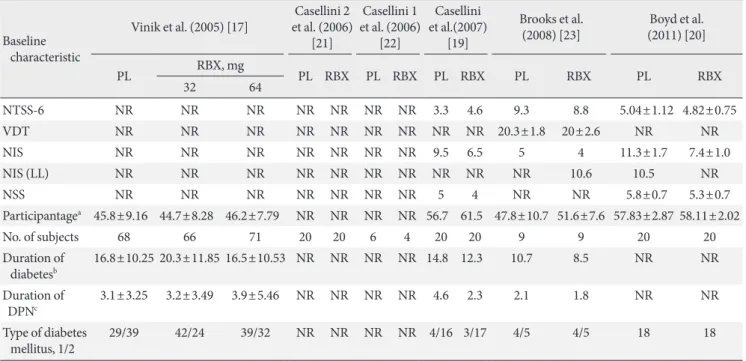
An attempt was also made to compare the baseline charac- teristics of participants in the included studies (Table 2). Only three studies by Vinik et al. [17], Boyd et al. [20], and Brooks et al. [23] had reported complete data regarding participant’s age
for the statistical analysis. The participants in the studies by Vi- nik et al. [17] and Brooks et al. [23] were significantly younger than in the study by Boyd et al. [20]. The other characteristics could not be compared because of lack of documented data.
Risk of bias
Fig. 2 shows the overall risk of bias involved in the studies based on sequence generation, allocation concealment, and blinding. There was unclear risk of bias in the majority of the studies based on random sequence generation and allocation concealment while high risk of bias was observed based on blinding of participants and observer.
Effect of interventions
Most studies presented outcome data numerically in tables.
Graphical presentation was also seen in some cases. The com- parisons were done between RBX and placebo in all the stud- ies. None of study compared RBX with active comparator (Ta- ble 3).
Primary outcome measure
Change in NTSS-6 was assessed in all included studies. Change EBSCO
RBX+Neuropathy=
11
EBSCO RBX+Neuropathy=4
Cochrane Central RBX+Neuropathy=
7
Cochrane Central RBX+Neuropathy=5
PubMed RBX+Neuropathy=
25
PubMed RBX+Neuropathy=5
EMBASE RBX+Neuropathy=
64
EMBASE RBX+Neuropathy=5
Other sources (Hand search, clinical trial registry) ProQuest
RBX+Neuropathy=
87
ProQuest RBX+Neuropathy=7
After excluding irrelevant studies
After excluding duplication
Total studies included 6 RCTs
Fig. 1. Summary of the procedure used to select studies for inclusion in the systematic review. RBX, ruboxistaurin; RCT, ran- domized controlled trials.
in VDT was the outcome measure seen in one study by Vinik et al. only [17].
Neurological total symptom score
Change in NTSS-6 was assessed in 353 participants. Decrease in NTSS score indicates improvement. Significant decrease in NTSS score was found in RBX treated group as compared to placebo in studies three studies by Casellini et al. [19] (P<
0.037), Boyd et al. [20] (P<0.001), Casellini et al. [22] (P<
0.04), and Casellini et al. [21] (P<0.0006) where total of 64 participants received RBX.
No significant difference was observed in two studies con- ducted by Brooks et al. [23] and Vinik et al. [17]. But in Vinik et al. [17] study, a subgroup of patients with clinically significant symptoms (defined as NTSS-6 score >6) at baseline (n=83), significant change in NTSS was observed at 12 months of fol- low-up in RBX 64 mg/day treated patients (n=71) (P=0.015)
but not in RBX 32 mg/day group (n=66) as compared to place- bo group. Similarly, in a subgroup of patients with clinically sig- nificant symptoms and less severe DPN (n=50) (defined as su- ral nerve action potential ≥0.5 µv and NTSS-6 rating >6) there was a statistically significant reduction in NTSS-6 total score with RBX 64 mg/day (P=0.006).
Vibration detection threshold
Change in VDT was assessed in only one study by Vinik et al.
[17] study. Decrease in VDT units represents improvement.
No significant improvement (P=not reported) was observed in VDT in both RBX treated groups (32, 64 mg/day) as compared to placebo in total of 205 patients. Decrease in VDT units was observed in a subgroup of patients with clinically significant symptoms (NTSS-6 score >6). Significant decrease in VDT units was also observed in a subgroup of patients with clinical- ly significant symptoms and less severe DPN (n=50), for RBX Table 1. Study design characteristics
Characteristic Vinik et al.
(2005) [17] Casellini 2 et al.
(2006) [21] Casellini 1 et al.
(2006) [22] Casellini et al.
(2007) [19] Brooks et al.
(2008) [23] Boyd et al.
(2011) [20]
Method Randomized,
double blind Randomized,
double blind NR Randomized,
double blind Randomized,
double blind Randomized (NR) Participants
(RBX/PL) (66/71)/68a 20/20 4/6 20/20 9/9 20/20
Treatment arm RBX RBX RBX RBX RBX RBX, TPX
(100 mg/day)b
Control arm PL PL PL PL PL PL
Dosesc FD (32, 64) FD (32) FD (32) FD (32) FD (32) FD (32)
Definition of DPN Neuropathy symp- tom & change score,
NTSS-6, NIS (LL)
NR NTSS-6, VDT NTSS-6, VDT NTSS-6,
SNAP, VDT NTSS-6
Duration of
intervention, mo 12 6 12 6 12 6
Duration of follow-up 12 6 12 6 12 Not clear
Primary endpoint VDT NTSS-6 NR Endothelin & C-
fibre mediated SkBF NTSS-6 Total QoL Other endpoint NTSS-6, NIS, CGI NSS, TNS,
SkBF, NTSS-6 NTSS-6,
SkBF QoL, sensory symp-
toms, NTSS-6 NIS, SNAP,
SkBF NTSS-6, NIS
Published as Full text Abstract Abstract Full text Full text Full text
No. of withdrawals 32 NR NR None None None
Casellini 1 and Casellini 2 are conference abstracts while Casellini is full text article.
NR, not reported; RBX, ruboxistaurin; PL, placebo; TPX, topiramate; FD, fixed dose; DPN, diabetic peripheral neuropathy; NTSS-6, neurolog- ical total symptom score (points); NIS (LL), neuropathy impairment score of lower limbs; VDT, vibration detection threshold; SNAP, sural neurological action potential (µv); SkBF, skin microvascular blood flow; QoL, quality of life; NIS, neurological impairment score (points); CGI, clinician global impression; NSS, neuropathy symptom score (points); TNS, total neurological score (points).
aSixty-six were assigned to 32 mg/day & 71 to 64 mg/day group, bTPX vs. PL and RBX vs. PL was separately compared, cFixed dose given in mg/day.
32 mg/day (P=0.012) and 64 mg/day (P=0.026) as compared with placebo group.
Secondary outcome measure Skin microvascular blood flow
Change in SkBF (endothelium dependent) was assessed in four studies [19,21-23]. Increase in SkBF represents improve- ment. In three studies with total of 44 RBX treated subjects,
significant increase in SkBF from baseline was observed in RBX treated group as compared to placebo (P<0.03, P<0.013, and P<0.002 respectively). In Brooks et al. [23] study, no sig- nificant (P=0.233) improvement in SkBF was found in RBX treated group (n=9) as compared to placebo group (n=9).
Total quality of life
Change in total QoL (by Norfolk QoL-DN) was assessed in two Table 2. Baseline characteristics of patients included in studies
Baseline characteristic
Vinik et al. (2005) [17] Casellini 2 et al. (2006)
[21]
Casellini 1 et al. (2006)
[22]
Casellini et al.(2007)
[19]
Brooks et al.
(2008) [23] Boyd et al.
(2011) [20]
PL RBX, mg
PL RBX PL RBX PL RBX PL RBX PL RBX
32 64
NTSS-6 NR NR NR NR NR NR NR 3.3 4.6 9.3 8.8 5.04±1.12 4.82±0.75
VDT NR NR NR NR NR NR NR NR NR 20.3±1.8 20±2.6 NR NR
NIS NR NR NR NR NR NR NR 9.5 6.5 5 4 11.3±1.7 7.4±1.0
NIS (LL) NR NR NR NR NR NR NR NR NR NR 10.6 10.5 NR
NSS NR NR NR NR NR NR NR 5 4 NR NR 5.8±0.7 5.3±0.7
Participantagea 45.8±9.16 44.7±8.28 46.2±7.79 NR NR NR NR 56.7 61.5 47.8±10.7 51.6±7.6 57.83±2.87 58.11±2.02
No. of subjects 68 66 71 20 20 6 4 20 20 9 9 20 20
Duration of
diabetesb 16.8±10.25 20.3±11.85 16.5±10.53 NR NR NR NR 14.8 12.3 10.7 8.5 NR NR Duration of
DPNc 3.1±3.25 3.2±3.49 3.9±5.46 NR NR NR NR 4.6 2.3 2.1 1.8 NR NR
Type of diabetes
mellitus, 1/2 29/39 42/24 39/32 NR NR NR NR 4/16 3/17 4/5 4/5 18 18
PL, placebo; RBX, ruboxistaurin; NTSS-6, neurological total symptom score (points); NR, not reported; VDT, vibration detection threshold; NIS, neurological impairment score (points); NIS (LL), neurological impairment score of lower limbs; NSS, neuropathy symptom score (points); DPN, diabetic peripheral neuropathy.
aParticipants age is expressed in years (here mean±standard deviation [SD] is mentioned), except for Boyd (mean±standard error of mean [SEM]) and Casellini (mean±interquartile range [IQR]), bDuration of diabetes is expressed in years (here mean±SD is mentioned), except for Boyd (mean±SEM), cDuration of DPN is expressed in years (here mean±SD is mentioned), except for Boyd (mean±SEM).
Low risk of bias Unclear risk of bias High risk of bias Random sequence generation (selection bias)
Blinding of participants and personnel (performance bias) Allocation concealment (selection bias)
0% 25% 50% 75% 100%
Fig. 2. Methodological quality graph: review authors’ judgements about each methodological quality item presented as percent- ages in six studies only.
studies recruiting a total of 80 participants. Increase in score in- dicates improvement. In Boyd et al. [20] study, significant im- provement was observed in two aspects of QoL including total QoL score (P<0.04) and symptom subscore (P<0.004) in RBX group (n=20) as compared to placebo group (n=20). In Casel- lini et al. [19] study, significant improvement in symptom sub- score was observed in RBX treated subjects as compared to pla- cebo treated subjects (P=0.041). Significant improvement from baseline was observed in RBX group (P=0.01) but not in pa- tients under placebo group. Similarly significant improvement of total QoL score was also observed in RBX treated group (P=0.04) at 6 months as compared to placebo. No significant difference for other aspects of QoL reported in either study.
Neurological impairment score
Change in NIS was assessed in five studies in 242 participants (RBX treated group only) [17,19,20,22,23]. Decrease in NIS score indicates improvement. Significant decrease in NIS score was observed in RBX group as compared to placebo group in study by Casellini et al. [22] where data from 10 participants was used (P<0.01). No significant decrease in NIS score was observed in the remaining studies in RBX group as compared to placebo group.
Safety profile
According to European Medicine Agency (EMA) report, com- mon observed adverse effects (AEs) with the use of RBX in dia- Table 3. Parameters assessed for diabetic peripheral neuropathya
Parameter Mean±SDb
P value
Ruboxistaurin Placebo
Neurological total symptom score-6
Vinik et al. (2005) [17] (32, 64 mg/day) -1.69b, -1.12b (NR)c – NR
Brooks et al. (2008) [23]d -2.7±3.2c -3±3.2c >0.05
Boyd et al. (2011) [20], mean±SEM 4.38±0.75c 1.49±0.38c <0.05
Casellini et al. (2007) [19], % -66 (NR)c -13 (NR)c <0.05
Casellini 1 et al. (2006) [22] 9.7 (NR)c 3.9 (NR)c <0.05
Casellini 2 et al. (2006) [21] 0.393 (NR)c 0.023 (NR)c <0.05
Vibration detection threshold
Vinik et al. (2005) [17] (32, 64 mg/day)d -0.54b, -0.33b (NR)c -0.49 (NR)c NR Neurological impairment score
Vinik et al. (2005) [17] (32, 64 mg/day) -1.63b, 0.13b (NR)c – NR
Brooks et al. (2008) [23] -0.03±1.7c -0.06±3.0c >0.05
Boyd et al. (2011) [20] 1.8±5.66c 3±8.98c NR
Casellini et al. (2007) [19], % -24.3 (NR)c -26.6 (NR)c NR
Casellini 1 et al. (2006) [22] 6.1 (NR)c 2.4 (NR)c <0.05
Quality of life
Boyd et al. (2011) [20] , mean±SEMd -9.56±-4.13c -5.56±3.49c <0.05
Casellini et al. (2007) [19], % -41.2 (NR)c -4 (NR)c <0.05
Skin microvascular blood flow
Brooks et al. (2008) [23], mean (IQR) 3.6 (2.4-6.9) 8.6 (3.4-10.5) >0.05
Casellini et al. (2007) [19], %d 78.2 (NR)c 22.5 (NR)c <0.05
Casellini 1 et al. (2006) [22] 143 (NR)c,e 263 (NR)c,e <0.05
Casellini 2 et al. (2006) [21] 92% (NR)c NR (NR)c <0.05
NR, not reported; SEM, standard error of mean; IQR, interquartile range.
aAt dose of 32 mg/day, bDifference between ruboxistaurin and placebo is mentioned, cValues mentioned are difference between baseline and posttreatment, dRefers to parameter used as a primary end point in that particular study, eValues are expressed in area under the curve×103 blood flow units measured at proximal calf.
betic retinopathy are QT prolongation, creatinine phospoki- nase elevation. Safety was assessed in only two studies. In Ca- sellini et al. [19] study 35 patients experienced treatment emer- gent adverse events (TEAE). No AE were considered to be study drug related. Four serious AEs were also reported in the same study in RBX group: bacterial pneumonia, myocardial ischemia, coronary artery disease with stent placement, and death resulting from acute myocardial infarction. None of seri- ous AEs were considered to be study drug related except for myocardial ischemia, for which causal relationship could not be ruled out. In Vinik et al. [17] study, 161 patients experienced TEAE but none were found to be relevant. In this study 26 pa- tients reported serious AEs (placebo-12, RBX 32 mg/day-9, RBX 64 mg/day-5). No documentation regarding AE was found in other four studies.
Tolerability
Two studies documented the number and reasons of with- drawals. In Vinik et al. [17] study (n=205), 32 (15.6%) discon- tinued treatment. In this, AEs caused withdrawal in nine pa- tients (RBX 32 mg/day, one; RBX 64 mg/day, four; placebo, four), lost to follow-up caused withdrawal in eight patients (RBX 32 mg/day, three; RBX 64 mg/day, one; placebo, four), withdrawal by patient decision in 11 patients (RBX 32 mg/day, three; RBX 64 mg/day, five; placebo, three) and withdrawal by physician or sponsor decision in four patients (RBX 32 mg/
day, three; RBX 64 mg/day, one). Casellini et al. [19] study re- ported no patient withdrawal. While in remaining studies pa- tient withdrawal data was not reported.
DISCUSSION
DPN has been found to be a common long term microvascu- lar complication in patients with diabetes mellitus. It is well known that hyperglycaemia leads to elevated levels of DAG, which is a potent activator of PKC. It also results in the dereg- ulation of several cellular processes in which PKC isoenzymes are involved, including those which lead to inhibition of Na-K ATPase, increasing permeability and stimulation of prolifera- tion in different cell types. RBX is a specific inhibitor of PKC-β enzyme which plays important role in pathogenesis of endo- thelial damage associated with diabetic microvascular compli- cations [25-28].
RBX showed significant results in animal studies for indica- tions such as neuropathy, retinopathy, and nephropathy asso-
ciated with diabetes. Several drugs with wide array of mecha- nisms are under clinical investigation, such as fidarestat [8]
and AS-3201 [29] (both increases polyol pathway), α-lipoic acid [8], phVEGF 165 gene transfer [8], and C-peptide [8].
New drug application for marketing authorization was filed by Eli Lilly for RBX (Arxxant) on February 2006 to U.S. Food and Drug Administration (USFDA) and on 30 May 2006 to the EMA for diabetic retinopathy. Approvable letter issued from USFDA, with a request for an additional clinical trial. Eli Lilly withdrew its marketing application for RBX for diabetic reti- nopathy due to non provision of the additional required data within the allowed timeframe [30]. Three clinical trials of RBX have been published since 2006. At present, no clinical trial is being registered within USFDA, EMA, and Canada. Only one clinical trial is found to be ongoing in Japan registry while no other trial is registered in other registries. There is no other molecule in PKC-β inhibitor category which could explored to be used in diabetic microvascular complications.
Improvement of sensory symptoms and nerve function are considered to be important end points. DPN is primarily a sen- sory disorder and measurement of sensory symptoms and nerve function must be an important outcome of therapeutic trials.
In our systematic review we observed various parameters for the assessment of DPN. NTSS-6 was assessed in all includ- ed studies out of which four observed significant decrease in NTSS-6 score in RBX group while two studies [17,23] did not observe significant fall in NTSS-6. Also, no significant increase in VDT was observed [17]. This may be due to relatively short period of follow-up (12 months), since progression of DPN is slow and might require up to 3 years of follow-up to demon- strate clinically significant difference [31]. However, patients with less severe DPN were found to be more responsive to RBX. Measurements of SkBF showed significant improvement with RBX in three studies [19,21,22]. Significant improvement in QoL was also observed in two studies [19,20].
Safety assessment was not done in majority of the studies except for two where none of the AE was related to RBX ex- cept for one case of myocardial ischemia in Casellini et al. [19]
study. The safety profile was consistent with that reported in previous safety profile evaluations of RBX in healthy volun- teers or patients with DM.
Some limitations of our review process must be noted. It was difficult to clarify details of study methodology of includ- ed studies. The total number of subjects in the included six
studies is too small to come to firm conclusion. We could not receive any information regarding the two registered large clinical trials (n=200 each) of RBX in DPN. A key limitation and challenge in synthesizing and interpreting this body of evi- dence is the issue of heterogeneous patient populations across and within studies. There are important issues of methodologi- cal quality involving most of these studies; in a substantial number we had incomplete information about concealment of treatment allocation and methods of randomization and blind- ing. Moreover, most of the studies included in this systematic review lacked proper reporting the statistical values which pre- cluded the quantitative pooling of the results by doing meta- analysis.
The current development status of RBX in DPN is not clear.
If any further clinical trials of PKC-β inhibitor are undertaken, we feel it is essential that it should be of at least 1 year duration with the use of clear methods of randomization, allocation concealment, and blinding and having good follow-up of sub- jects. Also results should be reported properly with all statisti- cal values.
In conclusion, implications for practice: RBX had effects on DPN in some studies which the evidence is not enough for firm conclusion. Implications for research: further research with PKC inhibitors should only involve compounds with substantial biological or preclinical advantages over RBX. Any future trials should last at least 1 year, use rigorous methodol- ogy, and employ clinically relevant outcome measures.
CONFLICTS OF INTEREST
No potential conflict of interest relevant to this article was re- ported.
REFERENCES
1. Cabezas-Cerrato J. The prevalence of clinical diabetic poly- neuropathy in Spain: a study in primary care and hospital clin- ic groups. Neuropathy Spanish Study Group of the Spanish Diabetes Society (SDS). Diabetologia 1998;41:1263-9.
2. Dyck PJ, Kratz KM, Karnes JL, Litchy WJ, Klein R, Pach JM, Wilson DM, O’Brien PC, Melton LJ 3rd, Service FJ. The preva- lence by staged severity of various types of diabetic neuropa- thy, retinopathy, and nephropathy in a population-based co- hort: the Rochester Diabetic Neuropathy Study. Neurology 1993;43:817-24.
3. Kumar S, Ashe HA, Parnell LN, Fernando DJ, Tsigos C, Young RJ, Ward JD, Boulton AJ. The prevalence of foot ulceration and its correlates in type 2 diabetic patients: a population-based study. Diabet Med 1994;11:480-4.
4. Young MJ, Boulton AJ, MacLeod AF, Williams DR, Sonksen PH. A multicentre study of the prevalence of diabetic periph- eral neuropathy in the United Kingdom hospital clinic popula- tion. Diabetologia 1993;36:150-4.
5. Boulton AJ, Gries FA, Jervell JA. Guidelines for the diagnosis and outpatient management of diabetic peripheral neuropa- thy. Diabet Med 1998;15:508-14.
6. Harris M, Eastman R, Cowie C. Symptoms of sensory neurop- athy in adults with NIDDM in the U.S. population. Diabetes Care 1993;16:1446-52.
7. Edwards JL, Vincent AM, Cheng HT, Feldman EL. Diabetic neuropathy: mechanisms to management. Pharmacol Ther 2008;120:1-34.
8. Boulton AJ, Vinik AI, Arezzo JC, Bril V, Feldman EL, Freeman R, Malik RA, Maser RE, Sosenko JM, Ziegler D; American Dia- betes Association. Diabetic neuropathies: a statement by the American Diabetes Association. Diabetes Care 2005;28:956-62.
9. Masson EA, Boulton AJ. Aldose reductase inhibitors in the treatment of diabetic neuropathy: a review of the rationale and clinical evidence. Drugs 1990;39:190-202.
10. Veves A, King GL. Can VEGF reverse diabetic neuropathy in human subjects? J Clin Invest 2001;107:1215-8.
11. Chalk C, Benstead TJ, Moore F. Aldose reductase inhibitors for the treatment of diabetic polyneuropathy. Cochrane Data- base Syst Rev 2007;(4):CD004572.
12. Ramirez MA, Borja NL. Epalrestat: an aldose reductase inhibi- tor for the treatment of diabetic neuropathy. Pharmacotherapy 2008;28:646-55.
13. Ring BJ, Gillespie JS, Binkley SN, Campanale KM, Wrighton SA. The interactions of a selective protein kinase C beta inhibi- tor with the human cytochromes P450. Drug Metab Dispos 2002;30:957-61.
14. Burkey JL, Campanale KM, Barbuch R, O’Bannon D, Rash J, Benson C, Small D. Disposition of [14C]ruboxistaurin in hu- mans. Drug Metab Dispos 2006;34:1909-17.
15. Ohkubo Y, Kishikawa H, Araki E, Miyata T, Isami S, Motoyo- shi S, Kojima Y, Furuyoshi N, Shichiri M. Intensive insulin therapy prevents the progression of diabetic microvascular complications in Japanese patients with non-insulin-depen- dent diabetes mellitus: a randomized prospective 6-year study.
Diabetes Res Clin Pract 1995;28:103-17.
16. Bastyr EJ 3rd, Price KL, Bril V; MBBQ Study Group. Develop- ment and validity testing of the neuropathy total symptom score-6: questionnaire for the study of sensory symptoms of diabetic peripheral neuropathy. Clin Ther 2005;27:1278-94.
17. Vinik AI, Bril V, Kempler P, Litchy WJ, Tesfaye S, Price KL, Ba- styr EJ 3rd; MBBQ Study Group. Treatment of symptomatic diabetic peripheral neuropathy with the protein kinase C beta- inhibitor ruboxistaurin mesylate during a 1-year, randomized, placebo-controlled, double-blind clinical trial. Clin Ther 2005;
27:1164-80.
18. Bril V. NIS-LL: the primary measurement scale for clinical trial endpoints in diabetic peripheral neuropathy. Eur Neurol 1999;
41 Suppl 1:8-13.
19. Casellini CM, Barlow PM, Rice AL, Casey M, Simmons K, Pit- tenger G, Bastyr EJ 3rd, Wolka AM, Vinik AI. A 6-month, ran- domized, double-masked, placebo-controlled study evaluating the effects of the protein kinase C-beta inhibitor ruboxistaurin on skin microvascular blood flow and other measures of dia- betic peripheral neuropathy. Diabetes Care 2007;30:896-902.
20. Boyd A, Casselini C, Vinik E, Vinik A. Quality of life and ob- jective measures of diabetic neuropathy in a prospective place- bo-controlled trial of ruboxistaurin and topiramate. J Diabetes Sci Technol 2011;5:714-22.
21. Casellini CM, Barlow PM, Rice AL, Casey ME, Simmons K, Pittenger G, Bastyr E, Vinik A. Effect of ruboxistaurin (RBX) on quantitative measures of diabetic peripheral neuropathy (DPN). 66th Scientific Session 2006; June 9-13; Washington, DC. Alexandria: American Diabetes Association; 2006.
22. Casellini CM, Barlow PM, Rice AL, Vinik AA. Effect of ruboxistaurin (RBX) on skin microvascular blood flow (SBF), sensory symptoms, and sensory perception in patients with diabetic peripheral neuropathy (DPN). 66th Scientific Session 2006; June 9-13; Washington, DC. Alexandria: American Dia- betes Association; 2006.
23. Brooks B, Delaney-Robinson C, Molyneaux L, Yue DK. Endo-
thelial and neural regulation of skin microvascular blood flow in patients with diabetic peripheral neuropathy: effect of treat- ment with the isoform-specific protein kinase C beta inhibitor, ruboxistaurin. J Diabetes Complications 2008;22:88-95.
24. Tesfaye S, Tandan R, Bastyr EJ 3rd, Kles KA, Skljarevski V, Price KL; Ruboxistaurin Study Group. Factors that impact symptomatic diabetic peripheral neuropathy in placebo-ad- ministered patients from two 1-year clinical trials. Diabetes Care 2007;30:2626-32.
25. Craven PA, Davidson CM, DeRubertis FR. Increase in diacyl- glycerol mass in isolated glomeruli by glucose from de novo synthesis of glycerolipids. Diabetes 1990;39:667-74.
26. Hempel A, Maasch C, Heintze U, Lindschau C, Dietz R, Luft FC, Haller H. High glucose concentrations increase endotheli- al cell permeability via activation of protein kinase C alpha.
Circ Res 1997;81:363-71.
27. Kishimoto A, Takai Y, Mori T, Kikkawa U, Nishizuka Y. Acti- vation of calcium and phospholipid-dependent protein kinase by diacylglycerol, its possible relation to phosphatidylinositol turnover. J Biol Chem 1980;255:2273-6.
28. Xia P, Inoguchi T, Kern TS, Engerman RL, Oates PJ, King GL.
Characterization of the mechanism for the chronic activation of diacylglycerol-protein kinase C pathway in diabetes and hy- pergalactosemia. Diabetes 1994;43:1122-9.
29. Oates PJ. Aldose reductase, still a compelling target for diabet- ic neuropathy. Curr Drug Targets 2008;9:14-36.
30. European Medicines Agency: Withdrawal assessment report for arxxant: Ruboxistaurin (as mesilate monohydrate). Avail- able from: http://www.ema.europa.eu/docs/en_GB/docu- ment_library/Application_withdrawal_assessment_re- port/2010/01/WC500068826.pdf (updated 2007 May 24).
31. The DCCT Research Group. Epidemiology of severe hypogly- cemia in the diabetes control and complications trial. Am J Med 1991;90:450-9.