230 https://e-jcvi.org
Keywords: Papillary muscles; Hypertrophic cardiomyopathy; Heart septum; Echocardiography
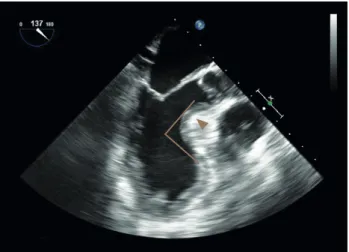
A 64-year-old female without significant cardiovascular history other than hypertension presented to the emergency department due to a syncopal episode after sustained palpitations and escalating dyspnea. Comprehensive workup revealed a generalized left ventricular hypertrophic cardiomyopathy, a sigmoid septum of 2.4 cm with a subsequent 82° angulation between the basal aspect of the septum and the ascending aorta (Figure 1), and an aberrant accessory papillary muscle (AAPM) with severe calcification and fibrosis (Figure 2 and Figure 3).
This unusual coalescence of anatomical variations triggered systolic anterior motion (SAM) of the mitral valve with severe mitral regurgitation and left ventricular outflow tract obstruction (LVOTO, maximum pressure gradient at rest 41 mmHg, maximum pressure gradient during exercise 91 mmHg) (Figure 4) under minimal stress. Patient was deemed as a surgical candidate due to poor response to maximal medical therapy and underwent septal myectomy and resection of the AAPM.
J Cardiovasc Imaging. 2019 Jul;27(3):230-233 https://doi.org/10.4250/jcvi.2019.27.e34 pISSN 2586-7210·eISSN 2586-7296
Images in
Cardiovascular Disease
Received: Feb 18, 2019 Revised: Apr 29, 2019 Accepted: May 15, 2019 Address for Correspondence:
Carlos Hallo, MD
Corazon En Forma Cardiology, 601 W 177th St #1, New York, NY 10033, USA.
E-mail: [email protected] Copyright © 2019 Korean Society of Echocardiography
This is an Open Access article distributed under the terms of the Creative Commons Attribution Non-Commercial License (https://
creativecommons.org/licenses/by-nc/4.0/) which permits unrestricted non-commercial use, distribution, and reproduction in any medium, provided the original work is properly cited.
ORCID iDs Carlos Hallo
https://orcid.org/0000-0002-8715-1316 Samer Kottiech
https://orcid.org/0000-0002-8080-8303 Javier Castillo
https://orcid.org/0000-0003-4853-8654 Conflict of Interest
The authors have no financial conflicts of interest.
Carlos Hallo , MD1, Samer Kottiech , MD1, and Javier Castillo , MD2
1Mount Sinai Heart, Cardiovascular Institute, The Mount Sinai Hospital, New York, NY, USA
2Department of Cardiovascular Surgery, The Mount Sinai Hospital, New York, NY, USA
Sigmoid Septum and Aberrant Calcified Papillary Muscle in the Setting of Advanced Hypertrophic Cardiomyopathy: An Unusual
Life-threatening Coalescence
Figure 1. Mid-esophageal long axis view shows severe focal hypertrophy of the ventricular septum (arrow head) with an 82° angulation between the basal portion of the ventricular septum and the ascending aorta (line), as well as an accessory calcified papillary muscle.
231 https://e-jcvi.org https://doi.org/10.4250/jcvi.2019.27.e34
Sigmoid Septum and Aberrant Papillary Muscle
Figure 2. Transgastric long axis view shows an aberrant accessory papillary muscle (arrow head).
LVOT
APM PL
AL
Figure 3. Three-dimensional transesophageal echocardiography demonstrates an abnormal attachment of an aberrant papillary muscle (arrow head). AL: anterior leaflet of mitral valve, APM: aberrant papillary muscle, LVOT:
left ventricular outflow tract, PL: posterior leaflet of mitral valve.
Figure 4. Mid-esophageal long axis view reveals severe systolic anterior motion of the mitral valve and obstruction of the left ventricular outflow tract.
Sigmoid septum becomes severely symptomatic in only 1.9% of patients, particularly when focal hypertrophy surpasses 15 mm.1) SAM and subsequent LVOTO may arise at rest in patients with very rare anatomical variations.2) In the present case, the dynamic obstruction was exacerbated by a tethering effect of the AAPM as well further obstruction due to calcification and thickening secondary to severe fibrosis.
SAM is predictable,3) especially in patients with very uncommon morphologic features like a basal interventricular septal thickness of > 15 mm, a distance from the mitral coaptation point to the septum of < 25 mm, an angle between the intersection of the mitral and aortic annulus of < 120°, and abnormal mitral leaflet length.4) Although directed maximal medical therapy is preferred,5) a surgical approach is required based on the combined severity of hemodynamic obstruction and clinical consequences.
SUPPLEMENTARY MATERIALS
Movie 1
(TEE1) Mid-esophageal long axis view shows severe focal hypertrophy of the ventricular septum with prominent angulation between the basal portion of the ventricular septum and the ascending aorta, and accessory calcified papillary muscle.
Click here to view Movie 2
(TEE2) Three-dimensional transesophageal echocardiography demonstrates an abnormal attachment of an aberrant papillary muscle.
Click here to view Movie 3
(TEE3) Transgastric long axis view shows an aberrant accessory papillary muscle.
Click here to view Movie 4
(TEE4) Mid-esophageal long axis view reveals severe systolic anterior motion of the mitral valve and obstruction of the left ventricular outflow tract.
Click here to view Movie 5
(TEE5) Mid-esophageal long axis view with color Doppler after septal myomectomy and resection of aberrant accessory papillary muscle shows no obstruction of left ventricular outflow tract.
Click here to view
232 https://e-jcvi.org https://doi.org/10.4250/jcvi.2019.27.e34
Sigmoid Septum and Aberrant Papillary Muscle
REFERENCES
1. Gentille-Lorente D, Salvadó-Usach T. Sigmoid septum: A variant of the ventricular hypertrophy or of the hypertrophic cardiomyopathy?. Arch Cardiol Mex 2016;86:110-22.
PUBMED
2. Uematsu S, Takaghi A, Imamura Y, Ashihara K, Hagiwara N. Clinical features of the systolic anterior motion of the mitral valve among patients without hypertrophic cardiomyopathy. J Cardiol 2017;69:495-500.
PUBMED | CROSSREF
3. Varghese R, Anyanwu AC, Itagaki S, Milla F, Castillo J, Adams DH. Management of systolic anterior motion after mitral valve repair: an algorithm. J Thorac Cardiovasc Surg 2012;143:S2-7.
PUBMED | CROSSREF
4. Moon YJ, Park JH, Oh J, Lee S, Hwang GS. Harmful effect of epinephrine on postreperfusion syndrome in an elderly liver transplantation recipient with sigmoid ventricular septum: a case report. Medicine (Baltimore) 2016;95:e4394.
PUBMED | CROSSREF
5. Kobayashi S, Sakai Y, Taguchi I, Utsunomiya H, Shiota T. Causes of an increased pressure gradient through the left ventricular outflow tract: a West Coast experience. J Echocardiogr 2018;16:34-41.
PUBMED | CROSSREF
233 https://e-jcvi.org https://doi.org/10.4250/jcvi.2019.27.e34
Sigmoid Septum and Aberrant Papillary Muscle