ISSN: 1738-7167
DOI: http://dx.doi.org/10.7731/KIFSE.2014.28.6.082
Modular Building for Urban Disaster Housing: Case Study of Urban Post-Disaster Housing Prototype in New York
George Ford · Yong Han Ahn* · Don Mook Choi** †
Department of Construction Management, Western Carolina University
*School of Architecture & Architectural Engineering, Hanyang University ERICA
**Department of Fire & Disaster Protection Engineering, Gachon University (Received September 24, 2014; Revised November 15, 2014; Accepted November 26, 2014)
요 약
주택 및 사회기반구조를 파괴하고 심각한 재정손실을 야기하는 재해들은 인류의 삶속에서 급속하게 증가하고 있다. 게 다가 몇몇 자연 재해들은 주택의 손상으로 인해 많은 이주민들을 만들거나 인류의 생명을 빼앗아가기도 하였다. 정부가 재해이후 주택관련 문제들에 대해 대처하고 파괴 또는 손실된 주택의 완전한 재건 전까지 지낼 임시 주택을 이주민에게 제공하는 일은 매우 중요하다. 재해의 결과로 주택을 잃을 거주민들을 위한 충분한 임시주택을 제공하기 위해 정부는 재 해후 임시주택 모형을 개발해야 한다. 기존의 정부는 자연재해 임시주택 제공은 단층 모듈러 주택, 컨테이너를 이용한 주택으로 한정되었다. 하지만 뉴욕과 서울의 도심지에서 인구밀도가 높고 토지가 부족하여 이런 방법들을 적용하기에는 한계가 있다. 본 연구는 이주민에게 빠른 설치뿐 아니라 쾌적한 생활공간과 환경, 에너지 효율성을 가진 주택을 제공할 수 있는 재해 후 도시주택모형을 파악하는데 그 목적을 두었다. ‘뉴욕에서 재해후도시주택모형’이라는 프로젝트의 사례 연구가 설계전문가, 공학자, 계약자, 뉴욕위기관리사무소, 미국공병, 그리고 임시주택 거주자들과 심층 면담을 통하여 이 루어졌다. 지역사회에서 이주민들이 삶의 터전을 지키고 이웃과 살아갈 수 있는 적절한 재해주택 프로그램이 개발되었다.
ABSTRACT
Disasters that destroy homes and infrastructure and cause significant financial damage are becoming more common as population centers grow. In addition, several natural disasters have resulted in a major loss of life and created countless refugees due to damage to housing. After major catastrophic disasters, it is very important that the government agencies respond to post-disaster housing issues and provide resources such as temporary housing before the full rehabilitation and reconstruction of destroyed and damaged housing. To provide affordable temporary housing for residents who may lose their homes as the result of a catastrophic disaster including storms, government agencies must develop a post-disaster housing prototype. In general, government agencies should explore several different forms of factory-built single-story, single family housing, such as modular homes, panelized homes, and precut homes. In urban cities including New York and Seoul, it is very important to provide housing which supports the demand for higher-density living spaces than single- family homes or trailers typically available due to the high population density and the desire to resettle as many residents as possible in their former neighborhoods. This study identified the urban post-disaster housing prototypes that may pro- vide higher density housing with high quality living spaces, high air quality, and energy efficiency as well as rapid deploy- ment. A case study of “Urban Post-Disaster Housing Prototype Program in New York” was conducted through a detailed interview process with a designer, engineer, contractor, the Office of Emergency Management (OEM) in New York, the U.S. Army Corps of Engineers (USACE), and temporary occupants. An appropriate disaster housing program that can provide living spaces for victims of disasters that keeps residents in their community and allows them to live and work in their neighborhoods was developed.
Keywords : Disaster, Modular building, Urban cities, Housing
1. Introduction
Natural disasters cause a major adverse effect that causes loss of life or property damage and have significant nega- tive economic impact. According to the World Watch Insti- tute, in 2012 there were 905 natural catastrophes worldwide, 93 percent of which were weather related disasters includ-
ing storms and hurricanes. These disasters caused overall economic losses of USD 170 billion for disaster recovery with a loss of 9,600 lives(1). Disasters damage not only homes and buildings but also almost city infrastructure. For example, Hurricane Katrina in August 2005 damaged over 214,700 homes in New Orleans and forced over 800,000 citizens to live outside of their homes due to flooding(2).
†
Corresponding Author, E-Mail: [email protected]
†
TEL: +82-31-750-5716, FAX: +82-31-750-8749
Due to housing damage, government agencies need to provide emergency shelters immediately after natural disas- ters. However, it is also very important to provide tempo- rary housing that provides shelter to those whose housing is destroyed while reconstructing new housing units to resi- dents. This temporary housing is used after emergency sheltering, and before those affected by a disaster move into permanent housing. Temporary housing is a key to returning evacuees to their city or neighborhood the Office of Emergency Management (OEM) and the Department of Design and Construction in since many of them desire to resettle in their former neighborhoods according to repre- sentatives of New York. In addition, housing plays a cru- cial role in a reconstruction or revitalization program since it is one of the most important needs for people and essen- tial for their well-being(3).
Current approaches to address temporary housing after disasters such as low-rise modular homes, panelized homes, precut homes, and container homes are applicable to the cities or regions that have wide open spaces with low den- sity. However, big cities like New York or Seoul with high population densities are very difficult to provide adequate temporary housing due to the limitation of open spaces and sites(4). According to the New York OEM, due to New York’s population density, shortage of affordable housing, and concentrated infrastructure, the City is not well suited for traditional post disaster temporary housing(5). Thus, it is very important to develop a new approach to temporary housing that provides higher-density living spaces than sin- gle-household homes or trailers typically used for post- disaster housing. In addition, new temporary housing units must be safe, and comfortable, so they may assist disaster victims to live and work, in their neighborhood. To con- duct this case study, the research team conducted an inter- view with all stakeholders including OEM managers, architects, engineers, a modular home manufacturer, and a New York City architect.
2. Literature Review
2.1 What is Temporary Disaster Housing?
The definition of disaster housing is a temporary hous- ing solution for people whose homes are damaged or destroyed during or after a disaster. In general there are four stages of emergency housing from sheltering to per- manent housing that may be employed after a disaster(4,6,7). The stages are:
1. Emergency shelter, which may take the form of a pub-
lic shelter, refuge at a friend’s house, or shelter under a plastic sheet, and is generally employed for one night to a couple of days during the emergency. Because the stay is so short it does not usually require the need for extensive food preparation or medical services.
2. Temporary shelter, which may be a tent or a public mass shelter used for a few weeks following a disaster, and is also includes provisions of food and water and medical treatment.
3. Temporary housing, which allows the return to daily activities of home life and the possible return to work and school. Temporary housing can take the form of rented apartment, a prefabricated home or a small shack, depend- ing on the context.
4. Permanent housing is the return to the former home after reconstruction, or resettlement in a new home where the family can plan to live on a permanent basis.
2.2 Temporary Housing
Catastrophic natural disasters usually require a govern- ment agency to prepare a plan to provide temporary hous- ing options for people who are evacuated. The emergency and temporary shelter options may be located in public buildings and may not be suitable for stays longer than a few days. Temporary disaster housing must also include a sufficient range of options that are compatible with com- munity characteristics, including population density, cli- mate, geography, and land availability(4). In addition, the housing must be safe, durable, physically accessible, and cost effective. Unit availability and capacity to meet the size and diversity of a household are also very important.
Temporary housing must provide a high level of com- fort and support a variety of neighborhood services beyond what might be found in emergency shelters. According to New York OEM(5), there are several options for temporary housing after a natural disaster including:
· Utilize available rental vacancies
· Utilize available non-rental residential units
· Rapidly repair residential properties with minimal dam- age
· Adaptive use of non-residential buildings
· Deploy temporary housing units.
Among these temporary options, the deployment of tem- porary housing units is one of the more common applica- ble options because housing demands almost always exceed the existing housing units within the city(5). It is also very important to provide not only physical structure, but also private-sector infrastructure such as grocery stores,
banks, school and healthcare facilities along with other social support services that can make temporary circum- stances work for people who are struggling to recover from a disaster and rebuild their lives(4).
2.3 Different Types of Temporary Housing for Deployment
This section describes different types of temporary hous- ing options currently used to meet the effects of a disaster.
There are many factors to consider, but providing housing units that meet pertinent health and safe standards, includ- ing air quality, is crucial. Two main options are to deploy manufactured housing units that are factory-built housing designed for longer-term residential use and recreational vehicles including travel trailers(3,4). The most common manufactured mobile home is a single-section home that is roughly 60 feet long and 14 feet wide. Recreational vehi- cles are designed to be either mounted on or towed by another vehicle and to be used as temporary living quarters for camping or travel. Recent development in housing design and construction technology provide other options including modular homes, panelized homes, and precut homes to house disaster victims. These three types of fac- tory-built housing may provide better temporary housing.
Three options can be described as Figure 1(4).
- Modular homes: Modular homes are housing units assembled in three dimensions at the factory and may be more than 90 percent complete. They are towed to the site on flatbed trailers, where the three-dimensional units are assembled in a variety of configurations.
- Panelized homes: Panelized homes consist of panels - a whole wall with windows, doors, wiring, and exterior slid- ing - that are built in a factory, transported to the site, and assembled. These panels can be combined in a wide vari- ety of sizes and designs and allow a high level of customi- zation. Panels can be shipped flat, which is less costly than
moving three-dimensional components of modular housing·
- Precut homes: Precut homes consist of building materi- als that are factory cut to design specifications, transported to the site, and assembled. Precut homes included kit, log, and dome homes.
Most of temporary housing solutions are prefabricated, mass-produced and standardized. In addition, these hous- ing units are constructed in a factory and are transported to the site where they will be erected. However, the current temporary housing options, mainly single story manufac- tured homes are not appropriate for urban cities such as New York City and Seoul due to population density, lim- ited land availability and concentrated infrastructure(4). To solve these challenges, low to medium rise modular build- ings may be considered for temporary disaster relief housing.
2.4 Modular Building
A ‘modular building’ is a building that is composed of factory-built volumetric units which are transported to a project site on a flatbed trailer and are installed on-site(8,9). Even though modular construction is a small portion in the construction industry, interest is growing. The primary ben- efits of modular construction are:
· Economy of scale in manufacturing of multiple repeated units
· Speed of installation on site
· Improved quality and accuracy in manufacturing
· Improved sustainability and safety
· The possibility to be dismantled and reused.
In addition, temporary housing is considered temporary for a period of between one month to eighteen months.
After that period time, temporary housing must be removed and stored for future uses. Due to their relative mobility and the possibility of permanent use of modular buildings, low to medium rise modular buildings are perfect disaster relief homes in urban and city areas. In addition, low and Figure 1. Three conventional temporary housing options.
medium modular buildings also provide better options from an environmental and structural standpoint compared to traditionally used shipping containers.
3. Objectives and Research Method
The primary objective of this study was to identify low and medium rise modular building alternatives for tempo- rary disaster housing if there are significant natural disas- ters in a big city or urban area. To achieve the objectives of this study, a qualitative research approach was adopted. A case study research method based on a series of in-depth interviews using a semi-structure method with an architect, OEM architect, construction manager, engineer, and the Army Corps of Engineers of urban post-disaster housing prototype in New York City was adopted. The authors developed an interview guide including a list of questions and topics to be covered during the interview. The inter- view questions covered the overall goals of the project, the relationship among stakeholders, modular design, manufac- turing, and construction processes, success factors of the project, challenges associated with the project, and so on.
This case study interview approach proved to be a particu- larly effective strategy for this research as it involved an empirical investigation of a particular contemporary phe-
Table 1. Project Description and Stakeholders
Project name: Urban disaster housing prototype General contractor: American manufactured structures and services Location: Brooklyn, NY, USA Architect: Garrison architecture
Size: 2,100SF Module manufacturer: Mark line industries Client: NYC OEM Engineer: Anastos engineering associates
Project manager: Army corps of engineers Consultants: Plus group consulting engineering P.L.L.C., Wohl & Mara, L.L.P.
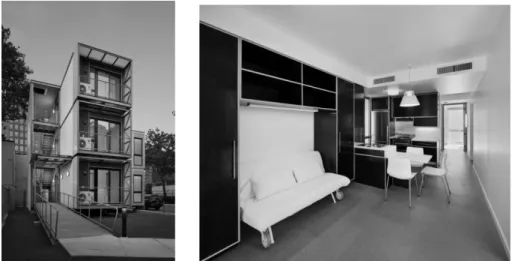
Figure 2. Urban disaster prototype modular building (Pictures from James Garrisons Architecture).
nomenon within its real life context using multiple sources of evidence, enabling the collection of highly detailed, in- depth, and comprehensive information and facilitating its analysis to pinpoint the pertinent specific variables(10,11).
4. Case Study of Urban Disaster Prototype Modular Buildings
4.1 Project Description
An urban post-disaster housing prototype project is located in Brooklyn, New York. This project produced a prototype of post-disaster housing that would allow city or urban residents to live in their neighborhood for months or years after a major disaster while their houses undergo repairs. This urban post-disaster housing adopted modular design, manufacturing, and construction approaches to deliver safe, comfortable, and temporary disaster housing in dense urban settings. The prototype (Figure 2) was designed by Garrisons Architects in conjunction with the New York City’s Office of Emergency Management (OEM), the Department of Design, construction, and several munici- pal, state, and federal organizations such as FEMA and the Army Corps of Engineer. The other project stakeholders are in Table 1.
The prototype modular building (Figure 2) is equipped
with a kitchen, storage area, bathroom and living area, and comes in one or three bedroom configurations that are per- fect for single families. It also includes ventilation systems that are extremely energy efficient. The prototype also pro- vides high quality indoor environment with modern inte- rior design and layout for the residents whose houses are destroyed or damaged in a disaster. The beauty of this modular prototype lies in its inherent flexibility according to James Garrison, the architect of this prototype building.
The modular building can be stacked like Legos to create row housing, or they can be interspersed between existing houses and structures. In addition, the modular building may be rapidly deployed, and transportable by truck, rail and by cargo ship. It also must be able to be disassembled after continuous use, transported and stored off site for future reassembly and reuse.
4.2 Design Standard and Performance Specifica- tion of Urban Disaster Modular Housing
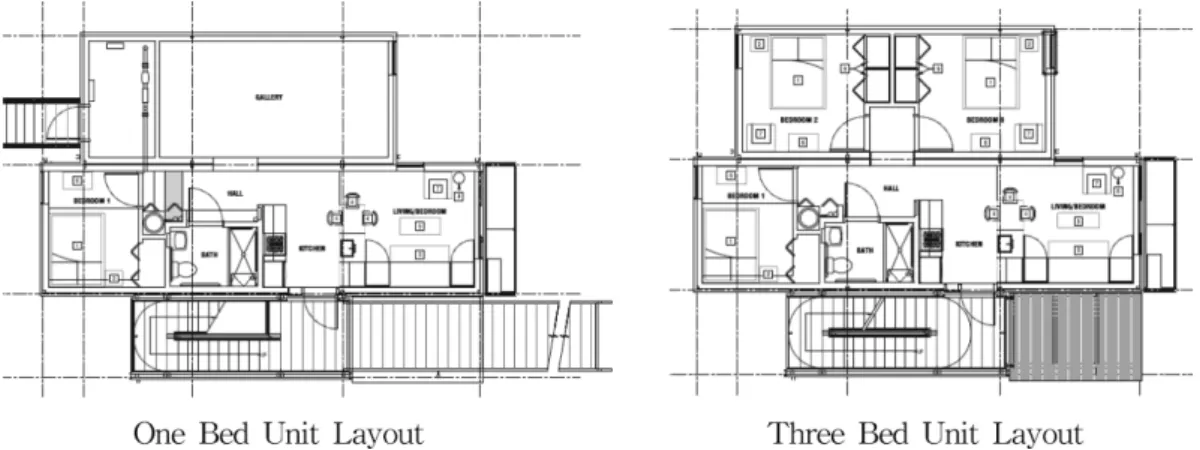
The purpose of urban disaster modular housing is to pro- vide appropriate living spaces at a density level signifi- cantly higher than conventionally provided through disaster relief operations. In addition, it is multi-story and multi- family, and able to be assembled in configurations that sup- port quicker return of community life. In response to the needs and goals of urban disaster modular housing, the modular building must be designed, manufactured, and constructed with standard designs and specifications that are adoptable to both temporary and permanent uses. In order to facility and accelerate the production schedule, the module unit incorporates pre-manufactured components, such as modular bathroom and kitchen pods. The basic design standard adopted the concept of utilizing a com- mon, but flexible, design layout and construction that could accommodate a wide range of family dwelling sizes. The
standard design envisions a basic “One Bed” unit that accommodates a minimum of 2-4 adults and includes all basic central requirements such as kitchen, bathroom, liv- ing/dining/bedroom, electric power distribution, plumbing and mechanical distribution and equipment. In addition, a standard “Three Beds” that incorporates additional living/
bed room spaces (2 bedrooms) without utilities to accom- modate an additional 4-6 adults, would be available. In addition, “Three Beds” unit would connect to the “One Bed” unit in various configurations to form a larger family dwelling unit as needed. This configuration can enlarge the size of dwelling without adding a lot of extra costs since it simply add a unit module that includes two bedrooms. In Figure 3, the layout of each dwelling is shown.
The configuration and components of each module unit is in Figure 4. In addition, it was to be used for modular manufacturing as well as material procurement. The design and project team also selected building materials that could be easily procured from the market in significant amounts to support accelerated production speed according to James Garrisons, a CEO of Garrison’s architecture. The design standard also passed the New York City Building Code (Section BC 310.1.2) for apartment type multiple dwelling and apartment hotels. This indicates that the disaster modu- lar building complies with a same regulation for fire, earth- quake, security safety.
A post disaster prototype modular building assembled in five modules with stairs is shown in Figure 5.
4.3 Manufacturing of Urban Disaster Modular Housing
The completed sets of drawings with the specifications for urban disaster modular housing was designed by Garri- son Architects. The manufacturer of this prototype module was Markline Industries located in Indiana. One of the
Figure 3. Layout of dwelling in a post disaster modular prototype (Pictures from James Garrisons Architecture).
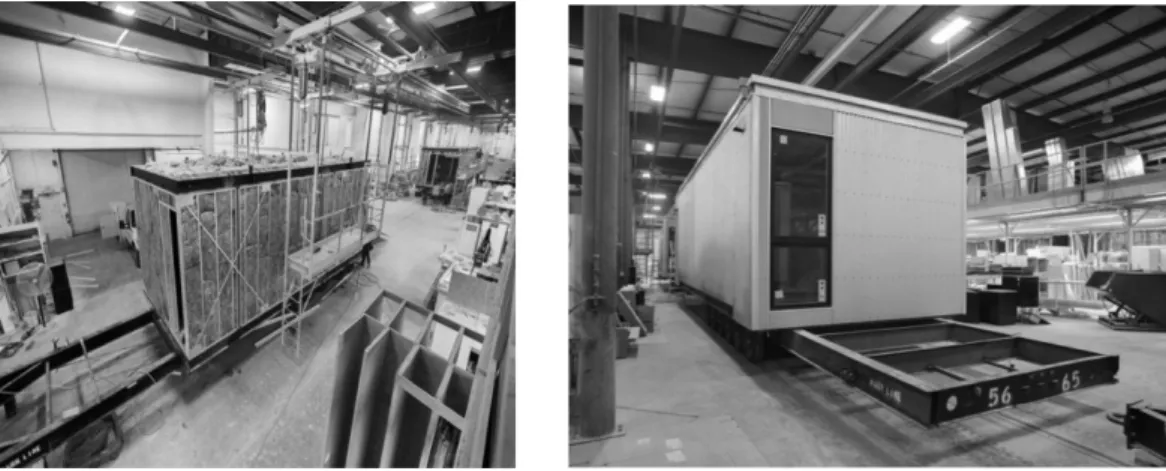
major considerations in selecting the manufacturing com- pany was to choose a company that would not affect labor and resource procurement in New York City. Thus, the project team chose Markline Industries in Indiana instead of modular manufacturers near New York City. The proj- ect team also evaluates potential challenges associated with transportation from Indiana to New York. Figure 6 shows
manufacturing processes of urban disaster modular build- ing units. Markline Industries were also responsible to doc- ument a Quality Assurance/Quality Control (QA/QC) program with all relevant documentation, protocols, staff and proce- dures. QA/QC of urban disaster housing was monitored by an independent third party inspection agency during both design phase and manufacturing process to ensure adher- ence to all relevant codes. The party QA/QC monitoring was conducted on a daily basis by a recognized engineer- ing firm with no conflicts of interest with the manufacturer and its contractors. In addition, QA/QC in-plant was also subject to the monitoring of NY OEM.
4.4 Construction and Installation
Manufactured modules were delivered to the site for installation by a third party contractor hired by the project team. The project team including American Manufactured Structures and Services and Garrison Architecture devel- oped detailed installation plans and a schedule to effi- ciently erect all modules within a day. In addition, all module units were connected to city utilities including elec- tric, sewage and water. A total of five modules have been constructed and installed in central Brooklyn, New York in Figure 7. The project team hired a module installation team Figure 4. Unit model design and components (Pictures from James Garrisons Architecture).
Figure 5. Configuration for a post disaster modular proto- type building (Pictures from James Garrisons Architecture).
which had much experience with installing modules that could minimize potential risks of damage during installa- tion. The installation endured multiple installations and takedowns at several sites and allowed restoration of the site to original condition after removal. According to the project architect and engineer, documentation of erection and installation was also important for operation, mainte- nance, and transportation to the next site. Once the installa- tion was completed, the project was inspected by the city inspectors.
4.5 Operation and Testing
This prototype of temporary post-disaster housing was tested and assessed by city OEM employees and city resi- dents for use after future urban disasters. In addition, this live test also helped the project team including the architect, engineer, and manufacturer to improve a prototype design, specifications, and manufacturing techniques including pro- curement and transportation. The New York OEM and the project team will test durability, transportability and stora- bility as well as any other additional design features that
ensure cost effective reusability. The OEM also will assess how well the temporary disaster housing can endure multi- ple installations and takedowns, can be easily and safely transported repeatedly, and be stored effectively without excessive maintenance or protection requirements. In addi- tion, the project team and users will assess the quality of the indoor environment of the housing including mechani- cal, electrical systems, and appliances, and location of all safety and shut-off devices. The project team will also test maintenance and periodic testing and inspection require- ments. The project team will also test the applicability of a
“temp-to-perm” solution. This prototype will be eventually installed at a permanent site to assess the potential useful life of the temporary modular buildings.
5. Conclusion
Natural disasters such as floods and tornados affect thou- sands of people each year as well as their living spaces.
The frequency of natural disasters is also dramatically increasing causing government agencies to plan for and Figure 6. Manufacturing module production processes (Pictures from James Garrisons Architecture).
Figure 7. Installation of temporary post disaster modular housing prototype (Pictures from James Garrisons Architecture).
prepare temporary housing units. To provide temporary housing needs of urban residents, the current temporary housing approaches including single story manufactured housing and recreational vehicles that are not appropriate in urban settings due to limited spaces and high population density. This study demonstrated the applicability of medium-rise modular buildings to provide temporary disas- ter housing needs with high indoor environmental quality and sufficient number of housing units. This study con- ducted a case study of temporary disaster housing in New York City. This case study provides a detailed process that demonstrates how urban cities can prepare temporary disaster housing needs using modular construction. The study found that the temporary disaster modular housing must be flexible in building configuration. The unit layout is also flexible to provide various configurations to form a larger family dwelling unit as needed. In addition, the mod- ular disaster housing must meet all zoning and code requirements and regulations in a modern city. In design, disaster housing must be built of materials that can be eas- ily procured from the market in sufficient amounts to sup- port acceptable production times. In manufacturing, detail shop drawings are required to provide manufacturers the means to produce acceptable quality. Each module needs to be easily assembled at the project site and be easily trans- ported. Finally, the temporary disaster modular housing needs to be easily relocated to other disaster cities and be converted to permanent housing if needed. The temporary disaster housing must meet national requirements for safety, sustainability, durability, functionality and accessibility as well as provide a high quality indoor environment. Tempo- rary modular housing may be the best of potential tempo- rary disaster housing approaches in urban cities. However, the research team suggests that it will be better to have bet- ter exterior facade that harmonizes with surroundings even though a disaster modular housing is temporary housing.
References
1. P. Löw, “Natural Catastrophes in 2012 Dominated by U.S. Weather Extremes”, [cited 2014 August 15]; Avail- able from (2013).
2. USCENSUS, “Census Bureau Releases First Detailed Data on Katrina Damage to New Orleans Area Hous- ing” [cited 2014 August 15]; Available from (2011).
3. S. Barakat, “Housing Reconstruction after Conflict and Disaster”, London, UK: Overseas Developmnet Institute (2003).
4. FEMA, “National Disaster Housing Strategy”, Washing- ton, DC: Federal Emergency Management Agency (2009).
5. NYOEM, “What If New York City: Designing Post- disaster Housing for Urban Areas”, New York, NY: New York Office of Emergency Management (2014).
6. F. X. McCarthy, “FEMA Disaster Housing: From Shel- tering to Permanent Housing”, Washington, DC: Con- gressional Research Service (2010).
7. C. Johnson, “Strategic Planning for Post-disaster Tempo- rary Housing”, Disasters, Vol. 31, No. 4, pp. 435-458 (2007).
8. J. Garrison and A. Tweedie, “Modular Architecture Man- ual”, Lebanon, NJ: Kullman Buildings Corp. (2008).
9. R. M. Lawson, R. G. Ogden and R. Bergin, “Application of Modular Construction in High-rise Buildings”, Jour- nal of Architectural Engineering, Vo. 18, No. 2, pp. 148- 154 (2012).
10. C. S. Hayles, K. Robson and S. E. Holdswort, “A Case Study from RMIT: Introducting Property Undergraduates to the Immediate Issues of Housing Sustainability and Affordability within Australia and New Zeland”, Pro- ceedings of the PRRES Conference, Auckland, New Zea- land (2006).
11. R. K. Yin, “Applications of Case Study Research”, Thou- sand Oaks, CA: Sage Publication, Inc. (2003).